NON-PARAMETRIC TESTS
ARUN KUMAR .P
13-501-003
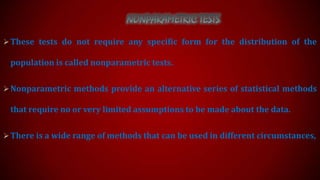
 These tests do not require any specific form for the distribution of the

population is called nonparametric tests.
 Nonparametric methods provide an alternative series of statistical methods

that require no or very limited assumptions to be made about the data.
 There is a wide range of methods that can be used in different circumstances,
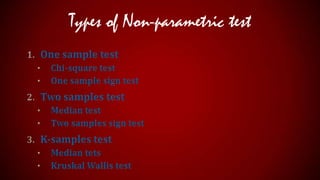
Types of Non-parametric test
Decision making/ forecasting.

Studying populations that take on a ranked

order (such as movie reviews receiving one to

four stars)
Simple analysis.
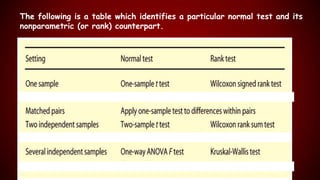
The following is a table which identifies a particular normal test and its
nonparametric (or rank) counterpart.
SIGN TEST
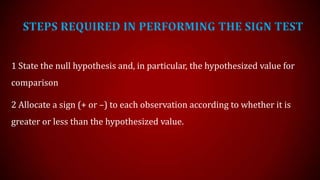
STEPS REQUIRED IN PERFORMING THE SIGN TEST
1 State the null hypothesis and, in particular, the hypothesized value for
comparison
2 Allocate a sign (+ or –) to each observation according to whether it is
greater or less than the hypothesized value.
 3 Determine: N+ = the number of observations greater than the

hypothesized value
 N– = the number of observations less than the hypothesized value
 S = the smaller of N+ and N–
 4 Calculate an appropriate P value
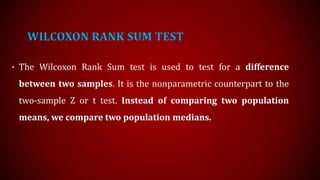
WILCOXON RANK SUM TEST
• The Wilcoxon Rank Sum test is used to test for a difference

between two samples. It is the nonparametric counterpart to the
two-sample Z or t test. Instead of comparing two population
means, we compare two population medians.
STEPS REQUIRED IN PERFORMING THE
WILCOXON RANK SUM
1 Rank all observations in increasing order of magnitude, ignoring
which group they come from. If two

observations have the same

magnitude, regardless of group, then they are given an average ranking.
2 Add up the ranks in the smaller of the two groups (S). If the two

groups are of equal size then either one can be chosen.
3 Calculate an appropriate P value.
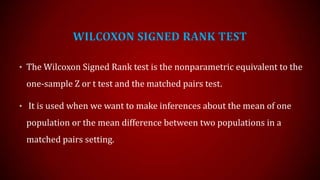
WILCOXON SIGNED RANK TEST
• The Wilcoxon Signed Rank test is the nonparametric equivalent to the

one-sample Z or t test and the matched pairs test.
• It is used when we want to make inferences about the mean of one

population or the mean difference between two populations in a
matched pairs setting.
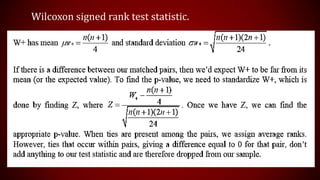
Wilcoxon signed rank test statistic.
Wilcoxon signed rank test consists of five basic steps
1 State the null hypothesis and, in particular, the hypothesized value for
comparison.
2 Rank all observations in increasing order of magnitude, ignoring their
sign. Ignore any observations that are equal to the hypothesized value. If
two observations have the same magnitude, regardless of sign, then they
are given an average ranking
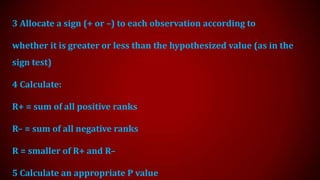
3 Allocate a sign (+ or –) to each observation according to
whether it is greater or less than the hypothesized value (as in the

sign test)
4 Calculate:

R+ = sum of all positive ranks
R– = sum of all negative ranks

R = smaller of R+ and R–
5 Calculate an appropriate P value
KRUSKAL-WALLIS TEST
 It is used to compare more than two populations as long as our data

come from a continuous distribution.
 Wallis test we are testing to see if our population medians are equal.

 The idea of the Kruskal-Wallis rank test is to rank all the responses

from all groups together and then apply one-way ANOVA to the ranks

rather than to the original observations.
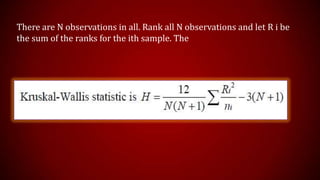
There are N observations in all. Rank all N observations and let R i be
the sum of the ranks for the ith sample. The
ADVANTAGES OF NONPARAMETRIC
METHODS
 Nonparametric methods require no or very limited assumptions to be

made about the format of the data, and they may therefore be preferable
when the assumptions required for parametric methods are not valid.
 Nonparametric methods can be useful for dealing with unexpected,

outlying observations that might be problematic with a parametric
approach.
Nonparametric methods are intuitive and are simple to

carryout by hand, for small samples at least.
Nonparametric methods are often useful in the analysis of

ordered categorical data in which assignation of scores to a
individual categories may be inappropriate.
DISADVANTAGES OF NONPARAMETRIC METHODS
 Nonparametric methods may lack power as compared with more

traditional approaches This is a particular concern if the sample size is
small or if the assumptions for the corresponding parametric method
hold.
 Nonparametric methods are geared toward hypothesis testing rather

than estimation of effects. It is often possible to obtain nonparametric

estimates and associated confidence intervals, but this is not generally
Tied values can be problematic when these are common, and

adjustments to the test statistic may be necessary.
Appropriate computer software for nonparametric methods can

be limited, although the situation is improving.
In addition, how a software package deals with tied values or

how it obtains appropriate P values may not always be obvious.
REFERENCE
Siegel S, Castellan NJ: Non-parametric Statistics for the Behavioral
Sciences, 2nd ed. New York: McGraw-Hill; 1988.

Thank you

Nonparametric tests

  • 1.
  • 2.
     These testsdo not require any specific form for the distribution of the population is called nonparametric tests.  Nonparametric methods provide an alternative series of statistical methods that require no or very limited assumptions to be made about the data.  There is a wide range of methods that can be used in different circumstances,
  • 3.
  • 4.
    Decision making/ forecasting. Studyingpopulations that take on a ranked order (such as movie reviews receiving one to four stars) Simple analysis.
  • 5.
    The following isa table which identifies a particular normal test and its nonparametric (or rank) counterpart.
  • 6.
  • 7.
    STEPS REQUIRED INPERFORMING THE SIGN TEST 1 State the null hypothesis and, in particular, the hypothesized value for comparison 2 Allocate a sign (+ or –) to each observation according to whether it is greater or less than the hypothesized value.
  • 8.
     3 Determine:N+ = the number of observations greater than the hypothesized value  N– = the number of observations less than the hypothesized value  S = the smaller of N+ and N–  4 Calculate an appropriate P value
  • 9.
    WILCOXON RANK SUMTEST • The Wilcoxon Rank Sum test is used to test for a difference between two samples. It is the nonparametric counterpart to the two-sample Z or t test. Instead of comparing two population means, we compare two population medians.
  • 10.
    STEPS REQUIRED INPERFORMING THE WILCOXON RANK SUM 1 Rank all observations in increasing order of magnitude, ignoring which group they come from. If two observations have the same magnitude, regardless of group, then they are given an average ranking. 2 Add up the ranks in the smaller of the two groups (S). If the two groups are of equal size then either one can be chosen. 3 Calculate an appropriate P value.
  • 11.
    WILCOXON SIGNED RANKTEST • The Wilcoxon Signed Rank test is the nonparametric equivalent to the one-sample Z or t test and the matched pairs test. • It is used when we want to make inferences about the mean of one population or the mean difference between two populations in a matched pairs setting.
  • 12.
    Wilcoxon signed ranktest statistic.
  • 13.
    Wilcoxon signed ranktest consists of five basic steps 1 State the null hypothesis and, in particular, the hypothesized value for comparison. 2 Rank all observations in increasing order of magnitude, ignoring their sign. Ignore any observations that are equal to the hypothesized value. If two observations have the same magnitude, regardless of sign, then they are given an average ranking
  • 14.
    3 Allocate asign (+ or –) to each observation according to whether it is greater or less than the hypothesized value (as in the sign test) 4 Calculate: R+ = sum of all positive ranks R– = sum of all negative ranks R = smaller of R+ and R– 5 Calculate an appropriate P value
  • 15.
    KRUSKAL-WALLIS TEST  Itis used to compare more than two populations as long as our data come from a continuous distribution.  Wallis test we are testing to see if our population medians are equal.  The idea of the Kruskal-Wallis rank test is to rank all the responses from all groups together and then apply one-way ANOVA to the ranks rather than to the original observations.
  • 16.
    There are Nobservations in all. Rank all N observations and let R i be the sum of the ranks for the ith sample. The
  • 17.
    ADVANTAGES OF NONPARAMETRIC METHODS Nonparametric methods require no or very limited assumptions to be made about the format of the data, and they may therefore be preferable when the assumptions required for parametric methods are not valid.  Nonparametric methods can be useful for dealing with unexpected, outlying observations that might be problematic with a parametric approach.
  • 18.
    Nonparametric methods areintuitive and are simple to carryout by hand, for small samples at least. Nonparametric methods are often useful in the analysis of ordered categorical data in which assignation of scores to a individual categories may be inappropriate.
  • 19.
    DISADVANTAGES OF NONPARAMETRICMETHODS  Nonparametric methods may lack power as compared with more traditional approaches This is a particular concern if the sample size is small or if the assumptions for the corresponding parametric method hold.  Nonparametric methods are geared toward hypothesis testing rather than estimation of effects. It is often possible to obtain nonparametric estimates and associated confidence intervals, but this is not generally
  • 20.
    Tied values canbe problematic when these are common, and adjustments to the test statistic may be necessary. Appropriate computer software for nonparametric methods can be limited, although the situation is improving. In addition, how a software package deals with tied values or how it obtains appropriate P values may not always be obvious.
  • 21.
    REFERENCE Siegel S, CastellanNJ: Non-parametric Statistics for the Behavioral Sciences, 2nd ed. New York: McGraw-Hill; 1988. Thank you