FaceBook
Objectives This session will include an overview of Facebook and the options it provides. The following issues will be discussed:   students violating policy and posting information on the site.  administrators and institutions using Facebook to adjudicate incidents.  staff using the site to advertise or learn more about their students.  free speech and privacy matters.    Participants will gain a better understanding of Facebook's components and learn how students are using Facebook--in both positive and negative ways.
Objectives Gain a quick historical perspective of Facebook and why and how it's become so popular in a short amount of time Gain a better understanding of Facebook's components Learn how students are using Facebook--in both positive and negative ways Learn how staff/faculty are responding to student use  Learn specific skills related to the site:  creating a profile, posting messages,  searching for other students, tagging,  and more
What is Facebook Facebook is the second largest social network on the web. Primarily focused on high school to college students. Since their launch in February 2004, they’ve been able to obtain over 8 million users in the U.S. alone.
History Facebook was founded by former-Harvard student Mark Zuckerberg (while at Harvard).  Facebook and its core idea spread across the dorm rooms of Harvard where it was very well received.  It was extended to Stanford and Yale where, like Harvard, it was widely endorsed.
Availability Unlike its competitors MySpace, Friendster, Xanga, hi5, Bebo and others, Facebook isn’t available to everyone.  This generally involves having a valid e-mail ID with the associated institution.
Surveys 2005 survey: approximately 85% of the students in colleges had a Facebook account, with 60% of them logging in daily.  A survey conducted Student Monitor revealed Facebook was the most “in” thing after the iPod and tying with beer. Another 2005 survey said 90% of all undergraduates in the U.S. use either Facebook or MySpace regularly. A questionnaire by Chris Roberts revealed that 76.2% never click on its ads. Perhaps the most amazing statistic of all may be that Facebook is the 7 th  most trafficked site in the U.S.
Lawsuits & Concerns Facebook has been host to other issues and concerns, especially in the privacy sector where its privacy policy states:  “ Facebook also collects information about you from other sources, such as newspapers and instant messaging services. This information is gathered regardless of your use of the Web Site. ” Another theory is that Facebook could also be a data-gathering project or if not, used extensively for these purposes. Facebook’s policy also states that it:  “ may share your information with third parties, including responsible companies with which we have a relationship.”
Legal matters Students violating policy and posting information on the site Administrators and institutions using Facebook to adjudicate incidents Staff using the site to advertise or learn more about their students
Free speech and privacy matters
The Service Now, let’s look into Facebook - the service itself, and some of its features.
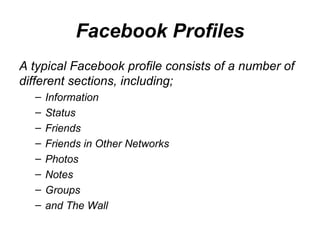
Facebook Profiles A typical Facebook profile consists of a number of different sections, including; Information  Status  Friends  Friends in Other Networks  Photos  Notes  Groups  and The Wall
Facebook Photos Facebook’s most popular features has been the ability to upload photos.  Facebook is one of the few services to offer an unlimited quota with their only restriction being a 60-photos-per-album limit demographic.
Facebook Groups There are two kind of groups, a normal group and a secret group, which isn’t shown on the profile.  A normal group is just like any other, but users can also create and invite others into secret groups. These can be used for collaborating on university projects, and provide a way to have closed discussions.
Facebook Events Another Facebook success is their ‘events’ feature, which provides the ability to organize, be part of, and plan for events.  This feature has been extremely successful when it comes to organizing parties. Along with organizing and joining events, users can also invite and recommend others to an event.  Colleges and universities use the feature to catch planning of such events before hand and investigate those that are over.
Facebook Notes Facebook Notes allows users to write a Facebook blog. All notes are displayed in the user’s profile, and other members can add comments. Notes possesses an important feature, which is the ability to import and syndicate an external blog.  You can attach photos and also post via cell phone by sending your notes to notes@facebook.com.  Another interesting feature is tagging - tagging a post with a username will automatically send it to that specific user.

Facebook

  • 1.
  • 2.
    Objectives This sessionwill include an overview of Facebook and the options it provides. The following issues will be discussed: students violating policy and posting information on the site. administrators and institutions using Facebook to adjudicate incidents. staff using the site to advertise or learn more about their students. free speech and privacy matters. Participants will gain a better understanding of Facebook's components and learn how students are using Facebook--in both positive and negative ways.
  • 3.
    Objectives Gain aquick historical perspective of Facebook and why and how it's become so popular in a short amount of time Gain a better understanding of Facebook's components Learn how students are using Facebook--in both positive and negative ways Learn how staff/faculty are responding to student use Learn specific skills related to the site: creating a profile, posting messages, searching for other students, tagging, and more
  • 4.
    What is FacebookFacebook is the second largest social network on the web. Primarily focused on high school to college students. Since their launch in February 2004, they’ve been able to obtain over 8 million users in the U.S. alone.
  • 5.
    History Facebook wasfounded by former-Harvard student Mark Zuckerberg (while at Harvard). Facebook and its core idea spread across the dorm rooms of Harvard where it was very well received. It was extended to Stanford and Yale where, like Harvard, it was widely endorsed.
  • 6.
    Availability Unlike itscompetitors MySpace, Friendster, Xanga, hi5, Bebo and others, Facebook isn’t available to everyone. This generally involves having a valid e-mail ID with the associated institution.
  • 7.
    Surveys 2005 survey:approximately 85% of the students in colleges had a Facebook account, with 60% of them logging in daily. A survey conducted Student Monitor revealed Facebook was the most “in” thing after the iPod and tying with beer. Another 2005 survey said 90% of all undergraduates in the U.S. use either Facebook or MySpace regularly. A questionnaire by Chris Roberts revealed that 76.2% never click on its ads. Perhaps the most amazing statistic of all may be that Facebook is the 7 th most trafficked site in the U.S.
  • 8.
    Lawsuits & ConcernsFacebook has been host to other issues and concerns, especially in the privacy sector where its privacy policy states: “ Facebook also collects information about you from other sources, such as newspapers and instant messaging services. This information is gathered regardless of your use of the Web Site. ” Another theory is that Facebook could also be a data-gathering project or if not, used extensively for these purposes. Facebook’s policy also states that it: “ may share your information with third parties, including responsible companies with which we have a relationship.”
  • 9.
    Legal matters Studentsviolating policy and posting information on the site Administrators and institutions using Facebook to adjudicate incidents Staff using the site to advertise or learn more about their students
  • 10.
    Free speech andprivacy matters
  • 11.
    The Service Now,let’s look into Facebook - the service itself, and some of its features.
  • 12.
    Facebook Profiles Atypical Facebook profile consists of a number of different sections, including; Information Status Friends Friends in Other Networks Photos Notes Groups and The Wall
  • 13.
    Facebook Photos Facebook’smost popular features has been the ability to upload photos. Facebook is one of the few services to offer an unlimited quota with their only restriction being a 60-photos-per-album limit demographic.
  • 14.
    Facebook Groups Thereare two kind of groups, a normal group and a secret group, which isn’t shown on the profile. A normal group is just like any other, but users can also create and invite others into secret groups. These can be used for collaborating on university projects, and provide a way to have closed discussions.
  • 15.
    Facebook Events AnotherFacebook success is their ‘events’ feature, which provides the ability to organize, be part of, and plan for events. This feature has been extremely successful when it comes to organizing parties. Along with organizing and joining events, users can also invite and recommend others to an event. Colleges and universities use the feature to catch planning of such events before hand and investigate those that are over.
  • 16.
    Facebook Notes FacebookNotes allows users to write a Facebook blog. All notes are displayed in the user’s profile, and other members can add comments. Notes possesses an important feature, which is the ability to import and syndicate an external blog. You can attach photos and also post via cell phone by sending your notes to notes@facebook.com. Another interesting feature is tagging - tagging a post with a username will automatically send it to that specific user.