
Information Skills and the 2.0’s Kara Jones Subject Librarian University of Bath Aslib Engineering event 22 November 2006
Themes Learner Characteristics Information Literacy Higher order skills Using  Web 2.0 / Library 2.0  Technologies
Learners Move from e-learning to c-learning: Community, communication or collaboration  (Owens et al, 2006) Learning preferences tend toward teamwork, experiential activities, structure, and the use of technology.  Their strengths include multitasking, goal orientation,  positive attitudes, and a collaborative style.   (Jones, S. 2002, qtd in Oblinger, D. 2003)
Information Literacy Information literacy (IL) is an intellectual framework for  recognising the need for,  understanding,  finding,  evaluating,  and using information .  (Australian Information Literacy Standards, 2000) Frameworks / competency standards / skills sets ….
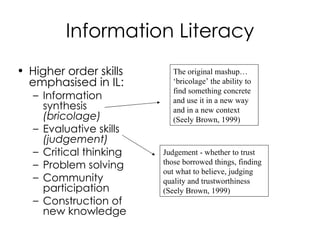
Information Literacy Higher order skills emphasised in IL: Information synthesis  (bricolage) Evaluative skills  (judgement) Critical thinking Problem solving Community participation Construction of new knowledge Judgement - whether to trust those borrowed things, finding out what to believe, judging quality and trustworthiness (Seely Brown, 1999) The original mashup…  ‘bricolage’ the ability to find something concrete and use it in a new way and in a new context  (Seely Brown, 1999)
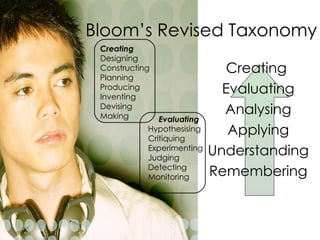
Bloom’s Revised Taxonomy Creating  Evaluating Analysing Applying Understanding Remembering Creating Designing Constructing Planning Producing Inventing Devising Making Evaluating Hypothesising Critiquing Experimenting Judging Detecting Monitoring
Impact of ICT on learning: Connectivism? Learning is a process of connecting specialized nodes or information sources.  Capacity to know more is more critical than what is currently known  Ability to see connections between fields, ideas, and concepts is a core skill.  Currency (accurate, up-to-date knowledge) is the intent of all connectivist learning activities.  Siemens, 2004.
Meeting the challenges  with 2.0 tools  Weblogs Wikis Social bookmarking … .. Use as resources  and as teaching tools
Weblog features Reflective tools   Highlighting a path of progression  Strengthening evaluation skills   Being prepared to respond Improving written communication skills   Ease of acknowledging sources online  Community building  Maturing with incorporation into more ‘scholarly’ platforms
Weblogs and IL Premised on evaluation! Encourage identification of purpose and audience of potential resource  Provide a place for critical reflection and journaling findings Value as a primary source Provide different perspectives outside of immediate community Use RSS feeds to keep current Critical thinking Evaluating Creating
Wiki features Easy to create websites, focus on the content Project development with peer review  Group authoring  Track a group project   (‘Using Wiki in Education’, 2006) Development of ‘communities of practice’ where reflection and feedback are important collaborative processes.
Wikis and IL Conferring with others to identify a research topic or other information need. Recognises that the search process is evolutionary and nonlinear Communicates findings and new understandings Participating in collaborative writing and publication – encourages discourse on topic Creating Constructing Judging
Social bookmarking features Organisation and management of information Sharing and dissemination of resources Collaborative discovery Bottom-up rather than top-down classification of information Folksonomies/ tagging
Social bookmarking and IL Keeps up to date with information sources and investigative tools Information can be acquired by browsing, scanning and monitoring information sources Organises (orders/classifies/stores) information Records pertinent citation information for future reference and retrieval Planning Inventing Monitoring
2.0 technologies and Information Literacy Social software can be used to engage learners in ways that work best for them. Tools that encourage recommendation and reputation help highlight the need for evaluation and analysis and create communities.  New learning theories emerging in response to people engaging with technologies to learn. Mechanisms for resource discovery, critical reflection and for recording the search process.
Thank you.
Works consulted Bundy, A (ed). 2004.  Australian and New Zealand Information Literacy Framework .  2nd ed.  Adelaide:  Australian and New Zealand Institute for Information Literacy. Jonas-Dwyer, D & Pospisil, R. 2004.  “The Millennial effect:  Implications for academic development”,  HERDSA 2004 Conference Proceedings . http://herdsa2004.curtin.edu.my/Contributions/RPapers/P050-jt.pdf. [ Accessed: 1 June 2006]. Owens, M., Grant, L, Sayers, S. & K. Facer.  2006.  Social Software and learning .  Futurelab: Bristol, UK. [http://www.futurelab.org.uk] [Accessed: 14 June 2006]. Seely Brown, J.  1999.  Learning, Working & Playing in the Digital Age.  Conference on Higher Education of the American Association for Higher Education  http://serendip.brynmawr.edu/sci_edu/seelybrown/.  Accessed: 14 June 2006. Siemens, G.  2004.  Connectivism: A Learning theory for a digital age.  Elearnspace .  [online].  Available from:  http://www.elearnspace.org/Articles/connectivism.htm [Accessed 18 Nov 2006].   ‘ Using Wiki in Education’  The Science of Spectroscopy .  2006.  http://www.scienceofspectroscopy.info/edit/index.php?title=Using_wiki_in_education [Accessed: 20 June 2006].

Information Literacy and the 2.0s

  • 1.
    Information Skills andthe 2.0’s Kara Jones Subject Librarian University of Bath Aslib Engineering event 22 November 2006
  • 2.
    Themes Learner CharacteristicsInformation Literacy Higher order skills Using Web 2.0 / Library 2.0 Technologies
  • 3.
    Learners Move frome-learning to c-learning: Community, communication or collaboration (Owens et al, 2006) Learning preferences tend toward teamwork, experiential activities, structure, and the use of technology. Their strengths include multitasking, goal orientation, positive attitudes, and a collaborative style. (Jones, S. 2002, qtd in Oblinger, D. 2003)
  • 4.
    Information Literacy Informationliteracy (IL) is an intellectual framework for recognising the need for, understanding, finding, evaluating, and using information . (Australian Information Literacy Standards, 2000) Frameworks / competency standards / skills sets ….
  • 5.
    Information Literacy Higherorder skills emphasised in IL: Information synthesis (bricolage) Evaluative skills (judgement) Critical thinking Problem solving Community participation Construction of new knowledge Judgement - whether to trust those borrowed things, finding out what to believe, judging quality and trustworthiness (Seely Brown, 1999) The original mashup… ‘bricolage’ the ability to find something concrete and use it in a new way and in a new context (Seely Brown, 1999)
  • 6.
    Bloom’s Revised TaxonomyCreating Evaluating Analysing Applying Understanding Remembering Creating Designing Constructing Planning Producing Inventing Devising Making Evaluating Hypothesising Critiquing Experimenting Judging Detecting Monitoring
  • 7.
    Impact of ICTon learning: Connectivism? Learning is a process of connecting specialized nodes or information sources. Capacity to know more is more critical than what is currently known Ability to see connections between fields, ideas, and concepts is a core skill. Currency (accurate, up-to-date knowledge) is the intent of all connectivist learning activities. Siemens, 2004.
  • 8.
    Meeting the challenges with 2.0 tools Weblogs Wikis Social bookmarking … .. Use as resources and as teaching tools
  • 9.
    Weblog features Reflectivetools Highlighting a path of progression Strengthening evaluation skills Being prepared to respond Improving written communication skills Ease of acknowledging sources online Community building Maturing with incorporation into more ‘scholarly’ platforms
  • 10.
    Weblogs and ILPremised on evaluation! Encourage identification of purpose and audience of potential resource Provide a place for critical reflection and journaling findings Value as a primary source Provide different perspectives outside of immediate community Use RSS feeds to keep current Critical thinking Evaluating Creating
  • 11.
    Wiki features Easyto create websites, focus on the content Project development with peer review Group authoring Track a group project (‘Using Wiki in Education’, 2006) Development of ‘communities of practice’ where reflection and feedback are important collaborative processes.
  • 12.
    Wikis and ILConferring with others to identify a research topic or other information need. Recognises that the search process is evolutionary and nonlinear Communicates findings and new understandings Participating in collaborative writing and publication – encourages discourse on topic Creating Constructing Judging
  • 13.
    Social bookmarking featuresOrganisation and management of information Sharing and dissemination of resources Collaborative discovery Bottom-up rather than top-down classification of information Folksonomies/ tagging
  • 14.
    Social bookmarking andIL Keeps up to date with information sources and investigative tools Information can be acquired by browsing, scanning and monitoring information sources Organises (orders/classifies/stores) information Records pertinent citation information for future reference and retrieval Planning Inventing Monitoring
  • 15.
    2.0 technologies andInformation Literacy Social software can be used to engage learners in ways that work best for them. Tools that encourage recommendation and reputation help highlight the need for evaluation and analysis and create communities. New learning theories emerging in response to people engaging with technologies to learn. Mechanisms for resource discovery, critical reflection and for recording the search process.
  • 16.
  • 17.
    Works consulted Bundy,A (ed). 2004. Australian and New Zealand Information Literacy Framework . 2nd ed. Adelaide: Australian and New Zealand Institute for Information Literacy. Jonas-Dwyer, D & Pospisil, R. 2004. “The Millennial effect: Implications for academic development”, HERDSA 2004 Conference Proceedings . http://herdsa2004.curtin.edu.my/Contributions/RPapers/P050-jt.pdf. [ Accessed: 1 June 2006]. Owens, M., Grant, L, Sayers, S. & K. Facer. 2006. Social Software and learning . Futurelab: Bristol, UK. [http://www.futurelab.org.uk] [Accessed: 14 June 2006]. Seely Brown, J. 1999. Learning, Working & Playing in the Digital Age. Conference on Higher Education of the American Association for Higher Education http://serendip.brynmawr.edu/sci_edu/seelybrown/. Accessed: 14 June 2006. Siemens, G. 2004. Connectivism: A Learning theory for a digital age. Elearnspace . [online]. Available from: http://www.elearnspace.org/Articles/connectivism.htm [Accessed 18 Nov 2006]. ‘ Using Wiki in Education’ The Science of Spectroscopy . 2006. http://www.scienceofspectroscopy.info/edit/index.php?title=Using_wiki_in_education [Accessed: 20 June 2006].