Academic social networking
sites
Katy Jordan
katy.jordan@open.ac.uk
@katy_jordan
Background
• Based in IET
• PhD focusing on academic social networking sites (SNS)
• Mixed methods social network analysis approach
• Here, drawing on my online survey and a large-scale survey by
Nature (NPG, 2014; van Noorden, 2014) as a data source
Nature survey
• Open from May to July 2014
• Online survey, circulated via publishers’ email networks
• Summary published in Nature (van Noorden, 2014), and
dataset published online (NPG, 2014)
• Purposes:
• Assess level of use of different academic SNS
• Likert scale items asked about different uses of sites in
general
• Ways of using particular sites
• Free text comments
PhD survey
• Open from November 2014 to January 2015
• Online survey, mainly circulated by social networks
• 527 responses
• Purposes:
• Assess level of use of different academic SNS
• Likert scale items asked about different uses of sites in
general
• Recruitment for network analyses
Outline
• Defining academic social networking sites
• Benefits
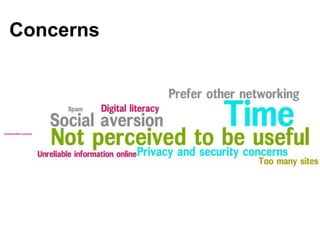
• Concerns
• Implications
Defining academic social
networking sites
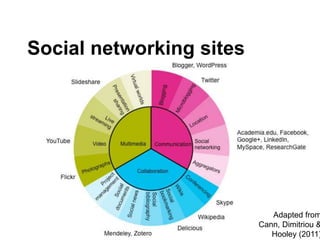
Social networking sites
“A social network site is a networked communication platform in which
participants
1) have uniquely identifiable profiles that consist of user-supplied
content, content provided by other users, and/or system-provided
data;
2) can publicly articulate connections that can be viewed and
traversed by others; and
3) can consume, produce, and/or interact with streams of user-
generated content provided by their connections on the site.”
(Ellison & boyd, 2013)
Social networking sites
Adapted from
Cann, Dimitriou &
Hooley (2011)
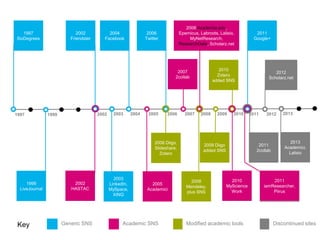
Key Generic SNS Academic SNS Modified academic tools Discontinued sites
1997
1997
SixDegrees
1999
LiveJournal
1999 2002
2002
Friendster
20052003 2004
2003
LinkedIn,
MySpace,
XING
2005
Academici
2004
Facebook
2006
2006
Twitter
2006 Diigo,
Slideshare,
Zotero
2007
2007
2collab
2008
2008 Academia.edu,
Epernicus, Labroots, Lalisio,
MyNetResearch,
ResearchGate, Scholarz.net
2008
Mendeley,
plus SNS
2009
2009 Diigo
added SNS
2010
2010
Zotero
added SNS
2011
2011
iamResearcher,
Piirus
2011
2collab
2012 2013
2013
Academici,
Lalisio
2002
HASTAC
2010
MyScience
Work
2012
Scholarz.net
2011
Google+
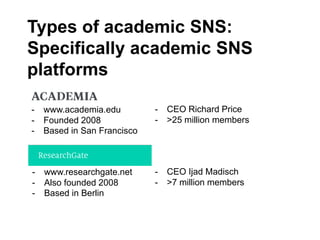
Types of academic SNS:
Specifically academic SNS
platforms
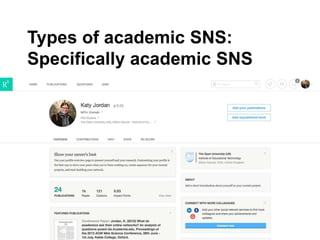
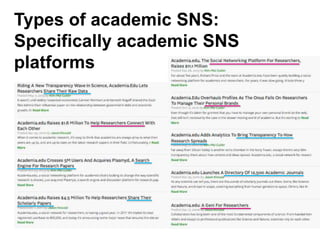
Academia.edu
- www.academia.edu
- Founded 2008
- Based in San Francisco
ResearchGate
- www.researchgate.net
- Also founded 2008
- Based in Berlin
- CEO Ijad Madisch
- >7 million members
- CEO Richard Price
- >25 million members
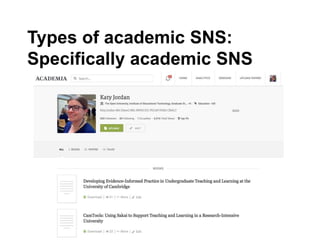
Types of academic SNS:
Specifically academic SNS
Types of academic SNS:
Specifically academic SNS
Types of academic SNS:
Specifically academic SNS
platforms
Types of academic SNS:
Specifically academic SNS
platforms
Types of academic SNS:
Specifically academic SNS
platforms
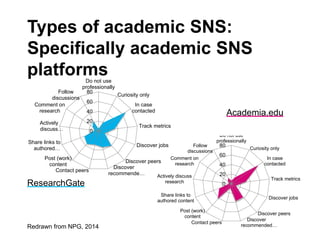
0
20
40
60
80
Do not use
professionally
Curiosity only
In case
contacted
Track metrics
Discover jobs
Discover peers
Discover
recommende…
Contact peers
Post (work)
content
Share links to
authored…
Actively
discuss…
Comment on
research
Follow
discussions
ResearchGate
Redrawn from NPG, 2014
0
20
40
60
80
Do not use
professionally
Curiosity only
In case
contacted
Track metrics
Discover jobs
Discover peers
Discover
recommended…
Contact peers
Post (work)
content
Share links to
authored content
Actively discuss
research
Comment on
research
Follow
discussions
Academia.edu
Types of academic SNS:
Specifically academic SNS
platforms
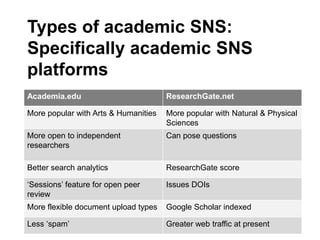
Academia.edu ResearchGate.net
More popular with Arts & Humanities More popular with Natural & Physical
Sciences
More open to independent
researchers
Can pose questions
Better search analytics ResearchGate score
‘Sessions’ feature for open peer
review
Issues DOIs
More flexible document upload types Google Scholar indexed
Less ‘spam’ Greater web traffic at present
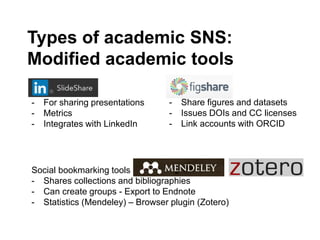
Types of academic SNS:
Modified academic tools
Slideshare
- For sharing presentations
- Metrics
- Integrates with LinkedIn
Figshare
- Share figures and datasets
- Issues DOIs and CC licenses
- Link accounts with ORCID
Social bookmarking tools (Mendeley, Zotero)
- Shares collections and bibliographies
- Can create groups - Export to Endnote
- Statistics (Mendeley) – Browser plugin (Zotero)
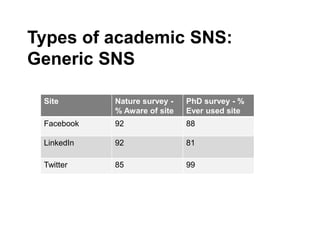
Types of academic SNS:
Generic SNS
Site Nature survey -
% Aware of site
PhD survey - %
Ever used site
Facebook 92 88
LinkedIn 92 81
Twitter 85 99
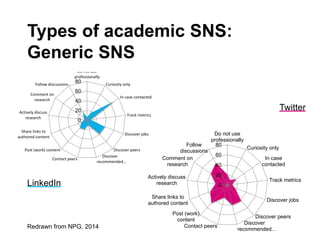
Types of academic SNS:
Generic SNS
0
20
40
60
80
Do not use
professionally
Curiosity only
In case
contacted
Track metrics
Discover jobs
Discover peers
Discover
recommended…
Contact peers
Post (work)
content
Share links to
authored content
Actively discuss
research
Comment on
research
Follow
discussions
LinkedIn
Twitter
Redrawn from NPG, 2014
0
20
40
60
80
Do not use
professionally
Curiosity only
In case contacted
Track metrics
Discover jobs
Discover peers
Discover
recommended…
Contact peers
Post (work) content
Share links to
authored content
Actively discuss
research
Comment on
research
Follow discussions
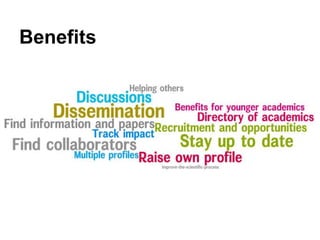
Benefits
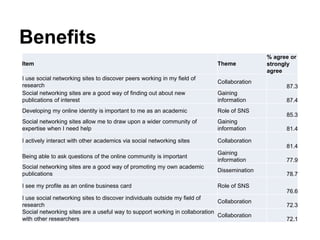
Benefits
Item Theme
% agree or
strongly
agree
I use social networking sites to discover peers working in my field of
research
Collaboration
87.3
Social networking sites are a good way of finding out about new
publications of interest
Gaining
information 87.4
Developing my online identity is important to me as an academic Role of SNS
85.3
Social networking sites allow me to draw upon a wider community of
expertise when I need help
Gaining
information 81.4
I actively interact with other academics via social networking sites Collaboration
81.4
Being able to ask questions of the online community is important
Gaining
information 77.9
Social networking sites are a good way of promoting my own academic
publications
Dissemination
78.7
I see my profile as an online business card Role of SNS
76.6
I use social networking sites to discover individuals outside my field of
research
Collaboration
72.3
Social networking sites are a useful way to support working in collaboration
with other researchers
Collaboration
72.1
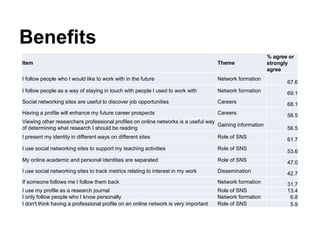
Benefits
Item Theme
% agree or
strongly
agree
I follow people who I would like to work with in the future Network formation
67.6
I follow people as a way of staying in touch with people I used to work with Network formation 69.1
Social networking sites are useful to discover job opportunities Careers 68.1
Having a profile will enhance my future career prospects Careers 58.5
Viewing other researchers professional profiles on online networks is a useful way
of determining what research I should be reading
Gaining information
56.5
I present my identity in different ways on different sites Role of SNS 61.7
I use social networking sites to support my teaching activities Role of SNS
53.6
My online academic and personal identities are separated Role of SNS 47.0
I use social networking sites to track metrics relating to interest in my work Dissemination 42.7
If someone follows me I follow them back Network formation 31.7
I use my profile as a research journal Role of SNS 13.4
I only follow people who I know personally Network formation 6.8
I don't think having a professional profile on an online network is very important Role of SNS 5.9
Benefits
• Items relating to career development show consistent differences
according to job position, being of greater importance to more
junior academics and students.
• Also, a greater willingness by more junior academics to make
connections based on who they would like to work with in the
future.
• ‘I use social networking sites to supporting my teaching activities’
shows significantly higher agreement levels for professors and
lecturers.
• Dissemination is of particular importance to researchers
(significantly higher value of ‘sharing authored content’).
Concerns
Implications
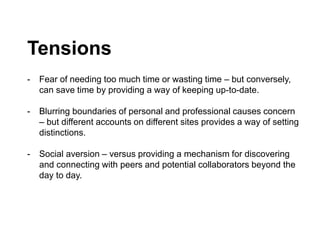
Tensions
- Fear of needing too much time or wasting time – but conversely,
can save time by providing a way of keeping up-to-date.
- Blurring boundaries of personal and professional causes concern
– but different accounts on different sites provides a way of setting
distinctions.
- Social aversion – versus providing a mechanism for discovering
and connecting with peers and potential collaborators beyond the
day to day.
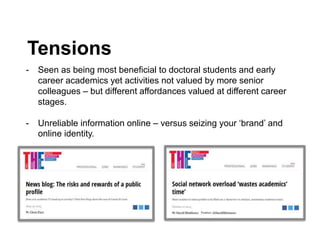
Tensions
- Seen as being most beneficial to doctoral students and early
career academics yet activities not valued by more senior
colleagues – but different affordances valued at different career
stages.
- Unreliable information online – versus seizing your ‘brand’ and
online identity.
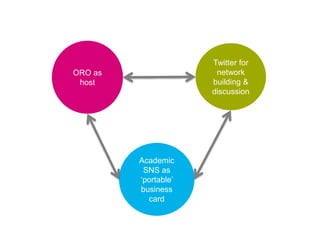
ORO as
host
Academic
SNS as
‘portable’
business
card
Twitter for
network
building &
discussion
References
Cann, A.J., Dimitriou, K. and Hooley, T. (2011) Social media: A guide for researchers.
Research Information Network. Retrieved from: http://www.rin.ac.uk/our-
work/communicating-and-disseminating-research/social-media-guide-researchers
Ellison, N. B. & boyd, d. (2013). Sociality through Social Network Sites. In Dutton,
W. H. (Ed.), The Oxford Handbook of Internet Studies. Oxford: Oxford University Pre
ss, pp. 151‐172.
(NPG), Nature Publishing Group (2014): NPG 2014 Social Networks survey. figshare.
http://dx.doi.org/10.6084/m9.figshare.1132584Retrieved 11:41, Oct 17, 2015 (GMT)
Van Noorden, R. (2014) Online collaboration: Scientists and the social network. Nature
12(7513), http://www.nature.com/news/onlinecollaboration-scientists-and-the-social-
network-1.15711 Retrieved 16th October 2015

Academic social networking sites

  • 1.
    Academic social networking sites KatyJordan katy.jordan@open.ac.uk @katy_jordan
  • 2.
    Background • Based inIET • PhD focusing on academic social networking sites (SNS) • Mixed methods social network analysis approach • Here, drawing on my online survey and a large-scale survey by Nature (NPG, 2014; van Noorden, 2014) as a data source
  • 3.
    Nature survey • Openfrom May to July 2014 • Online survey, circulated via publishers’ email networks • Summary published in Nature (van Noorden, 2014), and dataset published online (NPG, 2014) • Purposes: • Assess level of use of different academic SNS • Likert scale items asked about different uses of sites in general • Ways of using particular sites • Free text comments
  • 4.
    PhD survey • Openfrom November 2014 to January 2015 • Online survey, mainly circulated by social networks • 527 responses • Purposes: • Assess level of use of different academic SNS • Likert scale items asked about different uses of sites in general • Recruitment for network analyses
  • 5.
    Outline • Defining academicsocial networking sites • Benefits • Concerns • Implications
  • 6.
  • 7.
    Social networking sites “Asocial network site is a networked communication platform in which participants 1) have uniquely identifiable profiles that consist of user-supplied content, content provided by other users, and/or system-provided data; 2) can publicly articulate connections that can be viewed and traversed by others; and 3) can consume, produce, and/or interact with streams of user- generated content provided by their connections on the site.” (Ellison & boyd, 2013)
  • 8.
    Social networking sites Adaptedfrom Cann, Dimitriou & Hooley (2011)
  • 9.
    Key Generic SNSAcademic SNS Modified academic tools Discontinued sites 1997 1997 SixDegrees 1999 LiveJournal 1999 2002 2002 Friendster 20052003 2004 2003 LinkedIn, MySpace, XING 2005 Academici 2004 Facebook 2006 2006 Twitter 2006 Diigo, Slideshare, Zotero 2007 2007 2collab 2008 2008 Academia.edu, Epernicus, Labroots, Lalisio, MyNetResearch, ResearchGate, Scholarz.net 2008 Mendeley, plus SNS 2009 2009 Diigo added SNS 2010 2010 Zotero added SNS 2011 2011 iamResearcher, Piirus 2011 2collab 2012 2013 2013 Academici, Lalisio 2002 HASTAC 2010 MyScience Work 2012 Scholarz.net 2011 Google+
  • 10.
    Types of academicSNS: Specifically academic SNS platforms Academia.edu - www.academia.edu - Founded 2008 - Based in San Francisco ResearchGate - www.researchgate.net - Also founded 2008 - Based in Berlin - CEO Ijad Madisch - >7 million members - CEO Richard Price - >25 million members
  • 11.
    Types of academicSNS: Specifically academic SNS
  • 12.
    Types of academicSNS: Specifically academic SNS
  • 13.
    Types of academicSNS: Specifically academic SNS platforms
  • 14.
    Types of academicSNS: Specifically academic SNS platforms
  • 15.
    Types of academicSNS: Specifically academic SNS platforms 0 20 40 60 80 Do not use professionally Curiosity only In case contacted Track metrics Discover jobs Discover peers Discover recommende… Contact peers Post (work) content Share links to authored… Actively discuss… Comment on research Follow discussions ResearchGate Redrawn from NPG, 2014 0 20 40 60 80 Do not use professionally Curiosity only In case contacted Track metrics Discover jobs Discover peers Discover recommended… Contact peers Post (work) content Share links to authored content Actively discuss research Comment on research Follow discussions Academia.edu
  • 16.
    Types of academicSNS: Specifically academic SNS platforms Academia.edu ResearchGate.net More popular with Arts & Humanities More popular with Natural & Physical Sciences More open to independent researchers Can pose questions Better search analytics ResearchGate score ‘Sessions’ feature for open peer review Issues DOIs More flexible document upload types Google Scholar indexed Less ‘spam’ Greater web traffic at present
  • 17.
    Types of academicSNS: Modified academic tools Slideshare - For sharing presentations - Metrics - Integrates with LinkedIn Figshare - Share figures and datasets - Issues DOIs and CC licenses - Link accounts with ORCID Social bookmarking tools (Mendeley, Zotero) - Shares collections and bibliographies - Can create groups - Export to Endnote - Statistics (Mendeley) – Browser plugin (Zotero)
  • 18.
    Types of academicSNS: Generic SNS Site Nature survey - % Aware of site PhD survey - % Ever used site Facebook 92 88 LinkedIn 92 81 Twitter 85 99
  • 19.
    Types of academicSNS: Generic SNS 0 20 40 60 80 Do not use professionally Curiosity only In case contacted Track metrics Discover jobs Discover peers Discover recommended… Contact peers Post (work) content Share links to authored content Actively discuss research Comment on research Follow discussions LinkedIn Twitter Redrawn from NPG, 2014 0 20 40 60 80 Do not use professionally Curiosity only In case contacted Track metrics Discover jobs Discover peers Discover recommended… Contact peers Post (work) content Share links to authored content Actively discuss research Comment on research Follow discussions
  • 20.
  • 21.
    Benefits Item Theme % agreeor strongly agree I use social networking sites to discover peers working in my field of research Collaboration 87.3 Social networking sites are a good way of finding out about new publications of interest Gaining information 87.4 Developing my online identity is important to me as an academic Role of SNS 85.3 Social networking sites allow me to draw upon a wider community of expertise when I need help Gaining information 81.4 I actively interact with other academics via social networking sites Collaboration 81.4 Being able to ask questions of the online community is important Gaining information 77.9 Social networking sites are a good way of promoting my own academic publications Dissemination 78.7 I see my profile as an online business card Role of SNS 76.6 I use social networking sites to discover individuals outside my field of research Collaboration 72.3 Social networking sites are a useful way to support working in collaboration with other researchers Collaboration 72.1
  • 22.
    Benefits Item Theme % agreeor strongly agree I follow people who I would like to work with in the future Network formation 67.6 I follow people as a way of staying in touch with people I used to work with Network formation 69.1 Social networking sites are useful to discover job opportunities Careers 68.1 Having a profile will enhance my future career prospects Careers 58.5 Viewing other researchers professional profiles on online networks is a useful way of determining what research I should be reading Gaining information 56.5 I present my identity in different ways on different sites Role of SNS 61.7 I use social networking sites to support my teaching activities Role of SNS 53.6 My online academic and personal identities are separated Role of SNS 47.0 I use social networking sites to track metrics relating to interest in my work Dissemination 42.7 If someone follows me I follow them back Network formation 31.7 I use my profile as a research journal Role of SNS 13.4 I only follow people who I know personally Network formation 6.8 I don't think having a professional profile on an online network is very important Role of SNS 5.9
  • 23.
    Benefits • Items relatingto career development show consistent differences according to job position, being of greater importance to more junior academics and students. • Also, a greater willingness by more junior academics to make connections based on who they would like to work with in the future. • ‘I use social networking sites to supporting my teaching activities’ shows significantly higher agreement levels for professors and lecturers. • Dissemination is of particular importance to researchers (significantly higher value of ‘sharing authored content’).
  • 24.
  • 25.
  • 26.
    Tensions - Fear ofneeding too much time or wasting time – but conversely, can save time by providing a way of keeping up-to-date. - Blurring boundaries of personal and professional causes concern – but different accounts on different sites provides a way of setting distinctions. - Social aversion – versus providing a mechanism for discovering and connecting with peers and potential collaborators beyond the day to day.
  • 27.
    Tensions - Seen asbeing most beneficial to doctoral students and early career academics yet activities not valued by more senior colleagues – but different affordances valued at different career stages. - Unreliable information online – versus seizing your ‘brand’ and online identity.
  • 28.
  • 29.
    References Cann, A.J., Dimitriou,K. and Hooley, T. (2011) Social media: A guide for researchers. Research Information Network. Retrieved from: http://www.rin.ac.uk/our- work/communicating-and-disseminating-research/social-media-guide-researchers Ellison, N. B. & boyd, d. (2013). Sociality through Social Network Sites. In Dutton, W. H. (Ed.), The Oxford Handbook of Internet Studies. Oxford: Oxford University Pre ss, pp. 151‐172. (NPG), Nature Publishing Group (2014): NPG 2014 Social Networks survey. figshare. http://dx.doi.org/10.6084/m9.figshare.1132584Retrieved 11:41, Oct 17, 2015 (GMT) Van Noorden, R. (2014) Online collaboration: Scientists and the social network. Nature 12(7513), http://www.nature.com/news/onlinecollaboration-scientists-and-the-social- network-1.15711 Retrieved 16th October 2015

Editor's Notes

  • #3 480 in sample for qualitative analysis
  • #11 These are platforms which foreground themselves as academic SNS – i.e. the content is profiles, with personal information and publications attached, and links between. We saw on the previous slide that a number of these services have been – and gone. Academia.edu (34% Nature respondents aware of site; 72% my survey ever used) and ResearchGate.net (86% Nature; 50% my survey). Both had about 2 million users when I started my PhD in 2012. Both were founded in 2008 and are commercial enterprises, backed by venture capitalists…
  • #12 Academia.edu
  • #13 ResearchGate
  • #14 What do they do? ‘Facebook for Scientists’, but they are for-profit organisations and rhetoric from the sites suggests that they are trying to compete with traditional publishers as a revenue source. - If you’re not paying for it, you are the product
  • #15 But the perception of sites as a business card is prevalent among academics, and encouraging uploads of copyrighted material has created friction with publishers in the past. And may not meet OA guidelines from funders. -> Note replacement for ORO. BUT Academic SNS do better in Google searches for name – ORO better for specific papers.
  • #16 But – ways people do use them
  • #18 This includes … - Slideshare: 37% of PhD survey respondents have used it - Figshare: 10% of Nature survey respondents are aware of it 46% Nature/38% PhD survey aware/use Mendeley 31% PhD survey use Zotero
  • #20 ‘Facebook’ overwhelmingly seen as ‘not for work’
  • #21 189 of 480 academics raised benefits; 345 raised concerns.
  • #22 24 Likert scale questions in PhD survey Total n of 527 5 point scale from strongly disagree to strongly agree
  • #23 24 Likert scale questions in PhD survey Total n of 527 5 point scale from strongly disagree to strongly agree
  • #27 This includes …
  • #28 This includes …
  • #29 This includes … - Better to have one well maintained one than many not up to date