


Social Media: an overview
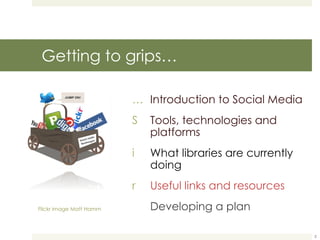
Getting to grips… Introduction to Social Media Tools, technologies and platforms What libraries are currently doing Useful links and resources Developing a plan Flickr image Matt Hamm
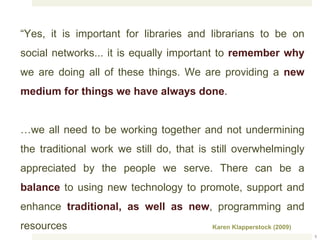
“ Yes, it is important for libraries and librarians to be on social networks... it is equally important to  remember why  we are doing all of these things. We are providing a  new medium for things we have always done .  … we all need to be working together and not undermining the traditional work we still do, that is still overwhelmingly appreciated by the people we serve. There can be a  balance  to using new technology to promote, support and enhance  traditional, as well as new , programming and resources Karen Klapperstock (2009) )
“ Many of the technologies we deal with are  residential platforms , meaning that it’s hard to see their real benefits until you’ve lived there for a while… It’s simple to sign up for a new tool, but it takes  time and effort  to make good use of it.” JISC Web2Practice
Introduction 1
Social Media A collection of  Tools, Technologies  and  Platforms   for sharing, networking, updating, connecting, researching and creating content
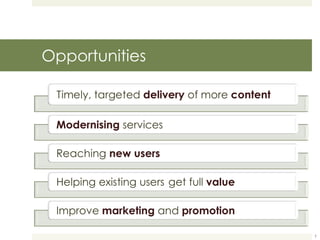
Opportunities
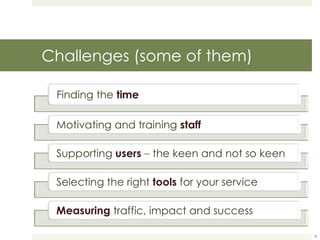
Challenges (some of them)
Always connected… The technologies we use are increasingly cloud-based consumerised decentralised Storage in the cloud Access from any device  …  and any location …  at any time
Trends People expect to be able to work, learn and study  whenever and wherever  they want to The world of work is increasingly  collaborative Source: Horizon Report 2011
Change and more change New   skills   and   competencies New   scholarly models  of communication are developing Publishing   is decentralising Keeping pace with new  devices ,  software and information sources is increasingly difficult
Years to adoption 1   eBooks and Mobiles 2-3 Augmented Reality Game Based Learning 4-5 Gesture Based Computing Learning Analytics Horizon Report 2011
“ There is a greater need than ever for  effective tools  and  filters  for  finding, interpreting, organising  and  retrieving   the data that is  important to us .” Source: Horizon Report 2011
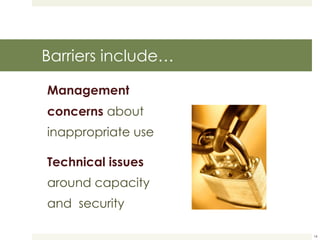
Barriers include… Management concerns  about inappropriate use Technical issues  around capacity and  security
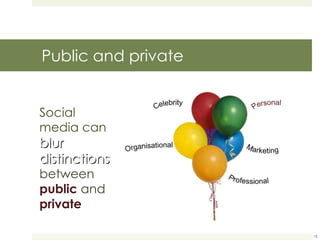
Public and private Social media can  blur  distinctions  between   public   and   private
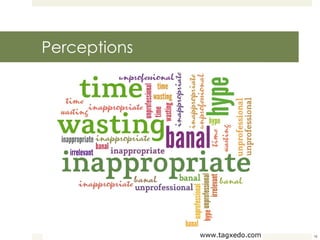
Perceptions Hype
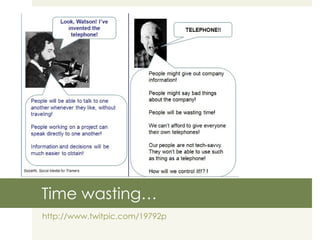
Time wasting… http://www.twitpic.com/19792p
Banal…. Some content is  banal  and   inappropriate  (just like other media) But some of it is  really, really useful  (just like other media) Flickr image Jeremy Brooks
  “ The purpose … is not to argue that social media are an absolute good, but rather that  they offer tools which, if used carefully, are likely to be beneficial  … and to  facilitate positive connections  with other communities e.g. the industrial research and development and policy communities.”  Social Media guide for researchers
“… using social media to  bridge disciplinary boundaries , to engage in  knowledge exchange  with industry and policy makers, and to provide a channel for the  public communication of their research ” Social Media: a guide for researchers
Tools, technologies and platforms 2
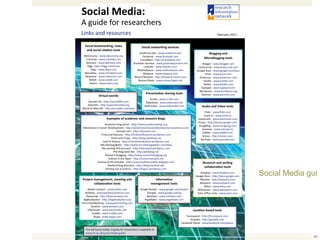
Social Media guide for researchers
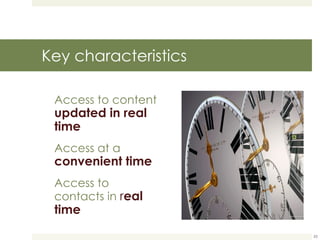
Key characteristics Access to content  updated in real time Access at a  convenient time Access to contacts in  r eal time
Top 10 tools for learning Twitter  – micro-updating tool  YouTube  – video hosting and sharing tool  GoogleDocs  - online collaboration tool  Delicious  – social bookmarking tool  Slideshare  – presentation hosting and sharing tool  Google Reader  – RSS feed reader  Wordpress  – blogging tool  Skype  – instant messaging and VoIP call tool  Moodle  – course management system  Facebook  – social networking site Source: C4LPT
RSS feeds A  format  for regularly  updating  web  content Users stay  current  by  subscribing  to feeds Updates are  automatically  delivered without having to visit websites.
Feeds … Content providers  deliver  content to feed  subscribers  by incorporating a feed burner into the web page
Managing feeds Many sites offer the option to subscribe by  e-mail or via a free  aggregator  like Google Reader increasingly  Twitter  is used as a feed
Connections to…
Connections to … RSS feeds Aggregators Bookmarks Slideshare YouTube Podcasts Wikis
Twitter
Used for…  Service updates Links News Alerts Marketing  Promotion Research Disseminating Following people and  organisations Following trends and  events Finding information
An alternative to Twitter? Yammer   is a social network that operates within an organisation’s secure network. It’s Twitter for internal use
Social Networks principally a  personal network  but used by organisations to reach a target audience used by many  professionals   for networking and discussion Groups can be closed or open
Used for… Status updates Service updates News Alerts Marketing  Promotion Sharing Links Disseminating Discussions Campaigns Events Networking Discussions
Blogs Blogs are created by individuals, groups, organisations, institutions. They are chronologically organised  and frequently updated Platforms include  Blogger  and  Wordpress   and can be hosted on organisational websites.
Used for… Sharing news and content Publishing Forums for discussion, reflection Delivering training
Wikis wiki |ˈwikē|  WIKee noun a Web site that allows collaborative editing of its content and structure by its users. ORIGIN coined by programmer Ward Cunningham (1949- ), from Hawaiian  wiki-wiki ‘quick-quick.’ Wikipedia
Used for… Sharing knowledge Aggregating content Peer review Supporting best practice Team working Reference queries
LibraryThing A networking site  for  readers with  additional functionality  for libraries Offering catalogue enhancement, new books content and other services Mobile access  via the LibraryAnywhere app. CIG (Bowker, ProQuest etc) is a commercial partner
Photo Sharing
Used for… Sharing images Sourcing images Publicity Marketing Providing access to archives Event amplification
Slideshare Presentations   from workshops and courses from around the world
Used for… Archiving training Accessing training Event amplification Accessing content Search engine
Bookmarks Diigo Delicious
Used for… Archiving content Accessing content Finding content Organising and sharing content Promoting resources
Video content Lectures, courses, tutorials, conferences, events from universities, organisations and individuals Biggest  search engine  after Google
Podcasts Audio and video to  download   - radio programmes from the archives, lectures, language courses, interviews… Via  iTunes or other feeds
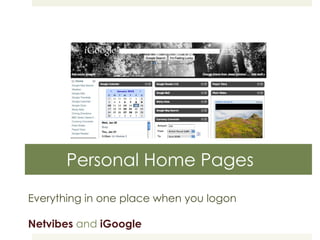
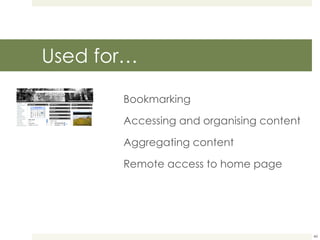
Personal Home Pages Everything in one place when you logon Netvibes  and  iGoogle
Used for… Bookmarking Accessing and organising content Aggregating content Remote access to home page
Library Apps “ Mobile devices today can run increasingly complex software, interact with cloud services, play rich multimedia content, and allow for advanced user interactivity” There's an App for that! Libraries and mobile technology
Used for… Access to catalogues Service information Content delivery Library induction Access to databases Ask a Librarian Library notifications
Costs and hidden costs There are   no   expensive licenses, set up is easy and many accounts are  free  to start with BUT There will be costs for  staff time, technical support, evaluation  and   design and charges can kick in eventually
What libraries are currently doing 3
Desktop library Digital Library, Rijkswaterstaat Directorate of Public Works and Water Management (The Netherlands) has moved from a network of satellite libraries to a desktop library service.
Supporting users Fire Resources The Fire Sciences Library of the Office of the Fire Marshall (U.S.) has developed a  Wiki  to support staff studying for the Master of Engineering in Fire Safety
Connecting via social media Bodleian Libraries Social Media Directory University of Oxford libraries communicate with their users through a variety of social media including  blogs, Facebook, Twitter  and  LibraryThing
Connecting 2 Follow, fan and connect with NLM The US National Library of Medicine provides access via  Twitter, Facebook, RSS feeds  and  e-mail lists.   Based at the US National Institutes of Health, it is the world’s largest medical library.
Aggregating content Team Knowledge Update Information services from Shrewsbury and Telford Health Libraries via  Netvibes Knowledge Source Regular  blog  with news, links and access to content
Aggregating content 2 HL Wiki Canada An open, freely-accessible  wiki  with entries about health librarianship, social media and current information technology topics relevant to the provision of health information.
Library Apps MIT Libraries Betas and Widgets Libraries at the Massachusetts Institute of Technology are experimenting with  apps  to improve access for their users  to content and services
Library Apps 2 Library Tools A guide to Cambridge University’s  apps  and other  online tools for library users
Library portal Dublin PL portal Comprehensive access to library and other resources provided by Dublin City Public Libraries for people living and working in Dublin via  Netvibes
Sharing research Research Information Network   disseminates information on resources, events and news via its  feeds and also uses  Facebook, Twitter  and  Delicious
Accessing resources Cochrane Social Media Workshop Health Librarians in Canada can access workshop content via  blog  and  Slideshare. Resources are available to participants and to a wider audience .
Useful links and resources 4
Bookmarks Government Libraries March 2011 A list of bookmarks on  Diigo  for this workshop Guides, articles, research, good practice, toolkits, advice, tutorials and other useful stuff
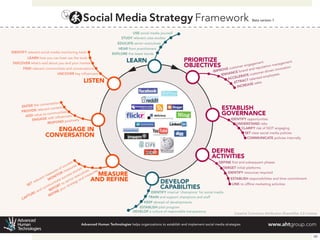
Planning for Social Media 5
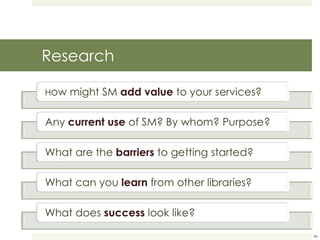
Research
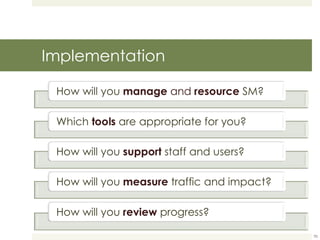
Implementation
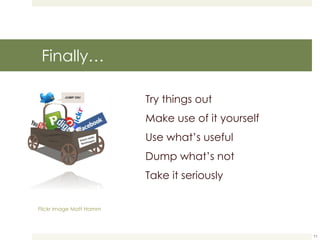
Finally… Try things out Make use of it yourself Use what’s useful Dump what’s not Take it seriously Flickr image Matt Hamm
Attribution – Share Alike License This presentation is available to reuse or adapt as long as  credit is given to the author. http://creativecommons.org/licenses/by-sa/3.0/

Social media overview

  • 1.
  • 2.
    Getting to grips…Introduction to Social Media Tools, technologies and platforms What libraries are currently doing Useful links and resources Developing a plan Flickr image Matt Hamm
  • 3.
    “ Yes, itis important for libraries and librarians to be on social networks... it is equally important to remember why we are doing all of these things. We are providing a new medium for things we have always done . … we all need to be working together and not undermining the traditional work we still do, that is still overwhelmingly appreciated by the people we serve. There can be a balance to using new technology to promote, support and enhance traditional, as well as new , programming and resources Karen Klapperstock (2009) )
  • 4.
    “ Many ofthe technologies we deal with are residential platforms , meaning that it’s hard to see their real benefits until you’ve lived there for a while… It’s simple to sign up for a new tool, but it takes time and effort to make good use of it.” JISC Web2Practice
  • 5.
  • 6.
    Social Media Acollection of Tools, Technologies and Platforms for sharing, networking, updating, connecting, researching and creating content
  • 7.
  • 8.
  • 9.
    Always connected… Thetechnologies we use are increasingly cloud-based consumerised decentralised Storage in the cloud Access from any device … and any location … at any time
  • 10.
    Trends People expectto be able to work, learn and study whenever and wherever they want to The world of work is increasingly collaborative Source: Horizon Report 2011
  • 11.
    Change and morechange New skills and competencies New scholarly models of communication are developing Publishing is decentralising Keeping pace with new devices , software and information sources is increasingly difficult
  • 12.
    Years to adoption1 eBooks and Mobiles 2-3 Augmented Reality Game Based Learning 4-5 Gesture Based Computing Learning Analytics Horizon Report 2011
  • 13.
    “ There isa greater need than ever for effective tools and filters for finding, interpreting, organising and retrieving the data that is important to us .” Source: Horizon Report 2011
  • 14.
    Barriers include… Managementconcerns about inappropriate use Technical issues around capacity and security
  • 15.
    Public and privateSocial media can blur distinctions between public and private
  • 16.
  • 17.
  • 18.
    Banal…. Some contentis banal and inappropriate (just like other media) But some of it is really, really useful (just like other media) Flickr image Jeremy Brooks
  • 19.
    The purpose … is not to argue that social media are an absolute good, but rather that they offer tools which, if used carefully, are likely to be beneficial … and to facilitate positive connections with other communities e.g. the industrial research and development and policy communities.” Social Media guide for researchers
  • 20.
    “… using socialmedia to bridge disciplinary boundaries , to engage in knowledge exchange with industry and policy makers, and to provide a channel for the public communication of their research ” Social Media: a guide for researchers
  • 21.
  • 22.
    Social Media guidefor researchers
  • 23.
    Key characteristics Accessto content updated in real time Access at a convenient time Access to contacts in r eal time
  • 24.
    Top 10 toolsfor learning Twitter – micro-updating tool YouTube – video hosting and sharing tool GoogleDocs - online collaboration tool Delicious – social bookmarking tool Slideshare – presentation hosting and sharing tool Google Reader – RSS feed reader Wordpress – blogging tool Skype – instant messaging and VoIP call tool Moodle – course management system Facebook – social networking site Source: C4LPT
  • 25.
    RSS feeds A format for regularly updating web content Users stay current by subscribing to feeds Updates are automatically delivered without having to visit websites.
  • 26.
    Feeds … Contentproviders deliver content to feed subscribers by incorporating a feed burner into the web page
  • 27.
    Managing feeds Manysites offer the option to subscribe by e-mail or via a free aggregator like Google Reader increasingly Twitter is used as a feed
  • 28.
  • 29.
    Connections to …RSS feeds Aggregators Bookmarks Slideshare YouTube Podcasts Wikis
  • 30.
  • 31.
    Used for… Service updates Links News Alerts Marketing Promotion Research Disseminating Following people and organisations Following trends and events Finding information
  • 32.
    An alternative toTwitter? Yammer is a social network that operates within an organisation’s secure network. It’s Twitter for internal use
  • 33.
    Social Networks principallya personal network but used by organisations to reach a target audience used by many professionals for networking and discussion Groups can be closed or open
  • 34.
    Used for… Statusupdates Service updates News Alerts Marketing Promotion Sharing Links Disseminating Discussions Campaigns Events Networking Discussions
  • 35.
    Blogs Blogs arecreated by individuals, groups, organisations, institutions. They are chronologically organised and frequently updated Platforms include Blogger and Wordpress and can be hosted on organisational websites.
  • 36.
    Used for… Sharingnews and content Publishing Forums for discussion, reflection Delivering training
  • 37.
    Wikis wiki |ˈwikē| WIKee noun a Web site that allows collaborative editing of its content and structure by its users. ORIGIN coined by programmer Ward Cunningham (1949- ), from Hawaiian wiki-wiki ‘quick-quick.’ Wikipedia
  • 38.
    Used for… Sharingknowledge Aggregating content Peer review Supporting best practice Team working Reference queries
  • 39.
    LibraryThing A networkingsite for readers with additional functionality for libraries Offering catalogue enhancement, new books content and other services Mobile access via the LibraryAnywhere app. CIG (Bowker, ProQuest etc) is a commercial partner
  • 40.
  • 41.
    Used for… Sharingimages Sourcing images Publicity Marketing Providing access to archives Event amplification
  • 42.
    Slideshare Presentations from workshops and courses from around the world
  • 43.
    Used for… Archivingtraining Accessing training Event amplification Accessing content Search engine
  • 44.
  • 45.
    Used for… Archivingcontent Accessing content Finding content Organising and sharing content Promoting resources
  • 46.
    Video content Lectures,courses, tutorials, conferences, events from universities, organisations and individuals Biggest search engine after Google
  • 47.
    Podcasts Audio andvideo to download - radio programmes from the archives, lectures, language courses, interviews… Via iTunes or other feeds
  • 48.
    Personal Home PagesEverything in one place when you logon Netvibes and iGoogle
  • 49.
    Used for… BookmarkingAccessing and organising content Aggregating content Remote access to home page
  • 50.
    Library Apps “Mobile devices today can run increasingly complex software, interact with cloud services, play rich multimedia content, and allow for advanced user interactivity” There's an App for that! Libraries and mobile technology
  • 51.
    Used for… Accessto catalogues Service information Content delivery Library induction Access to databases Ask a Librarian Library notifications
  • 52.
    Costs and hiddencosts There are no expensive licenses, set up is easy and many accounts are free to start with BUT There will be costs for staff time, technical support, evaluation and design and charges can kick in eventually
  • 53.
    What libraries arecurrently doing 3
  • 54.
    Desktop library DigitalLibrary, Rijkswaterstaat Directorate of Public Works and Water Management (The Netherlands) has moved from a network of satellite libraries to a desktop library service.
  • 55.
    Supporting users FireResources The Fire Sciences Library of the Office of the Fire Marshall (U.S.) has developed a Wiki to support staff studying for the Master of Engineering in Fire Safety
  • 56.
    Connecting via socialmedia Bodleian Libraries Social Media Directory University of Oxford libraries communicate with their users through a variety of social media including blogs, Facebook, Twitter and LibraryThing
  • 57.
    Connecting 2 Follow,fan and connect with NLM The US National Library of Medicine provides access via Twitter, Facebook, RSS feeds and e-mail lists. Based at the US National Institutes of Health, it is the world’s largest medical library.
  • 58.
    Aggregating content TeamKnowledge Update Information services from Shrewsbury and Telford Health Libraries via Netvibes Knowledge Source Regular blog with news, links and access to content
  • 59.
    Aggregating content 2HL Wiki Canada An open, freely-accessible wiki with entries about health librarianship, social media and current information technology topics relevant to the provision of health information.
  • 60.
    Library Apps MITLibraries Betas and Widgets Libraries at the Massachusetts Institute of Technology are experimenting with apps to improve access for their users to content and services
  • 61.
    Library Apps 2Library Tools A guide to Cambridge University’s apps and other online tools for library users
  • 62.
    Library portal DublinPL portal Comprehensive access to library and other resources provided by Dublin City Public Libraries for people living and working in Dublin via Netvibes
  • 63.
    Sharing research ResearchInformation Network disseminates information on resources, events and news via its feeds and also uses Facebook, Twitter and Delicious
  • 64.
    Accessing resources CochraneSocial Media Workshop Health Librarians in Canada can access workshop content via blog and Slideshare. Resources are available to participants and to a wider audience .
  • 65.
    Useful links andresources 4
  • 66.
    Bookmarks Government LibrariesMarch 2011 A list of bookmarks on Diigo for this workshop Guides, articles, research, good practice, toolkits, advice, tutorials and other useful stuff
  • 67.
  • 69.
  • 70.
  • 71.
    Finally… Try thingsout Make use of it yourself Use what’s useful Dump what’s not Take it seriously Flickr image Matt Hamm
  • 72.
    Attribution – ShareAlike License This presentation is available to reuse or adapt as long as credit is given to the author. http://creativecommons.org/licenses/by-sa/3.0/