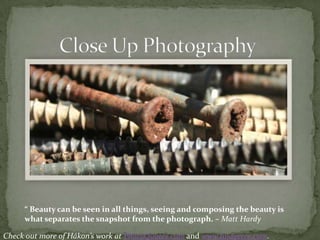
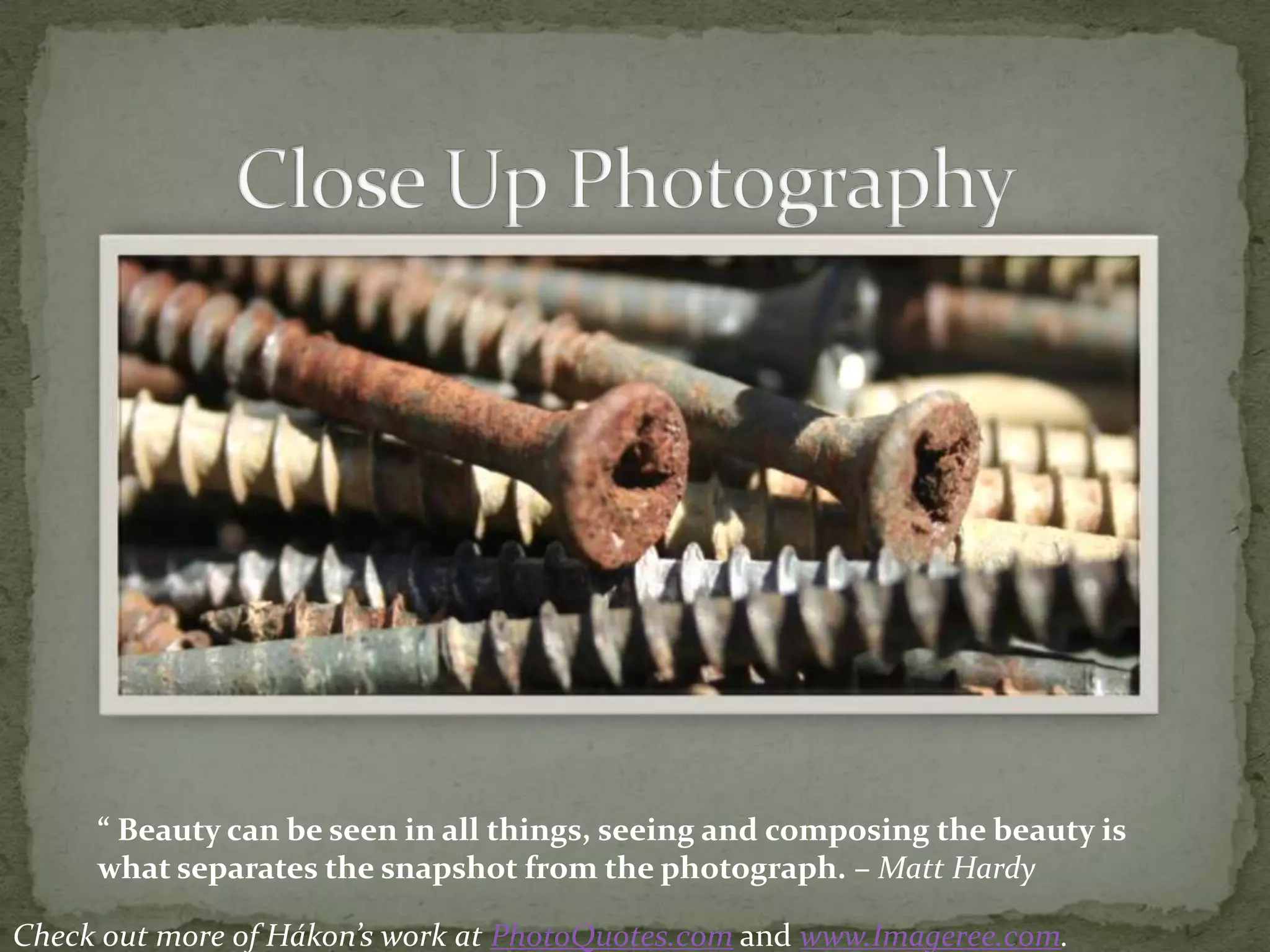
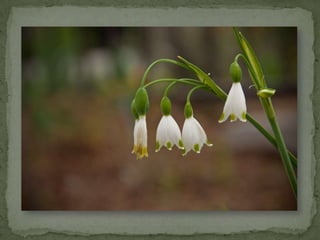
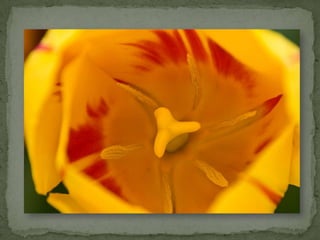
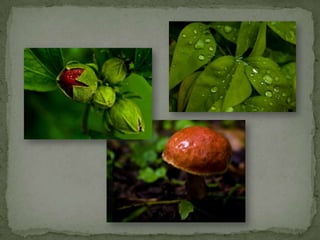
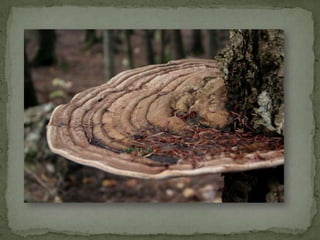
Close Up Photography“ Beauty can be seen in all things, seeing and composing the beauty is what separates the snapshot from the photograph. –Matt HardyCheck out more of Hákon’s work atPhotoQuotes.com and www.Imageree.com.
Macro/Close Up PresentationCritiqueOther  photo editing programs Agenda
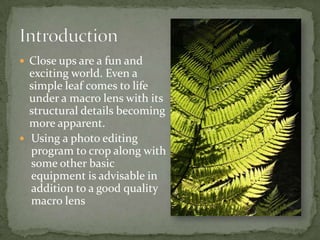
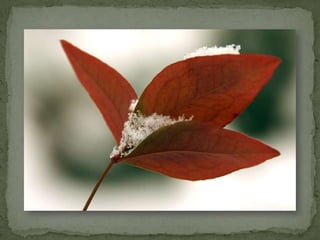
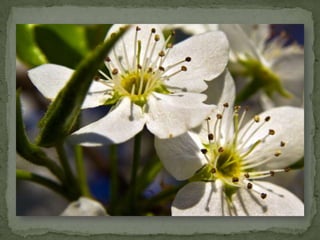
Close ups are a fun and exciting world. Even a simple leaf comes to life under a macro lens with its structural details becoming more apparent. Using a photo editing program to crop along with some other basic equipment is advisable in addition to a good quality macro lensIntroduction
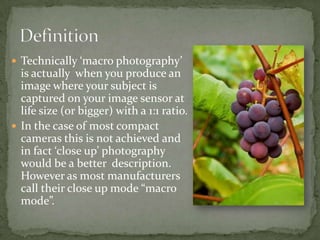
Technically ‘macro photography’ is actually  when you produce an image where your subject is captured on your image sensor at life size (or bigger) with a 1:1 ratio. In the case of most compact cameras this is not achieved and in fact ‘close up’ photography would be a better  description. However as most manufacturers call their close up mode “macro mode”.Definition
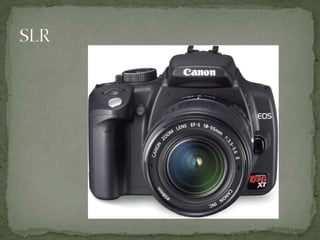
SLR
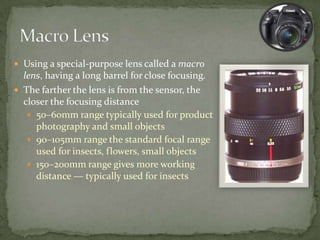
Using a special-purpose lens called a macro lens, having a long barrel for close focusing.The farther the lens is from the sensor, the closer the focusing distance50–60mm range typically used for product photography and small objects90–105mm range the standard focal range used for insects, flowers, small objects150–200mm range gives more working distance — typically used for insectsMacro Lens
Most zoom lenses out there that classify themselves as a macro lens. They are usually like a kit lens 28 - 70 mm macro. But if you look at their specs you will see that the magnification on most of these lens are 1:2, 1:3, or even as low as 1:4. So don't be fooled. If you want a true macro lens, make sure the specs say, magnification 1:1.Zoom Macro Lenses
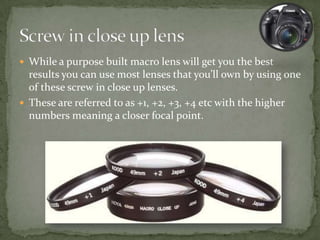
While a purpose built macro lens will get you the best results you can use most lenses that you’ll own by using one of these screw in close up lenses.These are referred to as +1, +2, +3, +4 etc with the higher numbers meaning a closer focal point.Screw in close up lens
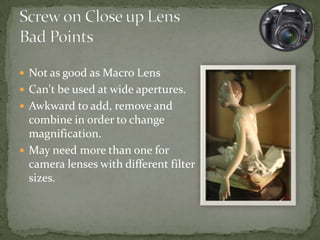
Not as good as Macro LensCan't be used at wide apertures.Awkward to add, remove and combine in order to change magnification.May need more than one for camera lenses with different filter sizes.Screw on Close up Lens Bad Points
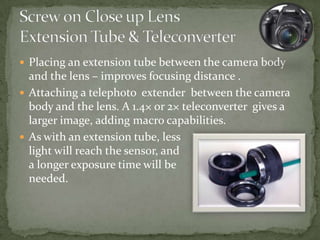
Placing an extension tube between the camera body and the lens – improves focusing distance .Attaching a telephoto  extender  between the camera body and the lens. A 1.4× or 2× teleconverter  gives a larger image, adding macro capabilities. As with an extension tube, lesslight will reach the sensor, and a longer exposure time will be needed. Screw on Close up LensExtension Tube & Teleconverter
Point and Shoot
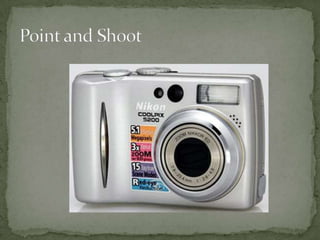
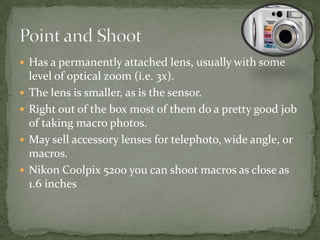
Has a permanently attached lens, usually with some level of optical zoom (i.e. 3x). The lens is smaller, as is the sensor. Right out of the box most of them do a pretty good job of taking macro photos.May sell accessory lenses for telephoto, wide angle, or macros. Nikon Coolpix 5200 you can shoot macros as close as 1.6 inches Point and Shoot
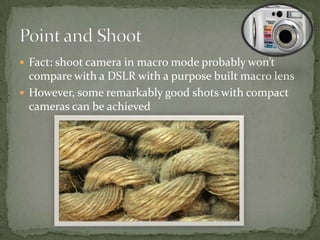
Fact: shoot camera in macro mode probably won’t compare with a DSLR with a purpose built macro lensHowever, some remarkably good shots with compact cameras can be achievedPoint and Shoot
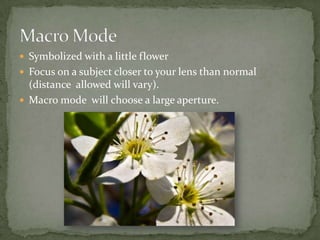
Symbolized with a little flowerFocus on a subject closer to your lens than normal (distance  allowed will vary).Macro mode  will choose a large aperture.Macro Mode
A Point and Shoot with 3x magnification
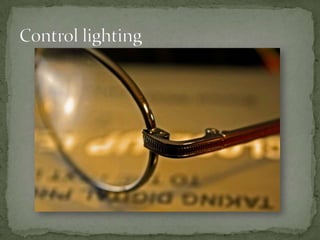
Control lighting
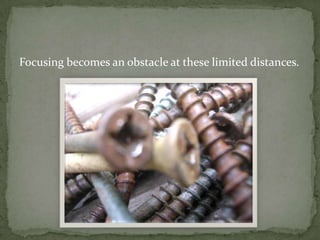
Focusing becomes an obstacle at these limited distances.
In close quarters, depth of field shrinks! Aperture - once in macro mode some cameras will not allow you to make many other adjustments but if you are able to play with your aperture settings it can be well worthwhile to do so.Don't forget that depth of field is very shallow, but this can be used to your advantage. Smaller apertures give greater  depth of field, but a slower exposure may be a disadvantage, particularly in windy conditions. This can be overcome with a fast film (ASA) or flash. Tips
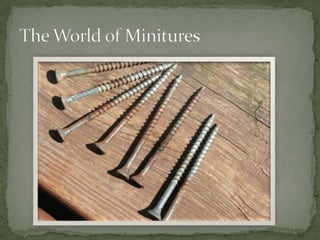
The World of Minitures
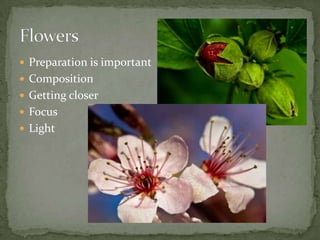
FlowersPreparation is importantCompositionGetting closerFocusLight
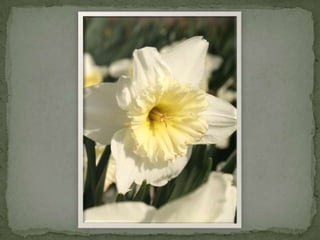
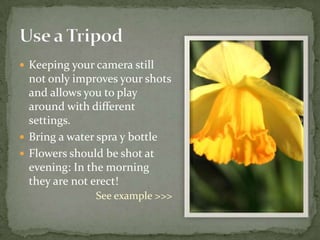
Keeping your camera still not only improves your shots and allows you to play around with different settings.Bring a water spra y bottleFlowers should be shot at evening: In the morning they are not erect!                         See example >>>Use a Tripod
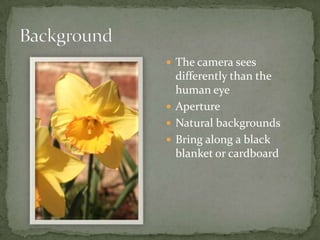
BackgroundThe camera sees differently than the human eyeApertureNatural backgroundsBring along a black blanket or cardboard
Focusing -  If your camera allows manual focusing select this option and manually focus on the part of our subject that is the main point of interest.Composition - Rule of Thirds. Focus on a main point of interest and place that focal point in a smart position in your image in order to draw the eye of your viewer. Try to select a non cluttered or simple background for your main subject so as it doesn’t compete with it visually.Tips
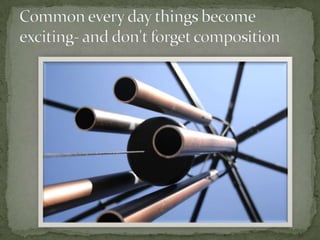
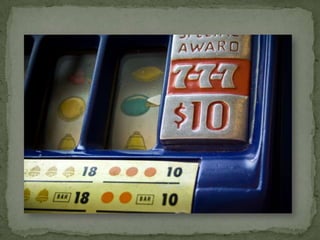
Common every day things become exciting- and don't forget composition
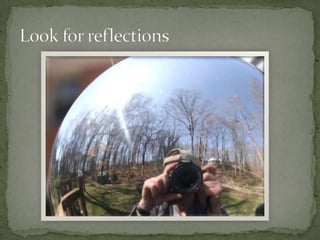
Look for reflections
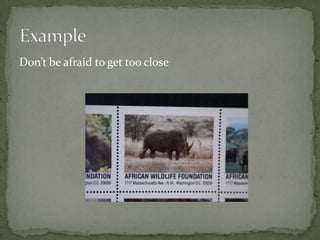
Don’t be afraid to get too closeExample
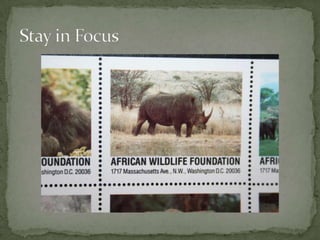
Stay in Focus
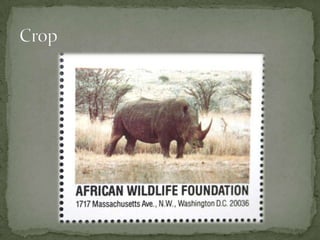
Crop
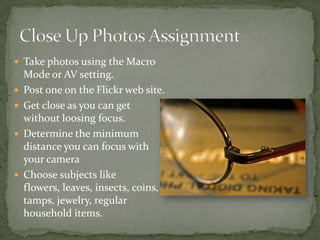
Take photos using the Macro Mode or AV setting.Post one on the Flickr web site.Get close as you can get without loosing focus.Determine the minimum distance you can focus with your camera Choose subjects like flowers, leaves, insects, coins, stamps, jewelry, regular household items.Close Up Photos Assignment
Alternative Photo Editing Options
Partnered togetherSome tools are only available with Picnik PremiumBasic  editing featuresRotate and  resizeReduce red-eyeAdjust exposureAdjust contrastApply special effects – boosting color and vignetteSharpenFlickr and Picnik
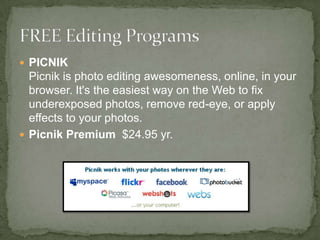
FREE Editing ProgramsPICNIKPicnik is photo editing awesomeness, online, in your browser. It's the easiest way on the Web to fix underexposed photos, remove red-eye, or apply effects to your photos.Picnik Premium  $24.95 yr.
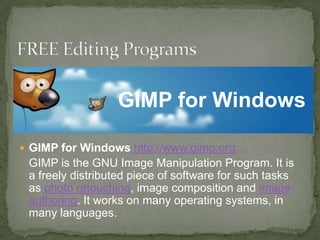
FREE Editing ProgramsGIMP for WindowsGIMP for Windows http://www.gimp.org	GIMP is the GNU Image Manipulation Program. It is a freely distributed piece of software for such tasks as photo retouching, image composition and image authoring. It works on many operating systems, in many languages.

Close-up Photography

  • 1.
    Close Up Photography“Beauty can be seen in all things, seeing and composing the beauty is what separates the snapshot from the photograph. –Matt HardyCheck out more of Hákon’s work atPhotoQuotes.com and www.Imageree.com.
  • 2.
    Macro/Close Up PresentationCritiqueOther photo editing programs Agenda
  • 3.
    Close ups area fun and exciting world. Even a simple leaf comes to life under a macro lens with its structural details becoming more apparent. Using a photo editing program to crop along with some other basic equipment is advisable in addition to a good quality macro lensIntroduction
  • 4.
    Technically ‘macro photography’is actually when you produce an image where your subject is captured on your image sensor at life size (or bigger) with a 1:1 ratio. In the case of most compact cameras this is not achieved and in fact ‘close up’ photography would be a better description. However as most manufacturers call their close up mode “macro mode”.Definition
  • 5.
  • 6.
    Using a special-purposelens called a macro lens, having a long barrel for close focusing.The farther the lens is from the sensor, the closer the focusing distance50–60mm range typically used for product photography and small objects90–105mm range the standard focal range used for insects, flowers, small objects150–200mm range gives more working distance — typically used for insectsMacro Lens
  • 7.
    Most zoom lensesout there that classify themselves as a macro lens. They are usually like a kit lens 28 - 70 mm macro. But if you look at their specs you will see that the magnification on most of these lens are 1:2, 1:3, or even as low as 1:4. So don't be fooled. If you want a true macro lens, make sure the specs say, magnification 1:1.Zoom Macro Lenses
  • 8.
    While a purposebuilt macro lens will get you the best results you can use most lenses that you’ll own by using one of these screw in close up lenses.These are referred to as +1, +2, +3, +4 etc with the higher numbers meaning a closer focal point.Screw in close up lens
  • 9.
    Not as goodas Macro LensCan't be used at wide apertures.Awkward to add, remove and combine in order to change magnification.May need more than one for camera lenses with different filter sizes.Screw on Close up Lens Bad Points
  • 10.
    Placing an extensiontube between the camera body and the lens – improves focusing distance .Attaching a telephoto extender between the camera body and the lens. A 1.4× or 2× teleconverter gives a larger image, adding macro capabilities. As with an extension tube, lesslight will reach the sensor, and a longer exposure time will be needed. Screw on Close up LensExtension Tube & Teleconverter
  • 11.
  • 12.
    Has a permanentlyattached lens, usually with some level of optical zoom (i.e. 3x). The lens is smaller, as is the sensor. Right out of the box most of them do a pretty good job of taking macro photos.May sell accessory lenses for telephoto, wide angle, or macros. Nikon Coolpix 5200 you can shoot macros as close as 1.6 inches Point and Shoot
  • 13.
    Fact: shoot camerain macro mode probably won’t compare with a DSLR with a purpose built macro lensHowever, some remarkably good shots with compact cameras can be achievedPoint and Shoot
  • 14.
    Symbolized with alittle flowerFocus on a subject closer to your lens than normal (distance allowed will vary).Macro mode will choose a large aperture.Macro Mode
  • 15.
    A Point andShoot with 3x magnification
  • 17.
  • 18.
    Focusing becomes anobstacle at these limited distances.
  • 20.
    In close quarters,depth of field shrinks! Aperture - once in macro mode some cameras will not allow you to make many other adjustments but if you are able to play with your aperture settings it can be well worthwhile to do so.Don't forget that depth of field is very shallow, but this can be used to your advantage. Smaller apertures give greater depth of field, but a slower exposure may be a disadvantage, particularly in windy conditions. This can be overcome with a fast film (ASA) or flash. Tips
  • 21.
    The World ofMinitures
  • 22.
  • 23.
    Keeping your camerastill not only improves your shots and allows you to play around with different settings.Bring a water spra y bottleFlowers should be shot at evening: In the morning they are not erect! See example >>>Use a Tripod
  • 24.
    BackgroundThe camera seesdifferently than the human eyeApertureNatural backgroundsBring along a black blanket or cardboard
  • 25.
    Focusing - If your camera allows manual focusing select this option and manually focus on the part of our subject that is the main point of interest.Composition - Rule of Thirds. Focus on a main point of interest and place that focal point in a smart position in your image in order to draw the eye of your viewer. Try to select a non cluttered or simple background for your main subject so as it doesn’t compete with it visually.Tips
  • 26.
    Common every daythings become exciting- and don't forget composition
  • 28.
  • 29.
    Don’t be afraidto get too closeExample
  • 30.
  • 31.
  • 39.
    Take photos usingthe Macro Mode or AV setting.Post one on the Flickr web site.Get close as you can get without loosing focus.Determine the minimum distance you can focus with your camera Choose subjects like flowers, leaves, insects, coins, stamps, jewelry, regular household items.Close Up Photos Assignment
  • 40.
  • 41.
    Partnered togetherSome toolsare only available with Picnik PremiumBasic editing featuresRotate and resizeReduce red-eyeAdjust exposureAdjust contrastApply special effects – boosting color and vignetteSharpenFlickr and Picnik
  • 42.
    FREE Editing ProgramsPICNIKPicnikis photo editing awesomeness, online, in your browser. It's the easiest way on the Web to fix underexposed photos, remove red-eye, or apply effects to your photos.Picnik Premium $24.95 yr.
  • 43.
    FREE Editing ProgramsGIMPfor WindowsGIMP for Windows http://www.gimp.org GIMP is the GNU Image Manipulation Program. It is a freely distributed piece of software for such tasks as photo retouching, image composition and image authoring. It works on many operating systems, in many languages.

Editor's Notes

  • #2 You often don’t or can’t see beauty in the world until someone shows it to you. Take a look around you just now – even without moving from the computer. Can you see something in a new way, a different way of presenting something common? Just take a look again…
  • #22 Repeated patterns
  • #27 Petterns and perspectiveGet on your knees