Facebook


          Done by:
                               Supervised by:
     AIT MOUSSA Hayat
ALAOUI MDAGHRI Fatima Zahraâ   M. BERRADA
       CHIHANI Mouna
What is Facebook?
• Facebook is a social networking site designed
  to connect users.

• Sites such as MySpace and Friendster are
  similar, but Facebook is generally considered
  the leading social networking site among
   college students.

• Facebook allows individuals to create profiles
  that include personal interests, affiliations,
  pictures, and virtually anything else a user wants
  to post.
What is Facebook?

• Information entered in a profile links that user
  to others who have posted similar information.

• Other connections are more structured, based on
  user-created groups that typically have
  descriptive titles, such as “Feminists are fun!”.
What is Facebook?
• “The Facebook is an online directory that connects
  people through social networks at schools.”
  (Facebook.com)

• “Part huge chat room, part diary, and part dating service,
  the Facebook site allows college students to post their
  photos and tell about about themselves – sometimes too
  much” (Messenger).

• “A huge online yearbook”.

• It is both a noun and a verb.
A little of History

• Originally called thefacebook, Facebook was
  founded in February 2004 by former-Harvard
  student Mark Zuckerberg (while at Harvard)
  who ran it as one of his hobby projects.

• Within months, Facebook and its core idea
  spread across the dorm rooms of Harvard where
  it was very well received.
A little of History
• Soon enough, it was extended to Stanford and
  Yale where, like Harvard, it was widely endorsed.

• It subsequently expanded to other Canadian
  colleges, then to European and Asian colleges.

• Before he knew it, Mark Zuckerberg was joined
  by two other fellow Harvard-students - Dustin
  Moskovitz and Chris Hughes - to help him grow
  the site to the next level.
A little of History

• Only months later when it was officially a
  national student network phenomenon,
  Zuckerberg and Moskovitz dropped out of
  Harvard to pursue their dreams and run
  Facebook full time.

• In August 2005, thefacebook was officially called
  Facebook and the domain facebook.com was
  purchased for a reported $200,000.
A little of History

• Since September 11, 2006, it has been available
  for any email address globally, but the interface
  was in English only.

• On May 24, 2007, Facebook launched the
  Facebook Platform (f8) which provides a
  framework for developers (anyone) to create
  applications that interact with core Facebook
  features.
A little of History

• In its early days, Facebook faced an extremely
  threatening lawsuit from ConnectU, a very
  similar social network which also shares its roots
  back to Harvard, and whose founders alleged
  that Mark Zuckerberg stole source code while he
  was in their employment.

• As a result, it almost got shutdown. But
  Zuckerberg denied the allegation and the lawsuit
  was dismissed.

• Facebook has also been host to other issues…
What about Business & Funding?


• Fall 2004: $500,000 from Peter Thiel (a co-
  founder of Paypal)

• May 2005: $13 million from Accel Partners

• April 2006: $25 million from Greylock Partners,
  Accel Partners, Meritech Capital Partners and
  Peter Thiel.
What about Business & Funding?

• Revenue model:

- Display ads: accounts for most of its current revenue
  through an advertising outsourcing deal with Microsoft;

- Sponsorship of groups: major potential source of future
  revenue ($300,000 for a 3 month presence, up 200% in
  June 2007 vs. February 2007), more than 150 companies
  are already present such as Nike, Victoria’s Secret, …

- Gifts: limited edition gifts for sale at a low price ($1).
What’s the facebook for?

Keep in touch with your old friends and meet new
ones:

- Private and public messaging options;

- Keep tabs on what your friends do via their News feed;

- Find former schoolmates using the search Feature;

- User groups let you discuss with others who share your
interests.
What’s the facebook for?

Keep them informed about what you do:

- Update your status;

- Share your pictures, blog messages and videos;

- Promote events you are organizing or planning to
attend.
What’s the facebook for?

Access a wealth of applications made for all
purposes:

- Fun, interactive applications;

- Applications that let you publish content (photos,
videos, notes,…);

- Applications linked to other platforms.
What’s the facebook for?


Retain your privacy:

- Control what strangers and friends
may see and read about you.
Main features


Facebook Profiles:
A typical Facebook profile consists of a number of
different sections, including Information, Status,
Friends, Friends in Other Networks, Photos, Notes,
Groups, and The Wall.

Most of the sections are self-explanatory but some
are specific to Facebook.
Main features
Facebook Photos:

Users create albums which they can assign limitations to
(e.g. visible to my friends only) and upload photos within
them.

The album is then put into their profile, and other users
have the ability to see and comment on them.

Facebook also gives the feature to share the photos or send
them with a simple web link. What’s more, users can also
order prints online through a simple integrated interface.
Main features

Facebook Groups

Users can create new ones or join and participate
in existing ones. This is also displayed in their
profile and is a good indication of hobbies and
interests a person might have.

There are two kind of groups, a normal group
and a secret group, which isn’t shown on the
profile.
Main features

Facebook Events:

Another Facebook success is their ‘events’ feature,
which provides the ability to organize, be part of,
and plan for events.

This feature has been extremely successful when it
comes to organizing parties.

Along with organizing and joining events, users
can also invite and recommend others to an event.
Main features


Facebook Developers:

As of August 2006, Facebook developped the offer
called Facebook Developers.

This essentially gives anyone access to Facebook’s
internals and lets programmers create widgets,
tools and projects based around Facebook.
Main features

Facebook Notes:

Facebook’s most recent addition launched in late
August. The service allows users to write a
Facebook blog. All notes are displayed in the user’s
profile, and other members can add comments.

The service allows HTML to be included in the
posts, although JavaScript and Flash are disabled.
How can we start?
• To create a profile, users—current students,
alumni, faculty, or staff—must have an e-mail
address in the domain of an institution that is
affiliated with Facebook.

• Once you establish an account, you can update it
as often as you like, adding or changing
information including pictures, favorites, and blog-
type entries.

• Users build networks of “friends,” people who
have agreed to be added as friends to users’
profiles.
How can we start?

• You can browse profiles based on criteria such as
age, relationship status, or major or search the
database for people you already know and contact
them through private messages or public notes on
their profiles.

• You can also send group announcements, such as
a message about a political rally to all users at a
particular institution who identify themselves as
politically liberal.
The evolution

• Less than a month after its launch, the
Facebook Platform had already attracted
more than 40,000 developers, and produced
more than 1,500 new applications.

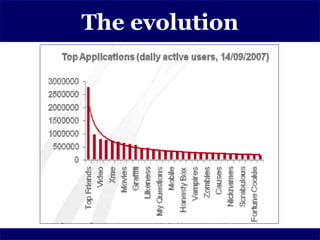
•3,900 applications exist as of Sept. 11,
2007, while Facebook itself only offers 13.
The evolution
The evolution


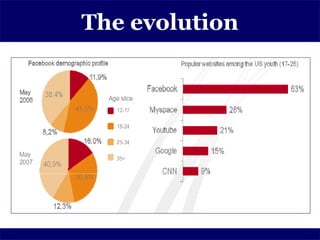
• Facebook is a favorite among students, but
half of Facebook users are now outside of
college.
The evolution
The evolution
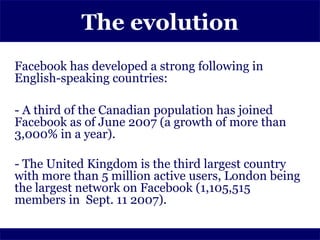
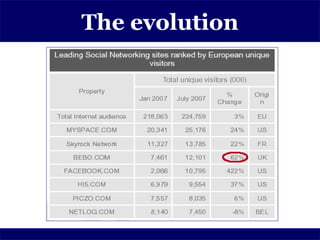
Facebook has developed a strong following in
English-speaking countries:

- A third of the Canadian population has joined
Facebook as of June 2007 (a growth of more than
3,000% in a year).

- The United Kingdom is the third largest country
with more than 5 million active users, London being
the largest network on Facebook (1,105,515
members in Sept. 11 2007).
The evolution
The evolution

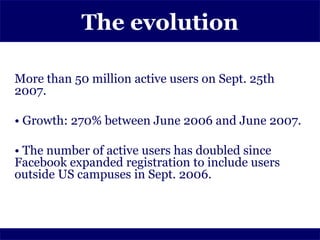
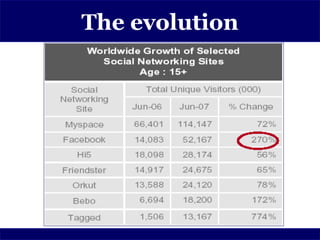
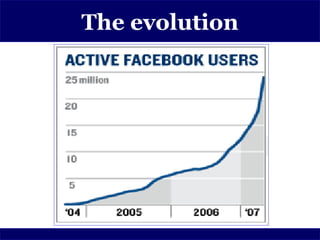
More than 50 million active users on Sept. 25th
2007.

• Growth: 270% between June 2006 and June 2007.

• The number of active users has doubled since
Facebook expanded registration to include users
outside US campuses in Sept. 2006.
The evolution
The evolution
Who’s using it?

Although some faculty and staff have profiles,
most Facebook users are students. Because social
networking sites constantly create connections
among users, the appeal is broad.

Jazz aficionados, women in science, aspiring
veterinarians and many others have built groups
of friends on Facebook. Others are starting to use
Facebook also.
Who’s using it?
At some institutions, following an incident such as
a party that got out of hand, campus police have
found information or photos on Facebook that
incriminate the students responsible.

Some employers look up students on Facebook to
get a fuller picture of the applicants.

In general, Facebook users can be segmented by
the usage they do:
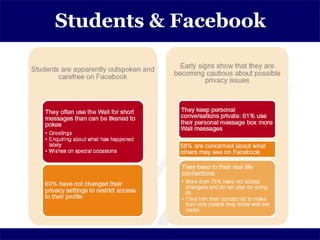
Students & Facebook
What students say about
       their addiction
“Sometimes I’ll sign-off Facebook and just stare at the login
screen like a cocaine addict looking at the edge of his coffee
table, thinking to myself, ‘Well, I’ve really got nothing
better to do right now,’ and then I sign right back on”.

“To tell you the truth, I am on it all the time…the first thing
I do the second I step in my [dorm] room is Facebook.
When I had to write my 10-page paper last night, I literally
checked it maybe every 15 minutes.”

“I was one of those people who thought, ‘What do I need
this for?’ but now it’s addictive. I check it at least twice a
day”
Why is Facebook so addictive?

“The unquenchable desire to see [their] list of friends
expand to outrageous proportions” (Whitall, 2005).

 - Keep in touch with old friends from Centre and other
 schools
 - Daily creation of new groups that fit people’s interests
 or amusement
 - See how many personal messages/wall posts you are
 getting from your friends
 - Viewing other people’s pictures & the new features
 Facebook continually adds.
 - Searching for new people who have recently joined
 whom you might know or want to meet
Why is Facebook so addictive?

• It’s the coolest thing to be doing right now.

• People are already on the internet (it’s like
checking your Messenger)

• Facebook.com has become our social law for
definitive information on our classmates, crushes
and high school peers we haven’t spoken to in
who-knows-how long” (Whitall, 2005).
Why is Facebook so addictive?

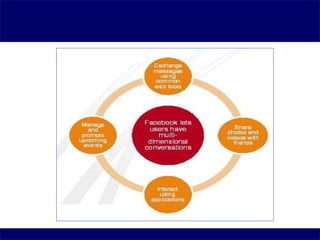
 • Facebook provides the means for a real
 conversation:

-The conversation is multi-media;

-The conversation is both verbal and non-verbal,
through dedications, gestures (pokes), and
emotions (gifts);

- It can be either instantaneous (chat) or
asynchronous (wall posts, messages);
Why is Facebook so addictive?

 • Facebook provides the means for a real
 conversation:

- The conversation takes place between real
personas (few hidden identities with avatars or
nicknames) and without outside intervention (no
moderation or censorship);

- It respects the users’ privacy if they so desire
(only 1 in 10 users changes his/her privacy
settings).
What are the downsides?


• Addiction
• Simulated interaction
• Stalking
• Advertisement of illegal and/or
inappropriate things
• Beyond Centre: The job search process
Some tips for you !!

• Tip 1: Do not spend more than 25 minutes a day on Facebook.

 – What ends up happening is you combine reality and “facebook
 reality”.


• Tip 2: Do not put any information that you don’t want
computer geeks to take advantage of.

 – Just by having your email address and a picture online makes the rest
 of your life pretty accessible to the entire school.

 – Don’t make it any easier by putting your phone number.
Some tips for you !!

• Tip 3: Refrain from updating your site too often.

 –People tend to notice this if the date changes every day, and all that
 means is that you’re spending too much time on the computer. Big social
 faut pas.


• Tip 4: Don’t create or join groups of which you wouldn’t be
proud to tell your mother you’re an “active” member.

 –Being a member of “Drink irresponsibly…or Don’t Drink at All” or “It’s
 cool to get wasted and not show up to class” isn’t going to help you out in
 the social ‘scene’, it’s just gross.
Some tips for you !!
• Tip 5: Don’t request friendship of people you don’t know.

 –If you want to be friends with someone, send them a message first.


• Tip 6: Don’t post messages on the walls of people you don’t
know.


• Tip 7: If you’re going to put a picture of yourself on Facebook,
make sure it’s the best one you can find.


• Tip 8: Don’t initiate (or respond to) chain mail. That went out
in the 7th grade.
Thank
you!!!

What is Facebook?

  • 1.
    Facebook Done by: Supervised by: AIT MOUSSA Hayat ALAOUI MDAGHRI Fatima Zahraâ M. BERRADA CHIHANI Mouna
  • 2.
    What is Facebook? •Facebook is a social networking site designed to connect users. • Sites such as MySpace and Friendster are similar, but Facebook is generally considered the leading social networking site among college students. • Facebook allows individuals to create profiles that include personal interests, affiliations, pictures, and virtually anything else a user wants to post.
  • 3.
    What is Facebook? •Information entered in a profile links that user to others who have posted similar information. • Other connections are more structured, based on user-created groups that typically have descriptive titles, such as “Feminists are fun!”.
  • 4.
    What is Facebook? •“The Facebook is an online directory that connects people through social networks at schools.” (Facebook.com) • “Part huge chat room, part diary, and part dating service, the Facebook site allows college students to post their photos and tell about about themselves – sometimes too much” (Messenger). • “A huge online yearbook”. • It is both a noun and a verb.
  • 5.
    A little ofHistory • Originally called thefacebook, Facebook was founded in February 2004 by former-Harvard student Mark Zuckerberg (while at Harvard) who ran it as one of his hobby projects. • Within months, Facebook and its core idea spread across the dorm rooms of Harvard where it was very well received.
  • 6.
    A little ofHistory • Soon enough, it was extended to Stanford and Yale where, like Harvard, it was widely endorsed. • It subsequently expanded to other Canadian colleges, then to European and Asian colleges. • Before he knew it, Mark Zuckerberg was joined by two other fellow Harvard-students - Dustin Moskovitz and Chris Hughes - to help him grow the site to the next level.
  • 7.
    A little ofHistory • Only months later when it was officially a national student network phenomenon, Zuckerberg and Moskovitz dropped out of Harvard to pursue their dreams and run Facebook full time. • In August 2005, thefacebook was officially called Facebook and the domain facebook.com was purchased for a reported $200,000.
  • 8.
    A little ofHistory • Since September 11, 2006, it has been available for any email address globally, but the interface was in English only. • On May 24, 2007, Facebook launched the Facebook Platform (f8) which provides a framework for developers (anyone) to create applications that interact with core Facebook features.
  • 9.
    A little ofHistory • In its early days, Facebook faced an extremely threatening lawsuit from ConnectU, a very similar social network which also shares its roots back to Harvard, and whose founders alleged that Mark Zuckerberg stole source code while he was in their employment. • As a result, it almost got shutdown. But Zuckerberg denied the allegation and the lawsuit was dismissed. • Facebook has also been host to other issues…
  • 10.
    What about Business& Funding? • Fall 2004: $500,000 from Peter Thiel (a co- founder of Paypal) • May 2005: $13 million from Accel Partners • April 2006: $25 million from Greylock Partners, Accel Partners, Meritech Capital Partners and Peter Thiel.
  • 11.
    What about Business& Funding? • Revenue model: - Display ads: accounts for most of its current revenue through an advertising outsourcing deal with Microsoft; - Sponsorship of groups: major potential source of future revenue ($300,000 for a 3 month presence, up 200% in June 2007 vs. February 2007), more than 150 companies are already present such as Nike, Victoria’s Secret, … - Gifts: limited edition gifts for sale at a low price ($1).
  • 12.
    What’s the facebookfor? Keep in touch with your old friends and meet new ones: - Private and public messaging options; - Keep tabs on what your friends do via their News feed; - Find former schoolmates using the search Feature; - User groups let you discuss with others who share your interests.
  • 13.
    What’s the facebookfor? Keep them informed about what you do: - Update your status; - Share your pictures, blog messages and videos; - Promote events you are organizing or planning to attend.
  • 14.
    What’s the facebookfor? Access a wealth of applications made for all purposes: - Fun, interactive applications; - Applications that let you publish content (photos, videos, notes,…); - Applications linked to other platforms.
  • 15.
    What’s the facebookfor? Retain your privacy: - Control what strangers and friends may see and read about you.
  • 16.
    Main features Facebook Profiles: Atypical Facebook profile consists of a number of different sections, including Information, Status, Friends, Friends in Other Networks, Photos, Notes, Groups, and The Wall. Most of the sections are self-explanatory but some are specific to Facebook.
  • 17.
    Main features Facebook Photos: Userscreate albums which they can assign limitations to (e.g. visible to my friends only) and upload photos within them. The album is then put into their profile, and other users have the ability to see and comment on them. Facebook also gives the feature to share the photos or send them with a simple web link. What’s more, users can also order prints online through a simple integrated interface.
  • 18.
    Main features Facebook Groups Userscan create new ones or join and participate in existing ones. This is also displayed in their profile and is a good indication of hobbies and interests a person might have. There are two kind of groups, a normal group and a secret group, which isn’t shown on the profile.
  • 19.
    Main features Facebook Events: AnotherFacebook success is their ‘events’ feature, which provides the ability to organize, be part of, and plan for events. This feature has been extremely successful when it comes to organizing parties. Along with organizing and joining events, users can also invite and recommend others to an event.
  • 20.
    Main features Facebook Developers: Asof August 2006, Facebook developped the offer called Facebook Developers. This essentially gives anyone access to Facebook’s internals and lets programmers create widgets, tools and projects based around Facebook.
  • 21.
    Main features Facebook Notes: Facebook’smost recent addition launched in late August. The service allows users to write a Facebook blog. All notes are displayed in the user’s profile, and other members can add comments. The service allows HTML to be included in the posts, although JavaScript and Flash are disabled.
  • 22.
    How can westart? • To create a profile, users—current students, alumni, faculty, or staff—must have an e-mail address in the domain of an institution that is affiliated with Facebook. • Once you establish an account, you can update it as often as you like, adding or changing information including pictures, favorites, and blog- type entries. • Users build networks of “friends,” people who have agreed to be added as friends to users’ profiles.
  • 23.
    How can westart? • You can browse profiles based on criteria such as age, relationship status, or major or search the database for people you already know and contact them through private messages or public notes on their profiles. • You can also send group announcements, such as a message about a political rally to all users at a particular institution who identify themselves as politically liberal.
  • 24.
    The evolution • Lessthan a month after its launch, the Facebook Platform had already attracted more than 40,000 developers, and produced more than 1,500 new applications. •3,900 applications exist as of Sept. 11, 2007, while Facebook itself only offers 13.
  • 25.
  • 26.
    The evolution • Facebookis a favorite among students, but half of Facebook users are now outside of college.
  • 27.
  • 28.
    The evolution Facebook hasdeveloped a strong following in English-speaking countries: - A third of the Canadian population has joined Facebook as of June 2007 (a growth of more than 3,000% in a year). - The United Kingdom is the third largest country with more than 5 million active users, London being the largest network on Facebook (1,105,515 members in Sept. 11 2007).
  • 29.
  • 30.
    The evolution More than50 million active users on Sept. 25th 2007. • Growth: 270% between June 2006 and June 2007. • The number of active users has doubled since Facebook expanded registration to include users outside US campuses in Sept. 2006.
  • 31.
  • 32.
  • 33.
    Who’s using it? Althoughsome faculty and staff have profiles, most Facebook users are students. Because social networking sites constantly create connections among users, the appeal is broad. Jazz aficionados, women in science, aspiring veterinarians and many others have built groups of friends on Facebook. Others are starting to use Facebook also.
  • 34.
    Who’s using it? Atsome institutions, following an incident such as a party that got out of hand, campus police have found information or photos on Facebook that incriminate the students responsible. Some employers look up students on Facebook to get a fuller picture of the applicants. In general, Facebook users can be segmented by the usage they do:
  • 35.
  • 36.
    What students sayabout their addiction “Sometimes I’ll sign-off Facebook and just stare at the login screen like a cocaine addict looking at the edge of his coffee table, thinking to myself, ‘Well, I’ve really got nothing better to do right now,’ and then I sign right back on”. “To tell you the truth, I am on it all the time…the first thing I do the second I step in my [dorm] room is Facebook. When I had to write my 10-page paper last night, I literally checked it maybe every 15 minutes.” “I was one of those people who thought, ‘What do I need this for?’ but now it’s addictive. I check it at least twice a day”
  • 37.
    Why is Facebookso addictive? “The unquenchable desire to see [their] list of friends expand to outrageous proportions” (Whitall, 2005). - Keep in touch with old friends from Centre and other schools - Daily creation of new groups that fit people’s interests or amusement - See how many personal messages/wall posts you are getting from your friends - Viewing other people’s pictures & the new features Facebook continually adds. - Searching for new people who have recently joined whom you might know or want to meet
  • 38.
    Why is Facebookso addictive? • It’s the coolest thing to be doing right now. • People are already on the internet (it’s like checking your Messenger) • Facebook.com has become our social law for definitive information on our classmates, crushes and high school peers we haven’t spoken to in who-knows-how long” (Whitall, 2005).
  • 40.
    Why is Facebookso addictive? • Facebook provides the means for a real conversation: -The conversation is multi-media; -The conversation is both verbal and non-verbal, through dedications, gestures (pokes), and emotions (gifts); - It can be either instantaneous (chat) or asynchronous (wall posts, messages);
  • 41.
    Why is Facebookso addictive? • Facebook provides the means for a real conversation: - The conversation takes place between real personas (few hidden identities with avatars or nicknames) and without outside intervention (no moderation or censorship); - It respects the users’ privacy if they so desire (only 1 in 10 users changes his/her privacy settings).
  • 43.
    What are thedownsides? • Addiction • Simulated interaction • Stalking • Advertisement of illegal and/or inappropriate things • Beyond Centre: The job search process
  • 44.
    Some tips foryou !! • Tip 1: Do not spend more than 25 minutes a day on Facebook. – What ends up happening is you combine reality and “facebook reality”. • Tip 2: Do not put any information that you don’t want computer geeks to take advantage of. – Just by having your email address and a picture online makes the rest of your life pretty accessible to the entire school. – Don’t make it any easier by putting your phone number.
  • 45.
    Some tips foryou !! • Tip 3: Refrain from updating your site too often. –People tend to notice this if the date changes every day, and all that means is that you’re spending too much time on the computer. Big social faut pas. • Tip 4: Don’t create or join groups of which you wouldn’t be proud to tell your mother you’re an “active” member. –Being a member of “Drink irresponsibly…or Don’t Drink at All” or “It’s cool to get wasted and not show up to class” isn’t going to help you out in the social ‘scene’, it’s just gross.
  • 46.
    Some tips foryou !! • Tip 5: Don’t request friendship of people you don’t know. –If you want to be friends with someone, send them a message first. • Tip 6: Don’t post messages on the walls of people you don’t know. • Tip 7: If you’re going to put a picture of yourself on Facebook, make sure it’s the best one you can find. • Tip 8: Don’t initiate (or respond to) chain mail. That went out in the 7th grade.
  • 47.