Export
Import
ALIGNED
DOCUMENTATION
SYSTEM
Import - Export
Policy of India
Why do we need export
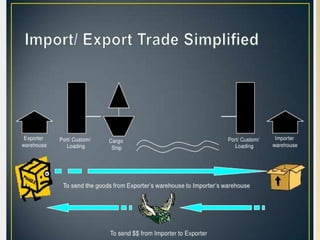
 Export means trade across the political boundaries
of different nation. No Nation is self sufficient and
had all the goods that it needs.
 This happens because of climatic variation &
unequal distribution of natural resources. As a result,
countries all over the world have become
interdependent, which necessitated foreign trade.
 A developing country like India with its fast growing
agricultural production to keep pace with the
population to keep pace with the population growth
and growing Industrial infrastructure needs high-
import and this can be sustained only with fast
export growth.

 To meet the oil import bill, export is unavoidable. Thus, it is
evident that export promotion continues to be a major
thrust area for the government. Several measures have
been under taken in the past for improving export
performance of the country.
 . In India, Govt. has come out from time to time with
various policies on foreign trade to promote export
thereby increasing the “Foreign Exchange Reserve”.
These policies are termed as “Exim Policy”
.
 Import export act was introduced by gov during
second world war and it lasted for around 45 yrs
and in June 1992 this act was superceded by the
Foreign Trade (Development & Regulation Act),
1992. . The basic objective of this new act was to
give effect to the new liberalized export and
import policy of the Govt. till 1985 annual policies
were made but from 1985-92, three yr policy was
made and then 5 yr policy was made coinciding
with 5 yr plans 1992-97, 1997-02, 2002-07.
Brief history
What is Exim Policy?
 It contains policies in the sphere of Foreign
trade i.e. with respect to import & export
from the country and more especially
export promotion measures, policies and
procedure related there to.
 Export means selling abroad and import
as bringing into India, any goods and
services
Objective of Exim Policy
 Accelerating the country’s transition to a globally
oriented vibrant economy with a view to derive
maximum benefits from expanding global market
opportunities;
 Stimulating sustained economic growth
 Enhancing the technological strength and efficiency
 Encouraging the attainment of internationally
accepted standards of quality
 Providing consumers with good quality products and
services at reasonable prices.
General provisions regarding export
import
Exports and Imports free unless regulated
Compliance with Laws
Interpretation of Policy
Procedure:
Exemption from Policy/ Procedure
Principles of Restriction
Restricted Goods
Terms and Conditions of a Licence
Importer-Exporter Code Number
Exemption from Bank Guarantee
Clearance of Goods from Customs
EXPORT PROMOTION MEASURES
 Policy measures
 Institutional set up.
 Import Facilitation for Export Production.
 Cash subsidies.
 Fiscal Incentives.
 Foreign Exchange Facilities.
 Export incentives
 Export production units
Export DocumentationExport Documentation
 The paperwork that is required for an export salesThe paperwork that is required for an export sales
transactiontransaction
 The means by which the shipping process isThe means by which the shipping process is
facilitated and recorded.facilitated and recorded.
 Documentation is essential for moving goodsDocumentation is essential for moving goods
through the channels of distribution, transferringthrough the channels of distribution, transferring
responsibility or possession, clearing goodsresponsibility or possession, clearing goods
through customs, and facilitating paymentthrough customs, and facilitating payment
according to the agreed upon terms.according to the agreed upon terms.
Standardised DocumentsStandardised Documents
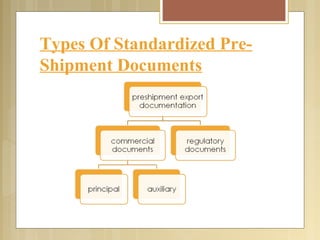
Types Of Standardized Pre-
Shipment Documents
New Standardised DocumentNew Standardised Document
Aligned Documentation SystemAligned Documentation System
 Meaning:
A methodology of creating information as a set of
standardized forms printed on paper of same size in
such a way that items of identical information occupy
the same position of each form.
Objectives of ADSObjectives of ADS
 To simplify, rationalize and prioritize information
 To achieve economy of time and effort involved in
the present methodology of export documentation.
 
Advantages Of ADSAdvantages Of ADS
 UniformityUniformity
 Generates many copiesGenerates many copies
 Ensures convenienceEnsures convenience
 Facilitates expeditious checkingFacilitates expeditious checking
 Easy to handleEasy to handle
Shipping DocumentsShipping Documents
 Commercial DocumentsCommercial Documents
 Regulatory DocumentsRegulatory Documents
Commercial DocumentsCommercial Documents
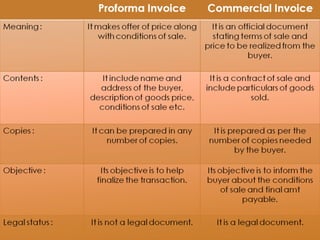
 Proforma InvoiceProforma Invoice
 Commercial InvoiceCommercial Invoice
 Packing ListPacking List
 Certificate Of OriginCertificate Of Origin
 Mate’s ReceiptMate’s Receipt
 Bill of LadingBill of Lading
 Bill Of ExchangeBill Of Exchange
Proforma InvoiceProforma Invoice
 Document that states a commitment from the sellerDocument that states a commitment from the seller
to sell goods to the buyer at specified prices andto sell goods to the buyer at specified prices and
termsterms
 Quote in an invoice formatQuote in an invoice format
 Usually issued by the exporting companyUsually issued by the exporting company
 Same information as the formal quotationSame information as the formal quotation
Contents in Proforma InvoiceContents in Proforma Invoice
 Description of itemDescription of item
 Type of currencyType of currency
 Terms of paymentTerms of payment
 Costs associated with freight and insuranceCosts associated with freight and insurance
 Buyers & sellers name & addressBuyers & sellers name & address
 Prices of items: per unit and extended totalsPrices of items: per unit and extended totals
 Weights and dimensions of quoted productsWeights and dimensions of quoted products
 Estimated shipping dateEstimated shipping date
Commercial InvoiceCommercial Invoice
 Document showing the value of goods exportedDocument showing the value of goods exported
 It includes:It includes:
- customs invoice- customs invoice
- legalized invoice- legalized invoice
- consular invoice- consular invoice
Customs Invoice: It is made on the
specific forms supplied by the
consular office of the respective
importer, duly filled and signed by
the shipper and serve the purpose
of making easy entry of the
merchandise into the importing
country usually at the preferential
tariff. 
 
 Consular Invoice
+ Issued by Usually by the Beneficiary and
countersigned by a Chamber of
Commerce and embassy or consulate of
the importing country residing in the
country of export.
+ Content: Describes details of goods and
price.
+ Purpose: For the records of the country
of import, and accordingly this document
may be required for clearance of goods
at the destination.
2. Legalized Invoice+ Issued by the
Beneficiary in terms similar to a
commercial invoice and in terms of the
Credit with the exception that the invoice
must evidence that it has been legalized
by the embassy of the county of import in
the country of export.
+ Content: As per commercial invoice
together with the legalization notation is
effected either by a notary and/or
embassy or consulate of the country of
import.
+ Purpose To satisfy the control authorities of
the country of import
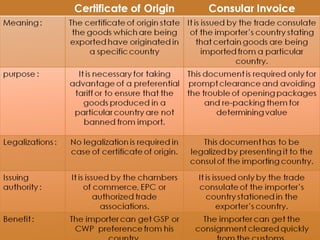
Certificate of origin v/s consular invoice
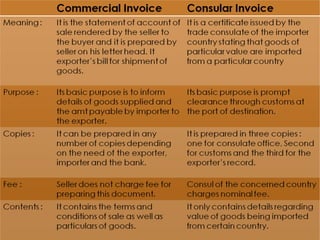
Commercial Invoice v/s Consular Invoice
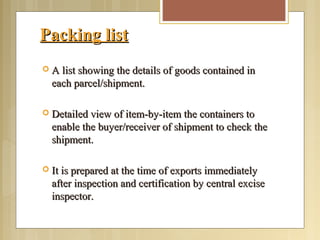
Packing listPacking list
 A list showing the details of goods contained inA list showing the details of goods contained in
each parcel/shipment.each parcel/shipment.
 Detailed view of item-by-item the containers toDetailed view of item-by-item the containers to
enable the buyer/receiver of shipment to check theenable the buyer/receiver of shipment to check the
shipment.shipment.
 It is prepared at the time of exports immediatelyIt is prepared at the time of exports immediately
after inspection and certification by central exciseafter inspection and certification by central excise
inspector.inspector.
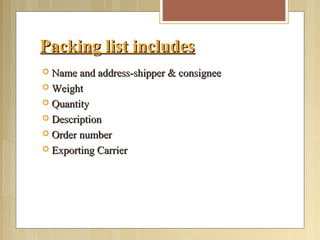
Packing list includesPacking list includes
 Name and address-shipper & consigneeName and address-shipper & consignee
 WeightWeight
 QuantityQuantity
 DescriptionDescription
 Order numberOrder number
 Exporting CarrierExporting Carrier
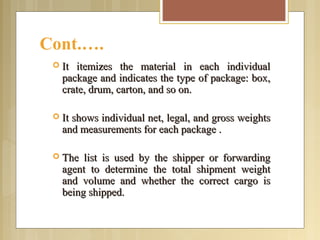
Cont.….
 It itemizes the material in each individualIt itemizes the material in each individual
package and indicates the type of package: box,package and indicates the type of package: box,
crate, drum, carton, and so on.crate, drum, carton, and so on.
 It shows individual net, legal, and gross weightsIt shows individual net, legal, and gross weights
and measurements for each package .and measurements for each package .
 The list is used by the shipper or forwardingThe list is used by the shipper or forwarding
agent to determine the total shipment weightagent to determine the total shipment weight
and volume and whether the correct cargo isand volume and whether the correct cargo is
being shipped.being shipped.
Presented to…Presented to…
 Excise inspectorExcise inspector
 CustomsCustoms
 Duty drawback cell of customsDuty drawback cell of customs
Certificate of originCertificate of origin
 It traditionally states from what country theIt traditionally states from what country the
shipped goodsshipped goods originateoriginate..
 It is require to claim preferential tariffs.It is require to claim preferential tariffs.
 Helps prove that the product is allowed into thatHelps prove that the product is allowed into that
particular country.particular country.
Issued byIssued by
 Chamber of commerceChamber of commerce
 Export promotion council(EPC)Export promotion council(EPC)
 Commodity boardsCommodity boards
Captain’s/Mate receiptCaptain’s/Mate receipt
 Temporary receipt issued for goods, which have beenTemporary receipt issued for goods, which have been
delivered to the vessel.delivered to the vessel.
 Acknowledgement that the ship owner has received theAcknowledgement that the ship owner has received the
goods in the condition stated.goods in the condition stated.
 Preliminary document only, which is later given up inPreliminary document only, which is later given up in
return for the bill of lading.return for the bill of lading.
 When the Chief Officer signs the receipt for goods he isWhen the Chief Officer signs the receipt for goods he is
personally liable for any deficiency in the number provedpersonally liable for any deficiency in the number proved
to exist on discharge of the good.to exist on discharge of the good.
ContCont.….
 Mate's Receipts should be issued on ship's forms andMate's Receipts should be issued on ship's forms and
numbered.numbered.
 The number in dispute should clearly be stated inThe number in dispute should clearly be stated in
words on the receipt which there is agreement beingwords on the receipt which there is agreement being
separately shown .separately shown .
 Mate's receipts should be endorsed "at shipper's riskMate's receipts should be endorsed "at shipper's risk
until actually shipped.until actually shipped.
ContentContent
 Name of the shipperName of the shipper
 Place of receiptPlace of receipt
 Voyage NumberVoyage Number
 Port of LoadingPort of Loading
 Port of DischargePort of Discharge
 Place of DeliveryPlace of Delivery
 Container NumberContainer Number
 Description of GoodsDescription of Goods
 Gross WeightGross Weight
Bill of LadingBill of Lading
 A document issued by a carrier or by a shipper's agentA document issued by a carrier or by a shipper's agent
that identifies the goods received for shipment, wherethat identifies the goods received for shipment, where
the goods are to be delivered, and who is entitled tothe goods are to be delivered, and who is entitled to
receive the shipment.receive the shipment.
 It is evidence that a valid contract of carriage exists,It is evidence that a valid contract of carriage exists,
and it may incorporate the full terms of the contractand it may incorporate the full terms of the contract
between the consignor and the carrier by reference .between the consignor and the carrier by reference .
Types of bills of ladingTypes of bills of lading
1. Straight Bill of Lading: This is typically used when shipping to a
customer. The "Straight Bill of Lading" is for shipping items that
have already been paid for.
 
2. To Order Bill of Lading: Used for shipments when payment is
not made in advance. This can be shipping to one of your
distributors or a customer on terms.
3. Clean Bill of Lading: A Clean Bill of Lading is simply a BOL that
the shipping carrier has to sign off on saying that when the
packages were loaded they were in good condition. If the
packages are damaged or the cargo is marred in some way
(rusted metal, stained paper, etc.), they will need to issue a
"Soiled Bill of Lading" or a "Foul Bill of Lading."
 
4. Inland Bill of Lading: This allows the shipping carrier to ship
cargo, by road or rail, across domestic land, but not over
seas.
5. Stale Bill of Lading: Occasionally in cases of short-over-seas
cargo transportation, the cargo arrives to port before the Bill of
Lading. When that happens, the Bill of Lading is then "stale."
6. Through Bill of Lading: Through Bills of Lading are a little more
complex than most BOLs. It allows for the shipping carrier to
pass the cargo through several different modes of
transportation and/or several different distribution centers. This
Bill of Lading needs to include an Inland Bill of Lading and/or
an Ocean Bill of Lading depending on its final destination.
7. Multimodal/Combined Transport Bill of Lading: This is a type of
Through Bill of Lading that involves a minimum of two different
modes of transport, land or ocean. The modes of
transportation can be anything from freight boat to air.
 
ContentContent
 Name of the shipping companyName of the shipping company
 Shipper's nameShipper's name
 Order and notify partyOrder and notify party
 Description of GoodsDescription of Goods
 Gross/net/tare weightGross/net/tare weight
 Freight rate/Measurements and weight ofFreight rate/Measurements and weight of
goods/Total freightgoods/Total freight
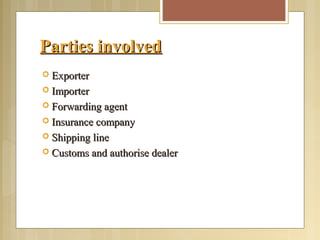
Parties involvedParties involved
 ExporterExporter
 ImporterImporter
 Forwarding agentForwarding agent
 Insurance companyInsurance company
 Shipping lineShipping line
 Customs and authorise dealerCustoms and authorise dealer
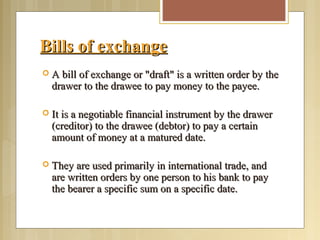
Bills of exchangeBills of exchange
 A bill of exchange or "draft" is a written order by theA bill of exchange or "draft" is a written order by the
drawer to the drawee to pay money to the payee.drawer to the drawee to pay money to the payee.
 It is a negotiable financial instrument by the drawerIt is a negotiable financial instrument by the drawer
(creditor) to the drawee (debtor) to pay a certain(creditor) to the drawee (debtor) to pay a certain
amount of money at a matured date.amount of money at a matured date.
 They are used primarily in international trade, andThey are used primarily in international trade, and
are written orders by one person to his bank to payare written orders by one person to his bank to pay
the bearer a specific sum on a specific date.the bearer a specific sum on a specific date.
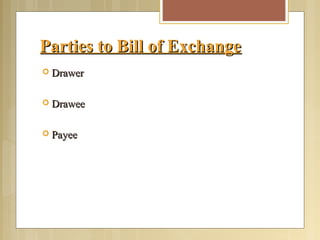
Parties to Bill of ExchangeParties to Bill of Exchange
 DrawerDrawer
 DraweeDrawee
 PayeePayee
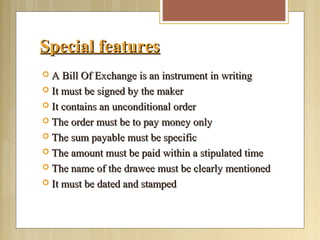
Special featuresSpecial features
 A Bill Of Exchange is an instrument in writingA Bill Of Exchange is an instrument in writing
 It must be signed by the makerIt must be signed by the maker
 It contains an unconditional orderIt contains an unconditional order
 The order must be to pay money onlyThe order must be to pay money only
 The sum payable must be specificThe sum payable must be specific
 The amount must be paid within a stipulated timeThe amount must be paid within a stipulated time
 The name of the drawee must be clearly mentionedThe name of the drawee must be clearly mentioned
 It must be dated and stampedIt must be dated and stamped
AdvantagesAdvantages
 A Bill of Exchange is used in settlement of debtsA Bill of Exchange is used in settlement of debts
 It fixes the date of paymentIt fixes the date of payment
 It is a written and signed acknowledgement of debtIt is a written and signed acknowledgement of debt
 A debtor enjoys full period of creditA debtor enjoys full period of credit
 A drawer can convert the bill into cash by getting itA drawer can convert the bill into cash by getting it
discounted with the bankdiscounted with the bank
Regulatory DocumentsRegulatory Documents
 Freight Payment CertificateFreight Payment Certificate
 Vehicle TicketVehicle Ticket
 Receipt for payment of Port ChargesReceipt for payment of Port Charges
 Shipping BillShipping Bill
Shipping billShipping bill
 The Shipping Bill/ Bill of Export are the mainThe Shipping Bill/ Bill of Export are the main
document required by the Customs Authority fordocument required by the Customs Authority for
allowing shipment for all products exportedallowing shipment for all products exported
 It is a document prescribed under custom act 1962It is a document prescribed under custom act 1962
for allowing shipment of cargo by customs authorityfor allowing shipment of cargo by customs authority
 It is prepared by custom house agentIt is prepared by custom house agent
Parties involvedParties involved
 ExporterExporter
 ImporterImporter
 Central exciseCentral excise
 Forwarding agentForwarding agent
 Insurance companyInsurance company
 Customs departmentCustoms department
 Inspection agencyInspection agency
Documents requiredDocuments required
 GR forms (in duplicate) for shipment to all theGR forms (in duplicate) for shipment to all the
countries.countries.
 Four copies of the packing list mentioning the contents,Four copies of the packing list mentioning the contents,
quantity, gross and net weight of each packagequantity, gross and net weight of each package
 Four copies of invoices which contains all relevantFour copies of invoices which contains all relevant
particulars like number of packages, quantity, unit rate,particulars like number of packages, quantity, unit rate,
total f.o.b./ c.i.f. value, correct & full description oftotal f.o.b./ c.i.f. value, correct & full description of
goods.goods.
 L/C, Purchase Order of the overseas buyer.L/C, Purchase Order of the overseas buyer.
 AR4 (both original and duplicate) and invoice.AR4 (both original and duplicate) and invoice.
 Inspection/ Examination Certificate.Inspection/ Examination Certificate.
ContentsContents
 Name and address of exporter and consigneeName and address of exporter and consignee
 Port of shipmentPort of shipment
 Country of destinationCountry of destination
 No.of packagesNo.of packages
 Nature of contractNature of contract
 Description of goodsDescription of goods
Types of shipping billTypes of shipping bill
 Duty free goods shipping billDuty free goods shipping bill
 Dutiable goods shipping billDutiable goods shipping bill
 Drawback shipping billDrawback shipping bill
 Entitlement of credit of duty under DEPB schemeEntitlement of credit of duty under DEPB scheme
 Shipping bill for shipment of excise bondShipping bill for shipment of excise bond
FormatsFormats
 White Shipping Bill in triplicate for export of duty free ofWhite Shipping Bill in triplicate for export of duty free of
goods.goods.
 Green Shipping Bill in quadruplicate for the export ofGreen Shipping Bill in quadruplicate for the export of
goods which are under claim for duty drawbackgoods which are under claim for duty drawback
 Yellow Shipping Bill in triplicate for the export ofYellow Shipping Bill in triplicate for the export of
dutiable goods,dutiable goods,
 Blue Shipping Bill in 7 copies for exports under theBlue Shipping Bill in 7 copies for exports under the
DEPB schemeDEPB scheme
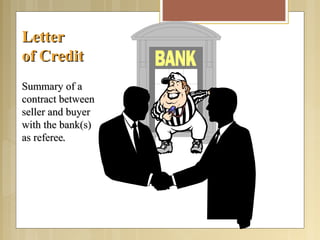
LetterLetter
of Creditof Credit
Summary of aSummary of a
contract betweencontract between
seller and buyerseller and buyer
with the bank(s)with the bank(s)
as refereeas referee..
Cont..….Cont..….
 A letter of credit is a commercial instrument used asA letter of credit is a commercial instrument used as
a means of financing international businessa means of financing international business
transaction.transaction.
 It is a contract under which a bank agrees to pay theIt is a contract under which a bank agrees to pay the
seller in connection with the export of specific goodsseller in connection with the export of specific goods
against the presentation of specified documentsagainst the presentation of specified documents
relating to those goods.relating to those goods.
 The credit is issued at the request of the buyer (theThe credit is issued at the request of the buyer (the
applicant) in favour of the seller (the beneficiary)”.applicant) in favour of the seller (the beneficiary)”.
Parties to an L/CParties to an L/C
The buyer (the applicant).The buyer (the applicant).
The issuing bank.The issuing bank.
The advising bank (may also be the correspondent,The advising bank (may also be the correspondent,
nominated, confirming bank).nominated, confirming bank).
The seller (the beneficiaryThe seller (the beneficiary).
Types of L/CTypes of L/C
 Revocable L/CRevocable L/C
 Irrevocable L/CIrrevocable L/C
 Confirmed L/CConfirmed L/C
 Transferable L/CTransferable L/C
 Back to back L/CBack to back L/C
 Revolving L/CRevolving L/C
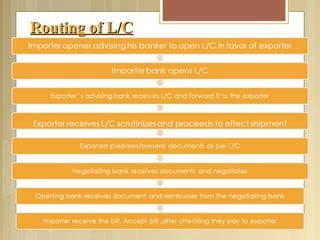
Routing of L/CRouting of L/C
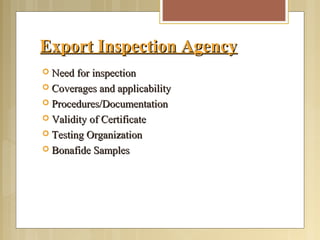
Export Inspection AgencyExport Inspection Agency
 Need for inspectionNeed for inspection
 Coverages and applicabilityCoverages and applicability
 Procedures/DocumentationProcedures/Documentation
 Validity of CertificateValidity of Certificate
 Testing OrganizationTesting Organization
 Bonafide SamplesBonafide Samples
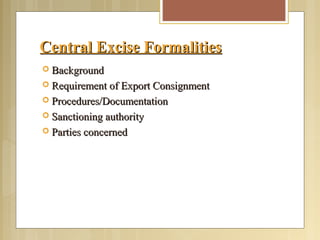
Central Excise FormalitiesCentral Excise Formalities
 BackgroundBackground
 Requirement of Export ConsignmentRequirement of Export Consignment
 Procedures/DocumentationProcedures/Documentation
 Sanctioning authoritySanctioning authority
 Parties concernedParties concerned
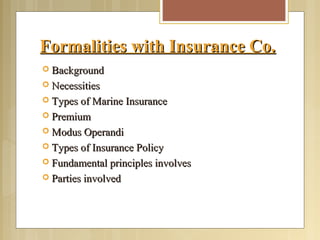
Formalities with Insurance Co.Formalities with Insurance Co.
 BackgroundBackground
 NecessitiesNecessities
 Types of Marine InsuranceTypes of Marine Insurance
 PremiumPremium
 Modus OperandiModus Operandi
 Types of Insurance PolicyTypes of Insurance Policy
 Fundamental principles involvesFundamental principles involves
 Parties involvedParties involved
Export - Import Steps & Documents

Export - Import Steps & Documents

  • 1.
  • 3.
  • 4.
    Why do weneed export  Export means trade across the political boundaries of different nation. No Nation is self sufficient and had all the goods that it needs.  This happens because of climatic variation & unequal distribution of natural resources. As a result, countries all over the world have become interdependent, which necessitated foreign trade.  A developing country like India with its fast growing agricultural production to keep pace with the population to keep pace with the population growth and growing Industrial infrastructure needs high- import and this can be sustained only with fast export growth. 
  • 5.
     To meetthe oil import bill, export is unavoidable. Thus, it is evident that export promotion continues to be a major thrust area for the government. Several measures have been under taken in the past for improving export performance of the country.  . In India, Govt. has come out from time to time with various policies on foreign trade to promote export thereby increasing the “Foreign Exchange Reserve”. These policies are termed as “Exim Policy”
  • 6.
    .  Import exportact was introduced by gov during second world war and it lasted for around 45 yrs and in June 1992 this act was superceded by the Foreign Trade (Development & Regulation Act), 1992. . The basic objective of this new act was to give effect to the new liberalized export and import policy of the Govt. till 1985 annual policies were made but from 1985-92, three yr policy was made and then 5 yr policy was made coinciding with 5 yr plans 1992-97, 1997-02, 2002-07. Brief history
  • 7.
    What is EximPolicy?  It contains policies in the sphere of Foreign trade i.e. with respect to import & export from the country and more especially export promotion measures, policies and procedure related there to.  Export means selling abroad and import as bringing into India, any goods and services
  • 8.
    Objective of EximPolicy  Accelerating the country’s transition to a globally oriented vibrant economy with a view to derive maximum benefits from expanding global market opportunities;  Stimulating sustained economic growth  Enhancing the technological strength and efficiency  Encouraging the attainment of internationally accepted standards of quality  Providing consumers with good quality products and services at reasonable prices.
  • 9.
    General provisions regardingexport import Exports and Imports free unless regulated Compliance with Laws Interpretation of Policy Procedure: Exemption from Policy/ Procedure Principles of Restriction Restricted Goods Terms and Conditions of a Licence Importer-Exporter Code Number Exemption from Bank Guarantee Clearance of Goods from Customs
  • 10.
    EXPORT PROMOTION MEASURES Policy measures  Institutional set up.  Import Facilitation for Export Production.  Cash subsidies.  Fiscal Incentives.  Foreign Exchange Facilities.  Export incentives  Export production units
  • 11.
    Export DocumentationExport Documentation The paperwork that is required for an export salesThe paperwork that is required for an export sales transactiontransaction  The means by which the shipping process isThe means by which the shipping process is facilitated and recorded.facilitated and recorded.  Documentation is essential for moving goodsDocumentation is essential for moving goods through the channels of distribution, transferringthrough the channels of distribution, transferring responsibility or possession, clearing goodsresponsibility or possession, clearing goods through customs, and facilitating paymentthrough customs, and facilitating payment according to the agreed upon terms.according to the agreed upon terms.
  • 12.
  • 13.
    Types Of StandardizedPre- Shipment Documents
  • 14.
    New Standardised DocumentNewStandardised Document
  • 15.
    Aligned Documentation SystemAlignedDocumentation System  Meaning: A methodology of creating information as a set of standardized forms printed on paper of same size in such a way that items of identical information occupy the same position of each form.
  • 16.
    Objectives of ADSObjectivesof ADS  To simplify, rationalize and prioritize information  To achieve economy of time and effort involved in the present methodology of export documentation.  
  • 17.
    Advantages Of ADSAdvantagesOf ADS  UniformityUniformity  Generates many copiesGenerates many copies  Ensures convenienceEnsures convenience  Facilitates expeditious checkingFacilitates expeditious checking  Easy to handleEasy to handle
  • 18.
    Shipping DocumentsShipping Documents Commercial DocumentsCommercial Documents  Regulatory DocumentsRegulatory Documents
  • 19.
    Commercial DocumentsCommercial Documents Proforma InvoiceProforma Invoice  Commercial InvoiceCommercial Invoice  Packing ListPacking List  Certificate Of OriginCertificate Of Origin  Mate’s ReceiptMate’s Receipt  Bill of LadingBill of Lading  Bill Of ExchangeBill Of Exchange
  • 20.
    Proforma InvoiceProforma Invoice Document that states a commitment from the sellerDocument that states a commitment from the seller to sell goods to the buyer at specified prices andto sell goods to the buyer at specified prices and termsterms  Quote in an invoice formatQuote in an invoice format  Usually issued by the exporting companyUsually issued by the exporting company  Same information as the formal quotationSame information as the formal quotation
  • 21.
    Contents in ProformaInvoiceContents in Proforma Invoice  Description of itemDescription of item  Type of currencyType of currency  Terms of paymentTerms of payment  Costs associated with freight and insuranceCosts associated with freight and insurance  Buyers & sellers name & addressBuyers & sellers name & address  Prices of items: per unit and extended totalsPrices of items: per unit and extended totals  Weights and dimensions of quoted productsWeights and dimensions of quoted products  Estimated shipping dateEstimated shipping date
  • 22.
    Commercial InvoiceCommercial Invoice Document showing the value of goods exportedDocument showing the value of goods exported  It includes:It includes: - customs invoice- customs invoice - legalized invoice- legalized invoice - consular invoice- consular invoice
  • 23.
    Customs Invoice: Itis made on the specific forms supplied by the consular office of the respective importer, duly filled and signed by the shipper and serve the purpose of making easy entry of the merchandise into the importing country usually at the preferential tariff. 
  • 24.
       Consular Invoice +Issued by Usually by the Beneficiary and countersigned by a Chamber of Commerce and embassy or consulate of the importing country residing in the country of export. + Content: Describes details of goods and price. + Purpose: For the records of the country of import, and accordingly this document may be required for clearance of goods at the destination.
  • 25.
    2. Legalized Invoice+ Issuedby the Beneficiary in terms similar to a commercial invoice and in terms of the Credit with the exception that the invoice must evidence that it has been legalized by the embassy of the county of import in the country of export. + Content: As per commercial invoice together with the legalization notation is effected either by a notary and/or embassy or consulate of the country of import. + Purpose To satisfy the control authorities of the country of import
  • 27.
    Certificate of originv/s consular invoice
  • 28.
    Commercial Invoice v/sConsular Invoice
  • 29.
    Packing listPacking list A list showing the details of goods contained inA list showing the details of goods contained in each parcel/shipment.each parcel/shipment.  Detailed view of item-by-item the containers toDetailed view of item-by-item the containers to enable the buyer/receiver of shipment to check theenable the buyer/receiver of shipment to check the shipment.shipment.  It is prepared at the time of exports immediatelyIt is prepared at the time of exports immediately after inspection and certification by central exciseafter inspection and certification by central excise inspector.inspector.
  • 30.
    Packing list includesPackinglist includes  Name and address-shipper & consigneeName and address-shipper & consignee  WeightWeight  QuantityQuantity  DescriptionDescription  Order numberOrder number  Exporting CarrierExporting Carrier
  • 31.
    Cont.….  It itemizesthe material in each individualIt itemizes the material in each individual package and indicates the type of package: box,package and indicates the type of package: box, crate, drum, carton, and so on.crate, drum, carton, and so on.  It shows individual net, legal, and gross weightsIt shows individual net, legal, and gross weights and measurements for each package .and measurements for each package .  The list is used by the shipper or forwardingThe list is used by the shipper or forwarding agent to determine the total shipment weightagent to determine the total shipment weight and volume and whether the correct cargo isand volume and whether the correct cargo is being shipped.being shipped.
  • 32.
    Presented to…Presented to… Excise inspectorExcise inspector  CustomsCustoms  Duty drawback cell of customsDuty drawback cell of customs
  • 33.
    Certificate of originCertificateof origin  It traditionally states from what country theIt traditionally states from what country the shipped goodsshipped goods originateoriginate..  It is require to claim preferential tariffs.It is require to claim preferential tariffs.  Helps prove that the product is allowed into thatHelps prove that the product is allowed into that particular country.particular country.
  • 34.
    Issued byIssued by Chamber of commerceChamber of commerce  Export promotion council(EPC)Export promotion council(EPC)  Commodity boardsCommodity boards
  • 35.
    Captain’s/Mate receiptCaptain’s/Mate receipt Temporary receipt issued for goods, which have beenTemporary receipt issued for goods, which have been delivered to the vessel.delivered to the vessel.  Acknowledgement that the ship owner has received theAcknowledgement that the ship owner has received the goods in the condition stated.goods in the condition stated.  Preliminary document only, which is later given up inPreliminary document only, which is later given up in return for the bill of lading.return for the bill of lading.  When the Chief Officer signs the receipt for goods he isWhen the Chief Officer signs the receipt for goods he is personally liable for any deficiency in the number provedpersonally liable for any deficiency in the number proved to exist on discharge of the good.to exist on discharge of the good.
  • 36.
    ContCont.….  Mate's Receiptsshould be issued on ship's forms andMate's Receipts should be issued on ship's forms and numbered.numbered.  The number in dispute should clearly be stated inThe number in dispute should clearly be stated in words on the receipt which there is agreement beingwords on the receipt which there is agreement being separately shown .separately shown .  Mate's receipts should be endorsed "at shipper's riskMate's receipts should be endorsed "at shipper's risk until actually shipped.until actually shipped.
  • 37.
    ContentContent  Name ofthe shipperName of the shipper  Place of receiptPlace of receipt  Voyage NumberVoyage Number  Port of LoadingPort of Loading  Port of DischargePort of Discharge  Place of DeliveryPlace of Delivery  Container NumberContainer Number  Description of GoodsDescription of Goods  Gross WeightGross Weight
  • 38.
    Bill of LadingBillof Lading  A document issued by a carrier or by a shipper's agentA document issued by a carrier or by a shipper's agent that identifies the goods received for shipment, wherethat identifies the goods received for shipment, where the goods are to be delivered, and who is entitled tothe goods are to be delivered, and who is entitled to receive the shipment.receive the shipment.  It is evidence that a valid contract of carriage exists,It is evidence that a valid contract of carriage exists, and it may incorporate the full terms of the contractand it may incorporate the full terms of the contract between the consignor and the carrier by reference .between the consignor and the carrier by reference .
  • 39.
    Types of billsof ladingTypes of bills of lading 1. Straight Bill of Lading: This is typically used when shipping to a customer. The "Straight Bill of Lading" is for shipping items that have already been paid for.   2. To Order Bill of Lading: Used for shipments when payment is not made in advance. This can be shipping to one of your distributors or a customer on terms. 3. Clean Bill of Lading: A Clean Bill of Lading is simply a BOL that the shipping carrier has to sign off on saying that when the packages were loaded they were in good condition. If the packages are damaged or the cargo is marred in some way (rusted metal, stained paper, etc.), they will need to issue a "Soiled Bill of Lading" or a "Foul Bill of Lading."  
  • 40.
    4. Inland Bill ofLading: This allows the shipping carrier to ship cargo, by road or rail, across domestic land, but not over seas. 5. Stale Bill of Lading: Occasionally in cases of short-over-seas cargo transportation, the cargo arrives to port before the Bill of Lading. When that happens, the Bill of Lading is then "stale." 6. Through Bill of Lading: Through Bills of Lading are a little more complex than most BOLs. It allows for the shipping carrier to pass the cargo through several different modes of transportation and/or several different distribution centers. This Bill of Lading needs to include an Inland Bill of Lading and/or an Ocean Bill of Lading depending on its final destination. 7. Multimodal/Combined Transport Bill of Lading: This is a type of Through Bill of Lading that involves a minimum of two different modes of transport, land or ocean. The modes of transportation can be anything from freight boat to air.  
  • 41.
    ContentContent  Name ofthe shipping companyName of the shipping company  Shipper's nameShipper's name  Order and notify partyOrder and notify party  Description of GoodsDescription of Goods  Gross/net/tare weightGross/net/tare weight  Freight rate/Measurements and weight ofFreight rate/Measurements and weight of goods/Total freightgoods/Total freight
  • 42.
    Parties involvedParties involved ExporterExporter  ImporterImporter  Forwarding agentForwarding agent  Insurance companyInsurance company  Shipping lineShipping line  Customs and authorise dealerCustoms and authorise dealer
  • 43.
    Bills of exchangeBillsof exchange  A bill of exchange or "draft" is a written order by theA bill of exchange or "draft" is a written order by the drawer to the drawee to pay money to the payee.drawer to the drawee to pay money to the payee.  It is a negotiable financial instrument by the drawerIt is a negotiable financial instrument by the drawer (creditor) to the drawee (debtor) to pay a certain(creditor) to the drawee (debtor) to pay a certain amount of money at a matured date.amount of money at a matured date.  They are used primarily in international trade, andThey are used primarily in international trade, and are written orders by one person to his bank to payare written orders by one person to his bank to pay the bearer a specific sum on a specific date.the bearer a specific sum on a specific date.
  • 44.
    Parties to Billof ExchangeParties to Bill of Exchange  DrawerDrawer  DraweeDrawee  PayeePayee
  • 45.
    Special featuresSpecial features A Bill Of Exchange is an instrument in writingA Bill Of Exchange is an instrument in writing  It must be signed by the makerIt must be signed by the maker  It contains an unconditional orderIt contains an unconditional order  The order must be to pay money onlyThe order must be to pay money only  The sum payable must be specificThe sum payable must be specific  The amount must be paid within a stipulated timeThe amount must be paid within a stipulated time  The name of the drawee must be clearly mentionedThe name of the drawee must be clearly mentioned  It must be dated and stampedIt must be dated and stamped
  • 46.
    AdvantagesAdvantages  A Billof Exchange is used in settlement of debtsA Bill of Exchange is used in settlement of debts  It fixes the date of paymentIt fixes the date of payment  It is a written and signed acknowledgement of debtIt is a written and signed acknowledgement of debt  A debtor enjoys full period of creditA debtor enjoys full period of credit  A drawer can convert the bill into cash by getting itA drawer can convert the bill into cash by getting it discounted with the bankdiscounted with the bank
  • 47.
    Regulatory DocumentsRegulatory Documents Freight Payment CertificateFreight Payment Certificate  Vehicle TicketVehicle Ticket  Receipt for payment of Port ChargesReceipt for payment of Port Charges  Shipping BillShipping Bill
  • 48.
    Shipping billShipping bill The Shipping Bill/ Bill of Export are the mainThe Shipping Bill/ Bill of Export are the main document required by the Customs Authority fordocument required by the Customs Authority for allowing shipment for all products exportedallowing shipment for all products exported  It is a document prescribed under custom act 1962It is a document prescribed under custom act 1962 for allowing shipment of cargo by customs authorityfor allowing shipment of cargo by customs authority  It is prepared by custom house agentIt is prepared by custom house agent
  • 49.
    Parties involvedParties involved ExporterExporter  ImporterImporter  Central exciseCentral excise  Forwarding agentForwarding agent  Insurance companyInsurance company  Customs departmentCustoms department  Inspection agencyInspection agency
  • 50.
    Documents requiredDocuments required GR forms (in duplicate) for shipment to all theGR forms (in duplicate) for shipment to all the countries.countries.  Four copies of the packing list mentioning the contents,Four copies of the packing list mentioning the contents, quantity, gross and net weight of each packagequantity, gross and net weight of each package  Four copies of invoices which contains all relevantFour copies of invoices which contains all relevant particulars like number of packages, quantity, unit rate,particulars like number of packages, quantity, unit rate, total f.o.b./ c.i.f. value, correct & full description oftotal f.o.b./ c.i.f. value, correct & full description of goods.goods.  L/C, Purchase Order of the overseas buyer.L/C, Purchase Order of the overseas buyer.  AR4 (both original and duplicate) and invoice.AR4 (both original and duplicate) and invoice.  Inspection/ Examination Certificate.Inspection/ Examination Certificate.
  • 51.
    ContentsContents  Name andaddress of exporter and consigneeName and address of exporter and consignee  Port of shipmentPort of shipment  Country of destinationCountry of destination  No.of packagesNo.of packages  Nature of contractNature of contract  Description of goodsDescription of goods
  • 52.
    Types of shippingbillTypes of shipping bill  Duty free goods shipping billDuty free goods shipping bill  Dutiable goods shipping billDutiable goods shipping bill  Drawback shipping billDrawback shipping bill  Entitlement of credit of duty under DEPB schemeEntitlement of credit of duty under DEPB scheme  Shipping bill for shipment of excise bondShipping bill for shipment of excise bond
  • 53.
    FormatsFormats  White ShippingBill in triplicate for export of duty free ofWhite Shipping Bill in triplicate for export of duty free of goods.goods.  Green Shipping Bill in quadruplicate for the export ofGreen Shipping Bill in quadruplicate for the export of goods which are under claim for duty drawbackgoods which are under claim for duty drawback  Yellow Shipping Bill in triplicate for the export ofYellow Shipping Bill in triplicate for the export of dutiable goods,dutiable goods,  Blue Shipping Bill in 7 copies for exports under theBlue Shipping Bill in 7 copies for exports under the DEPB schemeDEPB scheme
  • 54.
    LetterLetter of Creditof Credit Summaryof aSummary of a contract betweencontract between seller and buyerseller and buyer with the bank(s)with the bank(s) as refereeas referee..
  • 55.
    Cont..….Cont..….  A letterof credit is a commercial instrument used asA letter of credit is a commercial instrument used as a means of financing international businessa means of financing international business transaction.transaction.  It is a contract under which a bank agrees to pay theIt is a contract under which a bank agrees to pay the seller in connection with the export of specific goodsseller in connection with the export of specific goods against the presentation of specified documentsagainst the presentation of specified documents relating to those goods.relating to those goods.  The credit is issued at the request of the buyer (theThe credit is issued at the request of the buyer (the applicant) in favour of the seller (the beneficiary)”.applicant) in favour of the seller (the beneficiary)”.
  • 56.
    Parties to anL/CParties to an L/C The buyer (the applicant).The buyer (the applicant). The issuing bank.The issuing bank. The advising bank (may also be the correspondent,The advising bank (may also be the correspondent, nominated, confirming bank).nominated, confirming bank). The seller (the beneficiaryThe seller (the beneficiary).
  • 57.
    Types of L/CTypesof L/C  Revocable L/CRevocable L/C  Irrevocable L/CIrrevocable L/C  Confirmed L/CConfirmed L/C  Transferable L/CTransferable L/C  Back to back L/CBack to back L/C  Revolving L/CRevolving L/C
  • 58.
  • 59.
    Export Inspection AgencyExportInspection Agency  Need for inspectionNeed for inspection  Coverages and applicabilityCoverages and applicability  Procedures/DocumentationProcedures/Documentation  Validity of CertificateValidity of Certificate  Testing OrganizationTesting Organization  Bonafide SamplesBonafide Samples
  • 60.
    Central Excise FormalitiesCentralExcise Formalities  BackgroundBackground  Requirement of Export ConsignmentRequirement of Export Consignment  Procedures/DocumentationProcedures/Documentation  Sanctioning authoritySanctioning authority  Parties concernedParties concerned
  • 61.
    Formalities with InsuranceCo.Formalities with Insurance Co.  BackgroundBackground  NecessitiesNecessities  Types of Marine InsuranceTypes of Marine Insurance  PremiumPremium  Modus OperandiModus Operandi  Types of Insurance PolicyTypes of Insurance Policy  Fundamental principles involvesFundamental principles involves  Parties involvedParties involved