23: Demand Projections for Food Commodities
DEMAND PROJECTIONS FOR FOOD COMMODITIES
D.R. Singh
Indian Agricultural Statistics Research Institute, New Delhi-110012
Introduction
The food security is a primary concern of any developing country. Adequate nourishment in
terms of quantity and quality is necessary to sustain healthy life. Undernourishment (it refers
to the inadequacy in quantity (calorie) intake) and mal-nourishment (it refers to inadequacy in
quality (nutrients) intake) lead to poor body growth and health thereby resulting in poor
productivity capacity in terms of work at individual level which affects GDP at aggregate
level. Therefore, the availability and accessibility of food is important from the nutrition
point of view. Enough availability at macro-level does not mean that everybody is having
access to a fair share of it or that everyone has an adequate diet. Further, affordable food
prices and adequate purchasing power with the people are equally important. Satisfaction of
hunger is usually the primary criteria for sufficient food intake. However, accessibility
provides safe guide for selection of balanced food from a wide range of foods from nutrition
point of view for living healthy and active life.
India has a wide variety of climate and soil on which a large number of food crops such as,
cereals, pulses, oilseeds, fruits, vegetables and other like ornamental, medicinal and aromatic
plants, plantation crops, spices, cashew and cocoa are grown. After attaining independence,
major emphasis was laid on achieving self sufficiency in food production in the country.
After inception of green revolution, the country has made tremendous progress with respect
to food and the overall livelihood security. India has emerged as one of the leading producers
of rice, wheat, pulses, fruits, vegetables, milk and other commodities. The growth in the
agriculture sector, though lower than in the non-agriculture sectors remained higher than the
growth of population up to mid-nineties. Between 1950-51 and 2006-07, production of
foodgrains increased at an average annual rate of 2.5 per cent compared to the growth of
population which averaged 2.1 per cent during this period. As a result, India almost became
self-sufficient in foodgrains and there were hardly any imports during 1976-77 to 2005-06,
except occasionally. After mid 1990s, however, foodgrains production has failed to keep pace with
the population growth. The rate of growth of foodgrains production, decelerated to 1.2 per cent
during 1990-2007, lower than annual rate of growth of population, averaging 1.9 per cent.
(Economic Survey, 2008). The per capita availability of cereals and pulses, therefore,
witnessed a decline during this period. At the same time consumer preferences have also
shifted away from cereals and moved towards high-value agricultural produce.
Higher incomes and urbanization in India, changing lifestyles, international market
integration and trade liberalization are expected to increase the demand for livestock products
like milk, eggs, meat and fish and horticultural products even further. On the other hand,
population trends project India to emerge as the most populous country in the world in the
coming decades. Therefore, demand and supply of food commodities has become important
for country’s food security concerns in the future. Because, the imbalance between
production and demand impacts the prices and profitability, which intern adversely affect the
poor population and farming community and calls for policy interventions to tackle the
236
23: Demand Projections for Food Commodities
situation in future. A few studies were conducted in India to forecast the demand for various
food items (Kumar, 1998; Rosegrant et al., 2001; Bhalla, 2001; Mittal, 2008; Chand, 2007;
Kumar et al. 2009). However, they have focussed mainly on foodgrains and commodity
groups at aggregate level. However, dietary habits of population in different regions are
different and determined mainly by availability of food locally. It is therefore highly desirable
to project future demand for food commodities at disaggregated levels considering region aspects of
food consumption.
Data and Methodology
Data
The data on consumer expenditure of sample households collected by NSSO during the
various rounds i.e. 43rd
, 50th
and 61th
corresponding to the years 1987-88, 1992-93 and 2004-
05 respectively were utilized for the estimation of demand elasticities and demand projections
for selected food commodities. The NSS data consists of primary survey data collected
throughout India using a systematic two-stage stratified random sampling procedure with the
help of a detailed structured interview schedule. Each round was further split into four sub-
rounds denoting four different periods (seasons) of a year in order to nullify the seasonal
effect. The multipliers posted along with the data were appropriately used for aggregation
within and between rounds. The population figures projected by Registrar General of India and
state GDP were collected for the projections of demand of selected food commodities.
Analytical Techniques
The analysis was conducted at regional level to capture the wide disparities existing among
regions in the consumption of different types of food commodities. For this, the states in
India were classified under five regions, viz., North (Uttar Pradesh, Uttaranchal, Delhi,
Punjab, Chandigarh, Jammu and Kashmir and Himachal Pradesh), East (West Bengal, Bihar,
Jharkhand, Chhattisgarh and Orissa), North-East (Assam, Arunachal Pradesh, Manipur,
Meghalaya, Tripura, Mizoram, Sikkim and Nagaland), South (Andhra Pradesh, Tamil Nadu,
Karnataka, Pondicherry, Lakshadweep, Andaman and Nicobar and Kerala) and West
(Maharashtra, Madhya Pradesh, Gujarat, Rajasthan, Goa and Daman and Diu). The major
food commodities groups selected for the study were cereals, pulses, vegetables, fruits and fat
and oils. Rice, wheat, rice products, wheat products, bread and coarse cereals were
considered for cereal group. Arhar, gram, masur, moong, urad and other pulses were
considered in pulses groups. For the demand analysis some major vegetables like potato,
onion, brinjal, tomato had been considered whereas others were grouped as green leafy
vegetable (palak, spinach etc.), root vegetables (carrot, reddish, turnip and arum), gourds
(cucurbits like bottle gourd, ash gourd, bitter gourd, cucumber, parwar, ridge gourd) and
other vegetables (sweet potato, cauliflower, cabbage, lady finger, french bean, peas, green
chilli, capsicum, plantain, jackfruit, green papaya, lemon etc.). Similarly, various fruits were
also taken for the analysis like apple, banana, guava, mango and others fruits (coconut green,
water and musk melon, orange, sweet-orange and mandarin, jack fruit, pineapple, grapes,
singhara, pears, berries, litchi etc.).
Estimation of Demand Elasticities
A multi-stage (three-stage) budgeting framework was used for demand analysis of various
food commodities under study.
237
23: Demand Projections for Food Commodities
Fat &
oils
exp
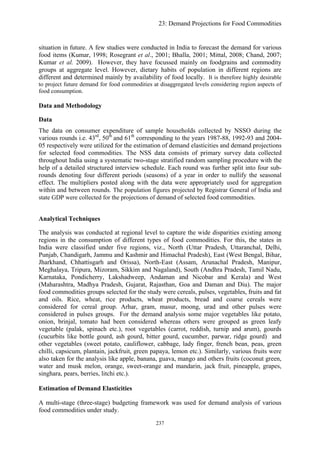
The LA-AIDS was fitted to estimate the demand for different pulses. This model is called
‘Almost Ideal’ for it encompasses almost all desirable characteristics of a demand function
(Deaton and Muellbauer, 1980). The model was further improved with the use of multi-
budgeting technique which facilitated the demand estimation at a greater disaggregate level
(Dey, 2000). This model is widely used in the estimation of demand elasticities in several
empirical research related to household data (Mittal, 2006; Sivaramane, 2009). The LA-AIDS
model is used to estimate the price and expenditure elasticities using the geometric Stone
price index which was approximated as
i
i
ln I= w lnP∑ ...(1)
Where, iw is the mean of the expenditure share of the ith
commodity and iP is the unit value
(price) of ith
commodity.
The nominal prices or unit values used were deflated through price index with base year as
1999-2000 and these real prices were used in the subsequent analysis. The elasticities of
demand of selected pulses were calculated using three-tier budgeting framework (Fig-1). In
the first stage, the expenditure elasticity of food was estimated using the log-linear
expenditure function.
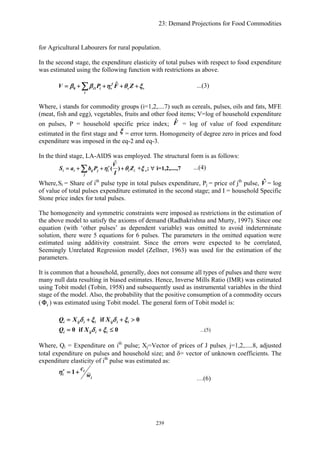
0 1 2
y
f nf f fF P P Y Z fα α α η θ= + + + + +ξ ...(2)
Where,F =Log of monthly per capita expenditure on food; Y=Log of monthly per capita total
expenditure; Pf = Log of price of food items, Pnf = Log of price of non-food items, and Z =
household size in adult units.
The unit value was used as the proxy for the price as it takes into account the quality aspects
of the commodities. The unit values of selected rounds were adjusted to the base year 2008-
2009 using Consumer Price Index (CPI) for Industrial Workers for urban population and CPI
238
23: Demand Projections for Food Commodities
Z
for Agricultural Labourers for rural population.
In the second stage, the expenditure elasticity of total pulses with respect to food expenditure
was estimated using the following function with restrictions as above.
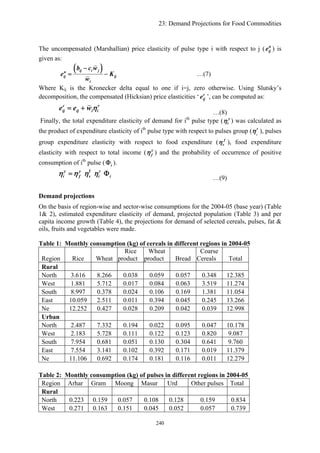
0 1
ˆf
i i v v v
i
V P Fβ β η θ= + + + +∑ ξ ...(3)
Where, i stands for commodity groups (i=1,2,....7) such as cereals, pulses, oils and fats, MFE
(meat, fish and egg), vegetables, fruits and other food items; V=log of household expenditure
on pulses, P = household specific price index; ˆF = log of value of food expenditure
estimated in the first stage and ξ = error term. Homogeneity of degree zero in prices and food
expenditure was imposed in the eq-2 and eq-3.
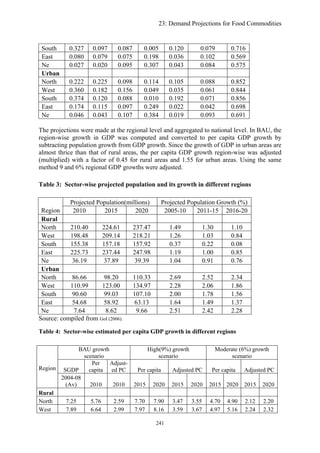
In the third stage, LA-AIDS was employed. The structural form is as follows:
s
ˆ
( ) + ; i=1,2,....,7v
i i ij j i i i
j
V
S a b P Z
I
η θ ξ= + + + ∀∑ ...(4)
Where,Si = Share of ith
pulse type in total pulses expenditure, Pj = price of jth
pulse, = log
of value of total pulses expenditure estimated in the second stage; and I = household Specific
Stone price index for total pulses.
ˆV
The homogeneity and symmetric constraints were imposed as restrictions in the estimation of
the above model to satisfy the axioms of demand (Radhakrishna and Murty, 1997). Since one
equation (with ‘other pulses’ as dependent variable) was omitted to avoid indeterminate
solution, there were 5 equations for 6 pulses. The parameters in the omitted equation were
estimated using additivity constraint. Since the errors were expected to be correlated,
Seemingly Unrelated Regression model (Zellner, 1963) was used for the estimation of the
parameters.
It is common that a household, generally, does not consume all types of pulses and there were
many null data resulting in biased estimates. Hence, Inverse Mills Ratio (IMR) was estimated
using Tobit model (Tobin, 1958) and subsequently used as instrumental variables in the third
stage of the model. Also, the probability that the positive consumption of a commodity occurs
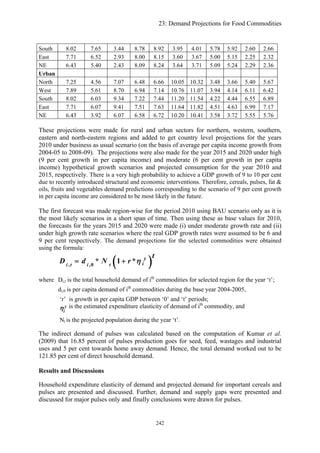
( ) was estimated using Tobit model. The general form of Tobit model is:iΦ
if 0i ij i i ij i iQ X Xδ ξ δ ξ= + + >
0 if 0i ij i iQ X δ ξ= + ≤ ...(5)
Where, Qi = Expenditure on ith
pulse; Xj=Vector of prices of J pulses, j=1,2,.....8, adjusted
total expenditure on pulses and household size; and δ= vector of unknown coefficients. The
expenditure elasticity of ith
pulse was estimated as:
1v i
i
i
c
w
η = +
…(6)
239
23: Demand Projections for Food Commodities
The uncompensated (Marshallian) price elasticity of pulse type i with respect to j ( ) is
given as:
u
ije
( )ij i ju
ij ij
i
b c w
e
w
−
= K− …(7)
Where Kij is the Kronecker delta equal to one if i=j, zero otherwise. Using Slutsky’s
decomposition, the compensated (Hicksian) price elasticities ‘ ’, can be computed as:c
ije
c v
ij ij i ie e w η= +
…(8)
Finally, the total expenditure elasticity of demand for ith
pulse type ( y
iη ) was calculated as
the product of expenditure elasticity of ith
pulse type with respect to pulses group ( i
v
η ), pulses
group expenditure elasticity with respect to food expenditure ( f
vη ), food expenditure
elasticity with respect to total income ( y
fη ) and the probability of occurrence of positive
consumption of ith
pulse ( ).iΦ
f
v
y y v
i f iη η η η= Φi
…(9)
Demand projections
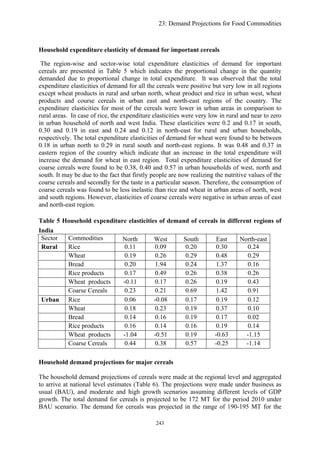
On the basis of region-wise and sector-wise consumptions for the 2004-05 (base year) (Table
1& 2), estimated expenditure elasticity of demand, projected population (Table 3) and per
capita income growth (Table 4), the projections for demand of selected cereals, pulses, fat &
oils, fruits and vegetables were made.
Table 1: Monthly consumption (kg) of cereals in different regions in 2004-05
Region Rice Wheat
Rice
product
Wheat
product Bread
Coarse
Cereals Total
Rural
North 3.616 8.266 0.038 0.059 0.057 0.348 12.385
West 1.881 5.712 0.017 0.084 0.063 3.519 11.274
South 8.997 0.378 0.024 0.106 0.169 1.381 11.054
East 10.059 2.511 0.011 0.394 0.045 0.245 13.266
Ne 12.252 0.427 0.028 0.209 0.042 0.039 12.998
Urban
North 2.487 7.332 0.194 0.022 0.095 0.047 10.178
West 2.183 5.728 0.111 0.122 0.123 0.820 9.087
South 7.954 0.681 0.051 0.130 0.304 0.641 9.760
East 7.554 3.141 0.102 0.392 0.171 0.019 11.379
Ne 11.106 0.692 0.174 0.181 0.116 0.011 12.279
Table 2: Monthly consumption (kg) of pulses in different regions in 2004-05
Region Arhar Gram Moong Masur Urd Other pulses Total
Rural
North 0.223 0.159 0.057 0.108 0.128 0.159 0.834
West 0.271 0.163 0.151 0.045 0.052 0.057 0.739
240
23: Demand Projections for Food Commodities
South 0.327 0.097 0.087 0.005 0.120 0.079 0.716
East 0.080 0.079 0.075 0.198 0.036 0.102 0.569
Ne 0.027 0.020 0.095 0.307 0.043 0.084 0.575
Urban
North 0.222 0.225 0.098 0.114 0.105 0.088 0.852
West 0.360 0.182 0.156 0.049 0.035 0.061 0.844
South 0.374 0.120 0.088 0.010 0.192 0.071 0.856
East 0.174 0.115 0.097 0.249 0.022 0.042 0.698
Ne 0.046 0.043 0.107 0.384 0.019 0.093 0.691
The projections were made at the regional level and aggregated to national level. In BAU, the
region-wise growth in GDP was computed and converted to per capita GDP growth by
subtracting population growth from GDP growth. Since the growth of GDP in urban areas are
almost thrice than that of rural areas, the per capita GDP growth region-wise was adjusted
(multiplied) with a factor of 0.45 for rural areas and 1.55 for urban areas. Using the same
method 9 and 6% regional GDP growths were adjusted.
Table 3: Sector-wise projected population and its growth in different regions
Projected Population(millions) Projected Population Growth (%)
Region 2010 2015 2020 2005-10 2011-15 2016-20
Rural
North 210.40 224.61 237.47 1.49 1.30 1.10
West 198.48 209.14 218.21 1.26 1.03 0.84
South 155.38 157.18 157.92 0.37 0.22 0.08
East 225.73 237.44 247.98 1.19 1.00 0.85
Ne 36.19 37.89 39.39 1.04 0.91 0.76
Urban
North 86.66 98.20 110.33 2.69 2.52 2.34
West 110.99 123.00 134.97 2.28 2.06 1.86
South 90.60 99.03 107.10 2.00 1.78 1.56
East 54.68 58.92 63.13 1.64 1.49 1.37
Ne 7.64 8.62 9.66 2.51 2.42 2.28
Source: compiled from GoI (2006).
Table 4: Sector-wise estimated per capita GDP growth in different regions
BAU growth
scenario
High(9%) growth
scenario
Moderate (6%) growth
scenario
SGDP
Per
capita
Adjust-
ed PC Per capita Adjusted PC Per capita Adjusted PCRegion
2004-08
(Av) 2010 2010 2015 2020 2015 2020 2015 2020 2015 2020
Rural
North 7.25 5.76 2.59 7.70 7.90 3.47 3.55 4.70 4.90 2.12 2.20
West 7.89 6.64 2.99 7.97 8.16 3.59 3.67 4.97 5.16 2.24 2.32
241
23: Demand Projections for Food Commodities
South 8.02 7.65 3.44 8.78 8.92 3.95 4.01 5.78 5.92 2.60 2.66
East 7.71 6.52 2.93 8.00 8.15 3.60 3.67 5.00 5.15 2.25 2.32
NE 6.43 5.40 2.43 8.09 8.24 3.64 3.71 5.09 5.24 2.29 2.36
Urban
North 7.25 4.56 7.07 6.48 6.66 10.05 10.32 3.48 3.66 5.40 5.67
West 7.89 5.61 8.70 6.94 7.14 10.76 11.07 3.94 4.14 6.11 6.42
South 8.02 6.03 9.34 7.22 7.44 11.20 11.54 4.22 4.44 6.55 6.89
East 7.71 6.07 9.41 7.51 7.63 11.64 11.82 4.51 4.63 6.99 7.17
NE 6.43 3.92 6.07 6.58 6.72 10.20 10.41 3.58 3.72 5.55 5.76
These projections were made for rural and urban sectors for northern, western, southern,
eastern and north-eastern regions and added to get country level projections for the years
2010 under business as usual scenario (on the basis of average per capita income growth from
2004-05 to 2008-09). The projections were also made for the year 2015 and 2020 under high
(9 per cent growth in per capita income) and moderate (6 per cent growth in per capita
income) hypothetical growth scenarios and projected consumption for the year 2010 and
2015, respectively. There is a very high probability to achieve a GDP growth of 9 to 10 per cent
due to recently introduced structural and economic interventions. Therefore, cereals, pulses, fat &
oils, fruits and vegetables demand predictions corresponding to the scenario of 9 per cent growth
in per capita income are considered to be most likely in the future.
The first forecast was made region-wise for the period 2010 using BAU scenario only as it is
the most likely scenarios in a short span of time. Then using these as base values for 2010,
the forecasts for the years 2015 and 2020 were made (i) under moderate growth rate and (ii)
under high growth rate scenarios where the real GDP growth rates were assumed to be 6 and
9 per cent respectively. The demand projections for the selected commodities were obtained
using the formula:
(, ,0
* 1 * y
ii t i t
t
D d N r η= + )
where Di,t is the total household demand of ith
commodities for selected region for the year ‘t’;
di,0 is per capita demand of ith
commodities during the base year 2004-2005,
‘r’ is growth in per capita GDP between ‘0’ and ‘t’ periods;
y
i
η is the estimated expenditure elasticity of demand of ith
commodity, and
Nt is the projected population during the year ‘t’.
The indirect demand of pulses was calculated based on the computation of Kumar et al.
(2009) that 16.85 percent of pulses production goes for seed, feed, wastages and industrial
uses and 5 per cent towards home away demand. Hence, the total demand worked out to be
121.85 per cent of direct household demand.
Results and Discussions
Household expenditure elasticity of demand and projected demand for important cereals and
pulses are presented and discussed. Further, demand and supply gaps were presented and
discussed for major pulses only and finally conclusions were drawn for pulses.
242
23: Demand Projections for Food Commodities
Household expenditure elasticity of demand for important cereals
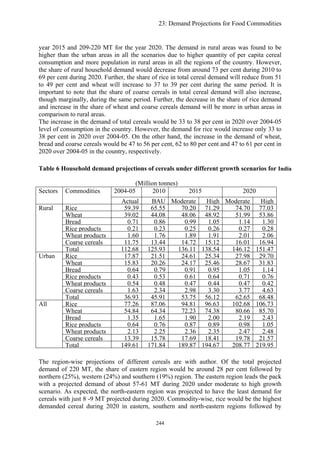
The region-wise and sector-wise total expenditure elasticities of demand for important
cereals are presented in Table 5 which indicates the proportional change in the quantity
demanded due to proportional change in total expenditure. It was observed that the total
expenditure elasticities of demand for all the cereals were positive but very low in all regions
except wheat products in rural and urban north, wheat product and rice in urban west, wheat
products and course cereals in urban east and north-east regions of the country. The
expenditure elasticities for most of the cereals were lower in urban areas in comparison to
rural areas. In case of rice, the expenditure elasticities were very low in rural and near to zero
in urban household of north and west India. These elasticities were 0.2 and 0.17 in south,
0.30 and 0.19 in east and 0.24 and 0.12 in north-east for rural and urban households,
respectively. The total expenditure elasticities of demand for wheat were found to be between
0.18 in urban north to 0.29 in rural south and north-east regions. It was 0.48 and 0.37 in
eastern region of the country which indicate that an increase in the total expenditure will
increase the demand for wheat in east region. Total expenditure elasticities of demand for
coarse cereals were found to be 0.38, 0.40 and 0.57 in urban households of west, north and
south. It may be due to the fact that firstly people are now realizing the nutritive values of the
coarse cereals and secondly for the taste in a particular season. Therefore, the consumption of
coarse cereals was found to be less inelastic than rice and wheat in urban areas of north, west
and south regions. However, elasticities of coarse cereals were negative in urban areas of east
and north-east region.
Table 5 Household expenditure elasticities of demand of cereals in different regions of
India
Sector Commodities North West South East North-east
Rural Rice 0.11 0.09 0.20 0.30 0.24
Wheat 0.19 0.26 0.29 0.48 0.29
Bread 0.20 1.94 0.24 1.37 0.16
Rice products 0.17 0.49 0.26 0.38 0.26
Wheat products -0.11 0.17 0.26 0.19 0.43
Coarse Cereals 0.23 0.21 0.69 1.42 0.91
Urban Rice 0.06 -0.08 0.17 0.19 0.12
Wheat 0.18 0.23 0.19 0.37 0.10
Bread 0.14 0.16 0.19 0.17 0.02
Rice products 0.16 0.14 0.16 0.19 0.14
Wheat products -1.04 -0.51 0.19 -0.63 -1.15
Coarse Cereals 0.44 0.38 0.57 -0.25 -1.14
Household demand projections for major cereals
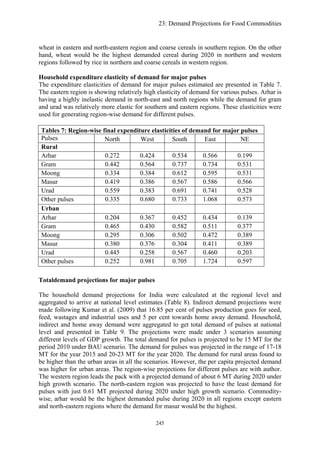
The household demand projections of cereals were made at the regional level and aggregated
to arrive at national level estimates (Table 6). The projections were made under business as
usual (BAU), and moderate and high growth scenarios assuming different levels of GDP
growth. The total demand for cereals is projected to be 172 MT for the period 2010 under
BAU scenario. The demand for cereals was projected in the range of 190-195 MT for the
243
23: Demand Projections for Food Commodities
year 2015 and 209-220 MT for the year 2020. The demand in rural areas was found to be
higher than the urban areas in all the scenarios due to higher quantity of per capita cereal
consumption and more population in rural areas in all the regions of the country. However,
the share of rural household demand would decrease from around 73 per cent during 2010 to
69 per cent during 2020. Further, the share of rice in total cereal demand will reduce from 51
to 49 per cent and wheat will increase to 37 to 39 per cent during the same period. It is
important to note that the share of coarse cereals in total cereal demand will also increase,
though marginally, during the same period. Further, the decrease in the share of rice demand
and increase in the share of wheat and coarse cereals demand will be more in urban areas in
comparison to rural areas.
The increase in the demand of total cereals would be 33 to 38 per cent in 2020 over 2004-05
level of consumption in the country. However, the demand for rice would increase only 33 to
38 per cent in 2020 over 2004-05. On the other hand, the increase in the demand of wheat,
bread and coarse cereals would be 47 to 56 per cent, 62 to 80 per cent and 47 to 61 per cent in
2020 over 2004-05 in the country, respectively.
Table 6 Household demand projections of cereals under different growth scenarios for India
(Million tonnes)
2004-05 2010 2015 2020Sectors Commodities
Actual BAU Moderate High Moderate High
Rice 59.39 65.55 70.20 71.29 74.70 77.03
Wheat 39.02 44.08 48.06 48.92 51.99 53.86
Bread 0.71 0.86 0.99 1.05 1.14 1.30
Rice products 0.21 0.23 0.25 0.26 0.27 0.28
Wheat products 1.60 1.76 1.89 1.91 2.01 2.06
Coarse cereals 11.75 13.44 14.72 15.12 16.01 16.94
Rural
Total 112.68 125.93 136.11 138.54 146.12 151.47
Rice 17.87 21.51 24.61 25.34 27.98 29.70
Wheat 15.83 20.26 24.17 25.46 28.67 31.83
Bread 0.64 0.79 0.91 0.95 1.05 1.14
Rice products 0.43 0.53 0.61 0.64 0.71 0.76
Wheat products 0.54 0.48 0.47 0.44 0.47 0.42
Coarse cereals 1.63 2.34 2.98 3.30 3.77 4.63
Urban
Total 36.93 45.91 53.75 56.12 62.65 68.48
Rice 77.26 87.06 94.81 96.63 102.68 106.73
Wheat 54.84 64.34 72.23 74.38 80.66 85.70
Bread 1.35 1.65 1.90 2.00 2.19 2.43
Rice products 0.64 0.76 0.87 0.89 0.98 1.05
Wheat products 2.13 2.25 2.36 2.35 2.47 2.48
Coarse cereals 13.39 15.78 17.69 18.41 19.78 21.57
All
Total 149.61 171.84 189.87 194.67 208.77 219.95
The region-wise projections of different cereals are with author. Of the total projected
demand of 220 MT, the share of eastern region would be around 28 per cent followed by
northern (25%), western (24%) and southern (19%) region. The eastern region leads the pack
with a projected demand of about 57-61 MT during 2020 under moderate to high growth
scenario. As expected, the north-eastern region was projected to have the least demand for
cereals with just 8 -9 MT projected during 2020. Commodity-wise, rice would be the highest
demanded cereal during 2020 in eastern, southern and north-eastern regions followed by
244
23: Demand Projections for Food Commodities
wheat in eastern and north-eastern region and coarse cereals in southern region. On the other
hand, wheat would be the highest demanded cereal during 2020 in northern and western
regions followed by rice in northern and coarse cereals in western region.
Household expenditure elasticity of demand for major pulses
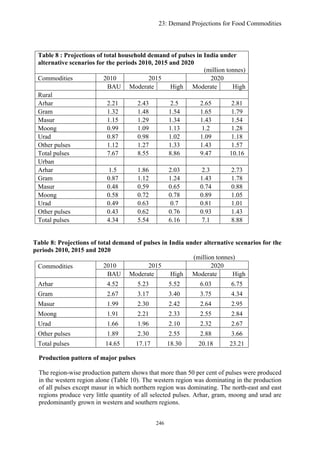
The expenditure elasticities of demand for major pulses estimated are presented in Table 7.
The eastern region is showing relatively high elasticity of demand for various pulses. Arhar is
having a highly inelastic demand in north-east and north regions while the demand for gram
and urad was relatively more elastic for southern and eastern regions. These elasticities were
used for generating region-wise demand for different pulses.
Tables 7: Region-wise final expenditure elasticities of demand for major pulses
Pulses North West South East NE
Rural
Arhar 0.272 0.424 0.534 0.566 0.199
Gram 0.442 0.564 0.737 0.734 0.531
Moong 0.334 0.384 0.612 0.595 0.531
Masur 0.419 0.386 0.567 0.586 0.566
Urad 0.559 0.383 0.691 0.741 0.528
Other pulses 0.335 0.680 0.733 1.068 0.573
Urban
Arhar 0.204 0.367 0.452 0.434 0.139
Gram 0.465 0.430 0.582 0.511 0.377
Moong 0.295 0.306 0.502 0.472 0.389
Masur 0.380 0.376 0.304 0.411 0.389
Urad 0.445 0.258 0.567 0.460 0.203
Other pulses 0.252 0.981 0.705 1.724 0.597
Totaldemand projections for major pulses
The household demand projections for India were calculated at the regional level and
aggregated to arrive at national level estimates (Table 8). Indirect demand projections were
made following Kumar et al. (2009) that 16.85 per cent of pulses production goes for seed,
feed, wastages and industrial uses and 5 per cent towards home away demand. Household,
indirect and home away demand were aggregated to get total demand of pulses at national
level and presented in Table 9. The projections were made under 3 scenarios assuming
different levels of GDP growth. The total demand for pulses is projected to be 15 MT for the
period 2010 under BAU scenario. The demand for pulses was projected in the range of 17-18
MT for the year 2015 and 20-23 MT for the year 2020. The demand for rural areas found to
be higher than the urban areas in all the scenarios. However, the per capita projected demand
was higher for urban areas. The region-wise projections for different pulses are with author.
The western region leads the pack with a projected demand of about 6 MT during 2020 under
high growth scenario. The north-eastern region was projected to have the least demand for
pulses with just 0.61 MT projected during 2020 under high growth scenario. Commodity-
wise, arhar would be the highest demanded pulse during 2020 in all regions except eastern
and north-eastern regions where the demand for masur would be the highest.
245
23: Demand Projections for Food Commodities
Table 8 : Projections of total household demand of pulses in India under
alternative scenarios for the periods 2010, 2015 and 2020
(million tonnes)
Commodities 2010 2015 2020
BAU Moderate High Moderate High
Rural
Arhar 2.21 2.43 2.5 2.65 2.81
Gram 1.32 1.48 1.54 1.65 1.79
Masur 1.15 1.29 1.34 1.43 1.54
Moong 0.99 1.09 1.13 1.2 1.28
Urad 0.87 0.98 1.02 1.09 1.18
Other pulses 1.12 1.27 1.33 1.43 1.57
Total pulses 7.67 8.55 8.86 9.47 10.16
Urban
Arhar 1.5 1.86 2.03 2.3 2.73
Gram 0.87 1.12 1.24 1.43 1.78
Masur 0.48 0.59 0.65 0.74 0.88
Moong 0.58 0.72 0.78 0.89 1.05
Urad 0.49 0.63 0.7 0.81 1.01
Other pulses 0.43 0.62 0.76 0.93 1.43
Total pulses 4.34 5.54 6.16 7.1 8.88
Table 8: Projections of total demand of pulses in India under alternative scenarios for the
periods 2010, 2015 and 2020
(million tonnes)
2010 2015 2020Commodities
BAU Moderate High Moderate High
Arhar 4.52 5.23 5.52 6.03 6.75
Gram 2.67 3.17 3.40 3.75 4.34
Masur 1.99 2.30 2.42 2.64 2.95
Moong 1.91 2.21 2.33 2.55 2.84
Urad 1.66 1.96 2.10 2.32 2.67
Other pulses 1.89 2.30 2.55 2.88 3.66
Total pulses 14.65 17.17 18.30 20.18 23.21
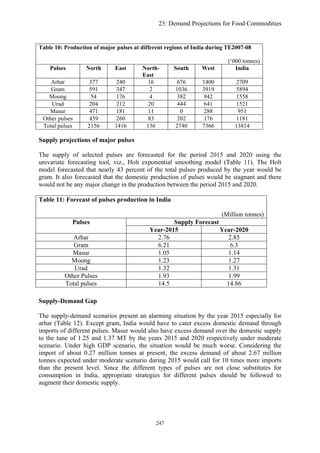
Production pattern of major pulses
The region-wise production pattern shows that more than 50 per cent of pulses were produced
in the western region alone (Table 10). The western region was dominating in the production
of all pulses except masur in which northern region was dominating. The north-east and east
regions produce very little quantity of all selected pulses. Arhar, gram, moong and urad are
predominantly grown in western and southern regions.
246
23: Demand Projections for Food Commodities
Table 10: Production of major pulses at different regions of India during TE2007-08
(‘000 tonnes)
Pulses North East North-
East
South West India
Arhar 377 240 16 676 1400 2709
Gram 591 347 2 1036 3919 5894
Moong 54 176 4 382 942 1558
Urad 204 212 20 444 641 1521
Masur 471 181 11 0 288 951
Other pulses 459 260 83 202 176 1181
Total pulses 2156 1416 136 2740 7366 13814
Supply projections of major pulses
The supply of selected pulses are forecasted for the period 2015 and 2020 using the
univariate forecasting tool, viz., Holt exponential smoothing model (Table 11). The Holt
model forecasted that nearly 43 percent of the total pulses produced by the year would be
gram. It also forecasted that the domestic production of pulses would be stagnant and there
would not be any major change in the production between the period 2015 and 2020.
Table 11: Forecast of pulses production in India
(Million tonnes)
Supply ForecastPulses
Year-2015 Year-2020
Arhar 2.76 2.85
Gram 6.21 6.3
Masur 1.05 1.14
Moong 1.23 1.27
Urad 1.32 1.31
Other Pulses 1.93 1.99
Total pulses 14.5 14.86
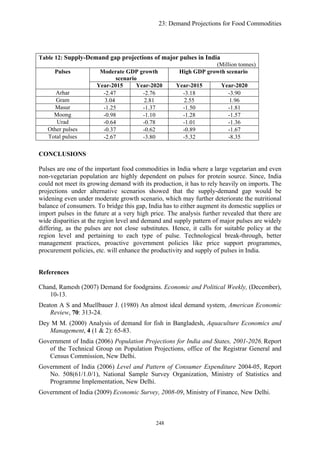
Supply-Demand Gap
The supply-demand scenarios present an alarming situation by the year 2015 especially for
arhar (Table 12). Except gram, India would have to cater excess domestic demand through
imports of different pulses. Masur would also have excess demand over the domestic supply
to the tune of 1.25 and 1.37 MT by the years 2015 and 2020 respectively under moderate
scenario. Under high GDP scenario, the situation would be much worse. Considering the
import of about 0.27 million tonnes at present, the excess demand of about 2.67 million
tonnes expected under moderate scenario during 2015 would call for 10 times more imports
than the present level. Since the different types of pulses are not close substitutes for
consumption in India, appropriate strategies for different pulses should be followed to
augment their domestic supply.
247
23: Demand Projections for Food Commodities
Table 12: Supply-Demand gap projections of major pulses in India
(Million tonnes)
Moderate GDP growth
scenario
High GDP growth scenarioPulses
Year-2015 Year-2020 Year-2015 Year-2020
Arhar -2.47 -2.76 -3.18 -3.90
Gram 3.04 2.81 2.55 1.96
Masur -1.25 -1.37 -1.50 -1.81
Moong -0.98 -1.10 -1.28 -1.57
Urad -0.64 -0.78 -1.01 -1.36
Other pulses -0.37 -0.62 -0.89 -1.67
Total pulses -2.67 -3.80 -5.32 -8.35
CONCLUSIONS
Pulses are one of the important food commodities in India where a large vegetarian and even
non-vegetarian population are highly dependent on pulses for protein source. Since, India
could not meet its growing demand with its production, it has to rely heavily on imports. The
projections under alternative scenarios showed that the supply-demand gap would be
widening even under moderate growth scenario, which may further deteriorate the nutritional
balance of consumers. To bridge this gap, India has to either augment its domestic supplies or
import pulses in the future at a very high price. The analysis further revealed that there are
wide disparities at the region level and demand and supply pattern of major pulses are widely
differing, as the pulses are not close substitutes. Hence, it calls for suitable policy at the
region level and pertaining to each type of pulse. Technological break-through, better
management practices, proactive government policies like price support programmes,
procurement policies, etc. will enhance the productivity and supply of pulses in India.
References
Chand, Ramesh (2007) Demand for foodgrains. Economic and Political Weekly, (December),
10-13.
Deaton A S and Muellbauer J. (1980) An almost ideal demand system, American Economic
Review, 70: 313-24.
Dey M M. (2000) Analysis of demand for fish in Bangladesh, Aquaculture Economics and
Management, 4 (1 & 2): 65-83.
Government of India (2006) Population Projections for India and States, 2001-2026, Report
of the Technical Group on Population Projections, office of the Registrar General and
Census Commission, New Delhi.
Government of India (2006) Level and Pattern of Consumer Expenditure 2004-05, Report
No. 508(61/1.0/1), National Sample Survey Organization, Ministry of Statistics and
Programme Implementation, New Delhi.
Government of India (2009) Economic Survey, 2008-09, Ministry of Finance, New Delhi.
248
23: Demand Projections for Food Commodities
249
Mittal, Surabhi (2006) Structural Shift in Demand for Food: India’s Prospects in 2020,
Indian Council for Research on International Economic Relations (ICRIER), Working
Paper 184, pp 1-35.
Mittal, Surabhi (2008) Demand and Supply trends and Projections of Food in India, Working
Paper No. 209, ICRIER, New Delhi, p.20.
Kumar, Praduman (1998) Food Demand and Supply Projections for India, Agricultural
Economics Policy Paper 98-01. Indian Agricultural Research Institute, New Delhi.
Kumar, Praduman, Mruthyunjaya and Dey, M. M. (2007) Long-term changes in food basket
and nutrition in India, Economic and Political Weekly, (September 1): 3567- 3572.
Kumar, Praduman, P.K. Joshi and Pratap S. Birthal (2009) Demand Projections for
Foodgrains in India1, Agricultural Economics Research Review, 22 (2): 237-243.
Rosegrant, Mark W., Agcaoili-Sombilla, M. and Perez, N.D. (1995) Global Food Projections
to 2020: Implications for Investment. 2020, Discussion Paper No. 5. International Food
Policy Research Institute, Washington, D.C.
Sivaramane N, Singh D R and Arya Prawin (2009) An econometric analysis of household
demand for major vegetables in India, Indian Journal of Agricultural Marketing, 23 (1):
66-76.
Tobin J. (1958) Estimation for relationships with limited dependent variables, Econometrica,
26 (1): 24-36.
Zellner A. (1963) Estimates for seemingly unrelated regression equations: Some exact finite
sample results. Journal of the American Statistical Association, 58: 977-992.
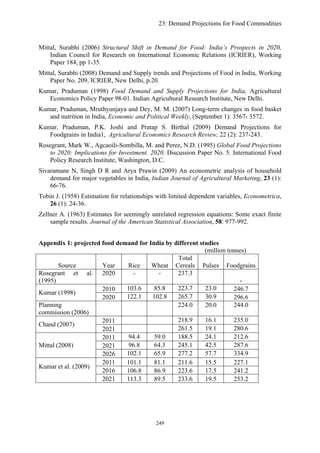
Appendix 1: projected food demand for India by different studies
(million tonnes)
Source Year Rice Wheat
Total
Cereals Pulses Foodgrains
Rosegrant et al.
(1995)
2020 - - 237.3
-
2010 103.6 85.8 223.7 23.0 246.7
Kumar (1998)
2020 122.1 102.8 265.7 30.9 296.6
Planning
commission (2006)
224.0 20.0 244.0
2011 218.9 16.1 235.0
Chand (2007)
2021 261.5 19.1 280.6
2011 94.4 59.0 188.5 24.1 212.6
2021 96.8 64.3 245.1 42.5 287.6Mittal (2008)
2026 102.1 65.9 277.2 57.7 334.9
2011 101.1 81.1 211.6 15.5 227.1
2016 106.8 86.9 223.6 17.5 241.2
Kumar et al. (2009)
2021 113.3 89.5 233.6 19.5 253.2

Demand projections

  • 1.
    23: Demand Projectionsfor Food Commodities DEMAND PROJECTIONS FOR FOOD COMMODITIES D.R. Singh Indian Agricultural Statistics Research Institute, New Delhi-110012 Introduction The food security is a primary concern of any developing country. Adequate nourishment in terms of quantity and quality is necessary to sustain healthy life. Undernourishment (it refers to the inadequacy in quantity (calorie) intake) and mal-nourishment (it refers to inadequacy in quality (nutrients) intake) lead to poor body growth and health thereby resulting in poor productivity capacity in terms of work at individual level which affects GDP at aggregate level. Therefore, the availability and accessibility of food is important from the nutrition point of view. Enough availability at macro-level does not mean that everybody is having access to a fair share of it or that everyone has an adequate diet. Further, affordable food prices and adequate purchasing power with the people are equally important. Satisfaction of hunger is usually the primary criteria for sufficient food intake. However, accessibility provides safe guide for selection of balanced food from a wide range of foods from nutrition point of view for living healthy and active life. India has a wide variety of climate and soil on which a large number of food crops such as, cereals, pulses, oilseeds, fruits, vegetables and other like ornamental, medicinal and aromatic plants, plantation crops, spices, cashew and cocoa are grown. After attaining independence, major emphasis was laid on achieving self sufficiency in food production in the country. After inception of green revolution, the country has made tremendous progress with respect to food and the overall livelihood security. India has emerged as one of the leading producers of rice, wheat, pulses, fruits, vegetables, milk and other commodities. The growth in the agriculture sector, though lower than in the non-agriculture sectors remained higher than the growth of population up to mid-nineties. Between 1950-51 and 2006-07, production of foodgrains increased at an average annual rate of 2.5 per cent compared to the growth of population which averaged 2.1 per cent during this period. As a result, India almost became self-sufficient in foodgrains and there were hardly any imports during 1976-77 to 2005-06, except occasionally. After mid 1990s, however, foodgrains production has failed to keep pace with the population growth. The rate of growth of foodgrains production, decelerated to 1.2 per cent during 1990-2007, lower than annual rate of growth of population, averaging 1.9 per cent. (Economic Survey, 2008). The per capita availability of cereals and pulses, therefore, witnessed a decline during this period. At the same time consumer preferences have also shifted away from cereals and moved towards high-value agricultural produce. Higher incomes and urbanization in India, changing lifestyles, international market integration and trade liberalization are expected to increase the demand for livestock products like milk, eggs, meat and fish and horticultural products even further. On the other hand, population trends project India to emerge as the most populous country in the world in the coming decades. Therefore, demand and supply of food commodities has become important for country’s food security concerns in the future. Because, the imbalance between production and demand impacts the prices and profitability, which intern adversely affect the poor population and farming community and calls for policy interventions to tackle the 236
  • 2.
    23: Demand Projectionsfor Food Commodities situation in future. A few studies were conducted in India to forecast the demand for various food items (Kumar, 1998; Rosegrant et al., 2001; Bhalla, 2001; Mittal, 2008; Chand, 2007; Kumar et al. 2009). However, they have focussed mainly on foodgrains and commodity groups at aggregate level. However, dietary habits of population in different regions are different and determined mainly by availability of food locally. It is therefore highly desirable to project future demand for food commodities at disaggregated levels considering region aspects of food consumption. Data and Methodology Data The data on consumer expenditure of sample households collected by NSSO during the various rounds i.e. 43rd , 50th and 61th corresponding to the years 1987-88, 1992-93 and 2004- 05 respectively were utilized for the estimation of demand elasticities and demand projections for selected food commodities. The NSS data consists of primary survey data collected throughout India using a systematic two-stage stratified random sampling procedure with the help of a detailed structured interview schedule. Each round was further split into four sub- rounds denoting four different periods (seasons) of a year in order to nullify the seasonal effect. The multipliers posted along with the data were appropriately used for aggregation within and between rounds. The population figures projected by Registrar General of India and state GDP were collected for the projections of demand of selected food commodities. Analytical Techniques The analysis was conducted at regional level to capture the wide disparities existing among regions in the consumption of different types of food commodities. For this, the states in India were classified under five regions, viz., North (Uttar Pradesh, Uttaranchal, Delhi, Punjab, Chandigarh, Jammu and Kashmir and Himachal Pradesh), East (West Bengal, Bihar, Jharkhand, Chhattisgarh and Orissa), North-East (Assam, Arunachal Pradesh, Manipur, Meghalaya, Tripura, Mizoram, Sikkim and Nagaland), South (Andhra Pradesh, Tamil Nadu, Karnataka, Pondicherry, Lakshadweep, Andaman and Nicobar and Kerala) and West (Maharashtra, Madhya Pradesh, Gujarat, Rajasthan, Goa and Daman and Diu). The major food commodities groups selected for the study were cereals, pulses, vegetables, fruits and fat and oils. Rice, wheat, rice products, wheat products, bread and coarse cereals were considered for cereal group. Arhar, gram, masur, moong, urad and other pulses were considered in pulses groups. For the demand analysis some major vegetables like potato, onion, brinjal, tomato had been considered whereas others were grouped as green leafy vegetable (palak, spinach etc.), root vegetables (carrot, reddish, turnip and arum), gourds (cucurbits like bottle gourd, ash gourd, bitter gourd, cucumber, parwar, ridge gourd) and other vegetables (sweet potato, cauliflower, cabbage, lady finger, french bean, peas, green chilli, capsicum, plantain, jackfruit, green papaya, lemon etc.). Similarly, various fruits were also taken for the analysis like apple, banana, guava, mango and others fruits (coconut green, water and musk melon, orange, sweet-orange and mandarin, jack fruit, pineapple, grapes, singhara, pears, berries, litchi etc.). Estimation of Demand Elasticities A multi-stage (three-stage) budgeting framework was used for demand analysis of various food commodities under study. 237
  • 3.
    23: Demand Projectionsfor Food Commodities Fat & oils exp The LA-AIDS was fitted to estimate the demand for different pulses. This model is called ‘Almost Ideal’ for it encompasses almost all desirable characteristics of a demand function (Deaton and Muellbauer, 1980). The model was further improved with the use of multi- budgeting technique which facilitated the demand estimation at a greater disaggregate level (Dey, 2000). This model is widely used in the estimation of demand elasticities in several empirical research related to household data (Mittal, 2006; Sivaramane, 2009). The LA-AIDS model is used to estimate the price and expenditure elasticities using the geometric Stone price index which was approximated as i i ln I= w lnP∑ ...(1) Where, iw is the mean of the expenditure share of the ith commodity and iP is the unit value (price) of ith commodity. The nominal prices or unit values used were deflated through price index with base year as 1999-2000 and these real prices were used in the subsequent analysis. The elasticities of demand of selected pulses were calculated using three-tier budgeting framework (Fig-1). In the first stage, the expenditure elasticity of food was estimated using the log-linear expenditure function. 0 1 2 y f nf f fF P P Y Z fα α α η θ= + + + + +ξ ...(2) Where,F =Log of monthly per capita expenditure on food; Y=Log of monthly per capita total expenditure; Pf = Log of price of food items, Pnf = Log of price of non-food items, and Z = household size in adult units. The unit value was used as the proxy for the price as it takes into account the quality aspects of the commodities. The unit values of selected rounds were adjusted to the base year 2008- 2009 using Consumer Price Index (CPI) for Industrial Workers for urban population and CPI 238
  • 4.
    23: Demand Projectionsfor Food Commodities Z for Agricultural Labourers for rural population. In the second stage, the expenditure elasticity of total pulses with respect to food expenditure was estimated using the following function with restrictions as above. 0 1 ˆf i i v v v i V P Fβ β η θ= + + + +∑ ξ ...(3) Where, i stands for commodity groups (i=1,2,....7) such as cereals, pulses, oils and fats, MFE (meat, fish and egg), vegetables, fruits and other food items; V=log of household expenditure on pulses, P = household specific price index; ˆF = log of value of food expenditure estimated in the first stage and ξ = error term. Homogeneity of degree zero in prices and food expenditure was imposed in the eq-2 and eq-3. In the third stage, LA-AIDS was employed. The structural form is as follows: s ˆ ( ) + ; i=1,2,....,7v i i ij j i i i j V S a b P Z I η θ ξ= + + + ∀∑ ...(4) Where,Si = Share of ith pulse type in total pulses expenditure, Pj = price of jth pulse, = log of value of total pulses expenditure estimated in the second stage; and I = household Specific Stone price index for total pulses. ˆV The homogeneity and symmetric constraints were imposed as restrictions in the estimation of the above model to satisfy the axioms of demand (Radhakrishna and Murty, 1997). Since one equation (with ‘other pulses’ as dependent variable) was omitted to avoid indeterminate solution, there were 5 equations for 6 pulses. The parameters in the omitted equation were estimated using additivity constraint. Since the errors were expected to be correlated, Seemingly Unrelated Regression model (Zellner, 1963) was used for the estimation of the parameters. It is common that a household, generally, does not consume all types of pulses and there were many null data resulting in biased estimates. Hence, Inverse Mills Ratio (IMR) was estimated using Tobit model (Tobin, 1958) and subsequently used as instrumental variables in the third stage of the model. Also, the probability that the positive consumption of a commodity occurs ( ) was estimated using Tobit model. The general form of Tobit model is:iΦ if 0i ij i i ij i iQ X Xδ ξ δ ξ= + + > 0 if 0i ij i iQ X δ ξ= + ≤ ...(5) Where, Qi = Expenditure on ith pulse; Xj=Vector of prices of J pulses, j=1,2,.....8, adjusted total expenditure on pulses and household size; and δ= vector of unknown coefficients. The expenditure elasticity of ith pulse was estimated as: 1v i i i c w η = + …(6) 239
  • 5.
    23: Demand Projectionsfor Food Commodities The uncompensated (Marshallian) price elasticity of pulse type i with respect to j ( ) is given as: u ije ( )ij i ju ij ij i b c w e w − = K− …(7) Where Kij is the Kronecker delta equal to one if i=j, zero otherwise. Using Slutsky’s decomposition, the compensated (Hicksian) price elasticities ‘ ’, can be computed as:c ije c v ij ij i ie e w η= + …(8) Finally, the total expenditure elasticity of demand for ith pulse type ( y iη ) was calculated as the product of expenditure elasticity of ith pulse type with respect to pulses group ( i v η ), pulses group expenditure elasticity with respect to food expenditure ( f vη ), food expenditure elasticity with respect to total income ( y fη ) and the probability of occurrence of positive consumption of ith pulse ( ).iΦ f v y y v i f iη η η η= Φi …(9) Demand projections On the basis of region-wise and sector-wise consumptions for the 2004-05 (base year) (Table 1& 2), estimated expenditure elasticity of demand, projected population (Table 3) and per capita income growth (Table 4), the projections for demand of selected cereals, pulses, fat & oils, fruits and vegetables were made. Table 1: Monthly consumption (kg) of cereals in different regions in 2004-05 Region Rice Wheat Rice product Wheat product Bread Coarse Cereals Total Rural North 3.616 8.266 0.038 0.059 0.057 0.348 12.385 West 1.881 5.712 0.017 0.084 0.063 3.519 11.274 South 8.997 0.378 0.024 0.106 0.169 1.381 11.054 East 10.059 2.511 0.011 0.394 0.045 0.245 13.266 Ne 12.252 0.427 0.028 0.209 0.042 0.039 12.998 Urban North 2.487 7.332 0.194 0.022 0.095 0.047 10.178 West 2.183 5.728 0.111 0.122 0.123 0.820 9.087 South 7.954 0.681 0.051 0.130 0.304 0.641 9.760 East 7.554 3.141 0.102 0.392 0.171 0.019 11.379 Ne 11.106 0.692 0.174 0.181 0.116 0.011 12.279 Table 2: Monthly consumption (kg) of pulses in different regions in 2004-05 Region Arhar Gram Moong Masur Urd Other pulses Total Rural North 0.223 0.159 0.057 0.108 0.128 0.159 0.834 West 0.271 0.163 0.151 0.045 0.052 0.057 0.739 240
  • 6.
    23: Demand Projectionsfor Food Commodities South 0.327 0.097 0.087 0.005 0.120 0.079 0.716 East 0.080 0.079 0.075 0.198 0.036 0.102 0.569 Ne 0.027 0.020 0.095 0.307 0.043 0.084 0.575 Urban North 0.222 0.225 0.098 0.114 0.105 0.088 0.852 West 0.360 0.182 0.156 0.049 0.035 0.061 0.844 South 0.374 0.120 0.088 0.010 0.192 0.071 0.856 East 0.174 0.115 0.097 0.249 0.022 0.042 0.698 Ne 0.046 0.043 0.107 0.384 0.019 0.093 0.691 The projections were made at the regional level and aggregated to national level. In BAU, the region-wise growth in GDP was computed and converted to per capita GDP growth by subtracting population growth from GDP growth. Since the growth of GDP in urban areas are almost thrice than that of rural areas, the per capita GDP growth region-wise was adjusted (multiplied) with a factor of 0.45 for rural areas and 1.55 for urban areas. Using the same method 9 and 6% regional GDP growths were adjusted. Table 3: Sector-wise projected population and its growth in different regions Projected Population(millions) Projected Population Growth (%) Region 2010 2015 2020 2005-10 2011-15 2016-20 Rural North 210.40 224.61 237.47 1.49 1.30 1.10 West 198.48 209.14 218.21 1.26 1.03 0.84 South 155.38 157.18 157.92 0.37 0.22 0.08 East 225.73 237.44 247.98 1.19 1.00 0.85 Ne 36.19 37.89 39.39 1.04 0.91 0.76 Urban North 86.66 98.20 110.33 2.69 2.52 2.34 West 110.99 123.00 134.97 2.28 2.06 1.86 South 90.60 99.03 107.10 2.00 1.78 1.56 East 54.68 58.92 63.13 1.64 1.49 1.37 Ne 7.64 8.62 9.66 2.51 2.42 2.28 Source: compiled from GoI (2006). Table 4: Sector-wise estimated per capita GDP growth in different regions BAU growth scenario High(9%) growth scenario Moderate (6%) growth scenario SGDP Per capita Adjust- ed PC Per capita Adjusted PC Per capita Adjusted PCRegion 2004-08 (Av) 2010 2010 2015 2020 2015 2020 2015 2020 2015 2020 Rural North 7.25 5.76 2.59 7.70 7.90 3.47 3.55 4.70 4.90 2.12 2.20 West 7.89 6.64 2.99 7.97 8.16 3.59 3.67 4.97 5.16 2.24 2.32 241
  • 7.
    23: Demand Projectionsfor Food Commodities South 8.02 7.65 3.44 8.78 8.92 3.95 4.01 5.78 5.92 2.60 2.66 East 7.71 6.52 2.93 8.00 8.15 3.60 3.67 5.00 5.15 2.25 2.32 NE 6.43 5.40 2.43 8.09 8.24 3.64 3.71 5.09 5.24 2.29 2.36 Urban North 7.25 4.56 7.07 6.48 6.66 10.05 10.32 3.48 3.66 5.40 5.67 West 7.89 5.61 8.70 6.94 7.14 10.76 11.07 3.94 4.14 6.11 6.42 South 8.02 6.03 9.34 7.22 7.44 11.20 11.54 4.22 4.44 6.55 6.89 East 7.71 6.07 9.41 7.51 7.63 11.64 11.82 4.51 4.63 6.99 7.17 NE 6.43 3.92 6.07 6.58 6.72 10.20 10.41 3.58 3.72 5.55 5.76 These projections were made for rural and urban sectors for northern, western, southern, eastern and north-eastern regions and added to get country level projections for the years 2010 under business as usual scenario (on the basis of average per capita income growth from 2004-05 to 2008-09). The projections were also made for the year 2015 and 2020 under high (9 per cent growth in per capita income) and moderate (6 per cent growth in per capita income) hypothetical growth scenarios and projected consumption for the year 2010 and 2015, respectively. There is a very high probability to achieve a GDP growth of 9 to 10 per cent due to recently introduced structural and economic interventions. Therefore, cereals, pulses, fat & oils, fruits and vegetables demand predictions corresponding to the scenario of 9 per cent growth in per capita income are considered to be most likely in the future. The first forecast was made region-wise for the period 2010 using BAU scenario only as it is the most likely scenarios in a short span of time. Then using these as base values for 2010, the forecasts for the years 2015 and 2020 were made (i) under moderate growth rate and (ii) under high growth rate scenarios where the real GDP growth rates were assumed to be 6 and 9 per cent respectively. The demand projections for the selected commodities were obtained using the formula: (, ,0 * 1 * y ii t i t t D d N r η= + ) where Di,t is the total household demand of ith commodities for selected region for the year ‘t’; di,0 is per capita demand of ith commodities during the base year 2004-2005, ‘r’ is growth in per capita GDP between ‘0’ and ‘t’ periods; y i η is the estimated expenditure elasticity of demand of ith commodity, and Nt is the projected population during the year ‘t’. The indirect demand of pulses was calculated based on the computation of Kumar et al. (2009) that 16.85 percent of pulses production goes for seed, feed, wastages and industrial uses and 5 per cent towards home away demand. Hence, the total demand worked out to be 121.85 per cent of direct household demand. Results and Discussions Household expenditure elasticity of demand and projected demand for important cereals and pulses are presented and discussed. Further, demand and supply gaps were presented and discussed for major pulses only and finally conclusions were drawn for pulses. 242
  • 8.
    23: Demand Projectionsfor Food Commodities Household expenditure elasticity of demand for important cereals The region-wise and sector-wise total expenditure elasticities of demand for important cereals are presented in Table 5 which indicates the proportional change in the quantity demanded due to proportional change in total expenditure. It was observed that the total expenditure elasticities of demand for all the cereals were positive but very low in all regions except wheat products in rural and urban north, wheat product and rice in urban west, wheat products and course cereals in urban east and north-east regions of the country. The expenditure elasticities for most of the cereals were lower in urban areas in comparison to rural areas. In case of rice, the expenditure elasticities were very low in rural and near to zero in urban household of north and west India. These elasticities were 0.2 and 0.17 in south, 0.30 and 0.19 in east and 0.24 and 0.12 in north-east for rural and urban households, respectively. The total expenditure elasticities of demand for wheat were found to be between 0.18 in urban north to 0.29 in rural south and north-east regions. It was 0.48 and 0.37 in eastern region of the country which indicate that an increase in the total expenditure will increase the demand for wheat in east region. Total expenditure elasticities of demand for coarse cereals were found to be 0.38, 0.40 and 0.57 in urban households of west, north and south. It may be due to the fact that firstly people are now realizing the nutritive values of the coarse cereals and secondly for the taste in a particular season. Therefore, the consumption of coarse cereals was found to be less inelastic than rice and wheat in urban areas of north, west and south regions. However, elasticities of coarse cereals were negative in urban areas of east and north-east region. Table 5 Household expenditure elasticities of demand of cereals in different regions of India Sector Commodities North West South East North-east Rural Rice 0.11 0.09 0.20 0.30 0.24 Wheat 0.19 0.26 0.29 0.48 0.29 Bread 0.20 1.94 0.24 1.37 0.16 Rice products 0.17 0.49 0.26 0.38 0.26 Wheat products -0.11 0.17 0.26 0.19 0.43 Coarse Cereals 0.23 0.21 0.69 1.42 0.91 Urban Rice 0.06 -0.08 0.17 0.19 0.12 Wheat 0.18 0.23 0.19 0.37 0.10 Bread 0.14 0.16 0.19 0.17 0.02 Rice products 0.16 0.14 0.16 0.19 0.14 Wheat products -1.04 -0.51 0.19 -0.63 -1.15 Coarse Cereals 0.44 0.38 0.57 -0.25 -1.14 Household demand projections for major cereals The household demand projections of cereals were made at the regional level and aggregated to arrive at national level estimates (Table 6). The projections were made under business as usual (BAU), and moderate and high growth scenarios assuming different levels of GDP growth. The total demand for cereals is projected to be 172 MT for the period 2010 under BAU scenario. The demand for cereals was projected in the range of 190-195 MT for the 243
  • 9.
    23: Demand Projectionsfor Food Commodities year 2015 and 209-220 MT for the year 2020. The demand in rural areas was found to be higher than the urban areas in all the scenarios due to higher quantity of per capita cereal consumption and more population in rural areas in all the regions of the country. However, the share of rural household demand would decrease from around 73 per cent during 2010 to 69 per cent during 2020. Further, the share of rice in total cereal demand will reduce from 51 to 49 per cent and wheat will increase to 37 to 39 per cent during the same period. It is important to note that the share of coarse cereals in total cereal demand will also increase, though marginally, during the same period. Further, the decrease in the share of rice demand and increase in the share of wheat and coarse cereals demand will be more in urban areas in comparison to rural areas. The increase in the demand of total cereals would be 33 to 38 per cent in 2020 over 2004-05 level of consumption in the country. However, the demand for rice would increase only 33 to 38 per cent in 2020 over 2004-05. On the other hand, the increase in the demand of wheat, bread and coarse cereals would be 47 to 56 per cent, 62 to 80 per cent and 47 to 61 per cent in 2020 over 2004-05 in the country, respectively. Table 6 Household demand projections of cereals under different growth scenarios for India (Million tonnes) 2004-05 2010 2015 2020Sectors Commodities Actual BAU Moderate High Moderate High Rice 59.39 65.55 70.20 71.29 74.70 77.03 Wheat 39.02 44.08 48.06 48.92 51.99 53.86 Bread 0.71 0.86 0.99 1.05 1.14 1.30 Rice products 0.21 0.23 0.25 0.26 0.27 0.28 Wheat products 1.60 1.76 1.89 1.91 2.01 2.06 Coarse cereals 11.75 13.44 14.72 15.12 16.01 16.94 Rural Total 112.68 125.93 136.11 138.54 146.12 151.47 Rice 17.87 21.51 24.61 25.34 27.98 29.70 Wheat 15.83 20.26 24.17 25.46 28.67 31.83 Bread 0.64 0.79 0.91 0.95 1.05 1.14 Rice products 0.43 0.53 0.61 0.64 0.71 0.76 Wheat products 0.54 0.48 0.47 0.44 0.47 0.42 Coarse cereals 1.63 2.34 2.98 3.30 3.77 4.63 Urban Total 36.93 45.91 53.75 56.12 62.65 68.48 Rice 77.26 87.06 94.81 96.63 102.68 106.73 Wheat 54.84 64.34 72.23 74.38 80.66 85.70 Bread 1.35 1.65 1.90 2.00 2.19 2.43 Rice products 0.64 0.76 0.87 0.89 0.98 1.05 Wheat products 2.13 2.25 2.36 2.35 2.47 2.48 Coarse cereals 13.39 15.78 17.69 18.41 19.78 21.57 All Total 149.61 171.84 189.87 194.67 208.77 219.95 The region-wise projections of different cereals are with author. Of the total projected demand of 220 MT, the share of eastern region would be around 28 per cent followed by northern (25%), western (24%) and southern (19%) region. The eastern region leads the pack with a projected demand of about 57-61 MT during 2020 under moderate to high growth scenario. As expected, the north-eastern region was projected to have the least demand for cereals with just 8 -9 MT projected during 2020. Commodity-wise, rice would be the highest demanded cereal during 2020 in eastern, southern and north-eastern regions followed by 244
  • 10.
    23: Demand Projectionsfor Food Commodities wheat in eastern and north-eastern region and coarse cereals in southern region. On the other hand, wheat would be the highest demanded cereal during 2020 in northern and western regions followed by rice in northern and coarse cereals in western region. Household expenditure elasticity of demand for major pulses The expenditure elasticities of demand for major pulses estimated are presented in Table 7. The eastern region is showing relatively high elasticity of demand for various pulses. Arhar is having a highly inelastic demand in north-east and north regions while the demand for gram and urad was relatively more elastic for southern and eastern regions. These elasticities were used for generating region-wise demand for different pulses. Tables 7: Region-wise final expenditure elasticities of demand for major pulses Pulses North West South East NE Rural Arhar 0.272 0.424 0.534 0.566 0.199 Gram 0.442 0.564 0.737 0.734 0.531 Moong 0.334 0.384 0.612 0.595 0.531 Masur 0.419 0.386 0.567 0.586 0.566 Urad 0.559 0.383 0.691 0.741 0.528 Other pulses 0.335 0.680 0.733 1.068 0.573 Urban Arhar 0.204 0.367 0.452 0.434 0.139 Gram 0.465 0.430 0.582 0.511 0.377 Moong 0.295 0.306 0.502 0.472 0.389 Masur 0.380 0.376 0.304 0.411 0.389 Urad 0.445 0.258 0.567 0.460 0.203 Other pulses 0.252 0.981 0.705 1.724 0.597 Totaldemand projections for major pulses The household demand projections for India were calculated at the regional level and aggregated to arrive at national level estimates (Table 8). Indirect demand projections were made following Kumar et al. (2009) that 16.85 per cent of pulses production goes for seed, feed, wastages and industrial uses and 5 per cent towards home away demand. Household, indirect and home away demand were aggregated to get total demand of pulses at national level and presented in Table 9. The projections were made under 3 scenarios assuming different levels of GDP growth. The total demand for pulses is projected to be 15 MT for the period 2010 under BAU scenario. The demand for pulses was projected in the range of 17-18 MT for the year 2015 and 20-23 MT for the year 2020. The demand for rural areas found to be higher than the urban areas in all the scenarios. However, the per capita projected demand was higher for urban areas. The region-wise projections for different pulses are with author. The western region leads the pack with a projected demand of about 6 MT during 2020 under high growth scenario. The north-eastern region was projected to have the least demand for pulses with just 0.61 MT projected during 2020 under high growth scenario. Commodity- wise, arhar would be the highest demanded pulse during 2020 in all regions except eastern and north-eastern regions where the demand for masur would be the highest. 245
  • 11.
    23: Demand Projectionsfor Food Commodities Table 8 : Projections of total household demand of pulses in India under alternative scenarios for the periods 2010, 2015 and 2020 (million tonnes) Commodities 2010 2015 2020 BAU Moderate High Moderate High Rural Arhar 2.21 2.43 2.5 2.65 2.81 Gram 1.32 1.48 1.54 1.65 1.79 Masur 1.15 1.29 1.34 1.43 1.54 Moong 0.99 1.09 1.13 1.2 1.28 Urad 0.87 0.98 1.02 1.09 1.18 Other pulses 1.12 1.27 1.33 1.43 1.57 Total pulses 7.67 8.55 8.86 9.47 10.16 Urban Arhar 1.5 1.86 2.03 2.3 2.73 Gram 0.87 1.12 1.24 1.43 1.78 Masur 0.48 0.59 0.65 0.74 0.88 Moong 0.58 0.72 0.78 0.89 1.05 Urad 0.49 0.63 0.7 0.81 1.01 Other pulses 0.43 0.62 0.76 0.93 1.43 Total pulses 4.34 5.54 6.16 7.1 8.88 Table 8: Projections of total demand of pulses in India under alternative scenarios for the periods 2010, 2015 and 2020 (million tonnes) 2010 2015 2020Commodities BAU Moderate High Moderate High Arhar 4.52 5.23 5.52 6.03 6.75 Gram 2.67 3.17 3.40 3.75 4.34 Masur 1.99 2.30 2.42 2.64 2.95 Moong 1.91 2.21 2.33 2.55 2.84 Urad 1.66 1.96 2.10 2.32 2.67 Other pulses 1.89 2.30 2.55 2.88 3.66 Total pulses 14.65 17.17 18.30 20.18 23.21 Production pattern of major pulses The region-wise production pattern shows that more than 50 per cent of pulses were produced in the western region alone (Table 10). The western region was dominating in the production of all pulses except masur in which northern region was dominating. The north-east and east regions produce very little quantity of all selected pulses. Arhar, gram, moong and urad are predominantly grown in western and southern regions. 246
  • 12.
    23: Demand Projectionsfor Food Commodities Table 10: Production of major pulses at different regions of India during TE2007-08 (‘000 tonnes) Pulses North East North- East South West India Arhar 377 240 16 676 1400 2709 Gram 591 347 2 1036 3919 5894 Moong 54 176 4 382 942 1558 Urad 204 212 20 444 641 1521 Masur 471 181 11 0 288 951 Other pulses 459 260 83 202 176 1181 Total pulses 2156 1416 136 2740 7366 13814 Supply projections of major pulses The supply of selected pulses are forecasted for the period 2015 and 2020 using the univariate forecasting tool, viz., Holt exponential smoothing model (Table 11). The Holt model forecasted that nearly 43 percent of the total pulses produced by the year would be gram. It also forecasted that the domestic production of pulses would be stagnant and there would not be any major change in the production between the period 2015 and 2020. Table 11: Forecast of pulses production in India (Million tonnes) Supply ForecastPulses Year-2015 Year-2020 Arhar 2.76 2.85 Gram 6.21 6.3 Masur 1.05 1.14 Moong 1.23 1.27 Urad 1.32 1.31 Other Pulses 1.93 1.99 Total pulses 14.5 14.86 Supply-Demand Gap The supply-demand scenarios present an alarming situation by the year 2015 especially for arhar (Table 12). Except gram, India would have to cater excess domestic demand through imports of different pulses. Masur would also have excess demand over the domestic supply to the tune of 1.25 and 1.37 MT by the years 2015 and 2020 respectively under moderate scenario. Under high GDP scenario, the situation would be much worse. Considering the import of about 0.27 million tonnes at present, the excess demand of about 2.67 million tonnes expected under moderate scenario during 2015 would call for 10 times more imports than the present level. Since the different types of pulses are not close substitutes for consumption in India, appropriate strategies for different pulses should be followed to augment their domestic supply. 247
  • 13.
    23: Demand Projectionsfor Food Commodities Table 12: Supply-Demand gap projections of major pulses in India (Million tonnes) Moderate GDP growth scenario High GDP growth scenarioPulses Year-2015 Year-2020 Year-2015 Year-2020 Arhar -2.47 -2.76 -3.18 -3.90 Gram 3.04 2.81 2.55 1.96 Masur -1.25 -1.37 -1.50 -1.81 Moong -0.98 -1.10 -1.28 -1.57 Urad -0.64 -0.78 -1.01 -1.36 Other pulses -0.37 -0.62 -0.89 -1.67 Total pulses -2.67 -3.80 -5.32 -8.35 CONCLUSIONS Pulses are one of the important food commodities in India where a large vegetarian and even non-vegetarian population are highly dependent on pulses for protein source. Since, India could not meet its growing demand with its production, it has to rely heavily on imports. The projections under alternative scenarios showed that the supply-demand gap would be widening even under moderate growth scenario, which may further deteriorate the nutritional balance of consumers. To bridge this gap, India has to either augment its domestic supplies or import pulses in the future at a very high price. The analysis further revealed that there are wide disparities at the region level and demand and supply pattern of major pulses are widely differing, as the pulses are not close substitutes. Hence, it calls for suitable policy at the region level and pertaining to each type of pulse. Technological break-through, better management practices, proactive government policies like price support programmes, procurement policies, etc. will enhance the productivity and supply of pulses in India. References Chand, Ramesh (2007) Demand for foodgrains. Economic and Political Weekly, (December), 10-13. Deaton A S and Muellbauer J. (1980) An almost ideal demand system, American Economic Review, 70: 313-24. Dey M M. (2000) Analysis of demand for fish in Bangladesh, Aquaculture Economics and Management, 4 (1 & 2): 65-83. Government of India (2006) Population Projections for India and States, 2001-2026, Report of the Technical Group on Population Projections, office of the Registrar General and Census Commission, New Delhi. Government of India (2006) Level and Pattern of Consumer Expenditure 2004-05, Report No. 508(61/1.0/1), National Sample Survey Organization, Ministry of Statistics and Programme Implementation, New Delhi. Government of India (2009) Economic Survey, 2008-09, Ministry of Finance, New Delhi. 248
  • 14.
    23: Demand Projectionsfor Food Commodities 249 Mittal, Surabhi (2006) Structural Shift in Demand for Food: India’s Prospects in 2020, Indian Council for Research on International Economic Relations (ICRIER), Working Paper 184, pp 1-35. Mittal, Surabhi (2008) Demand and Supply trends and Projections of Food in India, Working Paper No. 209, ICRIER, New Delhi, p.20. Kumar, Praduman (1998) Food Demand and Supply Projections for India, Agricultural Economics Policy Paper 98-01. Indian Agricultural Research Institute, New Delhi. Kumar, Praduman, Mruthyunjaya and Dey, M. M. (2007) Long-term changes in food basket and nutrition in India, Economic and Political Weekly, (September 1): 3567- 3572. Kumar, Praduman, P.K. Joshi and Pratap S. Birthal (2009) Demand Projections for Foodgrains in India1, Agricultural Economics Research Review, 22 (2): 237-243. Rosegrant, Mark W., Agcaoili-Sombilla, M. and Perez, N.D. (1995) Global Food Projections to 2020: Implications for Investment. 2020, Discussion Paper No. 5. International Food Policy Research Institute, Washington, D.C. Sivaramane N, Singh D R and Arya Prawin (2009) An econometric analysis of household demand for major vegetables in India, Indian Journal of Agricultural Marketing, 23 (1): 66-76. Tobin J. (1958) Estimation for relationships with limited dependent variables, Econometrica, 26 (1): 24-36. Zellner A. (1963) Estimates for seemingly unrelated regression equations: Some exact finite sample results. Journal of the American Statistical Association, 58: 977-992. Appendix 1: projected food demand for India by different studies (million tonnes) Source Year Rice Wheat Total Cereals Pulses Foodgrains Rosegrant et al. (1995) 2020 - - 237.3 - 2010 103.6 85.8 223.7 23.0 246.7 Kumar (1998) 2020 122.1 102.8 265.7 30.9 296.6 Planning commission (2006) 224.0 20.0 244.0 2011 218.9 16.1 235.0 Chand (2007) 2021 261.5 19.1 280.6 2011 94.4 59.0 188.5 24.1 212.6 2021 96.8 64.3 245.1 42.5 287.6Mittal (2008) 2026 102.1 65.9 277.2 57.7 334.9 2011 101.1 81.1 211.6 15.5 227.1 2016 106.8 86.9 223.6 17.5 241.2 Kumar et al. (2009) 2021 113.3 89.5 233.6 19.5 253.2