EXPORT DOCUMENTATION
Documentation
 Documentation requirements vary considerably by country,
commodity, and situations.
 Documents outline the sale, shipment, and responsibilities
of each party so that the full transaction is understood and
complete without delay or additional costs.
Factors to consider
 Country of origin and destination
 Mode of transportation - truck, rail, ocean, air, pipeline
 Commodity - agriculture, livestock, safety/security
 Size-value, volume, weight, dimensions
 Parties to the transaction-shipper,agents, brokers, banks
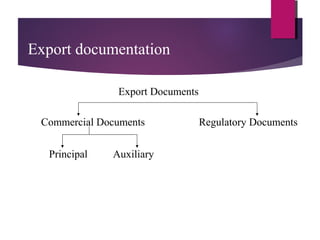
Export Documents
Commercial Documents Regulatory Documents
Principal Auxiliary
Export documentation
Principal documents are
1. The Commercial Invoice,
2. Packing List
3. Bill of Lading/Air Waybill
4. Certificate of Inspection/Quality control
5. Certificate of origin
6. Bill of Exchange and
7. Shipment Advice
8. Insurance Certificate
Export documentation
The auxiliary documents are
1. Proforma Invoice
2. Intimation for inspection
3. Shipping instructions
4. Insurance Declaration
5. Application for certificate of origin.
6. Letter to bank of collection/negotiation of
documents
EXPORT DOCUMENTATION
 These documents are prepared by the exporter
 Invoices - Commercial, Pro -forma
 Packing Lists - Dock, or Warehouse, Receipt
 Certificates of Origin (C/O
 Declaration of Dangerous Goods (DGD)
 Certificates - Insurance, Inspection
 Miscellaneous: Letters of Credit
Pro-forma invoice
It is an invoice sent to
the buyer before the shipment, giving the buyer a chance to
review the sale terms (quantity of goods, value, specifications)
It also allows the buyer to work with their bank to arrange
any financial process for payment. For example, to open a
Documentary Credit (Letter of Credit), the buyer’s bank will
use the pro-forma invoice as a source of information.
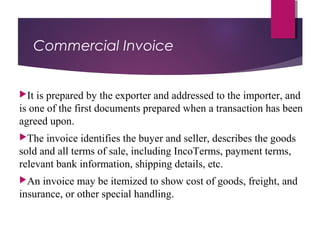
Commercial Invoice
It is prepared by the exporter and addressed to the importer, and
is one of the first documents prepared when a transaction has been
agreed upon.
The invoice identifies the buyer and seller, describes the goods
sold and all terms of sale, including IncoTerms, payment terms,
relevant bank information, shipping details, etc.
An invoice may be itemized to show cost of goods, freight, and
insurance, or other special handling.
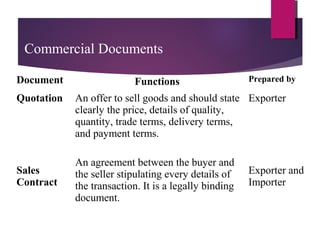
Document Functions Prepared by
Quotation
Sales
Contract
An offer to sell goods and should state
clearly the price, details of quality,
quantity, trade terms, delivery terms,
and payment terms.
An agreement between the buyer and
the seller stipulating every details of
the transaction. It is a legally binding
document.
Exporter
Exporter and
Importer
Commercial Documents
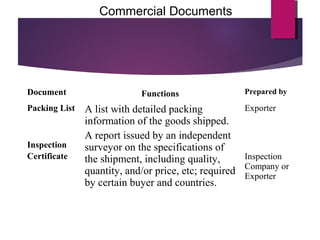
Document Functions Prepared by
Packing List
Inspection
Certificate
A list with detailed packing
information of the goods shipped.
A report issued by an independent
surveyor on the specifications of
the shipment, including quality,
quantity, and/or price, etc; required
by certain buyer and countries.
Exporter
Inspection
Company or
Exporter
Commercial Documents
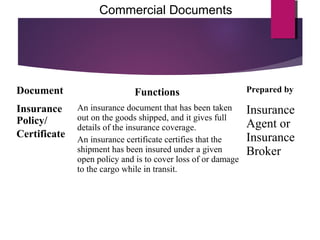
Document Functions Prepared by
Insurance
Policy/
Certificate
An insurance document that has been taken
out on the goods shipped, and it gives full
details of the insurance coverage.
An insurance certificate certifies that the
shipment has been insured under a given
open policy and is to cover loss of or damage
to the cargo while in transit.
Insurance
Agent or
Insurance
Broker
Commercial Documents
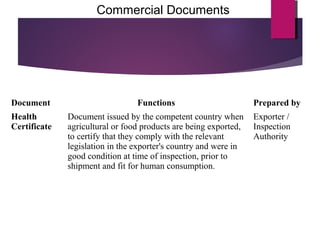
Document Functions Prepared by
Health
Certificate
Document issued by the competent country when
agricultural or food products are being exported,
to certify that they comply with the relevant
legislation in the exporter's country and were in
good condition at time of inspection, prior to
shipment and fit for human consumption.
Exporter /
Inspection
Authority
Commercial Documents
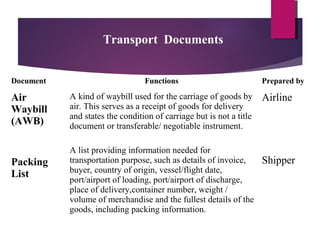
Document Functions Prepared by
Air
Waybill
(AWB)
Packing
List
A kind of waybill used for the carriage of goods by
air. This serves as a receipt of goods for delivery
and states the condition of carriage but is not a title
document or transferable/ negotiable instrument.
A list providing information needed for
transportation purpose, such as details of invoice,
buyer, country of origin, vessel/flight date,
port/airport of loading, port/airport of discharge,
place of delivery,container number, weight /
volume of merchandise and the fullest details of the
goods, including packing information.
Airline
Shipper
Transport Documents
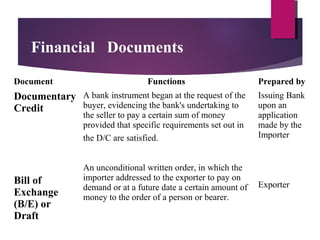
Document Functions Prepared by
Documentary
Credit
Bill of
Exchange
(B/E) or
Draft
A bank instrument began at the request of the
buyer, evidencing the bank's undertaking to
the seller to pay a certain sum of money
provided that specific requirements set out in
the D/C are satisfied.
An unconditional written order, in which the
importer addressed to the exporter to pay on
demand or at a future date a certain amount of
money to the order of a person or bearer.
Issuing Bank
upon an
application
made by the
Importer
Exporter
Financial Documents
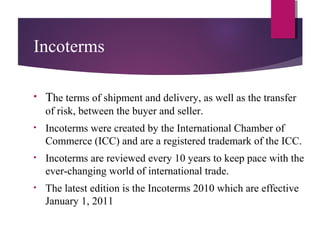
Incoterms
• The terms of shipment and delivery, as well as the transfer
of risk, between the buyer and seller.
• Incoterms were created by the International Chamber of
Commerce (ICC) and are a registered trademark of the ICC.
• Incoterms are reviewed every 10 years to keep pace with the
ever-changing world of international trade.
• The latest edition is the Incoterms 2010 which are effective
January 1, 2011
New changes
 The number of categories reduced from four to two in new
Incoterms – 2011
 These two categories are :
 Terms for any mode or modes of transport
 Term for sea and domestic waterway transport
 These Consists of following terms
 CIP - CARRIAGE AND INSURANCE PAID TO
 CPT - CARRIAGE PAID TO
 DAT - DELIVERED AT TERMINAL
 FCA - FREE CARRIER
 EXW - EX WORKS
 All of these terms need to specify the port or destination
 CIP - CARRIAGE AND INSURANCE PAID TO
 The Seller pays for moving the goods to destination. From the time
the goods are despatched.
 Seller, however, purchases the goods insurance.
 CPT - CARRIAGE PAID TO
 The Seller pays for moving the goods to destination. From the time
the goods are transferred to the first transporter, the Buyer bears the
risks of loss or damage.
 DAT - DELIVERED AT TERMINAL
 The Seller delivers when the goods, once unloaded from the arriving means
of transport, are placed at the Buyer's terminal.
 The Seller bears all risks involved in bringing the goods to and unloading
them at the terminal at the named port or place of destination.
 DAP - DELIVERED AT PLACE
 The Seller delivers when the goods are placed at the Buyer's clearance The
Seller bears all risks involved in bringing the goods to the named place.
 FCA - FREE CARRIER
The Seller delivers the goods, cleared for export, to the transporter
selected by the Buyer. The Seller loads the goods if the carrier pickup is
at the Seller's premises. From that point, the Buyer bears the costs and
risks of moving the goods to destination.
EXW - EX WORKS
The Seller's only responsibility is to make the goods available at the
Seller's premises. The Buyer bears full costs and risks of moving the
goods from there to destination.
CFR - COST AND FREIGHT
The Seller clears the goods for export and pays the costs of moving the
goods to destination. The Buyer bears all risks of loss or damage
CIF - COST INSURANCE AND FREIGHT
The Seller clears the goods for export and pays the costs of moving the
goods to the port of destination. The Buyer bears all risks of loss or damage.
The Seller, however, purchases the cargo insurance.
 METHODS OF PAYMENT IN INTERNATIONALTRADE:
 For exporters, any sale is a gift until payment is received.
 Exporters want to receive payment as soon as possible, preferably as
soon as an order is placed or before the goods are sent to the
importer.
 For importers, any payment is a donation until the goods are
received.
 Importers want to receive the goods as soon as possible but to delay
payment as long as possible, preferably until after the goods are
resold to generate enough income to pay the exporter.
 CASH IN ADVANCE / PREPAYMENTS:
 With cash-in-advance payment terms, the exporter can avoid
credit risk because payment is received before the ownership of
the goods is transferred.
 Foreign buyers are also concerned that the goods may not be sent
if payment is made in advance.
 LETTERS OF CREDIT: Letters of credit (LCs) are one of the most
secure instruments available to international traders.
 An LC is a commitment by a bank on behalf of the buyer that
payment will be made to the exporter, provided that the terms and
conditions stated in the LC have been met, as verified through the
presentation of all required documents.
 The buyer pays his or her bank to render this service.
 An LC also protects the buyer because no payment obligation arises
until the goods have been shipped or delivered as promised.
 OPEN ACCOUNT:
 An open account transaction is a sale where the goods are
shipped and delivered before payment is due, which is
usually in 30 to 90 days.
 This option is the most advantageous option to the importer
in terms of cash flow and cost, but it is consequently the
highest risk option for an exporter.
 TYPES OF LETTER OF CREDIT
 Irrevocable and revocable letters of credit
 Revocable can be changed or cancelled by the bank that
issued it at any time and for any reason.
 An irrevocable letter of credit cannot be changed or
cancelled unless everyone involved agrees. Irrevocable
letters of credit provide more security than revocable
ones.
 Transferable letters of credit :
 A transferable letter of credit can be passed from one
beneficiary (person receiving payment) to others.
 They are commonly used when intermediaries are involved
in a transaction.
 Revolving LC
 It is used for regular shipments of the same commodity to the
same importer. It can revolve in relation to time or value.
 If the credit is time revolving once utilized it is re-instated for
further regular shipments until the credit is fully drawn.
 They are useful to avoid the need for repetitious arrangements
for opening or amending letters of credit.
Transport Documents used in
International Trade
 In international trade, the goods move from the warehouse
of the exporter to the warehouse of the importer.
 The goods may move by land water or air or a combination
of one or more of these modes.
 In international trade, such transport documents are more in
number and it is very important to know the significance of
each type of document.
 Bill of Lading
 This is a transport document, which represents the
movement of goods by water.
 A Bill of Lading is a formal receipt given by a ship owner
or their authorized agents stating that the goods mentioned
therein (quantity, quality, description etc.) are shipped on a
specified date and vessel and are deliverable to the person
mentioned therein or to his order after payment of all dues
of the shipping company.
 Air Waybills (AWBs) are consignment notes for air-
freight.
 They act as a receipt for the goods “in apparent good
order and condition” and are also evidence of a contract
between the exporter and the carrier(s).
 Unlike Bills of Lading, AWBs are not documents of title,
so that the holder does not necessarily have ownership of
the goods. The consignee can claim the goods on arrival
merely by quoting the AWB number.
EXPORT DOCUMENTATION

EXPORT DOCUMENTATION

  • 1.
  • 2.
    Documentation  Documentation requirementsvary considerably by country, commodity, and situations.  Documents outline the sale, shipment, and responsibilities of each party so that the full transaction is understood and complete without delay or additional costs.
  • 3.
    Factors to consider Country of origin and destination  Mode of transportation - truck, rail, ocean, air, pipeline  Commodity - agriculture, livestock, safety/security  Size-value, volume, weight, dimensions  Parties to the transaction-shipper,agents, brokers, banks
  • 4.
    Export Documents Commercial DocumentsRegulatory Documents Principal Auxiliary Export documentation
  • 5.
    Principal documents are 1.The Commercial Invoice, 2. Packing List 3. Bill of Lading/Air Waybill 4. Certificate of Inspection/Quality control 5. Certificate of origin 6. Bill of Exchange and 7. Shipment Advice 8. Insurance Certificate Export documentation
  • 6.
    The auxiliary documentsare 1. Proforma Invoice 2. Intimation for inspection 3. Shipping instructions 4. Insurance Declaration 5. Application for certificate of origin. 6. Letter to bank of collection/negotiation of documents EXPORT DOCUMENTATION
  • 7.
     These documentsare prepared by the exporter  Invoices - Commercial, Pro -forma  Packing Lists - Dock, or Warehouse, Receipt  Certificates of Origin (C/O  Declaration of Dangerous Goods (DGD)  Certificates - Insurance, Inspection  Miscellaneous: Letters of Credit
  • 8.
    Pro-forma invoice It isan invoice sent to the buyer before the shipment, giving the buyer a chance to review the sale terms (quantity of goods, value, specifications) It also allows the buyer to work with their bank to arrange any financial process for payment. For example, to open a Documentary Credit (Letter of Credit), the buyer’s bank will use the pro-forma invoice as a source of information.
  • 9.
    Commercial Invoice It isprepared by the exporter and addressed to the importer, and is one of the first documents prepared when a transaction has been agreed upon. The invoice identifies the buyer and seller, describes the goods sold and all terms of sale, including IncoTerms, payment terms, relevant bank information, shipping details, etc. An invoice may be itemized to show cost of goods, freight, and insurance, or other special handling.
  • 10.
    Document Functions Preparedby Quotation Sales Contract An offer to sell goods and should state clearly the price, details of quality, quantity, trade terms, delivery terms, and payment terms. An agreement between the buyer and the seller stipulating every details of the transaction. It is a legally binding document. Exporter Exporter and Importer Commercial Documents
  • 11.
    Document Functions Preparedby Packing List Inspection Certificate A list with detailed packing information of the goods shipped. A report issued by an independent surveyor on the specifications of the shipment, including quality, quantity, and/or price, etc; required by certain buyer and countries. Exporter Inspection Company or Exporter Commercial Documents
  • 12.
    Document Functions Preparedby Insurance Policy/ Certificate An insurance document that has been taken out on the goods shipped, and it gives full details of the insurance coverage. An insurance certificate certifies that the shipment has been insured under a given open policy and is to cover loss of or damage to the cargo while in transit. Insurance Agent or Insurance Broker Commercial Documents
  • 13.
    Document Functions Preparedby Health Certificate Document issued by the competent country when agricultural or food products are being exported, to certify that they comply with the relevant legislation in the exporter's country and were in good condition at time of inspection, prior to shipment and fit for human consumption. Exporter / Inspection Authority Commercial Documents
  • 14.
    Document Functions Preparedby Air Waybill (AWB) Packing List A kind of waybill used for the carriage of goods by air. This serves as a receipt of goods for delivery and states the condition of carriage but is not a title document or transferable/ negotiable instrument. A list providing information needed for transportation purpose, such as details of invoice, buyer, country of origin, vessel/flight date, port/airport of loading, port/airport of discharge, place of delivery,container number, weight / volume of merchandise and the fullest details of the goods, including packing information. Airline Shipper Transport Documents
  • 15.
    Document Functions Preparedby Documentary Credit Bill of Exchange (B/E) or Draft A bank instrument began at the request of the buyer, evidencing the bank's undertaking to the seller to pay a certain sum of money provided that specific requirements set out in the D/C are satisfied. An unconditional written order, in which the importer addressed to the exporter to pay on demand or at a future date a certain amount of money to the order of a person or bearer. Issuing Bank upon an application made by the Importer Exporter Financial Documents
  • 16.
    Incoterms • The termsof shipment and delivery, as well as the transfer of risk, between the buyer and seller. • Incoterms were created by the International Chamber of Commerce (ICC) and are a registered trademark of the ICC. • Incoterms are reviewed every 10 years to keep pace with the ever-changing world of international trade. • The latest edition is the Incoterms 2010 which are effective January 1, 2011
  • 17.
    New changes  Thenumber of categories reduced from four to two in new Incoterms – 2011  These two categories are :  Terms for any mode or modes of transport  Term for sea and domestic waterway transport
  • 18.
     These Consistsof following terms  CIP - CARRIAGE AND INSURANCE PAID TO  CPT - CARRIAGE PAID TO  DAT - DELIVERED AT TERMINAL  FCA - FREE CARRIER  EXW - EX WORKS  All of these terms need to specify the port or destination
  • 19.
     CIP -CARRIAGE AND INSURANCE PAID TO  The Seller pays for moving the goods to destination. From the time the goods are despatched.  Seller, however, purchases the goods insurance.  CPT - CARRIAGE PAID TO  The Seller pays for moving the goods to destination. From the time the goods are transferred to the first transporter, the Buyer bears the risks of loss or damage.
  • 20.
     DAT -DELIVERED AT TERMINAL  The Seller delivers when the goods, once unloaded from the arriving means of transport, are placed at the Buyer's terminal.  The Seller bears all risks involved in bringing the goods to and unloading them at the terminal at the named port or place of destination.  DAP - DELIVERED AT PLACE  The Seller delivers when the goods are placed at the Buyer's clearance The Seller bears all risks involved in bringing the goods to the named place.
  • 21.
     FCA -FREE CARRIER The Seller delivers the goods, cleared for export, to the transporter selected by the Buyer. The Seller loads the goods if the carrier pickup is at the Seller's premises. From that point, the Buyer bears the costs and risks of moving the goods to destination. EXW - EX WORKS The Seller's only responsibility is to make the goods available at the Seller's premises. The Buyer bears full costs and risks of moving the goods from there to destination.
  • 22.
    CFR - COSTAND FREIGHT The Seller clears the goods for export and pays the costs of moving the goods to destination. The Buyer bears all risks of loss or damage CIF - COST INSURANCE AND FREIGHT The Seller clears the goods for export and pays the costs of moving the goods to the port of destination. The Buyer bears all risks of loss or damage. The Seller, however, purchases the cargo insurance.
  • 23.
     METHODS OFPAYMENT IN INTERNATIONALTRADE:  For exporters, any sale is a gift until payment is received.  Exporters want to receive payment as soon as possible, preferably as soon as an order is placed or before the goods are sent to the importer.  For importers, any payment is a donation until the goods are received.  Importers want to receive the goods as soon as possible but to delay payment as long as possible, preferably until after the goods are resold to generate enough income to pay the exporter.
  • 24.
     CASH INADVANCE / PREPAYMENTS:  With cash-in-advance payment terms, the exporter can avoid credit risk because payment is received before the ownership of the goods is transferred.  Foreign buyers are also concerned that the goods may not be sent if payment is made in advance.
  • 25.
     LETTERS OFCREDIT: Letters of credit (LCs) are one of the most secure instruments available to international traders.  An LC is a commitment by a bank on behalf of the buyer that payment will be made to the exporter, provided that the terms and conditions stated in the LC have been met, as verified through the presentation of all required documents.  The buyer pays his or her bank to render this service.  An LC also protects the buyer because no payment obligation arises until the goods have been shipped or delivered as promised.
  • 26.
     OPEN ACCOUNT: An open account transaction is a sale where the goods are shipped and delivered before payment is due, which is usually in 30 to 90 days.  This option is the most advantageous option to the importer in terms of cash flow and cost, but it is consequently the highest risk option for an exporter.
  • 27.
     TYPES OFLETTER OF CREDIT  Irrevocable and revocable letters of credit  Revocable can be changed or cancelled by the bank that issued it at any time and for any reason.  An irrevocable letter of credit cannot be changed or cancelled unless everyone involved agrees. Irrevocable letters of credit provide more security than revocable ones.
  • 28.
     Transferable lettersof credit :  A transferable letter of credit can be passed from one beneficiary (person receiving payment) to others.  They are commonly used when intermediaries are involved in a transaction.
  • 29.
     Revolving LC It is used for regular shipments of the same commodity to the same importer. It can revolve in relation to time or value.  If the credit is time revolving once utilized it is re-instated for further regular shipments until the credit is fully drawn.  They are useful to avoid the need for repetitious arrangements for opening or amending letters of credit.
  • 30.
    Transport Documents usedin International Trade  In international trade, the goods move from the warehouse of the exporter to the warehouse of the importer.  The goods may move by land water or air or a combination of one or more of these modes.  In international trade, such transport documents are more in number and it is very important to know the significance of each type of document.
  • 31.
     Bill ofLading  This is a transport document, which represents the movement of goods by water.  A Bill of Lading is a formal receipt given by a ship owner or their authorized agents stating that the goods mentioned therein (quantity, quality, description etc.) are shipped on a specified date and vessel and are deliverable to the person mentioned therein or to his order after payment of all dues of the shipping company.
  • 32.
     Air Waybills(AWBs) are consignment notes for air- freight.  They act as a receipt for the goods “in apparent good order and condition” and are also evidence of a contract between the exporter and the carrier(s).  Unlike Bills of Lading, AWBs are not documents of title, so that the holder does not necessarily have ownership of the goods. The consignee can claim the goods on arrival merely by quoting the AWB number.