MODULE - 7
RECENT TRENDS IN INDIA’S FOREIGN
TRADE
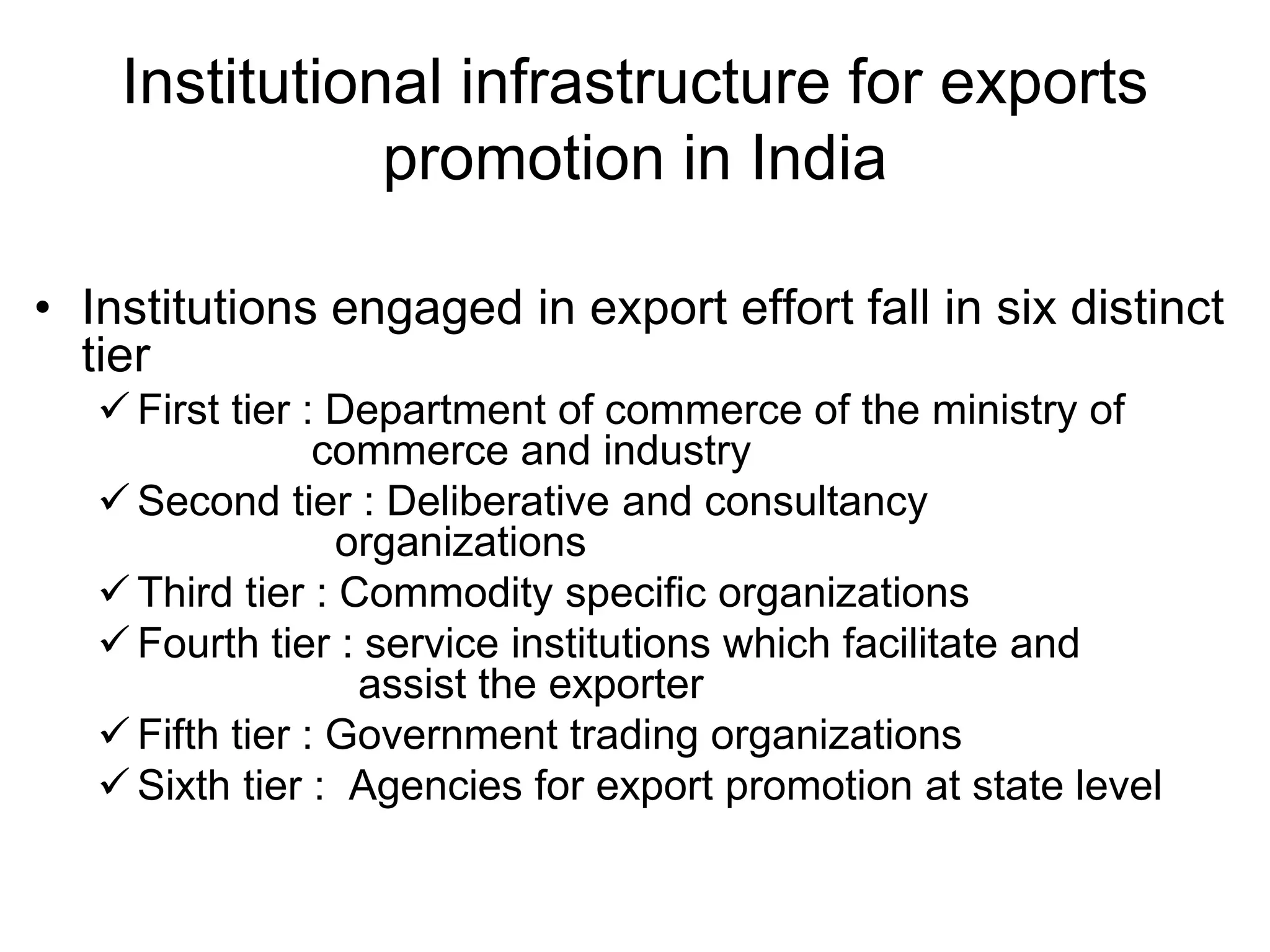
Institutional infrastructure for exports
promotion in India
• Institutions engaged in export effort fall in six distinct
tier
 First tier : Department of commerce of the ministry of
commerce and industry
 Second tier : Deliberative and consultancy
organizations
 Third tier : Commodity specific organizations
 Fourth tier : service institutions which facilitate and
assist the exporter
 Fifth tier : Government trading organizations
 Sixth tier : Agencies for export promotion at state level
Export-Import Bank (EXIM Bank)
• EXIM bank was established on Jan 1, 1982
for the purpose of financing, facilitating and
promoting foreign trade of India.
• It extends finance to exporters of capital and
manufactured goods, exporters of software
and consultancy services and to overseas
joint ventures and turnkey/construction
projects abroad.
India’s trade policy
• Trade policy of a country refers to the set of
policies which govern the external sector of its
economy.
• The twin objectives of India’s trade policy
have been to promote exports and to restrict
the level of imports to the level of foreign
exchange available to the government.
Export policy - Objectives
• To earn adequate foreign exchange to
finance the required volume of imports.
• To supplement domestic demand for
increasing employment opportunities.
• To raise unit value realization by promoting
exports of value added items.
• To impose minimum price regulation where
inter se competition is serve
• To impose controls when domestic
availability is less than adequate.
Import policy - Objectives
• To use the available foreign exchange
according to national priorities.
• Allocate the foreign exchange that capacity
utilization is maximized.
• To grant protection to domestic industries.
• To maintain price stability.
Significance of some Export Documents
1. Commercial invoice:
– It contains all the information which is required for
the preparation of all other documents.
• Details of Product category
• Price charged
• The terms of shipment
• Numbers on package
• Name, address of both buyer and seller
• Name of shipping vessel
• The port of debarkation
Cont…
2. GR form- This form has been prescribed by
the reserve bank of India under FERA to
ensure that the foreign exchange receipts in
respect of exports are repatriated to India.
3. Letter of Credit
Through the instrument of letter of credit, the
promise to pay usually made by the overseas
importer is submitted by the promise to pay by
bank.
Cont…
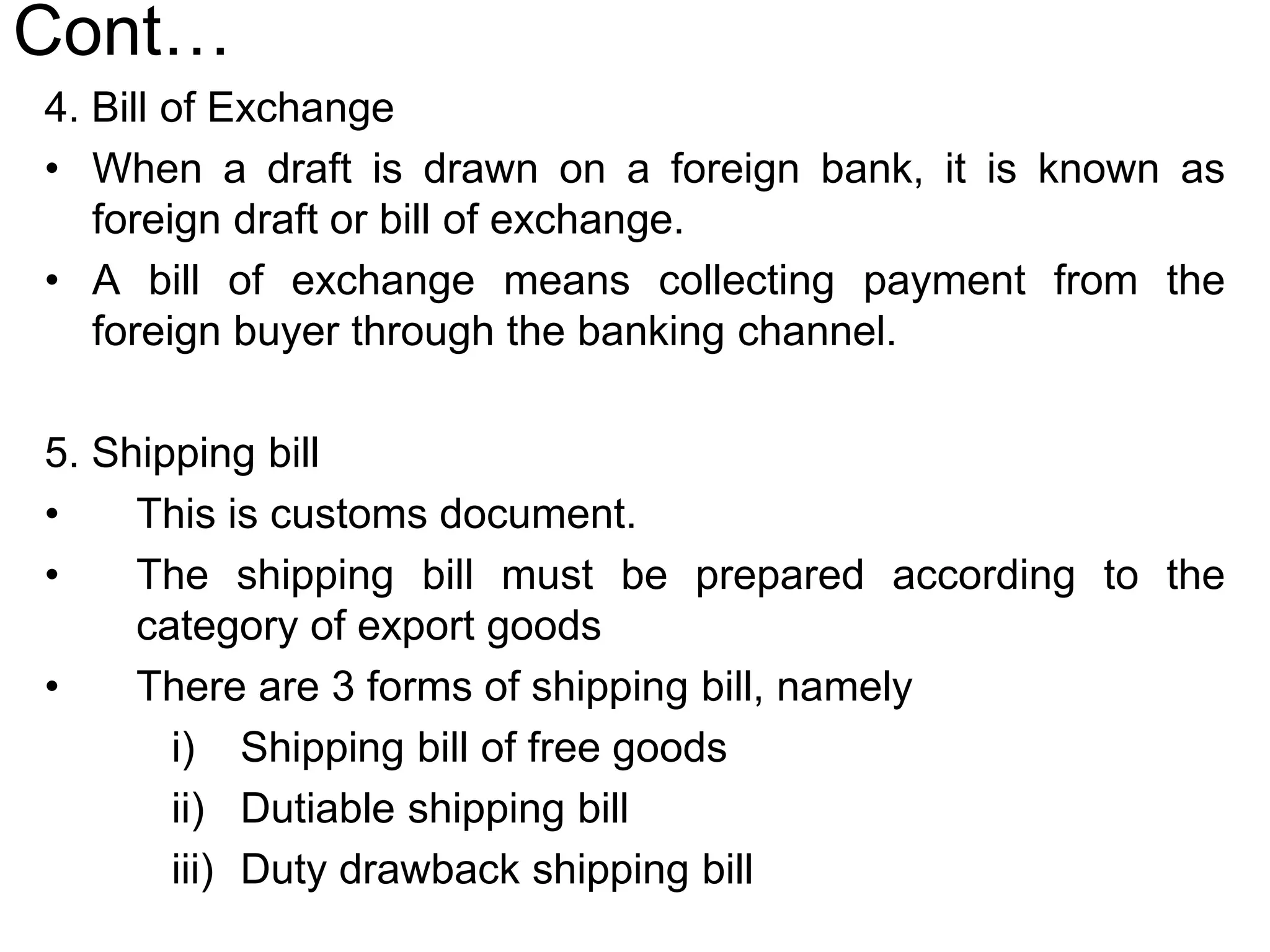
4. Bill of Exchange
• When a draft is drawn on a foreign bank, it is known as
foreign draft or bill of exchange.
• A bill of exchange means collecting payment from the
foreign buyer through the banking channel.
5. Shipping bill
• This is customs document.
• The shipping bill must be prepared according to the
category of export goods
• There are 3 forms of shipping bill, namely
i) Shipping bill of free goods
ii) Dutiable shipping bill
iii) Duty drawback shipping bill
Cont…
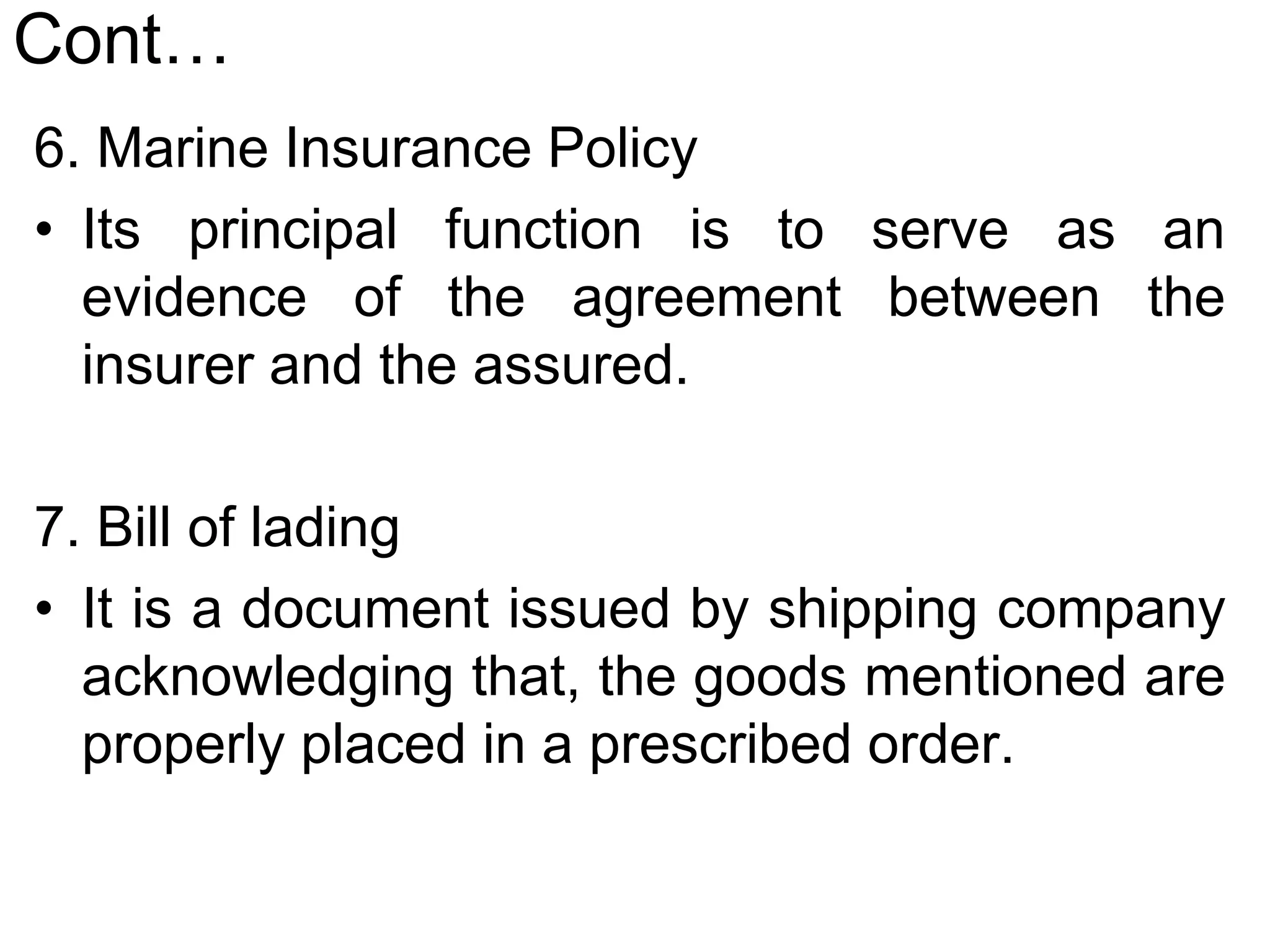
6. Marine Insurance Policy
• Its principal function is to serve as an
evidence of the agreement between the
insurer and the assured.
7. Bill of lading
• It is a document issued by shipping company
acknowledging that, the goods mentioned are
properly placed in a prescribed order.
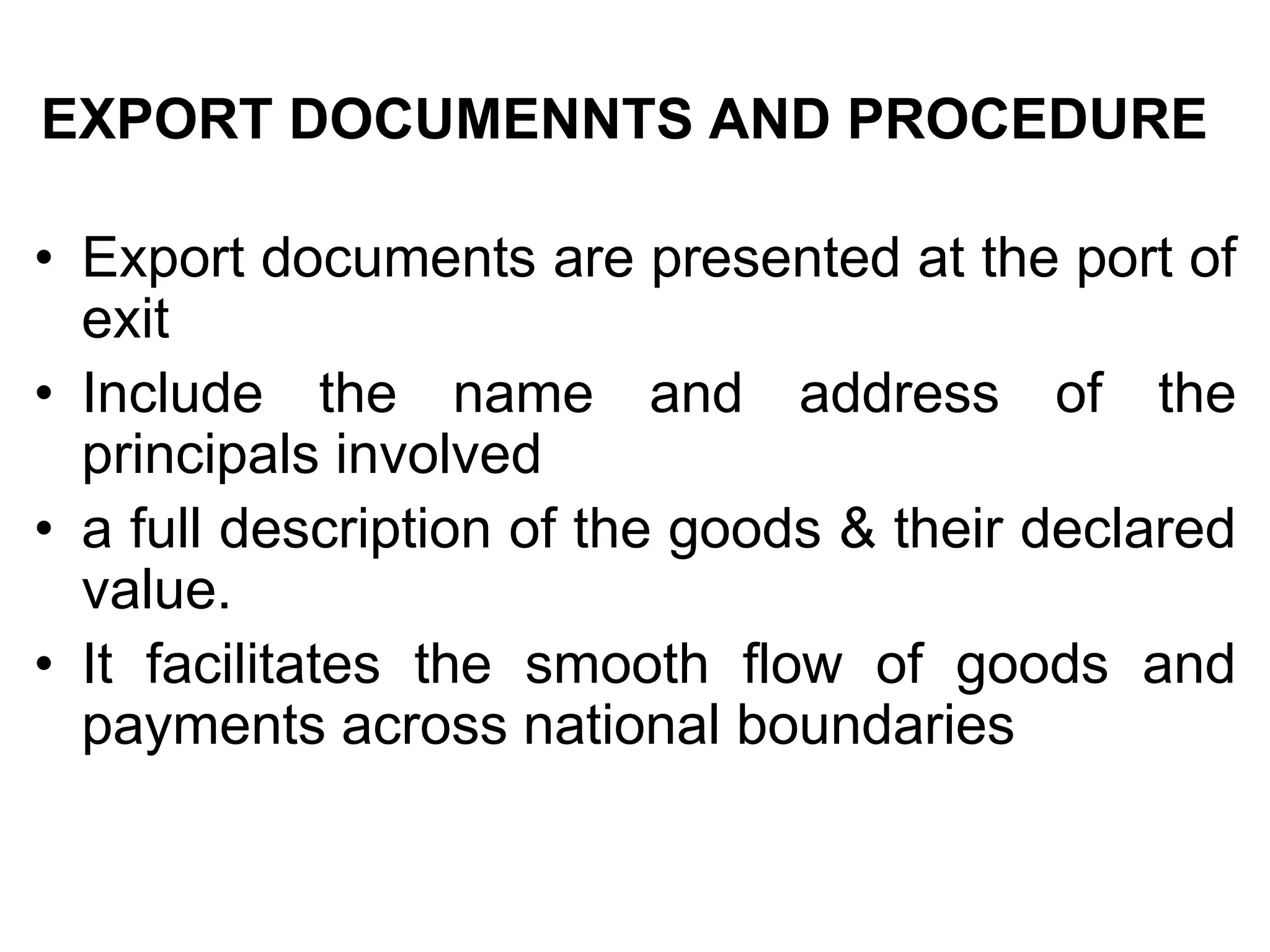
EXPORT DOCUMENNTS AND PROCEDURE
• Export documents are presented at the port of
exit
• Include the name and address of the
principals involved
• a full description of the goods & their declared
value.
• It facilitates the smooth flow of goods and
payments across national boundaries
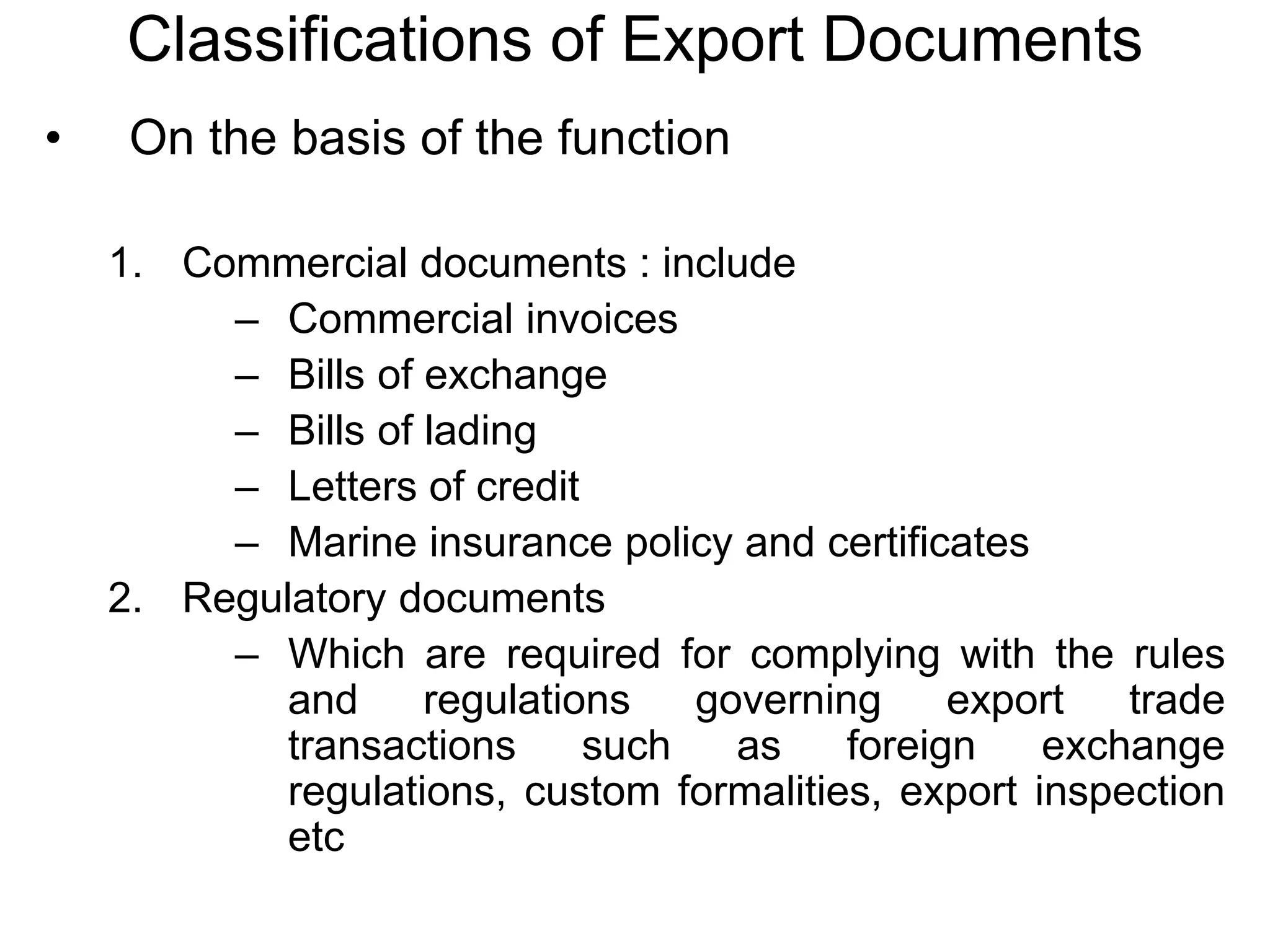
Classifications of Export Documents
• On the basis of the function
1. Commercial documents : include
– Commercial invoices
– Bills of exchange
– Bills of lading
– Letters of credit
– Marine insurance policy and certificates
2. Regulatory documents
– Which are required for complying with the rules
and regulations governing export trade
transactions such as foreign exchange
regulations, custom formalities, export inspection
etc
Cont…
3. Export assistance documents
– Require for climbing assistance
4. Documentation required by importing
countries
– Required to satisfy the requirement of his
government.
– Include certificate of origin, consular invoice,
quality control etc,.
• On the basis of specific requirements
1. Regulatory documents
– An exporter has to fallow strictly the regulations of
both the exporting country as well as that of
importing country
2. Operational document
– Shipping bill
– Commercial invoices
– Packing list
– Insurance policy
Processing of an export order
• Why is an Export order processed?
– An export order has to be processed to meet
the requirements of materials required by the
importers.
– Export order must be processed quickly so
that the buyer can receive the material on
time, as per their delivery schedule
First stage
• Scrutinize the export order with reference to
the terms and conditions of the contract.
• Ensure that contract enter according to foreign
exchange regulations.
• Export order must specify the mode of
payment.
Second stage
• After export order has been confirmed,
preparation for the dispatch of goods are
started.
• A ‘delivery note’ (in duplicate) containing
description of the goods along with the copy
of the instruction given by the importer is
sent to the work manager or the factory
manager.
• Time margin also intimated to the works
manager.
Third stage
• As soon as the goods have been
manufactured or procured, the fallowing
procedures are to be followed
1. The clearance of the excise authorities has to
be obtained
2. Approach Export Inspection Agency for
conducting quality control and pre-shipment
inspection .
3. If the goods are dispatched to the port of
shipment by railway, Railway Receipt is
obtained.
Fourth stage
• After goods have been despatched to the port
town, the works manager send a ‘despatch
advice’ to the Export department.
• After, an application is sent to the insurance
company for marine insurance cover.
• All formalities relation to floor price
regulations, certificate of origin, consular
invoice etc,.. should be completed.
Fifth stage
• The clearing and forwarding agent takes
delivery of the consignment from the
railways and arrange its storage in the
warehouse.
Sixth stage
• After the shipping bill has been passed by the
customs, the clearing and forwarding agent
presents the port trust copy of the shipping
bill to the Shed Superintendent of the port
trust and obtain carting order for bringing the
export cargo in the transit shed for physical
examination.

IMM_mod_7.ppt

  • 1.
    MODULE - 7 RECENTTRENDS IN INDIA’S FOREIGN TRADE
  • 2.
    Institutional infrastructure forexports promotion in India • Institutions engaged in export effort fall in six distinct tier  First tier : Department of commerce of the ministry of commerce and industry  Second tier : Deliberative and consultancy organizations  Third tier : Commodity specific organizations  Fourth tier : service institutions which facilitate and assist the exporter  Fifth tier : Government trading organizations  Sixth tier : Agencies for export promotion at state level
  • 3.
    Export-Import Bank (EXIMBank) • EXIM bank was established on Jan 1, 1982 for the purpose of financing, facilitating and promoting foreign trade of India. • It extends finance to exporters of capital and manufactured goods, exporters of software and consultancy services and to overseas joint ventures and turnkey/construction projects abroad.
  • 4.
    India’s trade policy •Trade policy of a country refers to the set of policies which govern the external sector of its economy. • The twin objectives of India’s trade policy have been to promote exports and to restrict the level of imports to the level of foreign exchange available to the government.
  • 5.
    Export policy -Objectives • To earn adequate foreign exchange to finance the required volume of imports. • To supplement domestic demand for increasing employment opportunities. • To raise unit value realization by promoting exports of value added items. • To impose minimum price regulation where inter se competition is serve • To impose controls when domestic availability is less than adequate.
  • 6.
    Import policy -Objectives • To use the available foreign exchange according to national priorities. • Allocate the foreign exchange that capacity utilization is maximized. • To grant protection to domestic industries. • To maintain price stability.
  • 7.
    Significance of someExport Documents 1. Commercial invoice: – It contains all the information which is required for the preparation of all other documents. • Details of Product category • Price charged • The terms of shipment • Numbers on package • Name, address of both buyer and seller • Name of shipping vessel • The port of debarkation
  • 8.
    Cont… 2. GR form-This form has been prescribed by the reserve bank of India under FERA to ensure that the foreign exchange receipts in respect of exports are repatriated to India. 3. Letter of Credit Through the instrument of letter of credit, the promise to pay usually made by the overseas importer is submitted by the promise to pay by bank.
  • 9.
    Cont… 4. Bill ofExchange • When a draft is drawn on a foreign bank, it is known as foreign draft or bill of exchange. • A bill of exchange means collecting payment from the foreign buyer through the banking channel. 5. Shipping bill • This is customs document. • The shipping bill must be prepared according to the category of export goods • There are 3 forms of shipping bill, namely i) Shipping bill of free goods ii) Dutiable shipping bill iii) Duty drawback shipping bill
  • 10.
    Cont… 6. Marine InsurancePolicy • Its principal function is to serve as an evidence of the agreement between the insurer and the assured. 7. Bill of lading • It is a document issued by shipping company acknowledging that, the goods mentioned are properly placed in a prescribed order.
  • 11.
    EXPORT DOCUMENNTS ANDPROCEDURE • Export documents are presented at the port of exit • Include the name and address of the principals involved • a full description of the goods & their declared value. • It facilitates the smooth flow of goods and payments across national boundaries
  • 12.
    Classifications of ExportDocuments • On the basis of the function 1. Commercial documents : include – Commercial invoices – Bills of exchange – Bills of lading – Letters of credit – Marine insurance policy and certificates 2. Regulatory documents – Which are required for complying with the rules and regulations governing export trade transactions such as foreign exchange regulations, custom formalities, export inspection etc
  • 13.
    Cont… 3. Export assistancedocuments – Require for climbing assistance 4. Documentation required by importing countries – Required to satisfy the requirement of his government. – Include certificate of origin, consular invoice, quality control etc,.
  • 14.
    • On thebasis of specific requirements 1. Regulatory documents – An exporter has to fallow strictly the regulations of both the exporting country as well as that of importing country 2. Operational document – Shipping bill – Commercial invoices – Packing list – Insurance policy
  • 15.
    Processing of anexport order • Why is an Export order processed? – An export order has to be processed to meet the requirements of materials required by the importers. – Export order must be processed quickly so that the buyer can receive the material on time, as per their delivery schedule
  • 16.
    First stage • Scrutinizethe export order with reference to the terms and conditions of the contract. • Ensure that contract enter according to foreign exchange regulations. • Export order must specify the mode of payment.
  • 17.
    Second stage • Afterexport order has been confirmed, preparation for the dispatch of goods are started. • A ‘delivery note’ (in duplicate) containing description of the goods along with the copy of the instruction given by the importer is sent to the work manager or the factory manager. • Time margin also intimated to the works manager.
  • 18.
    Third stage • Assoon as the goods have been manufactured or procured, the fallowing procedures are to be followed 1. The clearance of the excise authorities has to be obtained 2. Approach Export Inspection Agency for conducting quality control and pre-shipment inspection . 3. If the goods are dispatched to the port of shipment by railway, Railway Receipt is obtained.
  • 19.
    Fourth stage • Aftergoods have been despatched to the port town, the works manager send a ‘despatch advice’ to the Export department. • After, an application is sent to the insurance company for marine insurance cover. • All formalities relation to floor price regulations, certificate of origin, consular invoice etc,.. should be completed.
  • 20.
    Fifth stage • Theclearing and forwarding agent takes delivery of the consignment from the railways and arrange its storage in the warehouse.
  • 21.
    Sixth stage • Afterthe shipping bill has been passed by the customs, the clearing and forwarding agent presents the port trust copy of the shipping bill to the Shed Superintendent of the port trust and obtain carting order for bringing the export cargo in the transit shed for physical examination.