Members of Group 7 
 Samantha Masters 
 Cresent Ferguson 
 Narda England 
 Kacy-Ann Troupe 
 Kevin Oram 
 Nyelia Doyley 
 Adia Martin 
 Shavon Drysdale
What is the Bill of Lading? 
 The Bill of Lading of is a document that 
establishes the terms of contract between 
a shipper and a transportation company. 
(Glossary of Port and Shipping Terms, 2014) 
 The Bill of lading is one of the most 
important documents in the shipping 
industry.
Some important functions of the bill of 
lading are: 
 It is used as a proof of receipt of shipment 
by the carrier 
 It is a document of title 
 It is used as evidence for a contract of 
carriage
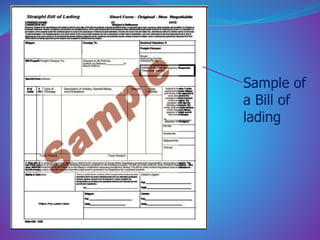
Sample of 
a Bill of 
lading
History of the Bill of lading 
The Bill of Lading is preceded by: 
 The Medieval Law Merchant 
 The Lex Mercatoria (New Law Merchant).
 The Bill of lading was invented in the 13th 
century 
 Its functions were gradually created by the 
practical needs of substantial and tangible 
evidence of contract for all primary parties 
(i.e. shipper, carrier and consignee) 
alongside technical development over 
time.
 It is widely accepted that Italy is the 
birthplace of the bill of lading, because of 
the growing economies of the Italian city 
states due to the sea commerce between 
Italy and the Roman Empire in 
Constantinople. 
 Its first copy was written in 1564.
The initial functions of the bill of lading 
during its inception were: 
 A receipt for goods received by master or 
ship owners, 
 contract of carriage between shipper and 
carrier, 
 negotiable document of title. 

 The Bill of lading became necessary when 
merchants stopped travelling on board 
ships with their goods.
Evolution of the Bill of Lading 
 Evidence of the evolution of the bill of 
lading can be seen in the revision of The 
Hague rules to the Hague-Visby rules 
(which both influenced the terms of 
contract included on the bills of lading.)
 Additional advancement can be seen in the 
numerous conventions established and 
their constant revisions as well as the 
creation of electronic bills of lading, even 
though there has been much resistance 
towards it.
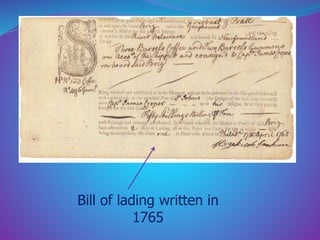
Bill of lading written in 
1765
Formalization of the Bill of 
lading 
 Ocean trade in the United States and 
Britain depended heavily on British Ship 
Owners. 
 A point of crisis was reached between 
these two domains concerning the struggle 
between ship owning and cargo interest.
 As a result, legislations were amended to 
remove the chaos and abuse produced by 
unlimited freedom of contract. 
 After considerable discussion amongst 
major actors of the maritime nation, a set 
of rules were drafted by the maritime law 
committee of the international law 
association at a meeting held in Hague 
1921.
 These rules came to be known as the 
Hague rules which constituted the various 
Bills of lading. 
 The rules were amended in London at a 
CMI (Comite Maritime International) 
conference in 1922.
 Further amendment was made at an 
international convention in Brussels, 1922. 
 Eventually an International Convention 
was ultimately signed on August 25, 1924, 
at which time the Bill of Lading became a 
formal document of the Mercantile System.
Reference 
Organization as Author 
 Seine Maritime. (2003). Glossary of Port and Shipping 
Terms. Retrieved from: http://www.seinemaritime.net/ 
 United Nations Conference on Trade and Development. 
(2013). Review of Maritime Transport. Retrieved from : 
http://unctad.org/en/publicationslibrary/rmt2013_en.pdf 
Unknown Author 
 How to Import Export. (2014). Importance of Bill of 
lading in international trade. Retrieved from: 
http://howtoexportimport.com/3-Reasons-under- 
Importance-of-bill-of-lading-in-in-45.aspx
Article in Journal Paginated by Volume 
 Sweet, A.S. (2006). The new Lex Mercatoria and 
transnational governance. Journal of European Public 
Policy, 13, 627 –646. Retrieved from: 
file:///C:/Users/SAM/Documents/COLLEGE%20NOTES/Co 
mmercial%20Shipping/LexMercatoriaTransnationalgovern 
ance.pdf

History of the Bill of Lading : An Overview

  • 2.
    Members of Group7  Samantha Masters  Cresent Ferguson  Narda England  Kacy-Ann Troupe  Kevin Oram  Nyelia Doyley  Adia Martin  Shavon Drysdale
  • 3.
    What is theBill of Lading?  The Bill of Lading of is a document that establishes the terms of contract between a shipper and a transportation company. (Glossary of Port and Shipping Terms, 2014)  The Bill of lading is one of the most important documents in the shipping industry.
  • 4.
    Some important functionsof the bill of lading are:  It is used as a proof of receipt of shipment by the carrier  It is a document of title  It is used as evidence for a contract of carriage
  • 5.
    Sample of aBill of lading
  • 6.
    History of theBill of lading The Bill of Lading is preceded by:  The Medieval Law Merchant  The Lex Mercatoria (New Law Merchant).
  • 7.
     The Billof lading was invented in the 13th century  Its functions were gradually created by the practical needs of substantial and tangible evidence of contract for all primary parties (i.e. shipper, carrier and consignee) alongside technical development over time.
  • 8.
     It iswidely accepted that Italy is the birthplace of the bill of lading, because of the growing economies of the Italian city states due to the sea commerce between Italy and the Roman Empire in Constantinople.  Its first copy was written in 1564.
  • 9.
    The initial functionsof the bill of lading during its inception were:  A receipt for goods received by master or ship owners,  contract of carriage between shipper and carrier,  negotiable document of title. 
  • 10.
     The Billof lading became necessary when merchants stopped travelling on board ships with their goods.
  • 11.
    Evolution of theBill of Lading  Evidence of the evolution of the bill of lading can be seen in the revision of The Hague rules to the Hague-Visby rules (which both influenced the terms of contract included on the bills of lading.)
  • 12.
     Additional advancementcan be seen in the numerous conventions established and their constant revisions as well as the creation of electronic bills of lading, even though there has been much resistance towards it.
  • 13.
    Bill of ladingwritten in 1765
  • 14.
    Formalization of theBill of lading  Ocean trade in the United States and Britain depended heavily on British Ship Owners.  A point of crisis was reached between these two domains concerning the struggle between ship owning and cargo interest.
  • 15.
     As aresult, legislations were amended to remove the chaos and abuse produced by unlimited freedom of contract.  After considerable discussion amongst major actors of the maritime nation, a set of rules were drafted by the maritime law committee of the international law association at a meeting held in Hague 1921.
  • 16.
     These rulescame to be known as the Hague rules which constituted the various Bills of lading.  The rules were amended in London at a CMI (Comite Maritime International) conference in 1922.
  • 17.
     Further amendmentwas made at an international convention in Brussels, 1922.  Eventually an International Convention was ultimately signed on August 25, 1924, at which time the Bill of Lading became a formal document of the Mercantile System.
  • 18.
    Reference Organization asAuthor  Seine Maritime. (2003). Glossary of Port and Shipping Terms. Retrieved from: http://www.seinemaritime.net/  United Nations Conference on Trade and Development. (2013). Review of Maritime Transport. Retrieved from : http://unctad.org/en/publicationslibrary/rmt2013_en.pdf Unknown Author  How to Import Export. (2014). Importance of Bill of lading in international trade. Retrieved from: http://howtoexportimport.com/3-Reasons-under- Importance-of-bill-of-lading-in-in-45.aspx
  • 19.
    Article in JournalPaginated by Volume  Sweet, A.S. (2006). The new Lex Mercatoria and transnational governance. Journal of European Public Policy, 13, 627 –646. Retrieved from: file:///C:/Users/SAM/Documents/COLLEGE%20NOTES/Co mmercial%20Shipping/LexMercatoriaTransnationalgovern ance.pdf