EXPORT IMPORT
&
CARGO
By Prabhash Sharma
Section – B
KAMATRADE & EXPO
CONCEPT & IMPORTANCE OF TRADE
 TRADE – Transfer of goods or services from one person or entity to another.
 INTERNATIONAL TRADE – The exchange of capital, goods, and services across
international borders or territories.
 FREE TRADE – laissez-faire, a policy by which a government does not
discriminate against imports or interfere with exports by applying tariffs (to imports)
or subsidies (to exports).
 TRADE PROTECTIONISM – A type of policy that limits unfair competition from
foreign industries. It's a politically motivated defensive measure.
 COMPETITION POLICY – Applying rules to make sure businesses and
companies compete fairly with each other. Its benefit include Low price, Better
Quality, More Choice, creation of employment, Promotion of Innovation etc.
FUNDAMENTAL OBJECTIVE OF REGULATORY
REFORM
 To infuse dynamic efficiency (3 conditions)
1. Existence of near- Perfect competition among producers
2. All consumers are fully informed
3. low switching cost – It refers to cost a consumer incurs while switching from one
option to another.
INCOTERMS (International Commercial Terms)
 Pre-defined commercial terms published by the international chamber of commerce
(ICC) these are widely used in international commercial transactions. First published
in 1936.
 It defines the responsibilities of exporters and importers in the arrangement of
shipment and the transfer of liability involved at various stages of the transactions.
 TABLE: -
INCOTERMS INCOTERMS
DAP – Delivered at Place FCA – Free Carrier
CIF – Cost, Insurance & Fright DDP – Delivered Duty Paid
DAT – Delivered at Terminal EEI – Electronic Export Information
FCA – Free Carrier CIP – Carriage and Insurance Paid
EXW CPT – Carriage Paid to
Export & Import
 Export –shipping the goods and services out of the port of a country. seller of such
goods and services is referred to as an "exporter“.
 Import – A good or service brought into one country from another. One who imports
goods and services from another country is known as importer.
Export Process
Establish an
organisation
Open a bank
account PAN CARD IEC
RCMC
{Registration cum
membership
certificate}
Product
Selection
Market
SelectionFind Buyers
Sampling Pricing/
Costing
Negotiation
with buyers
Covering Risks
through ECGC
PROCESSING AN EXPORT ORDER
Confirmati
on of order
Procureme
nt of goods
Quality
Control
Finance
Labelling,
packaging,
marketing
Insurance
Delivery
Customs
Procedure CHA
Documen
tation
Submission of
documents to
bank
Realisation
of export
proceeds
EXPORT DOCUMENTATION
 25 documents Pre-shipment stage to export transaction these documents are
categorised in to 2 types, Commercial & Regulatory.
 2 master documents are prepared one for commercial and another for Regulatory.
Export Documentation
(25)
Commercial
(16)
Regulatory
(9)
DOCUMENTS
 Aligned documentation system – An Exporter’s compulsion to prepare separately a
number of documents all containing practically same information.
The following 16 commercial documents are generally involved for pre shipment stage.
Proforma Invoice, Commercial Invoice, Packing List, Shipping Instruction, Intimation of
Inspection, Certificate of inspection, Insurance declaration, Certificate of insurance,
Shipping order, Mate’s Receipt, Bill of lading/ combined transport document, Application
for certificate of origin, Bill of exchange, Shipment Advice, Letter to bank for collection/
Negotiation of documents.
The following 9 regulatory documents are generally involved for pre shipment stage.
Gate pass 1/ 2- deleted now, AR-4 form, Shipping bill/ Bill of export, Export application/
Dock challan/ Port trust copy of shipping bill, Receipt of payment of port charges, Vehicle
chit, Exchange control Declaration (GRIPP) Forms, Freight payment certificate, Insurance
premium payment certificate
FORMS
 GR FORM {Guaranteed Remittance}
 PP FORM {Parcel Post}
 VP COD {Value Payable}
 Export Declaration Form
 Export Invoice {Bill by Exporter}
 Proforma Invoice
 Commercial Invoice {Documents of Contents}
 Packaging List
 Mates Receipt {Given by Captain of ship}
 Bill of Lading
 Certificate of Origin
 Shipping bill
IMPORT OF GOODS
 Import of unrestricted items
 Import of restricted items – apply for import licence under negative list.
 Import of Capital goods
CUSTOM CLEARANCE PROCEDURE FOR
IMPORTED GOODS
 Import Manifest {Sec 30, Customs Act 1962} – Must be submitted 24 hrs of the
arrival of the shipment.
 Entry in the Import Department of customs House – once shipment arrival
information is receive it must be prepared in prescribed format to import department
of customs.
 Presentation of bill of entry for appraisal
 Clearance of Goods
 Warehousing the Goods
 Import Follow-up
IMPORT PROCESS
 Bill of entry is to be prepared
 Self assessment of imported goods – a declaration is given by importer which is
verified by the proper officer.{Risk Management system}
 Examination of goods
 Execution of bonds
 Payment of duty
 Amendment of Bill of Entry
 Prior Entry for Bill of Entry – Before arrival of shipment
 Bill of entry for bond/ warehousing
 Risk Management system
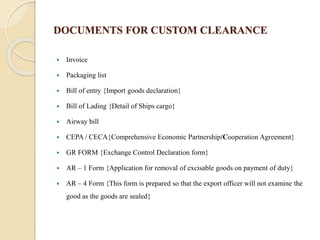
DOCUMENTS FOR CUSTOM CLEARANCE
 Invoice
 Packaging list
 Bill of entry {Import goods declaration}
 Bill of Lading {Detail of Ships cargo}
 Airway bill
 CEPA / CECA{Comprehensive Economic Partnership/Cooperation Agreement}
 GR FORM {Exchange Control Declaration form}
 AR – 1 Form {Application for removal of excisable goods on payment of duty}
 AR – 4 Form {This form is prepared so that the export officer will not examine the
good as the goods are sealed}
Eic

Eic

  • 1.
    EXPORT IMPORT & CARGO By PrabhashSharma Section – B KAMATRADE & EXPO
  • 2.
    CONCEPT & IMPORTANCEOF TRADE  TRADE – Transfer of goods or services from one person or entity to another.  INTERNATIONAL TRADE – The exchange of capital, goods, and services across international borders or territories.  FREE TRADE – laissez-faire, a policy by which a government does not discriminate against imports or interfere with exports by applying tariffs (to imports) or subsidies (to exports).  TRADE PROTECTIONISM – A type of policy that limits unfair competition from foreign industries. It's a politically motivated defensive measure.  COMPETITION POLICY – Applying rules to make sure businesses and companies compete fairly with each other. Its benefit include Low price, Better Quality, More Choice, creation of employment, Promotion of Innovation etc.
  • 3.
    FUNDAMENTAL OBJECTIVE OFREGULATORY REFORM  To infuse dynamic efficiency (3 conditions) 1. Existence of near- Perfect competition among producers 2. All consumers are fully informed 3. low switching cost – It refers to cost a consumer incurs while switching from one option to another.
  • 4.
    INCOTERMS (International CommercialTerms)  Pre-defined commercial terms published by the international chamber of commerce (ICC) these are widely used in international commercial transactions. First published in 1936.  It defines the responsibilities of exporters and importers in the arrangement of shipment and the transfer of liability involved at various stages of the transactions.  TABLE: - INCOTERMS INCOTERMS DAP – Delivered at Place FCA – Free Carrier CIF – Cost, Insurance & Fright DDP – Delivered Duty Paid DAT – Delivered at Terminal EEI – Electronic Export Information FCA – Free Carrier CIP – Carriage and Insurance Paid EXW CPT – Carriage Paid to
  • 5.
    Export & Import Export –shipping the goods and services out of the port of a country. seller of such goods and services is referred to as an "exporter“.  Import – A good or service brought into one country from another. One who imports goods and services from another country is known as importer.
  • 6.
    Export Process Establish an organisation Opena bank account PAN CARD IEC RCMC {Registration cum membership certificate} Product Selection Market SelectionFind Buyers Sampling Pricing/ Costing Negotiation with buyers Covering Risks through ECGC
  • 7.
    PROCESSING AN EXPORTORDER Confirmati on of order Procureme nt of goods Quality Control Finance Labelling, packaging, marketing Insurance Delivery Customs Procedure CHA Documen tation Submission of documents to bank Realisation of export proceeds
  • 8.
    EXPORT DOCUMENTATION  25documents Pre-shipment stage to export transaction these documents are categorised in to 2 types, Commercial & Regulatory.  2 master documents are prepared one for commercial and another for Regulatory. Export Documentation (25) Commercial (16) Regulatory (9)
  • 9.
    DOCUMENTS  Aligned documentationsystem – An Exporter’s compulsion to prepare separately a number of documents all containing practically same information. The following 16 commercial documents are generally involved for pre shipment stage. Proforma Invoice, Commercial Invoice, Packing List, Shipping Instruction, Intimation of Inspection, Certificate of inspection, Insurance declaration, Certificate of insurance, Shipping order, Mate’s Receipt, Bill of lading/ combined transport document, Application for certificate of origin, Bill of exchange, Shipment Advice, Letter to bank for collection/ Negotiation of documents. The following 9 regulatory documents are generally involved for pre shipment stage. Gate pass 1/ 2- deleted now, AR-4 form, Shipping bill/ Bill of export, Export application/ Dock challan/ Port trust copy of shipping bill, Receipt of payment of port charges, Vehicle chit, Exchange control Declaration (GRIPP) Forms, Freight payment certificate, Insurance premium payment certificate
  • 10.
    FORMS  GR FORM{Guaranteed Remittance}  PP FORM {Parcel Post}  VP COD {Value Payable}  Export Declaration Form  Export Invoice {Bill by Exporter}  Proforma Invoice  Commercial Invoice {Documents of Contents}  Packaging List  Mates Receipt {Given by Captain of ship}  Bill of Lading  Certificate of Origin  Shipping bill
  • 11.
    IMPORT OF GOODS Import of unrestricted items  Import of restricted items – apply for import licence under negative list.  Import of Capital goods
  • 12.
    CUSTOM CLEARANCE PROCEDUREFOR IMPORTED GOODS  Import Manifest {Sec 30, Customs Act 1962} – Must be submitted 24 hrs of the arrival of the shipment.  Entry in the Import Department of customs House – once shipment arrival information is receive it must be prepared in prescribed format to import department of customs.  Presentation of bill of entry for appraisal  Clearance of Goods  Warehousing the Goods  Import Follow-up
  • 13.
    IMPORT PROCESS  Billof entry is to be prepared  Self assessment of imported goods – a declaration is given by importer which is verified by the proper officer.{Risk Management system}  Examination of goods  Execution of bonds  Payment of duty  Amendment of Bill of Entry  Prior Entry for Bill of Entry – Before arrival of shipment  Bill of entry for bond/ warehousing  Risk Management system
  • 14.
    DOCUMENTS FOR CUSTOMCLEARANCE  Invoice  Packaging list  Bill of entry {Import goods declaration}  Bill of Lading {Detail of Ships cargo}  Airway bill  CEPA / CECA{Comprehensive Economic Partnership/Cooperation Agreement}  GR FORM {Exchange Control Declaration form}  AR – 1 Form {Application for removal of excisable goods on payment of duty}  AR – 4 Form {This form is prepared so that the export officer will not examine the good as the goods are sealed}