IMPORT
CLEARANCE
PROCEDURE
www.StudsPlanet.com
INTRODUCTION
• All goods imported into India have to pass through the
procedure of customs for proper examination, appraisal,
assessment and evaluation.
• This helps the custom authorities to charge the proper tax
and also check the goods against the illegal import.
• Import is not allowed if the importer doesn’t have the IEC
number issued by the DGFT.
• There is no requirement of IEC number if the goods are
imported for the personal use.
www.StudsPlanet.com
BILL OF ENTRY
A Bill of Entry also known as Shipment Bill
is a statement of the nature and value of goods to
be imported or exported, prepared by the shipper
and presented to a customhouse.
www.StudsPlanet.com
• The importer clearing the goods for domestic consumption has
to file bill of entry in four copies; original and duplicate are
meant for customs, third copy for the importer and the fourth
copy is meant for the bank for making remittances.
• The Bill of entry, where filed, is to be submitted in a set,
different copies meant for different purposes and also given
different color scheme, and on the body of the bill of entry the
purpose for which it will be used is generally mentioned in the
non-EDI declaration.
www.StudsPlanet.com
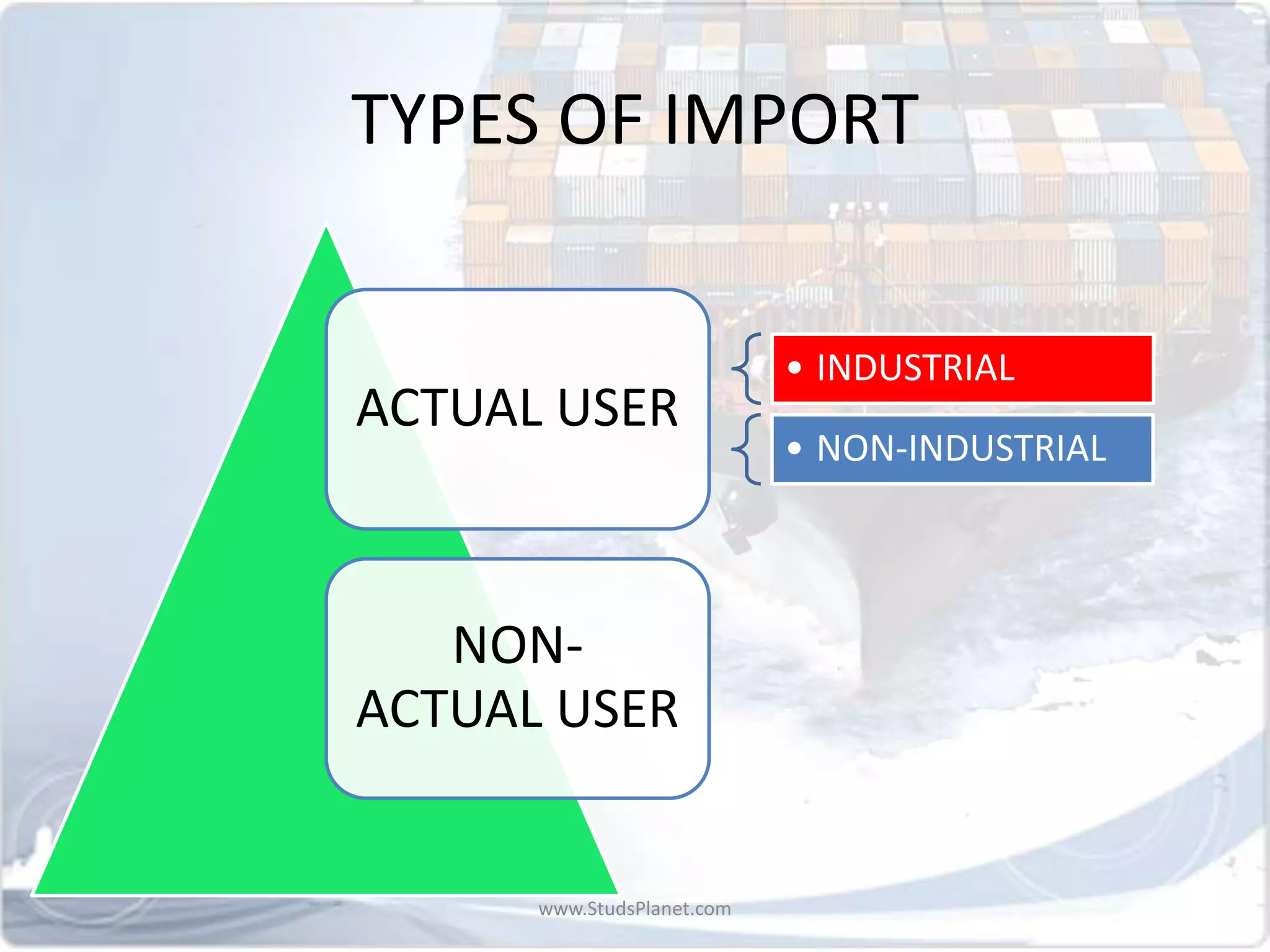
TYPES OF IMPORT
ACTUAL USER
NON-
ACTUAL USER
• INDUSTRIAL
• NON-INDUSTRIAL
www.StudsPlanet.com
IMPORT PROCESS
• What to IMPORT?
• From where to IMPORT(Location)
• From whom to IMPORT(specified supplier)?
• Import contract
• IEC no.
• Import License
• Import finance and clearance
www.StudsPlanet.com
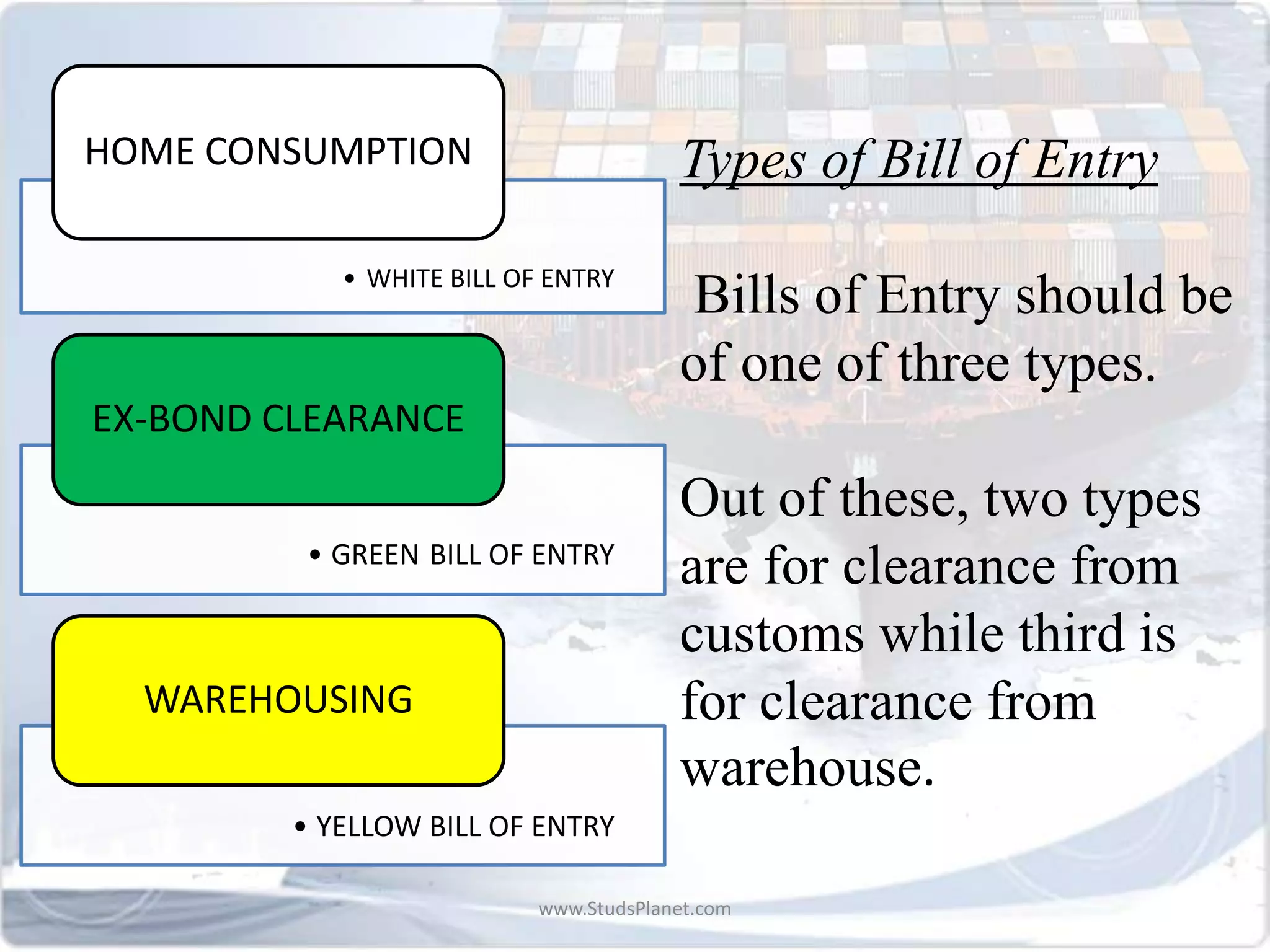
• WHITE BILL OF ENTRY
HOME CONSUMPTION
• GREEN BILL OF ENTRY
EX-BOND CLEARANCE
• YELLOW BILL OF ENTRY
WAREHOUSING
Types of Bill of Entry
Bills of Entry should be
of one of three types.
Out of these, two types
are for clearance from
customs while third is
for clearance from
warehouse.
www.StudsPlanet.com
-
• This form, called ‘Bill of Entry for Home
Consumption’, issued when the imported
goods are to be cleared on payment of full
duty.
• Home consumption means use within India. It
is white colored and hence often called ‘white
bill of entry’.
BILL OF ENTRY FOR HOME CONSUMPTION
www.StudsPlanet.com
• This is used for clearance from the warehouse on
payment of duty and is printed on green paper.
• The goods are classified and value is assessed at the
time of clearance from customs port.
• Thus, value and classification is not required to be
determined in this bill of entry.
• The columns in this bill of entry are similar to other
bills of entry. However, declaration by importer is not
required as the goods are already assessed
BILL OF ENTRY FOR EX-BOND CLEARANCE
www.StudsPlanet.com
• If the imported goods are not required
immediately, importer may like to store the goods in a
warehouse without payment of duty under a bond and
then clear from warehouse when required on payment
of duty.
• This will enable him to defer payment of customs duty
till goods are actually required by him.
• This Bill of Entry is printed on yellow paper and often
called ‘Yellow Bill of Entry’. It is also called ‘Into
Bond Bill of Entry’as bond is executed for transfer of
goods in warehouse without payment of duty.
BILL OF ENTRY FOR WAREHOUSING
www.StudsPlanet.com
Please ask if you are not
cleared with anything!!!
www.StudsPlanet.com
• There are two system mainly used for submission of
Import Documents.
EDI system
– Mainly used in large ports where the system is upgraded with
the help of technology and it makes the things easier.
Non- EDI system
– It is used for not so big ports, may be for the less traffic ports.
Thoka Number (Serial Number) is given while noting the Bill
of Entry.
www.StudsPlanet.com
EDI SYSTEM (used in Large ports)
• If the goods are cleared through the EDI system, no formal Bill of Entry is
filed as it is generated in the computer system,.
• But the importer is required to file a cargo declaration having prescribed
particulars required for processing of the entry for customs clearance.
• Importer should submit declaration in electronic format to ‘Service Centre’.
A signed paper copy of declaration for non-repudiability should be
submitted.
• Bill of Entry number is generated by system which is endorsed on printed
check list.
• Original documents are to be submitted only at the stage of examination.
www.StudsPlanet.com
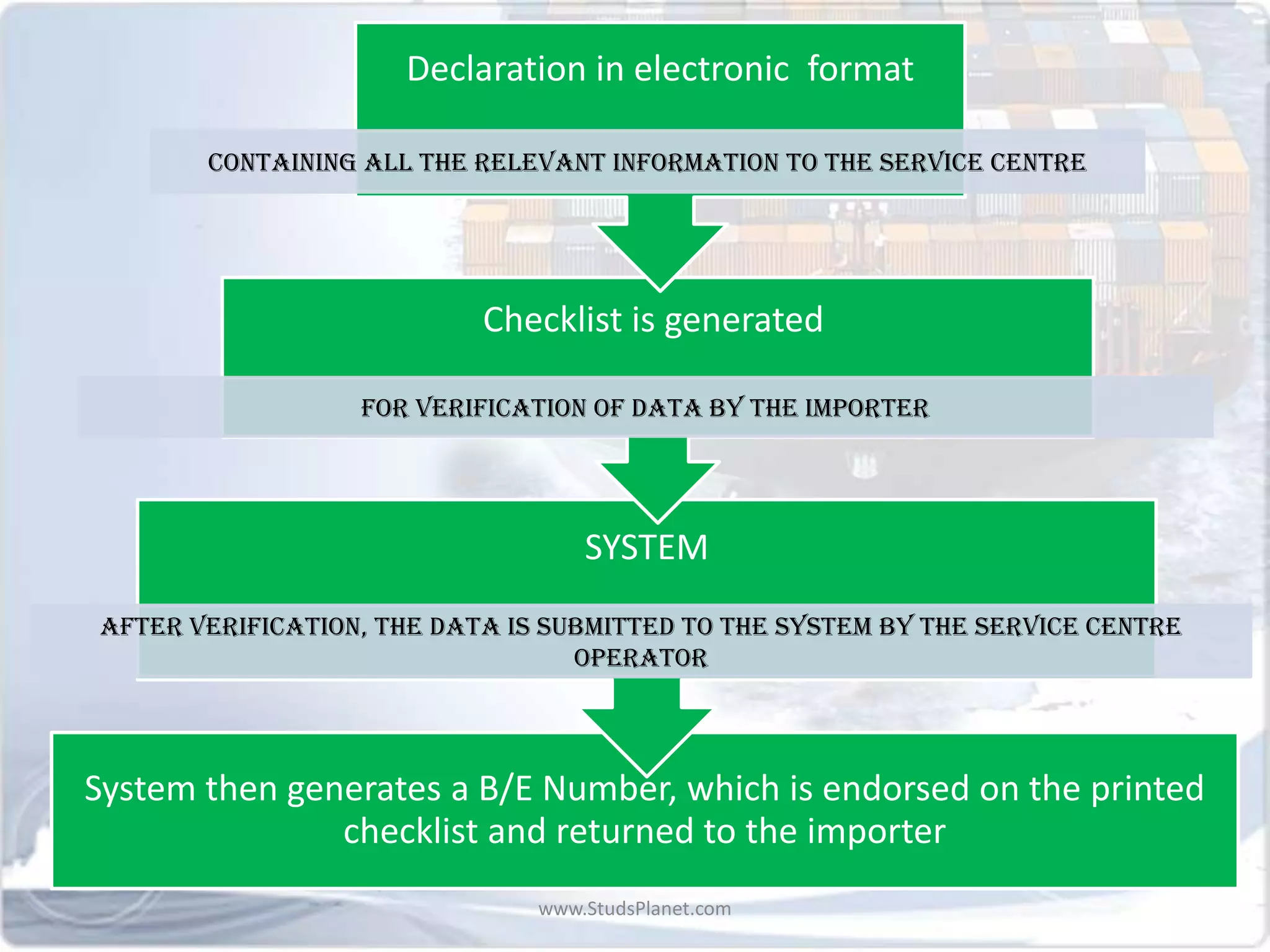
System then generates a B/E Number, which is endorsed on the printed
checklist and returned to the importer
SYSTEM
After verification, the data is submitted to the system by the Service Centre
Operator
Checklist is generated
For verification of data by the importer
Declaration in electronic format
Containing all the relevant information to the Service Centre
www.StudsPlanet.com
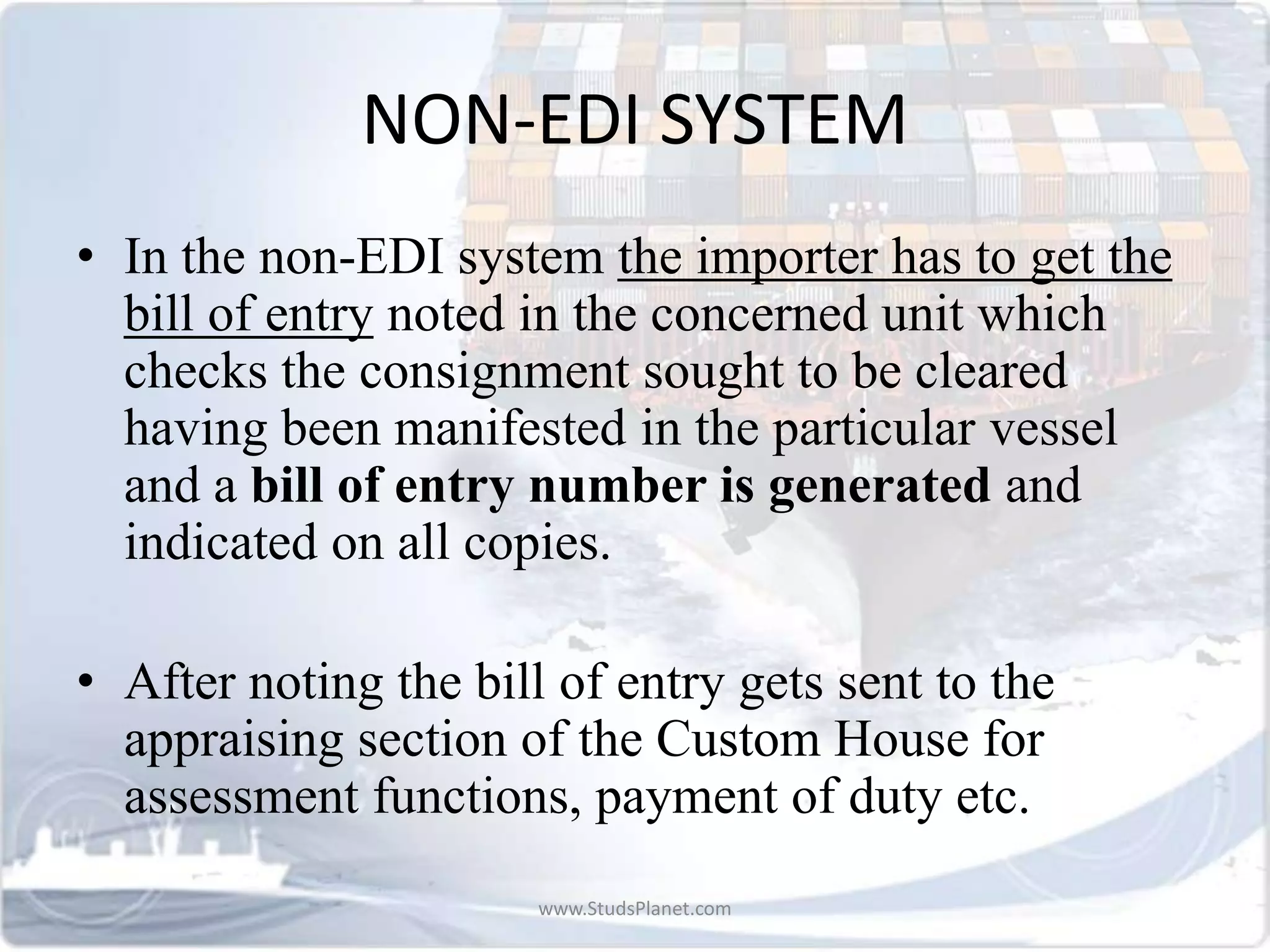
NON-EDI SYSTEM
• In the non-EDI system the importer has to get the
bill of entry noted in the concerned unit which
checks the consignment sought to be cleared
having been manifested in the particular vessel
and a bill of entry number is generated and
indicated on all copies.
• After noting the bill of entry gets sent to the
appraising section of the Custom House for
assessment functions, payment of duty etc.
www.StudsPlanet.com
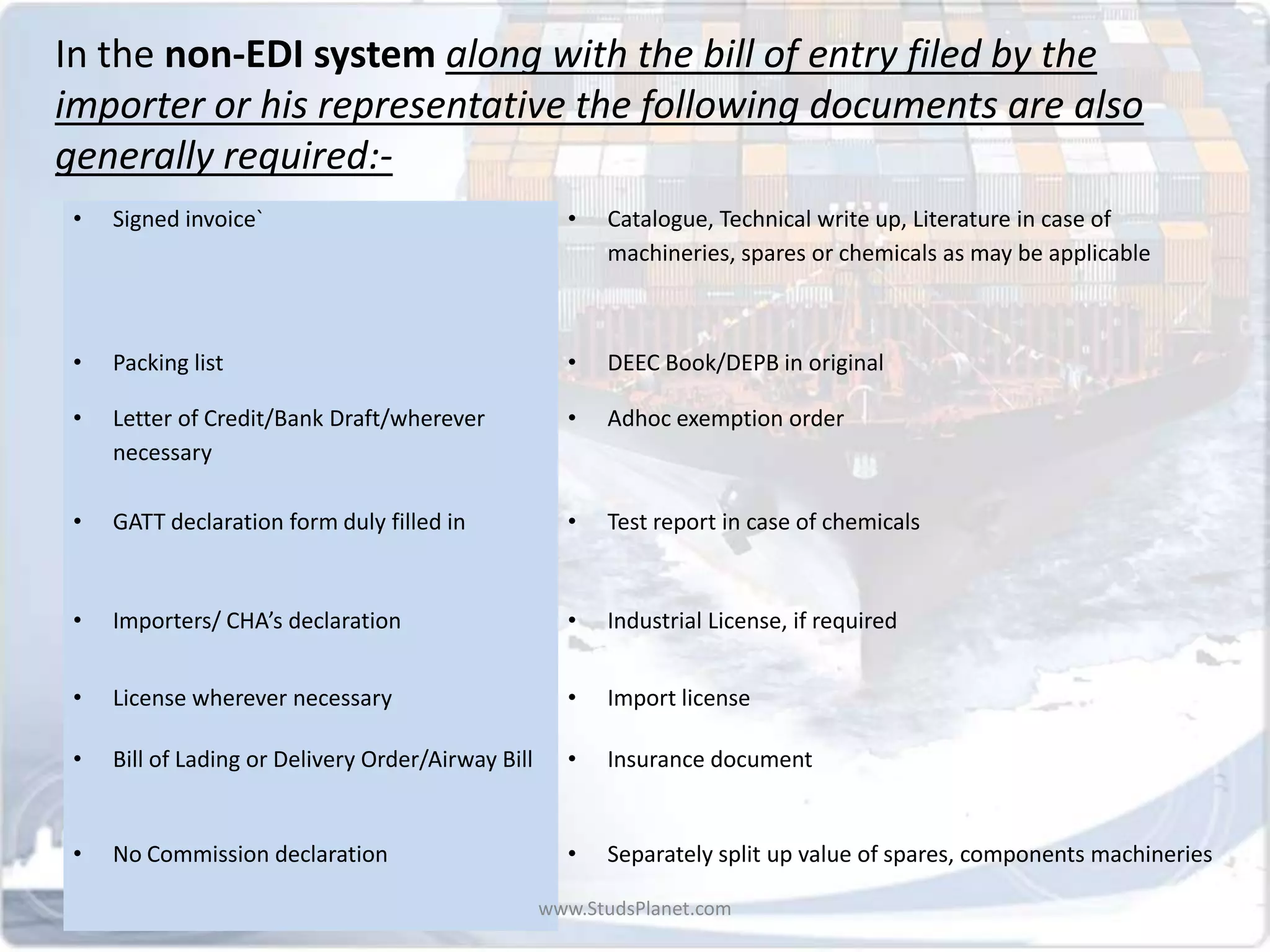
In the non-EDI system along with the bill of entry filed by the
importer or his representative the following documents are also
generally required:-
• Signed invoice` • Catalogue, Technical write up, Literature in case of
machineries, spares or chemicals as may be applicable
• Packing list • DEEC Book/DEPB in original
• Letter of Credit/Bank Draft/wherever
necessary
• Adhoc exemption order
• GATT declaration form duly filled in • Test report in case of chemicals
• Importers/ CHA’s declaration • Industrial License, if required
• License wherever necessary • Import license
• Bill of Lading or Delivery Order/Airway Bill • Insurance document
• No Commission declaration • Separately split up value of spares, components machineries
www.StudsPlanet.com
Don’t break your head.. Ask me 
www.StudsPlanet.com
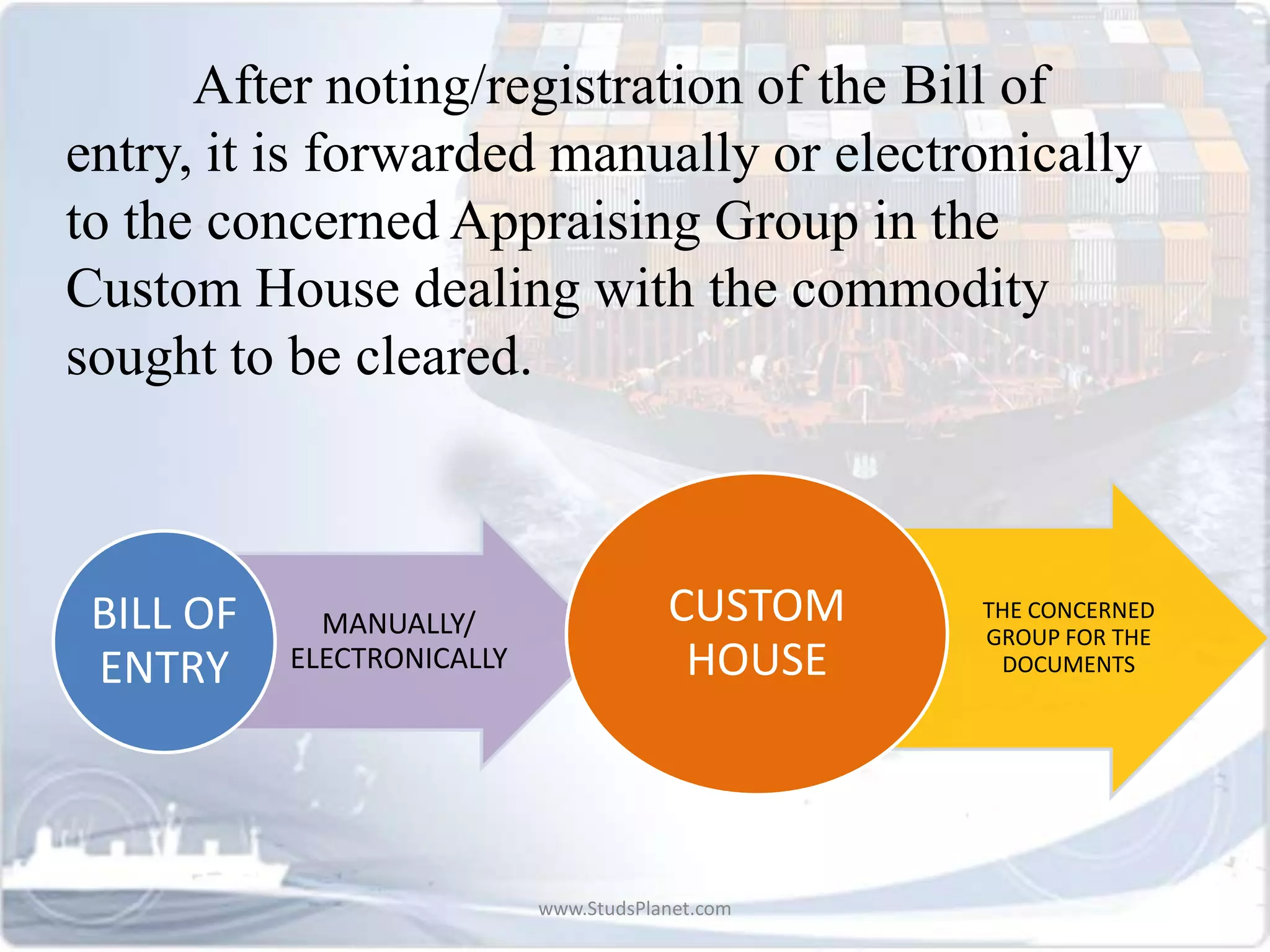
After noting/registration of the Bill of
entry, it is forwarded manually or electronically
to the concerned Appraising Group in the
Custom House dealing with the commodity
sought to be cleared.
MANUALLY/
ELECTRONICALLY
BILL OF
ENTRY
THE CONCERNED
GROUP FOR THE
DOCUMENTS
CUSTOM
HOUSE
www.StudsPlanet.com
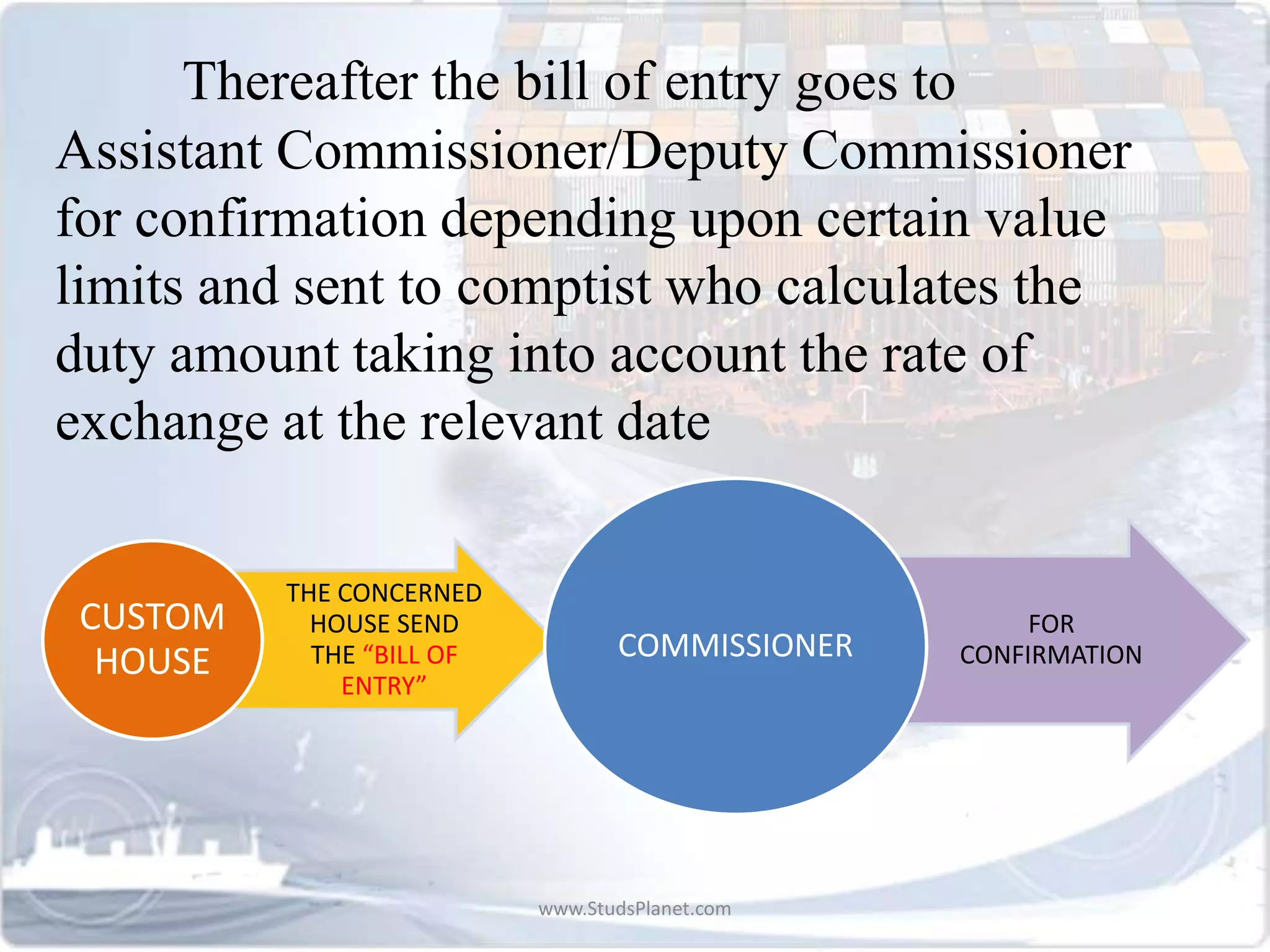
Thereafter the bill of entry goes to
Assistant Commissioner/Deputy Commissioner
for confirmation depending upon certain value
limits and sent to comptist who calculates the
duty amount taking into account the rate of
exchange at the relevant date
THE CONCERNED
HOUSE SEND
THE “BILL OF
ENTRY”
CUSTOM
HOUSE
FOR
CONFIRMATIONCOMMISSIONER
www.StudsPlanet.com
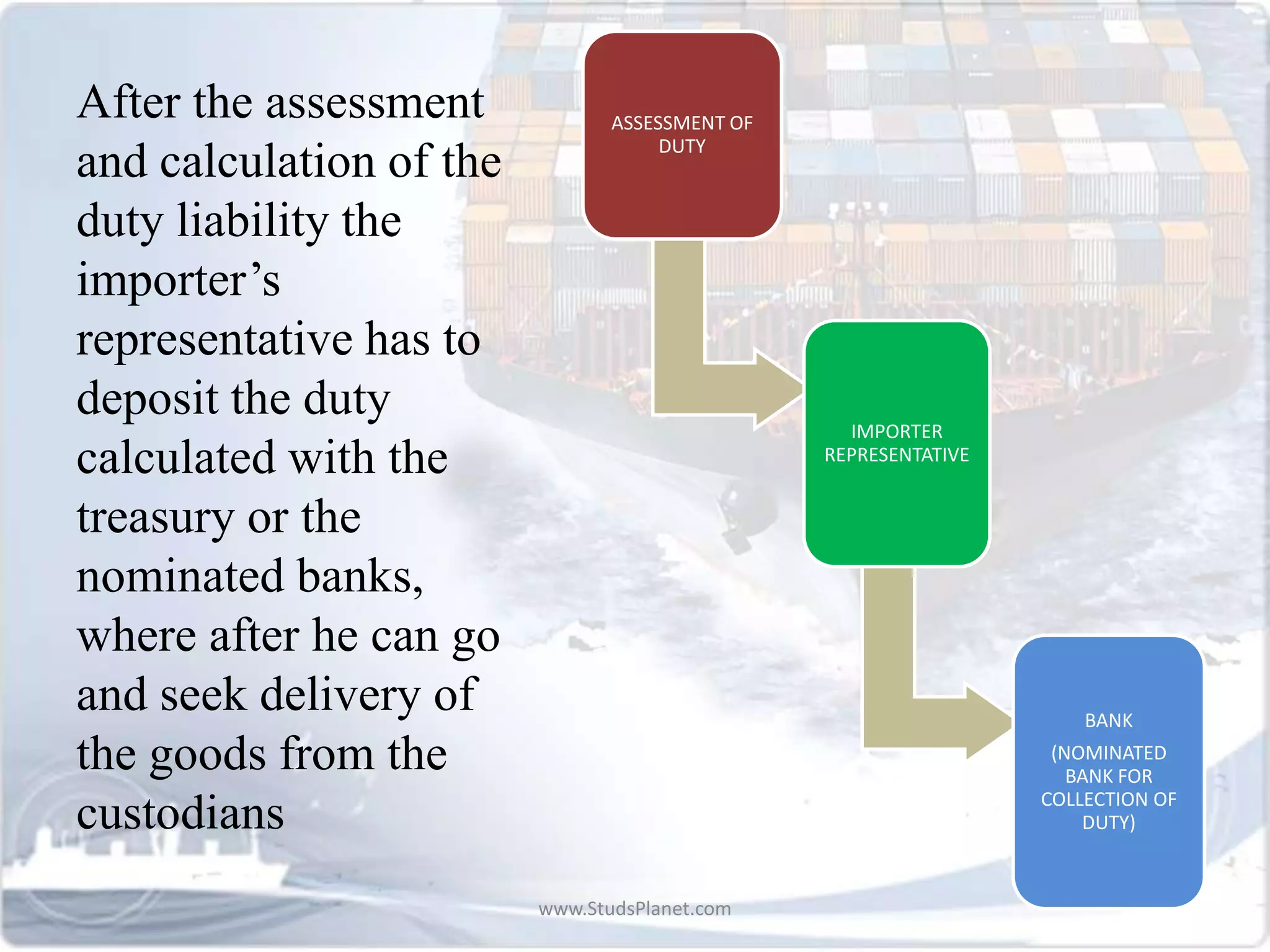
After the assessment
and calculation of the
duty liability the
importer’s
representative has to
deposit the duty
calculated with the
treasury or the
nominated banks,
where after he can go
and seek delivery of
the goods from the
custodians
ASSESSMENT OF
DUTY
IMPORTER
REPRESENTATIVE
BANK
(NOMINATED
BANK FOR
COLLECTION OF
DUTY)
www.StudsPlanet.com
The last step is the delivery of goods from the
warehouse, Where the goods have already been
examined for finalization of classification or valuation
no further examination/checking by the dock appraising
staff is required at the time of giving delivery and the
goods can be taken delivery after taking appropriate
orders and payment of dues to the custodians
www.StudsPlanet.com
You can shoot me with your
questions 
www.StudsPlanet.com
Basic document is
‘Entry’
Entry’ in relation to goods means entry made in Bill of Entry,
Shipping Bill or Bill of Export
Loading and unloading
at specified places only
Imported goods can be unloaded only at specified places. Goods can
be exported only from specified places.
Computerisation of
customs procedures
Customs procedures are largely computerised. Most of documents
have to be e-filed.
Amendment to
documents
Documents submitted to customs can be amended with
permission In case of bill of entry, shipping bill or bill of export, it can
be amended after clearance only on the basis of documentary
evidence which was in existence at the time the goods were cleared,
warehoused or exported, and not on basis of any subsequent
document. [proviso to section 149].
ICD and CFS Imported and export goods are usually handled in containers. These
can be stored in Inland Container Depot (ICD) or Container Freight
Station (CFS). They function like dry port for handling and temporary
storage of imported/export goods and empty containers.
GENERAL PROVISION ABOUT CUSTOM PROCEDURE
www.StudsPlanet.com
www.StudsPlanet.com
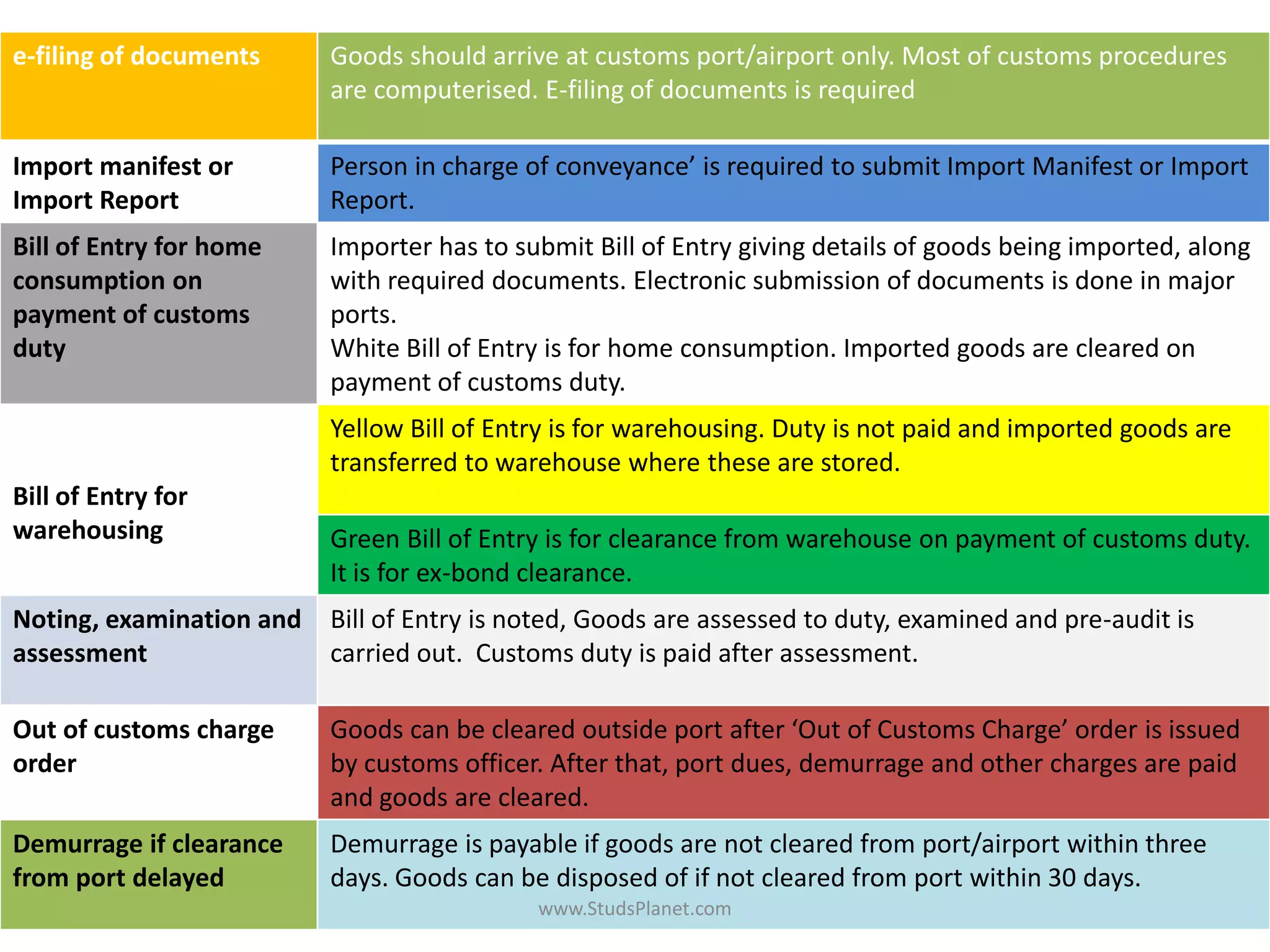
e-filing of documents Goods should arrive at customs port/airport only. Most of customs procedures
are computerised. E-filing of documents is required
Import manifest or
Import Report
Person in charge of conveyance’ is required to submit Import Manifest or Import
Report.
Bill of Entry for home
consumption on
payment of customs
duty
Importer has to submit Bill of Entry giving details of goods being imported, along
with required documents. Electronic submission of documents is done in major
ports.
White Bill of Entry is for home consumption. Imported goods are cleared on
payment of customs duty.
Bill of Entry for
warehousing
Yellow Bill of Entry is for warehousing. Duty is not paid and imported goods are
transferred to warehouse where these are stored.
Green Bill of Entry is for clearance from warehouse on payment of customs duty.
It is for ex-bond clearance.
Noting, examination and
assessment
Bill of Entry is noted, Goods are assessed to duty, examined and pre-audit is
carried out. Customs duty is paid after assessment.
Out of customs charge
order
Goods can be cleared outside port after ‘Out of Customs Charge’ order is issued
by customs officer. After that, port dues, demurrage and other charges are paid
and goods are cleared.
Demurrage if clearance
from port delayed
Demurrage is payable if goods are not cleared from port/airport within three
days. Goods can be disposed of if not cleared from port within 30 days.
www.StudsPlanet.com
INCOTERM
INTERNATIONAL COMMERCIAL TERM
www.StudsPlanet.com
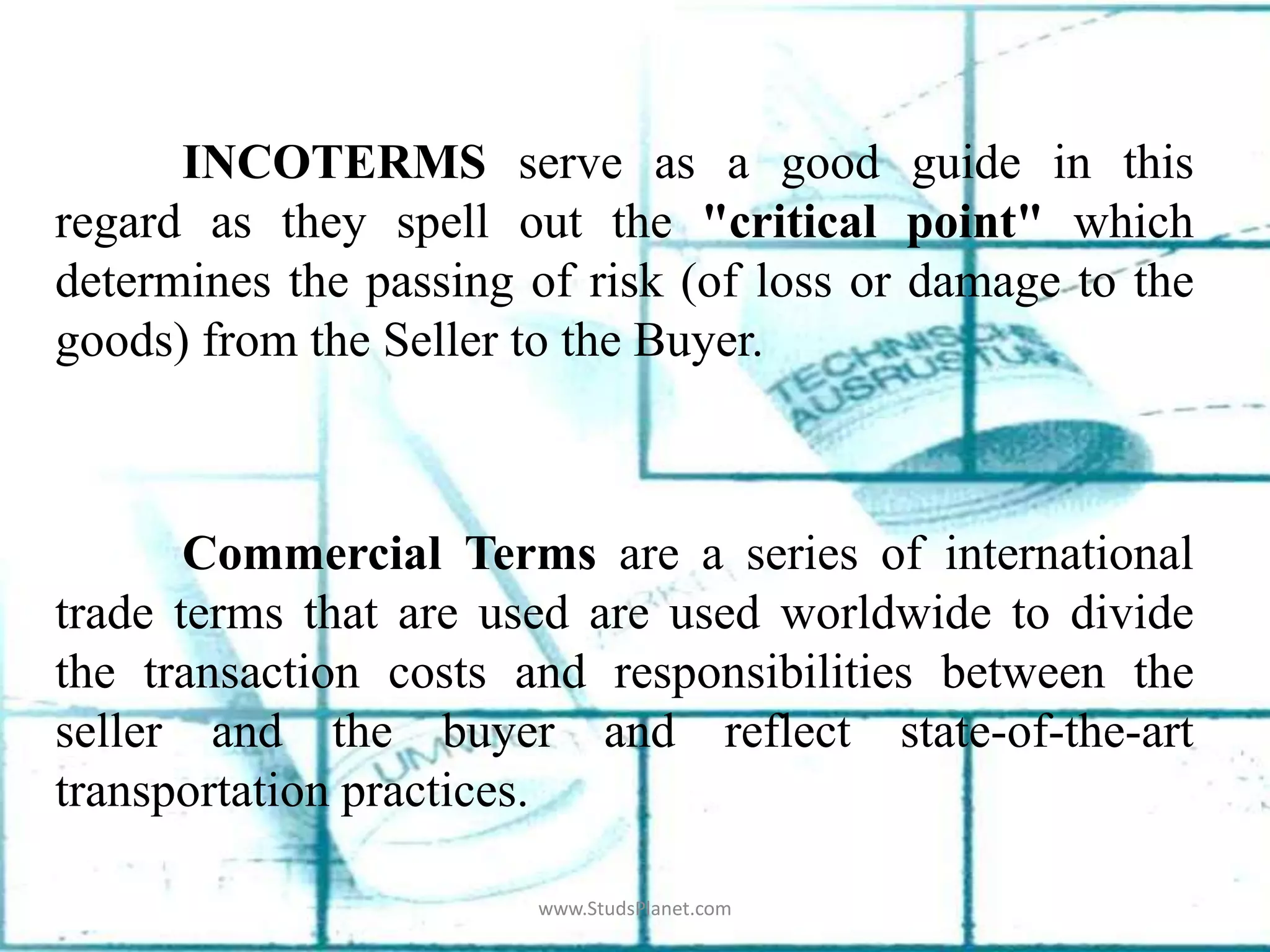
INCOTERMS serve as a good guide in this
regard as they spell out the "critical point" which
determines the passing of risk (of loss or damage to the
goods) from the Seller to the Buyer.
Commercial Terms are a series of international
trade terms that are used are used worldwide to divide
the transaction costs and responsibilities between the
seller and the buyer and reflect state-of-the-art
transportation practices.
www.StudsPlanet.com
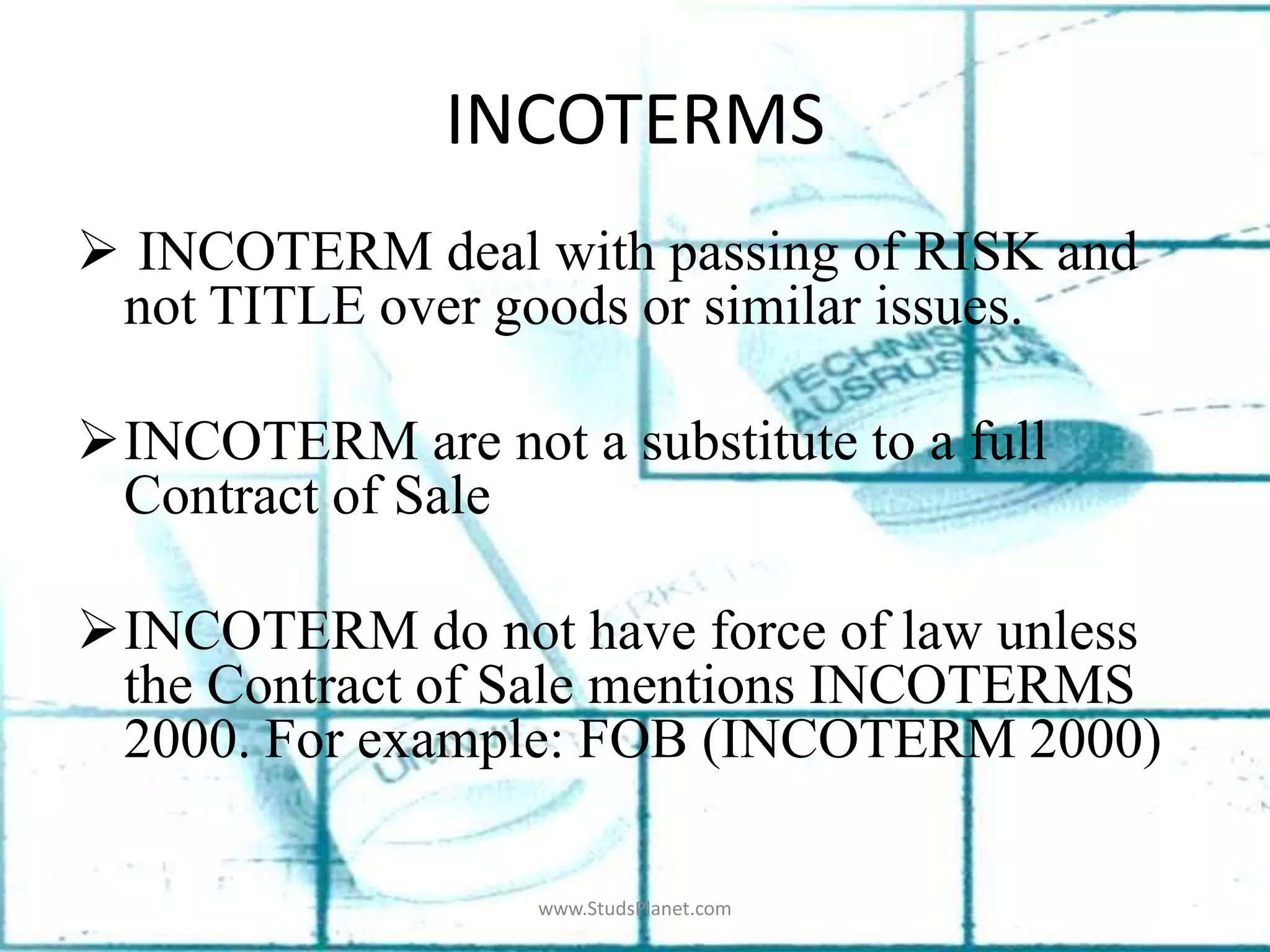
INCOTERMS
 INCOTERM deal with passing of RISK and
not TITLE over goods or similar issues.
INCOTERM are not a substitute to a full
Contract of Sale
INCOTERM do not have force of law unless
the Contract of Sale mentions INCOTERMS
2000. For example: FOB (INCOTERM 2000)
www.StudsPlanet.com
INCOTERM ARE NOT….
the part of the contract for carriage
used to transfer property rights or title
used to name a carrier
used to determine the effect of breach of
contract cases
www.StudsPlanet.com
THANKS…
Hope you had a Nice sleep..!!!!
www.StudsPlanet.com

Import clearance procedure

  • 1.
  • 2.
    INTRODUCTION • All goodsimported into India have to pass through the procedure of customs for proper examination, appraisal, assessment and evaluation. • This helps the custom authorities to charge the proper tax and also check the goods against the illegal import. • Import is not allowed if the importer doesn’t have the IEC number issued by the DGFT. • There is no requirement of IEC number if the goods are imported for the personal use. www.StudsPlanet.com
  • 3.
    BILL OF ENTRY ABill of Entry also known as Shipment Bill is a statement of the nature and value of goods to be imported or exported, prepared by the shipper and presented to a customhouse. www.StudsPlanet.com
  • 4.
    • The importerclearing the goods for domestic consumption has to file bill of entry in four copies; original and duplicate are meant for customs, third copy for the importer and the fourth copy is meant for the bank for making remittances. • The Bill of entry, where filed, is to be submitted in a set, different copies meant for different purposes and also given different color scheme, and on the body of the bill of entry the purpose for which it will be used is generally mentioned in the non-EDI declaration. www.StudsPlanet.com
  • 5.
    TYPES OF IMPORT ACTUALUSER NON- ACTUAL USER • INDUSTRIAL • NON-INDUSTRIAL www.StudsPlanet.com
  • 6.
    IMPORT PROCESS • Whatto IMPORT? • From where to IMPORT(Location) • From whom to IMPORT(specified supplier)? • Import contract • IEC no. • Import License • Import finance and clearance www.StudsPlanet.com
  • 7.
    • WHITE BILLOF ENTRY HOME CONSUMPTION • GREEN BILL OF ENTRY EX-BOND CLEARANCE • YELLOW BILL OF ENTRY WAREHOUSING Types of Bill of Entry Bills of Entry should be of one of three types. Out of these, two types are for clearance from customs while third is for clearance from warehouse. www.StudsPlanet.com
  • 8.
    - • This form,called ‘Bill of Entry for Home Consumption’, issued when the imported goods are to be cleared on payment of full duty. • Home consumption means use within India. It is white colored and hence often called ‘white bill of entry’. BILL OF ENTRY FOR HOME CONSUMPTION www.StudsPlanet.com
  • 9.
    • This isused for clearance from the warehouse on payment of duty and is printed on green paper. • The goods are classified and value is assessed at the time of clearance from customs port. • Thus, value and classification is not required to be determined in this bill of entry. • The columns in this bill of entry are similar to other bills of entry. However, declaration by importer is not required as the goods are already assessed BILL OF ENTRY FOR EX-BOND CLEARANCE www.StudsPlanet.com
  • 10.
    • If theimported goods are not required immediately, importer may like to store the goods in a warehouse without payment of duty under a bond and then clear from warehouse when required on payment of duty. • This will enable him to defer payment of customs duty till goods are actually required by him. • This Bill of Entry is printed on yellow paper and often called ‘Yellow Bill of Entry’. It is also called ‘Into Bond Bill of Entry’as bond is executed for transfer of goods in warehouse without payment of duty. BILL OF ENTRY FOR WAREHOUSING www.StudsPlanet.com
  • 11.
    Please ask ifyou are not cleared with anything!!! www.StudsPlanet.com
  • 12.
    • There aretwo system mainly used for submission of Import Documents. EDI system – Mainly used in large ports where the system is upgraded with the help of technology and it makes the things easier. Non- EDI system – It is used for not so big ports, may be for the less traffic ports. Thoka Number (Serial Number) is given while noting the Bill of Entry. www.StudsPlanet.com
  • 13.
    EDI SYSTEM (usedin Large ports) • If the goods are cleared through the EDI system, no formal Bill of Entry is filed as it is generated in the computer system,. • But the importer is required to file a cargo declaration having prescribed particulars required for processing of the entry for customs clearance. • Importer should submit declaration in electronic format to ‘Service Centre’. A signed paper copy of declaration for non-repudiability should be submitted. • Bill of Entry number is generated by system which is endorsed on printed check list. • Original documents are to be submitted only at the stage of examination. www.StudsPlanet.com
  • 14.
    System then generatesa B/E Number, which is endorsed on the printed checklist and returned to the importer SYSTEM After verification, the data is submitted to the system by the Service Centre Operator Checklist is generated For verification of data by the importer Declaration in electronic format Containing all the relevant information to the Service Centre www.StudsPlanet.com
  • 15.
    NON-EDI SYSTEM • Inthe non-EDI system the importer has to get the bill of entry noted in the concerned unit which checks the consignment sought to be cleared having been manifested in the particular vessel and a bill of entry number is generated and indicated on all copies. • After noting the bill of entry gets sent to the appraising section of the Custom House for assessment functions, payment of duty etc. www.StudsPlanet.com
  • 16.
    In the non-EDIsystem along with the bill of entry filed by the importer or his representative the following documents are also generally required:- • Signed invoice` • Catalogue, Technical write up, Literature in case of machineries, spares or chemicals as may be applicable • Packing list • DEEC Book/DEPB in original • Letter of Credit/Bank Draft/wherever necessary • Adhoc exemption order • GATT declaration form duly filled in • Test report in case of chemicals • Importers/ CHA’s declaration • Industrial License, if required • License wherever necessary • Import license • Bill of Lading or Delivery Order/Airway Bill • Insurance document • No Commission declaration • Separately split up value of spares, components machineries www.StudsPlanet.com
  • 17.
    Don’t break yourhead.. Ask me  www.StudsPlanet.com
  • 18.
    After noting/registration ofthe Bill of entry, it is forwarded manually or electronically to the concerned Appraising Group in the Custom House dealing with the commodity sought to be cleared. MANUALLY/ ELECTRONICALLY BILL OF ENTRY THE CONCERNED GROUP FOR THE DOCUMENTS CUSTOM HOUSE www.StudsPlanet.com
  • 19.
    Thereafter the billof entry goes to Assistant Commissioner/Deputy Commissioner for confirmation depending upon certain value limits and sent to comptist who calculates the duty amount taking into account the rate of exchange at the relevant date THE CONCERNED HOUSE SEND THE “BILL OF ENTRY” CUSTOM HOUSE FOR CONFIRMATIONCOMMISSIONER www.StudsPlanet.com
  • 20.
    After the assessment andcalculation of the duty liability the importer’s representative has to deposit the duty calculated with the treasury or the nominated banks, where after he can go and seek delivery of the goods from the custodians ASSESSMENT OF DUTY IMPORTER REPRESENTATIVE BANK (NOMINATED BANK FOR COLLECTION OF DUTY) www.StudsPlanet.com
  • 21.
    The last stepis the delivery of goods from the warehouse, Where the goods have already been examined for finalization of classification or valuation no further examination/checking by the dock appraising staff is required at the time of giving delivery and the goods can be taken delivery after taking appropriate orders and payment of dues to the custodians www.StudsPlanet.com
  • 22.
    You can shootme with your questions  www.StudsPlanet.com
  • 23.
    Basic document is ‘Entry’ Entry’in relation to goods means entry made in Bill of Entry, Shipping Bill or Bill of Export Loading and unloading at specified places only Imported goods can be unloaded only at specified places. Goods can be exported only from specified places. Computerisation of customs procedures Customs procedures are largely computerised. Most of documents have to be e-filed. Amendment to documents Documents submitted to customs can be amended with permission In case of bill of entry, shipping bill or bill of export, it can be amended after clearance only on the basis of documentary evidence which was in existence at the time the goods were cleared, warehoused or exported, and not on basis of any subsequent document. [proviso to section 149]. ICD and CFS Imported and export goods are usually handled in containers. These can be stored in Inland Container Depot (ICD) or Container Freight Station (CFS). They function like dry port for handling and temporary storage of imported/export goods and empty containers. GENERAL PROVISION ABOUT CUSTOM PROCEDURE www.StudsPlanet.com
  • 24.
  • 25.
    e-filing of documentsGoods should arrive at customs port/airport only. Most of customs procedures are computerised. E-filing of documents is required Import manifest or Import Report Person in charge of conveyance’ is required to submit Import Manifest or Import Report. Bill of Entry for home consumption on payment of customs duty Importer has to submit Bill of Entry giving details of goods being imported, along with required documents. Electronic submission of documents is done in major ports. White Bill of Entry is for home consumption. Imported goods are cleared on payment of customs duty. Bill of Entry for warehousing Yellow Bill of Entry is for warehousing. Duty is not paid and imported goods are transferred to warehouse where these are stored. Green Bill of Entry is for clearance from warehouse on payment of customs duty. It is for ex-bond clearance. Noting, examination and assessment Bill of Entry is noted, Goods are assessed to duty, examined and pre-audit is carried out. Customs duty is paid after assessment. Out of customs charge order Goods can be cleared outside port after ‘Out of Customs Charge’ order is issued by customs officer. After that, port dues, demurrage and other charges are paid and goods are cleared. Demurrage if clearance from port delayed Demurrage is payable if goods are not cleared from port/airport within three days. Goods can be disposed of if not cleared from port within 30 days. www.StudsPlanet.com
  • 26.
  • 27.
    INCOTERMS serve asa good guide in this regard as they spell out the "critical point" which determines the passing of risk (of loss or damage to the goods) from the Seller to the Buyer. Commercial Terms are a series of international trade terms that are used are used worldwide to divide the transaction costs and responsibilities between the seller and the buyer and reflect state-of-the-art transportation practices. www.StudsPlanet.com
  • 28.
    INCOTERMS  INCOTERM dealwith passing of RISK and not TITLE over goods or similar issues. INCOTERM are not a substitute to a full Contract of Sale INCOTERM do not have force of law unless the Contract of Sale mentions INCOTERMS 2000. For example: FOB (INCOTERM 2000) www.StudsPlanet.com
  • 29.
    INCOTERM ARE NOT…. thepart of the contract for carriage used to transfer property rights or title used to name a carrier used to determine the effect of breach of contract cases www.StudsPlanet.com
  • 30.
    THANKS… Hope you hada Nice sleep..!!!! www.StudsPlanet.com