12-1
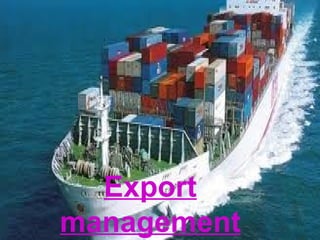
Export
management
• Export management means conducting the
export activity in an orderly, efficient and
profitable manner.
• Since the heart of each business is marketing,
export management can be termed as export
marketing management. Because it needs to be
managed efficiently so that the export should
increase and exporter should get more profit and
importer should get more satisfaction.
• Export management means managing export
marketing activity efficiently, smoothly and in an
orderly manner.
Export management
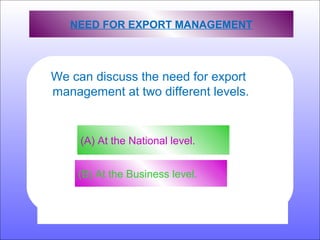
We can discuss the need for export
management at two different levels.
(A) At the National level.
(B) At the Business level.
NEED FOR EXPORT MANAGEMENT
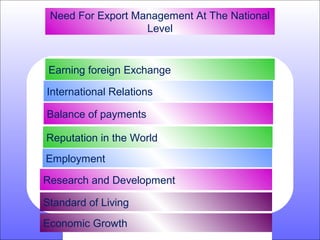
Need For Export Management At The National
Level
Earning foreign Exchange
International Relations
Balance of payments
Economic Growth
Reputation in the World
Employment
Research and Development
Standard of Living
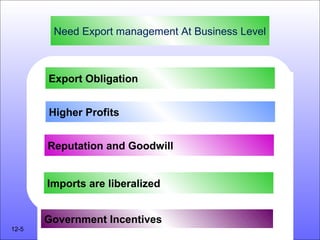
12-5
Export Obligation
Higher Profits
Reputation and Goodwill
Imports are liberalized
Government Incentives
Need Export management At Business Level
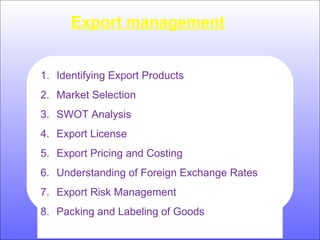
Export management
1. Identifying Export Products
2. Market Selection
3. SWOT Analysis
4. Export License
5. Export Pricing and Costing
6. Understanding of Foreign Exchange Rates
7. Export Risk Management
8. Packing and Labeling of Goods
1. Identifying Export Products
• The product should be manufactured or sourced with consistent
standard quality, comparable to your competitors
• If possible, avoid products which are monopoly of one or few suppliers
• The price of the exported product should not fluctuate very often -
threatening profitability to the export business.
• Strictly check the government policies related to the export of a
particular product
• Carefully study the various government incentive schemes and tax
exemption like duty drawback and DEPB.
• Seasonal vagaries of selected products
• Keep in mind special packaging and labeling requirements of
perishable products like processed food and dairy products.
12-7
2. Market Selection
 Market selection process requires a broad range of information
depending upon the products or services to be exported, which
includes:
• The demand for product/service.
• The size of the potential audience.
• Whether the target audience can afford product.
• What the regulatory issues are that impact on exports of product.
• Are there appropriate distribution channels for product/service?
• The environment for doing business – language, culture, politics
etc.
• Is it financially viable to export to selected market?
12-8
3. SWOT Analysis
• SWOT analysis is a useful method of
summaries all the information generated
during the export planning. SWOT stands
for strengths, weakness, opportunities
and threats, which helps to isolate the
strong and week areas within an export
strategy. SWOT also indicates the future
opportunities or threats that may exist in
the chosen markets and is instrumental in
strategy formulation and selection.
12-9
4. Export License
• Export license are only issued for
the goods mentioned in the
Schedule 2 of ITC (HS)
Classifications of Export and Import
items.
12-10
5. Export Pricing and Costing
Export Pricing can be determined by the following factors:
• Range of products offered.
• Prompt deliveries and continuity in supply.
• After-sales service in products like machine tools, consumer
durables.
• Product differentiation and brand image.
• Frequency of purchase.
• Presumed relationship between quality and price.
• Specialty value goods and gift items.
• Credit offered.
• Aggressive marketing and sales promotion.
• Unique value goods and gift items.
Export Costing
• Export Costing is basically Cost
Accountant's job. It consists of fixed cost
and variable cost comprising various
elements. It is advisable to prepare an
export costing sheet for every export
product.
12-12
6. Understanding of Foreign
Exchange Rates
An exporter without any commercial contract is
completely exposed of foreign exchange risks that arises
due to the probability of an adverse change in exchange
rates.
Therefore, it becomes important for the exporter to gain
some knowledge about the foreign exchange rates,
quoting of exchange rates and various factors
determining the exchange rates.
• Rate at which one country’s currency is exchanged for
another country’s
• Has become a major concern for companies doing
business internationally
• Changes in the exchange rate can have major
implications for profitability of international operations12-13
7. Export Risk Management
The various types of export risks involve
in an international trade are as follow
• Credit Risk
• Poor Quality Risk
• Transportation Risks
• Logistic Risk
• Legal Risks
• Political Risk
• Unforeseen Risks
• Exchange Rate Risks
8. Packing and Labeling Of Goods
Packing
The primary role of packaging
is to contain, protect and
preserve a product as well as
aid in its handling and final
presentation.
Packaging provides following
benefits
• Physical Protection
• Containment
• Marketing
• Security
Labeling
Labeling on product provides
the following important
information:
• Shipper's mark
• Country of origin
• Weight marking (in pounds
and in kilograms)
• Number of packages and size
of cases (in inches and
centimeters)
• Handling marks (international
pictorial symbols)
Tools used to aid transactions
Letters of Credit (LOC)
Bank guarantee on behalf of importer to
exporter assuring payment when exporter
presents specified documents
Drafts (Bill of Exchange)
Written order exporter, telling an importer to
pay a specified amount of money at a
specified time
Bill of Lading
Issued to exporter, by carrier. Serves as
receipt, contract and document of title
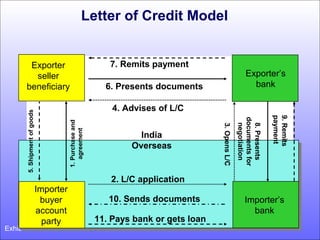
Letter of Credit Model
Exhibit 5.6
Exporter
seller
beneficiary
Importer’s
bank
Importer
buyer
account
party
Exporter’s
bank
7. Remits payment
6. Presents documents
4. Advises of L/C
2. L/C application
10. Sends documents
11. Pays bank or gets loan
India
Overseas
5.Shipmentofgoods
1.Purchaseand
agreement
9.Remits
payment
8.Presents
documentsfor
negotiation
3.OpensL/C
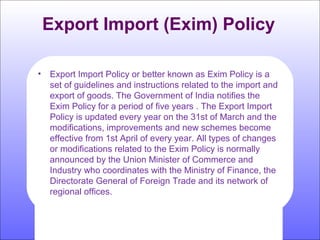
• Export Import Policy or better known as Exim Policy is a
set of guidelines and instructions related to the import and
export of goods. The Government of India notifies the
Exim Policy for a period of five years . The Export Import
Policy is updated every year on the 31st of March and the
modifications, improvements and new schemes become
effective from 1st April of every year. All types of changes
or modifications related to the Exim Policy is normally
announced by the Union Minister of Commerce and
Industry who coordinates with the Ministry of Finance, the
Directorate General of Foreign Trade and its network of
regional offices.
Export Import (Exim) Policy
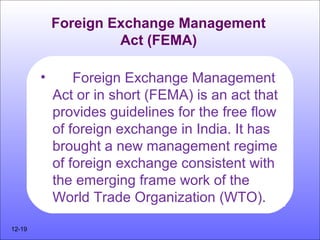
Foreign Exchange Management
Act (FEMA)
• Foreign Exchange Management
Act or in short (FEMA) is an act that
provides guidelines for the free flow
of foreign exchange in India. It has
brought a new management regime
of foreign exchange consistent with
the emerging frame work of the
World Trade Organization (WTO).
12-19
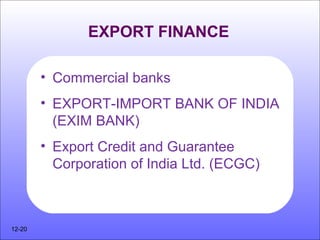
EXPORT FINANCE
• Commercial banks
• EXPORT-IMPORT BANK OF INDIA
(EXIM BANK)
• Export Credit and Guarantee
Corporation of India Ltd. (ECGC)
12-20
Export management ppt

Export management ppt

  • 1.
  • 2.
    • Export managementmeans conducting the export activity in an orderly, efficient and profitable manner. • Since the heart of each business is marketing, export management can be termed as export marketing management. Because it needs to be managed efficiently so that the export should increase and exporter should get more profit and importer should get more satisfaction. • Export management means managing export marketing activity efficiently, smoothly and in an orderly manner. Export management
  • 3.
    We can discussthe need for export management at two different levels. (A) At the National level. (B) At the Business level. NEED FOR EXPORT MANAGEMENT
  • 4.
    Need For ExportManagement At The National Level Earning foreign Exchange International Relations Balance of payments Economic Growth Reputation in the World Employment Research and Development Standard of Living
  • 5.
    12-5 Export Obligation Higher Profits Reputationand Goodwill Imports are liberalized Government Incentives Need Export management At Business Level
  • 6.
    Export management 1. IdentifyingExport Products 2. Market Selection 3. SWOT Analysis 4. Export License 5. Export Pricing and Costing 6. Understanding of Foreign Exchange Rates 7. Export Risk Management 8. Packing and Labeling of Goods
  • 7.
    1. Identifying ExportProducts • The product should be manufactured or sourced with consistent standard quality, comparable to your competitors • If possible, avoid products which are monopoly of one or few suppliers • The price of the exported product should not fluctuate very often - threatening profitability to the export business. • Strictly check the government policies related to the export of a particular product • Carefully study the various government incentive schemes and tax exemption like duty drawback and DEPB. • Seasonal vagaries of selected products • Keep in mind special packaging and labeling requirements of perishable products like processed food and dairy products. 12-7
  • 8.
    2. Market Selection Market selection process requires a broad range of information depending upon the products or services to be exported, which includes: • The demand for product/service. • The size of the potential audience. • Whether the target audience can afford product. • What the regulatory issues are that impact on exports of product. • Are there appropriate distribution channels for product/service? • The environment for doing business – language, culture, politics etc. • Is it financially viable to export to selected market? 12-8
  • 9.
    3. SWOT Analysis •SWOT analysis is a useful method of summaries all the information generated during the export planning. SWOT stands for strengths, weakness, opportunities and threats, which helps to isolate the strong and week areas within an export strategy. SWOT also indicates the future opportunities or threats that may exist in the chosen markets and is instrumental in strategy formulation and selection. 12-9
  • 10.
    4. Export License •Export license are only issued for the goods mentioned in the Schedule 2 of ITC (HS) Classifications of Export and Import items. 12-10
  • 11.
    5. Export Pricingand Costing Export Pricing can be determined by the following factors: • Range of products offered. • Prompt deliveries and continuity in supply. • After-sales service in products like machine tools, consumer durables. • Product differentiation and brand image. • Frequency of purchase. • Presumed relationship between quality and price. • Specialty value goods and gift items. • Credit offered. • Aggressive marketing and sales promotion. • Unique value goods and gift items.
  • 12.
    Export Costing • ExportCosting is basically Cost Accountant's job. It consists of fixed cost and variable cost comprising various elements. It is advisable to prepare an export costing sheet for every export product. 12-12
  • 13.
    6. Understanding ofForeign Exchange Rates An exporter without any commercial contract is completely exposed of foreign exchange risks that arises due to the probability of an adverse change in exchange rates. Therefore, it becomes important for the exporter to gain some knowledge about the foreign exchange rates, quoting of exchange rates and various factors determining the exchange rates. • Rate at which one country’s currency is exchanged for another country’s • Has become a major concern for companies doing business internationally • Changes in the exchange rate can have major implications for profitability of international operations12-13
  • 14.
    7. Export RiskManagement The various types of export risks involve in an international trade are as follow • Credit Risk • Poor Quality Risk • Transportation Risks • Logistic Risk • Legal Risks • Political Risk • Unforeseen Risks • Exchange Rate Risks
  • 15.
    8. Packing andLabeling Of Goods Packing The primary role of packaging is to contain, protect and preserve a product as well as aid in its handling and final presentation. Packaging provides following benefits • Physical Protection • Containment • Marketing • Security Labeling Labeling on product provides the following important information: • Shipper's mark • Country of origin • Weight marking (in pounds and in kilograms) • Number of packages and size of cases (in inches and centimeters) • Handling marks (international pictorial symbols)
  • 16.
    Tools used toaid transactions Letters of Credit (LOC) Bank guarantee on behalf of importer to exporter assuring payment when exporter presents specified documents Drafts (Bill of Exchange) Written order exporter, telling an importer to pay a specified amount of money at a specified time Bill of Lading Issued to exporter, by carrier. Serves as receipt, contract and document of title
  • 17.
    Letter of CreditModel Exhibit 5.6 Exporter seller beneficiary Importer’s bank Importer buyer account party Exporter’s bank 7. Remits payment 6. Presents documents 4. Advises of L/C 2. L/C application 10. Sends documents 11. Pays bank or gets loan India Overseas 5.Shipmentofgoods 1.Purchaseand agreement 9.Remits payment 8.Presents documentsfor negotiation 3.OpensL/C
  • 18.
    • Export ImportPolicy or better known as Exim Policy is a set of guidelines and instructions related to the import and export of goods. The Government of India notifies the Exim Policy for a period of five years . The Export Import Policy is updated every year on the 31st of March and the modifications, improvements and new schemes become effective from 1st April of every year. All types of changes or modifications related to the Exim Policy is normally announced by the Union Minister of Commerce and Industry who coordinates with the Ministry of Finance, the Directorate General of Foreign Trade and its network of regional offices. Export Import (Exim) Policy
  • 19.
    Foreign Exchange Management Act(FEMA) • Foreign Exchange Management Act or in short (FEMA) is an act that provides guidelines for the free flow of foreign exchange in India. It has brought a new management regime of foreign exchange consistent with the emerging frame work of the World Trade Organization (WTO). 12-19
  • 20.
    EXPORT FINANCE • Commercialbanks • EXPORT-IMPORT BANK OF INDIA (EXIM BANK) • Export Credit and Guarantee Corporation of India Ltd. (ECGC) 12-20

Editor's Notes