


EXPORTS
Component
of
international
trade
Goods and
services
produced in
one
country &
purchased
another
It can be
shipped, sent
by email, or
carried in
personal
luggage
Most
countries
want to
increase their
exports.
Exports Affect Economy _How ?
The more they export,
the greater
their competitive
advantage (expertise in
making the goods and
services & knowledge
about how to sell in
foreign market)
Governments encourage
exports. Exports increase
jobs, bring in higher
wages, and raise
the standard of
living for residents.
Exports also increase
the foreign exchange
reserves held in the
nation's central bank. A
country with large
reserves can use it to
manage their own
currency's value.
Countries also use currency reserves to manage liquidity. That
means they can better control inflation, which is too much
money chasing too few goods.
To control inflation, they use the foreign currency to
purchase their own currency. That decreases the money
supply, making the local currency worth more.
That lowers the cost of their exports in other countries.
EXPORT
PROCEDURE
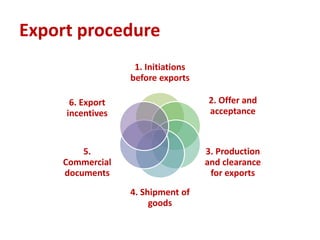
Export procedure
1. Initiations
before exports
2. Offer and
acceptance
3. Production
and clearance
for exports
4. Shipment of
goods
5.
Commercial
documents
6. Export
incentives
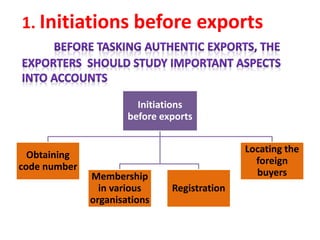
1. Initiations before exports
Initiations
before exports
Obtaining
code number
Membership
in various
organisations
Registration
Locating the
foreign
buyers
a) Obtaining code number
§ Obligatory for every
exporter to obtain
Exporter's Code Number
(CNX) number from RBI.
(Exchange control
department)
§ CNX number has been
replaced by Importer
Exporter Code (IEC)
number issued by the Direct
General for Foreign Trade
(DGFT) (fee of Rs. 1000.)
b) Membership in various organisation
- Not mandatory
- Exporters should become member of any
recognized ministry of commerce and trade
c)Registration
– It is vital for every exporter to register with
appropriate Export Promotion Council (EPC)
and obtain the Registration-cum-Membership
Certificate' (RCMC)
– Only registered exporters can avail the benefits
d) Identifying foreign buyers
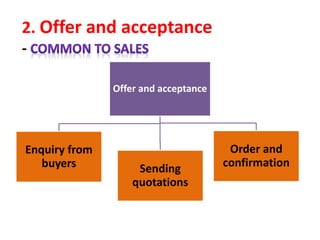
2. Offer and acceptance
-
Offer and acceptance
Enquiry from
buyers Sending
quotations
Order and
confirmation
a)Enquiry from buyers
- Enquiry is the first step to exports.
- Either directly or through agents
(Marketing)
b) Sending quotations
FOB price
Period of delivery
Mode of payment
Packing
Discounts
Clauses
c)Receipts and
order confirmation
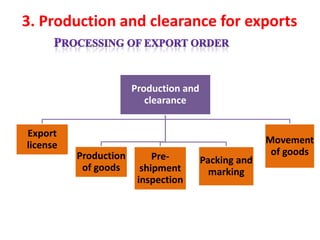
3. Production and clearance for exports
Production and
clearance
Export
license
Production
of goods
Pre-
shipment
inspection
Packing and
marking
Movement
of goods
a) Obtaining export license
- From licensing authority.
- With reference to quantity, value and
description of goods
- Only satisfied documents gets license for
exports from JCCI & E
b) Production of goods
c) Pre-shipment inspections
– ensures quality of export goods.
Inspections certificate is issued
d) Packing and marking
- once goods are ready, they should be
properly packed and marked
-marking: the shipping marks of the
consignee, the port of destination, etc.
e) Movement by rail in the port
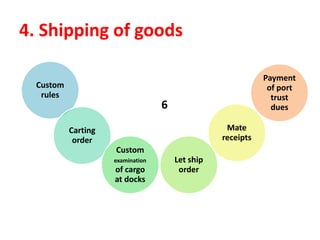
4. Shipping of goods
6
Custom
rules
Carting
order
Custom
examination
of cargo
at docks
Let ship
order
Mate
receipts
Payment
of port
trust
dues
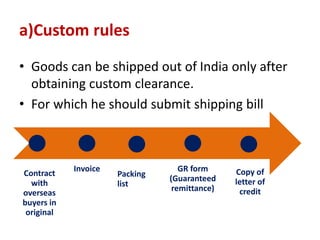
a)Custom rules
• Goods can be shipped out of India only after
obtaining custom clearance.
• For which he should submit shipping bill
Contract
with
overseas
buyers in
original
Invoice
Packing
list
GR form
(Guaranteed
remittance)
Copy of
letter of
credit
b)Carting order:
- It is a permission to bring the goods inside
the docks.
- The carting order is issued by the
superintendent of port trust.
- It is issued only after verifying the
endorsement on the duplicate copy of shipping bill
c)Custom examination of cargo at docks
- To verify whether the goods are packed and
kept ready for shipment as mentioned in the shipping
bill
- “Out of charge” of customs
d) Let ship order:
- Endorsement on duplicate copy of shipping
bill.
- Authentication given by the customer
department to shipping co. to accept the cargo on
board.
e) Mate receipt: Caption of the ship issued to
port trust authorities
f) Payment of port trust dues:
- Exporter can get the mate receipt only
after making payment of port dues.
5. Commercial documents
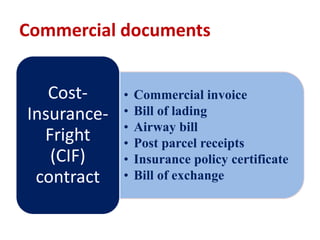
Commercial documents
• Commercial invoice
• Bill of lading
• Airway bill
• Post parcel receipts
• Insurance policy certificate
• Bill of exchange
Cost-
Insurance-
Fright
(CIF)
contract
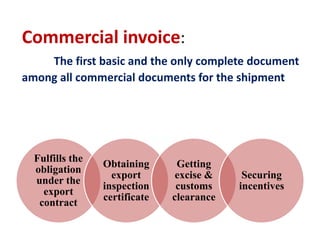
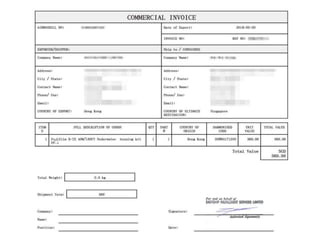
Commercial invoice:
The first basic and the only complete document
among all commercial documents for the shipment
Fulfills the
obligation
under the
export
contract
Obtaining
export
inspection
certificate
Getting
excise &
customs
clearance
Securing
incentives
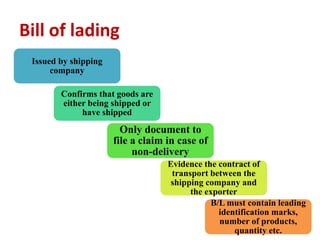
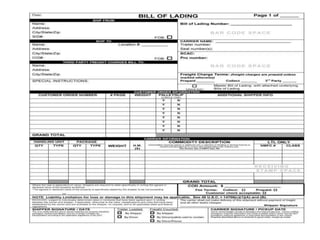
Bill of lading
Issued by shipping
company
Confirms that goods are
either being shipped or
have shipped
Only document to
file a claim in case of
non-delivery
Evidence the contract of
transport between the
shipping company and
the exporter
B/L must contain leading
identification marks,
number of products,
quantity etc.
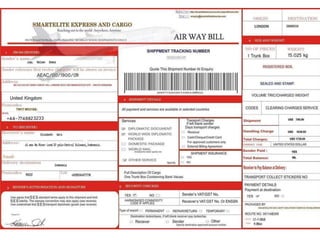
Airway bill
Transport document of air carriage
• Contract for transport
• Receipt of goods
• Conditions of carriage
AWB is not a document of title to goods
AWB can be made into transferable documents
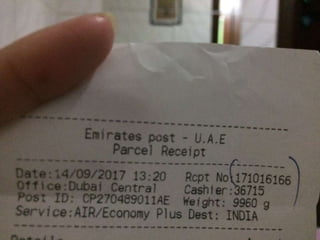
Post parcel receipts
• Evidence merely the receipt of the
goods exported through postal
channels to the buyers.
• It does not evidence the title to goods
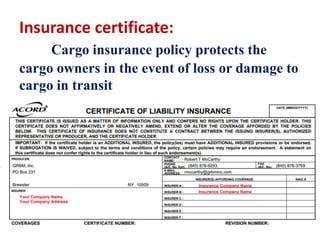
Insurance certificate:
Cargo insurance policy protects the
cargo owners in the event of loss or damage to
cargo in transit
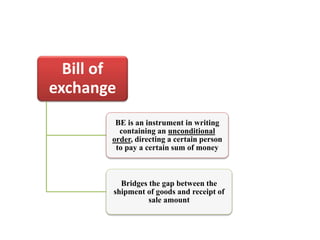
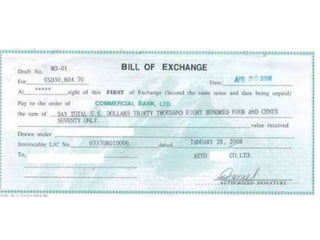
Bill of
exchange
BE is an instrument in writing
containing an unconditional
order, directing a certain person
to pay a certain sum of money
Bridges the gap between the
shipment of goods and receipt of
sale amount
Additional commercial documents
such as packing list, certificate of inspection,
certificate of quality etc.
6.Obtaining export incentives
Export finance
• Short term
Pre-shipment and post-shipment finance
• Medium term and long term
Suppliers credit and buyers credit

EXPORT PROCEDURE

  • 2.
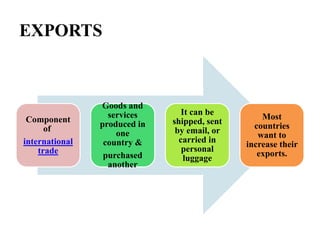
    EXPORTS Component of international trade Goods and services produced in one country& purchased another It can be shipped, sent by email, or carried in personal luggage Most countries want to increase their exports.
  • 3.
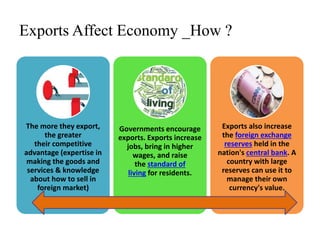
    Exports Affect Economy_How ? The more they export, the greater their competitive advantage (expertise in making the goods and services & knowledge about how to sell in foreign market) Governments encourage exports. Exports increase jobs, bring in higher wages, and raise the standard of living for residents. Exports also increase the foreign exchange reserves held in the nation's central bank. A country with large reserves can use it to manage their own currency's value.
  • 4.
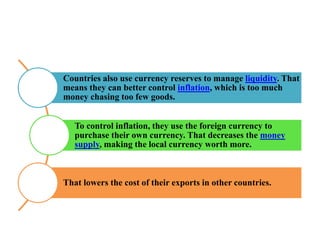
    Countries also usecurrency reserves to manage liquidity. That means they can better control inflation, which is too much money chasing too few goods. To control inflation, they use the foreign currency to purchase their own currency. That decreases the money supply, making the local currency worth more. That lowers the cost of their exports in other countries.
  • 5.
  • 6.
    Export procedure 1. Initiations beforeexports 2. Offer and acceptance 3. Production and clearance for exports 4. Shipment of goods 5. Commercial documents 6. Export incentives
  • 7.
    1. Initiations beforeexports Initiations before exports Obtaining code number Membership in various organisations Registration Locating the foreign buyers
  • 8.
    a) Obtaining codenumber § Obligatory for every exporter to obtain Exporter's Code Number (CNX) number from RBI. (Exchange control department) § CNX number has been replaced by Importer Exporter Code (IEC) number issued by the Direct General for Foreign Trade (DGFT) (fee of Rs. 1000.)
  • 9.
    b) Membership invarious organisation - Not mandatory - Exporters should become member of any recognized ministry of commerce and trade c)Registration – It is vital for every exporter to register with appropriate Export Promotion Council (EPC) and obtain the Registration-cum-Membership Certificate' (RCMC) – Only registered exporters can avail the benefits d) Identifying foreign buyers
  • 10.
    2. Offer andacceptance - Offer and acceptance Enquiry from buyers Sending quotations Order and confirmation
  • 11.
    a)Enquiry from buyers -Enquiry is the first step to exports. - Either directly or through agents (Marketing) b) Sending quotations FOB price Period of delivery Mode of payment Packing Discounts Clauses c)Receipts and order confirmation
  • 12.
    3. Production andclearance for exports Production and clearance Export license Production of goods Pre- shipment inspection Packing and marking Movement of goods
  • 13.
    a) Obtaining exportlicense - From licensing authority. - With reference to quantity, value and description of goods - Only satisfied documents gets license for exports from JCCI & E b) Production of goods c) Pre-shipment inspections – ensures quality of export goods. Inspections certificate is issued
  • 15.
    d) Packing andmarking - once goods are ready, they should be properly packed and marked -marking: the shipping marks of the consignee, the port of destination, etc. e) Movement by rail in the port
  • 16.
    4. Shipping ofgoods 6 Custom rules Carting order Custom examination of cargo at docks Let ship order Mate receipts Payment of port trust dues
  • 17.
    a)Custom rules • Goodscan be shipped out of India only after obtaining custom clearance. • For which he should submit shipping bill Contract with overseas buyers in original Invoice Packing list GR form (Guaranteed remittance) Copy of letter of credit
  • 18.
    b)Carting order: - Itis a permission to bring the goods inside the docks. - The carting order is issued by the superintendent of port trust. - It is issued only after verifying the endorsement on the duplicate copy of shipping bill c)Custom examination of cargo at docks - To verify whether the goods are packed and kept ready for shipment as mentioned in the shipping bill - “Out of charge” of customs
  • 19.
    d) Let shiporder: - Endorsement on duplicate copy of shipping bill. - Authentication given by the customer department to shipping co. to accept the cargo on board. e) Mate receipt: Caption of the ship issued to port trust authorities f) Payment of port trust dues: - Exporter can get the mate receipt only after making payment of port dues.
  • 20.
  • 21.
    Commercial documents • Commercialinvoice • Bill of lading • Airway bill • Post parcel receipts • Insurance policy certificate • Bill of exchange Cost- Insurance- Fright (CIF) contract
  • 22.
    Commercial invoice: The firstbasic and the only complete document among all commercial documents for the shipment Fulfills the obligation under the export contract Obtaining export inspection certificate Getting excise & customs clearance Securing incentives
  • 24.
    Bill of lading Issuedby shipping company Confirms that goods are either being shipped or have shipped Only document to file a claim in case of non-delivery Evidence the contract of transport between the shipping company and the exporter B/L must contain leading identification marks, number of products, quantity etc.
  • 26.
    Airway bill Transport documentof air carriage • Contract for transport • Receipt of goods • Conditions of carriage AWB is not a document of title to goods AWB can be made into transferable documents
  • 28.
    Post parcel receipts •Evidence merely the receipt of the goods exported through postal channels to the buyers. • It does not evidence the title to goods
  • 30.
    Insurance certificate: Cargo insurancepolicy protects the cargo owners in the event of loss or damage to cargo in transit
  • 31.
    Bill of exchange BE isan instrument in writing containing an unconditional order, directing a certain person to pay a certain sum of money Bridges the gap between the shipment of goods and receipt of sale amount
  • 33.
    Additional commercial documents suchas packing list, certificate of inspection, certificate of quality etc.
  • 36.
    6.Obtaining export incentives Exportfinance • Short term Pre-shipment and post-shipment finance • Medium term and long term Suppliers credit and buyers credit