The document discusses procedures and documentation related to international trade. It defines key terms like exports, imports, and documents involved. For exports, it explains that an exporter must submit documents like a shipping bill, packing list, invoices, and export contract. It lists required export documents like commercial invoices, packing lists, certificates of origin, and more. For imports, it defines imports and restricted imports. It outlines the import process and important documents like import licenses, indents, letters of credit, bills of entry and lading. It also discusses terms for international trade like FOB, CIF, and documents involved in documentary collection.
DEFINATION
An exportof a good occurs when there is a change
of ownership from a resident to a non-resident; this
does not necessarily imply that the good in question
physically crosses the frontier. However, in specific
cases national accounts impute changes of
ownership even though in legal terms no change of
ownership takes place (e.g. cross border financial
leasing, cross border deliveries between affiliates of
the same enterprise, goods crossing the border for
significant processing to order or repair). Also
smuggled goods must be included in the export
measurement.
4.
PROCEDURE
exporter hasto submit ‘shipping bill’ for export by sea
or air and ‘bill of export’ for export by road.
Relevant documents i.e. copies of packing list,
invoices, export contract, letter of credit etc. are also to
be submitted.
5.
DECLARATION
Declaration incase of export of goods under claim for
drawback.
Declaration in case of export of goods under DEEC
scheme.
Declaration in case of export of goods in anticipation
of issue of advance license.
Declaration for consignment covered by AR-4 pending
weighment at docks.
6.
DOCUMENTS
Four copiesof commercial invoice.
Four copies of packing list.
Certificate of origin.
Insurance policy
Letter of credit.
Declaration of value.
GR/SDF form prescribed by RBI in duplicate
7.
DOCUMENTS
Four copiesof commercial invoice.
Four copies of packing list.
Certificate of origin.
Insurance policy
Letter of credit.
Declaration of value.
GR/SDF form prescribed by RBI in duplicate
BILL OF LADING
As a document of title, it is a certificate of
ownership that allows a holder or consignee to
claim the merchandise described.
As a receipt of goods, it is issued by the carrier to
the shipper for goods entrusted to the carrier’s care
for transportation.
As a contract of carriage, the bill of lading defines
the contracts terms between the shipper and his
carrier.
DEFINITION
Section 2(23)of the customs act ,defines import ,
“Import means bringing into India from a place
outside India”.
13.
RESTRICTED IMPORT
Importof agriculture
Food adulteration Act
Restricted old motor car’s
Canalized import
14.
PROCEDURE
Preliminary formalities
Trade enquires
Getting proforma invoice
Obtaining import license
Placing the order
Placing the indent
Opining later of credit
Getting document of titles
Receiving advice note
Making payment
Receiving documents of title
15.
Clearing ofgoods
Getting delivery order
Payment of custom duties
16.
IMPORTENT DOCUMENT IN
IMPORTTRADE
Import license (if required)
Indent
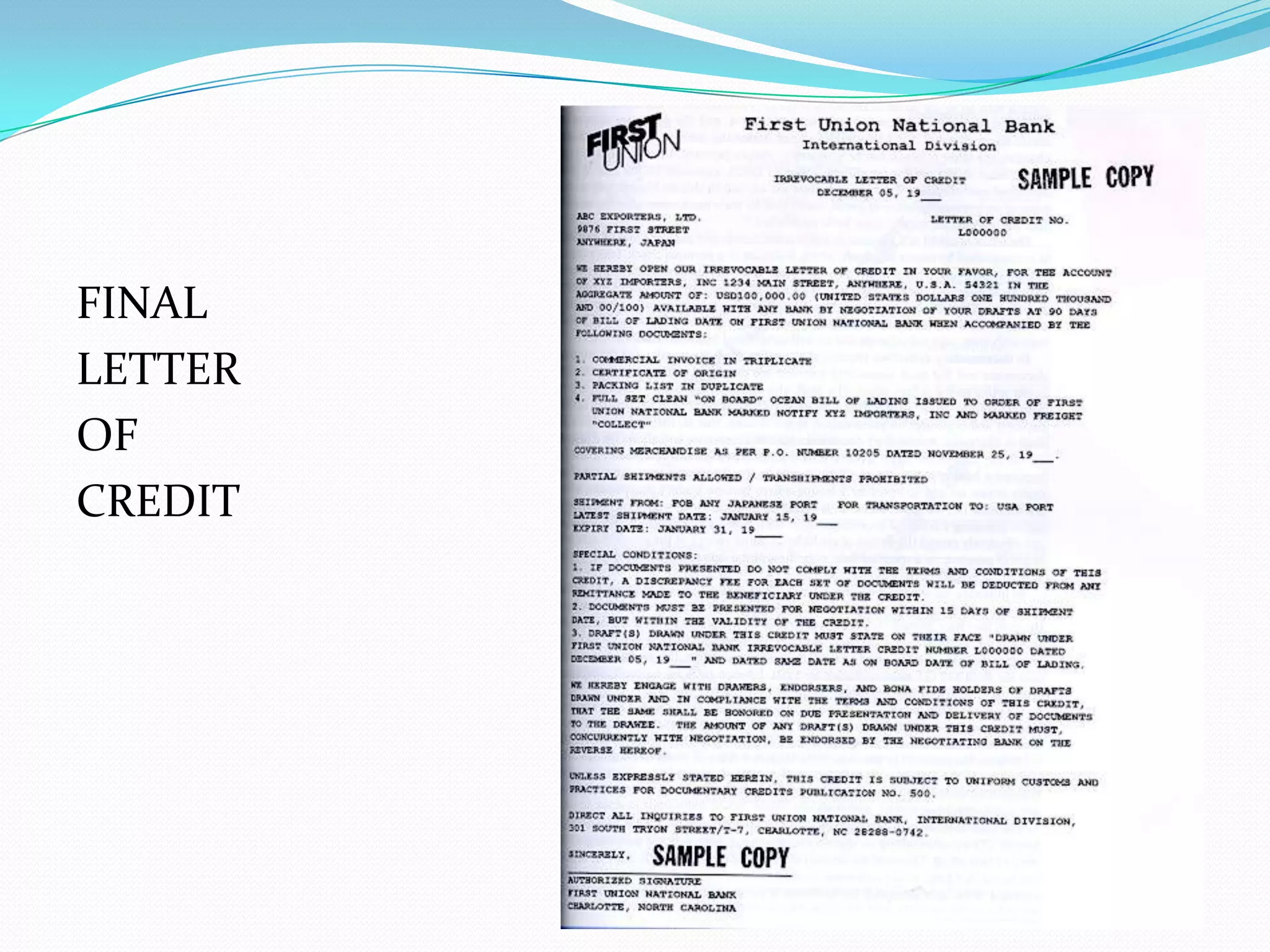
Letter of credit
Bill of Entry
Bill of sight
17.
DOCUMENT TO BESUBMITTED BY
IMPORTER
Invoice
Packing list
Bill of lading
Delivery order
Copy of license attested
Insurance policy
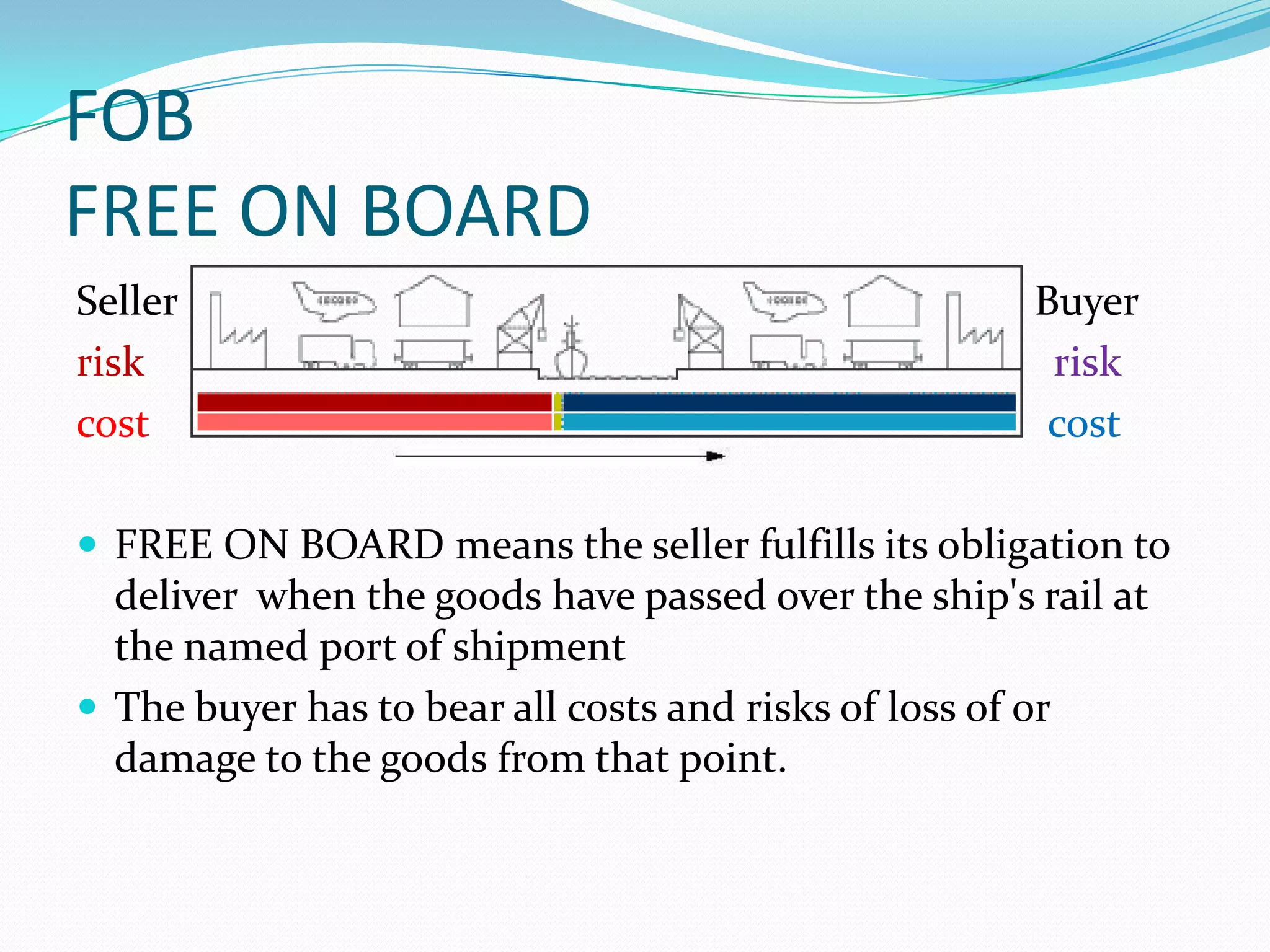
FOB
FREE ON BOARD
Seller Buyer
risk risk
cost cost
FREE ON BOARD means the seller fulfills its obligation to
deliver when the goods have passed over the ship's rail at
the named port of shipment
The buyer has to bear all costs and risks of loss of or
damage to the goods from that point.
21.
FREE ONBOARD requires the seller to clear the goods
for export.
FREE ON BOARD can only be used for sea or inland
waterway transport.
22.
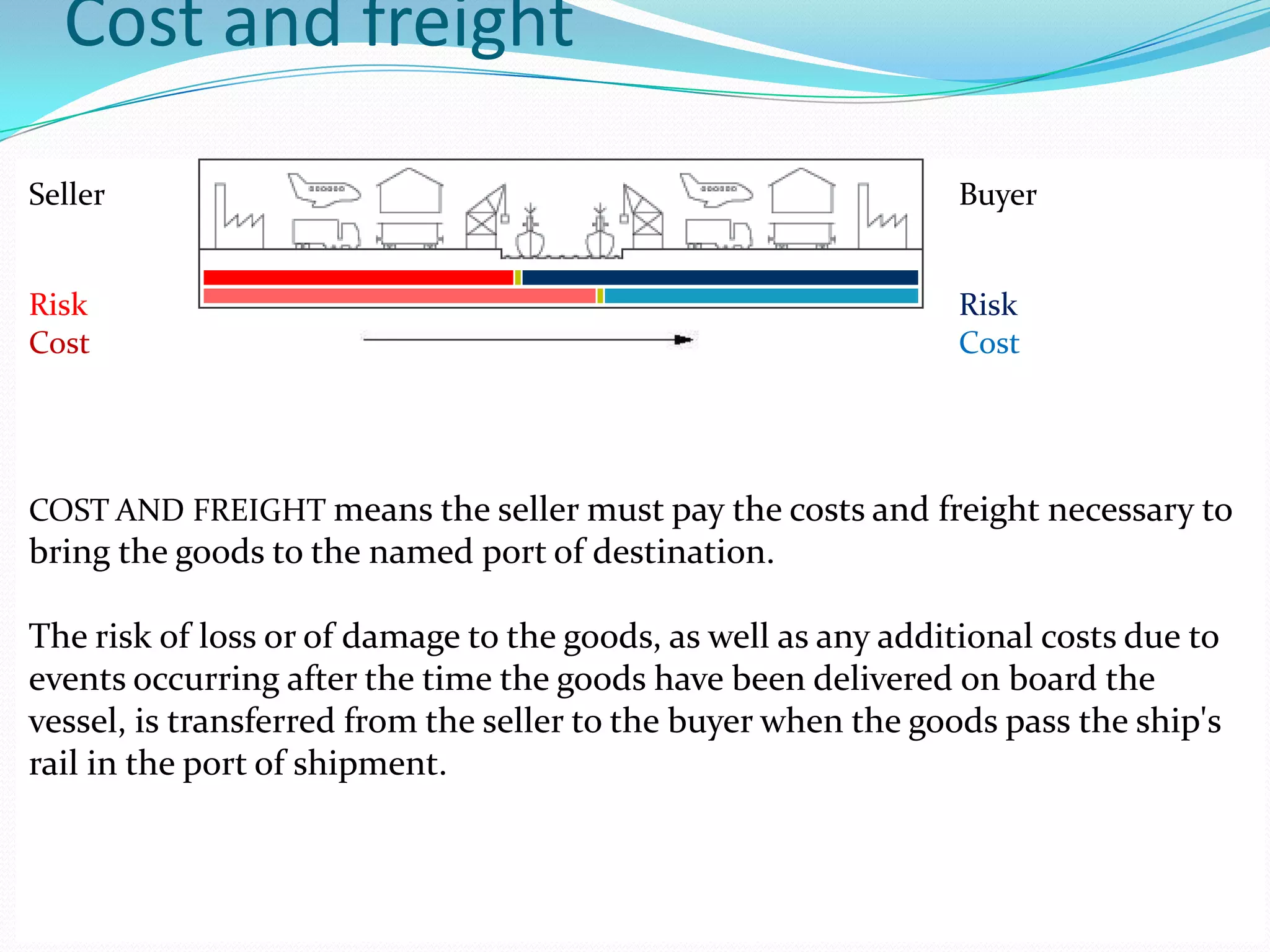
Cost and freight
Seller Buyer
Risk Risk
Cost Cost
COST AND FREIGHT means the seller must pay the costs and freight necessary to
bring the goods to the named port of destination.
The risk of loss or of damage to the goods, as well as any additional costs due to
events occurring after the time the goods have been delivered on board the
vessel, is transferred from the seller to the buyer when the goods pass the ship's
rail in the port of shipment.
23.
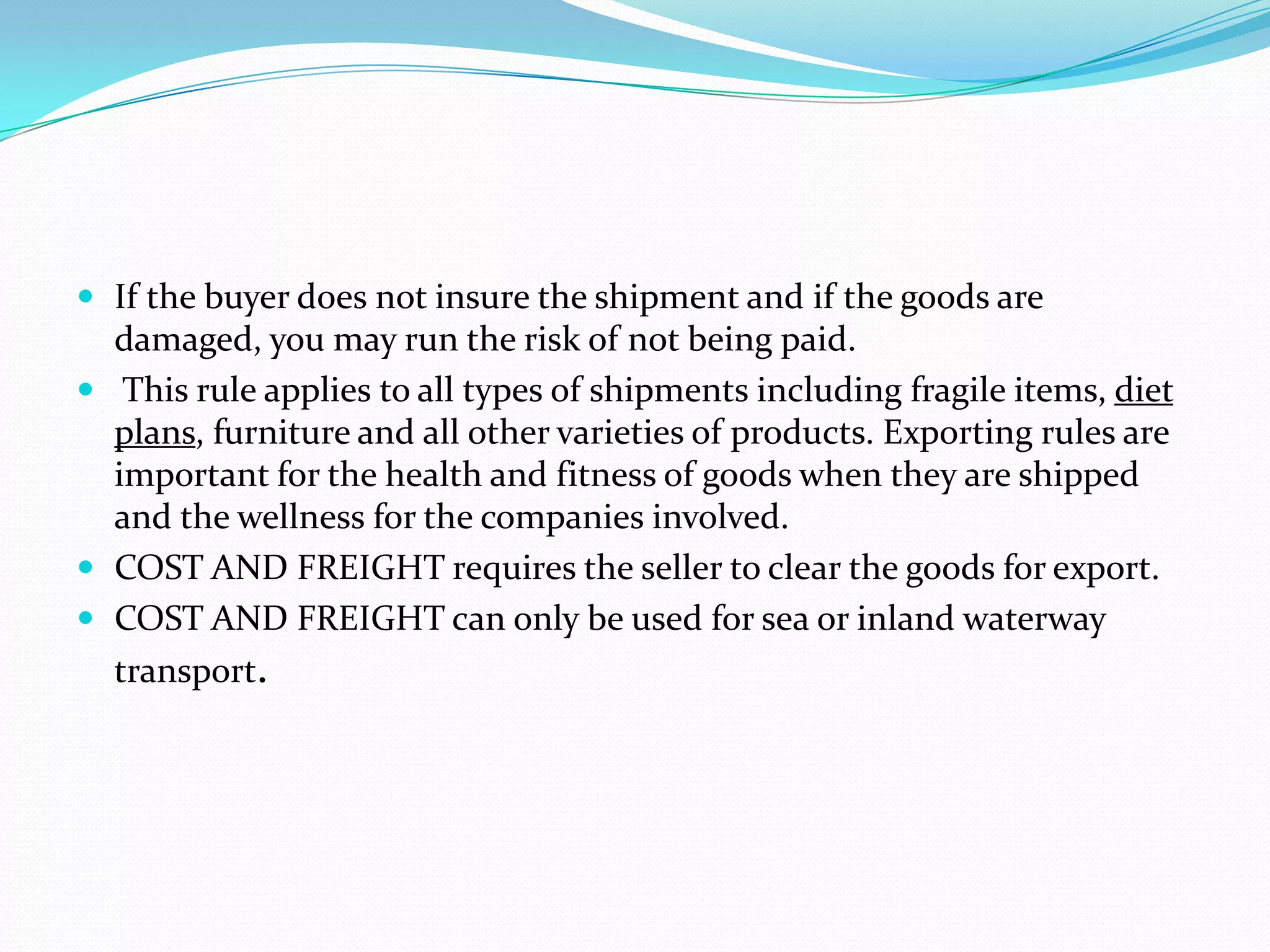
If thebuyer does not insure the shipment and if the goods are
damaged, you may run the risk of not being paid.
This rule applies to all types of shipments including fragile items, diet
plans, furniture and all other varieties of products. Exporting rules are
important for the health and fitness of goods when they are shipped
and the wellness for the companies involved.
COST AND FREIGHT requires the seller to clear the goods for export.
COST AND FREIGHT can only be used for sea or inland waterway
transport.
24.
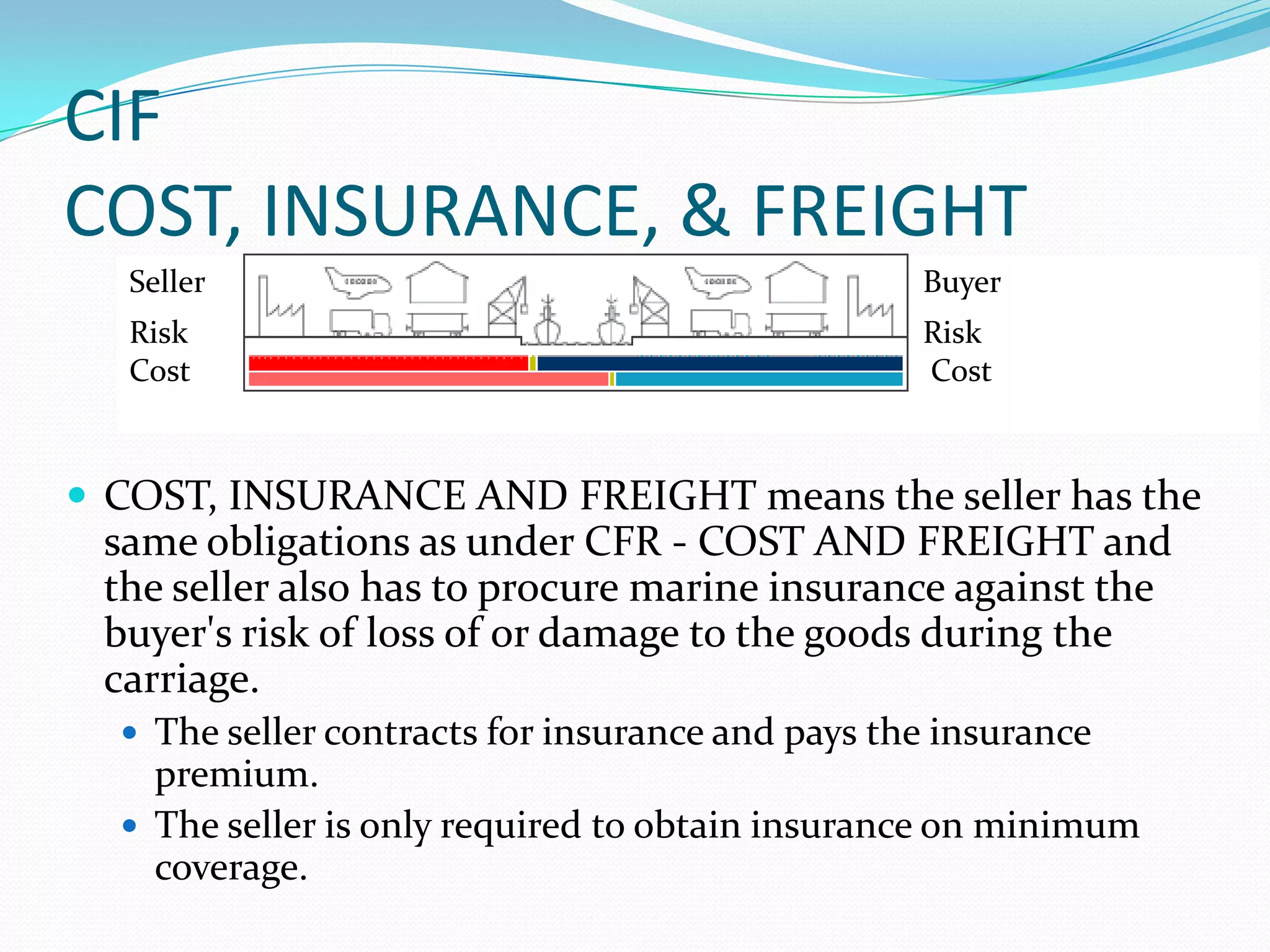
CIF
COST, INSURANCE, &FREIGHT
Seller Buyer
Risk Risk
Cost Cost
COST, INSURANCE AND FREIGHT means the seller has the
same obligations as under CFR - COST AND FREIGHT and
the seller also has to procure marine insurance against the
buyer's risk of loss of or damage to the goods during the
carriage.
The seller contracts for insurance and pays the insurance
premium.
The seller is only required to obtain insurance on minimum
coverage.
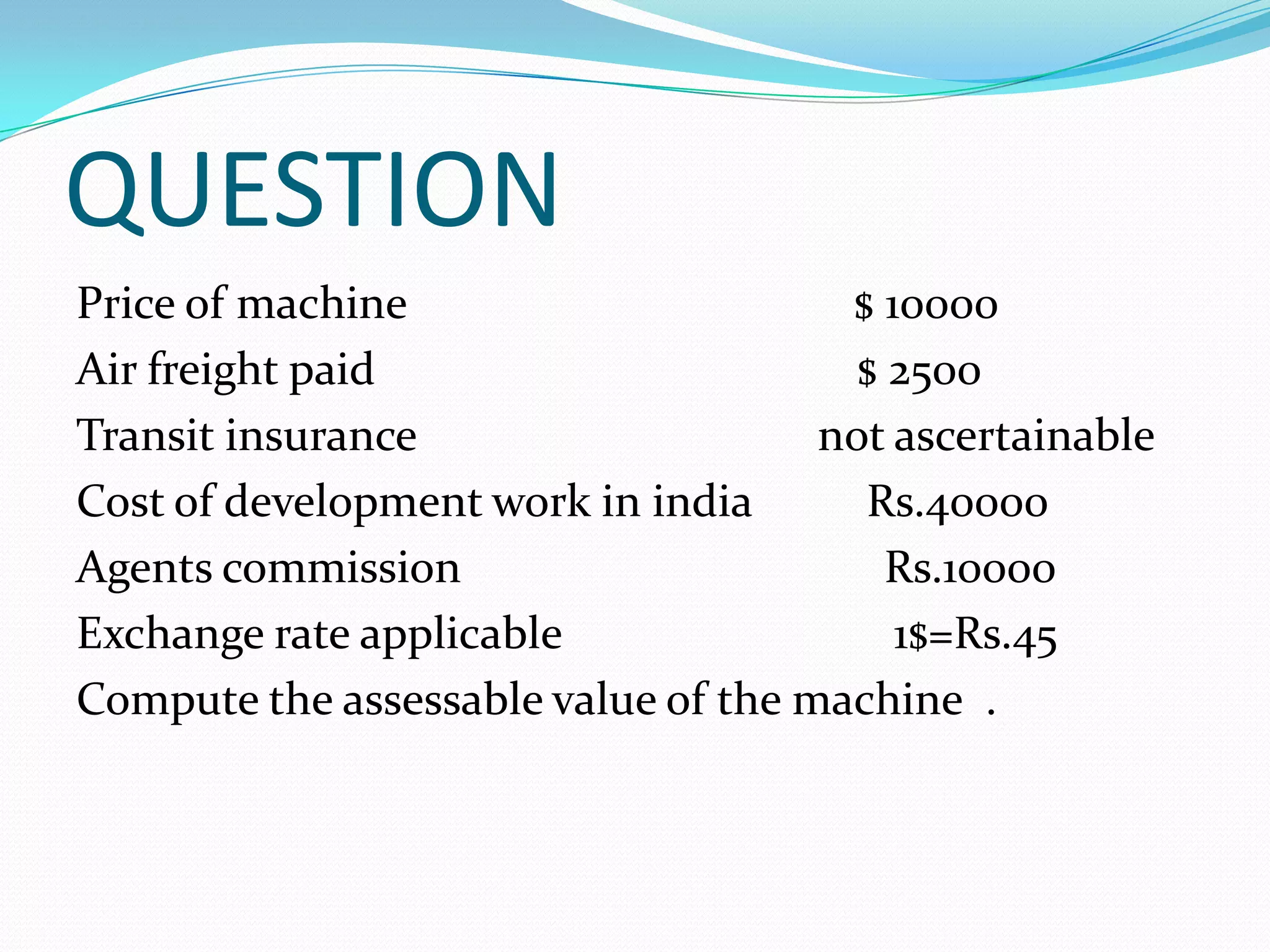
QUESTION
Price of machine $ 10000
Air freight paid $ 2500
Transit insurance not ascertainable
Cost of development work in india Rs.40000
Agents commission Rs.10000
Exchange rate applicable 1$=Rs.45
Compute the assessable value of the machine .
27.
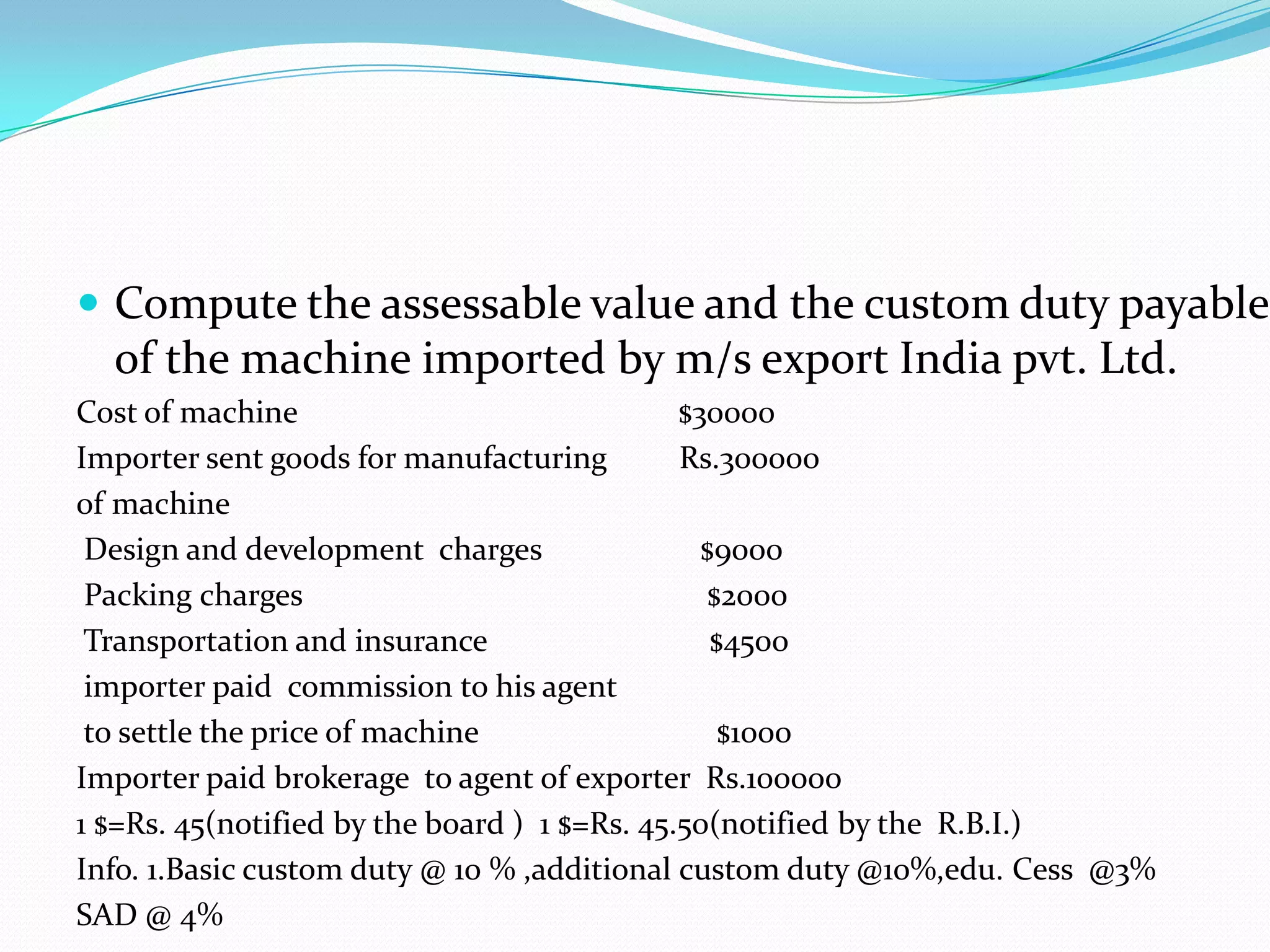
Compute theassessable value and the custom duty payable
of the machine imported by m/s export India pvt. Ltd.
Cost of machine $30000
Importer sent goods for manufacturing Rs.300000
0f machine
Design and development charges $9000
Packing charges $2000
Transportation and insurance $4500
importer paid commission to his agent
to settle the price of machine $1000
Importer paid brokerage to agent of exporter Rs.100000
1 $=Rs. 45(notified by the board ) 1 $=Rs. 45.50(notified by the R.B.I.)
Info. 1.Basic custom duty @ 10 % ,additional custom duty @10%,edu. Cess @3%
SAD @ 4%