Law Of Variable
Proportion1
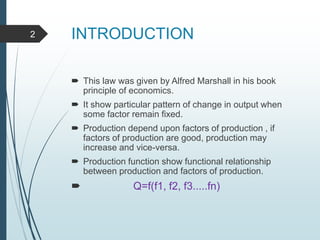
INTRODUCTION
 This law was given by Alfred Marshall in his book
principle of economics.
 It show particular pattern of change in output when
some factor remain fixed.
 Production depend upon factors of production , if
factors of production are good, production may
increase and vice-versa.
 Production function show functional relationship
between production and factors of production.
 Q=f(f1, f2, f3.....fn)
2
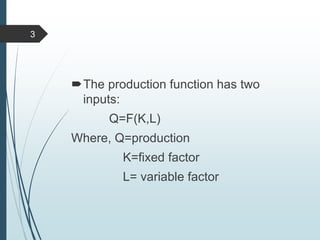
The production function has two
inputs:
Q=F(K,L)
Where, Q=production
K=fixed factor
L= variable factor
3
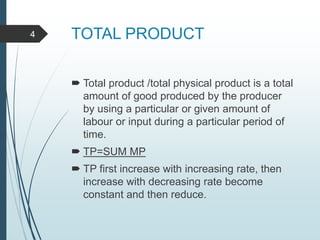
TOTAL PRODUCT
 Total product /total physical product is a total
amount of good produced by the producer
by using a particular or given amount of
labour or input during a particular period of
time.
 TP=SUM MP
 TP first increase with increasing rate, then
increase with decreasing rate become
constant and then reduce.
4
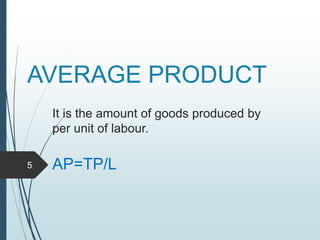
AVERAGE PRODUCT
It is the amount of goods produced by
per unit of labour.
AP=TP/L5
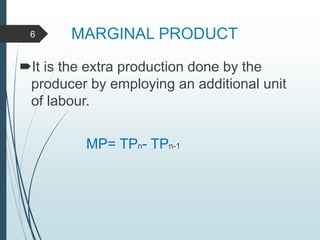
MARGINAL PRODUCT
It is the extra production done by the
producer by employing an additional unit
of labour.
MP= TPn- TPn-1
6
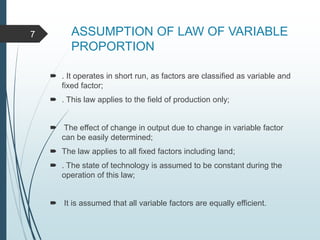
ASSUMPTION OF LAW OF VARIABLE
PROPORTION
 . It operates in short run, as factors are classified as variable and
fixed factor;
 . This law applies to the field of production only;
 The effect of change in output due to change in variable factor
can be easily determined;
 The law applies to all fixed factors including land;
 . The state of technology is assumed to be constant during the
operation of this law;
 It is assumed that all variable factors are equally efficient.
7
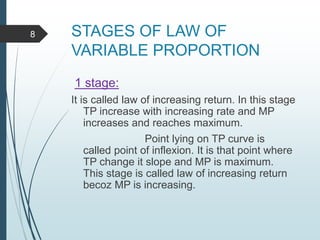
STAGES OF LAW OF
VARIABLE PROPORTION
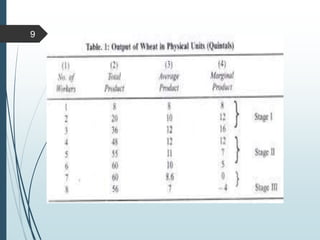
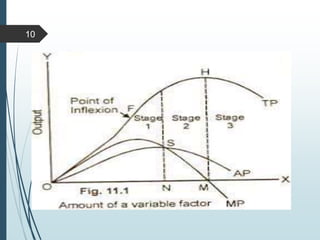
1 stage:
It is called law of increasing return. In this stage
TP increase with increasing rate and MP
increases and reaches maximum.
Point lying on TP curve is
called point of inflexion. It is that point where
TP change it slope and MP is maximum.
This stage is called law of increasing return
becoz MP is increasing.
8
9
10
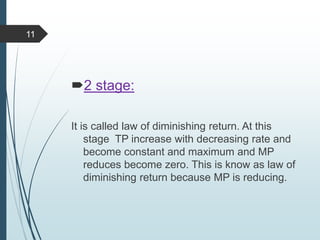
2 stage:
It is called law of diminishing return. At this
stage TP increase with decreasing rate and
become constant and maximum and MP
reduces become zero. This is know as law of
diminishing return because MP is reducing.
11
3 stages:
This stage is called law of
negative return. At this stage
TP reduces and MP become
negative.
12
CAUSES OF LAW OF
INCREASING RETURNS
DUE TO BEST UTILISATION
OF FIXED FACTOR-
At initial stage supply and
contribution of fixed factors is more as
compared to variable factor or the fixed
factors are not utilised fully so giving its
best contribution to increase the
production.
13
 EFFICIENCY OF VARIABLE FACTORS
DUE TO DIVISION OF LABOUR AND
SPECIALISATION
variable factors in first stage are working
efficiently as there are few labours which
makes coordination easy and thus increases
the production.
14
CAUSES OF DECREASING
OR NEGATIVE RETURNS
OPTIMUM UTILISATION OF FIXED
FACTORS OF PRODUCTION
In 2 and 3 stage it is assume fixed factors are
utilised optimally due to optimum utilisation
of fixed factors total production starts
reducing because fixed factors have already
attributed its fullest to production process
and has no more capacity to increase
production.
15
LACK OF COORDINATION AMONG
VARIOUS FACTORS
In 2 and 3 stage as the number of labour
increases the coordination among them
reduces and due to this total production
increases with decreasing rate and ultimately
reduces. As lack of coordination leads to
mutual conflicts , strikes, lockout.
16

Law of variable proportion

  • 1.
  • 2.
    INTRODUCTION  This lawwas given by Alfred Marshall in his book principle of economics.  It show particular pattern of change in output when some factor remain fixed.  Production depend upon factors of production , if factors of production are good, production may increase and vice-versa.  Production function show functional relationship between production and factors of production.  Q=f(f1, f2, f3.....fn) 2
  • 3.
    The production functionhas two inputs: Q=F(K,L) Where, Q=production K=fixed factor L= variable factor 3
  • 4.
    TOTAL PRODUCT  Totalproduct /total physical product is a total amount of good produced by the producer by using a particular or given amount of labour or input during a particular period of time.  TP=SUM MP  TP first increase with increasing rate, then increase with decreasing rate become constant and then reduce. 4
  • 5.
    AVERAGE PRODUCT It isthe amount of goods produced by per unit of labour. AP=TP/L5
  • 6.
    MARGINAL PRODUCT It isthe extra production done by the producer by employing an additional unit of labour. MP= TPn- TPn-1 6
  • 7.
    ASSUMPTION OF LAWOF VARIABLE PROPORTION  . It operates in short run, as factors are classified as variable and fixed factor;  . This law applies to the field of production only;  The effect of change in output due to change in variable factor can be easily determined;  The law applies to all fixed factors including land;  . The state of technology is assumed to be constant during the operation of this law;  It is assumed that all variable factors are equally efficient. 7
  • 8.
    STAGES OF LAWOF VARIABLE PROPORTION 1 stage: It is called law of increasing return. In this stage TP increase with increasing rate and MP increases and reaches maximum. Point lying on TP curve is called point of inflexion. It is that point where TP change it slope and MP is maximum. This stage is called law of increasing return becoz MP is increasing. 8
  • 9.
  • 10.
  • 11.
    2 stage: It iscalled law of diminishing return. At this stage TP increase with decreasing rate and become constant and maximum and MP reduces become zero. This is know as law of diminishing return because MP is reducing. 11
  • 12.
    3 stages: This stageis called law of negative return. At this stage TP reduces and MP become negative. 12
  • 13.
    CAUSES OF LAWOF INCREASING RETURNS DUE TO BEST UTILISATION OF FIXED FACTOR- At initial stage supply and contribution of fixed factors is more as compared to variable factor or the fixed factors are not utilised fully so giving its best contribution to increase the production. 13
  • 14.
     EFFICIENCY OFVARIABLE FACTORS DUE TO DIVISION OF LABOUR AND SPECIALISATION variable factors in first stage are working efficiently as there are few labours which makes coordination easy and thus increases the production. 14
  • 15.
    CAUSES OF DECREASING ORNEGATIVE RETURNS OPTIMUM UTILISATION OF FIXED FACTORS OF PRODUCTION In 2 and 3 stage it is assume fixed factors are utilised optimally due to optimum utilisation of fixed factors total production starts reducing because fixed factors have already attributed its fullest to production process and has no more capacity to increase production. 15
  • 16.
    LACK OF COORDINATIONAMONG VARIOUS FACTORS In 2 and 3 stage as the number of labour increases the coordination among them reduces and due to this total production increases with decreasing rate and ultimately reduces. As lack of coordination leads to mutual conflicts , strikes, lockout. 16