



Prepared by: Eric Lee
International Business
Oculus Pte Ltd
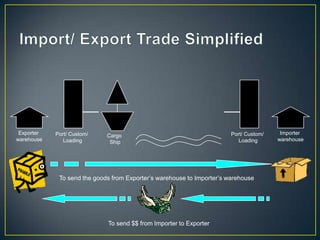
Exporter   Port/ Custom/                                               Port/ Custom/    Importer
                             Cargo
warehouse      Loading                                                     Loading      warehouse
                              Ship


             To send the goods from Exporter’s warehouse to Importer’s warehouse


                             To send $$ from Importer to Exporter
1.   Incoterms 2010
2.   Shipping Documents
3.   Cargo Insurance
4.   Payment Modes/ Letter of Credit
5.   Import/ Export Procedures
• Incoterms – International Commercial Terms
• ICC – International Chamber of Commerce, 1936
     • Revised in 1953, 1967, 1976, 1980, 1990, 2000 and 2010
• Spells out responsibility of both the importer and
  exporters
  • Documentations
  • Cost
  • Risk
• Uniform set of rule, reduces misunderstanding and
  dispute, overcome diversity of interpretation
• BUT, it is NOT LAW
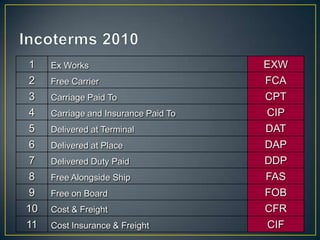
1    Ex Works                         EXW
2    Free Carrier                     FCA
3    Carriage Paid To                 CPT
4    Carriage and Insurance Paid To   CIP
5    Delivered at Terminal            DAT
6    Delivered at Place               DAP
7    Delivered Duty Paid              DDP
8    Free Alongside Ship              FAS
9    Free on Board                    FOB
10   Cost & Freight                   CFR
11   Cost Insurance & Freight         CIF
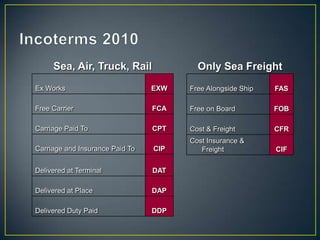
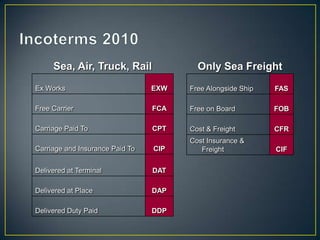
Sea, Air, Truck, Rail               Only Sea Freight
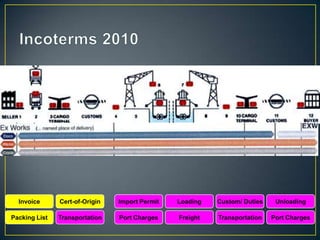
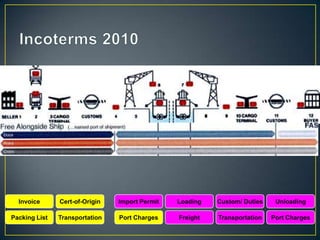
Ex Works                         EXW   Free Alongside Ship   FAS

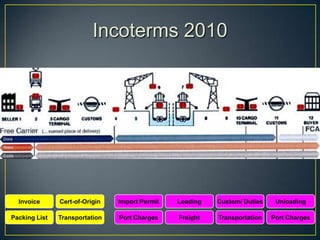
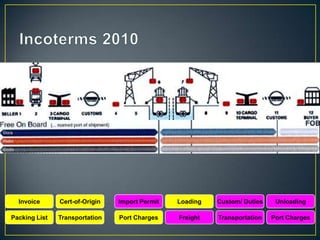
Free Carrier                     FCA   Free on Board         FOB

Carriage Paid To                 CPT   Cost & Freight        CFR
                                       Cost Insurance &
Carriage and Insurance Paid To   CIP      Freight            CIF

Delivered at Terminal            DAT

Delivered at Place               DAP

Delivered Duty Paid              DDP
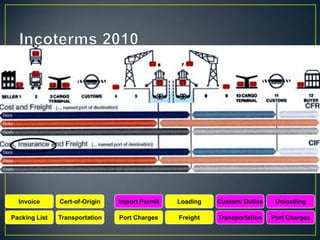
Invoice      Cert-of-Origin   Import Permit   Loading   Custom/ Duties    Unloading

Packing List   Transportation   Port Charges    Freight   Transportation   Port Charges
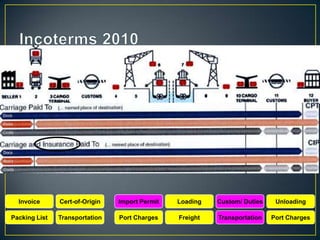
Incoterms 2010


  Invoice      Cert-of-Origin   Import Permit   Loading   Custom/ Duties    Unloading

Packing List   Transportation   Port Charges    Freight   Transportation   Port Charges
Invoice      Cert-of-Origin   Import Permit   Loading   Custom/ Duties    Unloading

Packing List   Transportation   Port Charges    Freight   Transportation   Port Charges
Invoice      Cert-of-Origin   Import Permit   Loading   Custom/ Duties    Unloading

Packing List   Transportation   Port Charges    Freight   Transportation   Port Charges
Invoice      Cert-of-Origin   Import Permit   Loading   Custom/ Duties    Unloading

Packing List   Transportation   Port Charges    Freight   Transportation   Port Charges
Invoice      Cert-of-Origin   Import Permit   Loading   Custom/ Duties    Unloading

Packing List   Transportation   Port Charges    Freight   Transportation   Port Charges
Sea, Air, Truck, Rail               Only Sea Freight
Ex Works                         EXW   Free Alongside Ship   FAS

Free Carrier                     FCA   Free on Board         FOB

Carriage Paid To                 CPT   Cost & Freight        CFR
                                       Cost Insurance &
Carriage and Insurance Paid To   CIP      Freight            CIF

Delivered at Terminal            DAT

Delivered at Place               DAP

Delivered Duty Paid              DDP
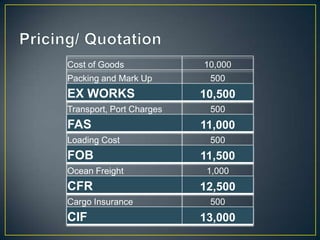
Cost of Goods             10,000
Packing and Mark Up        500
EX WORKS                  10,500
Transport, Port Charges    500
FAS                       11,000
Loading Cost               500
FOB                       11,500
Ocean Freight              1,000
CFR                       12,500
Cargo Insurance            500
CIF                       13,000
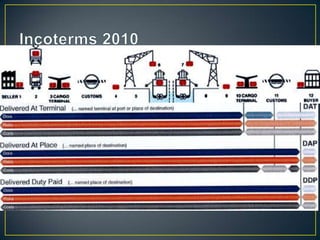
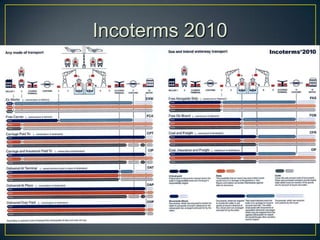
Incoterms 2010
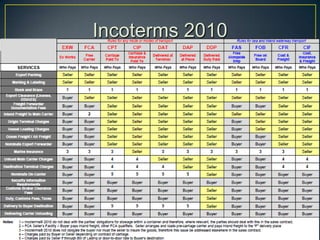
Incoterms 2010
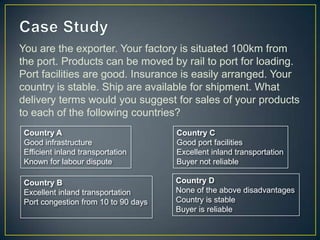
You are the exporter. Your factory is situated 100km from
the port. Products can be moved by rail to port for loading.
Port facilities are good. Insurance is easily arranged. Your
country is stable. Ship are available for shipment. What
delivery terms would you suggest for sales of your products
to each of the following countries?
Country A                            Country C
Good infrastructure                  Good port facilities
Efficient inland transportation      Excellent inland transportation
Known for labour dispute             Buyer not reliable

Country B                            Country D
Excellent inland transportation      None of the above disadvantages
Port congestion from 10 to 90 days   Country is stable
                                     Buyer is reliable
Basic Type of Documents
- Carriers
  - Bill of Lading
  - Air Way Bill
- Seller
  - Invoice
  - Packing List
  - Certificate of Origin
- Buyer
  - Application of Shipping Guarantee (if necessary)
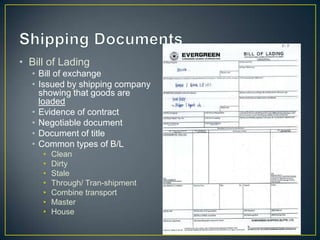
• Bill of Lading
  • Bill of exchange
  • Issued by shipping company
    showing that goods are
    loaded
  • Evidence of contract
  • Negotiable document
  • Document of title
  • Common types of B/L
     •   Clean
     •   Dirty
     •   Stale
     •   Through/ Tran-shipment
     •   Combine transport
     •   Master
     •   House
Shipping Documents
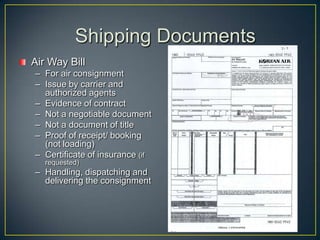
Air Way Bill
– For air consignment
– Issue by carrier and
  authorized agents
– Evidence of contract
– Not a negotiable document
– Not a document of title
– Proof of receipt/ booking
  (not loading)
– Certificate of insurance (if
   requested)
– Handling, dispatching and
  delivering the consignment
• Bill of Lading                  • Air Way Bill
  • Bill of exchange                • For air consignment
  • Issued by shipping company      • Issue by carrier and
    showing that goods are            authorized agents
    loaded                          • Evidence of contract
  • Evidence of contract            • Not a negotiable document
  • Negotiable document             • Not a document of title
  • Document of title               • Proof of receipt/ booking (not
  • Common types of B/L               loading)
     •   Clean                      • Certificate of insurance (if
     •   Dirty                        requested)
     •   Stale                      • Handling, dispatching and
     •   Through/ Tran-shipment       delivering the consignment
     •   Combine transport
     •   Master
     •   House
• Invoice
  • Indicates the value of the cargo and relevant details
    relating to payment
  • Custom duties, insurance claims, declaration of permits
    and L/C negotiation
  • Type of invoice:
    •   Commercial Invoice
    •   Proforma Invoice
    •   Consular Invoice
    •   Custom Invoice
    •   Non-commercial value Invoice
• Packing List
  • Indicates the content and description of the cargo
  (aka Weight measurement list, Cargo manifest, Cargo certificate)
  • Use for permits, customers, insurance claims
  • Essential contents:
    •   Description
    •   Measurement
    •   Quantity
    •   Weight
• Certificate of Origin
  • Certify where the product is produced or manufactures
  • Endorse by chamber of commerce


Purpose
- Proof of country of produce – political reasons
- Claim tariff rebate - FTA
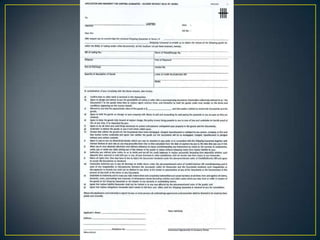
• Shipping Guarantee
  • To clear cargo without original contract of carriage
    document e.g. Original B/L
  • Indemnify the carrier against any claim
  • Protect the carrier against any fraud
  • May require bankers guarantee as back-up
What is RISK?
- Of Damage – condition of cargo before vs after

- Of Loss – disappearance of cargo (i.e. stolen, hi-jack,
  drop into the sea)
• Reasons for Insurance
  •   Protection against RISK
  •   Prevent financial loss
  •   Requirement by bank e.g. L/C term
  •   Selling on certain terms e.g. CIF
  •   Carrier’s limited liability
  •   Reduce business anxiety
Refer to individual insurance policy
              for details
• Exclusion Clause
  • Unseaworthiness of the vessel
  • Wilful misconduct
     • Illegal act
     • Done on purpose
  • Insolvency of the carrier
• Claims Procedure
  • Inform insurance company
  • Cargo survey by inspection company
     • Cost
     • Cause
  • Notify relevant parties
  • Submission of documents
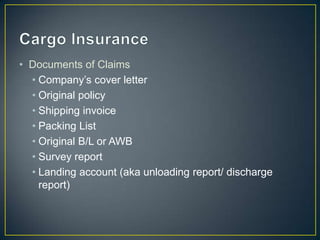
• Documents of Claims
  • Company’s cover letter
  • Original policy
  • Shipping invoice
  • Packing List
  • Original B/L or AWB
  • Survey report
  • Landing account (aka unloading report/ discharge
    report)
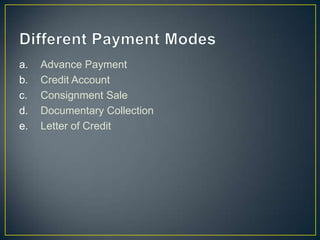
a.   Advance Payment
b.   Credit Account
c.   Consignment Sale
d.   Documentary Collection
e.   Letter of Credit
• Document against                • Document against
  Payment (D/P)                     Acceptance (D/A)

  • Supplier ship goods and         • Supplier ship goods and
    forward bill of exchange to       forward bill of exchange to
    buyer’s bank through his          buyer’s bank through his
    own bank                          own bank
  • No credit involved              • Credit period involved
  • Buyer obtain title to goods     • Buyer obtain title to goods
    after payment                     before payment
                                    • In case buyer default, only
                                      legal action is possible
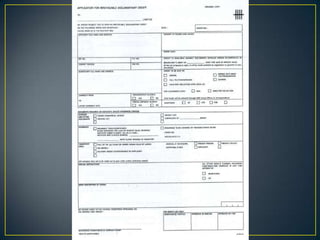
• Letter of undertaking by importer’s bank to pay
  oversea exporter against exporter’s shipping
  document
• Shipping document must adhere strictly to terms
  and conditions of the L/C
• Exporter receive payment once documents are
  accepted without discrepancy
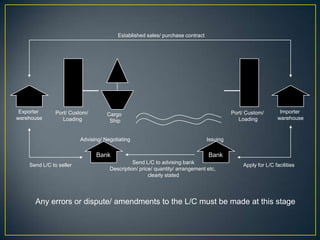
• Procedures
  •   Sales Contract
  •   Buyer open L/C
  •   Issuing bank sends L/C to Advising bank
  •   Advising bank sends L/C to seller
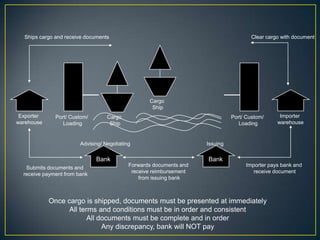
  •   Seller ships cargo
  •   Seller presents documents to negotiating bank for payment
  •   Negotiating bank checks and pay
  •   Negotiating bank forwards document to issuing bank
  •   Issuing bank checks and reimburse
  •   Buyer pays issuing bank
  •   Issuing bank releases shipping document to buyer
  •   Buyer uses shipping document to clear cargo
Established sales/ purchase contract


 Exporter      Port/ Custom/                                                             Port/ Custom/        Importer
                                    Cargo
warehouse         Loading                                                                   Loading          warehouse
                                     Ship


                         Advising/ Negotiating                                 Issuing

                               Bank                                            Bank
                                               Send L/C to advising bank
    Send L/C to seller                                                                       Apply for L/C facilities
                                     Description/ price/ quantity/ arrangement etc,
                                                      clearly stated


      Any errors or dispute/ amendments to the L/C must be made at this stage
Ships cargo and receive documents                                                    Clear cargo with document


                                                   Cargo
                                                    Ship
 Exporter     Port/ Custom/        Cargo                                       Port/ Custom/      Importer
warehouse        Loading            Ship                                          Loading        warehouse


                        Advising/ Negotiating                        Issuing

                              Bank                                   Bank
                                            Forwards documents and                  Importer pays bank and
   Submits documents and
                                             receive reimbursement                     receive document
  receive payment from bank
                                                from issuing bank


            Once cargo is shipped, documents must be presented at immediately
                  All terms and conditions must be in order and consistent
                         All documents must be complete and in order
                              Any discrepancy, bank will NOT pay
• Different type of L/C
  • Revocable
  • Irrevocable
     • Confirmed
     • Unconfirmed
  • Red Clause
  • Revolving
  • Transferrable
  • Back-to-back
• Advantages                         • Disadvantages
  • Secure                             • Over reliance on shipping
  • Financial assistance                 documents
  • Bank control and hold title to     • No physical inspection of
    goods                                goods
  • Seller receive payment when        • Bank not familiar with
    all terms are fulfilled, even        shipping practices
    before buyer receive the           • Subject to fraud
    goods                              • Very costly
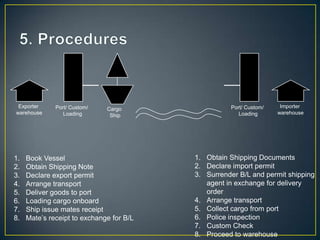
Exporter     Port/ Custom/                         Port/ Custom/    Importer
                              Cargo
warehouse        Loading                               Loading      warehouse
                               Ship


1.   Book Vessel                          1. Obtain Shipping Documents
2.   Obtain Shipping Note                 2. Declare import permit
3.   Declare export permit                3. Surrender B/L and permit shipping
4.   Arrange transport                       agent in exchange for delivery
5.   Deliver goods to port                   order
6.   Loading cargo onboard                4. Arrange transport
7.   Ship issue mates receipt             5. Collect cargo from port
8.   Mate’s receipt to exchange for B/L   6. Police inspection
                                          7. Custom Check
                                          8. Proceed to warehouse
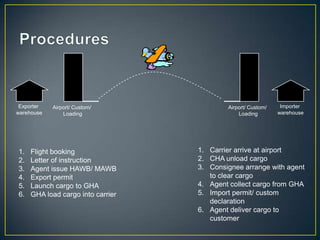
Exporter   Airport/ Custom/               Airport/ Custom/    Importer
warehouse       Loading                        Loading        warehouse


1.   Flight booking                1. Carrier arrive at airport
2.   Letter of instruction         2. CHA unload cargo
3.   Agent issue HAWB/ MAWB        3. Consignee arrange with agent
4.   Export permit                    to clear cargo
5.   Launch cargo to GHA           4. Agent collect cargo from GHA
6.   GHA load cargo into carrier   5. Import permit/ custom
                                      declaration
                                   6. Agent deliver cargo to
                                      customer
Import & export presentation

Import & export presentation

  • 1.
    Prepared by: EricLee International Business Oculus Pte Ltd
  • 2.
    Exporter Port/ Custom/ Port/ Custom/ Importer Cargo warehouse Loading Loading warehouse Ship To send the goods from Exporter’s warehouse to Importer’s warehouse To send $$ from Importer to Exporter
  • 3.
    1. Incoterms 2010 2. Shipping Documents 3. Cargo Insurance 4. Payment Modes/ Letter of Credit 5. Import/ Export Procedures
  • 4.
    • Incoterms –International Commercial Terms • ICC – International Chamber of Commerce, 1936 • Revised in 1953, 1967, 1976, 1980, 1990, 2000 and 2010 • Spells out responsibility of both the importer and exporters • Documentations • Cost • Risk • Uniform set of rule, reduces misunderstanding and dispute, overcome diversity of interpretation • BUT, it is NOT LAW
  • 5.
    1 Ex Works EXW 2 Free Carrier FCA 3 Carriage Paid To CPT 4 Carriage and Insurance Paid To CIP 5 Delivered at Terminal DAT 6 Delivered at Place DAP 7 Delivered Duty Paid DDP 8 Free Alongside Ship FAS 9 Free on Board FOB 10 Cost & Freight CFR 11 Cost Insurance & Freight CIF
  • 7.
    Sea, Air, Truck,Rail Only Sea Freight Ex Works EXW Free Alongside Ship FAS Free Carrier FCA Free on Board FOB Carriage Paid To CPT Cost & Freight CFR Cost Insurance & Carriage and Insurance Paid To CIP Freight CIF Delivered at Terminal DAT Delivered at Place DAP Delivered Duty Paid DDP
  • 8.
    Invoice Cert-of-Origin Import Permit Loading Custom/ Duties Unloading Packing List Transportation Port Charges Freight Transportation Port Charges
  • 9.
    Incoterms 2010 Invoice Cert-of-Origin Import Permit Loading Custom/ Duties Unloading Packing List Transportation Port Charges Freight Transportation Port Charges
  • 10.
    Invoice Cert-of-Origin Import Permit Loading Custom/ Duties Unloading Packing List Transportation Port Charges Freight Transportation Port Charges
  • 11.
    Invoice Cert-of-Origin Import Permit Loading Custom/ Duties Unloading Packing List Transportation Port Charges Freight Transportation Port Charges
  • 12.
    Invoice Cert-of-Origin Import Permit Loading Custom/ Duties Unloading Packing List Transportation Port Charges Freight Transportation Port Charges
  • 13.
    Invoice Cert-of-Origin Import Permit Loading Custom/ Duties Unloading Packing List Transportation Port Charges Freight Transportation Port Charges
  • 15.
    Sea, Air, Truck,Rail Only Sea Freight Ex Works EXW Free Alongside Ship FAS Free Carrier FCA Free on Board FOB Carriage Paid To CPT Cost & Freight CFR Cost Insurance & Carriage and Insurance Paid To CIP Freight CIF Delivered at Terminal DAT Delivered at Place DAP Delivered Duty Paid DDP
  • 16.
    Cost of Goods 10,000 Packing and Mark Up 500 EX WORKS 10,500 Transport, Port Charges 500 FAS 11,000 Loading Cost 500 FOB 11,500 Ocean Freight 1,000 CFR 12,500 Cargo Insurance 500 CIF 13,000
  • 17.
  • 18.
  • 19.
    You are theexporter. Your factory is situated 100km from the port. Products can be moved by rail to port for loading. Port facilities are good. Insurance is easily arranged. Your country is stable. Ship are available for shipment. What delivery terms would you suggest for sales of your products to each of the following countries? Country A Country C Good infrastructure Good port facilities Efficient inland transportation Excellent inland transportation Known for labour dispute Buyer not reliable Country B Country D Excellent inland transportation None of the above disadvantages Port congestion from 10 to 90 days Country is stable Buyer is reliable
  • 21.
    Basic Type ofDocuments - Carriers - Bill of Lading - Air Way Bill - Seller - Invoice - Packing List - Certificate of Origin - Buyer - Application of Shipping Guarantee (if necessary)
  • 22.
    • Bill ofLading • Bill of exchange • Issued by shipping company showing that goods are loaded • Evidence of contract • Negotiable document • Document of title • Common types of B/L • Clean • Dirty • Stale • Through/ Tran-shipment • Combine transport • Master • House
  • 23.
    Shipping Documents Air WayBill – For air consignment – Issue by carrier and authorized agents – Evidence of contract – Not a negotiable document – Not a document of title – Proof of receipt/ booking (not loading) – Certificate of insurance (if requested) – Handling, dispatching and delivering the consignment
  • 24.
    • Bill ofLading • Air Way Bill • Bill of exchange • For air consignment • Issued by shipping company • Issue by carrier and showing that goods are authorized agents loaded • Evidence of contract • Evidence of contract • Not a negotiable document • Negotiable document • Not a document of title • Document of title • Proof of receipt/ booking (not • Common types of B/L loading) • Clean • Certificate of insurance (if • Dirty requested) • Stale • Handling, dispatching and • Through/ Tran-shipment delivering the consignment • Combine transport • Master • House
  • 25.
    • Invoice • Indicates the value of the cargo and relevant details relating to payment • Custom duties, insurance claims, declaration of permits and L/C negotiation • Type of invoice: • Commercial Invoice • Proforma Invoice • Consular Invoice • Custom Invoice • Non-commercial value Invoice
  • 26.
    • Packing List • Indicates the content and description of the cargo (aka Weight measurement list, Cargo manifest, Cargo certificate) • Use for permits, customers, insurance claims • Essential contents: • Description • Measurement • Quantity • Weight
  • 28.
    • Certificate ofOrigin • Certify where the product is produced or manufactures • Endorse by chamber of commerce Purpose - Proof of country of produce – political reasons - Claim tariff rebate - FTA
  • 29.
    • Shipping Guarantee • To clear cargo without original contract of carriage document e.g. Original B/L • Indemnify the carrier against any claim • Protect the carrier against any fraud • May require bankers guarantee as back-up
  • 32.
    What is RISK? -Of Damage – condition of cargo before vs after - Of Loss – disappearance of cargo (i.e. stolen, hi-jack, drop into the sea)
  • 33.
    • Reasons forInsurance • Protection against RISK • Prevent financial loss • Requirement by bank e.g. L/C term • Selling on certain terms e.g. CIF • Carrier’s limited liability • Reduce business anxiety
  • 34.
    Refer to individualinsurance policy for details
  • 35.
    • Exclusion Clause • Unseaworthiness of the vessel • Wilful misconduct • Illegal act • Done on purpose • Insolvency of the carrier
  • 36.
    • Claims Procedure • Inform insurance company • Cargo survey by inspection company • Cost • Cause • Notify relevant parties • Submission of documents
  • 37.
    • Documents ofClaims • Company’s cover letter • Original policy • Shipping invoice • Packing List • Original B/L or AWB • Survey report • Landing account (aka unloading report/ discharge report)
  • 40.
    a. Advance Payment b. Credit Account c. Consignment Sale d. Documentary Collection e. Letter of Credit
  • 41.
    • Document against • Document against Payment (D/P) Acceptance (D/A) • Supplier ship goods and • Supplier ship goods and forward bill of exchange to forward bill of exchange to buyer’s bank through his buyer’s bank through his own bank own bank • No credit involved • Credit period involved • Buyer obtain title to goods • Buyer obtain title to goods after payment before payment • In case buyer default, only legal action is possible
  • 42.
    • Letter ofundertaking by importer’s bank to pay oversea exporter against exporter’s shipping document • Shipping document must adhere strictly to terms and conditions of the L/C • Exporter receive payment once documents are accepted without discrepancy
  • 44.
    • Procedures • Sales Contract • Buyer open L/C • Issuing bank sends L/C to Advising bank • Advising bank sends L/C to seller • Seller ships cargo • Seller presents documents to negotiating bank for payment • Negotiating bank checks and pay • Negotiating bank forwards document to issuing bank • Issuing bank checks and reimburse • Buyer pays issuing bank • Issuing bank releases shipping document to buyer • Buyer uses shipping document to clear cargo
  • 45.
    Established sales/ purchasecontract Exporter Port/ Custom/ Port/ Custom/ Importer Cargo warehouse Loading Loading warehouse Ship Advising/ Negotiating Issuing Bank Bank Send L/C to advising bank Send L/C to seller Apply for L/C facilities Description/ price/ quantity/ arrangement etc, clearly stated Any errors or dispute/ amendments to the L/C must be made at this stage
  • 46.
    Ships cargo andreceive documents Clear cargo with document Cargo Ship Exporter Port/ Custom/ Cargo Port/ Custom/ Importer warehouse Loading Ship Loading warehouse Advising/ Negotiating Issuing Bank Bank Forwards documents and Importer pays bank and Submits documents and receive reimbursement receive document receive payment from bank from issuing bank Once cargo is shipped, documents must be presented at immediately All terms and conditions must be in order and consistent All documents must be complete and in order Any discrepancy, bank will NOT pay
  • 47.
    • Different typeof L/C • Revocable • Irrevocable • Confirmed • Unconfirmed • Red Clause • Revolving • Transferrable • Back-to-back
  • 48.
    • Advantages • Disadvantages • Secure • Over reliance on shipping • Financial assistance documents • Bank control and hold title to • No physical inspection of goods goods • Seller receive payment when • Bank not familiar with all terms are fulfilled, even shipping practices before buyer receive the • Subject to fraud goods • Very costly
  • 49.
    Exporter Port/ Custom/ Port/ Custom/ Importer Cargo warehouse Loading Loading warehouse Ship 1. Book Vessel 1. Obtain Shipping Documents 2. Obtain Shipping Note 2. Declare import permit 3. Declare export permit 3. Surrender B/L and permit shipping 4. Arrange transport agent in exchange for delivery 5. Deliver goods to port order 6. Loading cargo onboard 4. Arrange transport 7. Ship issue mates receipt 5. Collect cargo from port 8. Mate’s receipt to exchange for B/L 6. Police inspection 7. Custom Check 8. Proceed to warehouse
  • 50.
    Exporter Airport/ Custom/ Airport/ Custom/ Importer warehouse Loading Loading warehouse 1. Flight booking 1. Carrier arrive at airport 2. Letter of instruction 2. CHA unload cargo 3. Agent issue HAWB/ MAWB 3. Consignee arrange with agent 4. Export permit to clear cargo 5. Launch cargo to GHA 4. Agent collect cargo from GHA 6. GHA load cargo into carrier 5. Import permit/ custom declaration 6. Agent deliver cargo to customer