

Executive and
real self
Prepared By
Manu Melwin Joy
Research Scholar
School of Management Studies
CUSAT, Kerala, India.
Phone – 9744551114
Mail – manu_melwinjoy@yahoo.com
Kindly restrict the use of slides for personal purpose.
Please seek permission to reproduce the same in public
forms and presentations.
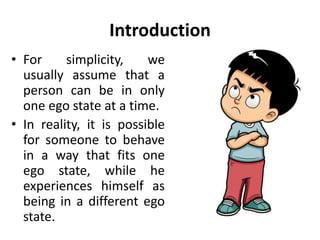
Introduction
• For simplicity, we
usually assume that a
person can be in only
one ego state at a time.
• In reality, it is possible
for someone to behave
in a way that fits one
ego state, while he
experiences himself as
being in a different ego
state.
Example
• Imagine that I am at work,
discussing a planned
assignment with a colleague.
• For the first few minutes of
the discussion, I have my
attention fully on the task in
hand.
• If you were watching my
behavioral signals, you
would make a secure
judgment that I am in Adult.
• My own internal experience
also is that I am in Adult –
responding to the here and
now, exchanging and
assessing information.
Example
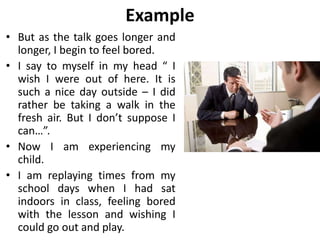
• But as the talk goes longer and
longer, I begin to feel bored.
• I say to myself in my head “ I
wish I were out of here. It is
such a nice day outside – I did
rather be taking a walk in the
fresh air. But I don’t suppose I
can…”.
• Now I am experiencing my
child.
• I am replaying times from my
school days when I had sat
indoors in class, feeling bored
with the lesson and wishing I
could go out and play.
Example
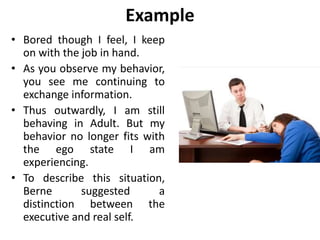
• Bored though I feel, I keep
on with the job in hand.
• As you observe my behavior,
you see me continuing to
exchange information.
• Thus outwardly, I am still
behaving in Adult. But my
behavior no longer fits with
the ego state I am
experiencing.
• To describe this situation,
Berne suggested a
distinction between the
executive and real self.
Real and executive
• When an ego state is
dictating a person’s
behavior, that ego state
is said to have executive
power.
• When a person
experiences himself to
be in a particular ego
state, we say he is
experiencing that ego
state as his real self.
Real and executive
• Most often, the ego state with
executive power will also be
experienced as the real self.
• In the example, initially I had
executive power in Adult and
simultaneously experienced
Adult as my real self.
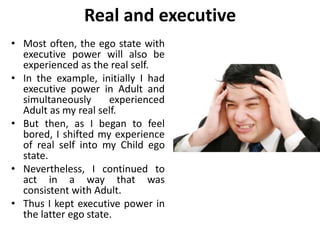
• But then, as I began to feel
bored, I shifted my experience
of real self into my Child ego
state.
• Nevertheless, I continued to
act in a way that was
consistent with Adult.
• Thus I kept executive power in
the latter ego state.
Real and executive
• Suppose my work colleague
had kept up the discussion
for even longer, I might the
have yawned and lost track
of what he said.
• As he waited for me to reply
to one of his points, I might
have blushed and said “Oh,
Sorry, I am afraid, I wasn’t
with you”.
• Now I would have executive
power in Child while also
experiencing Child as real
self.
Activity
• Make up at least three
more examples which
illustrate someone
having executive power
in one ego state while
experiencing a different
ego state as her real
self.
• Do you recall any
examples of this from
your own experience in
the past week?
Thank YouThank You
Other TA topics available on slideshare
1. Strokes - http://www.slideshare.net/manumjoy/strokes-24081607.
2. Games People Play - http://www.slideshare.net/manumjoy/psychological-
games-people-play.
3. Structural Analysis - http://www.slideshare.net/manumjoy/the-ego-state-model.
4. What is TA? - http://www.slideshare.net/manumjoy/what-ta-is
5. Cycles of Development - http://www.slideshare.net/manumjoy/cycles-of-
developement-pamela-levin-transactional-analysis.
6. Stages of Cure - http://www.slideshare.net/manumjoy/stages-of-cure.
7. Transactions - http://www.slideshare.net/manumjoy/transactions-33677298.
8. Time Structuring - http://www.slideshare.net/manumjoy/time-structuring.
9. Life Position - http://www.slideshare.net/manumjoy/life-position.
10. Autonomy - http://www.slideshare.net/manumjoy/autonomy-33690557.
11. Structural Pathology - http://www.slideshare.net/manumjoy/structural-pathology.
12. Game Analysis - http://www.slideshare.net/manumjoy/game-analysis-33725636.
13. Integrated Adult - http://www.slideshare.net/manumjoy/integrated-adult.
14. Stroke Economy - http://www.slideshare.net/manumjoy/stroke-economy-
33826702.

Executive and real self (Transactional analysis / TA is an integrative approach to the theory of psychology and psychotherapy).

  • 1.
  • 2.
    Prepared By Manu MelwinJoy Research Scholar School of Management Studies CUSAT, Kerala, India. Phone – 9744551114 Mail – manu_melwinjoy@yahoo.com Kindly restrict the use of slides for personal purpose. Please seek permission to reproduce the same in public forms and presentations.
  • 3.
    Introduction • For simplicity,we usually assume that a person can be in only one ego state at a time. • In reality, it is possible for someone to behave in a way that fits one ego state, while he experiences himself as being in a different ego state.
  • 4.
    Example • Imagine thatI am at work, discussing a planned assignment with a colleague. • For the first few minutes of the discussion, I have my attention fully on the task in hand. • If you were watching my behavioral signals, you would make a secure judgment that I am in Adult. • My own internal experience also is that I am in Adult – responding to the here and now, exchanging and assessing information.
  • 5.
    Example • But asthe talk goes longer and longer, I begin to feel bored. • I say to myself in my head “ I wish I were out of here. It is such a nice day outside – I did rather be taking a walk in the fresh air. But I don’t suppose I can…”. • Now I am experiencing my child. • I am replaying times from my school days when I had sat indoors in class, feeling bored with the lesson and wishing I could go out and play.
  • 6.
    Example • Bored thoughI feel, I keep on with the job in hand. • As you observe my behavior, you see me continuing to exchange information. • Thus outwardly, I am still behaving in Adult. But my behavior no longer fits with the ego state I am experiencing. • To describe this situation, Berne suggested a distinction between the executive and real self.
  • 7.
    Real and executive •When an ego state is dictating a person’s behavior, that ego state is said to have executive power. • When a person experiences himself to be in a particular ego state, we say he is experiencing that ego state as his real self.
  • 8.
    Real and executive •Most often, the ego state with executive power will also be experienced as the real self. • In the example, initially I had executive power in Adult and simultaneously experienced Adult as my real self. • But then, as I began to feel bored, I shifted my experience of real self into my Child ego state. • Nevertheless, I continued to act in a way that was consistent with Adult. • Thus I kept executive power in the latter ego state.
  • 9.
    Real and executive •Suppose my work colleague had kept up the discussion for even longer, I might the have yawned and lost track of what he said. • As he waited for me to reply to one of his points, I might have blushed and said “Oh, Sorry, I am afraid, I wasn’t with you”. • Now I would have executive power in Child while also experiencing Child as real self.
  • 10.
    Activity • Make upat least three more examples which illustrate someone having executive power in one ego state while experiencing a different ego state as her real self. • Do you recall any examples of this from your own experience in the past week?
  • 11.
  • 12.
    Other TA topicsavailable on slideshare 1. Strokes - http://www.slideshare.net/manumjoy/strokes-24081607. 2. Games People Play - http://www.slideshare.net/manumjoy/psychological- games-people-play. 3. Structural Analysis - http://www.slideshare.net/manumjoy/the-ego-state-model. 4. What is TA? - http://www.slideshare.net/manumjoy/what-ta-is 5. Cycles of Development - http://www.slideshare.net/manumjoy/cycles-of- developement-pamela-levin-transactional-analysis. 6. Stages of Cure - http://www.slideshare.net/manumjoy/stages-of-cure. 7. Transactions - http://www.slideshare.net/manumjoy/transactions-33677298. 8. Time Structuring - http://www.slideshare.net/manumjoy/time-structuring. 9. Life Position - http://www.slideshare.net/manumjoy/life-position. 10. Autonomy - http://www.slideshare.net/manumjoy/autonomy-33690557. 11. Structural Pathology - http://www.slideshare.net/manumjoy/structural-pathology. 12. Game Analysis - http://www.slideshare.net/manumjoy/game-analysis-33725636. 13. Integrated Adult - http://www.slideshare.net/manumjoy/integrated-adult. 14. Stroke Economy - http://www.slideshare.net/manumjoy/stroke-economy- 33826702.