TRANSACTIONAL ANALYSIS
•Transactional analysis (TA), is an integrative approach to
the theory of psychology and psychotherapy.
•It is described as integrative because it has elements
of psychoanalytic, humanist and cognitive approaches.
• TA was first developed by Canadian-born
US psychiatrist Eric Berne, starting in the late 1950s and it is
a widely recognized form of modern psychology.
•It is a theory for analysing human behavior and
communication.It is a model for explaining why and how
people think, act and interact like they do.It is very useful in
studying various behaiour patterns and it is a social
psychology and a method to improve communication.
The key aspects of TA are:
• THE EGO STATES
• An ego state is a set of related thoughts,
feelings, and behaviors in which part of an
individual’s personality is manifested at a given
time (Stewart & Joines, 1987)
• Each of our personalities is made up of various
parts: the Parent, the Adult, and the Child ego
states.. All transactional analysts work with ego
states, which encompass important facets of the
personality.
CHILD EGO STATE
• When people are in the Child ego state, for example,
they sit, stand, speak, think, perceive, and feel as they
did in childhood.
• Behavior of the Child is impulsive and stimulus-bound
rather than mediated and delayed by reason. Throwing
temper tantrums, being irresponsible, and engaging in
wishful thinking or daydreams are some of the
expressions of the Child. At the same time, the Child is
the source of spontaneity, creativity, humor, and fun and
is thought to be the best part of the personality, because
it is the only part that can truly enjoy life.
The Child can be further differentiated into
• Natural Child, which is the most emotional,
spontaneous, and powerful expression of
a child
• Adapted Child, which is the more obedient
child molded to parental demands.
• Little Professor, which is the inquisitive
and intuitive child who acts like a
precocious adult.
PARENT EGOSTATE
• The Parent ego state contains the values, morals,
core beliefs, and behaviors incorporated from
significant authority figures, primarily one’s parents.
• The Parent contains all the “shoulds” and “oughts” and
other rules for living.
• We each have a “Nurturing Parent” and a “Critical
Parent.
• The Critical Parent. (also sometimes called the
Prejudiced Parent) includes part of our personality
contains the prejudged thoughts,feelings and beliefs that
we learned from our parents.
• The Nurturing Parent ego state includes the nurturing
side and can be soft, loving, and permission giving.
ADULT EGO STATE
• It is the part of our personality that can process
data accurately, that sees, hears, thinks, and
can come up with solutions to problems based
on the facts and not solely on our pre- judged
thoughts or childlike emotions.
• This ego state gives a person a measure of
objectivity. .
• The Adult is a gradually developed ego state
that emerges as the person interacts with the
physical and social environment over many
years.
Examples for different egostates
• Critical Parent; Individual stands one hand on hip, one
finger wagging toward the person being transacted with,
sharp tone of voice saying 'You shouldn't do that!'
• Nurturing Parent; Individual stands leaning forward with
one arm around the shoulder of the other individual, a
gentle expression on their face, saying in a soft tone of
voice 'Would you like me to help you with that?'
• Adult; Stands squarely facing another and asks 'What is
the time?'
• Adapted Child - Head facing the floor, hands twisting in
each other and says in a small voice 'Please can I have
…'
• Free Child; Running wildly with arms outstretched
shouting 'Yippee.'
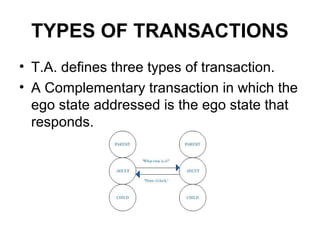
TYPES OF TRANSACTIONS
• T.A. defines three types of transaction.
• A Complementary transaction in which the
ego state addressed is the ego state that
responds.
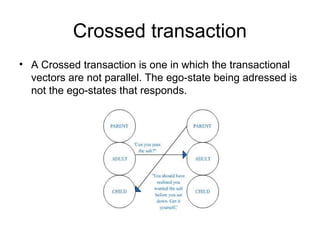
Crossed transaction
• A Crossed transaction is one in which the transactional
vectors are not parallel. The ego-state being adressed is
not the ego-states that responds.
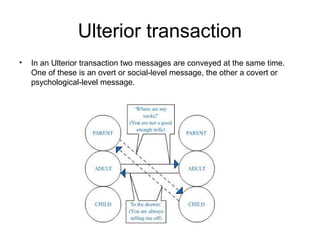
Ulterior transaction
• In an Ulterior transaction two messages are conveyed at the same time.
One of these is an overt or social-level message, the other a covert or
psychological-level message.
LIFE POSITIONS
• Transactional analysis identifies four basic life
positions, all of which are based on decisions
made as a result of childhood experiences, and
all of which determine how people feel about
themselves and how they relate to others:
• 1. I’m OK—You’re OK.
• 2. I’m OK—You’re not OK.
• 3. I’m not OK—You’re OK.
• 4. I’m not OK—You’re not OK.
I’m OK—You’re OK
• The I’m OK—You’re OK position is generally
game-free.
• It is the belief that people have basic value,
worth, and dignity as human beings. That people
are OK is a statement of their essence, not
necessarily their behavior. This position is
characterized by an attitude of trust and
openness, a willingness to give and take, and an
acceptance of others as they are. People are
close to themselves and to others. There are no
losers, only winners.
I’m OK—You’re not OK
• I’m OK—You’re not OK is the position of people
who project their problems onto others and
blame them, put them down, and criticize them.
The games that reinforce thisposition involve a
self-styled superior (the “I’m OK”) who projects
anger, disgust, and scorn onto a designated
inferior. This position involves a lack of trust in
others and makes it difficult for the person to
form and maintain intimate friendships or
relationships.
I’m not OK—You’re OK
• I’m not OK—You’re OK is known as the
depressive position and is characterized by
feeling powerless in comparison with others.
• Typically such people serve others’ needs
instead of their own and generally feel
victimized.
• This position also leaves the person with
difficulty feeling good about himself or herself
both in the work arena and in forming trusting
and lasting relationships.
I’m not OK—You’re not OK
• The I’m not OK—You’re not OK quadrant is
known as the position of futility and frustration ”
• This is the life position of despair. The person in
this position has great difficulty seeing the good
in anyone and has trouble having any hope for
the future.This self-destructive stance is
characteristic of people who are unable to cope
in the real world, and it may lead to extreme
withdrawal, a return to infantile behavior, or
violent behavior resulting in injury or death of
themselves or others.
CONCLUSION
• When people interact in assertive or non-assertive ways, there is
a social transaction in which one person responds to another. The
study of these social transactions between people is called
Transactional Analysis (TA).
• One useful approach is the classification of Parent, Adult and child
ego states. An Adult-to-adult complementary transaction is
especially desirable at work. Crossed transactions tend to cut off
communication and produce conflicts. TA is essentially a learning
experience through which an individual discovers how to sort out the
data that goes into his decisions. This approach is useful to improve
the interpersonal communication in organization and in social life..
TA gives employees fresh insights into their own personalities

Transactional Analysis

  • 1.
    TRANSACTIONAL ANALYSIS •Transactional analysis(TA), is an integrative approach to the theory of psychology and psychotherapy. •It is described as integrative because it has elements of psychoanalytic, humanist and cognitive approaches. • TA was first developed by Canadian-born US psychiatrist Eric Berne, starting in the late 1950s and it is a widely recognized form of modern psychology. •It is a theory for analysing human behavior and communication.It is a model for explaining why and how people think, act and interact like they do.It is very useful in studying various behaiour patterns and it is a social psychology and a method to improve communication.
  • 2.
    The key aspectsof TA are: • THE EGO STATES • An ego state is a set of related thoughts, feelings, and behaviors in which part of an individual’s personality is manifested at a given time (Stewart & Joines, 1987) • Each of our personalities is made up of various parts: the Parent, the Adult, and the Child ego states.. All transactional analysts work with ego states, which encompass important facets of the personality.
  • 3.
    CHILD EGO STATE •When people are in the Child ego state, for example, they sit, stand, speak, think, perceive, and feel as they did in childhood. • Behavior of the Child is impulsive and stimulus-bound rather than mediated and delayed by reason. Throwing temper tantrums, being irresponsible, and engaging in wishful thinking or daydreams are some of the expressions of the Child. At the same time, the Child is the source of spontaneity, creativity, humor, and fun and is thought to be the best part of the personality, because it is the only part that can truly enjoy life.
  • 4.
    The Child canbe further differentiated into • Natural Child, which is the most emotional, spontaneous, and powerful expression of a child • Adapted Child, which is the more obedient child molded to parental demands. • Little Professor, which is the inquisitive and intuitive child who acts like a precocious adult.
  • 5.
    PARENT EGOSTATE • TheParent ego state contains the values, morals, core beliefs, and behaviors incorporated from significant authority figures, primarily one’s parents. • The Parent contains all the “shoulds” and “oughts” and other rules for living. • We each have a “Nurturing Parent” and a “Critical Parent. • The Critical Parent. (also sometimes called the Prejudiced Parent) includes part of our personality contains the prejudged thoughts,feelings and beliefs that we learned from our parents. • The Nurturing Parent ego state includes the nurturing side and can be soft, loving, and permission giving.
  • 6.
    ADULT EGO STATE •It is the part of our personality that can process data accurately, that sees, hears, thinks, and can come up with solutions to problems based on the facts and not solely on our pre- judged thoughts or childlike emotions. • This ego state gives a person a measure of objectivity. . • The Adult is a gradually developed ego state that emerges as the person interacts with the physical and social environment over many years.
  • 7.
    Examples for differentegostates • Critical Parent; Individual stands one hand on hip, one finger wagging toward the person being transacted with, sharp tone of voice saying 'You shouldn't do that!' • Nurturing Parent; Individual stands leaning forward with one arm around the shoulder of the other individual, a gentle expression on their face, saying in a soft tone of voice 'Would you like me to help you with that?' • Adult; Stands squarely facing another and asks 'What is the time?' • Adapted Child - Head facing the floor, hands twisting in each other and says in a small voice 'Please can I have …' • Free Child; Running wildly with arms outstretched shouting 'Yippee.'
  • 8.
    TYPES OF TRANSACTIONS •T.A. defines three types of transaction. • A Complementary transaction in which the ego state addressed is the ego state that responds.
  • 9.
    Crossed transaction • ACrossed transaction is one in which the transactional vectors are not parallel. The ego-state being adressed is not the ego-states that responds.
  • 10.
    Ulterior transaction • Inan Ulterior transaction two messages are conveyed at the same time. One of these is an overt or social-level message, the other a covert or psychological-level message.
  • 11.
    LIFE POSITIONS • Transactionalanalysis identifies four basic life positions, all of which are based on decisions made as a result of childhood experiences, and all of which determine how people feel about themselves and how they relate to others: • 1. I’m OK—You’re OK. • 2. I’m OK—You’re not OK. • 3. I’m not OK—You’re OK. • 4. I’m not OK—You’re not OK.
  • 12.
    I’m OK—You’re OK •The I’m OK—You’re OK position is generally game-free. • It is the belief that people have basic value, worth, and dignity as human beings. That people are OK is a statement of their essence, not necessarily their behavior. This position is characterized by an attitude of trust and openness, a willingness to give and take, and an acceptance of others as they are. People are close to themselves and to others. There are no losers, only winners.
  • 13.
    I’m OK—You’re notOK • I’m OK—You’re not OK is the position of people who project their problems onto others and blame them, put them down, and criticize them. The games that reinforce thisposition involve a self-styled superior (the “I’m OK”) who projects anger, disgust, and scorn onto a designated inferior. This position involves a lack of trust in others and makes it difficult for the person to form and maintain intimate friendships or relationships.
  • 14.
    I’m not OK—You’reOK • I’m not OK—You’re OK is known as the depressive position and is characterized by feeling powerless in comparison with others. • Typically such people serve others’ needs instead of their own and generally feel victimized. • This position also leaves the person with difficulty feeling good about himself or herself both in the work arena and in forming trusting and lasting relationships.
  • 15.
    I’m not OK—You’renot OK • The I’m not OK—You’re not OK quadrant is known as the position of futility and frustration ” • This is the life position of despair. The person in this position has great difficulty seeing the good in anyone and has trouble having any hope for the future.This self-destructive stance is characteristic of people who are unable to cope in the real world, and it may lead to extreme withdrawal, a return to infantile behavior, or violent behavior resulting in injury or death of themselves or others.
  • 16.
    CONCLUSION • When peopleinteract in assertive or non-assertive ways, there is a social transaction in which one person responds to another. The study of these social transactions between people is called Transactional Analysis (TA). • One useful approach is the classification of Parent, Adult and child ego states. An Adult-to-adult complementary transaction is especially desirable at work. Crossed transactions tend to cut off communication and produce conflicts. TA is essentially a learning experience through which an individual discovers how to sort out the data that goes into his decisions. This approach is useful to improve the interpersonal communication in organization and in social life.. TA gives employees fresh insights into their own personalities