Ego state diagnosis in practice
Prepared By
Manu Melwin Joy
Research Scholar
School of Management Studies
CUSAT, Kerala, India.
Phone – 9744551114
Mail – manu_melwinjoy@yahoo.com
Kindly restrict the use of slides for personal purpose.
Please seek permission to reproduce the same in public
forms and presentations.
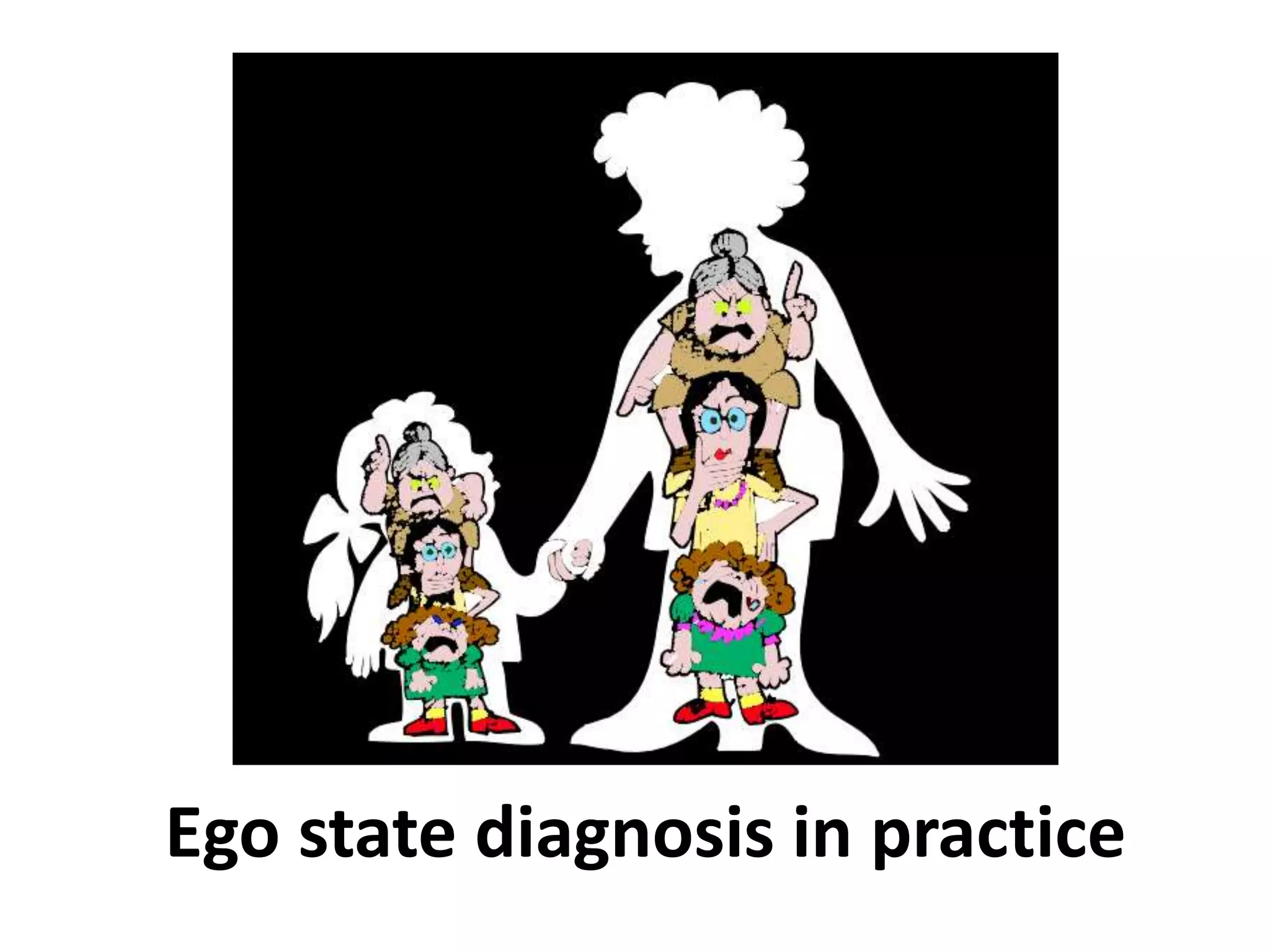
Ego state diagnosis in practice
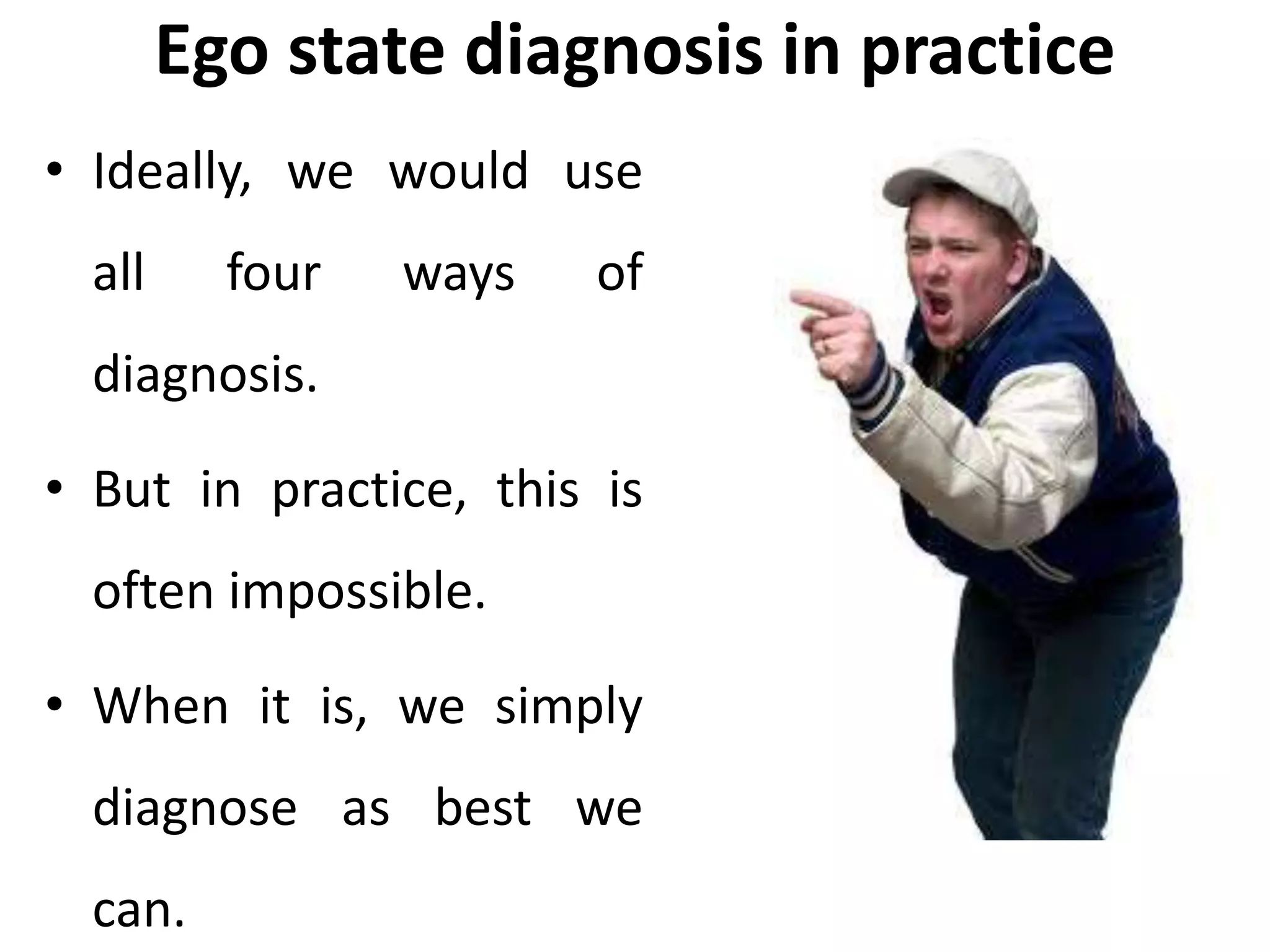
• Ideally, we would use
all four ways of
diagnosis.
• But in practice, this is
often impossible.
• When it is, we simply
diagnose as best we
can.
Ego state diagnosis in practice
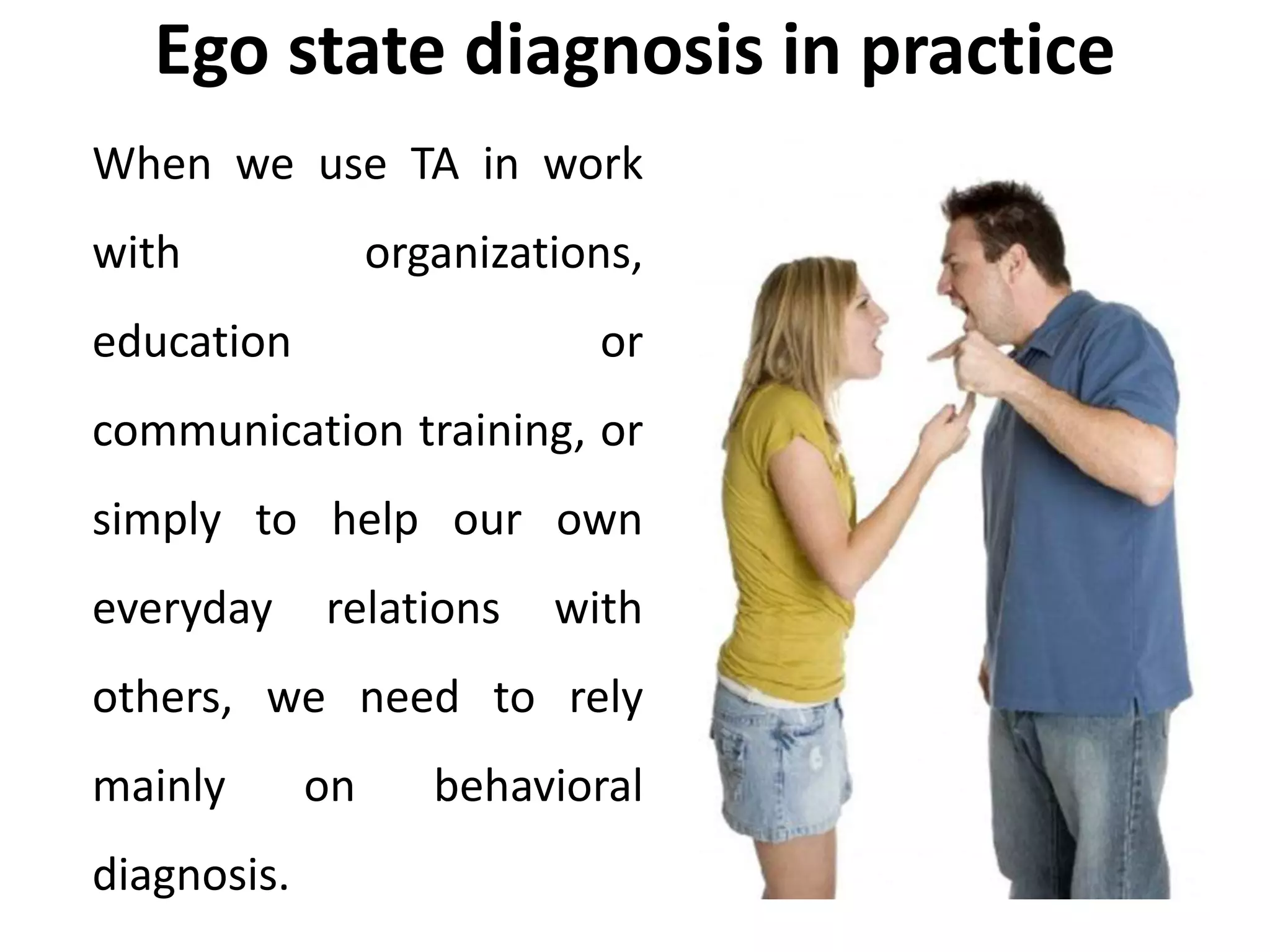
When we use TA in work
with organizations,
education or
communication training, or
simply to help our own
everyday relations with
others, we need to rely
mainly on behavioral
diagnosis.
Ego state diagnosis in practice
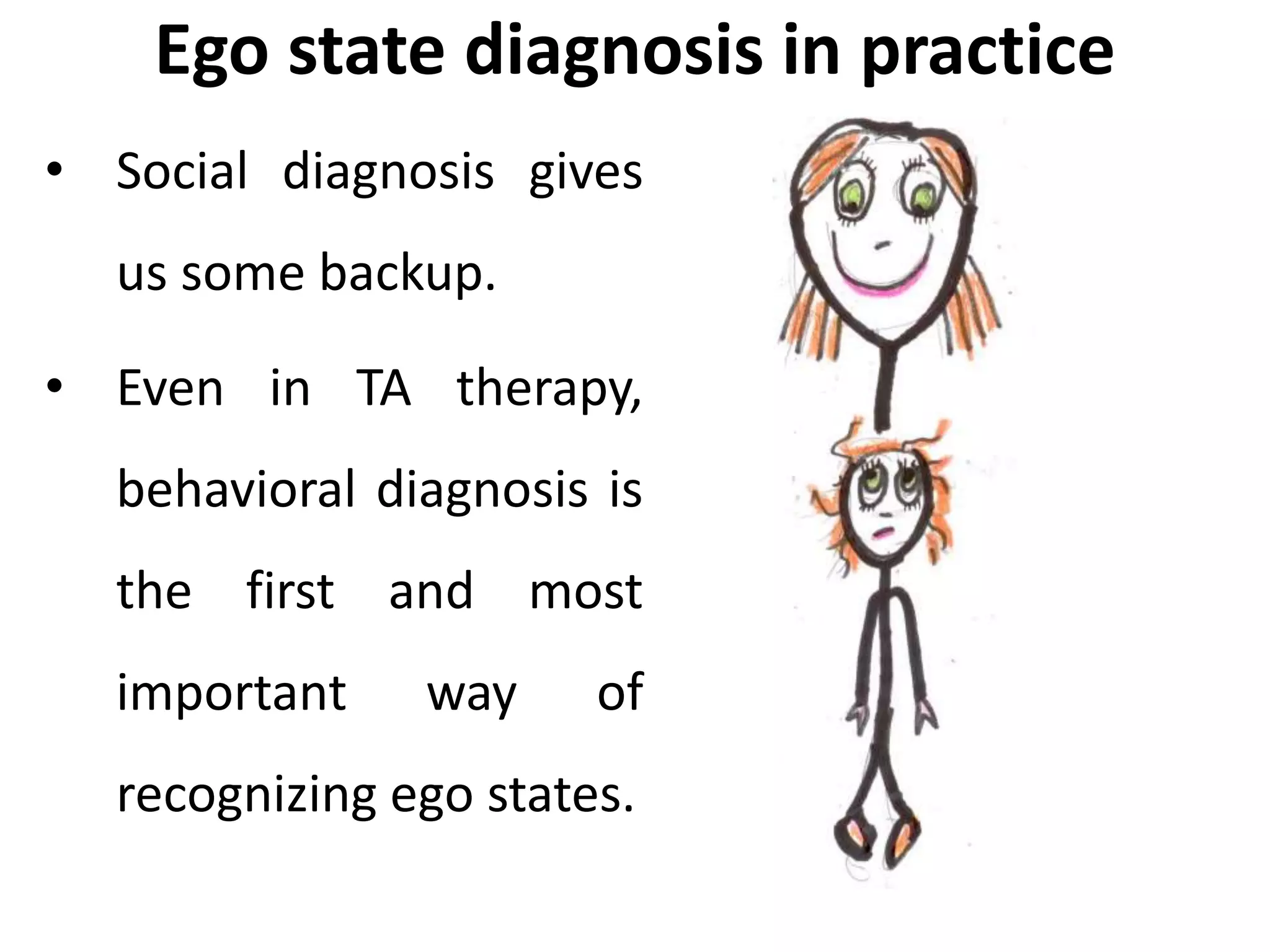
• Social diagnosis gives
us some backup.
• Even in TA therapy,
behavioral diagnosis is
the first and most
important way of
recognizing ego states.
Activity
• To develop your effectiveness
in using TA, practice
continually refining your
behavioral diagnosis,
• Keep referring back to the
table of ego state clues you
have made out for yourself,
revising it as you become
more and more aware of your
own ego state shifts.
Activity
• If you have the equipment,
make audio tapes or video
tapes of yourself.
• Analyze your ego states clues
second by second.
• Relate your changes in words,
voice tone and body signals if
you have video, to what you
were experiencing internally.
Activity
• Get into the habit of doing
behavioral analysis when you
are communicating with
others.
• Do it when you are in
meetings or classes.
• Do it when you are talking
with your spouse, your boss,
your employee.
• Keep track of other person’s
ego state shifts and your own.
• This may feel awkward at first.
• Persist until it becomes
second nature.
Activity
• Take every available
chance to check your
behavioral diagnosis
against historical and
phenomenological
evidence.
• But only do this with
others if you have their
explicit agreement in
advance.
• The more often you check
in this way, the more
accurate will your
behavioral diagnosis
become.
Thank You
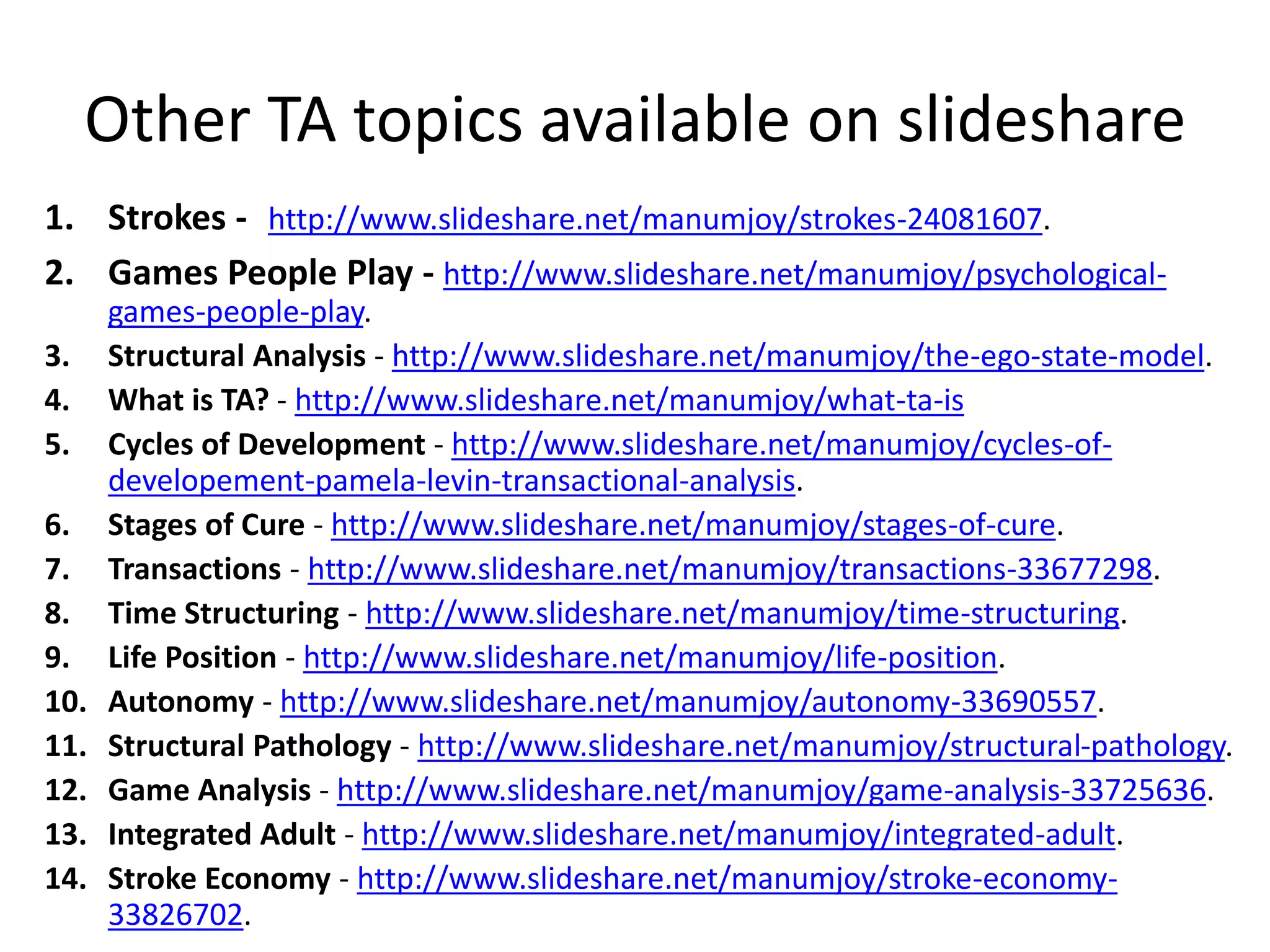
Other TA topics available on slideshare
1. Strokes - http://www.slideshare.net/manumjoy/strokes-24081607.
2. Games People Play - http://www.slideshare.net/manumjoy/psychological-
games-people-play.
3. Structural Analysis - http://www.slideshare.net/manumjoy/the-ego-state-model.
4. What is TA? - http://www.slideshare.net/manumjoy/what-ta-is
5. Cycles of Development - http://www.slideshare.net/manumjoy/cycles-of-
developement-pamela-levin-transactional-analysis.
6. Stages of Cure - http://www.slideshare.net/manumjoy/stages-of-cure.
7. Transactions - http://www.slideshare.net/manumjoy/transactions-33677298.
8. Time Structuring - http://www.slideshare.net/manumjoy/time-structuring.
9. Life Position - http://www.slideshare.net/manumjoy/life-position.
10. Autonomy - http://www.slideshare.net/manumjoy/autonomy-33690557.
11. Structural Pathology - http://www.slideshare.net/manumjoy/structural-pathology.
12. Game Analysis - http://www.slideshare.net/manumjoy/game-analysis-33725636.
13. Integrated Adult - http://www.slideshare.net/manumjoy/integrated-adult.
14. Stroke Economy - http://www.slideshare.net/manumjoy/stroke-economy-
33826702.

Ego states diagnosis in practice (Transactional analysis / TA is an integrative approach to the theory of psychology and psychotherapy).

  • 1.
  • 2.
    Prepared By Manu MelwinJoy Research Scholar School of Management Studies CUSAT, Kerala, India. Phone – 9744551114 Mail – manu_melwinjoy@yahoo.com Kindly restrict the use of slides for personal purpose. Please seek permission to reproduce the same in public forms and presentations.
  • 3.
    Ego state diagnosisin practice • Ideally, we would use all four ways of diagnosis. • But in practice, this is often impossible. • When it is, we simply diagnose as best we can.
  • 4.
    Ego state diagnosisin practice When we use TA in work with organizations, education or communication training, or simply to help our own everyday relations with others, we need to rely mainly on behavioral diagnosis.
  • 5.
    Ego state diagnosisin practice • Social diagnosis gives us some backup. • Even in TA therapy, behavioral diagnosis is the first and most important way of recognizing ego states.
  • 6.
    Activity • To developyour effectiveness in using TA, practice continually refining your behavioral diagnosis, • Keep referring back to the table of ego state clues you have made out for yourself, revising it as you become more and more aware of your own ego state shifts.
  • 7.
    Activity • If youhave the equipment, make audio tapes or video tapes of yourself. • Analyze your ego states clues second by second. • Relate your changes in words, voice tone and body signals if you have video, to what you were experiencing internally.
  • 8.
    Activity • Get intothe habit of doing behavioral analysis when you are communicating with others. • Do it when you are in meetings or classes. • Do it when you are talking with your spouse, your boss, your employee. • Keep track of other person’s ego state shifts and your own. • This may feel awkward at first. • Persist until it becomes second nature.
  • 9.
    Activity • Take everyavailable chance to check your behavioral diagnosis against historical and phenomenological evidence. • But only do this with others if you have their explicit agreement in advance. • The more often you check in this way, the more accurate will your behavioral diagnosis become.
  • 10.
  • 11.
    Other TA topicsavailable on slideshare 1. Strokes - http://www.slideshare.net/manumjoy/strokes-24081607. 2. Games People Play - http://www.slideshare.net/manumjoy/psychological- games-people-play. 3. Structural Analysis - http://www.slideshare.net/manumjoy/the-ego-state-model. 4. What is TA? - http://www.slideshare.net/manumjoy/what-ta-is 5. Cycles of Development - http://www.slideshare.net/manumjoy/cycles-of- developement-pamela-levin-transactional-analysis. 6. Stages of Cure - http://www.slideshare.net/manumjoy/stages-of-cure. 7. Transactions - http://www.slideshare.net/manumjoy/transactions-33677298. 8. Time Structuring - http://www.slideshare.net/manumjoy/time-structuring. 9. Life Position - http://www.slideshare.net/manumjoy/life-position. 10. Autonomy - http://www.slideshare.net/manumjoy/autonomy-33690557. 11. Structural Pathology - http://www.slideshare.net/manumjoy/structural-pathology. 12. Game Analysis - http://www.slideshare.net/manumjoy/game-analysis-33725636. 13. Integrated Adult - http://www.slideshare.net/manumjoy/integrated-adult. 14. Stroke Economy - http://www.slideshare.net/manumjoy/stroke-economy- 33826702.