Transactional Analysis
About TA
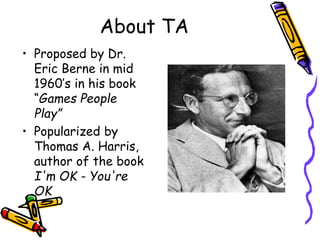
• Proposed by Dr.
Eric Berne in mid
1960’s in his book
“Games People
Play”
• Popularized by
Thomas A. Harris,
author of the book
I'm OK - You're
OK
A unit of social intercourse is called a
transaction
A relationship established between two or
more persons who come in contact with
each other is a transaction.
Study or Analysis of such social
transactions is known as Transactional
Analysis.
It is used to study and analyze
interpersonal communication
TA
Different methods to understand & predict
human behaviour
• Structural analysis – within the person
• Transactional analysis – 2 or more people
• Game analysis – understanding transactions
that lead to bad feelings
• Script analysis – understand a person’s life
plan
• Strokes
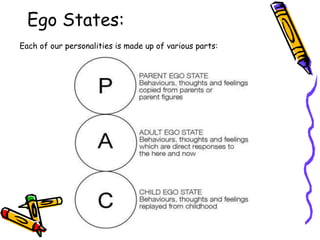
Ego States:
Each of our personalities is made up of various parts:
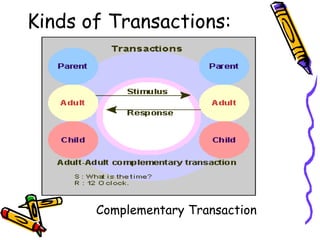
Kinds of Transactions:
Complementary Transaction
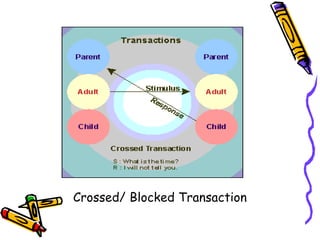
Crossed/ Blocked Transaction
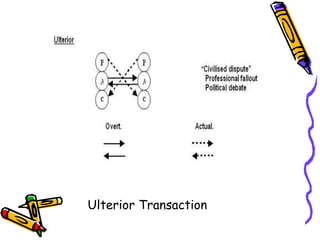
Ulterior Transaction
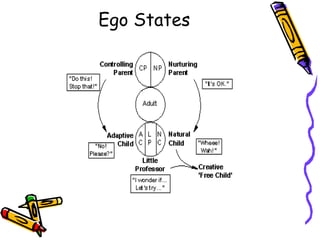
Ego States
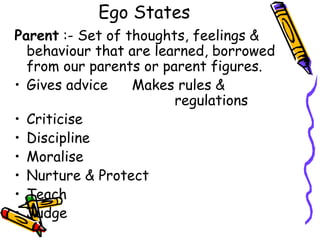
Parent :- Set of thoughts, feelings &
behaviour that are learned, borrowed
from our parents or parent figures.
• Gives advice Makes rules &
regulations
• Criticise
• Discipline
• Moralise
• Nurture & Protect
• Teach
• Judge
Ego States
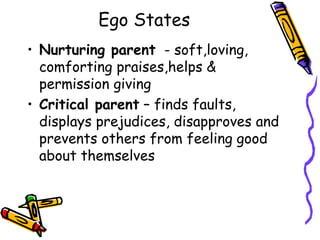
• Nurturing parent - soft,loving,
comforting praises,helps &
permission giving
• Critical parent – finds faults,
displays prejudices, disapproves and
prevents others from feeling good
about themselves
Ego States
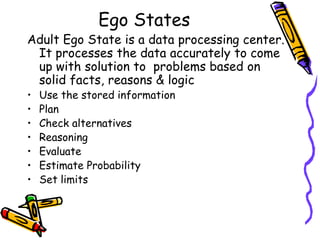
Adult Ego State is a data processing center.
It processes the data accurately to come
up with solution to problems based on
solid facts, reasons & logic
• Use the stored information
• Plan
• Check alternatives
• Reasoning
• Evaluate
• Estimate Probability
• Set limits
Ego States
• The Child ego state is the part of our personality
that is the seat of emotions, thoughts, feelings
,memories, experiences that we have of ourselves
from childhood.
• Showing Anger
• Fear
• Rebelliousness
• Curiosity
• Love
• Excitement
• Aggressiveness
Natural child :spontaneous, impulsive, playful, authentic,
emotional & pleasure loving
Adapted Child: That part of our personality that has
learned to comply with parental messages. Compliant,
conforms to the wishes & demands of parental figures
Little Professor: Curious and exploring Child who is always
trying out new stuff
Together with the Natural Child they make up the
Free Child.
Ego States
Ego States
Strokes:
Fundamental unit of social action .
A stroke is a unit of recognition, when one
person recognizes another person.
 Verbal or non verbal
 Positive or negative
 Conditonal or Unconditional
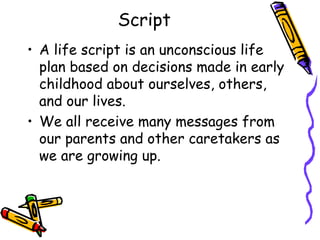
Script
• A life script is an unconscious life
plan based on decisions made in early
childhood about ourselves, others,
and our lives.
• We all receive many messages from
our parents and other caretakers as
we are growing up.
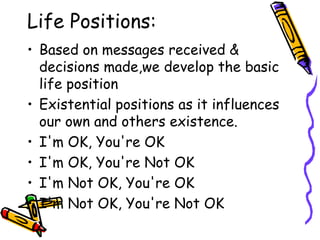
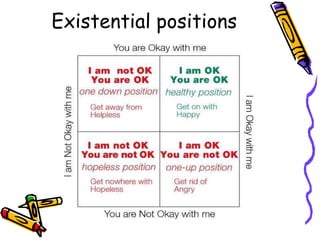
Life Positions:
• Based on messages received &
decisions made,we develop the basic
life position
• Existential positions as it influences
our own and others existence.
• I'm OK, You're OK
• I'm OK, You're Not OK
• I'm Not OK, You're OK
• I'm Not OK, You're Not OK
Existential positions
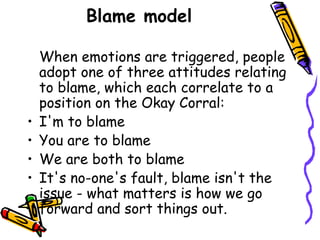
Blame model
When emotions are triggered, people
adopt one of three attitudes relating
to blame, which each correlate to a
position on the Okay Corral:
• I'm to blame
• You are to blame
• We are both to blame
• It's no-one's fault, blame isn't the
issue - what matters is how we go
forward and sort things out.
Games
A game is a familiar pattern of behaviour
with a predictable outcome
Games are played outside Adult awareness
and they are our best attempt to get our
needs met - although of course we don't.
Games are learned patterns of behaviour,
and most people play a small number of
games with a range of different people
and in varying intensities.
Games
• First Degree games are played in
social circles generally lead to mild
upsets not major traumas.
• Second Degree games occur when the
stakes may be higher. This ends up
with an even greater negative payoff.
Games
• Third Degree games involve tissue
damage and may end up in the jail,
hospital or morgue.
• World politics can involve as fourth
degree games - where the outcomes
involve whole communities, countries
or even the world
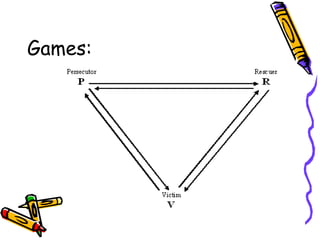
Games:
Advantages of TA:
Improves interpersonal communication
Applicable in Motivation
Helps in Organizational Development
Can be used at home as well as in office
Disadvantages of TA:
Few scientific facts to prove
Ego states are difficult to define.
Thank You 

Transactional analysis

  • 1.
  • 2.
    About TA • Proposedby Dr. Eric Berne in mid 1960’s in his book “Games People Play” • Popularized by Thomas A. Harris, author of the book I'm OK - You're OK
  • 3.
    A unit ofsocial intercourse is called a transaction A relationship established between two or more persons who come in contact with each other is a transaction. Study or Analysis of such social transactions is known as Transactional Analysis. It is used to study and analyze interpersonal communication
  • 4.
    TA Different methods tounderstand & predict human behaviour • Structural analysis – within the person • Transactional analysis – 2 or more people • Game analysis – understanding transactions that lead to bad feelings • Script analysis – understand a person’s life plan • Strokes
  • 5.
    Ego States: Each ofour personalities is made up of various parts:
  • 6.
  • 7.
  • 8.
  • 9.
    Ego States Parent :-Set of thoughts, feelings & behaviour that are learned, borrowed from our parents or parent figures. • Gives advice Makes rules & regulations • Criticise • Discipline • Moralise • Nurture & Protect • Teach • Judge
  • 10.
    Ego States • Nurturingparent - soft,loving, comforting praises,helps & permission giving • Critical parent – finds faults, displays prejudices, disapproves and prevents others from feeling good about themselves
  • 11.
    Ego States Adult EgoState is a data processing center. It processes the data accurately to come up with solution to problems based on solid facts, reasons & logic • Use the stored information • Plan • Check alternatives • Reasoning • Evaluate • Estimate Probability • Set limits
  • 12.
    Ego States • TheChild ego state is the part of our personality that is the seat of emotions, thoughts, feelings ,memories, experiences that we have of ourselves from childhood. • Showing Anger • Fear • Rebelliousness • Curiosity • Love • Excitement • Aggressiveness
  • 13.
    Natural child :spontaneous,impulsive, playful, authentic, emotional & pleasure loving Adapted Child: That part of our personality that has learned to comply with parental messages. Compliant, conforms to the wishes & demands of parental figures Little Professor: Curious and exploring Child who is always trying out new stuff Together with the Natural Child they make up the Free Child. Ego States
  • 14.
  • 15.
    Strokes: Fundamental unit ofsocial action . A stroke is a unit of recognition, when one person recognizes another person.  Verbal or non verbal  Positive or negative  Conditonal or Unconditional
  • 16.
    Script • A lifescript is an unconscious life plan based on decisions made in early childhood about ourselves, others, and our lives. • We all receive many messages from our parents and other caretakers as we are growing up.
  • 17.
    Life Positions: • Basedon messages received & decisions made,we develop the basic life position • Existential positions as it influences our own and others existence. • I'm OK, You're OK • I'm OK, You're Not OK • I'm Not OK, You're OK • I'm Not OK, You're Not OK
  • 18.
  • 19.
    Blame model When emotionsare triggered, people adopt one of three attitudes relating to blame, which each correlate to a position on the Okay Corral: • I'm to blame • You are to blame • We are both to blame • It's no-one's fault, blame isn't the issue - what matters is how we go forward and sort things out.
  • 20.
    Games A game isa familiar pattern of behaviour with a predictable outcome Games are played outside Adult awareness and they are our best attempt to get our needs met - although of course we don't. Games are learned patterns of behaviour, and most people play a small number of games with a range of different people and in varying intensities.
  • 21.
    Games • First Degreegames are played in social circles generally lead to mild upsets not major traumas. • Second Degree games occur when the stakes may be higher. This ends up with an even greater negative payoff.
  • 22.
    Games • Third Degreegames involve tissue damage and may end up in the jail, hospital or morgue. • World politics can involve as fourth degree games - where the outcomes involve whole communities, countries or even the world
  • 23.
  • 24.
    Advantages of TA: Improvesinterpersonal communication Applicable in Motivation Helps in Organizational Development Can be used at home as well as in office
  • 25.
    Disadvantages of TA: Fewscientific facts to prove Ego states are difficult to define.
  • 26.