TRANSACTIONAL
ANALYSIS IN
PSYCHOTHERAPY
Tejal Hemant Patil
Mumbai University
1
What is Transactional
Analysis
• Transactional Analysis is a personality theory which gives us a picture of how
people are structured psychologically.
• It is a method of understanding communication between people, a system of
analyzing and understanding human relationship.
• It is a technique used to help people better understand their own and other
behavior, especially in interpersonal relationship.
• Transactional Analysis is underpinned by the philosophy that people can
change and we all have a right to be in the world and be accepted.
Who is the founder
of Transactional
Analysis ?
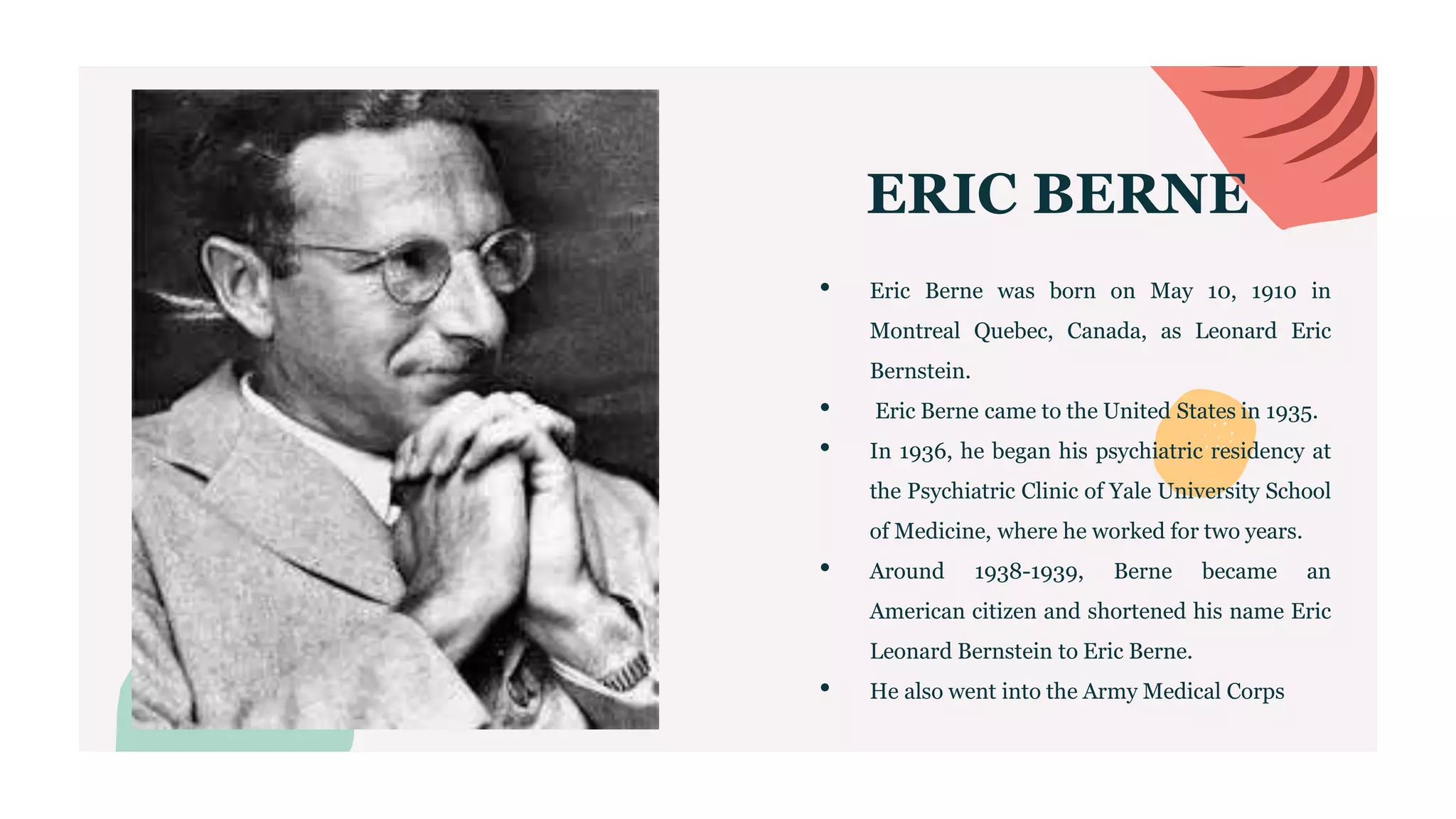
ERIC BERNE
• Eric Berne was born on May 10, 1910 in
Montreal Quebec, Canada, as Leonard Eric
Bernstein.
• Eric Berne came to the United States in 1935.
• In 1936, he began his psychiatric residency at
the Psychiatric Clinic of Yale University School
of Medicine, where he worked for two years.
• Around 1938-1939, Berne became an
American citizen and shortened his name Eric
Leonard Bernstein to Eric Berne.
• He also went into the Army Medical Corps
• Eric Berne married thrice and was divorced
twice in his whole life.
• In 1947 he began to work with Erik Erikson;
their working relationship lasted for two
years.
• Berne's work began to diverge from the
mainstream of psychoanalytic thought.
• The origins of transactional analysis can be
traced to the first three of Berne’s six articles
on intuition, which he began writing in 1949.
i. "Intuition V: The Ego Image
ii. "Ego States in Psychotherapy,”
iii. "Transactional Analysis: A New and
Effective Method of Group Therapy
Assumption Made By Transactional Analysis
i. Everyone is born OK.
ii. Each person has a right to be in this world and to be accepted
as they are.
iii. Everyone is responsible for themselves
iv. All seek physical and emotional nurturing so our behavior is
modified to achieve things in life.
• Late Dr. Eric Berne created a strong theory that helps you understand your
own methods of communication.
• The International Transactional Analysis Association defines TA as,
“Transactional Analysis is a theory of personality and a systematic
psychotherapy for personal growth and personal change.”
• TA helps us to understand why and how people think, act and interact like
they do.
What is Transactional Analysis
Theory?
• Transactional analysis elevates your thinking to a high level while
raising awareness, so you can understand your own difficult and
dysfunctional behaviors and communication patterns to develop
deeper connections with self and the world.
• Ask yourself, “how many times have I repeated my behaviors which
were not helping me?”
For example, shouting at people in traffic or sulking during an argument.
• How you communicate with the world while being aware of how
others communicate with you.
DEVELOPMENT OF TRANSACTIONAL ANALYSIS
● Dr. Eric Berne developed transactional analysis in the last 1950s, using
“transaction” to describe the fundamental unit of social intercourse, with
“transactional analysis” being the study of social interactions between
individuals.
● Inspired by Freud’s theory of personality—primarily his belief that the human
psyche is multifaceted and that different components interact to produce a
variety of emotions, attitudes and complex behaviors
● Berne developed an approach that he described as both neo and extra
Freudian.
● Berne developed his own observable Ego Sates of Parent, Adult, and Child,
following Freud’s proposal of the existence of the Id (emotional and irrational
component), Ego (rational component), and Superego (moral component) as
different and unobservable factions of personality.
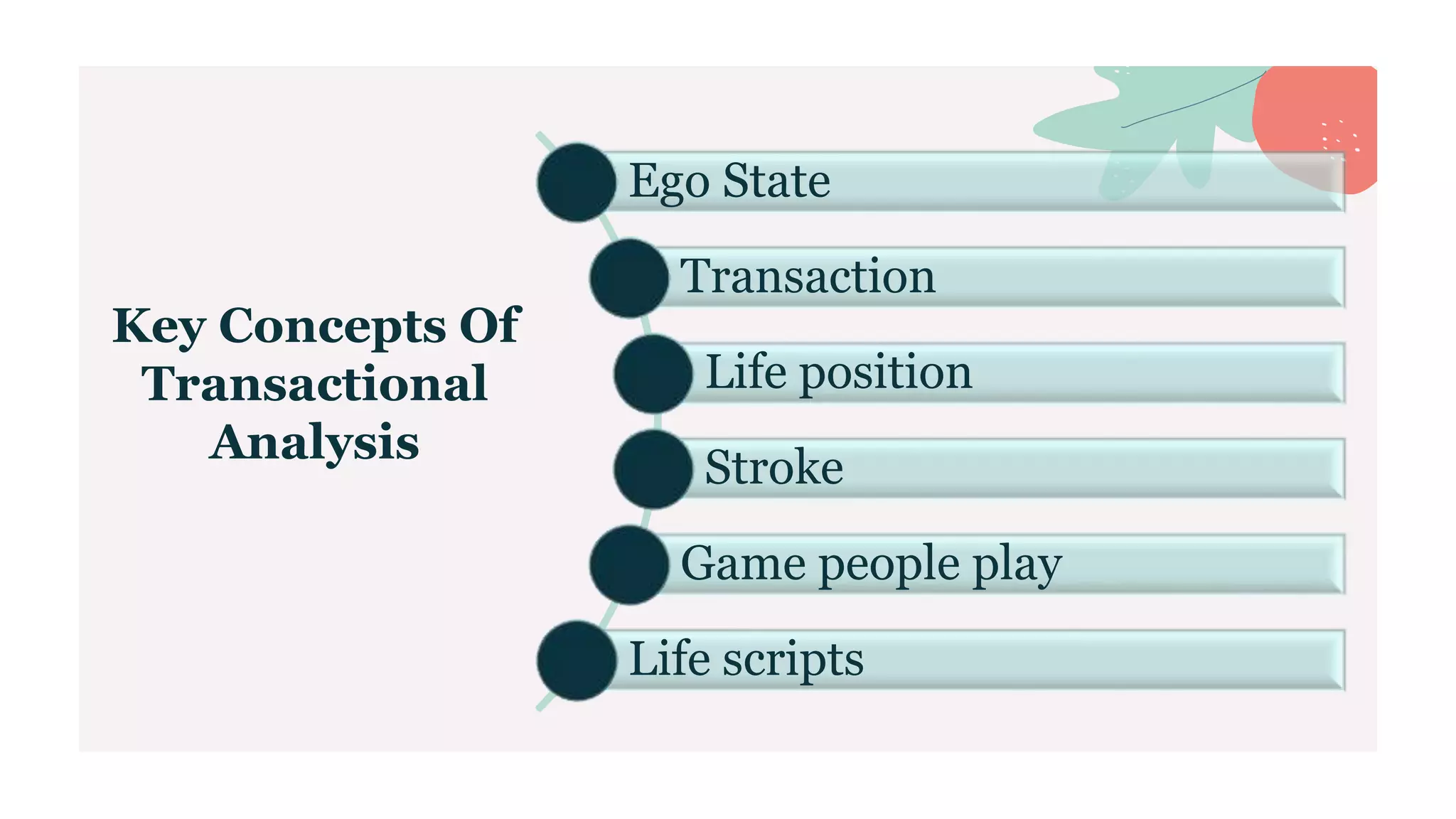
Key Concepts Of
Transactional
Analysis
Ego State
Transaction
Life position
Stroke
Game people play
Life scripts
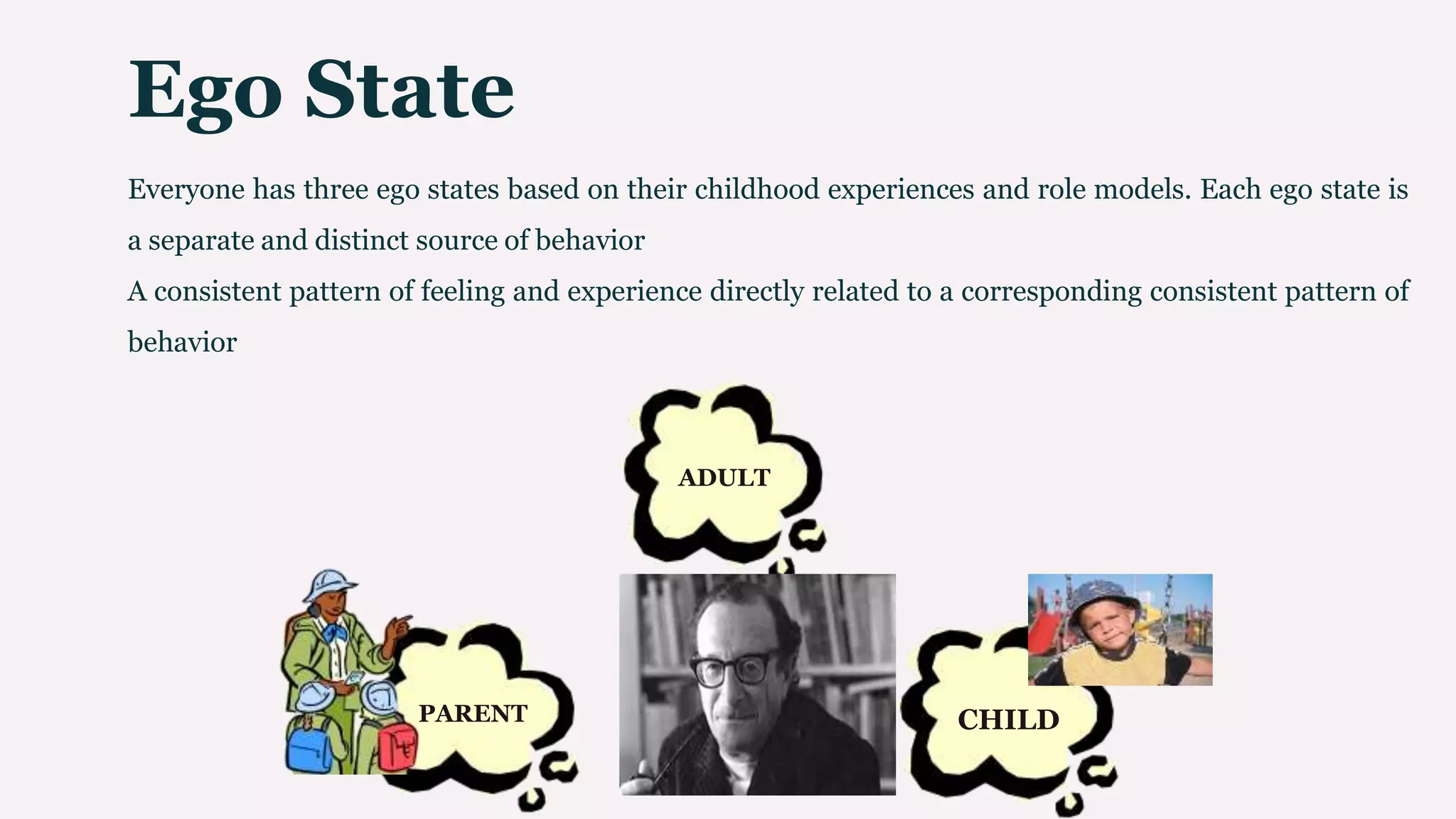
Ego State
● Everyone has three ego states based on their childhood experiences and role models. Each ego state is
a separate and distinct source of behavior
● A consistent pattern of feeling and experience directly related to a corresponding consistent pattern of
behavior, He believed that there were three states of mind in all humans, no matter how old they were,
called ego states.
ADULT
CHILD
PARENT
Adult
Parent
Child
Taught Concept of Life
Thought Concept of Life
Felt Concept of life
PAC Model
Parent Ego State
o It is the reflex of the received education, which impress upon the
childhood and adolescence, continuing to act on the adult, too.
o This is a set of feelings, thinking and behavior that we have copied
from our parents and significant others.
o Examples of recordings in the parent include:
o “Never talk to strangers”
o “Always chew with your mouth closed”
o “Look both ways before you cross the street”
• The parent ego state means that the values, attitudes and behaviors of
parents an integral part of the personality of an individual.
• These people tend to talk to people and treat others like children.
• The characteristics of a person with parent ego state are:
i. Judgmental
ii. Rule maker
iii. Moralizing
iv. Over protective
v. Indispensable
The Two Levels Of The Parent Ego State
Nurturing Parent Ego
• The one who protects,
comforts and
encourage.
• Nurturing behavior,
caring, loving,
forgiving
Controlling Parent Ego
• The parent who gives
orders and sets limits
• Has a punishing
personality, criticize,
prejudice, finds faults
and disapproves.
Each individual has both, a nurturing and critical parent ego.
Adult Ego State
o The adult ego state is authentic, direct, reality based, fact seeking and
problem solving. They assume that human beings as equal, worthy and
responsible.
o The process of adult ego state formation goes through one’s own
experiences and continuously updating attitudes left over from childhood.
o People with adult ego state, gather relevant information, carefully analyze
it, generate alternatives and make logical choices.
o The adult represents the use of discrimination, reasoning, evaluation,
data analysis, use of logic, ability to observe objectively and correctly
o The adult state usually activates when the person wants to solve a
problem, to decide objectives, to assume responsibility, to make a
decision, wants evaluation of some results etc.
o The characteristic of the adult state consists in receiving a series of information in order to
put together and to develop it in a logical, rational and objective way.
o The typical phrases are:
“ It is possible to…”
“I think that….”
“ We conclude that…”
o Their sight is direct and neutral .
o The body posture: straight and relaxed.
o The voice is normal and neutral. The tone is clear but inexpressive.
Advantages : the information is elaborated logically and objectively.
Disadvantages: it can become cold and emotionless, he disturbs when a spontaneous solution
is required, he can curb in situations which cannot be postponed.
Child Ego Stage
o The child ego state appears when we have to deal with the expressing of
spontaneity, of feelings, desires, intentions and hopes, emotions.
o At this level, inner events are registered – feelings lived as a response to
exterior events, from birth and up to the age of 5. It is the emotional
component. It appears to the adult in leisure activities.
o The child ego state is characterized by very immature behavior. The
important features of child ego state are creativity, anxiety, depression,
dependence, fear, joy, emotional sentimental etc.
o Thoughts, feelings, attitudes and behavioral patterns based on child like emotions
o Divided into two parts : Free child ego state( known as Natural child) and Adaptive child ego
state(includes Rebellious child ego state)
Free child : spontaneous feeling and behavior. Characteristics : playful, expressive and emotional
Adaptive child : Experience and parental influence on behavior
o Part of the personality that has learned to comply with the parental messages received while growing up.
Rebellious Child ego state: Sometimes when faced with parental messages that are restricting, instead of
complying with them, we rebel against them.
Values of child ego state : Selfish, Mean, Playful, Affectionate, Whining, Manipulative and Curious, Impulsive,
Pleasure seeking, Angry, Happy and Self centered.
Different Types of
Interactions
Complementary Transaction
Both people are operating
from the same ego state
Crosses Transaction
The other person reacts from
an unexpected ego state
Ulterior Transaction
Two ego states within the
same person but one
disguises the other
Transactions between people are
seen as having 3 levels:
Complementary Transactions
P
A
C
P
A
C
“You’re three hours
late, I want an
explanation.”
DIRECTOR EMPLOYEE
“I’m really sorry, I slept
through the alarm, it
won’t happen again, I
promise.”
This is a complementary
transaction because the
employee accepts the child
ego state assigned to him
by the director and
responds in child ego state.
Crossed Transaction
P
A
C
P
A
C
DIRECTOR EMPLOYEE
“You’re three
hours late, I want
an explanation.”
“Oh, didn’t you
get held up by
that accident on
the road as well?”
This is a crossed transaction
because although the manager,
parent ego state, attempted to
address the employee as a
child, the employee refuses
this ego state and responds in
adult ego state to the manager’s
ego state.
A crossed transaction is any
transaction where the person
being spoken to refuses the ego
state they are assigned by the
first speaker.
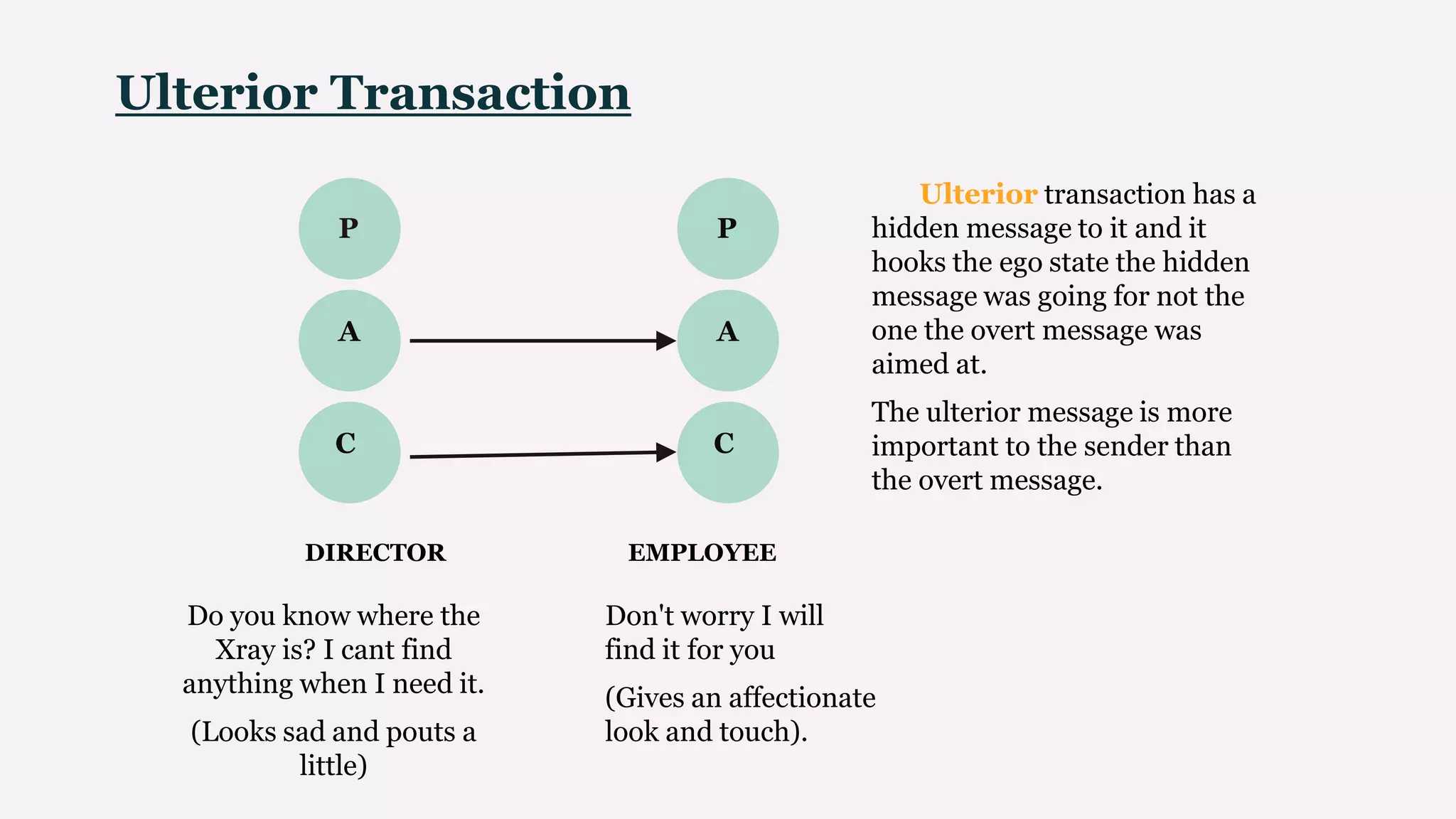
Ulterior Transaction
P
A
C
P
A
C
DIRECTOR EMPLOYEE
Do you know where the
Xray is? I cant find
anything when I need it.
(Looks sad and pouts a
little)
Don't worry I will
find it for you
(Gives an affectionate
look and touch).
TheUlterior transaction has a
hidden message to it and it
hooks the ego state the hidden
message was going for not the
one the overt message was
aimed at.
The ulterior message is more
important to the sender than
the overt message.
Life Position
o Very early in childhood a person develops from experience a
dominant philosophy. Such philosophy is tied into his identity,
sense of worth, and perception of other people.
o This tends to remain with the person for lifetime unless major
experience occur to change it. Such positions are called life positions
o The combination of assumptions about self and the other person
called as life position.
o Transactional analysis constructs the following classifications of
the four possible life positions or psychological positions:
o I am OK, You are OK (we both have value)
o I am OK, You are not OK (I have value but you don't have)
o I am not OK, You are OK (you have value but I do not have)
o I am not OK, You are not OK (neither person have value)
I’m OK — I’m OK —
You’re not OK You’re OK
I’m not OK — I’m not OK —
You’re not OK You’re OK
Attitude
toward
Oneself
Attitude toward Others
Negative Positive
Positive
Negative
Life Position
Stroke
● Stroking is an important aspects of the transactional analysis. • The term stroke
refers to “giving some kind of recognition to others.”
● Berne defined a stroke as the “fundamental unit of social action.”
● People need strokes for their sense of survival and well being on the job. Lack of
stroking can have negative consequences both on physiological and psychological
well being of a person.
● Berne introduced the idea of strokes into transactional analysis based upon the work
of Rene Spitz, a researcher who did pioneering work in the area of child
development.
o He proposed that adults need physical contact just like infants, but have learned to
substitute other types of recognition instead of physical stimulation.
o Berne defined the term Recognition Hunger as this requirement of adults to receive
strokes.
o Recognition Hunger
 As grownups, we learn to substitute other forms of recognition in place of physical
touching.
 A smile, a compliment, frown or insult – all shows our existence has been recognized.
 Berne used to term recognition hunger to describe our need for this kind of
acknowledgement from others.
 Strokes reassure, provide confirmation of value of individuals, communicate about
desirable and undesirable behaviors.
o There are three types of strokes:
i. Positive strokes: The stroke one feel good, is a positive stroke. Example:
Recognition, approval, compliment, praise.
ii. Negative strokes: A stroke one feel bad or not good is a negative stroke. negative
strokes hurt physically or psychologically. Example: Criticism, ridicule.
iii. Mixed strokes: A stroke may be of a mixed type also. Example :the boss comment
to a worker “you did an excellent job, even though you have limited experience.
o Many workers have become recalcitrant because they were ignored at work and got
no strokes at all.
o A stroke is satisfying and is therefore a reward. Like any other reward, strokes also,
if given indiscreetly, may misdirect.
o Many marriages are threatened after a few years, because each spouse takes the
other for granted and does not provide strokes.
Game People Play
● When people fail to get enough strokes at work they try a variety of things. One of the
most important thing is that they play psychological games.
● A psychological game is a set of transaction with three characteristics:
i. The transaction tend to be repeated.
ii. They make sense on superficial or social level.
iii. One or more transactions is ulterior.
● Games keep people safe from exposing their thoughts and feelings.
● Game players are losers because they avoid meaningful and healthy human
interactions.
o Types of games:
i. A first degree game is one which is socially acceptable in the agent’s circle.
ii. A second degree game is one which more intimate end up with bad feelings.
iii. A third degree game is one which usually involve physical injury.
o These are psychological games and are played quite spontaneously. They provide
satisfactions to the players, which are called pay-offs.
o Games have hidden agendas. The player is aiming at a certain outcome, which is
not obvious to the uninitiated. They tend to be repetitive.
o Games prevent honest, intimate and open relationships. Yet people play them
because they fill up time, often provoke attention, and fulfil a sense of identity.
o Games help you to feel that ones problems are created by others misdemeanors.
o Examples Of Games Players Are:
o The Persecutor:
o "if it weren't for you", "see what you made me do", "yes, but".
o The Rescuer:
o "I'm only trying to help", "what would you do without me?"
o The Victim:
o "this always happens to me", "poor old me", "go on, kick me"
Life Scripts
● According to Eric Berne, “A script is an ongoing programmed,
developed in early childhood under parental influence which directs the
individual behavior in the most important aspects of his life.”
● In transactional analysis a person’s life is compared to a play and the
script is the text of the play.
● A script is a complete plan of living, offering prescriptions, permissions
and structure which makes one winner or loser in life. It is based on the
external events and determines how one interacts with other.
o Everyone develops a life script by age 5 & these scripts determine how one
interacts with others based upon the interpretation of external events.
o During the early years of development, one learns about one’s worth as a
person and one’s place in life. Later, scripting occurs in direct as well as
indirect ways in a family, for example, such messages as the following may
be picked up:
o “In this family, the man is the boss of the house.”
o “Children are to be seen but not heard.”
o “We always expect the best from you.”
o “Never question our authority, and strive to be respectful and
obedient.”
o A negative life script occurs when the person receives lots of injunctions by the
parents that used the word DON’T
o Because the life script forms the core of a person’s identity and destiny, life
experiences may lead the person to conclude, on one hand,
“I’m really dumb because nothing I do ever turns out right. I suppose I’ll always be
stupid”
OR
“I can do almost anything that I really decide I want to do. I know I can attain my
goals if I channel my efforts in a direction I want to go.”
Transactional Analysis used as a form of
Psychotherapy
o Transactional Analysis is used extensively as a form of psychotherapy to
accelerate an internal change in people. A counsellor is able to explore the
client’s personality and their experiences which are shaped by their decisions.
o An understanding of the personality gives many answers to the problems faced
by the client.
o A counsellor can use a number of techniques to question and listen to the client.
TA is useful to resolve many problems wherein a person is guided towards a
reflective practice.
o TA is useful to eliminate unhelpful thoughts and feelings to raise awareness of
actions. People learn to be responsible without blaming situations or others.
o People learn to be responsible without blaming situations or others.
Transactional Analysis Is Beneficial For Effective
Communication.
o Transactional analysis is beneficial for effective communication, as a person understands their
communication with self while identifying the personality of another. A deeper understanding
of personality and behaviors allows one to improve communication that is designed to create
the best outcomes.
o It is also beneficial in following areas;
Personal Development - it creates people who are highly self-aware and responsible in life, brings
focus on personal and professional goals
Jobs - TA is beneficial at work as you learn techniques to manager interpersonal communications,
encourage team building, and more
Business - A businessperson learns to manage situations through self-awareness, make decisions
based on the here-and-now
o Transactional Analysis is also useful for any industry - medicine, coaching, education, media,
art, and more.
Goal of Transactional
Analysis Theory
Examine own thoughts,
behaviors, actions
Be present in the Adult
Ego-State
Be a highly self-aware
individual
Understand own behavior,
modify patterns
Advantages
o The approach uses terms that are easily understood and clearly
defined.
o The approach is easily and collectively combined with other more
action-oriented approaches.
o The approach puts the responsibility of change on the client.
o The approach is goal-directed
o Improved interpersonal communication.
Disadvantages
o The approach has been criticized for its primary cognitive
orientation.
o The approach is criticized for its simplicity, structure, and popularity.
o The research behind the approach is relatively weak.
o The approach has not developed much since Berne's death in 1970
References
1) Allen, J. R., Allen, B. A. (1997). A new type of transactional analysis and one version of script work with a
constructivist sensibility. Transactional Analysis Journal, 27, 89–98.
2) Berne, E. (1963). The structure and dynamics of organizations and groups. New York: Grove Press.
3) Berne, E. (1964). Games people play: The psychology of human relationships. New York: Grove Press.
4) Bennett, R. (1999). A transactional analysis approach to the categorization of corporate marketing
behavior. Journal of Marketing Management, 15, 265-289.
5) Key Concepts in Transactional Analysis. (n.d.). Retrieved from https://itaaworld.org/key-concepts-
transactional-analysis
6) http://www.goodtherapy.org/learn-about-therapy/types/transactional-analysis
7) McLeod, J. (2013). Process and outcome in pluralistic transactional analysis counselling for long-term health
conditions: A case series. Counseling and Psychotherapy Research, 13(1), 32-43.
8) Qualifying in TA. (n.d.). Retrieved from https://itaaworld.org/qualifying-ta
9) Transactional Analysis. (n.d.). Retrieved from http://www.ericberne.com/transactional-analysis
CREDITS: This presentation template was created by Slidesgo,
including icons by Flaticon, and infographics & images by Freepik
THANK YOU

Transactional analysis in psychotherapy

  • 1.
  • 2.
    What is Transactional Analysis •Transactional Analysis is a personality theory which gives us a picture of how people are structured psychologically. • It is a method of understanding communication between people, a system of analyzing and understanding human relationship. • It is a technique used to help people better understand their own and other behavior, especially in interpersonal relationship. • Transactional Analysis is underpinned by the philosophy that people can change and we all have a right to be in the world and be accepted.
  • 3.
    Who is thefounder of Transactional Analysis ?
  • 4.
    ERIC BERNE • EricBerne was born on May 10, 1910 in Montreal Quebec, Canada, as Leonard Eric Bernstein. • Eric Berne came to the United States in 1935. • In 1936, he began his psychiatric residency at the Psychiatric Clinic of Yale University School of Medicine, where he worked for two years. • Around 1938-1939, Berne became an American citizen and shortened his name Eric Leonard Bernstein to Eric Berne. • He also went into the Army Medical Corps
  • 5.
    • Eric Bernemarried thrice and was divorced twice in his whole life. • In 1947 he began to work with Erik Erikson; their working relationship lasted for two years. • Berne's work began to diverge from the mainstream of psychoanalytic thought. • The origins of transactional analysis can be traced to the first three of Berne’s six articles on intuition, which he began writing in 1949. i. "Intuition V: The Ego Image ii. "Ego States in Psychotherapy,” iii. "Transactional Analysis: A New and Effective Method of Group Therapy
  • 6.
    Assumption Made ByTransactional Analysis i. Everyone is born OK. ii. Each person has a right to be in this world and to be accepted as they are. iii. Everyone is responsible for themselves iv. All seek physical and emotional nurturing so our behavior is modified to achieve things in life.
  • 7.
    • Late Dr.Eric Berne created a strong theory that helps you understand your own methods of communication. • The International Transactional Analysis Association defines TA as, “Transactional Analysis is a theory of personality and a systematic psychotherapy for personal growth and personal change.” • TA helps us to understand why and how people think, act and interact like they do. What is Transactional Analysis Theory?
  • 8.
    • Transactional analysiselevates your thinking to a high level while raising awareness, so you can understand your own difficult and dysfunctional behaviors and communication patterns to develop deeper connections with self and the world. • Ask yourself, “how many times have I repeated my behaviors which were not helping me?” For example, shouting at people in traffic or sulking during an argument. • How you communicate with the world while being aware of how others communicate with you.
  • 9.
    DEVELOPMENT OF TRANSACTIONALANALYSIS ● Dr. Eric Berne developed transactional analysis in the last 1950s, using “transaction” to describe the fundamental unit of social intercourse, with “transactional analysis” being the study of social interactions between individuals. ● Inspired by Freud’s theory of personality—primarily his belief that the human psyche is multifaceted and that different components interact to produce a variety of emotions, attitudes and complex behaviors ● Berne developed an approach that he described as both neo and extra Freudian. ● Berne developed his own observable Ego Sates of Parent, Adult, and Child, following Freud’s proposal of the existence of the Id (emotional and irrational component), Ego (rational component), and Superego (moral component) as different and unobservable factions of personality.
  • 10.
    Key Concepts Of Transactional Analysis EgoState Transaction Life position Stroke Game people play Life scripts
  • 11.
    Ego State ● Everyonehas three ego states based on their childhood experiences and role models. Each ego state is a separate and distinct source of behavior ● A consistent pattern of feeling and experience directly related to a corresponding consistent pattern of behavior, He believed that there were three states of mind in all humans, no matter how old they were, called ego states. ADULT CHILD PARENT
  • 12.
    Adult Parent Child Taught Concept ofLife Thought Concept of Life Felt Concept of life PAC Model
  • 13.
    Parent Ego State oIt is the reflex of the received education, which impress upon the childhood and adolescence, continuing to act on the adult, too. o This is a set of feelings, thinking and behavior that we have copied from our parents and significant others. o Examples of recordings in the parent include: o “Never talk to strangers” o “Always chew with your mouth closed” o “Look both ways before you cross the street”
  • 14.
    • The parentego state means that the values, attitudes and behaviors of parents an integral part of the personality of an individual. • These people tend to talk to people and treat others like children. • The characteristics of a person with parent ego state are: i. Judgmental ii. Rule maker iii. Moralizing iv. Over protective v. Indispensable
  • 15.
    The Two LevelsOf The Parent Ego State Nurturing Parent Ego • The one who protects, comforts and encourage. • Nurturing behavior, caring, loving, forgiving Controlling Parent Ego • The parent who gives orders and sets limits • Has a punishing personality, criticize, prejudice, finds faults and disapproves. Each individual has both, a nurturing and critical parent ego.
  • 16.
    Adult Ego State oThe adult ego state is authentic, direct, reality based, fact seeking and problem solving. They assume that human beings as equal, worthy and responsible. o The process of adult ego state formation goes through one’s own experiences and continuously updating attitudes left over from childhood. o People with adult ego state, gather relevant information, carefully analyze it, generate alternatives and make logical choices. o The adult represents the use of discrimination, reasoning, evaluation, data analysis, use of logic, ability to observe objectively and correctly o The adult state usually activates when the person wants to solve a problem, to decide objectives, to assume responsibility, to make a decision, wants evaluation of some results etc.
  • 17.
    o The characteristicof the adult state consists in receiving a series of information in order to put together and to develop it in a logical, rational and objective way. o The typical phrases are: “ It is possible to…” “I think that….” “ We conclude that…” o Their sight is direct and neutral . o The body posture: straight and relaxed. o The voice is normal and neutral. The tone is clear but inexpressive. Advantages : the information is elaborated logically and objectively. Disadvantages: it can become cold and emotionless, he disturbs when a spontaneous solution is required, he can curb in situations which cannot be postponed.
  • 18.
    Child Ego Stage oThe child ego state appears when we have to deal with the expressing of spontaneity, of feelings, desires, intentions and hopes, emotions. o At this level, inner events are registered – feelings lived as a response to exterior events, from birth and up to the age of 5. It is the emotional component. It appears to the adult in leisure activities. o The child ego state is characterized by very immature behavior. The important features of child ego state are creativity, anxiety, depression, dependence, fear, joy, emotional sentimental etc.
  • 19.
    o Thoughts, feelings,attitudes and behavioral patterns based on child like emotions o Divided into two parts : Free child ego state( known as Natural child) and Adaptive child ego state(includes Rebellious child ego state) Free child : spontaneous feeling and behavior. Characteristics : playful, expressive and emotional Adaptive child : Experience and parental influence on behavior o Part of the personality that has learned to comply with the parental messages received while growing up. Rebellious Child ego state: Sometimes when faced with parental messages that are restricting, instead of complying with them, we rebel against them. Values of child ego state : Selfish, Mean, Playful, Affectionate, Whining, Manipulative and Curious, Impulsive, Pleasure seeking, Angry, Happy and Self centered.
  • 20.
    Different Types of Interactions ComplementaryTransaction Both people are operating from the same ego state Crosses Transaction The other person reacts from an unexpected ego state Ulterior Transaction Two ego states within the same person but one disguises the other Transactions between people are seen as having 3 levels:
  • 21.
    Complementary Transactions P A C P A C “You’re threehours late, I want an explanation.” DIRECTOR EMPLOYEE “I’m really sorry, I slept through the alarm, it won’t happen again, I promise.” This is a complementary transaction because the employee accepts the child ego state assigned to him by the director and responds in child ego state.
  • 22.
    Crossed Transaction P A C P A C DIRECTOR EMPLOYEE “You’rethree hours late, I want an explanation.” “Oh, didn’t you get held up by that accident on the road as well?” This is a crossed transaction because although the manager, parent ego state, attempted to address the employee as a child, the employee refuses this ego state and responds in adult ego state to the manager’s ego state. A crossed transaction is any transaction where the person being spoken to refuses the ego state they are assigned by the first speaker.
  • 23.
    Ulterior Transaction P A C P A C DIRECTOR EMPLOYEE Doyou know where the Xray is? I cant find anything when I need it. (Looks sad and pouts a little) Don't worry I will find it for you (Gives an affectionate look and touch). TheUlterior transaction has a hidden message to it and it hooks the ego state the hidden message was going for not the one the overt message was aimed at. The ulterior message is more important to the sender than the overt message.
  • 24.
    Life Position o Veryearly in childhood a person develops from experience a dominant philosophy. Such philosophy is tied into his identity, sense of worth, and perception of other people. o This tends to remain with the person for lifetime unless major experience occur to change it. Such positions are called life positions o The combination of assumptions about self and the other person called as life position.
  • 25.
    o Transactional analysisconstructs the following classifications of the four possible life positions or psychological positions: o I am OK, You are OK (we both have value) o I am OK, You are not OK (I have value but you don't have) o I am not OK, You are OK (you have value but I do not have) o I am not OK, You are not OK (neither person have value)
  • 26.
    I’m OK —I’m OK — You’re not OK You’re OK I’m not OK — I’m not OK — You’re not OK You’re OK Attitude toward Oneself Attitude toward Others Negative Positive Positive Negative Life Position
  • 27.
    Stroke ● Stroking isan important aspects of the transactional analysis. • The term stroke refers to “giving some kind of recognition to others.” ● Berne defined a stroke as the “fundamental unit of social action.” ● People need strokes for their sense of survival and well being on the job. Lack of stroking can have negative consequences both on physiological and psychological well being of a person. ● Berne introduced the idea of strokes into transactional analysis based upon the work of Rene Spitz, a researcher who did pioneering work in the area of child development.
  • 28.
    o He proposedthat adults need physical contact just like infants, but have learned to substitute other types of recognition instead of physical stimulation. o Berne defined the term Recognition Hunger as this requirement of adults to receive strokes. o Recognition Hunger  As grownups, we learn to substitute other forms of recognition in place of physical touching.  A smile, a compliment, frown or insult – all shows our existence has been recognized.  Berne used to term recognition hunger to describe our need for this kind of acknowledgement from others.  Strokes reassure, provide confirmation of value of individuals, communicate about desirable and undesirable behaviors.
  • 29.
    o There arethree types of strokes: i. Positive strokes: The stroke one feel good, is a positive stroke. Example: Recognition, approval, compliment, praise. ii. Negative strokes: A stroke one feel bad or not good is a negative stroke. negative strokes hurt physically or psychologically. Example: Criticism, ridicule. iii. Mixed strokes: A stroke may be of a mixed type also. Example :the boss comment to a worker “you did an excellent job, even though you have limited experience. o Many workers have become recalcitrant because they were ignored at work and got no strokes at all. o A stroke is satisfying and is therefore a reward. Like any other reward, strokes also, if given indiscreetly, may misdirect. o Many marriages are threatened after a few years, because each spouse takes the other for granted and does not provide strokes.
  • 30.
    Game People Play ●When people fail to get enough strokes at work they try a variety of things. One of the most important thing is that they play psychological games. ● A psychological game is a set of transaction with three characteristics: i. The transaction tend to be repeated. ii. They make sense on superficial or social level. iii. One or more transactions is ulterior. ● Games keep people safe from exposing their thoughts and feelings. ● Game players are losers because they avoid meaningful and healthy human interactions.
  • 31.
    o Types ofgames: i. A first degree game is one which is socially acceptable in the agent’s circle. ii. A second degree game is one which more intimate end up with bad feelings. iii. A third degree game is one which usually involve physical injury. o These are psychological games and are played quite spontaneously. They provide satisfactions to the players, which are called pay-offs. o Games have hidden agendas. The player is aiming at a certain outcome, which is not obvious to the uninitiated. They tend to be repetitive. o Games prevent honest, intimate and open relationships. Yet people play them because they fill up time, often provoke attention, and fulfil a sense of identity. o Games help you to feel that ones problems are created by others misdemeanors.
  • 32.
    o Examples OfGames Players Are: o The Persecutor: o "if it weren't for you", "see what you made me do", "yes, but". o The Rescuer: o "I'm only trying to help", "what would you do without me?" o The Victim: o "this always happens to me", "poor old me", "go on, kick me"
  • 33.
    Life Scripts ● Accordingto Eric Berne, “A script is an ongoing programmed, developed in early childhood under parental influence which directs the individual behavior in the most important aspects of his life.” ● In transactional analysis a person’s life is compared to a play and the script is the text of the play. ● A script is a complete plan of living, offering prescriptions, permissions and structure which makes one winner or loser in life. It is based on the external events and determines how one interacts with other.
  • 34.
    o Everyone developsa life script by age 5 & these scripts determine how one interacts with others based upon the interpretation of external events. o During the early years of development, one learns about one’s worth as a person and one’s place in life. Later, scripting occurs in direct as well as indirect ways in a family, for example, such messages as the following may be picked up: o “In this family, the man is the boss of the house.” o “Children are to be seen but not heard.” o “We always expect the best from you.” o “Never question our authority, and strive to be respectful and obedient.”
  • 35.
    o A negativelife script occurs when the person receives lots of injunctions by the parents that used the word DON’T o Because the life script forms the core of a person’s identity and destiny, life experiences may lead the person to conclude, on one hand, “I’m really dumb because nothing I do ever turns out right. I suppose I’ll always be stupid” OR “I can do almost anything that I really decide I want to do. I know I can attain my goals if I channel my efforts in a direction I want to go.”
  • 36.
    Transactional Analysis usedas a form of Psychotherapy o Transactional Analysis is used extensively as a form of psychotherapy to accelerate an internal change in people. A counsellor is able to explore the client’s personality and their experiences which are shaped by their decisions. o An understanding of the personality gives many answers to the problems faced by the client. o A counsellor can use a number of techniques to question and listen to the client. TA is useful to resolve many problems wherein a person is guided towards a reflective practice. o TA is useful to eliminate unhelpful thoughts and feelings to raise awareness of actions. People learn to be responsible without blaming situations or others. o People learn to be responsible without blaming situations or others.
  • 37.
    Transactional Analysis IsBeneficial For Effective Communication. o Transactional analysis is beneficial for effective communication, as a person understands their communication with self while identifying the personality of another. A deeper understanding of personality and behaviors allows one to improve communication that is designed to create the best outcomes. o It is also beneficial in following areas; Personal Development - it creates people who are highly self-aware and responsible in life, brings focus on personal and professional goals Jobs - TA is beneficial at work as you learn techniques to manager interpersonal communications, encourage team building, and more Business - A businessperson learns to manage situations through self-awareness, make decisions based on the here-and-now o Transactional Analysis is also useful for any industry - medicine, coaching, education, media, art, and more.
  • 38.
    Goal of Transactional AnalysisTheory Examine own thoughts, behaviors, actions Be present in the Adult Ego-State Be a highly self-aware individual Understand own behavior, modify patterns
  • 39.
    Advantages o The approachuses terms that are easily understood and clearly defined. o The approach is easily and collectively combined with other more action-oriented approaches. o The approach puts the responsibility of change on the client. o The approach is goal-directed o Improved interpersonal communication.
  • 40.
    Disadvantages o The approachhas been criticized for its primary cognitive orientation. o The approach is criticized for its simplicity, structure, and popularity. o The research behind the approach is relatively weak. o The approach has not developed much since Berne's death in 1970
  • 41.
    References 1) Allen, J.R., Allen, B. A. (1997). A new type of transactional analysis and one version of script work with a constructivist sensibility. Transactional Analysis Journal, 27, 89–98. 2) Berne, E. (1963). The structure and dynamics of organizations and groups. New York: Grove Press. 3) Berne, E. (1964). Games people play: The psychology of human relationships. New York: Grove Press. 4) Bennett, R. (1999). A transactional analysis approach to the categorization of corporate marketing behavior. Journal of Marketing Management, 15, 265-289. 5) Key Concepts in Transactional Analysis. (n.d.). Retrieved from https://itaaworld.org/key-concepts- transactional-analysis 6) http://www.goodtherapy.org/learn-about-therapy/types/transactional-analysis 7) McLeod, J. (2013). Process and outcome in pluralistic transactional analysis counselling for long-term health conditions: A case series. Counseling and Psychotherapy Research, 13(1), 32-43. 8) Qualifying in TA. (n.d.). Retrieved from https://itaaworld.org/qualifying-ta 9) Transactional Analysis. (n.d.). Retrieved from http://www.ericberne.com/transactional-analysis
  • 42.
    CREDITS: This presentationtemplate was created by Slidesgo, including icons by Flaticon, and infographics & images by Freepik THANK YOU