Passive behaviors
Prepared By
Manu Melwin Joy
Research Scholar
School of Management Studies
CUSAT, Kerala, India.
Phone – 9744551114
Mail – manu_melwinjoy@yahoo.com
Kindly restrict the use of slides for personal purpose.
Please seek permission to reproduce the same in public
forms and presentations.
Passive behaviors
• When I discount, I do so by making
statement to myself in my own
head.
• Thus a discount itself is not
observable.
• Since you can’t thought read, you
have no way of knowing I am
discounting unless I speak or act in
some way which indicates the
presence of the discount.
Passive behaviors
• There are four types of behavior
which always indicate that the
person concerned is
discounting. They are
• Doing nothing.
• Over adaptation.
• Agitation.
• Incapacitation or violence.
Doing nothing
• The members of a TA group are
sitting in a circle.
• The group leader says : “ Let’s
go round the group and each
person say what he or she
appreciates or resents about
today’s session. If you don’t
want to take part, it’s OK to say
“Pass”.
• The exercise begins. People
round the group each give an
appreciation or resentment.
One or two say “Pass”.
Doing nothing
• Then came Norman’s turn. There is a silence. People
waited for Norman to say something but he doesn’t.
• He sits unmoving and silent, staring into space. Since he
doesn’t seem to want to speak any appreciation or
resentment, the person next to him waits for him to say
“Pass”.
• But Norman doesn’t do that either. He continues to sit
as if dumb.
Doing nothing
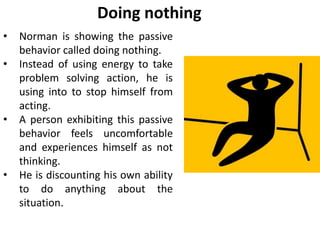
• Norman is showing the passive
behavior called doing nothing.
• Instead of using energy to take
problem solving action, he is
using into to stop himself from
acting.
• A person exhibiting this passive
behavior feels uncomfortable
and experiences himself as not
thinking.
• He is discounting his own ability
to do anything about the
situation.
Over adaptation
• Amy comes into the house after a
hard day’s work. Her husband
Brian is sitting reading a
newspaper.
• Looking beyond him into the
kitchen, Amy sees a huge pile of
unwashed dishes besides the
sink.
• “Hi”, says Brian, “Hope you’ve had
a good day. Just about time for
tea, isn’t it?”.
• Taking her coat off, Amy goes
straight through to the kitchen.
She washes the pile of dishes and
gets down to making tea.
Over adaptation
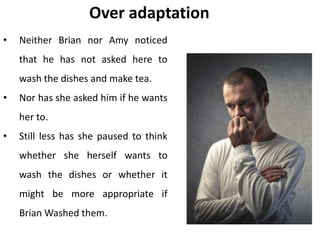
• Neither Brian nor Amy noticed
that he has not asked here to
wash the dishes and make tea.
• Nor has she asked him if he wants
her to.
• Still less has she paused to think
whether she herself wants to
wash the dishes or whether it
might be more appropriate if
Brian Washed them.
Over adaptation
• Amy’s passive behavior is over
adaptation.
• When someone overadapts, she is
complying with what she believes in
Child are the wishes of others.
• She does so without checking with
them what their wishes are in
reality, and without any reference to
what her own wishes are.
• The person in overadapation, unlike
the person in doing nothing,
experiences herself as thinking
during the passive behavior.
• He thinking actually proceeds from a
contamination
Over adaptation
• Someone is overadaptation will
often be experienced by others as
helpful, adaptable or
accommodating.
• Thus overadaptation is frequently
stroked by those to whom the
person relates.
• Because of this social acceptability
and because the person appears to
be thinking, overadaptation is the
most difficult to detect of the four
passive behavior.
• The person in overadaptation is
discounting her ability to act on her
own options. Instead, she follows
options she believes others want.
Agitation
• The class of students is listening to
the lecturer. At the back of the room
sits Adam.
• The lecturer is speaking rather
quietly and Adam has difficulty in
hearing him.
• As the lecture period goes on, Adam
has more and more trouble
following what lecturer is talking
about.
• He puts down his pen and starts
drumming his fingers on the desk.
He is waggling his foot rapidly up
and own in time of his finger
drumming.
Agitation
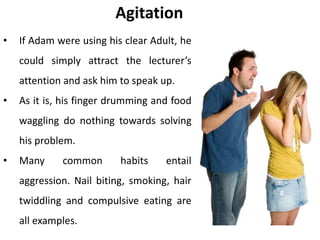
• Adam is showing agitation.
• In this passive behavior, the
person is discounting his ability
to act to solve the problem.
• He feels acutely uncomfortable,
and engages in purposeless,
repetitive activity in an attempt
to relieve the discomfort.
• Energy is directed into the
agitated activity instead of into
action to solve the problem.
• During agitation, the person
does not experience himself as
thinking.
Agitation
• If Adam were using his clear Adult, he
could simply attract the lecturer’s
attention and ask him to speak up.
• As it is, his finger drumming and food
waggling do nothing towards solving
his problem.
• Many common habits entail
aggression. Nail biting, smoking, hair
twiddling and compulsive eating are
all examples.
Incapacitation and violence
• Betty is in her late thirties.
The younger of two
daughters, she still lives at
home with her aged mother,
whom she looks after. The
old woman, despite her age,
is really in pretty and sound
health.
• Out of the blue, Betty meets
a man and they fall in love.
Happily, she announces to
her mother that she intends
to move out to live with him
and perhaps get married.
Incapacitation and violence
• A couple of days later, the
mother begins having dizzy spells
and has to take to her bed.
• The doctor can find nothing
physically wrong with her. But
Betty begins to feel guilty about
her intention to move out.
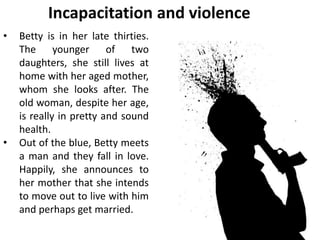
• Mother’s passive behavior is
incapacitation.
Incapacitation and violence
• Here, the person disables
herself in some way.
• Discounting her own ability
to solve a problem, she
hopes in Child that by
incapacitating herself she
can get someone else to
solve it.
• Incapacitation can
sometimes be in the form of
psychosomatic ailments, as
here. Alternatively, it can be
achieved by mental
breakdown or by abuse of
drugs or alcohol.
Incapacitation and violence
• Robert has just had a furious
row with his girlfriend.
• He storms out of the house
and walks the streets for a
long while.
• He goes down town, has a
few beers.
• Then he picks up a chair and
smashes all the plate – glass
windows in the bar.
Incapacitation and violence
• Robert’s passive behavior
is violence.
• It may seem strange to
refer to violence as
passive behavior.
• But it is passive because it
is not directed at solving
the problem in hand.
• When Robert smashes
the window, he does
nothing to resolve his
differences with is
girlfriend.
Incapacitation and violence
• Incapacitation can be
viewed as violence
directed inwards.
• In both incapacitation and
violence, the person is
discounting his ability to
solve a problem.
• He releases a burst of
energy, directed to self or
others, in a desperate
attempt to force the
environment to solve the
problem for him.
Incapacitation and violence
• Incapacitation or violence will
often follow a period of
agitation.
• When the person is agitating,
he is building up energy which
he may then discharge
destructively by either
incapacitating or getting
violent.
Activity
• Review the problem situation you
considered in the last activity.
• Do you identify which of the
passive behaviors you engaged in?
• Now re-run the situation in your
mind’s eye. When you come to
the moment where you began the
passive behavior, imagine yourself
instead staying in Adult and using
the full power of your grown up
thinking, feeling or behaving to
solve the problem.
• How do you then act differently?
Thank You
Other TA topics available on slideshare
1. Strokes - http://www.slideshare.net/manumjoy/strokes-24081607.
2. Games People Play - http://www.slideshare.net/manumjoy/psychological-
games-people-play.
3. Structural Analysis - http://www.slideshare.net/manumjoy/the-ego-state-model.
4. What is TA? - http://www.slideshare.net/manumjoy/what-ta-is
5. Cycles of Development - http://www.slideshare.net/manumjoy/cycles-of-
developement-pamela-levin-transactional-analysis.
6. Stages of Cure - http://www.slideshare.net/manumjoy/stages-of-cure.
7. Transactions - http://www.slideshare.net/manumjoy/transactions-33677298.
8. Time Structuring - http://www.slideshare.net/manumjoy/time-structuring.
9. Life Position - http://www.slideshare.net/manumjoy/life-position.
10. Autonomy - http://www.slideshare.net/manumjoy/autonomy-33690557.
11. Structural Pathology - http://www.slideshare.net/manumjoy/structural-pathology.
12. Game Analysis - http://www.slideshare.net/manumjoy/game-analysis-33725636.
13. Integrated Adult - http://www.slideshare.net/manumjoy/integrated-adult.
14. Stroke Economy - http://www.slideshare.net/manumjoy/stroke-economy-
33826702.

Passive behaviors - Discounting (Transactional analysis / TA is an integrative approach to the theory of psychology and psychotherapy).

  • 1.
  • 2.
    Prepared By Manu MelwinJoy Research Scholar School of Management Studies CUSAT, Kerala, India. Phone – 9744551114 Mail – manu_melwinjoy@yahoo.com Kindly restrict the use of slides for personal purpose. Please seek permission to reproduce the same in public forms and presentations.
  • 3.
    Passive behaviors • WhenI discount, I do so by making statement to myself in my own head. • Thus a discount itself is not observable. • Since you can’t thought read, you have no way of knowing I am discounting unless I speak or act in some way which indicates the presence of the discount.
  • 4.
    Passive behaviors • Thereare four types of behavior which always indicate that the person concerned is discounting. They are • Doing nothing. • Over adaptation. • Agitation. • Incapacitation or violence.
  • 5.
    Doing nothing • Themembers of a TA group are sitting in a circle. • The group leader says : “ Let’s go round the group and each person say what he or she appreciates or resents about today’s session. If you don’t want to take part, it’s OK to say “Pass”. • The exercise begins. People round the group each give an appreciation or resentment. One or two say “Pass”.
  • 6.
    Doing nothing • Thencame Norman’s turn. There is a silence. People waited for Norman to say something but he doesn’t. • He sits unmoving and silent, staring into space. Since he doesn’t seem to want to speak any appreciation or resentment, the person next to him waits for him to say “Pass”. • But Norman doesn’t do that either. He continues to sit as if dumb.
  • 7.
    Doing nothing • Normanis showing the passive behavior called doing nothing. • Instead of using energy to take problem solving action, he is using into to stop himself from acting. • A person exhibiting this passive behavior feels uncomfortable and experiences himself as not thinking. • He is discounting his own ability to do anything about the situation.
  • 8.
    Over adaptation • Amycomes into the house after a hard day’s work. Her husband Brian is sitting reading a newspaper. • Looking beyond him into the kitchen, Amy sees a huge pile of unwashed dishes besides the sink. • “Hi”, says Brian, “Hope you’ve had a good day. Just about time for tea, isn’t it?”. • Taking her coat off, Amy goes straight through to the kitchen. She washes the pile of dishes and gets down to making tea.
  • 9.
    Over adaptation • NeitherBrian nor Amy noticed that he has not asked here to wash the dishes and make tea. • Nor has she asked him if he wants her to. • Still less has she paused to think whether she herself wants to wash the dishes or whether it might be more appropriate if Brian Washed them.
  • 10.
    Over adaptation • Amy’spassive behavior is over adaptation. • When someone overadapts, she is complying with what she believes in Child are the wishes of others. • She does so without checking with them what their wishes are in reality, and without any reference to what her own wishes are. • The person in overadapation, unlike the person in doing nothing, experiences herself as thinking during the passive behavior. • He thinking actually proceeds from a contamination
  • 11.
    Over adaptation • Someoneis overadaptation will often be experienced by others as helpful, adaptable or accommodating. • Thus overadaptation is frequently stroked by those to whom the person relates. • Because of this social acceptability and because the person appears to be thinking, overadaptation is the most difficult to detect of the four passive behavior. • The person in overadaptation is discounting her ability to act on her own options. Instead, she follows options she believes others want.
  • 12.
    Agitation • The classof students is listening to the lecturer. At the back of the room sits Adam. • The lecturer is speaking rather quietly and Adam has difficulty in hearing him. • As the lecture period goes on, Adam has more and more trouble following what lecturer is talking about. • He puts down his pen and starts drumming his fingers on the desk. He is waggling his foot rapidly up and own in time of his finger drumming.
  • 13.
    Agitation • Adam isshowing agitation. • In this passive behavior, the person is discounting his ability to act to solve the problem. • He feels acutely uncomfortable, and engages in purposeless, repetitive activity in an attempt to relieve the discomfort. • Energy is directed into the agitated activity instead of into action to solve the problem. • During agitation, the person does not experience himself as thinking.
  • 14.
    Agitation • If Adamwere using his clear Adult, he could simply attract the lecturer’s attention and ask him to speak up. • As it is, his finger drumming and food waggling do nothing towards solving his problem. • Many common habits entail aggression. Nail biting, smoking, hair twiddling and compulsive eating are all examples.
  • 15.
    Incapacitation and violence •Betty is in her late thirties. The younger of two daughters, she still lives at home with her aged mother, whom she looks after. The old woman, despite her age, is really in pretty and sound health. • Out of the blue, Betty meets a man and they fall in love. Happily, she announces to her mother that she intends to move out to live with him and perhaps get married.
  • 16.
    Incapacitation and violence •A couple of days later, the mother begins having dizzy spells and has to take to her bed. • The doctor can find nothing physically wrong with her. But Betty begins to feel guilty about her intention to move out. • Mother’s passive behavior is incapacitation.
  • 17.
    Incapacitation and violence •Here, the person disables herself in some way. • Discounting her own ability to solve a problem, she hopes in Child that by incapacitating herself she can get someone else to solve it. • Incapacitation can sometimes be in the form of psychosomatic ailments, as here. Alternatively, it can be achieved by mental breakdown or by abuse of drugs or alcohol.
  • 18.
    Incapacitation and violence •Robert has just had a furious row with his girlfriend. • He storms out of the house and walks the streets for a long while. • He goes down town, has a few beers. • Then he picks up a chair and smashes all the plate – glass windows in the bar.
  • 19.
    Incapacitation and violence •Robert’s passive behavior is violence. • It may seem strange to refer to violence as passive behavior. • But it is passive because it is not directed at solving the problem in hand. • When Robert smashes the window, he does nothing to resolve his differences with is girlfriend.
  • 20.
    Incapacitation and violence •Incapacitation can be viewed as violence directed inwards. • In both incapacitation and violence, the person is discounting his ability to solve a problem. • He releases a burst of energy, directed to self or others, in a desperate attempt to force the environment to solve the problem for him.
  • 21.
    Incapacitation and violence •Incapacitation or violence will often follow a period of agitation. • When the person is agitating, he is building up energy which he may then discharge destructively by either incapacitating or getting violent.
  • 22.
    Activity • Review theproblem situation you considered in the last activity. • Do you identify which of the passive behaviors you engaged in? • Now re-run the situation in your mind’s eye. When you come to the moment where you began the passive behavior, imagine yourself instead staying in Adult and using the full power of your grown up thinking, feeling or behaving to solve the problem. • How do you then act differently?
  • 23.
  • 24.
    Other TA topicsavailable on slideshare 1. Strokes - http://www.slideshare.net/manumjoy/strokes-24081607. 2. Games People Play - http://www.slideshare.net/manumjoy/psychological- games-people-play. 3. Structural Analysis - http://www.slideshare.net/manumjoy/the-ego-state-model. 4. What is TA? - http://www.slideshare.net/manumjoy/what-ta-is 5. Cycles of Development - http://www.slideshare.net/manumjoy/cycles-of- developement-pamela-levin-transactional-analysis. 6. Stages of Cure - http://www.slideshare.net/manumjoy/stages-of-cure. 7. Transactions - http://www.slideshare.net/manumjoy/transactions-33677298. 8. Time Structuring - http://www.slideshare.net/manumjoy/time-structuring. 9. Life Position - http://www.slideshare.net/manumjoy/life-position. 10. Autonomy - http://www.slideshare.net/manumjoy/autonomy-33690557. 11. Structural Pathology - http://www.slideshare.net/manumjoy/structural-pathology. 12. Game Analysis - http://www.slideshare.net/manumjoy/game-analysis-33725636. 13. Integrated Adult - http://www.slideshare.net/manumjoy/integrated-adult. 14. Stroke Economy - http://www.slideshare.net/manumjoy/stroke-economy- 33826702.