Life script
Definition
Prepared By
Manu Melwin Joy
Research Scholar
School of Management Studies
CUSAT, Kerala, India.
Phone – 9744551114
Mail – manu_melwinjoy@yahoo.com
Kindly restrict the use of slides for personal purpose.
Please seek permission to reproduce the same in public
forms and presentations.
Introduction
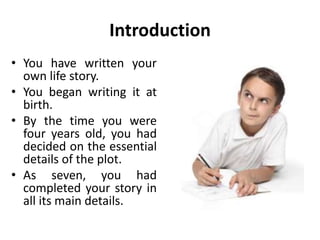
• You have written your
own life story.
• You began writing it at
birth.
• By the time you were
four years old, you had
decided on the essential
details of the plot.
• As seven, you had
completed your story in
all its main details.
Introduction
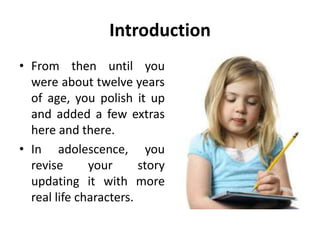
• From then until you
were about twelve years
of age, you polish it up
and added a few extras
here and there.
• In adolescence, you
revise your story
updating it with more
real life characters.
Introduction
• Like all stories, your life
story has a beginning, a
middle and an end.
• It has its heroes, heroines,
villains, stooges and walk
on characters.
• It has its main theme and
sub plots.
• It may be comic or tragic,
enthralling or boring,
inspiring or inglorious.
Activity
• Suppose of now, that you
have indeed written the
story which is your own
life.
– What is the title of the
story?
– What kind of story is it?
(Happy/Sad/Tragic/comic)
– In a few sentence,
describe the closing scene
of your story.
Life script
• The theory of script was
developed by Eric Berne
and his Co-workers,
notably Claude Steiner,
in the mid 1960’s.
• The concept of script has
grown in importance as a
part of TA theory, until
now it ranks with the ego
state model as a central
idea of TA.
Definition
“Life script is an
unconscious life plan.”
Eric Berne
Principles of Group Treatment
Definition
“A life plan made in childhood,
reinforced by parents, justified by
subsequent events, and culminating
in a chosen alternative.”
Eric Berne
What do you say after you say hello
Details of definition
• Script is a life plan.
• Script is directed
towards a payoff.
• Script is decisional.
• Script is reinforced by
parents.
• Script is outside
awareness.
• Reality is redefined to
justify the script.
Script is a life plan
• The notion that people’s
grown up life patterns are
affected by childhood
experience is central to
TA.
• Script theory suggests that
child lays down a specific
plan for her life, rather
than simply a general view
of the world.
• This life plan is laid out in
the form of a drama, with
a clear cut beginning,
middle and end.
Script is directed towards a payoff
• When the young child
writes his life drama, he
writes the closing scene
(Payoff) as an integral part
of it.
• All the other parts of the
plot, from the opening
scene onwards, are then
planned to lead up to this
final scene.
• We are unawarely
choosing behavior which
will bring us closer to our
script payoff.
Script is decisional
• Child decides upon the
life plan.
• Even different children
brought up in same
environment may decide
upon quite different life
plans.
• The child’s script
decisions are not made
in the deliberate
thinking way which we
associate with adult
decision making.
Script is reinforced by parents
• From child’s earliest days,
parents are giving her
messages, on the basis of
which she forms
conclusion about herself,
others and world.
• These script messages are
verbal and non verbal.
• They form the framework
in response to which the
child’s main script
decisions are made.
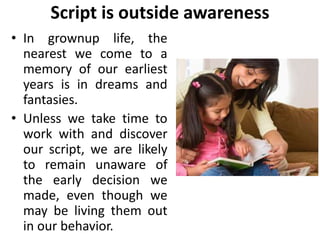
Script is outside awareness
• In grownup life, the
nearest we come to a
memory of our earliest
years is in dreams and
fantasies.
• Unless we take time to
work with and discover
our script, we are likely
to remain unaware of
the early decision we
made, even though we
may be living them out
in our behavior.
Reality is redefined to justify the script
• We interpret reality in
our own frame of
reference to justify our
script decisions.
• We do this because, in
our child ego state, we
may perceive any threat
to our script based view
of the world as a threat
to the satisfaction of our
needs or even a threat
to our survival.
Thank You
Other TA topics available on slideshare
1. Strokes - http://www.slideshare.net/manumjoy/strokes-24081607.
2. Games People Play - http://www.slideshare.net/manumjoy/psychological-
games-people-play.
3. Structural Analysis - http://www.slideshare.net/manumjoy/the-ego-state-model.
4. What is TA? - http://www.slideshare.net/manumjoy/what-ta-is
5. Cycles of Development - http://www.slideshare.net/manumjoy/cycles-of-
developement-pamela-levin-transactional-analysis.
6. Stages of Cure - http://www.slideshare.net/manumjoy/stages-of-cure.
7. Transactions - http://www.slideshare.net/manumjoy/transactions-33677298.
8. Time Structuring - http://www.slideshare.net/manumjoy/time-structuring.
9. Life Position - http://www.slideshare.net/manumjoy/life-position.
10. Autonomy - http://www.slideshare.net/manumjoy/autonomy-33690557.
11. Structural Pathology - http://www.slideshare.net/manumjoy/structural-pathology.
12. Game Analysis - http://www.slideshare.net/manumjoy/game-analysis-33725636.
13. Integrated Adult - http://www.slideshare.net/manumjoy/integrated-adult.
14. Stroke Economy - http://www.slideshare.net/manumjoy/stroke-economy-
33826702.

Life scripts definitions (Transactional analysis / TA is an integrative approach to the theory of psychology and psychotherapy)

  • 1.
  • 2.
    Prepared By Manu MelwinJoy Research Scholar School of Management Studies CUSAT, Kerala, India. Phone – 9744551114 Mail – manu_melwinjoy@yahoo.com Kindly restrict the use of slides for personal purpose. Please seek permission to reproduce the same in public forms and presentations.
  • 3.
    Introduction • You havewritten your own life story. • You began writing it at birth. • By the time you were four years old, you had decided on the essential details of the plot. • As seven, you had completed your story in all its main details.
  • 4.
    Introduction • From thenuntil you were about twelve years of age, you polish it up and added a few extras here and there. • In adolescence, you revise your story updating it with more real life characters.
  • 5.
    Introduction • Like allstories, your life story has a beginning, a middle and an end. • It has its heroes, heroines, villains, stooges and walk on characters. • It has its main theme and sub plots. • It may be comic or tragic, enthralling or boring, inspiring or inglorious.
  • 6.
    Activity • Suppose ofnow, that you have indeed written the story which is your own life. – What is the title of the story? – What kind of story is it? (Happy/Sad/Tragic/comic) – In a few sentence, describe the closing scene of your story.
  • 7.
    Life script • Thetheory of script was developed by Eric Berne and his Co-workers, notably Claude Steiner, in the mid 1960’s. • The concept of script has grown in importance as a part of TA theory, until now it ranks with the ego state model as a central idea of TA.
  • 8.
    Definition “Life script isan unconscious life plan.” Eric Berne Principles of Group Treatment
  • 9.
    Definition “A life planmade in childhood, reinforced by parents, justified by subsequent events, and culminating in a chosen alternative.” Eric Berne What do you say after you say hello
  • 10.
    Details of definition •Script is a life plan. • Script is directed towards a payoff. • Script is decisional. • Script is reinforced by parents. • Script is outside awareness. • Reality is redefined to justify the script.
  • 11.
    Script is alife plan • The notion that people’s grown up life patterns are affected by childhood experience is central to TA. • Script theory suggests that child lays down a specific plan for her life, rather than simply a general view of the world. • This life plan is laid out in the form of a drama, with a clear cut beginning, middle and end.
  • 12.
    Script is directedtowards a payoff • When the young child writes his life drama, he writes the closing scene (Payoff) as an integral part of it. • All the other parts of the plot, from the opening scene onwards, are then planned to lead up to this final scene. • We are unawarely choosing behavior which will bring us closer to our script payoff.
  • 13.
    Script is decisional •Child decides upon the life plan. • Even different children brought up in same environment may decide upon quite different life plans. • The child’s script decisions are not made in the deliberate thinking way which we associate with adult decision making.
  • 14.
    Script is reinforcedby parents • From child’s earliest days, parents are giving her messages, on the basis of which she forms conclusion about herself, others and world. • These script messages are verbal and non verbal. • They form the framework in response to which the child’s main script decisions are made.
  • 15.
    Script is outsideawareness • In grownup life, the nearest we come to a memory of our earliest years is in dreams and fantasies. • Unless we take time to work with and discover our script, we are likely to remain unaware of the early decision we made, even though we may be living them out in our behavior.
  • 16.
    Reality is redefinedto justify the script • We interpret reality in our own frame of reference to justify our script decisions. • We do this because, in our child ego state, we may perceive any threat to our script based view of the world as a threat to the satisfaction of our needs or even a threat to our survival.
  • 17.
  • 18.
    Other TA topicsavailable on slideshare 1. Strokes - http://www.slideshare.net/manumjoy/strokes-24081607. 2. Games People Play - http://www.slideshare.net/manumjoy/psychological- games-people-play. 3. Structural Analysis - http://www.slideshare.net/manumjoy/the-ego-state-model. 4. What is TA? - http://www.slideshare.net/manumjoy/what-ta-is 5. Cycles of Development - http://www.slideshare.net/manumjoy/cycles-of- developement-pamela-levin-transactional-analysis. 6. Stages of Cure - http://www.slideshare.net/manumjoy/stages-of-cure. 7. Transactions - http://www.slideshare.net/manumjoy/transactions-33677298. 8. Time Structuring - http://www.slideshare.net/manumjoy/time-structuring. 9. Life Position - http://www.slideshare.net/manumjoy/life-position. 10. Autonomy - http://www.slideshare.net/manumjoy/autonomy-33690557. 11. Structural Pathology - http://www.slideshare.net/manumjoy/structural-pathology. 12. Game Analysis - http://www.slideshare.net/manumjoy/game-analysis-33725636. 13. Integrated Adult - http://www.slideshare.net/manumjoy/integrated-adult. 14. Stroke Economy - http://www.slideshare.net/manumjoy/stroke-economy- 33826702.