Autonomy
Prepared By
Manu Melwin Joy
Research Scholar
School of Management Studies
CUSAT, Kerala, India.
Phone – 9744551114
Mail – manu_melwinjoy@yahoo.com
Kindly restrict the use of slides for personal purpose.
Please seek permission to reproduce the same in public
forms and presentations.
Content
• Introduction.
• Autonomy.
• Awareness.
• Spontaneity
• Intimacy.
• Integrated Adult.
“Man Ultimately decides for himself!
And in the end, education must be
education towards the ability to
decide. “
Victor Frankl
Autonomy
• Achieving autonomy is
the ultimate goal in
transactional analysis.
• Being autonomous
means being self
governing, determining
one’s own destiny, taking
responsibility for one’s
own actions and feelings
and throwing off patterns
that are irrelevant and
inappropriate to living in
the here and now.
Autonomy
• Every one has the
capacity to obtain a
measure of autonomy.
• But in spite of that fact
that autonomy is a
human birthright, few
actually achieve it.
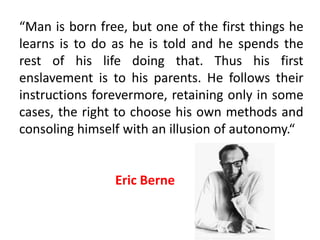
“Man is born free, but one of the first things he
learns is to do as he is told and he spends the
rest of his life doing that. Thus his first
enslavement is to his parents. He follows their
instructions forevermore, retaining only in some
cases, the right to choose his own methods and
consoling himself with an illusion of autonomy.“
Eric Berne
Autonomy
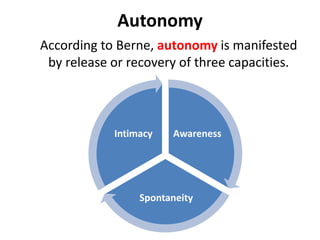
According to Berne, autonomy is manifested
by release or recovery of three capacities.
Awareness
Spontaneity
Intimacy
Awareness
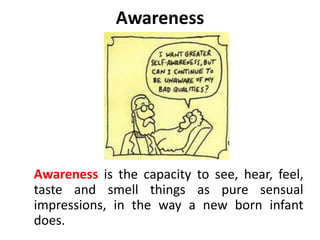
Awareness is the capacity to see, hear, feel,
taste and smell things as pure sensual
impressions, in the way a new born infant
does.
Awareness
• Awareness is knowing what is
happening now.
• An autonomous person is aware.
• This person peels away the layers
of contamination from the Adult
and beings to hear, see, smell,
touch, taste, study and evaluate
independently.
Awareness
• Knowing that life is temporal, an aware person
appreciates nature now.
• An aware person experiences that part of the universe
know to the self, as well as the mystery of those
universes yet to be discovered.
Awareness
• An aware person is all
there and fully aware.
• People who are aware
know where they are,
what they are doing and
how they feel about it.
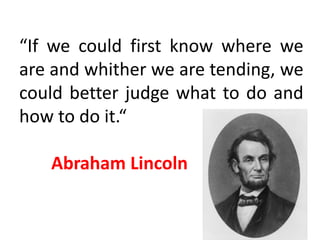
“If we could first know where we
are and whither we are tending, we
could better judge what to do and
how to do it.“
Abraham Lincoln
Awareness
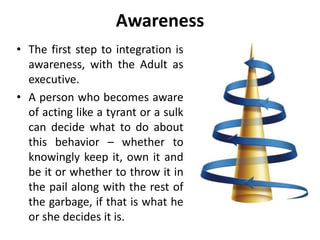
• The first step to integration is
awareness, with the Adult as
executive.
• A person who becomes aware

of acting like a tyrant or a sulk
can decide what to do about
this behavior – whether to
knowingly keep it, own it and
be it or whether to throw it in
the pail along with the rest of
the garbage, if that is what he
or she decides it is.
“Everything is grounded in
awareness.“
Frank Perls
Spontaneity
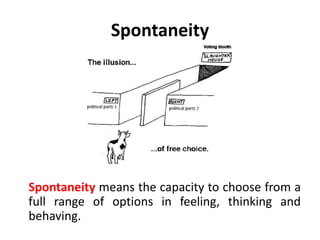
Spontaneity means the capacity to choose from a
full range of options in feeling, thinking and
behaving.
Spontaneity
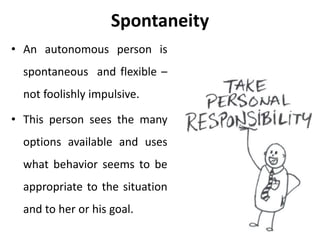
• An autonomous person is
spontaneous and flexible –
not foolishly impulsive.
• This person sees the many
options available and uses
what behavior seems to be
appropriate to the situation
and to her or his goal.
Spontaneity
• A spontaneous person is
liberated, making and
accepting responsibility by
personal choices.
• He uses or recaptures the
ability to decide
independently.
• Within realistic limitations,
the person knowingly take
responsibility for a self
imposed destiny.
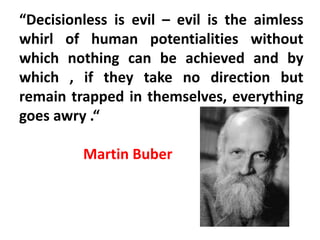
“Decisionless is evil – evil is the aimless
whirl of human potentialities without
which nothing can be achieved and by
which , if they take no direction but
remain trapped in themselves, everything
goes awry .“
Martin Buber
Spontaneity
• A person must do more than
make a decision. Unless the
person acts on that decision, it
is meaningless.
• Only when one’s inner ethics
and outward behavior match
is a person congruent and
whole.
• A spontaneous person is free
to do his own thing but not at
the expense of other through
exploitation and / or
indifference.
Intimacy
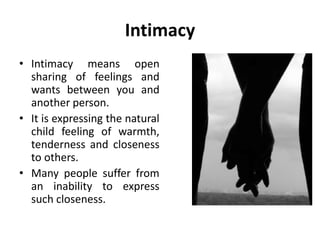
• Intimacy means open
sharing of feelings and
wants between you and
another person.
• It is expressing the natural
child feeling of warmth,
tenderness and closeness
to others.
• Many people suffer from
an inability to express
such closeness.
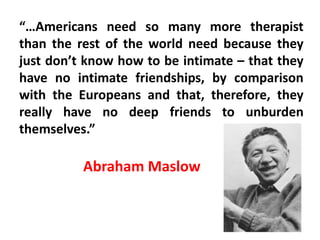
“…Americans need so many more therapist
than the rest of the world need because they
just don’t know how to be intimate – that they
have no intimate friendships, by comparison
with the Europeans and that, therefore, they
really have no deep friends to unburden
themselves.”
Abraham Maslow
Intimacy
• Autonomous people risk
friendships and intimacy
when they decide it is
appropriate.
• This does not come easy to
people who have restricted
their affectionate feelings
and are not in the habit of
expressing them.
• In fact, they may feel
awkward, even phony, when
they first try to go against old
programming.
Intimacy
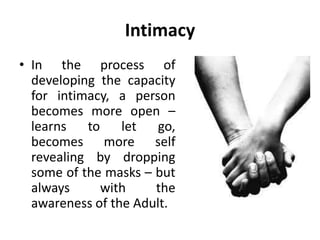
• In the process of
developing the capacity
for intimacy, a person
becomes more open –
learns to let go,
becomes more self
revealing by dropping
some of the masks – but
always with the
awareness of the Adult.
Intimacy
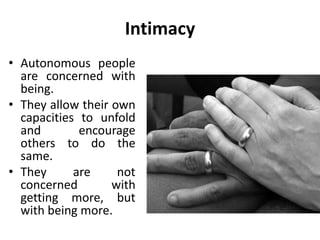
• Autonomous people
are concerned with
being.
• They allow their own
capacities to unfold
and encourage
others to do the
same.
• They are not
concerned with
getting more, but
with being more.
Autonomy
• Berne implied that
autonomy was the
same thing as freedom
from the script.
• It can be defined as the
behavior, thinking or
feeling which is a
response to here and
now reality, rather than
a response to the script
beliefs.
Autonomy
• Does autonomous
means being in adult
all the times?
• An autonomous
person engages in
problem solving
instead of passivity.
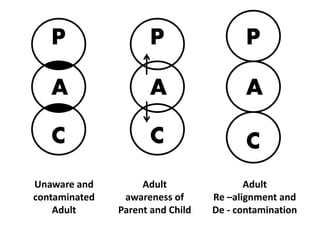
Integrated Adult
• People moving toward
autonomy expand their
personal capacities for
awareness, spontaneity
and intimacy. As this
occurs, they develop
integrated adult ego
states.
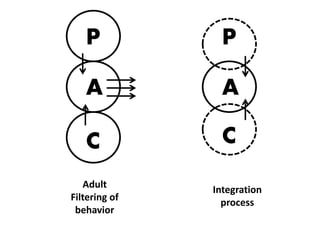
• Filtering more and more
Parent and Child material
through their Adult and
learning new behavior
patterns are parts of the
integrating process.
Integrated Adult
• The person in the process of
integration takes
responsibility for everything
he or she feels, thinks and
believes and also either has
or develops an ethical
system of life – Ethos.
• In addition, the person
develops social graciousness
and experiences the
emotions of passion,
tenderness and suffering –
Pathos.
0
P
A
C
Unaware and
contaminated
Adult
0
P
A
C
Adult
awareness of
Parent and Child
0
P
A
C
Adult
Re –alignment and
De - contamination
0
P
A
C
Adult
Filtering of
behavior
0
P
A
C
Integration
process
Integrated Adult
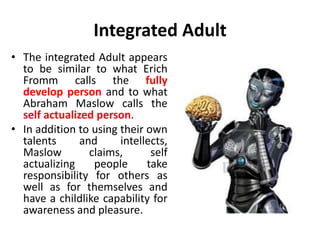
• The integrated Adult appears
to be similar to what Erich
Fromm calls the fully
develop person and to what
Abraham Maslow calls the
self actualized person.
• In addition to using their own
talents and intellects,
Maslow claims, self
actualizing people take
responsibility for others as
well as for themselves and
have a childlike capability for
awareness and pleasure.
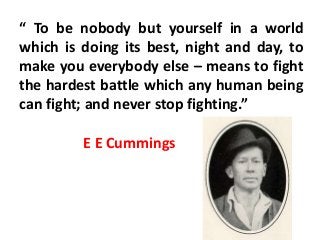
“ To be nobody but yourself in a world
which is doing its best, night and day, to
make you everybody else – means to fight
the hardest battle which any human being
can fight; and never stop fighting.”
E E Cummings
Thank You
Other TA topics available on slideshare
1. Strokes - http://www.slideshare.net/manumjoy/strokes-24081607.
2. Games People Play - http://www.slideshare.net/manumjoy/psychological-
games-people-play.
3. Structural Analysis - http://www.slideshare.net/manumjoy/the-ego-state-model.
4. What is TA? - http://www.slideshare.net/manumjoy/what-ta-is
5. Cycles of Development - http://www.slideshare.net/manumjoy/cycles-of-
developement-pamela-levin-transactional-analysis.
6. Stages of Cure - http://www.slideshare.net/manumjoy/stages-of-cure.
7. Transactions - http://www.slideshare.net/manumjoy/transactions-33677298.
8. Time Structuring - http://www.slideshare.net/manumjoy/time-structuring.
9. Life Position - http://www.slideshare.net/manumjoy/life-position.
10. Autonomy - http://www.slideshare.net/manumjoy/autonomy-33690557.
11. Structural Pathology - http://www.slideshare.net/manumjoy/structural-pathology.
12. Game Analysis - http://www.slideshare.net/manumjoy/game-analysis-33725636.
13. Integrated Adult - http://www.slideshare.net/manumjoy/integrated-adult.
14. Stroke Economy - http://www.slideshare.net/manumjoy/stroke-economy-
33826702.

Autonomy - Transactional Analysis

  • 1.
  • 2.
    Prepared By Manu MelwinJoy Research Scholar School of Management Studies CUSAT, Kerala, India. Phone – 9744551114 Mail – manu_melwinjoy@yahoo.com Kindly restrict the use of slides for personal purpose. Please seek permission to reproduce the same in public forms and presentations.
  • 3.
    Content • Introduction. • Autonomy. •Awareness. • Spontaneity • Intimacy. • Integrated Adult.
  • 4.
    “Man Ultimately decidesfor himself! And in the end, education must be education towards the ability to decide. “ Victor Frankl
  • 5.
    Autonomy • Achieving autonomyis the ultimate goal in transactional analysis. • Being autonomous means being self governing, determining one’s own destiny, taking responsibility for one’s own actions and feelings and throwing off patterns that are irrelevant and inappropriate to living in the here and now.
  • 6.
    Autonomy • Every onehas the capacity to obtain a measure of autonomy. • But in spite of that fact that autonomy is a human birthright, few actually achieve it.
  • 7.
    “Man is bornfree, but one of the first things he learns is to do as he is told and he spends the rest of his life doing that. Thus his first enslavement is to his parents. He follows their instructions forevermore, retaining only in some cases, the right to choose his own methods and consoling himself with an illusion of autonomy.“ Eric Berne
  • 8.
    Autonomy According to Berne,autonomy is manifested by release or recovery of three capacities. Awareness Spontaneity Intimacy
  • 10.
    Awareness Awareness is thecapacity to see, hear, feel, taste and smell things as pure sensual impressions, in the way a new born infant does.
  • 11.
    Awareness • Awareness isknowing what is happening now. • An autonomous person is aware. • This person peels away the layers of contamination from the Adult and beings to hear, see, smell, touch, taste, study and evaluate independently.
  • 12.
    Awareness • Knowing thatlife is temporal, an aware person appreciates nature now. • An aware person experiences that part of the universe know to the self, as well as the mystery of those universes yet to be discovered.
  • 13.
    Awareness • An awareperson is all there and fully aware. • People who are aware know where they are, what they are doing and how they feel about it.
  • 14.
    “If we couldfirst know where we are and whither we are tending, we could better judge what to do and how to do it.“ Abraham Lincoln
  • 15.
    Awareness • The firststep to integration is awareness, with the Adult as executive. • A person who becomes aware of acting like a tyrant or a sulk can decide what to do about this behavior – whether to knowingly keep it, own it and be it or whether to throw it in the pail along with the rest of the garbage, if that is what he or she decides it is.
  • 16.
    “Everything is groundedin awareness.“ Frank Perls
  • 17.
    Spontaneity Spontaneity means thecapacity to choose from a full range of options in feeling, thinking and behaving.
  • 19.
    Spontaneity • An autonomousperson is spontaneous and flexible – not foolishly impulsive. • This person sees the many options available and uses what behavior seems to be appropriate to the situation and to her or his goal.
  • 20.
    Spontaneity • A spontaneousperson is liberated, making and accepting responsibility by personal choices. • He uses or recaptures the ability to decide independently. • Within realistic limitations, the person knowingly take responsibility for a self imposed destiny.
  • 21.
    “Decisionless is evil– evil is the aimless whirl of human potentialities without which nothing can be achieved and by which , if they take no direction but remain trapped in themselves, everything goes awry .“ Martin Buber
  • 22.
    Spontaneity • A personmust do more than make a decision. Unless the person acts on that decision, it is meaningless. • Only when one’s inner ethics and outward behavior match is a person congruent and whole. • A spontaneous person is free to do his own thing but not at the expense of other through exploitation and / or indifference.
  • 23.
    Intimacy • Intimacy meansopen sharing of feelings and wants between you and another person. • It is expressing the natural child feeling of warmth, tenderness and closeness to others. • Many people suffer from an inability to express such closeness.
  • 24.
    “…Americans need somany more therapist than the rest of the world need because they just don’t know how to be intimate – that they have no intimate friendships, by comparison with the Europeans and that, therefore, they really have no deep friends to unburden themselves.” Abraham Maslow
  • 25.
    Intimacy • Autonomous peoplerisk friendships and intimacy when they decide it is appropriate. • This does not come easy to people who have restricted their affectionate feelings and are not in the habit of expressing them. • In fact, they may feel awkward, even phony, when they first try to go against old programming.
  • 26.
    Intimacy • In theprocess of developing the capacity for intimacy, a person becomes more open – learns to let go, becomes more self revealing by dropping some of the masks – but always with the awareness of the Adult.
  • 27.
    Intimacy • Autonomous people areconcerned with being. • They allow their own capacities to unfold and encourage others to do the same. • They are not concerned with getting more, but with being more.
  • 28.
    Autonomy • Berne impliedthat autonomy was the same thing as freedom from the script. • It can be defined as the behavior, thinking or feeling which is a response to here and now reality, rather than a response to the script beliefs.
  • 29.
    Autonomy • Does autonomous meansbeing in adult all the times? • An autonomous person engages in problem solving instead of passivity.
  • 30.
    Integrated Adult • Peoplemoving toward autonomy expand their personal capacities for awareness, spontaneity and intimacy. As this occurs, they develop integrated adult ego states. • Filtering more and more Parent and Child material through their Adult and learning new behavior patterns are parts of the integrating process.
  • 31.
    Integrated Adult • Theperson in the process of integration takes responsibility for everything he or she feels, thinks and believes and also either has or develops an ethical system of life – Ethos. • In addition, the person develops social graciousness and experiences the emotions of passion, tenderness and suffering – Pathos.
  • 32.
    0 P A C Unaware and contaminated Adult 0 P A C Adult awareness of Parentand Child 0 P A C Adult Re –alignment and De - contamination
  • 33.
  • 34.
    Integrated Adult • Theintegrated Adult appears to be similar to what Erich Fromm calls the fully develop person and to what Abraham Maslow calls the self actualized person. • In addition to using their own talents and intellects, Maslow claims, self actualizing people take responsibility for others as well as for themselves and have a childlike capability for awareness and pleasure.
  • 35.
    “ To benobody but yourself in a world which is doing its best, night and day, to make you everybody else – means to fight the hardest battle which any human being can fight; and never stop fighting.” E E Cummings
  • 36.
  • 37.
    Other TA topicsavailable on slideshare 1. Strokes - http://www.slideshare.net/manumjoy/strokes-24081607. 2. Games People Play - http://www.slideshare.net/manumjoy/psychological- games-people-play. 3. Structural Analysis - http://www.slideshare.net/manumjoy/the-ego-state-model. 4. What is TA? - http://www.slideshare.net/manumjoy/what-ta-is 5. Cycles of Development - http://www.slideshare.net/manumjoy/cycles-of- developement-pamela-levin-transactional-analysis. 6. Stages of Cure - http://www.slideshare.net/manumjoy/stages-of-cure. 7. Transactions - http://www.slideshare.net/manumjoy/transactions-33677298. 8. Time Structuring - http://www.slideshare.net/manumjoy/time-structuring. 9. Life Position - http://www.slideshare.net/manumjoy/life-position. 10. Autonomy - http://www.slideshare.net/manumjoy/autonomy-33690557. 11. Structural Pathology - http://www.slideshare.net/manumjoy/structural-pathology. 12. Game Analysis - http://www.slideshare.net/manumjoy/game-analysis-33725636. 13. Integrated Adult - http://www.slideshare.net/manumjoy/integrated-adult. 14. Stroke Economy - http://www.slideshare.net/manumjoy/stroke-economy- 33826702.