Structure and Function
Prepared By
Manu Melwin Joy
Research Scholar
School of Management Studies
CUSAT, Kerala, India.
Phone – 9744551114
Mail – manu_melwinjoy@yahoo.com
Kindly restrict the use of slides for personal purpose.
Please seek permission to reproduce the same in public
forms and presentations.
Introduction
• To use the ego state model
effectively, you need clear
understanding of the
differences between structure
and function.
• Confusion between the two
has been a long standing
problem in the development of
TA theory.
Introduction
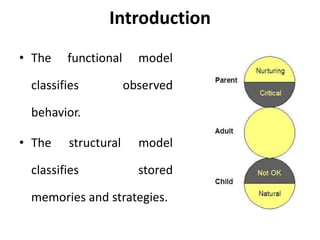
• The functional model
classifies observed
behavior.
• The structural model
classifies stored
memories and strategies.
Introduction
• Berne was careful in his
presentations to
differentiate structural
and functional model
• He had a solid logical
basis of doing so.
Analogy
• Many present day writers
are attempting to equate
these two modifying
categories.
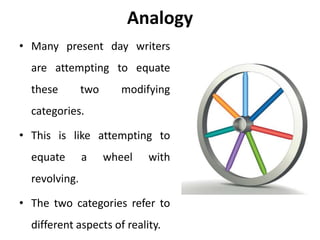
• This is like attempting to
equate a wheel with
revolving.
• The two categories refer to
different aspects of reality.
Analogy
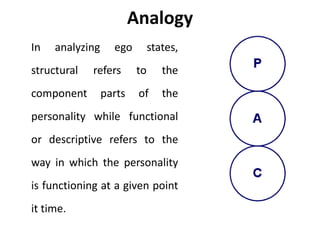
In analyzing ego states,
structural refers to the
component parts of the
personality while functional
or descriptive refers to the
way in which the personality
is functioning at a given point
it time.
Analogy
• An analogy would be the
different ways to look at a
heat pump used to heat and
cool a house.
• One could look at the heat
pump structurally and point
to its various components
such as the compressor, the
air ducts, the thermostats etc.
Analogy
• One could also look at the heat
pump functionally or
descriptively and talk about it
heating the house, cooling the
house, transferring the air from
one place to another, using
electricity etc.
• These are descriptions of how
the total system is functioning
at a given point in time.
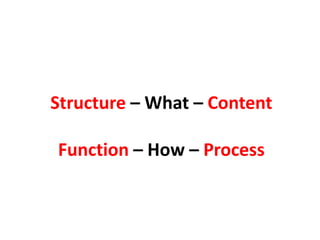
Structure – What – Content
Function – How – Process
Difference
• Any time we are talking about
the interaction between the
people, we must use the
functional model.
• The structural model fits
when we are considering
what goes on inside the
individual.
Difference
• Interpersonal aspects of
TA work require the
functional model.
• Intrapsychic matters
need to be studied in
terms of the structural
model.
Function
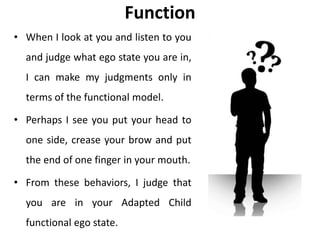
• When I look at you and listen to you
and judge what ego state you are in,
I can make my judgments only in
terms of the functional model.
• Perhaps I see you put your head to
one side, crease your brow and put
the end of one finger in your mouth.
• From these behaviors, I judge that
you are in your Adapted Child
functional ego state.
Structure
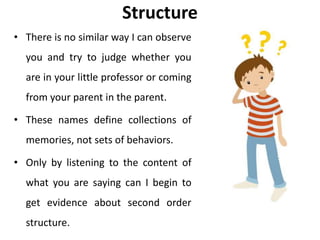
• There is no similar way I can observe
you and try to judge whether you
are in your little professor or coming
from your parent in the parent.
• These names define collections of
memories, not sets of behaviors.
• Only by listening to the content of
what you are saying can I begin to
get evidence about second order
structure.
Structure
• If I need to know about the content
of your little professor or parent in
parent – the what rather than the
how – I need to do some detective
work.
• Principally, I need to ask you a lot of
questions.
• I may also use my general
knowledge about different kinds of
personality and about how children
develop.
Relationship between function and structure
• It is possible for two things to
be different, yet to be related
to each other.
• This is true of structure and
function.
• Obviously, the way I behave at
any moment will depend partly
on the set of memories and
strategies I am contacting
internally.
Relationship between function and structure
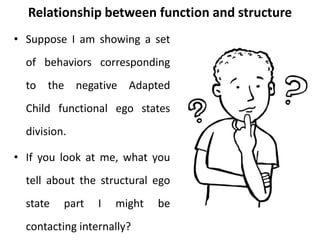
• Suppose I am showing a set
of behaviors corresponding
to the negative Adapted
Child functional ego states
division.
• If you look at me, what you
tell about the structural ego
state part I might be
contacting internally?
Relationship between function and structure
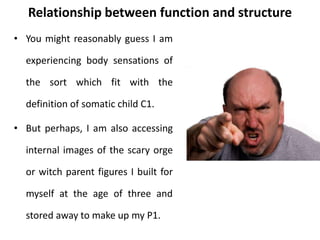
• You might reasonably guess I am
experiencing body sensations of
the sort which fit with the
definition of somatic child C1.
• But perhaps, I am also accessing
internal images of the scary orge
or witch parent figures I built for
myself at the age of three and
stored away to make up my P1.
Relationship between function and structure
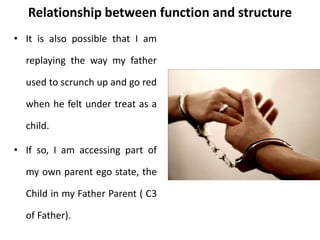
• It is also possible that I am
replaying the way my father
used to scrunch up and go red
when he felt under treat as a
child.
• If so, I am accessing part of
my own parent ego state, the
Child in my Father Parent ( C3
of Father).
Relationship between function and structure
• For all you know, I may be
skillful actor and be setting up
the whole charade for some
grown up purpose which you
don’t know about yet.
• If so, the I am likely to be
switching internally between
the content of my Adult, A2
and Little professor, A1.
Relationship between function and structure
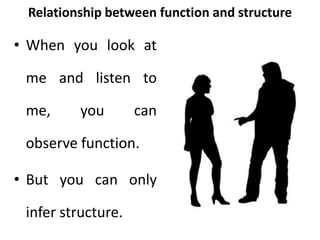
• When you look at
me and listen to
me, you can
observe function.
• But you can only
infer structure.
Thank You
Other TA topics available on slideshare
1. Strokes - http://www.slideshare.net/manumjoy/strokes-24081607.
2. Games People Play - http://www.slideshare.net/manumjoy/psychological-
games-people-play.
3. Structural Analysis - http://www.slideshare.net/manumjoy/the-ego-state-model.
4. What is TA? - http://www.slideshare.net/manumjoy/what-ta-is
5. Cycles of Development - http://www.slideshare.net/manumjoy/cycles-of-
developement-pamela-levin-transactional-analysis.
6. Stages of Cure - http://www.slideshare.net/manumjoy/stages-of-cure.
7. Transactions - http://www.slideshare.net/manumjoy/transactions-33677298.
8. Time Structuring - http://www.slideshare.net/manumjoy/time-structuring.
9. Life Position - http://www.slideshare.net/manumjoy/life-position.
10. Autonomy - http://www.slideshare.net/manumjoy/autonomy-33690557.
11. Structural Pathology - http://www.slideshare.net/manumjoy/structural-pathology.
12. Game Analysis - http://www.slideshare.net/manumjoy/game-analysis-33725636.
13. Integrated Adult - http://www.slideshare.net/manumjoy/integrated-adult.
14. Stroke Economy - http://www.slideshare.net/manumjoy/stroke-economy-
33826702.

Structure and function (Transactional analysis / TA is an integrative approach to the theory of psychology and psychotherapy).

  • 1.
  • 2.
    Prepared By Manu MelwinJoy Research Scholar School of Management Studies CUSAT, Kerala, India. Phone – 9744551114 Mail – manu_melwinjoy@yahoo.com Kindly restrict the use of slides for personal purpose. Please seek permission to reproduce the same in public forms and presentations.
  • 3.
    Introduction • To usethe ego state model effectively, you need clear understanding of the differences between structure and function. • Confusion between the two has been a long standing problem in the development of TA theory.
  • 4.
    Introduction • The functionalmodel classifies observed behavior. • The structural model classifies stored memories and strategies.
  • 5.
    Introduction • Berne wascareful in his presentations to differentiate structural and functional model • He had a solid logical basis of doing so.
  • 6.
    Analogy • Many presentday writers are attempting to equate these two modifying categories. • This is like attempting to equate a wheel with revolving. • The two categories refer to different aspects of reality.
  • 7.
    Analogy In analyzing egostates, structural refers to the component parts of the personality while functional or descriptive refers to the way in which the personality is functioning at a given point it time.
  • 8.
    Analogy • An analogywould be the different ways to look at a heat pump used to heat and cool a house. • One could look at the heat pump structurally and point to its various components such as the compressor, the air ducts, the thermostats etc.
  • 9.
    Analogy • One couldalso look at the heat pump functionally or descriptively and talk about it heating the house, cooling the house, transferring the air from one place to another, using electricity etc. • These are descriptions of how the total system is functioning at a given point in time.
  • 10.
    Structure – What– Content Function – How – Process
  • 11.
    Difference • Any timewe are talking about the interaction between the people, we must use the functional model. • The structural model fits when we are considering what goes on inside the individual.
  • 12.
    Difference • Interpersonal aspectsof TA work require the functional model. • Intrapsychic matters need to be studied in terms of the structural model.
  • 13.
    Function • When Ilook at you and listen to you and judge what ego state you are in, I can make my judgments only in terms of the functional model. • Perhaps I see you put your head to one side, crease your brow and put the end of one finger in your mouth. • From these behaviors, I judge that you are in your Adapted Child functional ego state.
  • 14.
    Structure • There isno similar way I can observe you and try to judge whether you are in your little professor or coming from your parent in the parent. • These names define collections of memories, not sets of behaviors. • Only by listening to the content of what you are saying can I begin to get evidence about second order structure.
  • 15.
    Structure • If Ineed to know about the content of your little professor or parent in parent – the what rather than the how – I need to do some detective work. • Principally, I need to ask you a lot of questions. • I may also use my general knowledge about different kinds of personality and about how children develop.
  • 16.
    Relationship between functionand structure • It is possible for two things to be different, yet to be related to each other. • This is true of structure and function. • Obviously, the way I behave at any moment will depend partly on the set of memories and strategies I am contacting internally.
  • 17.
    Relationship between functionand structure • Suppose I am showing a set of behaviors corresponding to the negative Adapted Child functional ego states division. • If you look at me, what you tell about the structural ego state part I might be contacting internally?
  • 18.
    Relationship between functionand structure • You might reasonably guess I am experiencing body sensations of the sort which fit with the definition of somatic child C1. • But perhaps, I am also accessing internal images of the scary orge or witch parent figures I built for myself at the age of three and stored away to make up my P1.
  • 19.
    Relationship between functionand structure • It is also possible that I am replaying the way my father used to scrunch up and go red when he felt under treat as a child. • If so, I am accessing part of my own parent ego state, the Child in my Father Parent ( C3 of Father).
  • 20.
    Relationship between functionand structure • For all you know, I may be skillful actor and be setting up the whole charade for some grown up purpose which you don’t know about yet. • If so, the I am likely to be switching internally between the content of my Adult, A2 and Little professor, A1.
  • 21.
    Relationship between functionand structure • When you look at me and listen to me, you can observe function. • But you can only infer structure.
  • 22.
  • 23.
    Other TA topicsavailable on slideshare 1. Strokes - http://www.slideshare.net/manumjoy/strokes-24081607. 2. Games People Play - http://www.slideshare.net/manumjoy/psychological- games-people-play. 3. Structural Analysis - http://www.slideshare.net/manumjoy/the-ego-state-model. 4. What is TA? - http://www.slideshare.net/manumjoy/what-ta-is 5. Cycles of Development - http://www.slideshare.net/manumjoy/cycles-of- developement-pamela-levin-transactional-analysis. 6. Stages of Cure - http://www.slideshare.net/manumjoy/stages-of-cure. 7. Transactions - http://www.slideshare.net/manumjoy/transactions-33677298. 8. Time Structuring - http://www.slideshare.net/manumjoy/time-structuring. 9. Life Position - http://www.slideshare.net/manumjoy/life-position. 10. Autonomy - http://www.slideshare.net/manumjoy/autonomy-33690557. 11. Structural Pathology - http://www.slideshare.net/manumjoy/structural-pathology. 12. Game Analysis - http://www.slideshare.net/manumjoy/game-analysis-33725636. 13. Integrated Adult - http://www.slideshare.net/manumjoy/integrated-adult. 14. Stroke Economy - http://www.slideshare.net/manumjoy/stroke-economy- 33826702.