Structural Pathology
Prepared By
Manu Melwin Joy
Research Scholar
School of Management Studies
CUSAT, Kerala,India.
Phone – 9744551114
Mail – manu_melwinjoy@yahoo.com
Kindly restrict the use of the slides for personal purpose.
Please seek permission to reproduce the same in public
forms and presentations.
Contents
• Structural analysis.
• Ego state boundaries.
• Lax Ego Boundaries.
• Contamination.
• Boundary Lesions.
• Exclusion.
• Rigid Ego Boundaries.
• Constant.
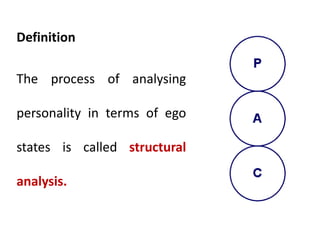
The process of analysing
personality in terms of ego
states is called structural
analysis.
Definition
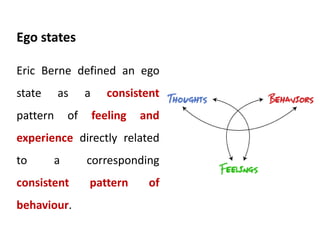
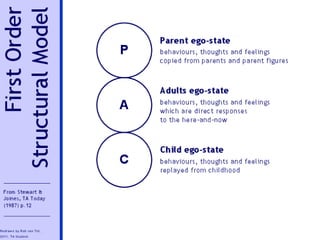
Eric Berne defined an ego
state as a consistent
pattern of feeling and
experience directly related
to a corresponding
consistent pattern of
behaviour.
Ego states
Ego State Boundaries
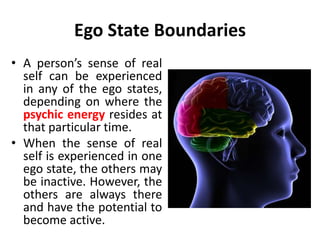
• A person’s sense of real
self can be experienced
in any of the ego states,
depending on where the
psychic energy resides at
that particular time.
• When the sense of real
self is experienced in one
ego state, the others may
be inactive. However, the
others are always there
and have the potential to
become active.
Ego State Boundaries
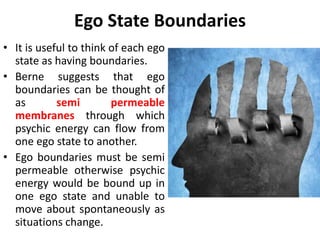
• It is useful to think of each ego
state as having boundaries.
• Berne suggests that ego
boundaries can be thought of
as semi permeable
membranes through which
psychic energy can flow from
one ego state to another.
• Ego boundaries must be semi
permeable otherwise psychic
energy would be bound up in
one ego state and unable to
move about spontaneously as
situations change.
Ego State Boundaries
• In some highly effective people,
the flow of energy may be very
rapid in others it may be
sluggish.
• The person whose free energy
moves rapidly may be exciting
and stimulating but others may
have difficulty keeping with this
fast moving pace.
• The one whose energy moves
more slowly is the person who
is slow to start and slow to stop
activities and others may
become impatient.
Ego State Boundaries
• The physiology of the ego state
boundaries is not yet
understood, but the
assumption that they exist is
made by observing specific
kinds of behavior defects.
• Some people continually act in
unpredictable ways and others
are so predictable they seem
monotonous.
• These disorders are caused by
ego state boundaries which are
too lax or tight, have lesions
or overlap.
“ An open mind is all very well in its way,
but it ought not to be so open that there is
no keeping anything in or out o fit. It
should be capable of shutting its doors
sometimes, or it may be found a little
drafty.”
Samuel Butler
Lax Ego Boundaries
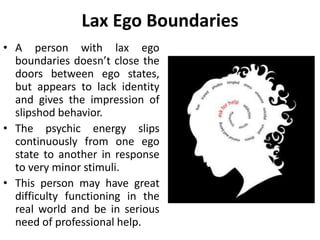
• A person with lax ego
boundaries doesn’t close the
doors between ego states,
but appears to lack identity
and gives the impression of
slipshod behavior.
• The psychic energy slips
continuously from one ego
state to another in response
to very minor stimuli.
• This person may have great
difficulty functioning in the
real world and be in serious
need of professional help.
Lax Ego Boundaries
• One woman with this
boundary problem was
described by others in
counseling group.
• “You will never know what is
going on whit her or what she
is going to do next”.
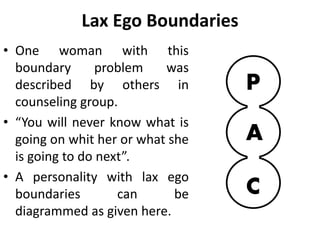
• A personality with lax ego
boundaries can be
diagrammed as given here.
0
P
A
C
Lax Ego Boundaries
• The person with lax ego
boundaries has little adult
control and behaves differently
from the person whose psychic
energy moves rapidly from one
ego state to another, yet the
Adult in control.
• In the latter case, the person’s
behavior may be quite rational.
In the former, it is
unpredictable, often irrational.
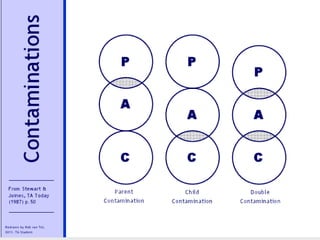
Contamination of Adult
• The clear thinking of the Adult
is often spoiled by
contamination.
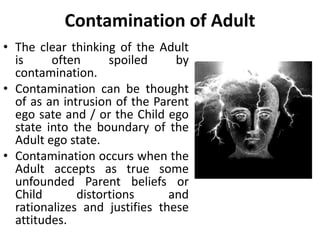
• Contamination can be thought
of as an intrusion of the Parent
ego sate and / or the Child ego
state into the boundary of the
Adult ego state.
• Contamination occurs when the
Adult accepts as true some
unfounded Parent beliefs or
Child distortions and
rationalizes and justifies these
attitudes.
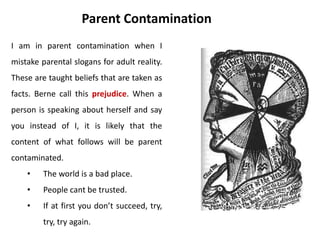
I am in parent contamination when I
mistake parental slogans for adult reality.
These are taught beliefs that are taken as
facts. Berne call this prejudice. When a
person is speaking about herself and say
you instead of I, it is likely that the
content of what follows will be parent
contaminated.
• The world is a bad place.
• People cant be trusted.
• If at first you don’t succeed, try,
try, try again.
Parent Contamination
“ The difference between a conviction and
a prejudice is that you can explain a
conviction without getting angry.”
Samuel Butler
• Parental contaminations often
involve considerable emotions and
are likely to occur in relation to
specific subjects such as food,
religion, politics, race, class and
sex.
• At times, large segments of society
agree with prejudiced ideas.
• Contaminations often intrudes on
the laws of society.
Parent Contamination
• Take two minutes to write down all the
slogans and beliefs you remember hearing
from your parents and parental figures.
• Look through you list of parental slogans
and beliefs. Check whether each one is a
statement of reality or a parent
contamination.
• If you decide there are any you want to
update to fit with grown up reality, strike
them out and substitute your new version.
Activity
When I am child contaminated, I cloud my
grown up thinking with beliefs from my
childhood. These are fantasies, evoked by
feelings, that are taken as facts. Berne used the
word delusion to describe the kind of belief
that typically arise from child contamination.
When the content of a child contamination
comes from earlier childhood, the delusion is
likely to be more bizarre.
• People just don’t like me.
• There is something wrong with me.
• I cant stop smoking.
• I was born fat.
Child Contamination
• One for of child contamination is the
delusion of grandeur. In its extreme
form, a person may believe that she or
he is savior of the world or the ruler of
the world.
• Another common delusion is feeling
persecuted – being poisoned, spied
upon or plotted against.
• In its less sever forms, a person whose
Child contaminates the Adult has


distorted perceptions of realities.
Child Contamination
• Take a piece of paper and head it : “ I am the
sort of person who….”
• Take two minutes to write down all the ways
you think of to finish the sentence.
• At the end of two minutes, relax, breathe and
look around the room for a while.
• For each of the ways you finished the
sentence, check whether it is a statement
about reality or a child contamination.
• If you decide any of the statement about
yourself do come from child contamination,
think what the reality of the matter is. Strike
out the child contamination words and put in
the adult updates.
Activity
It occurs when the person replays a
parental slogan, agrees to it with a child
belief, and mistakes both of these for
reality.
• People cant be trusted
paired with
• I can never trust anyone.
• Children should be seen and
not heart
paired with
• To get by in the world, I have to
keep quit.
Double Contamination
Boundary Lesions
• A person with ego boundary
lesions is one who exhibits
uncontrollable behavior when
“sore points” are touched.
• This person’s psyche has been
seriously injured by one
traumatic event or by a series
of unhappy experiences during
childhood.
• When something rubs the sore
spot, the injury may break open
with an outpouring of strong,
irrational emotion.
Boundary Lesions
• A lesion is usually indicated
when a person faints at the
sight of a mouse, gets
hysterical over a clap of
thunder, panics and hides at
the thought of performing
and so forth.
• A lesion is manifested by a
gross overreaction to the
reality of stimulus.
• If it interferes with adequate
functioning, professional
help is needed.
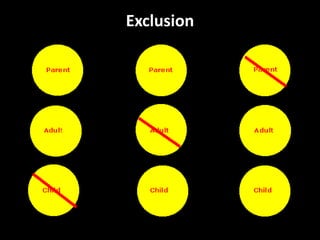
Exclusion
• Sometimes, Berne suggested,
a person will shut out one or
more of her ego states. He
called this exclusion.
• It is a serious ego boundary
issue since the person
suffering from Parent, Adult
or Child exclusion will be
confronted with behavioral
problems.
Exclusion
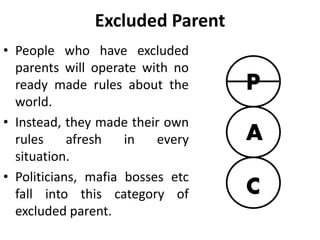
Excluded Parent
• People who have excluded
parents will operate with no
ready made rules about the
world.
• Instead, they made their own
rules afresh in every
situation.
• Politicians, mafia bosses etc
fall into this category of
excluded parent.
0
P
A
C
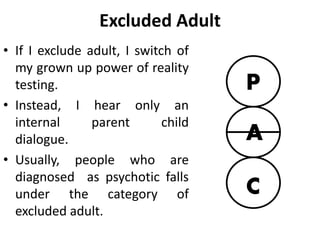
Excluded Adult
• If I exclude adult, I switch of
my grown up power of reality
testing.
• Instead, I hear only an
internal parent child
dialogue.
• Usually, people who are
diagnosed as psychotic falls
under the category of
excluded adult.
0
P
A
C
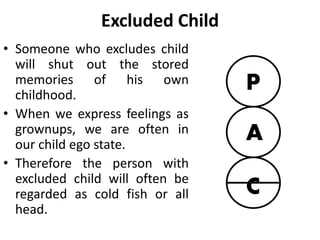
Excluded Child
• Someone who excludes child
will shut out the stored
memories of his own
childhood.
• When we express feelings as
grownups, we are often in
our child ego state.
• Therefore the person with
excluded child will often be
regarded as cold fish or all
head.
0
P
A
C
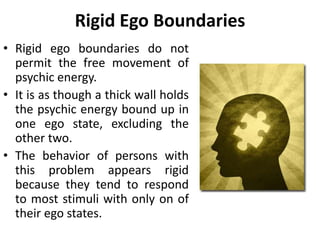
Rigid Ego Boundaries
• Rigid ego boundaries do not
permit the free movement of
psychic energy.
• It is as though a thick wall holds
the psychic energy bound up in
one ego state, excluding the
other two.
• The behavior of persons with
this problem appears rigid
because they tend to respond
to most stimuli with only on of
their ego states.
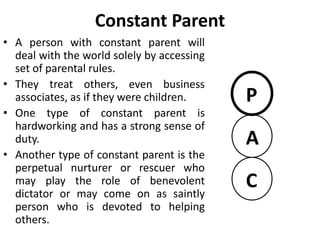
Constant Parent
• A person with constant parent will
deal with the world solely by accessing
set of parental rules.
• They treat others, even business
associates, as if they were children.
• One type of constant parent is
hardworking and has a strong sense of
duty.
• Another type of constant parent is the
perpetual nurturer or rescuer who
may play the role of benevolent
dictator or may come on as saintly
person who is devoted to helping
others.
P
A
C
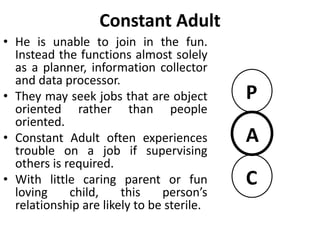
Constant Adult
• He is unable to join in the fun.
Instead the functions almost solely
as a planner, information collector
and data processor.
• They may seek jobs that are object
oriented rather than people
oriented.
• Constant Adult often experiences
trouble on a job if supervising
others is required.
• With little caring parent or fun
loving child, this person’s
relationship are likely to be sterile.
P
A
C
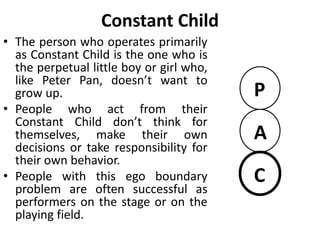
Constant Child
• The person who operates primarily
as Constant Child is the one who is
the perpetual little boy or girl who,
like Peter Pan, doesn’t want to
grow up.
• People who act from their
Constant Child don’t think for
themselves, make their own
decisions or take responsibility for
their own behavior.
• People with this ego boundary
problem are often successful as
performers on the stage or on the
playing field.
P
A
C
Thank You
Other TA topics available on slideshare
1. Strokes - http://www.slideshare.net/manumjoy/strokes-24081607.
2. Games People Play - http://www.slideshare.net/manumjoy/psychological-
games-people-play.
3. Structural Analysis - http://www.slideshare.net/manumjoy/the-ego-state-model.
4. What is TA? - http://www.slideshare.net/manumjoy/what-ta-is
5. Cycles of Development - http://www.slideshare.net/manumjoy/cycles-of-
developement-pamela-levin-transactional-analysis.
6. Stages of Cure - http://www.slideshare.net/manumjoy/stages-of-cure.
7. Transactions - http://www.slideshare.net/manumjoy/transactions-33677298.
8. Time Structuring - http://www.slideshare.net/manumjoy/time-structuring.
9. Life Position - http://www.slideshare.net/manumjoy/life-position.
10. Autonomy - http://www.slideshare.net/manumjoy/autonomy-33690557.
11. Structural Pathology - http://www.slideshare.net/manumjoy/structural-pathology.
12. Game Analysis - http://www.slideshare.net/manumjoy/game-analysis-33725636.
13. Integrated Adult - http://www.slideshare.net/manumjoy/integrated-adult.
14. Stroke Economy - http://www.slideshare.net/manumjoy/stroke-economy-
33826702.

Structural pathology - Transactional Analysis

  • 1.
  • 2.
    Prepared By Manu MelwinJoy Research Scholar School of Management Studies CUSAT, Kerala,India. Phone – 9744551114 Mail – manu_melwinjoy@yahoo.com Kindly restrict the use of the slides for personal purpose. Please seek permission to reproduce the same in public forms and presentations.
  • 3.
    Contents • Structural analysis. •Ego state boundaries. • Lax Ego Boundaries. • Contamination. • Boundary Lesions. • Exclusion. • Rigid Ego Boundaries. • Constant.
  • 4.
    The process ofanalysing personality in terms of ego states is called structural analysis. Definition
  • 5.
    Eric Berne definedan ego state as a consistent pattern of feeling and experience directly related to a corresponding consistent pattern of behaviour. Ego states
  • 9.
    Ego State Boundaries •A person’s sense of real self can be experienced in any of the ego states, depending on where the psychic energy resides at that particular time. • When the sense of real self is experienced in one ego state, the others may be inactive. However, the others are always there and have the potential to become active.
  • 10.
    Ego State Boundaries •It is useful to think of each ego state as having boundaries. • Berne suggests that ego boundaries can be thought of as semi permeable membranes through which psychic energy can flow from one ego state to another. • Ego boundaries must be semi permeable otherwise psychic energy would be bound up in one ego state and unable to move about spontaneously as situations change.
  • 11.
    Ego State Boundaries •In some highly effective people, the flow of energy may be very rapid in others it may be sluggish. • The person whose free energy moves rapidly may be exciting and stimulating but others may have difficulty keeping with this fast moving pace. • The one whose energy moves more slowly is the person who is slow to start and slow to stop activities and others may become impatient.
  • 12.
    Ego State Boundaries •The physiology of the ego state boundaries is not yet understood, but the assumption that they exist is made by observing specific kinds of behavior defects. • Some people continually act in unpredictable ways and others are so predictable they seem monotonous. • These disorders are caused by ego state boundaries which are too lax or tight, have lesions or overlap.
  • 13.
    “ An openmind is all very well in its way, but it ought not to be so open that there is no keeping anything in or out o fit. It should be capable of shutting its doors sometimes, or it may be found a little drafty.” Samuel Butler
  • 14.
    Lax Ego Boundaries •A person with lax ego boundaries doesn’t close the doors between ego states, but appears to lack identity and gives the impression of slipshod behavior. • The psychic energy slips continuously from one ego state to another in response to very minor stimuli. • This person may have great difficulty functioning in the real world and be in serious need of professional help.
  • 15.
    Lax Ego Boundaries •One woman with this boundary problem was described by others in counseling group. • “You will never know what is going on whit her or what she is going to do next”. • A personality with lax ego boundaries can be diagrammed as given here. 0 P A C
  • 16.
    Lax Ego Boundaries •The person with lax ego boundaries has little adult control and behaves differently from the person whose psychic energy moves rapidly from one ego state to another, yet the Adult in control. • In the latter case, the person’s behavior may be quite rational. In the former, it is unpredictable, often irrational.
  • 17.
    Contamination of Adult •The clear thinking of the Adult is often spoiled by contamination. • Contamination can be thought of as an intrusion of the Parent ego sate and / or the Child ego state into the boundary of the Adult ego state. • Contamination occurs when the Adult accepts as true some unfounded Parent beliefs or Child distortions and rationalizes and justifies these attitudes.
  • 19.
    I am inparent contamination when I mistake parental slogans for adult reality. These are taught beliefs that are taken as facts. Berne call this prejudice. When a person is speaking about herself and say you instead of I, it is likely that the content of what follows will be parent contaminated. • The world is a bad place. • People cant be trusted. • If at first you don’t succeed, try, try, try again. Parent Contamination
  • 20.
    “ The differencebetween a conviction and a prejudice is that you can explain a conviction without getting angry.” Samuel Butler
  • 21.
    • Parental contaminationsoften involve considerable emotions and are likely to occur in relation to specific subjects such as food, religion, politics, race, class and sex. • At times, large segments of society agree with prejudiced ideas. • Contaminations often intrudes on the laws of society. Parent Contamination
  • 22.
    • Take twominutes to write down all the slogans and beliefs you remember hearing from your parents and parental figures. • Look through you list of parental slogans and beliefs. Check whether each one is a statement of reality or a parent contamination. • If you decide there are any you want to update to fit with grown up reality, strike them out and substitute your new version. Activity
  • 23.
    When I amchild contaminated, I cloud my grown up thinking with beliefs from my childhood. These are fantasies, evoked by feelings, that are taken as facts. Berne used the word delusion to describe the kind of belief that typically arise from child contamination. When the content of a child contamination comes from earlier childhood, the delusion is likely to be more bizarre. • People just don’t like me. • There is something wrong with me. • I cant stop smoking. • I was born fat. Child Contamination
  • 24.
    • One forof child contamination is the delusion of grandeur. In its extreme form, a person may believe that she or he is savior of the world or the ruler of the world. • Another common delusion is feeling persecuted – being poisoned, spied upon or plotted against. • In its less sever forms, a person whose Child contaminates the Adult has distorted perceptions of realities. Child Contamination
  • 25.
    • Take apiece of paper and head it : “ I am the sort of person who….” • Take two minutes to write down all the ways you think of to finish the sentence. • At the end of two minutes, relax, breathe and look around the room for a while. • For each of the ways you finished the sentence, check whether it is a statement about reality or a child contamination. • If you decide any of the statement about yourself do come from child contamination, think what the reality of the matter is. Strike out the child contamination words and put in the adult updates. Activity
  • 26.
    It occurs whenthe person replays a parental slogan, agrees to it with a child belief, and mistakes both of these for reality. • People cant be trusted paired with • I can never trust anyone. • Children should be seen and not heart paired with • To get by in the world, I have to keep quit. Double Contamination
  • 27.
    Boundary Lesions • Aperson with ego boundary lesions is one who exhibits uncontrollable behavior when “sore points” are touched. • This person’s psyche has been seriously injured by one traumatic event or by a series of unhappy experiences during childhood. • When something rubs the sore spot, the injury may break open with an outpouring of strong, irrational emotion.
  • 28.
    Boundary Lesions • Alesion is usually indicated when a person faints at the sight of a mouse, gets hysterical over a clap of thunder, panics and hides at the thought of performing and so forth. • A lesion is manifested by a gross overreaction to the reality of stimulus. • If it interferes with adequate functioning, professional help is needed.
  • 29.
    Exclusion • Sometimes, Bernesuggested, a person will shut out one or more of her ego states. He called this exclusion. • It is a serious ego boundary issue since the person suffering from Parent, Adult or Child exclusion will be confronted with behavioral problems.
  • 30.
  • 31.
    Excluded Parent • Peoplewho have excluded parents will operate with no ready made rules about the world. • Instead, they made their own rules afresh in every situation. • Politicians, mafia bosses etc fall into this category of excluded parent. 0 P A C
  • 32.
    Excluded Adult • IfI exclude adult, I switch of my grown up power of reality testing. • Instead, I hear only an internal parent child dialogue. • Usually, people who are diagnosed as psychotic falls under the category of excluded adult. 0 P A C
  • 33.
    Excluded Child • Someonewho excludes child will shut out the stored memories of his own childhood. • When we express feelings as grownups, we are often in our child ego state. • Therefore the person with excluded child will often be regarded as cold fish or all head. 0 P A C
  • 34.
    Rigid Ego Boundaries •Rigid ego boundaries do not permit the free movement of psychic energy. • It is as though a thick wall holds the psychic energy bound up in one ego state, excluding the other two. • The behavior of persons with this problem appears rigid because they tend to respond to most stimuli with only on of their ego states.
  • 35.
    Constant Parent • Aperson with constant parent will deal with the world solely by accessing set of parental rules. • They treat others, even business associates, as if they were children. • One type of constant parent is hardworking and has a strong sense of duty. • Another type of constant parent is the perpetual nurturer or rescuer who may play the role of benevolent dictator or may come on as saintly person who is devoted to helping others. P A C
  • 36.
    Constant Adult • Heis unable to join in the fun. Instead the functions almost solely as a planner, information collector and data processor. • They may seek jobs that are object oriented rather than people oriented. • Constant Adult often experiences trouble on a job if supervising others is required. • With little caring parent or fun loving child, this person’s relationship are likely to be sterile. P A C
  • 37.
    Constant Child • Theperson who operates primarily as Constant Child is the one who is the perpetual little boy or girl who, like Peter Pan, doesn’t want to grow up. • People who act from their Constant Child don’t think for themselves, make their own decisions or take responsibility for their own behavior. • People with this ego boundary problem are often successful as performers on the stage or on the playing field. P A C
  • 38.
  • 39.
    Other TA topicsavailable on slideshare 1. Strokes - http://www.slideshare.net/manumjoy/strokes-24081607. 2. Games People Play - http://www.slideshare.net/manumjoy/psychological- games-people-play. 3. Structural Analysis - http://www.slideshare.net/manumjoy/the-ego-state-model. 4. What is TA? - http://www.slideshare.net/manumjoy/what-ta-is 5. Cycles of Development - http://www.slideshare.net/manumjoy/cycles-of- developement-pamela-levin-transactional-analysis. 6. Stages of Cure - http://www.slideshare.net/manumjoy/stages-of-cure. 7. Transactions - http://www.slideshare.net/manumjoy/transactions-33677298. 8. Time Structuring - http://www.slideshare.net/manumjoy/time-structuring. 9. Life Position - http://www.slideshare.net/manumjoy/life-position. 10. Autonomy - http://www.slideshare.net/manumjoy/autonomy-33690557. 11. Structural Pathology - http://www.slideshare.net/manumjoy/structural-pathology. 12. Game Analysis - http://www.slideshare.net/manumjoy/game-analysis-33725636. 13. Integrated Adult - http://www.slideshare.net/manumjoy/integrated-adult. 14. Stroke Economy - http://www.slideshare.net/manumjoy/stroke-economy- 33826702.