Between You andEternity
• Many gene expression
controls regulate cell
growth and division
• When those controls
fail, cancer results
• Robin Shoulla was
diagnosed with breast
cancer when she was
seventeen
• BRCA1 and BRCA2
3.
Cancer
• Cancer isa multistep process in which abnormally growing
and dividing cells disrupt body tissues
• Cancer often begins with a mutation in a gene whose product
is part of a system of controls over cell growth and division
• cancer
• Disease that occurs when uncontrolled growth of body
cells physically and metabolically disrupts tissues
4.
Between You andEternity
• A mutated version of BRCA1 and/or BRCA2 genes is often
found in breast cancer cells
• Researchers recently found that the RNA product of the XIST
gene localizes abnormally in these cancer cells
• They were able to restore proper XIST RNA localization by
restoring the function of the BRCA1 gene product in these
cancer cells
5.
Key Concepts:
• Agene is a molecular unit of heredity of a living organism. a name
given to some parts of DNA and RNA that code for a polypeptide or
for a functional RNA chain.
• allele is one variant of that gene.
• Gene expression is the process by which information from a gene is
used in the synthesis of a functional gene product. These products
are often proteins or a functional RNA.
• Transcription is the first step of gene expression, in which a particular
segment of DNA is copied into RNA by the enzyme RNA polymerase
• Translation is the process through which cellular ribosomes
manufacture proteins, in which messenger RNA (mRNA) is
sequentially decoded by transfer RNA (tRNA).
6.
15.1 Gene Expressionin Eukaryotic Cells
• Differentiation occurs as different cell lineages begin to
express different subsets of their genes
• Which genes a cell uses determines the molecules it will
produce, which in turn determines what kind of cell it will be
• differentiation
• Process by which cells become specialized
7.
Eukaryotic Gene Expression
•Which genes are expressed at any given time depends on
many factors, such as conditions in the cytoplasm and
extracellular fluid, and type of cell
• These factors affect controls governing all steps of gene
expression, starting with transcription and ending with delivery
of an RNA or protein product to its final destination
• Controls may start, enhance, slow, or stop gene expression
Gene Expression in Eukaryotic Cells
8.
Key Concepts:
• Avariety of controls govern how genes are
expressed
• Control is exerted by regulatory proteins
• Prokaryotes depend on rapid control over short-term
shifts in environmental conditions
• Eukaryotes depend on controls over short-term shifts
in diet and levels activity, growth and development
• Different allele types activate or suppress genes in
different ways in multicellular organisms
9.
Key Terms
• transcriptionfactor
• Regulatory protein that influences transcription; e.g. an activator or
repressor
• activator
• Regulatory protein that increases the rate of transcription when it
binds to a promoter or enhancer
• enhancer
• Binding site in DNA for proteins that enhance transcription rate
• repressor
• Regulatory protein that blocks transcription
10.
Overview of GeneControls
• Regulatory proteins
• Internal and external control
• Negative Control Systems
• Positive Control Systems
11.
Control of Transcription
•Whether and how fast a gene is transcribed depends on
which transcription factors are bound to the DNA
• Activators speed transcription by binding to DNA enhancers
• Repressors slow or stop transcription
12.
new RNA
transcript
mRNA
Nucleus
DNA
active
protein
polypeptid
e chain
Cytoplasm
mRNA
Transcription
Bindingof transcription factors to
special sequences in DNA slows or
speeds transcription. Chemical
modifications and chromosome
duplications affect RNA polymerase’s
physical access to genes.
1
mRNA Processing
New mRNA cannot leave the nucleus
before being modified, so controls over
mRNA processing affect the timing of
transcription. Controls over alternative
splicing influence the final form of the
protein.
2
mRNA Transport
RNA cannot pass through a nuclear pore
unless bound to certain proteins.
Transport protein binding affects where
the transcript will be delivered in the cell.
3
Translation
An mRNA’s stability influences how
long it is translated. Proteins that
attach to ribosomes or initiation factors
can inhibit translation. Double-stranded
RNA triggers degradation of
complementary mRNA.
4
Protein Processing
A new protein molecule may become
activated or disabled by enzyme-
mediated modifications, such as
phosphorylation or cleavage. Controls
over these enzymes influence many
other cell activities.
5
Points of
Control Over
Eukaryotic
Gene
Expression
Control of Transcription(cont.)
• Interactions between DNA and histone proteins also affect
transcription
• Molecules that methylate DNA prevent transcription
• Number of gene copies affects how fast its product is made
• Polytene chromosomes consists of hundreds or thousands
of copies of the same DNA molecule
15.
Drosophila Polytene Chromosomes
•Giant polytene
chromosomes form in
Drosophila salivary
gland cells by repeated
DNA replication
• Transcription is visible
(white arrows) where
DNA has loosened
16.
mRNA Processing
• Beforeeukaryotic mRNAs leave the nucleus, they are
modified—spliced, capped, and finished with a poly-A tail
• Controls over these modifications can affect the form of a
protein product and when it will appear in the cell
17.
mRNA Transport
• Controlsthat delay processing also delay an mRNA’s
appearance in the cytoplasm, and delay its translation
• Controls also govern mRNA localization – delivery to a
specified organelle or area of the cytoplasm
18.
Translational Control
• Mostcontrols over eukaryotic gene expression affect
translation
• Many controls govern the production or function of various
molecules that carry out translation
• Others affect mRNA stability: Depends on base sequence,
length of poly-A tail, and which proteins are attached to it
19.
Translational Control (cont.)
•Micro-RNAs inhibit translation of other RNA by folding to form
a small double-stranded region
• RNA interference enzymatically destroys base-paired RNA,
so expression of a micro-RNA complementary in sequence to
a gene inhibits expression of that gene
20.
Post-Translational Modification
• Manynewly-synthesized polypeptide chains must be modified
before they become functional
• Post-translational modifications inhibit, activate, or stabilize
many molecules, including the enzymes that participate in
transcription and translation
21.
Key Concepts
• GeneControl in Eukaryotes
• A variety of molecules and processes alter gene
expression in response to changing conditions both inside
and outside the cell
• Selective gene expression also results in differentiation, by
which cell lineages become specialized
22.
Outcomes of GeneControls
• Many traits of humans and other eukaryotic organisms arise
as an outcome of gene expression controls
• Examples:
• X-chromosome inactivation
• Flower formation
23.
X Chromosome Inactivation
•A female’s cells each contain two X chromosomes, one
inherited from her mother, the other from her father
• One X chromosome is always tightly condensed (Barr bodies)
• This X chromosome inactivation ensures that only one of
the two X chromosomes in a female’s cells is active
• According to the dosage compensation theory, this
equalizes expression of X chromosome genes between sexes
24.
Key Terms
• Xchromosome inactivation
• Shutdown of one of the two X chromosomes in the cells of
female mammals
• Caused by transcription of the XIST gene which keeps the
chromosome from transcribing other genes
• dosage compensation
• Theory that X chromosome inactivation equalizes gene
expression between males and females
Flower Formation
• Activationof three sets of master genes (A, B, and C) guide
flower formation – the differentiation of leaf cells into floral
parts (sepals, petals, stamens, and carpels)
• These genes are switched on by environmental cues such as
seasonal changes in the length of night
15.3 There’s aFly in My Research
• The fruit fly Drosophila melanogaster has been the subject of
of many research experiments on eukaryotic gene expression
• It reproduces quickly and has a short life cycle
30.
Homeotic Genes
• Homeoticgenes encode transcription factors with a
homeodomain – a region of about sixty amino acids that can
bind to a promoter or some other DNA sequence in a
chromosome
• homeotic gene
• Type of master gene
• Its expression controls formation of specific body parts
during development
31.
Master Genes
• Mastergenes affect the expression of many other genes.
• Expression of a master gene causes other genes to be
expressed, allowing completion of intricate tasks such as eye
formation during embryonic development
• master gene
• Gene encoding a product that affects the expression of
many other genes
32.
Knockouts
• Researchers inactivatea homeotic gene by introducing a
mutation or deleting it entirely (knockout)
• Any differences in an organism with a knocked-out gene may
be clues to the function of the missing gene product
• knockout
• An experiment in which a gene is deliberately inactivated
in a living organism
33.
Homeotic Genes: Eyesand eyeless
• A normal fruit fly, a fruit fly with eyeless mutation, and
expression of eyeless on a fly’s head and wing
34.
Homeotic Genes: PAX6
•Humans and other
animals have a gene
similar to eyeless
• A mutation in PAX6
results in missing irises
(aniridia)
35.
Filling in Detailsof Body Plans
• As an embryo develops, its differentiating cells form tissues,
organs, and body parts
• Some cells alternately migrate and stick to other cells to
develop structures that weave through tissues
• These events fill in the body’s details, and are driven by
cascades of master gene expression
36.
Pattern Formation
• Patternformation determines the body plan of an embryo:
• Protein products diffuse in gradients along the embryo
• Cells translate different master genes, depending on
where they fall within those gradients
• Some master gene products cause undifferentiated cells
to differentiate into specialized tissues
• pattern formation
• Process by which a complex body forms from local
processes during embryonic development
37.
Key Concepts
• Mechanismsof Control
• All cells in an embryo inherit the same genes, but they
start using different subsets of those genes during
development
• The orderly, localized expression of master genes gives
rise to the body plan of complex multicelled organisms
38.
Key Concepts
• Examplesin Eukaryotes
• One of the two X chromosomes is inactivated in every cell
of female mammals
• The Y chromosome carries a master gene that causes
male traits to develop in the human fetus
• Flower development is orchestrated by a set of homeotic
genes
39.
15.4 Prokaryotic GeneControl
• Bacteria and archaea do not use master genes
• Bacteria control gene expression mainly by adjusting the rate
of transcription
• Genes that are used together often occur together on the
chromosome – all are transcribed together, so their
transcription is controllable in a single step
40.
Key Terms
• operon
•Group of genes together with a promoter–operator DNA
sequence that controls their transcription
• Occur in bacteria, archaeans, and eukaryotes
• operator
• Part of an operon; a DNA binding site for a repressor
which stops transcription
41.
The Lactose Operon
•E. coli uses three enzymes whose genes are transcribed
together to break down lactose molecules
• There is one promoter for all three genes
Negative Control
Unless lactose is present, these genes are turned off
Lactose-degrading enzymes are not built when they are not
required
Lactose binds to repressor
Operator is no longer blocked
Positive Control
A promoter and one or more operators that control transcription
of multiple genes are called an operon
Lactose-Operon isn’t used much unless glucose is absent
Regulatory proteins like CAP exert rapid on/off control
42.
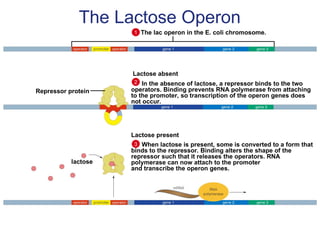
The Lactose Operon
(1)The operon consists of a promoter flanked by two
operators, and three genes for lactose-metabolizing enzymes
(2) In the absence of lactose, a repressor binds the two
operators, preventing RNA polymerase from attaching to the
promoter – transcription does not occur
(3) When lactose is present, some binds to the repressor,
altering the shape of the repressor so it releases the
operators – RNA polymerase attaches to the promoter and
transcribes the genes
43.
The lac operonin the E. coli chromosome.
1
In the absence of lactose, a repressor binds to the two
operators. Binding prevents RNA polymerase from attaching
to the promoter, so transcription of the operon genes does
not occur.
Repressor protein
2
Lactose absent
When lactose is present, some is converted to a form that
binds to the repressor. Binding alters the shape of the
repressor such that it releases the operators. RNA
polymerase can now attach to the promoter
and transcribe the operon genes.
Lactose present
lactose
3
The Lactose Operon
44.
Key Concepts
• GeneControl in Bacteria
• Bacterial gene controls govern responses to short-term
changes in nutrient availability and other aspects of the
environment
• The main gene controls bring about fast adjustments in the
rate of transcription
45.
Lactose Intolerance
• Inmost people, production of the enzyme lactase (which
digests lactose in food) starts declining at age five
• The inability to produce lactase is called lactose intolerance
• People who carry a mutation in one of the genes responsible
for programmed lactase shutdown make enough lactase to
continue drinking milk without problems into adulthood
Editor's Notes
#12 Figure 15.2 Points of control over eukaryotic gene expression.
#13 Figure 15.3 Hypothetical part of a chromosome that contains a gene. Molecules that affect the rate of transcription of the gene bind at promoter (yellow) or enhancer (green) sequences.
#27 Figure 15.7 A Control of flower formation, as revealed by mutations in Arabidopsis thaliana.
#28 Figure 15.7 B Control of flower formation, as revealed by mutations in Arabidopsis thaliana.
#33 Figure 15.8 Eyes and eyeless. A A normal fruit fly has large, round eyes. B A fruit fly with a mutation in its eyeless gene develops with no eyes. C Eyes form wherever the eyeless gene is expressed in fly embryos—here, on the head and wing. Humans, mice, squids, and other animals have a gene called PAX6. In humans, PAX6 mutations result in missing irises, a condition called aniridia D. Compare a normal iris E PAX6 is so similar to eyeless that it triggers eye development when expressed in fly embryos.
#34 Figure 15.8 Eyes and eyeless. A A normal fruit fly has large, round eyes. B A fruit fly with a mutation in its eyeless gene develops with no eyes. C Eyes form wherever the eyeless gene is expressed in fly embryos—here, on the head and wing. Humans, mice, squids, and other animals have a gene called PAX6. In humans, PAX6 mutations result in missing irises, a condition called aniridia D. Compare a normal iris E. D E PAX6 is so similar to eyeless that it triggers eye development when expressed in fly embryos.
#43 Figure 15.11 Example of gene control in bacteria: the lactose operon on a bacterial chromosome. The operon consists of a promoter flanked by two operators, and three genes for lactose-metabolizing enzymes.