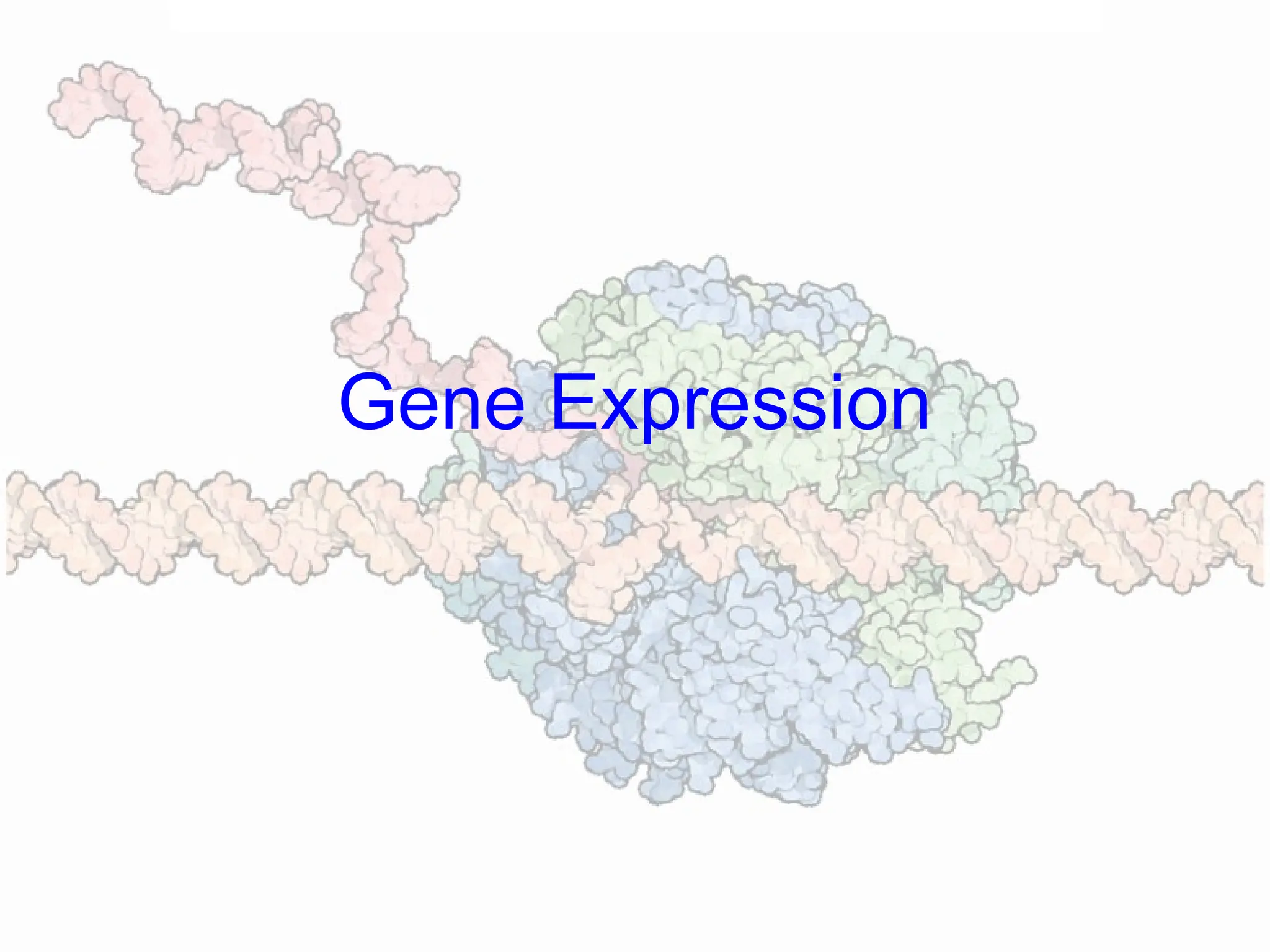
Gene Expression
What is gene expression?
Gene expression is the process by which a gene gets turned on in a cell
to transcript RNA and produce proteins.
Gene expression is the process by which the instructions in our DNA are
converted into a functional product (protein).
Gene expression is the process by which information from a gene is used
in the synthesis of a functional gene product. These products are
often proteins, but in non-protein-coding genes such as (tRNA) and small
nuclear RNA (snRNA), the product is a functional non-coding RNA.
Control of Gene Expression
Regulatory genes & Regulatory proteins
• Controlling gene expression is often occur
by controlling transcription initiation.
• The product of a regulatory genes is
required to initiate (turn on) or (turn off)
the expression.
• Regulatory genes → regulatory proteins
that bind to DNA to either block or
stimulate transcription, depending on how
they interact with RNA polymerase.
Types of gene expression
a. Constitutive expression:
Some genes are essential and necessary for life, and
therefore are continuously expressed. These genes are
called housekeeping genes (such as: Actin, GAPDH (glyceraldehyde
3-phosphate dehydrogenase).
b. Induction and repression:
The expression levels of some genes fluctuate in response
to the external signals.
•
‫د‬ ‫عن‬ ‫ها‬ ‫نفس‬ ‫ن‬ ‫ع‬ ‫بير‬ ‫بالتع‬ ‫ة‬ ‫معين‬ ‫لجينات‬ ‫مح‬ ‫يس‬ ‫خاص‬ ‫م‬ ‫لتنظي‬ ‫ي‬ ‫الجين‬ ‫بير‬ ‫التع‬ ‫ة‬ ‫عملي‬ ‫ع‬ ‫تخض‬
,
‫يتوقف‬ ‫البروتينات‬ ‫لهذه‬ ‫الخلية‬ ‫حاجة‬ ‫تنتهي‬ ‫وعندما‬ ‫الجينات‬ ‫تلك‬ ‫بروتينات‬ ‫إلى‬ ‫الخلية‬ ‫حاجة‬
. .
‫وهكذا‬ ‫أخرى‬ ‫بروتينات‬ ‫النتاج‬ ‫نفسها‬ ‫عن‬ ‫التعبير‬ ‫في‬ ‫أخرى‬ ‫جينات‬ ‫تبدأ‬ ‫وقد‬ ‫الجيني‬ ‫التعبير‬
•
‫تنظيم‬ ‫المراد‬ ‫ن‬‫بالجي‬ ‫مرتبطة‬ ‫ة‬‫وراثي‬ ‫عناصر‬ ‫وجود‬ ‫ن‬‫م‬ ‫د‬‫ب‬ ‫ال‬ ‫الجينات‬ ‫خ‬‫نس‬ ‫عملية‬ ‫ولتنظيم‬
(
‫أوليات‬ ‫ي‬ ‫ف‬ ‫ة‬ ‫وخاص‬ ‫ن‬ ‫بالجي‬ ‫ط‬ ‫المحي‬ ‫ط‬ ‫الوس‬ ‫ع‬ ‫م‬ ‫ل‬ ‫تتفاع‬ ‫ر‬ ‫العناص‬ ‫وهذه‬ ‫خه‬ ‫نس‬ ‫و‬ ‫أ‬ ‫بيره‬ ‫تع‬
. )
‫الجين‬ ‫بنسخ‬ ‫تسمح‬ ‫ال‬ ‫أو‬ ‫العناصر‬ ‫هذه‬ ‫تسمح‬ ‫وبالتالي‬ ‫النواة‬
Gene expression in multicellular
organisms
• All of our genes are present in every single
cell, but only certain proteins are needed.
• Expression of a gene at the wrong time, in the
wrong type of cell, or in abnormal amounts
can lead to deleterious phenotypes or death -
even when the gene itself is normal.
Some genes demonstrate higher expression
level once being activated. It is called induced
expression.
On the other hand, some genes are repressed
and their expression levels are lower. It is
called repressed expression.
Exons and Coding sequences
What’s the difference between exons and coding sequences?
Exons are those segments of sequence that are spliced together
after the introns have been removed from the pre-mRNA.
The coding sequence is contained in exons, but it is possible
for some exons to contain no coding sequence.
Exons may contain sequence that is not translated into amino
acids. These are the untranslated regions (UTRs). UTRs are
found upstream and downstream of the protein-coding
sequence.
• Why do bacterial and eukaryotic cells have different
mechanisms of gene regulation? or why the control of
gene expression is much more complex in eukaryotes
than in prokaryotes.
• Reasons being, Eukaryotes have:
– Compartmentalization of cells (Unlike in Prokaryotes, the Eukaryotes having
different cell organelles to perform different functions. Compartmentalization allows each
compartment to perform specific functions without interference from other cell functions).
– More extensive transcript processing.
– Regulation from a distance.
– Cell and tissue specific gene expression.
– Larger Genome size.
– Genes scattered among the genome.
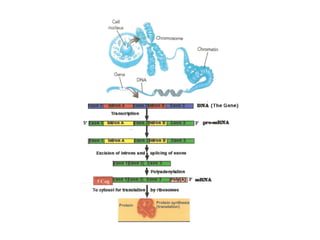
Gene Expression
• There are 4 major events that occur durin
the process of gene expression:
–Transcription.
–RNA processing.
–Translation.
–Protein processing.
Gene Control in Prokaryotes
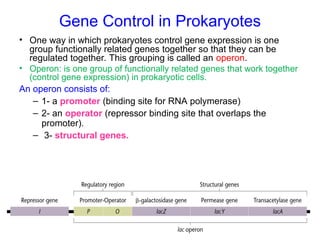
• One way in which prokaryotes control gene expression is one
group functionally related genes together so that they can be
regulated together. This grouping is called an operon.
• Operon: is one group of functionally related genes that work together
(control gene expression) in prokaryotic cells.
An operon consists of:
– 1- a promoter (binding site for RNA polymerase)
– 2- an operator (repressor binding site that overlaps the
promoter).
– 3- structural genes.
• Promoter
Promoter: is a specific short sequence on DNA at which
RNA polymerase attaches and initiates transcription at
the beginning of the transcription unit.
Promoter sequences are recognized by RNA polymerase.
When RNA polymerase binds to the promoter, transcription
occurs.
• Operator
• Operator: is a specific short of DNA sequence
adjacent to the structural genes that the repressor
protein* can bind to and prevent the transcription of
structural genes.
*Repressor proteins encoded by repressor genes to
regulate gene expression.
Activators
• The activity of RNA polymerase is also
regulated by interaction with accessory
proteins called activators.
• The presence of the activator removes
repression and transcription occurs.
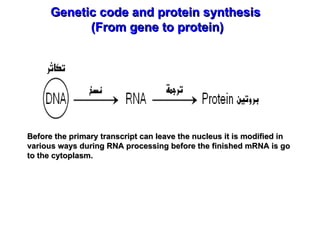
Genetic code and protein synthesis
(From gene to protein)
Before the primary transcript can leave the nucleus it is modified in
various ways during RNA processing before the finished mRNA is go
to the cytoplasm.
to the cytoplasm.
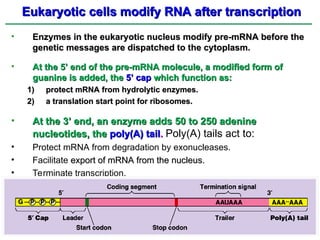
• Enzymes in the eukaryotic nucleus modify pre-mRNA before the
Enzymes in the eukaryotic nucleus modify pre-mRNA before the
genetic messages are dispatched to the cytoplasm.
• At the 5’ end of the pre-mRNA molecule, a modified form of
At the 5’ end of the pre-mRNA molecule, a modified form of
guanine is added, the
guanine is added, the 5’ cap
5’ cap which function as:
which function as:
1)
1) protect mRNA from hydrolytic enzymes.
protect mRNA from hydrolytic enzymes.
2)
2) a translation start point for ribosomes.
a translation start point for ribosomes.
• At the 3’ end, an enzyme adds 50 to 250 adenine
At the 3’ end, an enzyme adds 50 to 250 adenine
nucleotides, the
nucleotides, the poly(A) tail
poly(A) tail.
. Poly(A) tails act to:
• Protect mRNA from degradation by exonucleases.
• Facilitate export of mRNA from the nucleus.
export of mRNA from the nucleus.
• Terminate transcription.
Eukaryotic cells modify RNA after transcription
RNA transcription and translation are the two
main processing that link gene to protein
• The information content of DNA is in the form of specific sequences
The information content of DNA is in the form of specific sequences
of nucleotides along the DNA strands.
• Proteins are the links between genotype and phenotype.
Proteins are the links between genotype and phenotype.
– For example, Mendel’s rules.
For example, Mendel’s rules.
– Genes provide the instructions for making specific proteins.
Genes provide the instructions for making specific proteins.
• The bridge between DNA and protein synthesis is RNA.
The bridge between DNA and protein synthesis is RNA.
• The specific sequence of hundreds or thousands of nucleotides in
The specific sequence of hundreds or thousands of nucleotides in
each gene carries the information for the primary structure of a
protein, the linear order of the 20 possible amino acids.
• During RNA
During RNA transcription,
transcription, a DNA strand provides a template for the
a DNA strand provides a template for the
synthesis of a
synthesis of a complementary RNA
complementary RNA strand.
strand.
• Transcription of a gene produces a messenger RNA (mRNA)
Transcription of a gene produces a messenger RNA (mRNA)
molecule.
molecule.
• During RNA
During RNA translation
translation (at ribosomes), the information contained in
), the information contained in
the order of nucleotides in mRNA is used to determine the amino
acid sequence of a polypeptide.
• The basic mechanics of transcription and translation are similar in
The basic mechanics of transcription and translation are similar in
eukaryotes and prokaryotes.
• Because bacteria lack nuclei,
Because bacteria lack nuclei, transcription and translation are coupled.
transcription and translation are coupled.
Which means:
Which means: ribosomes attach to the leading end of a mRNA while
ribosomes attach to the leading end of a mRNA while
mRNA transcription is still in
progress.
progress.
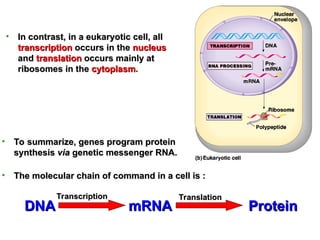
• In contrast, in a eukaryotic cell, all
In contrast, in a eukaryotic cell, all
transcription
transcription occurs in the
occurs in the nucleus
nucleus
and
and translation
translation occurs mainly at
occurs mainly at
ribosomes
ribosomes in the
in the cytoplasm
cytoplasm.
.
• To summarize, genes program protein
To summarize, genes program protein
synthesis
synthesis via
via genetic messenger RNA.
genetic messenger RNA.
• The molecular chain of command in a cell is :
The molecular chain of command in a cell is :
mRNA
mRNA
DNA
DNA
Transcription
Transcription
Protein
Protein
Translation
Translation
• Triplets of nucleotide bases are the smallest units that can code for all the
Triplets of nucleotide bases are the smallest units that can code for all the
amino acid.
amino acid.
• In the
In the triplet code
triplet code three consecutive bases specify an amino acid.
three consecutive bases specify an amino acid.
• The genetic instructions for a polypeptide
The genetic instructions for a polypeptide
chain are written in DNA as a series of
three-nucleotide words (triplets).
In the genetic code, nucleotide triplets specify
amino acids
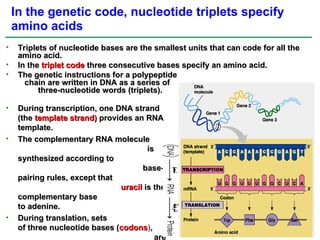
• During transcription, one DNA strand
During transcription, one DNA strand
(the
(the template strand)
template strand) provides an RNA
provides an RNA
template.
template.
• The complementary RNA molecule
The complementary RNA molecule
is
is
synthesized according to
base-
base-
pairing rules, except that
uracil
uracil is the
is the
complementary base
complementary base
to adenine.
to adenine.
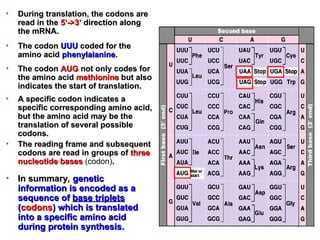
• During translation, sets
During translation, sets
of three nucleotide bases (
of three nucleotide bases (codons
codons),
,
are
• During translation, the codons are
During translation, the codons are
read in the
read in the 5’->3’
5’->3’ direction along
direction along
the mRNA.
the mRNA.
• The codon
The codon UUU
UUU coded for the
coded for the
amino acid
amino acid phenylalanine
phenylalanine.
.
• The codon
The codon AUG
AUG not only codes for
not only codes for
the amino acid
the amino acid methionine
methionine but also
but also
indicates the start of translation.
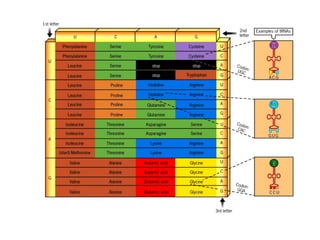
• A specific codon indicates a
A specific codon indicates a
specific corresponding amino acid,
but the amino acid may be the
translation of several possible
codons.
codons.
• The reading frame and subsequent
The reading frame and subsequent
codons are read in groups of
codons are read in groups of three
three
nucleotide bases
nucleotide bases (codon).
.
• In summary,
In summary, genetic
genetic
information is encoded as a
sequence of
sequence of base triplets
base triplets
(
(codons
codons) which is translated
) which is translated
into a specific amino acid
during protein synthesis.
Section B: The Transcription and Processing of RNA
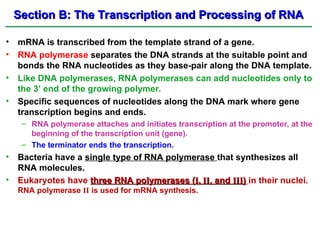
• mRNA is transcribed from the template strand of a gene.
• RNA polymerase separates the DNA strands at the suitable point and
bonds the RNA nucleotides as they base-pair along the DNA template.
• Like DNA polymerases, RNA polymerases can add nucleotides only to
the 3’ end of the growing polymer.
• Specific sequences of nucleotides along the DNA mark where gene
transcription begins and ends.
– RNA polymerase attaches and initiates transcription at the promoter, at the
beginning of the transcription unit (gene).
– The terminator ends the transcription.
• Bacteria have a single type of RNA polymerase that synthesizes all
RNA molecules.
• Eukaryotes have three RNA polymerases (
three RNA polymerases (I, II
I, II, and
, and III
III)
) in their nuclei.
RNA polymerase II is used for mRNA synthesis.
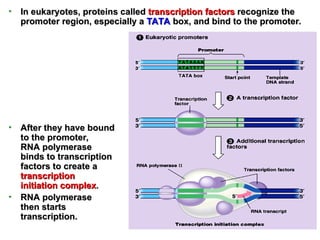
• In eukaryotes, proteins called
In eukaryotes, proteins called transcription
transcription factors
factors recognize the
recognize the
promoter region, especially a
promoter region, especially a TATA
TATA box, and bind to the promoter.
box, and bind to the promoter.
• After they have bound
After they have bound
to the promoter,
to the promoter,
RNA polymerase
RNA polymerase
binds to transcription
factors to create a
factors to create a
transcription
transcription
initiation complex
initiation complex.
.
• RNA polymerase
RNA polymerase
then starts
then starts
transcription.
transcription.
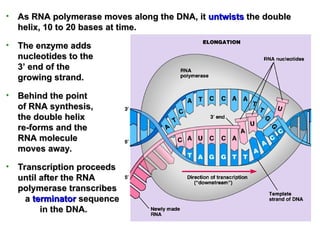
• As RNA polymerase moves along the DNA, it
As RNA polymerase moves along the DNA, it untwists
untwists the double
the double
helix, 10 to 20 bases at time.
• The enzyme adds
The enzyme adds
nucleotides to the
nucleotides to the
3’ end of the
3’ end of the
growing strand.
growing strand.
• Behind the point
Behind the point
of RNA synthesis,
of RNA synthesis,
the double helix
the double helix
re-forms and the
re-forms and the
RNA molecule
RNA molecule
moves away.
moves away.
• Transcription proceeds
Transcription proceeds
until after the RNA
until after the RNA
polymerase transcribes
a
a terminator
terminator sequence
sequence
in the DNA.
in the DNA.
28
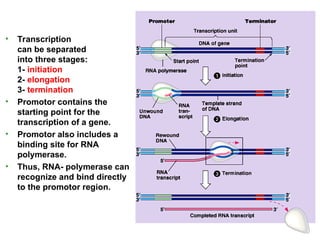
• Transcription
can be separated
into three stages:
1- initiation
2- elongation
3- termination
• Promotor contains the
starting point for the
transcription of a gene.
• Promotor also includes a
binding site for RNA
polymerase.
• Thus, RNA- polymerase can
recognize and bind directly
to the promotor region.

gene expression central dogma 1111111111

  • 1.
  • 2.
    What is geneexpression?
  • 3.
    What is geneexpression? Gene expression is the process by which a gene gets turned on in a cell to transcript RNA and produce proteins. Gene expression is the process by which the instructions in our DNA are converted into a functional product (protein). Gene expression is the process by which information from a gene is used in the synthesis of a functional gene product. These products are often proteins, but in non-protein-coding genes such as (tRNA) and small nuclear RNA (snRNA), the product is a functional non-coding RNA.
  • 4.
    Control of GeneExpression Regulatory genes & Regulatory proteins • Controlling gene expression is often occur by controlling transcription initiation. • The product of a regulatory genes is required to initiate (turn on) or (turn off) the expression. • Regulatory genes → regulatory proteins that bind to DNA to either block or stimulate transcription, depending on how they interact with RNA polymerase.
  • 5.
    Types of geneexpression a. Constitutive expression: Some genes are essential and necessary for life, and therefore are continuously expressed. These genes are called housekeeping genes (such as: Actin, GAPDH (glyceraldehyde 3-phosphate dehydrogenase). b. Induction and repression: The expression levels of some genes fluctuate in response to the external signals. • ‫د‬ ‫عن‬ ‫ها‬ ‫نفس‬ ‫ن‬ ‫ع‬ ‫بير‬ ‫بالتع‬ ‫ة‬ ‫معين‬ ‫لجينات‬ ‫مح‬ ‫يس‬ ‫خاص‬ ‫م‬ ‫لتنظي‬ ‫ي‬ ‫الجين‬ ‫بير‬ ‫التع‬ ‫ة‬ ‫عملي‬ ‫ع‬ ‫تخض‬ , ‫يتوقف‬ ‫البروتينات‬ ‫لهذه‬ ‫الخلية‬ ‫حاجة‬ ‫تنتهي‬ ‫وعندما‬ ‫الجينات‬ ‫تلك‬ ‫بروتينات‬ ‫إلى‬ ‫الخلية‬ ‫حاجة‬ . . ‫وهكذا‬ ‫أخرى‬ ‫بروتينات‬ ‫النتاج‬ ‫نفسها‬ ‫عن‬ ‫التعبير‬ ‫في‬ ‫أخرى‬ ‫جينات‬ ‫تبدأ‬ ‫وقد‬ ‫الجيني‬ ‫التعبير‬ • ‫تنظيم‬ ‫المراد‬ ‫ن‬‫بالجي‬ ‫مرتبطة‬ ‫ة‬‫وراثي‬ ‫عناصر‬ ‫وجود‬ ‫ن‬‫م‬ ‫د‬‫ب‬ ‫ال‬ ‫الجينات‬ ‫خ‬‫نس‬ ‫عملية‬ ‫ولتنظيم‬ ( ‫أوليات‬ ‫ي‬ ‫ف‬ ‫ة‬ ‫وخاص‬ ‫ن‬ ‫بالجي‬ ‫ط‬ ‫المحي‬ ‫ط‬ ‫الوس‬ ‫ع‬ ‫م‬ ‫ل‬ ‫تتفاع‬ ‫ر‬ ‫العناص‬ ‫وهذه‬ ‫خه‬ ‫نس‬ ‫و‬ ‫أ‬ ‫بيره‬ ‫تع‬ . ) ‫الجين‬ ‫بنسخ‬ ‫تسمح‬ ‫ال‬ ‫أو‬ ‫العناصر‬ ‫هذه‬ ‫تسمح‬ ‫وبالتالي‬ ‫النواة‬
  • 6.
    Gene expression inmulticellular organisms • All of our genes are present in every single cell, but only certain proteins are needed. • Expression of a gene at the wrong time, in the wrong type of cell, or in abnormal amounts can lead to deleterious phenotypes or death - even when the gene itself is normal.
  • 7.
    Some genes demonstratehigher expression level once being activated. It is called induced expression. On the other hand, some genes are repressed and their expression levels are lower. It is called repressed expression.
  • 8.
    Exons and Codingsequences What’s the difference between exons and coding sequences? Exons are those segments of sequence that are spliced together after the introns have been removed from the pre-mRNA. The coding sequence is contained in exons, but it is possible for some exons to contain no coding sequence. Exons may contain sequence that is not translated into amino acids. These are the untranslated regions (UTRs). UTRs are found upstream and downstream of the protein-coding sequence.
  • 9.
    • Why dobacterial and eukaryotic cells have different mechanisms of gene regulation? or why the control of gene expression is much more complex in eukaryotes than in prokaryotes. • Reasons being, Eukaryotes have: – Compartmentalization of cells (Unlike in Prokaryotes, the Eukaryotes having different cell organelles to perform different functions. Compartmentalization allows each compartment to perform specific functions without interference from other cell functions). – More extensive transcript processing. – Regulation from a distance. – Cell and tissue specific gene expression. – Larger Genome size. – Genes scattered among the genome.
  • 10.
    Gene Expression • Thereare 4 major events that occur durin the process of gene expression: –Transcription. –RNA processing. –Translation. –Protein processing.
  • 11.
    Gene Control inProkaryotes
  • 12.
    Gene Control inProkaryotes • One way in which prokaryotes control gene expression is one group functionally related genes together so that they can be regulated together. This grouping is called an operon. • Operon: is one group of functionally related genes that work together (control gene expression) in prokaryotic cells. An operon consists of: – 1- a promoter (binding site for RNA polymerase) – 2- an operator (repressor binding site that overlaps the promoter). – 3- structural genes.
  • 13.
    • Promoter Promoter: isa specific short sequence on DNA at which RNA polymerase attaches and initiates transcription at the beginning of the transcription unit. Promoter sequences are recognized by RNA polymerase. When RNA polymerase binds to the promoter, transcription occurs.
  • 14.
    • Operator • Operator:is a specific short of DNA sequence adjacent to the structural genes that the repressor protein* can bind to and prevent the transcription of structural genes. *Repressor proteins encoded by repressor genes to regulate gene expression.
  • 15.
    Activators • The activityof RNA polymerase is also regulated by interaction with accessory proteins called activators. • The presence of the activator removes repression and transcription occurs.
  • 16.
    Genetic code andprotein synthesis Genetic code and protein synthesis (From gene to protein) (From gene to protein) Before the primary transcript can leave the nucleus it is modified in Before the primary transcript can leave the nucleus it is modified in various ways during RNA processing before the finished mRNA is go various ways during RNA processing before the finished mRNA is go to the cytoplasm. to the cytoplasm.
  • 18.
    • Enzymes inthe eukaryotic nucleus modify pre-mRNA before the Enzymes in the eukaryotic nucleus modify pre-mRNA before the genetic messages are dispatched to the cytoplasm. genetic messages are dispatched to the cytoplasm. • At the 5’ end of the pre-mRNA molecule, a modified form of At the 5’ end of the pre-mRNA molecule, a modified form of guanine is added, the guanine is added, the 5’ cap 5’ cap which function as: which function as: 1) 1) protect mRNA from hydrolytic enzymes. protect mRNA from hydrolytic enzymes. 2) 2) a translation start point for ribosomes. a translation start point for ribosomes. • At the 3’ end, an enzyme adds 50 to 250 adenine At the 3’ end, an enzyme adds 50 to 250 adenine nucleotides, the nucleotides, the poly(A) tail poly(A) tail. . Poly(A) tails act to: • Protect mRNA from degradation by exonucleases. • Facilitate export of mRNA from the nucleus. export of mRNA from the nucleus. • Terminate transcription. Eukaryotic cells modify RNA after transcription Eukaryotic cells modify RNA after transcription
  • 19.
    RNA transcription andtranslation are the two RNA transcription and translation are the two main processing that link gene to protein main processing that link gene to protein • The information content of DNA is in the form of specific sequences The information content of DNA is in the form of specific sequences of nucleotides along the DNA strands. of nucleotides along the DNA strands. • Proteins are the links between genotype and phenotype. Proteins are the links between genotype and phenotype. – For example, Mendel’s rules. For example, Mendel’s rules. – Genes provide the instructions for making specific proteins. Genes provide the instructions for making specific proteins. • The bridge between DNA and protein synthesis is RNA. The bridge between DNA and protein synthesis is RNA. • The specific sequence of hundreds or thousands of nucleotides in The specific sequence of hundreds or thousands of nucleotides in each gene carries the information for the primary structure of a each gene carries the information for the primary structure of a protein, the linear order of the 20 possible amino acids. protein, the linear order of the 20 possible amino acids.
  • 20.
    • During RNA DuringRNA transcription, transcription, a DNA strand provides a template for the a DNA strand provides a template for the synthesis of a synthesis of a complementary RNA complementary RNA strand. strand. • Transcription of a gene produces a messenger RNA (mRNA) Transcription of a gene produces a messenger RNA (mRNA) molecule. molecule. • During RNA During RNA translation translation (at ribosomes), the information contained in ), the information contained in the order of nucleotides in mRNA is used to determine the amino the order of nucleotides in mRNA is used to determine the amino acid sequence of a polypeptide. acid sequence of a polypeptide. • The basic mechanics of transcription and translation are similar in The basic mechanics of transcription and translation are similar in eukaryotes and prokaryotes. eukaryotes and prokaryotes. • Because bacteria lack nuclei, Because bacteria lack nuclei, transcription and translation are coupled. transcription and translation are coupled. Which means: Which means: ribosomes attach to the leading end of a mRNA while ribosomes attach to the leading end of a mRNA while mRNA transcription is still in mRNA transcription is still in progress. progress.
  • 21.
    • In contrast,in a eukaryotic cell, all In contrast, in a eukaryotic cell, all transcription transcription occurs in the occurs in the nucleus nucleus and and translation translation occurs mainly at occurs mainly at ribosomes ribosomes in the in the cytoplasm cytoplasm. . • To summarize, genes program protein To summarize, genes program protein synthesis synthesis via via genetic messenger RNA. genetic messenger RNA. • The molecular chain of command in a cell is : The molecular chain of command in a cell is : mRNA mRNA DNA DNA Transcription Transcription Protein Protein Translation Translation
  • 22.
    • Triplets ofnucleotide bases are the smallest units that can code for all the Triplets of nucleotide bases are the smallest units that can code for all the amino acid. amino acid. • In the In the triplet code triplet code three consecutive bases specify an amino acid. three consecutive bases specify an amino acid. • The genetic instructions for a polypeptide The genetic instructions for a polypeptide chain are written in DNA as a series of chain are written in DNA as a series of three-nucleotide words (triplets). three-nucleotide words (triplets). In the genetic code, nucleotide triplets specify amino acids • During transcription, one DNA strand During transcription, one DNA strand (the (the template strand) template strand) provides an RNA provides an RNA template. template. • The complementary RNA molecule The complementary RNA molecule is is synthesized according to synthesized according to base- base- pairing rules, except that pairing rules, except that uracil uracil is the is the complementary base complementary base to adenine. to adenine. • During translation, sets During translation, sets of three nucleotide bases ( of three nucleotide bases (codons codons), , are
  • 23.
    • During translation,the codons are During translation, the codons are read in the read in the 5’->3’ 5’->3’ direction along direction along the mRNA. the mRNA. • The codon The codon UUU UUU coded for the coded for the amino acid amino acid phenylalanine phenylalanine. . • The codon The codon AUG AUG not only codes for not only codes for the amino acid the amino acid methionine methionine but also but also indicates the start of translation. indicates the start of translation. • A specific codon indicates a A specific codon indicates a specific corresponding amino acid, specific corresponding amino acid, but the amino acid may be the but the amino acid may be the translation of several possible translation of several possible codons. codons. • The reading frame and subsequent The reading frame and subsequent codons are read in groups of codons are read in groups of three three nucleotide bases nucleotide bases (codon). . • In summary, In summary, genetic genetic information is encoded as a information is encoded as a sequence of sequence of base triplets base triplets ( (codons codons) which is translated ) which is translated into a specific amino acid into a specific amino acid during protein synthesis. during protein synthesis.
  • 25.
    Section B: TheTranscription and Processing of RNA Section B: The Transcription and Processing of RNA • mRNA is transcribed from the template strand of a gene. • RNA polymerase separates the DNA strands at the suitable point and bonds the RNA nucleotides as they base-pair along the DNA template. • Like DNA polymerases, RNA polymerases can add nucleotides only to the 3’ end of the growing polymer. • Specific sequences of nucleotides along the DNA mark where gene transcription begins and ends. – RNA polymerase attaches and initiates transcription at the promoter, at the beginning of the transcription unit (gene). – The terminator ends the transcription. • Bacteria have a single type of RNA polymerase that synthesizes all RNA molecules. • Eukaryotes have three RNA polymerases ( three RNA polymerases (I, II I, II, and , and III III) ) in their nuclei. RNA polymerase II is used for mRNA synthesis.
  • 26.
    • In eukaryotes,proteins called In eukaryotes, proteins called transcription transcription factors factors recognize the recognize the promoter region, especially a promoter region, especially a TATA TATA box, and bind to the promoter. box, and bind to the promoter. • After they have bound After they have bound to the promoter, to the promoter, RNA polymerase RNA polymerase binds to transcription binds to transcription factors to create a factors to create a transcription transcription initiation complex initiation complex. . • RNA polymerase RNA polymerase then starts then starts transcription. transcription.
  • 27.
    • As RNApolymerase moves along the DNA, it As RNA polymerase moves along the DNA, it untwists untwists the double the double helix, 10 to 20 bases at time. helix, 10 to 20 bases at time. • The enzyme adds The enzyme adds nucleotides to the nucleotides to the 3’ end of the 3’ end of the growing strand. growing strand. • Behind the point Behind the point of RNA synthesis, of RNA synthesis, the double helix the double helix re-forms and the re-forms and the RNA molecule RNA molecule moves away. moves away. • Transcription proceeds Transcription proceeds until after the RNA until after the RNA polymerase transcribes polymerase transcribes a a terminator terminator sequence sequence in the DNA. in the DNA.
  • 28.
    28 • Transcription can beseparated into three stages: 1- initiation 2- elongation 3- termination • Promotor contains the starting point for the transcription of a gene. • Promotor also includes a binding site for RNA polymerase. • Thus, RNA- polymerase can recognize and bind directly to the promotor region.