
THE lac OPERON
The control of gene expression
 Each cell in the human contains all the genetic
material for the growth and development of a
human
 Some of these genes will be need to be
expressed all the time
 These are the genes that are involved in of vital
biochemical processes such as respiration
 Other genes are not expressed all the time
 They are switched on an off at need
Operons
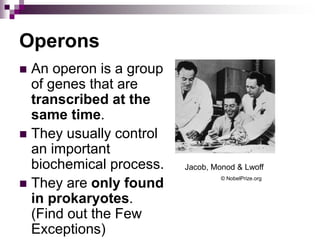
 An operon is a group
of genes that are
transcribed at the
same time.
 They usually control
an important
biochemical process.
 They are only found
in prokaryotes.
(Find out the Few
Exceptions)
© NobelPrize.org
Jacob, Monod & Lwoff
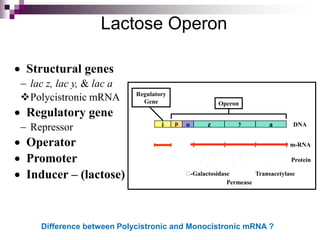
Lactose Operon
 Structural genes
 lac z, lac y, & lac a
Polycistronic mRNA
 Regulatory gene
 Repressor
 Operator
 Promoter
 Inducer – (lactose)
i
Operon
Regulatory
Gene
p o z y a DNA
m-RNA
-Galactosidase
Permease
Transacetylase
Protein
Difference between Polycistronic and Monocistronic mRNA ?
The lac Operon
 The lac operon consists of three genes
each involved in processing the sugar
lactose
 One of them is the gene for the enzyme β-
galactosidase
 This enzyme hydrolyses lactose into
glucose and galactose
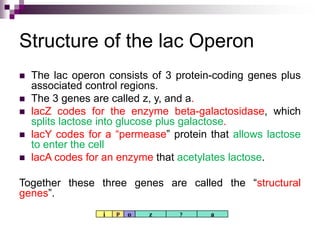
Structure of the lac Operon
 The lac operon consists of 3 protein-coding genes plus
associated control regions.
 The 3 genes are called z, y, and a.
 lacZ codes for the enzyme beta-galactosidase, which
splits lactose into glucose plus galactose.
 lacY codes for a “permease” protein that allows lactose
to enter the cell
 lacA codes for an enzyme that acetylates lactose.
Together these three genes are called the “structural
genes”.
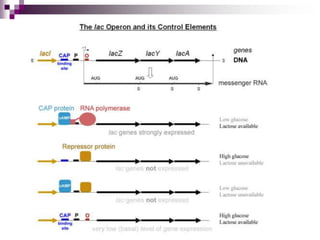
i p o z y a
Control Regions
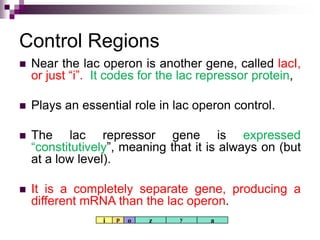
 Near the lac operon is another gene, called lacI,
or just “i”. It codes for the lac repressor protein,
 Plays an essential role in lac operon control.
 The lac repressor gene is expressed
“constitutively”, meaning that it is always on (but
at a low level).
 It is a completely separate gene, producing a
different mRNA than the lac operon.
i p o z y a
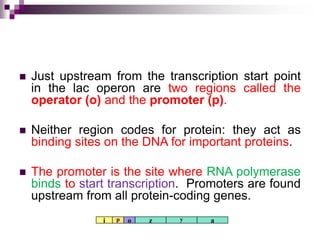
 Just upstream from the transcription start point
in the lac operon are two regions called the
operator (o) and the promoter (p).
 Neither region codes for protein: they act as
binding sites on the DNA for important proteins.
 The promoter is the site where RNA polymerase
binds to start transcription. Promoters are found
upstream from all protein-coding genes.
i p o z y a
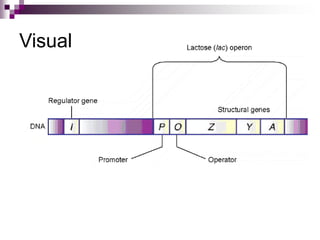
Visual
Adapting to the environment
 E. coli can use either glucose, which is a
monosaccharide, or lactose, which is a
disaccharide
 However, lactose needs to be hydrolysed
(digested) first
 So the bacterium prefers to use glucose when it
can
Four situations are possible
1. When glucose is present and lactose is absent the
E. coli does not produce β-galactosidase.
2. When glucose is present and lactose is present the
E. coli does not produce β-galactosidase.
3. When glucose is absent and lactose is absent the
E. coli does not produce β-galactosidase.
4. When glucose is absent and lactose is present the
E. coli does produce β-galactosidase
The control of the lac operon
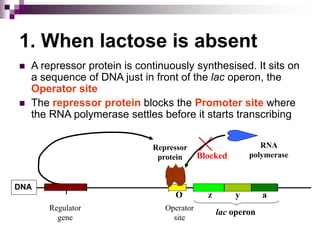
1. When lactose is absent
 A repressor protein is continuously synthesised. It sits on
a sequence of DNA just in front of the lac operon, the
Operator site
 The repressor protein blocks the Promoter site where
the RNA polymerase settles before it starts transcribing
Regulator
gene
lac operon
Operator
site
z y a
DNA
I
O
Repressor
protein
RNA
polymerase
Blocked
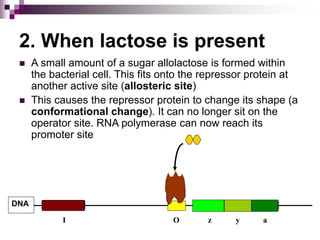
2. When lactose is present
 A small amount of a sugar allolactose is formed within
the bacterial cell. This fits onto the repressor protein at
another active site (allosteric site)
 This causes the repressor protein to change its shape (a
conformational change). It can no longer sit on the
operator site. RNA polymerase can now reach its
promoter site
z y a
DNA
I O
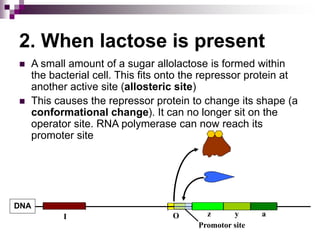
2. When lactose is present
 A small amount of a sugar allolactose is formed within
the bacterial cell. This fits onto the repressor protein at
another active site (allosteric site)
 This causes the repressor protein to change its shape (a
conformational change). It can no longer sit on the
operator site. RNA polymerase can now reach its
promoter site
Promotor site
z y a
DNA
I O
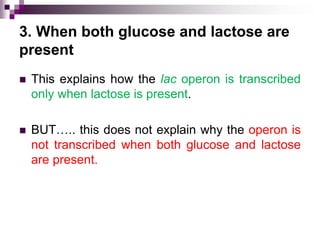
3. When both glucose and lactose are
present
 This explains how the lac operon is transcribed
only when lactose is present.
 BUT….. this does not explain why the operon is
not transcribed when both glucose and lactose
are present.
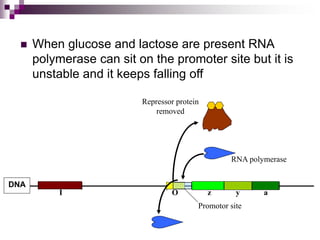
 When glucose and lactose are present RNA
polymerase can sit on the promoter site but it is
unstable and it keeps falling off
Promotor site
z y a
DNA
I O
Repressor protein
removed
RNA polymerase
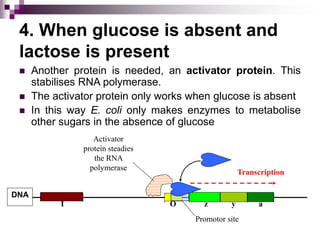
4. When glucose is absent and
lactose is present
 Another protein is needed, an activator protein. This
stabilises RNA polymerase.
 The activator protein only works when glucose is absent
 In this way E. coli only makes enzymes to metabolise
other sugars in the absence of glucose
Promotor site
z y a
DNA
I O
Transcription
Activator
protein steadies
the RNA
polymerase
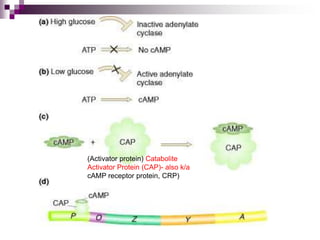
(Activator protein) Catabolite
Activator Protein (CAP)- also k/a
cAMP receptor protein, CRP)
Summary
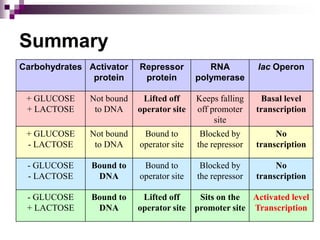
Carbohydrates Activator
protein
Repressor
protein
RNA
polymerase
lac Operon
+ GLUCOSE
+ LACTOSE
Not bound
to DNA
Lifted off
operator site
Keeps falling
off promoter
site
Basal level
transcription
+ GLUCOSE
- LACTOSE
Not bound
to DNA
Bound to
operator site
Blocked by
the repressor
No
transcription
- GLUCOSE
- LACTOSE
Bound to
DNA
Bound to
operator site
Blocked by
the repressor
No
transcription
- GLUCOSE
+ LACTOSE
Bound to
DNA
Lifted off
operator site
Sits on the
promoter site
Activated level
Transcription
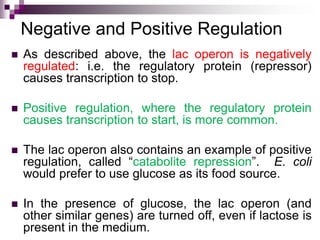
Negative and Positive Regulation
 As described above, the lac operon is negatively
regulated: i.e. the regulatory protein (repressor)
causes transcription to stop.
 Positive regulation, where the regulatory protein
causes transcription to start, is more common.
 The lac operon also contains an example of positive
regulation, called “catabolite repression”. E. coli
would prefer to use glucose as its food source.
 In the presence of glucose, the lac operon (and
other similar genes) are turned off, even if lactose is
present in the medium.
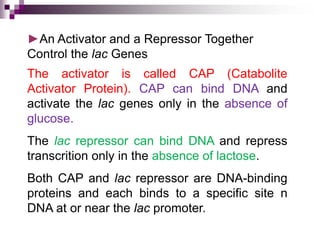
►An Activator and a Repressor Together
Control the lac Genes
The activator is called CAP (Catabolite
Activator Protein). CAP can bind DNA and
activate the lac genes only in the absence of
glucose.
The lac repressor can bind DNA and repress
transcrition only in the absence of lactose.
Both CAP and lac repressor are DNA-binding
proteins and each binds to a specific site n
DNA at or near the lac promoter.
Lac operon
Lac operon
Lac operon

Lac operon

  • 1.
  • 2.
    The control ofgene expression  Each cell in the human contains all the genetic material for the growth and development of a human  Some of these genes will be need to be expressed all the time  These are the genes that are involved in of vital biochemical processes such as respiration  Other genes are not expressed all the time  They are switched on an off at need
  • 3.
    Operons  An operonis a group of genes that are transcribed at the same time.  They usually control an important biochemical process.  They are only found in prokaryotes. (Find out the Few Exceptions) © NobelPrize.org Jacob, Monod & Lwoff
  • 4.
    Lactose Operon  Structuralgenes  lac z, lac y, & lac a Polycistronic mRNA  Regulatory gene  Repressor  Operator  Promoter  Inducer – (lactose) i Operon Regulatory Gene p o z y a DNA m-RNA -Galactosidase Permease Transacetylase Protein Difference between Polycistronic and Monocistronic mRNA ?
  • 5.
    The lac Operon The lac operon consists of three genes each involved in processing the sugar lactose  One of them is the gene for the enzyme β- galactosidase  This enzyme hydrolyses lactose into glucose and galactose
  • 6.
    Structure of thelac Operon  The lac operon consists of 3 protein-coding genes plus associated control regions.  The 3 genes are called z, y, and a.  lacZ codes for the enzyme beta-galactosidase, which splits lactose into glucose plus galactose.  lacY codes for a “permease” protein that allows lactose to enter the cell  lacA codes for an enzyme that acetylates lactose. Together these three genes are called the “structural genes”. i p o z y a
  • 7.
    Control Regions  Nearthe lac operon is another gene, called lacI, or just “i”. It codes for the lac repressor protein,  Plays an essential role in lac operon control.  The lac repressor gene is expressed “constitutively”, meaning that it is always on (but at a low level).  It is a completely separate gene, producing a different mRNA than the lac operon. i p o z y a
  • 8.
     Just upstreamfrom the transcription start point in the lac operon are two regions called the operator (o) and the promoter (p).  Neither region codes for protein: they act as binding sites on the DNA for important proteins.  The promoter is the site where RNA polymerase binds to start transcription. Promoters are found upstream from all protein-coding genes. i p o z y a
  • 9.
  • 10.
    Adapting to theenvironment  E. coli can use either glucose, which is a monosaccharide, or lactose, which is a disaccharide  However, lactose needs to be hydrolysed (digested) first  So the bacterium prefers to use glucose when it can
  • 11.
    Four situations arepossible 1. When glucose is present and lactose is absent the E. coli does not produce β-galactosidase. 2. When glucose is present and lactose is present the E. coli does not produce β-galactosidase. 3. When glucose is absent and lactose is absent the E. coli does not produce β-galactosidase. 4. When glucose is absent and lactose is present the E. coli does produce β-galactosidase
  • 12.
    The control ofthe lac operon
  • 13.
    1. When lactoseis absent  A repressor protein is continuously synthesised. It sits on a sequence of DNA just in front of the lac operon, the Operator site  The repressor protein blocks the Promoter site where the RNA polymerase settles before it starts transcribing Regulator gene lac operon Operator site z y a DNA I O Repressor protein RNA polymerase Blocked
  • 14.
    2. When lactoseis present  A small amount of a sugar allolactose is formed within the bacterial cell. This fits onto the repressor protein at another active site (allosteric site)  This causes the repressor protein to change its shape (a conformational change). It can no longer sit on the operator site. RNA polymerase can now reach its promoter site z y a DNA I O
  • 15.
    2. When lactoseis present  A small amount of a sugar allolactose is formed within the bacterial cell. This fits onto the repressor protein at another active site (allosteric site)  This causes the repressor protein to change its shape (a conformational change). It can no longer sit on the operator site. RNA polymerase can now reach its promoter site Promotor site z y a DNA I O
  • 16.
    3. When bothglucose and lactose are present  This explains how the lac operon is transcribed only when lactose is present.  BUT….. this does not explain why the operon is not transcribed when both glucose and lactose are present.
  • 17.
     When glucoseand lactose are present RNA polymerase can sit on the promoter site but it is unstable and it keeps falling off Promotor site z y a DNA I O Repressor protein removed RNA polymerase
  • 18.
    4. When glucoseis absent and lactose is present  Another protein is needed, an activator protein. This stabilises RNA polymerase.  The activator protein only works when glucose is absent  In this way E. coli only makes enzymes to metabolise other sugars in the absence of glucose Promotor site z y a DNA I O Transcription Activator protein steadies the RNA polymerase
  • 19.
    (Activator protein) Catabolite ActivatorProtein (CAP)- also k/a cAMP receptor protein, CRP)
  • 20.
    Summary Carbohydrates Activator protein Repressor protein RNA polymerase lac Operon +GLUCOSE + LACTOSE Not bound to DNA Lifted off operator site Keeps falling off promoter site Basal level transcription + GLUCOSE - LACTOSE Not bound to DNA Bound to operator site Blocked by the repressor No transcription - GLUCOSE - LACTOSE Bound to DNA Bound to operator site Blocked by the repressor No transcription - GLUCOSE + LACTOSE Bound to DNA Lifted off operator site Sits on the promoter site Activated level Transcription
  • 22.
    Negative and PositiveRegulation  As described above, the lac operon is negatively regulated: i.e. the regulatory protein (repressor) causes transcription to stop.  Positive regulation, where the regulatory protein causes transcription to start, is more common.  The lac operon also contains an example of positive regulation, called “catabolite repression”. E. coli would prefer to use glucose as its food source.  In the presence of glucose, the lac operon (and other similar genes) are turned off, even if lactose is present in the medium.
  • 23.
    ►An Activator anda Repressor Together Control the lac Genes The activator is called CAP (Catabolite Activator Protein). CAP can bind DNA and activate the lac genes only in the absence of glucose. The lac repressor can bind DNA and repress transcrition only in the absence of lactose. Both CAP and lac repressor are DNA-binding proteins and each binds to a specific site n DNA at or near the lac promoter.