Presented by,
M.Evangelin flora
11701101285
IInd year BIO-TECH
 Translation is basilly the process of protein synthesis
 Is the biological process by which messenger RNA is traslated into
proteins in eukaryotes.
 Protein synthesized from the information contained in a molecule
of messenger RNA (mRna)
 and in eukaryotes the translation occur in cytoplasm.
 Proteins are composed of amino acid –there are 20 different
amino acids
 In Eukaryotes,the trascription and translation are carried out in
separate compartments of the cell(the nucleus and cytoplasm)
 Eukaryotic mRna precursors must be processed in the
nucleus(eg:capping)
 And before they are exported to the cytoplasm for the
translation
 Protein synthesis is accomplished through a
process called translation.
 After DNA is transcribed into a messenger
RNA (m RNA) molecule during
transcription,the m RNA must be translated
to produce a protein .
 In translation,m RNA along with transfer RNA
(t RNA) and ribosomes work together to
produce proteins.
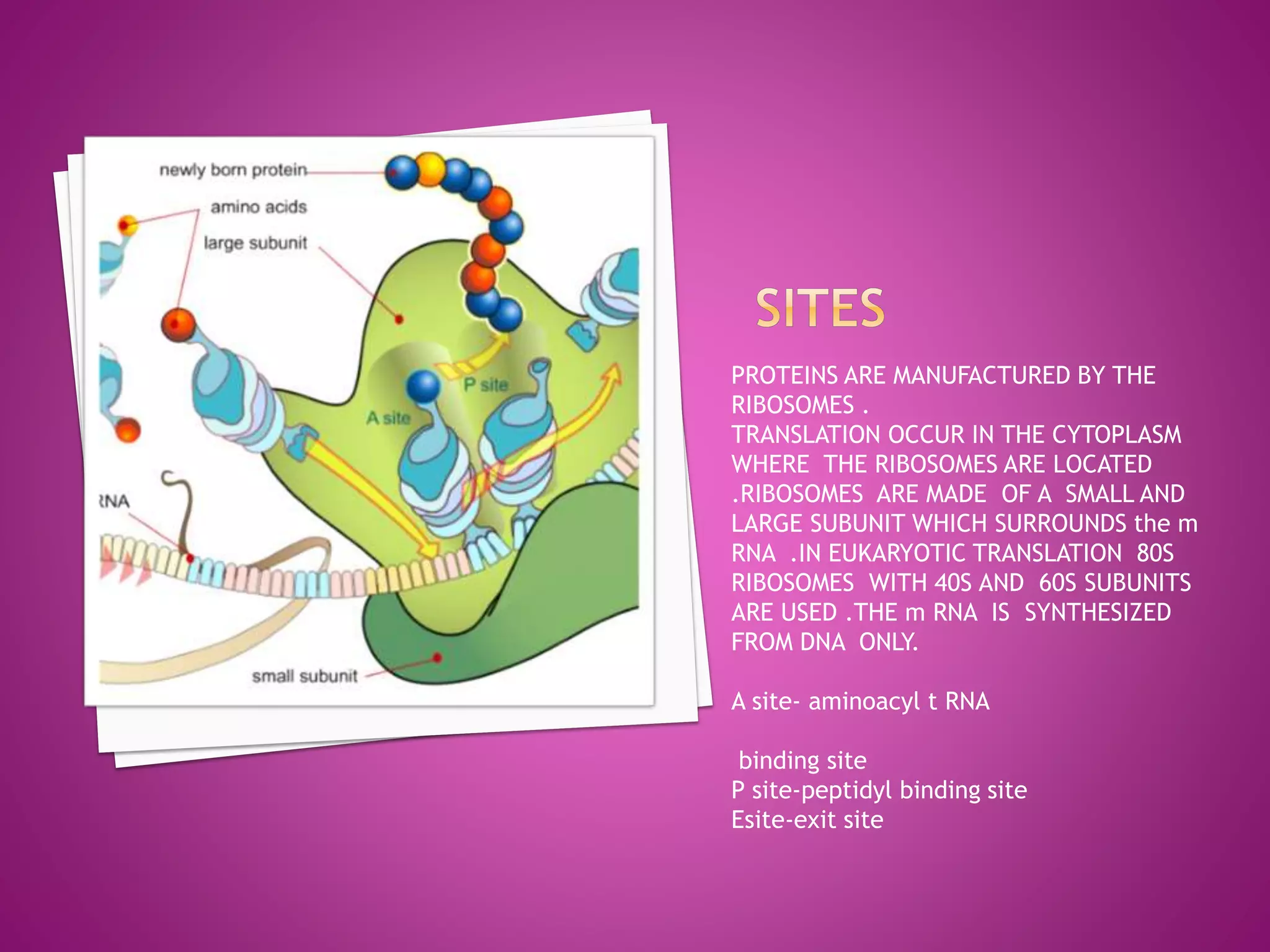
PROTEINS ARE MANUFACTURED BY THE
RIBOSOMES .
TRANSLATION OCCUR IN THE CYTOPLASM
WHERE THE RIBOSOMES ARE LOCATED
.RIBOSOMES ARE MADE OF A SMALL AND
LARGE SUBUNIT WHICH SURROUNDS the m
RNA .IN EUKARYOTIC TRANSLATION 80S
RIBOSOMES WITH 40S AND 60S SUBUNITS
ARE USED .THE m RNA IS SYNTHESIZED
FROM DNA ONLY.
A site- aminoacyl t RNA
binding site
P site-peptidyl binding site
Esite-exit site
An M rna sequence template to guide the
synthesis of a chain of amino acids that form a
protein.
The translation process requires m RNA ,r RNA ,20
AMINO ACIDS and their specific t RNA.
And In the process of translation two types of
codons
1)start codons
2) end codons
The codon AUG( methionine) . Initiate the process
of translation, and one of three stop codons ie.,UAA
,UAG, or UGA.
m RNA CARRYING THE DNA INSTRUCTIONS
AND t RNA CARRYING AMINO ACIDS MEET IN THE
RIBOSOMES
AMINOACID ARE JOINED TOGETHER TO MAKE A
PROTEIN.
A SERIES OF THREE ADJACENT BASES
IN AN m RNA MOLECULE CODES FOR A
SPECIFIC AMINO ACID CALLED A CODON.
A TRIPLET OF NUCLEOTIDES IN t RNA
THAT IS COMPLEMENTARY TO THE
CODON IN m RNA CALLED AN
ANTICODON.
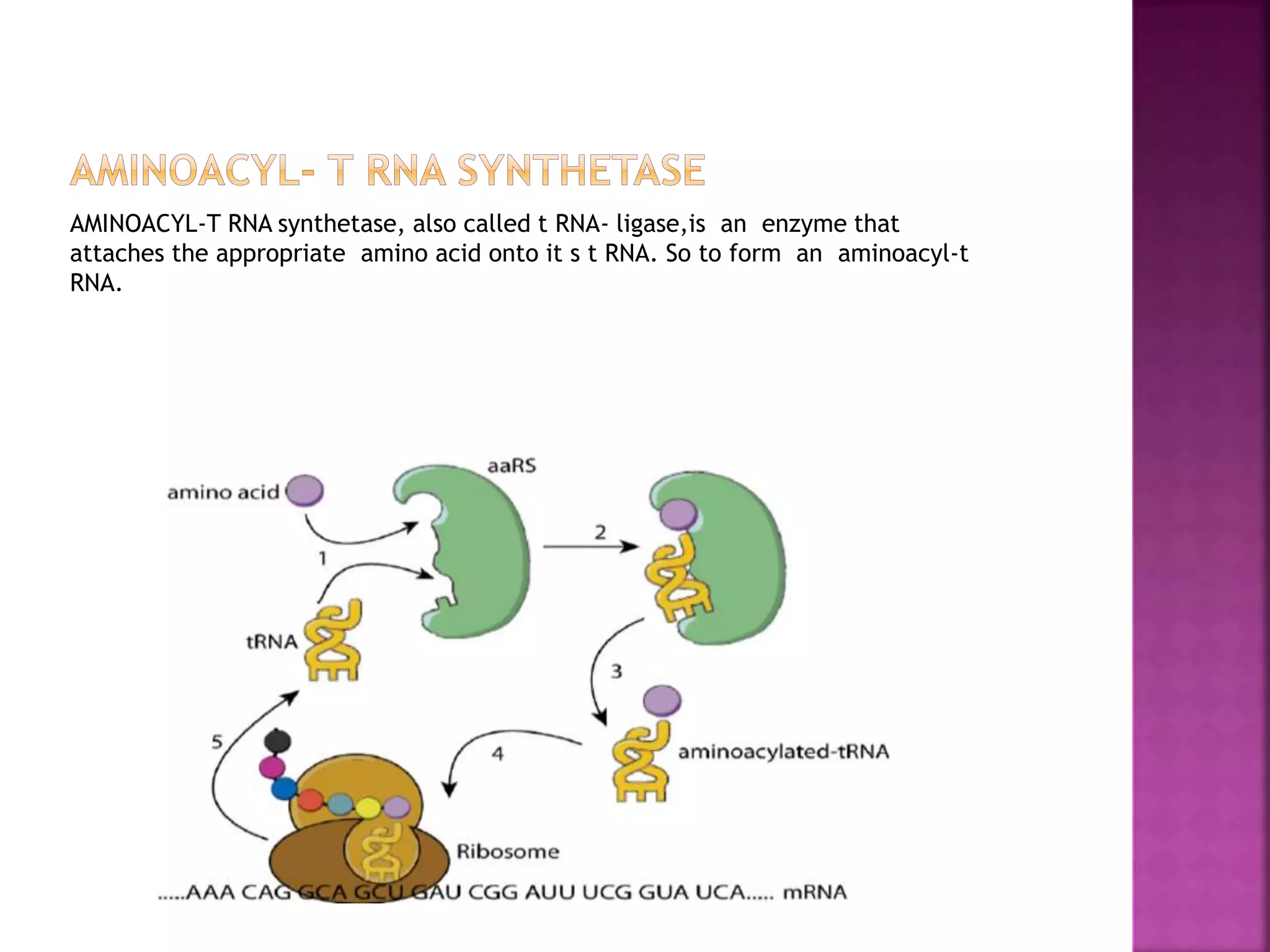
AMINOACYL-T RNA synthetase, also called t RNA- ligase,is an enzyme that
attaches the appropriate amino acid onto it s t RNA. So to form an aminoacyl-t
RNA.
 The mechanism of translation in eukaryotes
is similar to that of prokaryotes in several
aspects.
i. Intiation,
ii. Elongation and
iii. Termination.
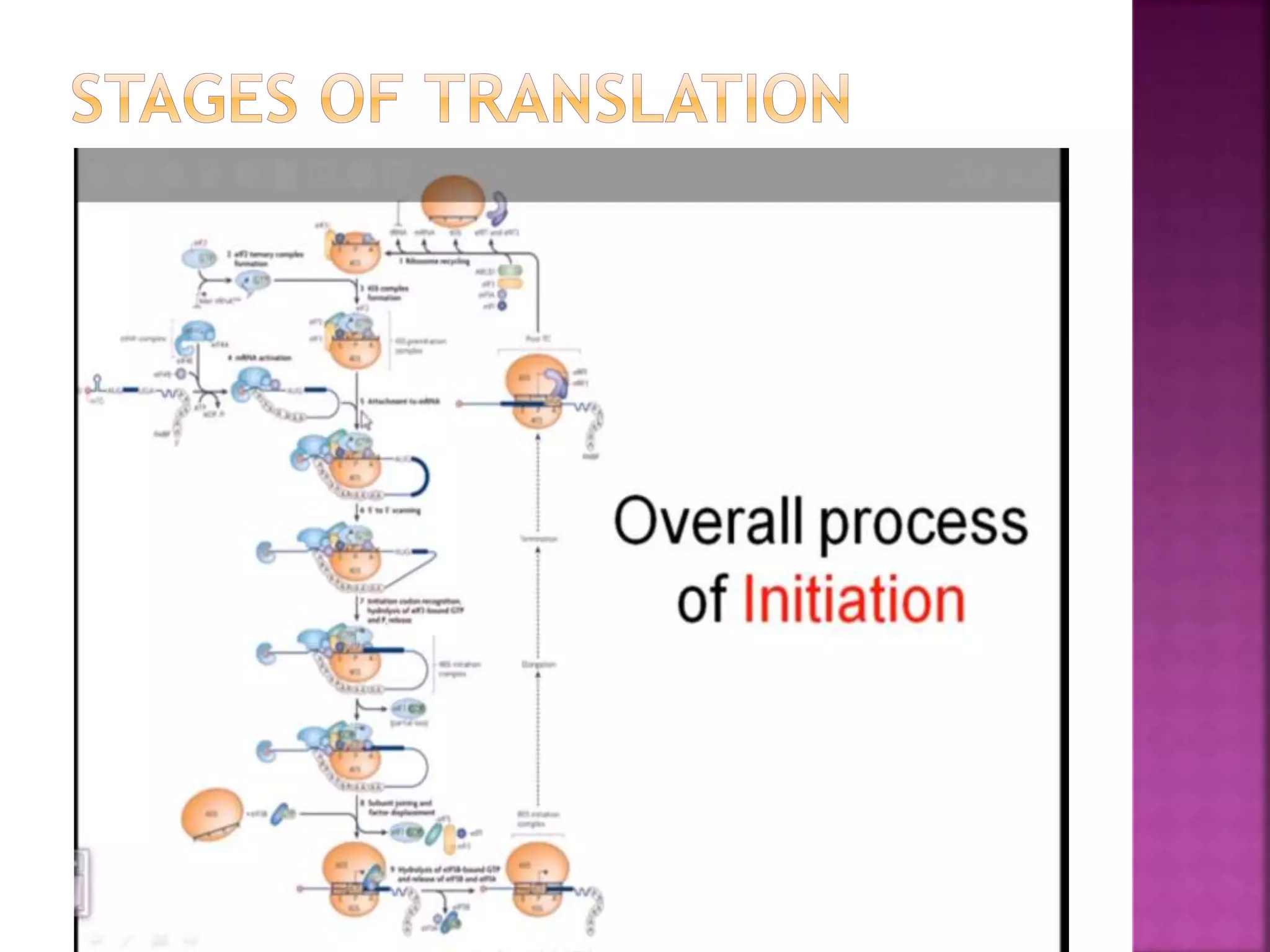
 WE HAVE THE 40S SUB UNIT WITH THAT e IF3 COMES AND BIND TO THE
Esite . BUT THE Psite SHOULD BE FREE BECAUSE THE FIRST t RNA SHOULD
BE PLACED IN THE Psite NOT IN OTHER site. AND THE INITIATION FACTOR
1 & 2 BLOCK THE Asite.
THE Psite INTERACT TO THE FIRST t RNA THAT IS CARRYING THE (F
MET)FORMAILATED METHIONINE
A TERNARY COMPLEX CONTAINING F MET t rna & THE Eif2 BOUND TO
GTP ATTACHES TO THE Psite TO FORM 43S PREINITIATION COMPLEX.
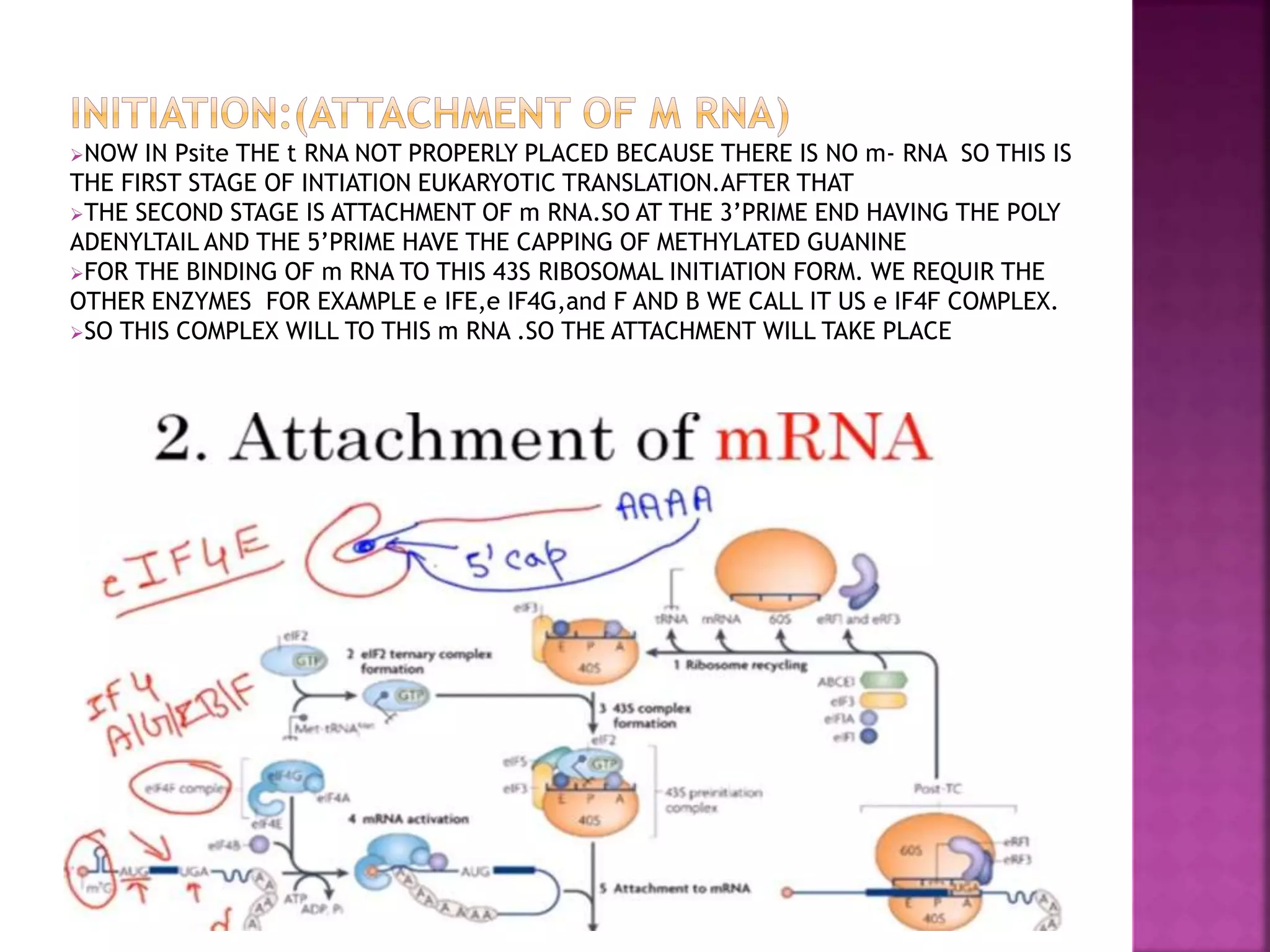
NOW IN Psite THE t RNA NOT PROPERLY PLACED BECAUSE THERE IS NO m- RNA SO THIS IS
THE FIRST STAGE OF INTIATION EUKARYOTIC TRANSLATION.AFTER THAT
THE SECOND STAGE IS ATTACHMENT OF m RNA.SO AT THE 3’PRIME END HAVING THE POLY
ADENYLTAIL AND THE 5’PRIME HAVE THE CAPPING OF METHYLATED GUANINE
FOR THE BINDING OF m RNA TO THIS 43S RIBOSOMAL INITIATION FORM. WE REQUIR THE
OTHER ENZYMES FOR EXAMPLE e IFE,e IF4G,and F AND B WE CALL IT US e IF4F COMPLEX.
SO THIS COMPLEX WILL TO THIS m RNA .SO THE ATTACHMENT WILL TAKE PLACE
THIRD STAGE IS SCANNING THE START CODON BUT STILL THE t RNA NOT PROPERLY PLACED
WHAT WILL HAPPEN NOW ,THEY NEED TO FIND EXACTLY WHICH IS THE START CODON
ONCE DESIGNATED THE START CODON THEN ONLY THIS FMET t RNA WILL PLACED PROPERLY BY THE
HELP OF HYDROGEN BONDING . SCANNING IS NOTHING BUT THIS POLYADENYLTALE START MOVING
FROM THIS TOWARD THE 5 PRIME TO 3 PRIME DIRECTION. THE e LF2 BRING THAT FIRST T-RNA SO IT
WILL HYDROLYS THE GTP PLACE THE T-RNA PROPERLY AND IT WILL RELEASE THE PLACE.
They have assemble every thing and properly positioned the T-RNA now the stages is to bind the 60s
ribosome subunit.
The 60s subunit comes along with e iF5B intiation factor
Once the 60s subunit assembled with the 40s complex and the m-rna with the t-rna attach to it all other
factors are release like e IF3 & e IF1 as well as initiation factor 5 release because the GTP will hydrolyse
for energy required to bring the large subunit finally the 80s intiation complex is formed .
SO INITIATION (BEGINNING) in this stage ,the ribosome get together with the m-rna & the first t-rna so
translation can begin.
 Is the middle stage,amino acids are brought
to the ribosomes by t-rnas and linked
together to form a chain.
 Ribosome elongate the polypeptide chain by
the sequential addition of amino acids.
Elongation ,a cycle process involving certain
elongation factor(Efs).elongation may be
divided into three stages.
a)Binding of aminoacylt-rna to A site.
b)Peptide bond formation
c)translocation.
 The 80s initiation complex contains met trna
in the p-site & A-site is free.
 Another aminoacyl-t RNA is placed in the A-
site .
 For this requires proper codon recoginition
on the m RNA & involvement of elongation
factor 1a(EF-1a) & supply of energy by GTP.
 The aminoacyl-t RNA is placed in the A-
site,EF-1a & GDP are recycled to bring
another aminoacyl-t RNA.
 Net result of peptide bond formation is the
attachment of the growing peptide chain to
the t RNA IN THE A-SITE.
 The ribosome moves to the next codon of the
m-RNA (towards 3’-end).
 This process is called translocation,involves
the movement of growing peptide chain from
A-site to P- site.
 Translocation requires EF-2 & GTP.
 GTP gets hydrolyzed and supplies energy to
move m-RNA.
 One of the stop or termination signals
(UAA,UAG,UGA)terminates the growing poiypeptide.
 When the ribosome encounters a stop codon,there is
no t-RNA available to bind to the A site of the
ribosome,
-instead a release factor bind to it.
 In eukaryotes, a single release factor-eukaryotic
release factor 1(e RF1)-recognizes all the three stop
codons,and e RF3 stimulates the termination events.
 Once release factor binds,the ribosome unit fall
apart,
-releasing the large & small subunits.
-The t-RNA carrying the polypeptide is also
released,freeing up .
 Ribosome recycling occurs in eukaryotes
1)Translation occur in the
a.nucleus
b.cytoplasm.
c.nucleolus.
2)Which is the energy rich molecule required for initiation of translation,
a.ATP
b.GTP
C.CTP
3)Which of the following is not a necessary component of translation,
a.anticodon
b.mrna
c.ligase.
4)Amino acids are joined together into a protein chain by which of the following,
a.transfer RNA
b.DNA polymerase
c.messenger RNA.
3)Difference between prokaryotic and eukaryotic translation?
4)What are the steps in the process of eukaryotic translation?
 www.researchgate.net
 www.khanacademy.org
 Shomu’s biology(video series of lectures
explain the protein synthesis.
Protein Synthesis In Eukaryotes

Protein Synthesis In Eukaryotes

  • 1.
  • 2.
     Translation isbasilly the process of protein synthesis  Is the biological process by which messenger RNA is traslated into proteins in eukaryotes.  Protein synthesized from the information contained in a molecule of messenger RNA (mRna)  and in eukaryotes the translation occur in cytoplasm.  Proteins are composed of amino acid –there are 20 different amino acids  In Eukaryotes,the trascription and translation are carried out in separate compartments of the cell(the nucleus and cytoplasm)  Eukaryotic mRna precursors must be processed in the nucleus(eg:capping)  And before they are exported to the cytoplasm for the translation
  • 3.
     Protein synthesisis accomplished through a process called translation.  After DNA is transcribed into a messenger RNA (m RNA) molecule during transcription,the m RNA must be translated to produce a protein .  In translation,m RNA along with transfer RNA (t RNA) and ribosomes work together to produce proteins.
  • 4.
    PROTEINS ARE MANUFACTUREDBY THE RIBOSOMES . TRANSLATION OCCUR IN THE CYTOPLASM WHERE THE RIBOSOMES ARE LOCATED .RIBOSOMES ARE MADE OF A SMALL AND LARGE SUBUNIT WHICH SURROUNDS the m RNA .IN EUKARYOTIC TRANSLATION 80S RIBOSOMES WITH 40S AND 60S SUBUNITS ARE USED .THE m RNA IS SYNTHESIZED FROM DNA ONLY. A site- aminoacyl t RNA binding site P site-peptidyl binding site Esite-exit site
  • 5.
    An M rnasequence template to guide the synthesis of a chain of amino acids that form a protein. The translation process requires m RNA ,r RNA ,20 AMINO ACIDS and their specific t RNA. And In the process of translation two types of codons 1)start codons 2) end codons The codon AUG( methionine) . Initiate the process of translation, and one of three stop codons ie.,UAA ,UAG, or UGA. m RNA CARRYING THE DNA INSTRUCTIONS AND t RNA CARRYING AMINO ACIDS MEET IN THE RIBOSOMES AMINOACID ARE JOINED TOGETHER TO MAKE A PROTEIN.
  • 6.
    A SERIES OFTHREE ADJACENT BASES IN AN m RNA MOLECULE CODES FOR A SPECIFIC AMINO ACID CALLED A CODON. A TRIPLET OF NUCLEOTIDES IN t RNA THAT IS COMPLEMENTARY TO THE CODON IN m RNA CALLED AN ANTICODON.
  • 7.
    AMINOACYL-T RNA synthetase,also called t RNA- ligase,is an enzyme that attaches the appropriate amino acid onto it s t RNA. So to form an aminoacyl-t RNA.
  • 9.
     The mechanismof translation in eukaryotes is similar to that of prokaryotes in several aspects. i. Intiation, ii. Elongation and iii. Termination.
  • 11.
     WE HAVETHE 40S SUB UNIT WITH THAT e IF3 COMES AND BIND TO THE Esite . BUT THE Psite SHOULD BE FREE BECAUSE THE FIRST t RNA SHOULD BE PLACED IN THE Psite NOT IN OTHER site. AND THE INITIATION FACTOR 1 & 2 BLOCK THE Asite. THE Psite INTERACT TO THE FIRST t RNA THAT IS CARRYING THE (F MET)FORMAILATED METHIONINE A TERNARY COMPLEX CONTAINING F MET t rna & THE Eif2 BOUND TO GTP ATTACHES TO THE Psite TO FORM 43S PREINITIATION COMPLEX.
  • 12.
    NOW IN PsiteTHE t RNA NOT PROPERLY PLACED BECAUSE THERE IS NO m- RNA SO THIS IS THE FIRST STAGE OF INTIATION EUKARYOTIC TRANSLATION.AFTER THAT THE SECOND STAGE IS ATTACHMENT OF m RNA.SO AT THE 3’PRIME END HAVING THE POLY ADENYLTAIL AND THE 5’PRIME HAVE THE CAPPING OF METHYLATED GUANINE FOR THE BINDING OF m RNA TO THIS 43S RIBOSOMAL INITIATION FORM. WE REQUIR THE OTHER ENZYMES FOR EXAMPLE e IFE,e IF4G,and F AND B WE CALL IT US e IF4F COMPLEX. SO THIS COMPLEX WILL TO THIS m RNA .SO THE ATTACHMENT WILL TAKE PLACE
  • 13.
    THIRD STAGE ISSCANNING THE START CODON BUT STILL THE t RNA NOT PROPERLY PLACED WHAT WILL HAPPEN NOW ,THEY NEED TO FIND EXACTLY WHICH IS THE START CODON ONCE DESIGNATED THE START CODON THEN ONLY THIS FMET t RNA WILL PLACED PROPERLY BY THE HELP OF HYDROGEN BONDING . SCANNING IS NOTHING BUT THIS POLYADENYLTALE START MOVING FROM THIS TOWARD THE 5 PRIME TO 3 PRIME DIRECTION. THE e LF2 BRING THAT FIRST T-RNA SO IT WILL HYDROLYS THE GTP PLACE THE T-RNA PROPERLY AND IT WILL RELEASE THE PLACE.
  • 14.
    They have assembleevery thing and properly positioned the T-RNA now the stages is to bind the 60s ribosome subunit. The 60s subunit comes along with e iF5B intiation factor Once the 60s subunit assembled with the 40s complex and the m-rna with the t-rna attach to it all other factors are release like e IF3 & e IF1 as well as initiation factor 5 release because the GTP will hydrolyse for energy required to bring the large subunit finally the 80s intiation complex is formed . SO INITIATION (BEGINNING) in this stage ,the ribosome get together with the m-rna & the first t-rna so translation can begin.
  • 15.
     Is themiddle stage,amino acids are brought to the ribosomes by t-rnas and linked together to form a chain.  Ribosome elongate the polypeptide chain by the sequential addition of amino acids. Elongation ,a cycle process involving certain elongation factor(Efs).elongation may be divided into three stages. a)Binding of aminoacylt-rna to A site. b)Peptide bond formation c)translocation.
  • 16.
     The 80sinitiation complex contains met trna in the p-site & A-site is free.  Another aminoacyl-t RNA is placed in the A- site .  For this requires proper codon recoginition on the m RNA & involvement of elongation factor 1a(EF-1a) & supply of energy by GTP.  The aminoacyl-t RNA is placed in the A- site,EF-1a & GDP are recycled to bring another aminoacyl-t RNA.
  • 17.
     Net resultof peptide bond formation is the attachment of the growing peptide chain to the t RNA IN THE A-SITE.
  • 18.
     The ribosomemoves to the next codon of the m-RNA (towards 3’-end).  This process is called translocation,involves the movement of growing peptide chain from A-site to P- site.  Translocation requires EF-2 & GTP.  GTP gets hydrolyzed and supplies energy to move m-RNA.
  • 20.
     One ofthe stop or termination signals (UAA,UAG,UGA)terminates the growing poiypeptide.  When the ribosome encounters a stop codon,there is no t-RNA available to bind to the A site of the ribosome, -instead a release factor bind to it.  In eukaryotes, a single release factor-eukaryotic release factor 1(e RF1)-recognizes all the three stop codons,and e RF3 stimulates the termination events.  Once release factor binds,the ribosome unit fall apart, -releasing the large & small subunits. -The t-RNA carrying the polypeptide is also released,freeing up .  Ribosome recycling occurs in eukaryotes
  • 22.
    1)Translation occur inthe a.nucleus b.cytoplasm. c.nucleolus. 2)Which is the energy rich molecule required for initiation of translation, a.ATP b.GTP C.CTP 3)Which of the following is not a necessary component of translation, a.anticodon b.mrna c.ligase. 4)Amino acids are joined together into a protein chain by which of the following, a.transfer RNA b.DNA polymerase c.messenger RNA. 3)Difference between prokaryotic and eukaryotic translation? 4)What are the steps in the process of eukaryotic translation?
  • 23.
     www.researchgate.net  www.khanacademy.org Shomu’s biology(video series of lectures explain the protein synthesis.