
REGULATION OF GENE
     EXPRESSION IN
      EUKARYOTES


SUBMITTED TO :               SUBMITTED BY
Ms: SHRADDHA GOSWAMI       BRAJBALA MISHRA
BIOTECHNOLOGY DEPARTMENT         MSC II SEM
Contents

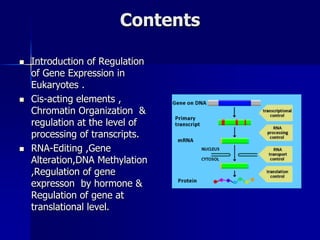
   Introduction of Regulation
    of Gene Expression in
    Eukaryotes .
   Cis-acting elements ,
    Chromatin Organization &
    regulation at the level of
    processing of transcripts.
   RNA-Editing ,Gene
    Alteration,DNA Methylation
    ,Regulation of gene
    expresson by hormone &
    Regulation of gene at
    translational level.
INTRODUCTION

   Objectives
   Know the different levels at which gene
    expression is regulated in eukaryotes,
    and understand the principles of
    regulation at each level.
   Understand the functional difference
    between promoters and enhancers.
   Understand the basics of tissue-specific
    gene regulation.
Eukaryotic Gene Expression

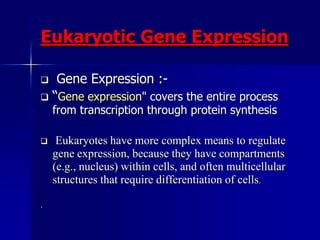
  Gene Expression :-
 “Gene expression" covers the entire process
    from transcription through protein synthesis

    Eukaryotes have more complex means to regulate
    gene expression, because they have compartments
    (e.g., nucleus) within cells, and often multicellular
    structures that require differentiation of cells.

.
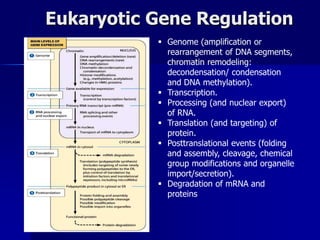
Eukaryotic Gene Regulation
            Genome (amplification or
             rearrangement of DNA segments,
             chromatin remodeling:
             decondensation/ condensation
             and DNA methylation).
            Transcription.
            Processing (and nuclear export)
             of RNA.
            Translation (and targeting) of
             protein.
            Posttranslational events (folding
             and assembly, cleavage, chemical
             group modifications and organelle
             import/secretion).
            Degradation of mRNA and
             proteins
 Proximal elements of promoter
        in prokaryote: -35 region
        in eukaryote: CAAT-box, GC-box
          UPE: upstream promoter element
          UAS: upstream activating sequence

(2) Terminator
     A DNA sequence just downstream of the coding
  segment of a gene, which is recognized by RNA
  polymerase as a signal to stop transcription.
(3) Enhancer
    A regulatory DNA sequence that greatly
enhances the transcription of a gene.
 (4) Silencer
    A DNA sequence that helps to reduce
 or shut off the expression of a nearby gene.
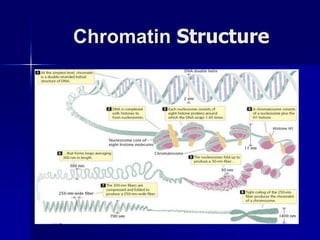
Chromatin Organization

Two forms of chromatin
  o Euchromatin – A lesser coiled
    transcriptionally active region which can be
    easily accessed by the RNA polymerase
  o Heterochromatin – A highly condensed
    transcriptionally inactive region. The genes
    in this region cannot be accessed by the
    RNA polymerases for active transcription
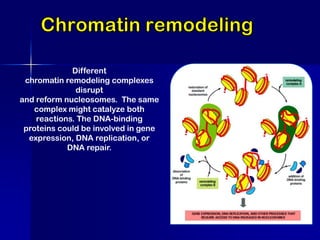
Different
 chromatin remodeling complexes
              disrupt
and reform nucleosomes. The same
   complex might catalyze both
    reactions. The DNA-binding
 proteins could be involved in gene
  expression, DNA replication, or
            DNA repair.
Chromatin Structure
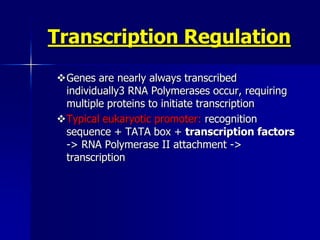
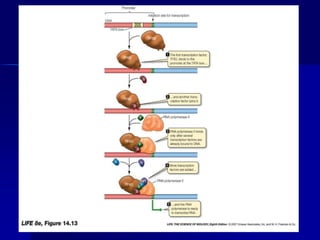
Transcription Regulation
Genes are nearly always transcribed
 individually3 RNA Polymerases occur, requiring
 multiple proteins to initiate transcription
Typical eukaryotic promoter: recognition
 sequence + TATA box + transcription factors
 -> RNA Polymerase II attachment ->
 transcription
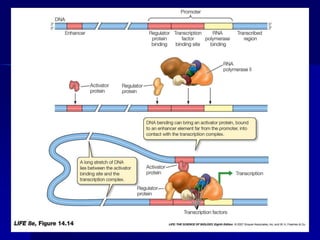
Transcription Regulation
   RNA polymerase interacts w/promoter,
    regulator sequences, & enhancer
    sequences to begin transcription
    – Regulator proteins bind to regulator sequences
      to activate transcription
          Found prior to promoter
    – Enhancer sequences bind activator proteins
          Typically far from the gene
   Silencer sequences stop transcription if
    they bind with repressor proteins
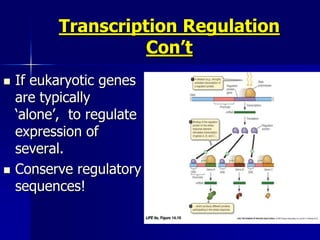
Transcription Regulation
                    Con’t
   If eukaryotic genes
    are typically
    ‘alone’, to regulate
    expression of
    several.
   Conserve regulatory
    sequences!
RNA Editing
   RNA editing is a molecular process through which some cells
    can make discrete changes to specific nucleotide
    sequences within a RNA molecule after it has been generated
    by RNA polymerase
   RNA editing is relatively rare, and common forms of RNA
    processing (e.g. splicing, 5'-capping and 3'-polyadenylation)
    are not usually included as editing. Editing events may include
    the insertion, deletion, and base substitution of nucleotides
    within the edited RNA molecule.
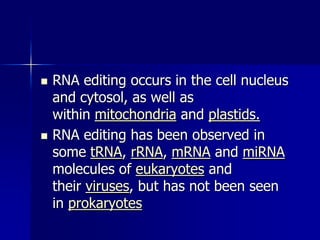
   RNA editing occurs in the cell nucleus
    and cytosol, as well as
    within mitochondria and plastids.
   RNA editing has been observed in
    some tRNA, rRNA, mRNA and miRNA
    molecules of eukaryotes and
    their viruses, but has not been seen
    in prokaryotes
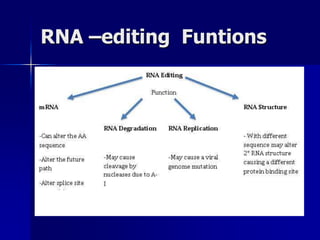
RNA –editing Funtions
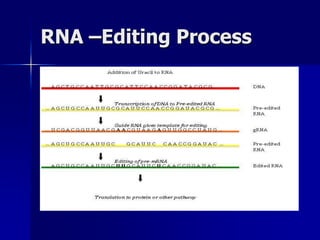
RNA –Editing Process
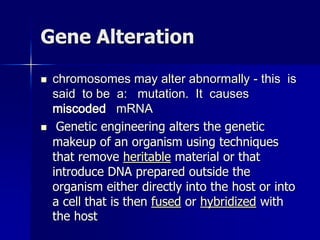
Gene Alteration

   chromosomes may alter abnormally - this is
    said to be a: mutation. It causes
    miscoded mRNA
    Genetic engineering alters the genetic
    makeup of an organism using techniques
    that remove heritable material or that
    introduce DNA prepared outside the
    organism either directly into the host or into
    a cell that is then fused or hybridized with
    the host
DNA-Methylation

DNA methylation involves the addition of
  a methyl group to the 5 position of the
  cytosine pyrimidine ring or the number
  6 nitrogen of the adenine purine ring
In addition, DNA methylation suppresses
  the expression of viral genes and other
  deleterious elements that have been
  incorporated into the genome of the
  host over time.
DNA -Methylation
   The attachment of methyl groups (-CH3) to DNA
    bases after synthesis
   Inactive DNA is generally highly methylated
    compared to DNA that is actively transcribed
     – The same genes in different tissues are more
       heavily methylated in cells where they are not
       expressed
     – Demethylating inactive genes can turn them on
   May determine long term inactivation of genes
   Methylation patterns are passed on, preserving a
    record of embryonic development
     – May account for genomic imprinting in mammals
     – Methylation permanantly turns off either the
       maternal or paternal allele of some genes
The role of methylation in
Gene Expression

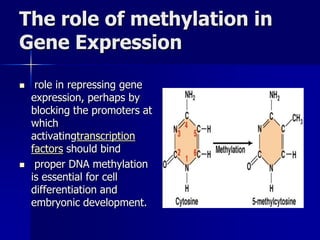
    role in repressing gene
    expression, perhaps by
    blocking the promoters at
    which
    activatingtranscription
    factors should bind
    proper DNA methylation
    is essential for cell
    differentiation and
    embryonic development.
Regulation of gene
    expression by hormone
   Hormone affect th eregulation of gene
    expression in one of two ways.
   Steroid Hormones : A group of
    hydrophobic hormones that are
    derivatives of cholesterol.The effect of
    steriod hormones in eukaryotic
    regulatory proteins by direct
    interaction with molecular signals.
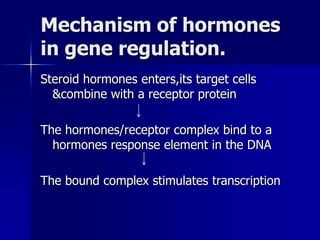
Mechanism of hormones
in gene regulation.
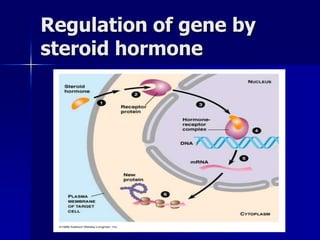
Steroid hormones enters,its target cells
  &combine with a receptor protein

The hormones/receptor complex bind to a
  hormones response element in the DNA

The bound complex stimulates transcription
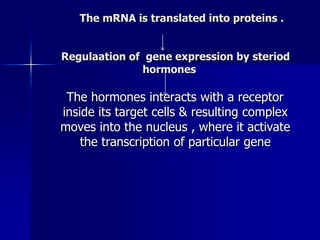
The mRNA is translated into proteins .


Regulaation of gene expression by steriod
              hormones

 The hormones interacts with a receptor
inside its target cells & resulting complex
moves into the nucleus , where it activate
    the transcription of particular gene
Regulation of gene by
steroid hormone
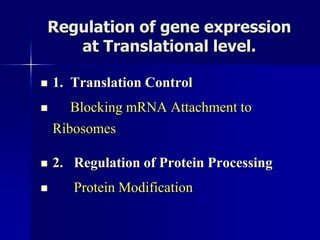
Regulation of gene expression
   at Translational level.

   1. Translation Control
      Blocking mRNA Attachment to
    Ribosomes

   2. Regulation of Protein Processing
      Protein Modification
   Inititation factors are subjected to
    phosphorylation by a no. of protein
    kinases.
   Some protein binds directly to mRNA
    & Act as translational repressor, many
    of them binding at specific sites in the
    3’ un translated region .
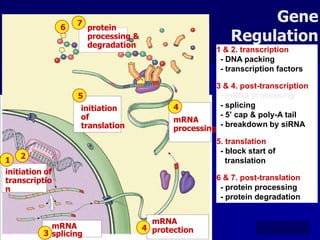
7                                             Gene
                6       protein
                        processing &
                        degradation
                                                             Regulation
                                                         1 & 2. transcription
                                                          - DNA packing
                                                          - transcription factors

                                                        3 & 4. post-transcription
                    5                                    - mRNA processing
                    initiation                4          - splicing
                    of                                   - 5’ cap & poly-A tail
                                              mRNA
                    translation               processing
                                                         - breakdown by siRNA

                                                         5. translation
                                                          - block start of
     2
1                                                           translation
initiation of
transcriptio                                             6 & 7. post-translation
n                                                         - protein processing
                                                          - protein degradation


                                         mRNA
            mRNA                       4 protection
          3 splicing
Discussion
   Regulation of Gene Expreesion in Eukaryotes :Any
    of the processes by which nuclear, cytoplasmic, or
    intercellular factors influence the differential control
    of gene action during the developmental stages of
    an organism.
THANK YOU

Braj

  • 1.
    REGULATION OF GENE EXPRESSION IN EUKARYOTES SUBMITTED TO : SUBMITTED BY Ms: SHRADDHA GOSWAMI BRAJBALA MISHRA BIOTECHNOLOGY DEPARTMENT MSC II SEM
  • 2.
    Contents  Introduction of Regulation of Gene Expression in Eukaryotes .  Cis-acting elements , Chromatin Organization & regulation at the level of processing of transcripts.  RNA-Editing ,Gene Alteration,DNA Methylation ,Regulation of gene expresson by hormone & Regulation of gene at translational level.
  • 3.
    INTRODUCTION  Objectives  Know the different levels at which gene expression is regulated in eukaryotes, and understand the principles of regulation at each level.  Understand the functional difference between promoters and enhancers.  Understand the basics of tissue-specific gene regulation.
  • 4.
    Eukaryotic Gene Expression  Gene Expression :-  “Gene expression" covers the entire process from transcription through protein synthesis  Eukaryotes have more complex means to regulate gene expression, because they have compartments (e.g., nucleus) within cells, and often multicellular structures that require differentiation of cells. .
  • 5.
    Eukaryotic Gene Regulation  Genome (amplification or rearrangement of DNA segments, chromatin remodeling: decondensation/ condensation and DNA methylation).  Transcription.  Processing (and nuclear export) of RNA.  Translation (and targeting) of protein.  Posttranslational events (folding and assembly, cleavage, chemical group modifications and organelle import/secretion).  Degradation of mRNA and proteins
  • 6.
     Proximal elementsof promoter  in prokaryote: -35 region  in eukaryote: CAAT-box, GC-box UPE: upstream promoter element UAS: upstream activating sequence (2) Terminator A DNA sequence just downstream of the coding segment of a gene, which is recognized by RNA polymerase as a signal to stop transcription.
  • 7.
    (3) Enhancer A regulatory DNA sequence that greatly enhances the transcription of a gene. (4) Silencer A DNA sequence that helps to reduce or shut off the expression of a nearby gene.
  • 8.
    Chromatin Organization Two formsof chromatin o Euchromatin – A lesser coiled transcriptionally active region which can be easily accessed by the RNA polymerase o Heterochromatin – A highly condensed transcriptionally inactive region. The genes in this region cannot be accessed by the RNA polymerases for active transcription
  • 9.
    Different chromatin remodelingcomplexes disrupt and reform nucleosomes. The same complex might catalyze both reactions. The DNA-binding proteins could be involved in gene expression, DNA replication, or DNA repair.
  • 10.
  • 11.
    Transcription Regulation Genes arenearly always transcribed individually3 RNA Polymerases occur, requiring multiple proteins to initiate transcription Typical eukaryotic promoter: recognition sequence + TATA box + transcription factors -> RNA Polymerase II attachment -> transcription
  • 13.
    Transcription Regulation  RNA polymerase interacts w/promoter, regulator sequences, & enhancer sequences to begin transcription – Regulator proteins bind to regulator sequences to activate transcription  Found prior to promoter – Enhancer sequences bind activator proteins  Typically far from the gene  Silencer sequences stop transcription if they bind with repressor proteins
  • 15.
    Transcription Regulation Con’t  If eukaryotic genes are typically ‘alone’, to regulate expression of several.  Conserve regulatory sequences!
  • 16.
    RNA Editing  RNA editing is a molecular process through which some cells can make discrete changes to specific nucleotide sequences within a RNA molecule after it has been generated by RNA polymerase  RNA editing is relatively rare, and common forms of RNA processing (e.g. splicing, 5'-capping and 3'-polyadenylation) are not usually included as editing. Editing events may include the insertion, deletion, and base substitution of nucleotides within the edited RNA molecule.
  • 17.
    RNA editing occurs in the cell nucleus and cytosol, as well as within mitochondria and plastids.  RNA editing has been observed in some tRNA, rRNA, mRNA and miRNA molecules of eukaryotes and their viruses, but has not been seen in prokaryotes
  • 18.
  • 19.
  • 20.
    Gene Alteration  chromosomes may alter abnormally - this is said to be a: mutation. It causes miscoded mRNA  Genetic engineering alters the genetic makeup of an organism using techniques that remove heritable material or that introduce DNA prepared outside the organism either directly into the host or into a cell that is then fused or hybridized with the host
  • 22.
    DNA-Methylation DNA methylation involvesthe addition of a methyl group to the 5 position of the cytosine pyrimidine ring or the number 6 nitrogen of the adenine purine ring In addition, DNA methylation suppresses the expression of viral genes and other deleterious elements that have been incorporated into the genome of the host over time.
  • 23.
    DNA -Methylation  The attachment of methyl groups (-CH3) to DNA bases after synthesis  Inactive DNA is generally highly methylated compared to DNA that is actively transcribed – The same genes in different tissues are more heavily methylated in cells where they are not expressed – Demethylating inactive genes can turn them on  May determine long term inactivation of genes  Methylation patterns are passed on, preserving a record of embryonic development – May account for genomic imprinting in mammals – Methylation permanantly turns off either the maternal or paternal allele of some genes
  • 24.
    The role ofmethylation in Gene Expression  role in repressing gene expression, perhaps by blocking the promoters at which activatingtranscription factors should bind  proper DNA methylation is essential for cell differentiation and embryonic development.
  • 25.
    Regulation of gene expression by hormone  Hormone affect th eregulation of gene expression in one of two ways.  Steroid Hormones : A group of hydrophobic hormones that are derivatives of cholesterol.The effect of steriod hormones in eukaryotic regulatory proteins by direct interaction with molecular signals.
  • 26.
    Mechanism of hormones ingene regulation. Steroid hormones enters,its target cells &combine with a receptor protein The hormones/receptor complex bind to a hormones response element in the DNA The bound complex stimulates transcription
  • 27.
    The mRNA istranslated into proteins . Regulaation of gene expression by steriod hormones The hormones interacts with a receptor inside its target cells & resulting complex moves into the nucleus , where it activate the transcription of particular gene
  • 28.
    Regulation of geneby steroid hormone
  • 29.
    Regulation of geneexpression at Translational level.  1. Translation Control  Blocking mRNA Attachment to Ribosomes  2. Regulation of Protein Processing  Protein Modification
  • 30.
    Inititation factors are subjected to phosphorylation by a no. of protein kinases.  Some protein binds directly to mRNA & Act as translational repressor, many of them binding at specific sites in the 3’ un translated region .
  • 31.
    7 Gene 6 protein processing & degradation Regulation 1 & 2. transcription - DNA packing - transcription factors 3 & 4. post-transcription 5 - mRNA processing initiation 4 - splicing of - 5’ cap & poly-A tail mRNA translation processing - breakdown by siRNA 5. translation - block start of 2 1 translation initiation of transcriptio 6 & 7. post-translation n - protein processing - protein degradation mRNA mRNA 4 protection 3 splicing
  • 32.
    Discussion  Regulation of Gene Expreesion in Eukaryotes :Any of the processes by which nuclear, cytoplasmic, or intercellular factors influence the differential control of gene action during the developmental stages of an organism.
  • 33.