LIMIT TEST
• The quantitative or semiquantitative test designed to identify and control small
quantity of impurity which is likely to be present in the substance.
• Purpose: To determine the inorganic impurities present in the compound.
• TYpes: Limit test for chlorides, sulphates, iron, lead and heavy metal are carried
out in Nessler cylinders.
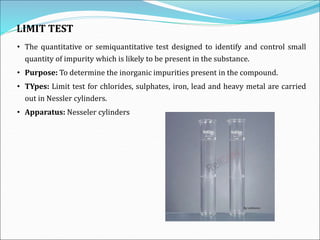
• Apparatus: Nesseler cylinders
Limit test for chloride
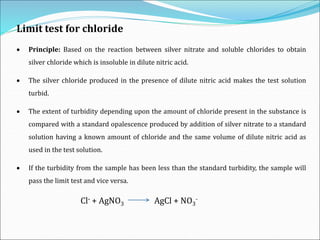
 Principle: Based on the reaction between silver nitrate and soluble chlorides to obtain
silver chloride which is insoluble in dilute nitric acid.
 The silver chloride produced in the presence of dilute nitric acid makes the test solution
turbid.
 The extent of turbidity depending upon the amount of chloride present in the substance is
compared with a standard opalescence produced by addition of silver nitrate to a standard
solution having a known amount of chloride and the same volume of dilute nitric acid as
used in the test solution.
 If the turbidity from the sample has been less than the standard turbidity, the sample will
pass the limit test and vice versa.
Cl- + AgNO3 AgCl + NO3
-
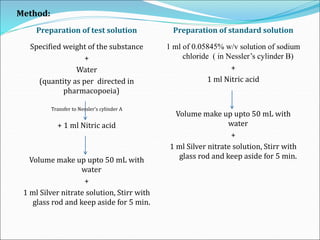
Preparation of test solution Preparation of standard solution
Specified weight of the substance
+
Water
(quantity as per directed in
pharmacopoeia)
+ 1 ml Nitric acid
Volume make up upto 50 mL with
water
+
1 ml Silver nitrate solution, Stirr with
glass rod and keep aside for 5 min.
1 ml of 0.05845% w/v solution of sodium
chloride ( in Nessler’s cylinder B)
+
1 ml Nitric acid
Volume make up upto 50 mL with
water
+
1 ml Silver nitrate solution, Stirr with
glass rod and keep aside for 5 min.
Method:
Transfer to Nessler’s cylinder A
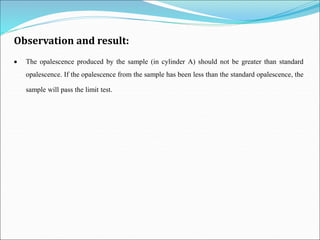
Observation and result:
 The opalescence produced by the sample (in cylinder A) should not be greater than standard
opalescence. If the opalescence from the sample has been less than the standard opalescence, the
sample will pass the limit test.
Limit test for sulphate
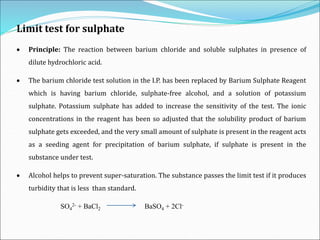
 Principle: The reaction between barium chloride and soluble sulphates in presence of
dilute hydrochloric acid.
 The barium chloride test solution in the I.P. has been replaced by Barium Sulphate Reagent
which is having barium chloride, sulphate-free alcohol, and a solution of potassium
sulphate. Potassium sulphate has added to increase the sensitivity of the test. The ionic
concentrations in the reagent has been so adjusted that the solubility product of barium
sulphate gets exceeded, and the very small amount of sulphate is present in the reagent acts
as a seeding agent for precipitation of barium sulphate, if sulphate is present in the
substance under test.
 Alcohol helps to prevent super-saturation. The substance passes the limit test if it produces
turbidity that is less than standard.
SO4
2- + BaCl2 BaSO4 + 2Cl-
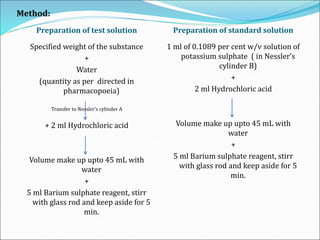
Preparation of test solution Preparation of standard solution
Specified weight of the substance
+
Water
(quantity as per directed in
pharmacopoeia)
+ 2 ml Hydrochloric acid
Volume make up upto 45 mL with
water
+
5 ml Barium sulphate reagent, stirr
with glass rod and keep aside for 5
min.
1 ml of 0.1089 per cent w/v solution of
potassium sulphate ( in Nessler’s
cylinder B)
+
2 ml Hydrochloric acid
Volume make up upto 45 mL with
water
+
5 ml Barium sulphate reagent, stirr
with glass rod and keep aside for 5
min.
Method:
Transfer to Nessler’s cylinder A
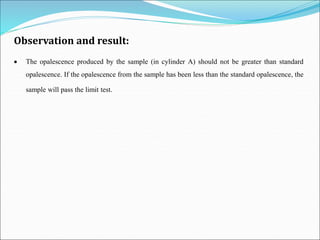
Observation and result:
 The opalescence produced by the sample (in cylinder A) should not be greater than standard
opalescence. If the opalescence from the sample has been less than the standard opalescence, the
sample will pass the limit test.
Limit test for Iron
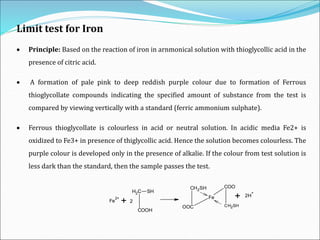
 Principle: Based on the reaction of iron in arnmonical solution with thioglycollic acid in the
presence of citric acid.
 A formation of pale pink to deep reddish purple colour due to formation of Ferrous
thioglycollate compounds indicating the specified amount of substance from the test is
compared by viewing vertically with a standard (ferric ammonium sulphate).
 Ferrous thioglycollate is colourless in acid or neutral solution. In acidic media Fe2+ is
oxidized to Fe3+ in presence of thiglycollic acid. Hence the solution becomes colourless. The
purple colour is developed only in the presence of alkalie. If the colour from test solution is
less dark than the standard, then the sample passes the test.
Fe
2+
+ 2
COOH
SH
C
H2
OOC
CH2SH
CH2SH
COO
Fe + 2H
+
 Citric acid does not allow the precipitation of iron by ammonia by forming a complex with it.
The colour due to ferrous compound gets destroyed by oxidising agents and alkalies. The
thioglycollic acid reduces iron (III) to iron (II).
 Thioglycollic acid, is a analogue of glycollic acid, which is prepared by the action of potassium
hydrogen sulphide on monochloroacetic acid.
 It is a colourless liquid having unpleasant odour. This test is very sensitive. Interference of
other metal cations is eliminated by making use of 20% citric acid, which forms a complex with
other metal cations.
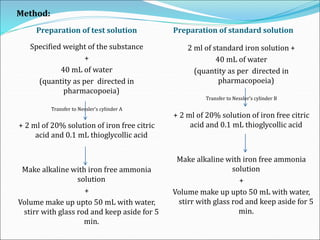
Preparation of test solution Preparation of standard solution
Specified weight of the substance
+
40 mL of water
(quantity as per directed in
pharmacopoeia)
+ 2 ml of 20% solution of iron free citric
acid and 0.1 mL thioglycollic acid
Make alkaline with iron free ammonia
solution
+
Volume make up upto 50 mL with water,
stirr with glass rod and keep aside for 5
min.
Method:
Transfer to Nessler’s cylinder A
2 ml of standard iron solution +
40 mL of water
(quantity as per directed in
pharmacopoeia)
+ 2 ml of 20% solution of iron free citric
acid and 0.1 mL thioglycollic acid
Make alkaline with iron free ammonia
solution
+
Volume make up upto 50 mL with water,
stirr with glass rod and keep aside for 5
min.
Transfer to Nessler’s cylinder B
 Standard iron solution: It is prepared by adding 0.173 g of ferric ammonium sulphate
[NH4Fe(SO4)2.12H2O] to 1.5 ml of HCl and adding sufficient water to produce 1000 ml. Each
ml of solution contains 0.02 mg of iron.
Observation and result:
 The colour produced by the sample (in cylinder A) should not be greater than standard
colour. If the colour from the sample has been less than the standard colour, the sample will
pass the limit test.
Limit test for Arsenic
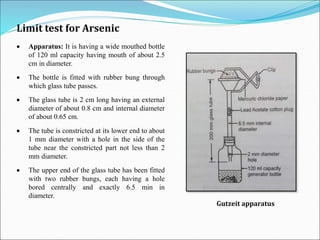
 Apparatus: It is having a wide mouthed bottle
of 120 ml capacity having mouth of about 2.5
cm in diameter.
 The bottle is fitted with rubber bung through
which glass tube passes.
 The glass tube is 2 cm long having an external
diameter of about 0.8 cm and internal diameter
of about 0.65 cm.
 The tube is constricted at its lower end to about
1 mm diameter with a hole in the side of the
tube near the constricted part not less than 2
mm diameter.
 The upper end of the glass tube has been fitted
with two rubber bungs, each having a hole
bored centrally and exactly 6.5 min in
diameter.
Gutzeit apparatus
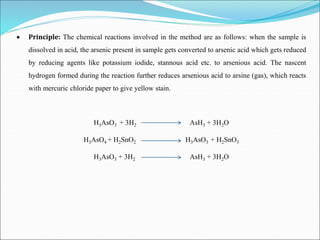
 Principle: The chemical reactions involved in the method are as follows: when the sample is
dissolved in acid, the arsenic present in sample gets converted to arsenic acid which gets reduced
by reducing agents like potassium iodide, stannous acid etc. to arsenious acid. The nascent
hydrogen formed during the reaction further reduces arsenious acid to arsine (gas), which reacts
with mercuric chloride paper to give yellow stain.
H3AsO3 + 3H2 AsH3 + 3H2O
H3AsO4 + H2SnO2 H3AsO3 + H2SnO3
H3AsO3 + 3H2 AsH3 + 3H2O
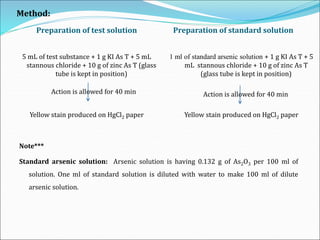
Preparation of test solution Preparation of standard solution
5 mL of test substance + 1 g KI As T + 5 mL
stannous chloride + 10 g of zinc As T (glass
tube is kept in position)
Yellow stain produced on HgCl2 paper
Method:
Action is allowed for 40 min
1 ml of standard arsenic solution + 1 g KI As T + 5
mL stannous chloride + 10 g of zinc As T
(glass tube is kept in position)
Yellow stain produced on HgCl2 paper
Action is allowed for 40 min
Note***
Standard arsenic solution: Arsenic solution is having 0.132 g of As2O3 per 100 ml of
solution. One ml of standard solution is diluted with water to make 100 ml of dilute
arsenic solution.
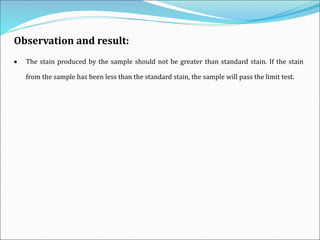
Observation and result:
 The stain produced by the sample should not be greater than standard stain. If the stain
from the sample has been less than the standard stain, the sample will pass the limit test.
Limit test for Lead
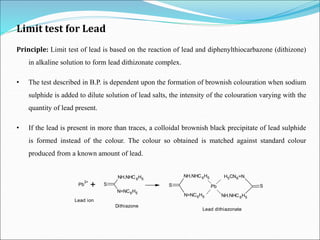
Principle: Limit test of lead is based on the reaction of lead and diphenylthiocarbazone (dithizone)
in alkaline solution to form lead dithizonate complex.
• The test described in B.P. is dependent upon the formation of brownish colouration when sodium
sulphide is added to dilute solution of lead salts, the intensity of the colouration varying with the
quantity of lead present.
• If the lead is present in more than traces, a colloidal brownish black precipitate of lead sulphide
is formed instead of the colour. The colour so obtained is matched against standard colour
produced from a known amount of lead.
Pb
2+
+
N=NC6H5
S
NH.NHC6H5
N=NC6H5
S
NH.NHC6H5
Pb
H5CN6=N
S
NH.NHC6H5
Lead ion
Dithiazone
Lead dithiazonate
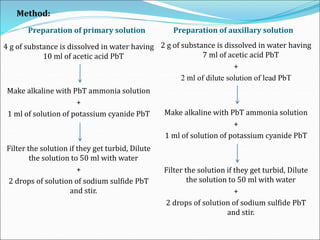
Preparation of primary solution Preparation of auxillary solution
4 g of substance is dissolved in water having
10 ml of acetic acid PbT
Make alkaline with PbT ammonia solution
+
1 ml of solution of potassium cyanide PbT
Filter the solution if they get turbid, Dilute
the solution to 50 ml with water
+
2 drops of solution of sodium sulfide PbT
and stir.
Method:
2 g of substance is dissolved in water having
7 ml of acetic acid PbT
+
2 ml of dilute solution of lead PbT
Make alkaline with PbT ammonia solution
+
1 ml of solution of potassium cyanide PbT
Filter the solution if they get turbid, Dilute
the solution to 50 ml with water
+
2 drops of solution of sodium sulfide PbT
and stir.
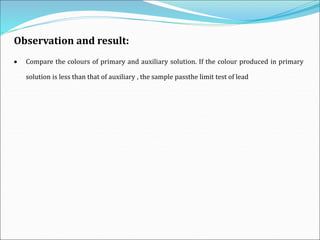
Observation and result:
 Compare the colours of primary and auxiliary solution. If the colour produced in primary
solution is less than that of auxiliary , the sample passthe limit test of lead
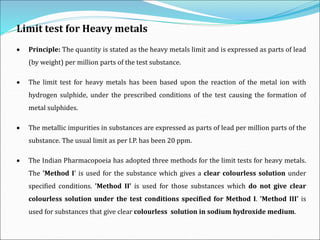
Limit test for Heavy metals
 Principle: The quantity is stated as the heavy metals limit and is expressed as parts of lead
(by weight) per million parts of the test substance.
 The limit test for heavy metals has been based upon the reaction of the metal ion with
hydrogen sulphide, under the prescribed conditions of the test causing the formation of
metal sulphides.
 The metallic impurities in substances are expressed as parts of lead per million parts of the
substance. The usual limit as per I.P. has been 20 ppm.
 The Indian Pharmacopoeia has adopted three methods for the limit tests for heavy metals.
The 'Method I' is used for the substance which gives a clear colourless solution under
specified conditions. 'Method II' is used for those substances which do not give clear
colourless solution under the test conditions specified for Method I. 'Method III' is
used for substances that give clear colourless solution in sodium hydroxide medium.
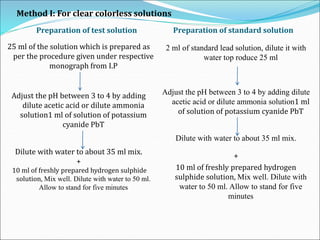
Preparation of test solution Preparation of standard solution
25 ml of the solution which is prepared as
per the procedure given under respective
monograph from I.P
Adjust the pH between 3 to 4 by adding
dilute acetic acid or dilute ammonia
solution1 ml of solution of potassium
cyanide PbT
Dilute with water to about 35 ml mix.
+
10 ml of freshly prepared hydrogen sulphide
solution, Mix well. Dilute with water to 50 ml.
Allow to stand for five minutes
Method I: For clear colorless solutions
2 ml of standard lead solution, dilute it with
water top roduce 25 ml
Adjust the pH between 3 to 4 by adding dilute
acetic acid or dilute ammonia solution1 ml
of solution of potassium cyanide PbT
Dilute with water to about 35 ml mix.
+
10 ml of freshly prepared hydrogen
sulphide solution, Mix well. Dilute with
water to 50 ml. Allow to stand for five
minutes
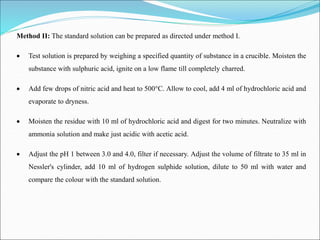
Method II: The standard solution can be prepared as directed under method I.
 Test solution is prepared by weighing a specified quantity of substance in a crucible. Moisten the
substance with sulphuric acid, ignite on a low flame till completely charred.
 Add few drops of nitric acid and heat to 500°C. Allow to cool, add 4 ml of hydrochloric acid and
evaporate to dryness.
 Moisten the residue with 10 ml of hydrochloric acid and digest for two minutes. Neutralize with
ammonia solution and make just acidic with acetic acid.
 Adjust the pH 1 between 3.0 and 4.0, filter if necessary. Adjust the volume of filtrate to 35 ml in
Nessler's cylinder, add 10 ml of hydrogen sulphide solution, dilute to 50 ml with water and
compare the colour with the standard solution.
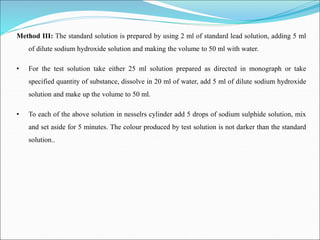
Method III: The standard solution is prepared by using 2 ml of standard lead solution, adding 5 ml
of dilute sodium hydroxide solution and making the volume to 50 ml with water.
• For the test solution take either 25 ml solution prepared as directed in monograph or take
specified quantity of substance, dissolve in 20 ml of water, add 5 ml of dilute sodium hydroxide
solution and make up the volume to 50 ml.
• To each of the above solution in nesselrs cylinder add 5 drops of sodium sulphide solution, mix
and set aside for 5 minutes. The colour produced by test solution is not darker than the standard
solution..
THANK YOU