ERRORS IN PHARMACEUTICALS
PRAMOD KUMAR
INTRODUCTION OF ERRORS
Error is the difference between the true result (or accepted true result) and the
measured result.
•Relative Error = Measured Mean Value – True Value
True Value
•And the difference between the experimental value and true value is termed as
Absolute Error.
• Absolute error may be negative or positive.
• If the error in an analysis is large, serious consequences may result.
• As reliability, reproducibility and accuracy are the basis of analytical chemistry.
• A patient may undergo expensive & even dangerous medical treatment based on an
incorrect laboratory result because of an analytical error.
SOURCES OF ERRORS
Errors in the results in an analysis can be resulted from various sources.
Some major sources of errors in pharmaceutical analysis are described here under:
1. Human Sources:
• The Qualification and experience of an analyst performing the analysis has major
impact on error in results.
• If an experiment is performed by inexperienced person the chances of error are
more as compared to same experiment performed by the experienced analyst.
2. Instrumental, Apparatus and Glassware:
If the Instrument, Glassware as well as apparatus used in analysis is of low quality and
uncalibrated the chances of error are increased at significant extent.
3. Experimental conditions:
If the analysis is carried out in the conditions which are unfavorable for
particular experiment or analysis the desirable result will not obtained.
4. Constitutes used in analysis:
If various constituents like standards, solvents, reagents etc used in analysis
are not of desired quality and purity the results will be obtained with errors.
5. Procedure:
If the analytical procedure used in analysis is not validated and if validated but
not fallowed carefully the errors on the results will be obtained.
TYPES OF ERRORS
Errors that may be broadly divided into two heads, namely :
(i) Determinate (systematic)Errors
(ii) Indeterminate (random) Errors
1. Determinate (Systematic) Errors –These are errors that possess a definite
value with a reasonable cause and these avoidable errors may be measured and
accounted for rectification.
The most important errors belonging to this particular class are :
(a) Personal Errors : They are exclusively caused due to ‘personal equation’ of an
analyst and do not due to either on the prescribed procedure or methodology
b) Instrumental Errors :
These are invariably caused due to faulty and uncalibrated instruments, such as : pH meters, uv-
spectrophotometers, potentiometers etc.
(c) Reagent Errors :
The errors that are solely introduced by virtue of the individual reagents, for instance : impurities
inherently present in reagents ; high temperature volatalization of platinum (Pt) ; unwanted
introduction of ‘foreign substances’ caused by the action of reagents on either porcelain or glass
apparatus.
(d) Constant Errors :
They are observed to be rather independent of the magnitude of the measured amount ; and turn
out to be relatively less significant as the magnitude enhances.
(e) Proportional Errors : The absolute value of this kind of error changes with the
size of the sample in such a fashion that the relative error remains constant. It is usually
incorporated by a material that directly interferes in an analytical procedure.
(f) Errors due to Methodology : Both improper (incorrect) sampling and
incompleteness of a reaction often lead to serious errors.
A few typical examples invariably encountered in titrimetric and gravimetric analysis
(g) Additive Errors : It has been observed that the additive errors are independent of
the quantum of the substances actually present in the assay.
Examples : (i) Errors caused due to weights, and
(ii) Loss in weight of a crucible in which a precipitate is incinerated.
2. Indeterminate (Random) Errors-
The second type of error includes the Indeterminate Errors Generally Called Accidental Or Random Errors.
They are revealed by small differences in successive measurements made by the same analyst under virtually
identical conditions.
These errors cannot be Predicted Or Determined.
These accidental errors will follow a random distribution thus a mathematical law of probability can be applied to
arrive at some conclusion regarding the most probability can be applied to arrive at some conclusion regarding the
most probable series of measurements.
To give a simple example an analyst reads incorrectly the instrument panel reading in pH meter or
spectrophotometer. He notes down this reading which is used in calculations based on in pH meter or
spectrophotometer. He notes down these reading which is used in calculations based on this reading.
Salient Features of Indeterminate Errors
1)Repeated measurement of the same variable several times and subsequent refinement to the extent
where it is simply a coincidence if the corresponding replicates eventually agree to the last digit,
(2)Both unpredictable and imperceptible factors are unavoidably incorporated in the results what
generally appear to be ‘random fluctuations’ in the measured quantity.
(3)Recognition of specific definite variables which are beyond anyone’s control lying very close to the
performance limit of an instrument, such as : temperature variations, noise as well as drift from an
electronic circuit, and vibrations caused to a building by heavy vehicular-traffic
 1. Calibration Of Apparatus And Application Of Corrections
 All instruments (weights, flasks, burettes, pipettes, etc.) should be calibrated, and the
appropriate corrections applied to the original measurements.
 In some cases where an error cannot be eliminated, it is possible to apply a correction for the
effect that it produces; thus, an impurity in a weighed precipitate may be determined and its
weight deducted.
2. Running A Blank Determination
 This consists in carrying out a separate determination, the sample being omitted, under exactly
the same experimental conditions as are employed in the actual analysis of the sample.
 The object is to find out the effect of the impurities introduced through the reagents and vessels,
or to determine the excess of standard solution necessary to establish the end-point under the
conditions met with in the titration of the unknown sample.
 A large blank correction is undesirable, because the exact value then becomes uncertain and the
precision of the analysis is reduced.
Running A Control Determination
By running a control determination parallelly to the sample by taking standard under same
experimental conditions the error can reduce at very possible extent.
However a standard should contain same weight of the constituent present in unknown sample..
The weight of the constituent in the unknown can then be calculated from the relation:
Results Found For Standard = Weight of Constituent in Standard
Results Found For Unknown X
Where, x is the weight of the constituent in the unknown.
Standard samples include primary standards (sodium oxalate, potassium hydrogen phthalate,
arsenic(II1) oxide, and benzoic acid) and ores, ceramic materials, irons, steels, steel-making
alloys, and non- ferrous alloys.
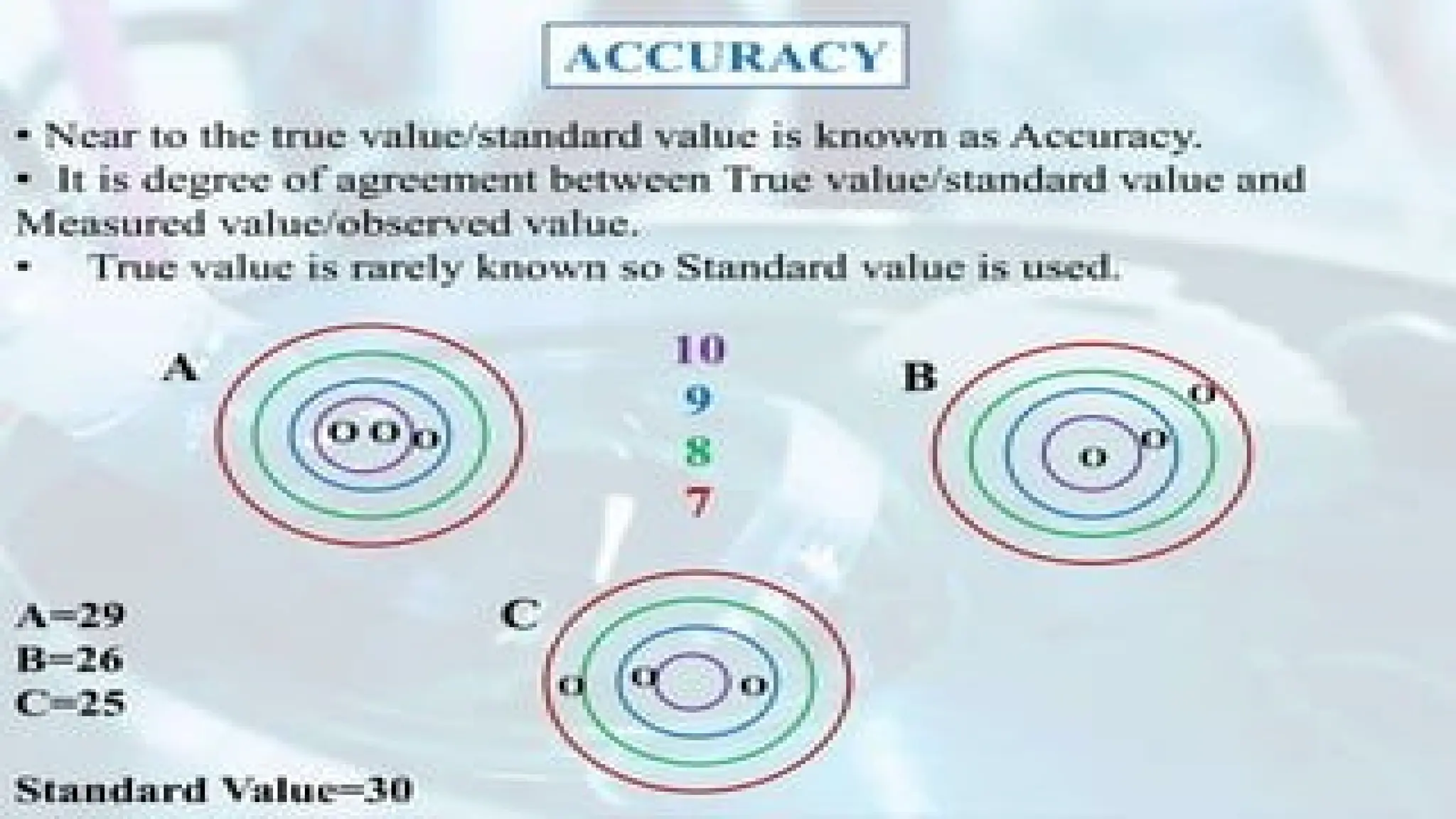
The Accuracy Of A Determination May Be Defined As The Concordance Between The Data And The True Or Most
Probable Value.
 Accuracy Is The Agreement Between The Data And The True Value Or It Refers To The Closeness Of A Single
Measurement To Its True Value.
 The Accuracy Is Used To Denote The Agreement Of An Experimental Result Or The Agreement Of The Mean
Value X Of A Series Of Experimental Results With The True Value, And It Is Usually Expressed In Terms Of
Error.
 The Difference Btw The Mean And The True Value Is Known As The Absolute Error
 The Relative Error Is Found By Dividing The Absolute Error By The True Value.
 Relative Error Is Usually Reported On A Percentage Basis By Multiplying The Relative Error By 100 Or On A
Parts Per 1000 Basis By Multiplying The Relative Error By 1000.
ACCURACY
• The 2 analytical methods to determine the accuracy:
1. Absolute Method
2. Comparative Method
1) Absolute method : A synthetic sample containing known amounts of the constituents is used.
• Known amounts of a constituent can be obtained by weighing out pure elements or compounds of known stoichiometric
composition.
• These substances, primary standards may be available commercially or they may be prepared by the analyst and subjected
to rigorous purification by recrystallization etc. – substance must be known purity.
• Test for accuracy carried out and result expressed as parts per thousand, is a measure of accuracy of the method in the
absence of foreign substance
2) Comparative Method: As in the analysis of a mineral it may be impossible to prepare solid synthetic samples of the desired
composition .
It is then necessary to resort to standard samples of the material in which the content of the constituent sought has been determined
by one or more supposedly “accurate” methods of analysis. is method involving secondary standards.
• Standard samples are issued by CDL.
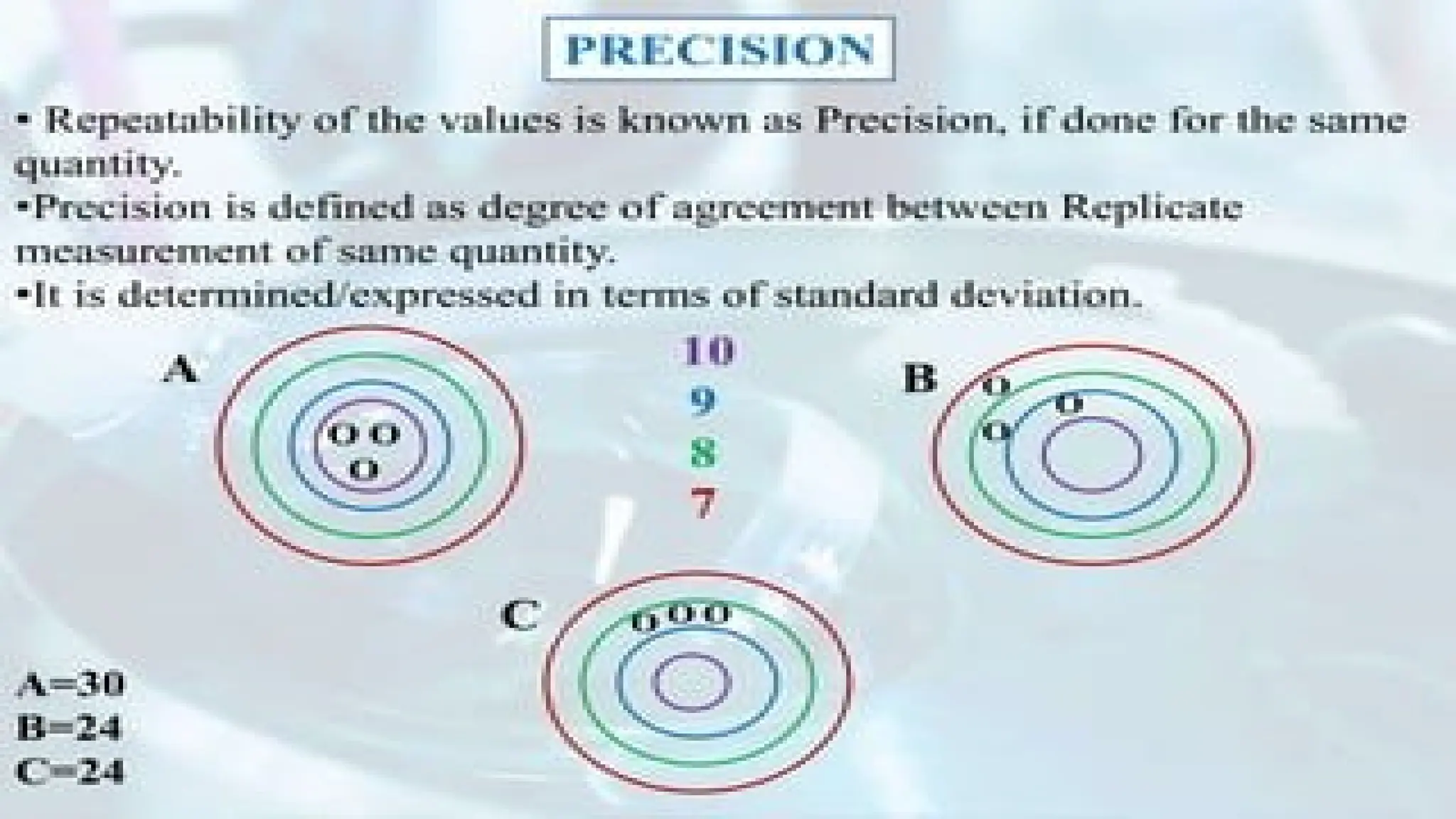
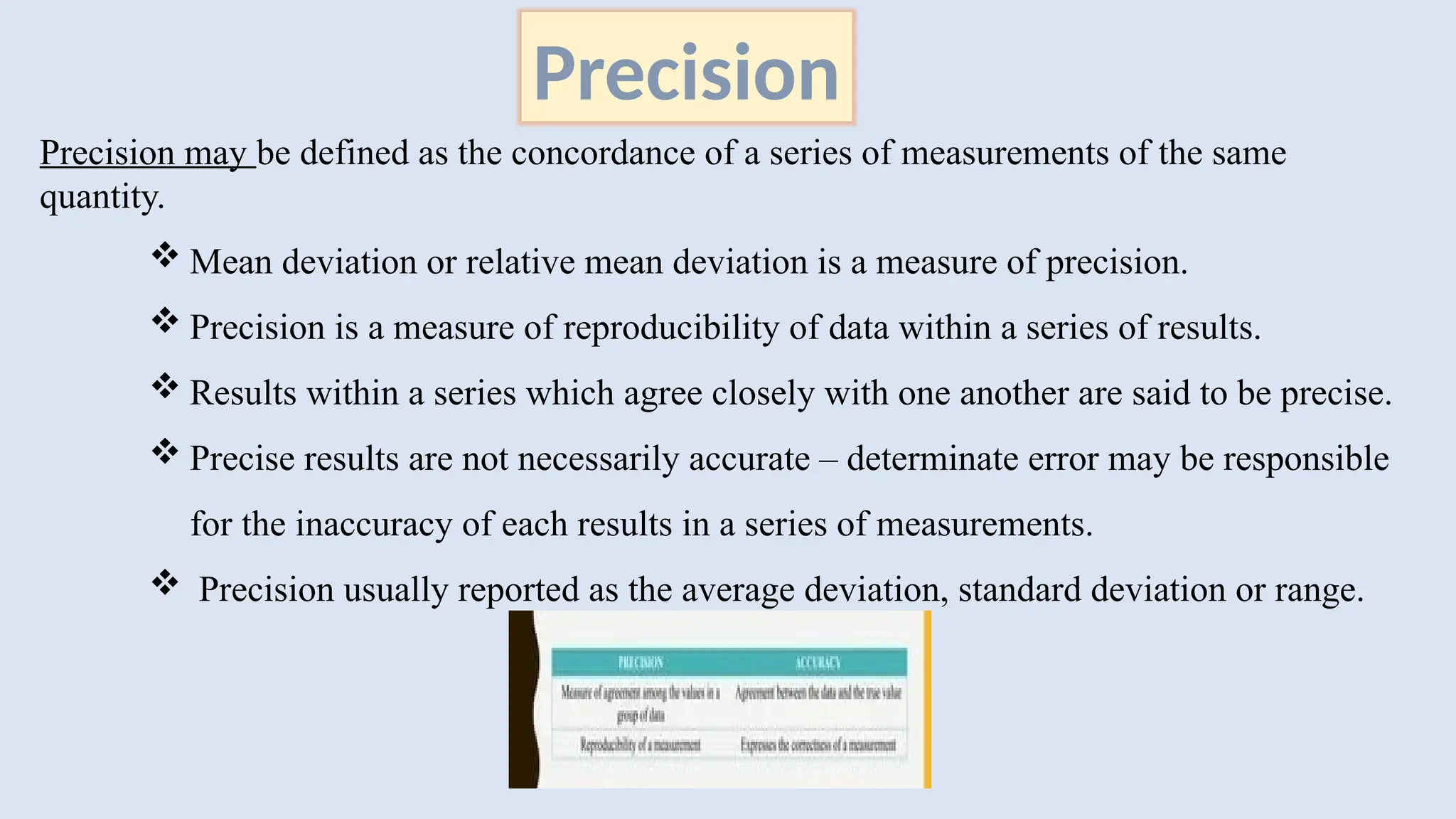
Precision may be defined as the concordance of a series of measurements of the same
quantity.
 Mean deviation or relative mean deviation is a measure of precision.
 Precision is a measure of reproducibility of data within a series of results.
 Results within a series which agree closely with one another are said to be precise.
 Precise results are not necessarily accurate – determinate error may be responsible
for the inaccuracy of each results in a series of measurements.
 Precision usually reported as the average deviation, standard deviation or range.
Precision
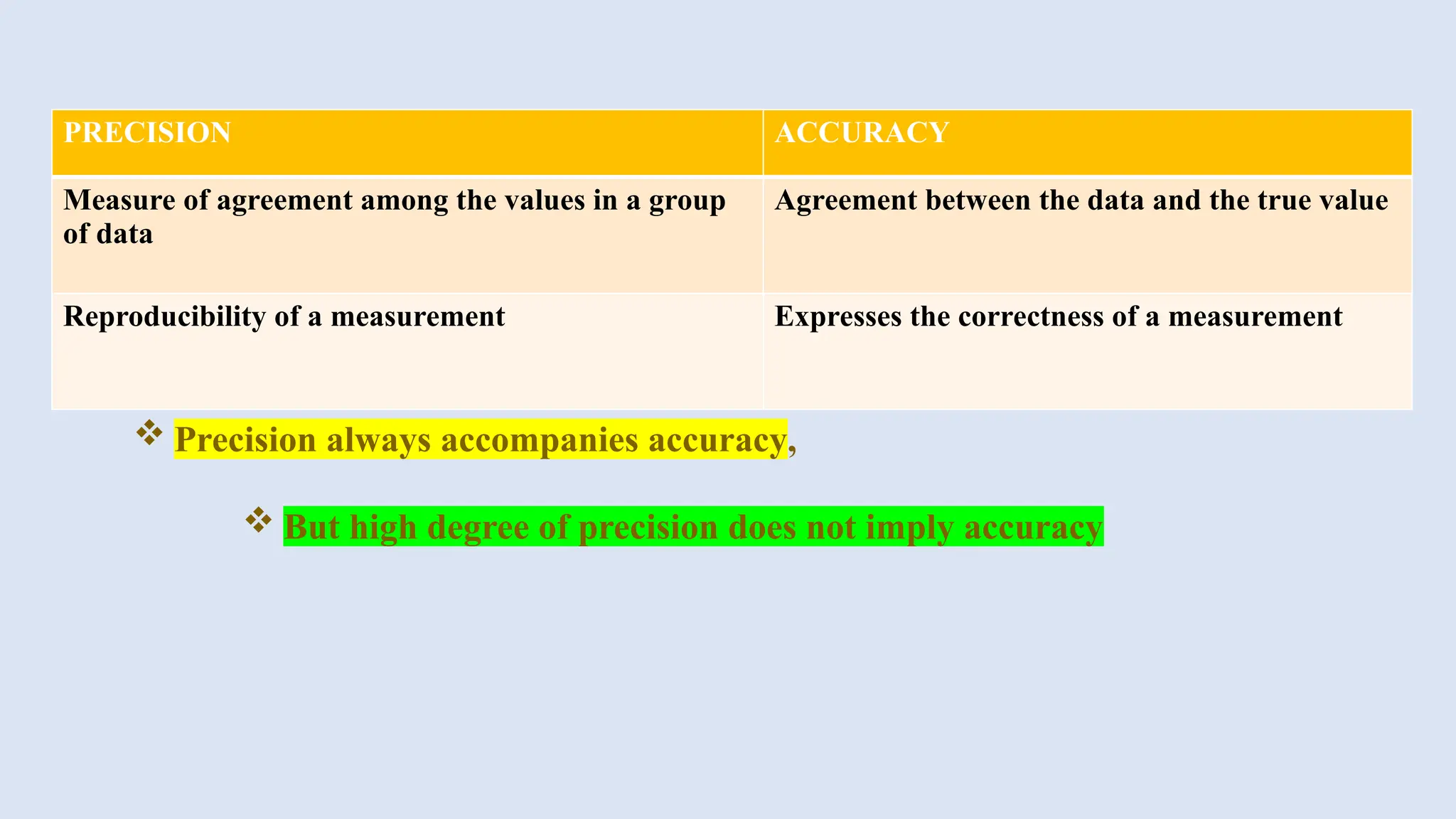
PRECISION ACCURACY
Measure of agreement among the values in a group
of data
Agreement between the data and the true value
Reproducibility of a measurement Expresses the correctness of a measurement
 Precision always accompanies accuracy,
 But high degree of precision does not imply accuracy
PRECISION MEASURES RUGGEDNESS TESTS
Ruggedness Tests describes the influence of small but reasonable alterations in the procedures of the quality of analysis .E.g. of
these minor variations are:
• Source and age of reagents
• Concentration and stability of solution and reagents
• Heating rate
• Thermometer errors
• Column temperature
• Humidity
• Voltage
• Fluctuation
Variations of column to column, plate to plate, analyst to analyst and instrument to instrument
 The various types of inter laboratory checks should be carried out to ensure that the analyst who developed the method is
not the only one who can obtain satisfactory results from the procedure.
 All details are written into the testing directions and are not in advertently omitted
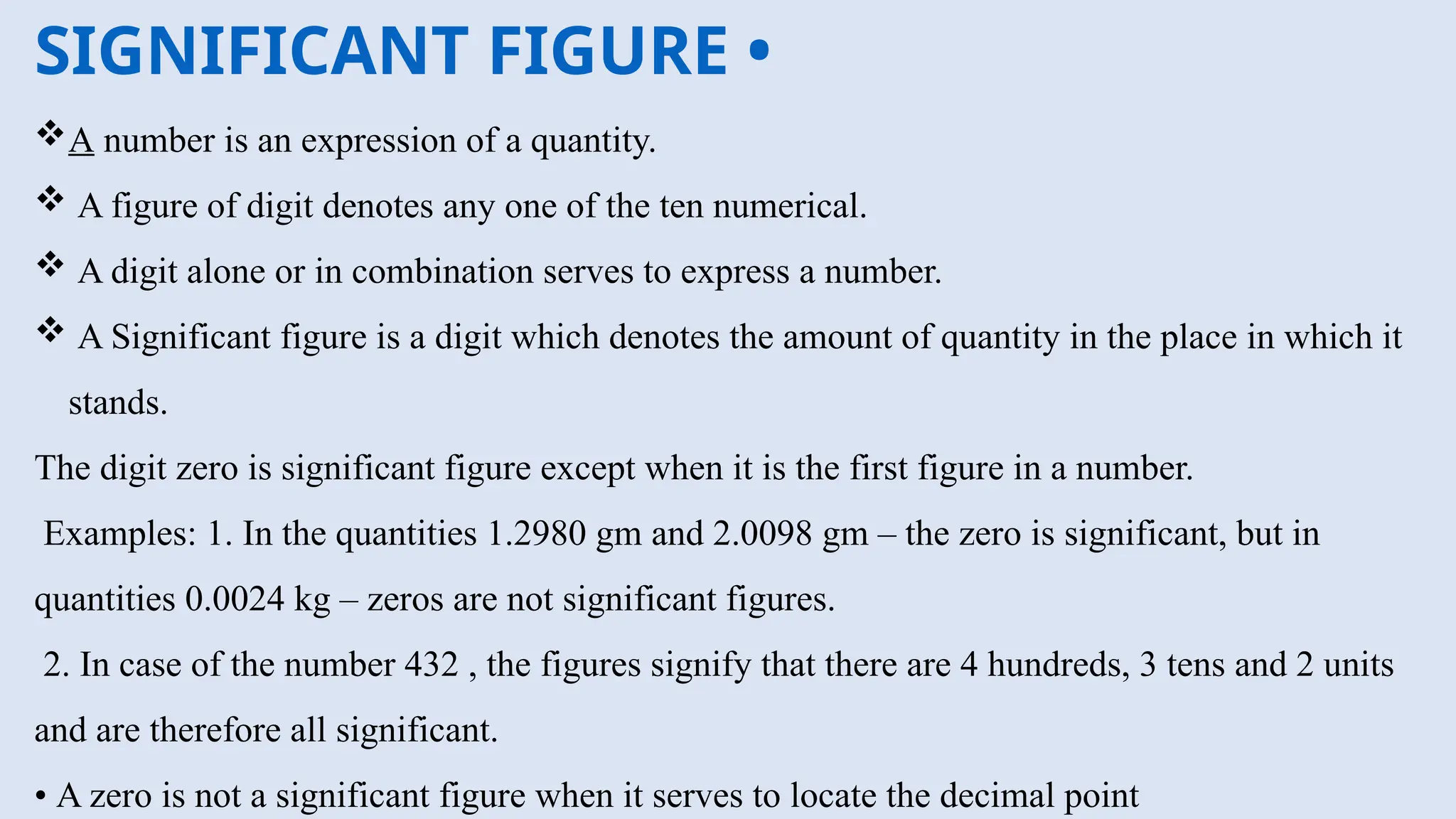
SIGNIFICANT FIGURE •
A number is an expression of a quantity.
 A figure of digit denotes any one of the ten numerical.
 A digit alone or in combination serves to express a number.
 A Significant figure is a digit which denotes the amount of quantity in the place in which it
stands.
The digit zero is significant figure except when it is the first figure in a number.
Examples: 1. In the quantities 1.2980 gm and 2.0098 gm – the zero is significant, but in
quantities 0.0024 kg – zeros are not significant figures.
2. In case of the number 432 , the figures signify that there are 4 hundreds, 3 tens and 2 units
and are therefore all significant.
• A zero is not a significant figure when it serves to locate the decimal point
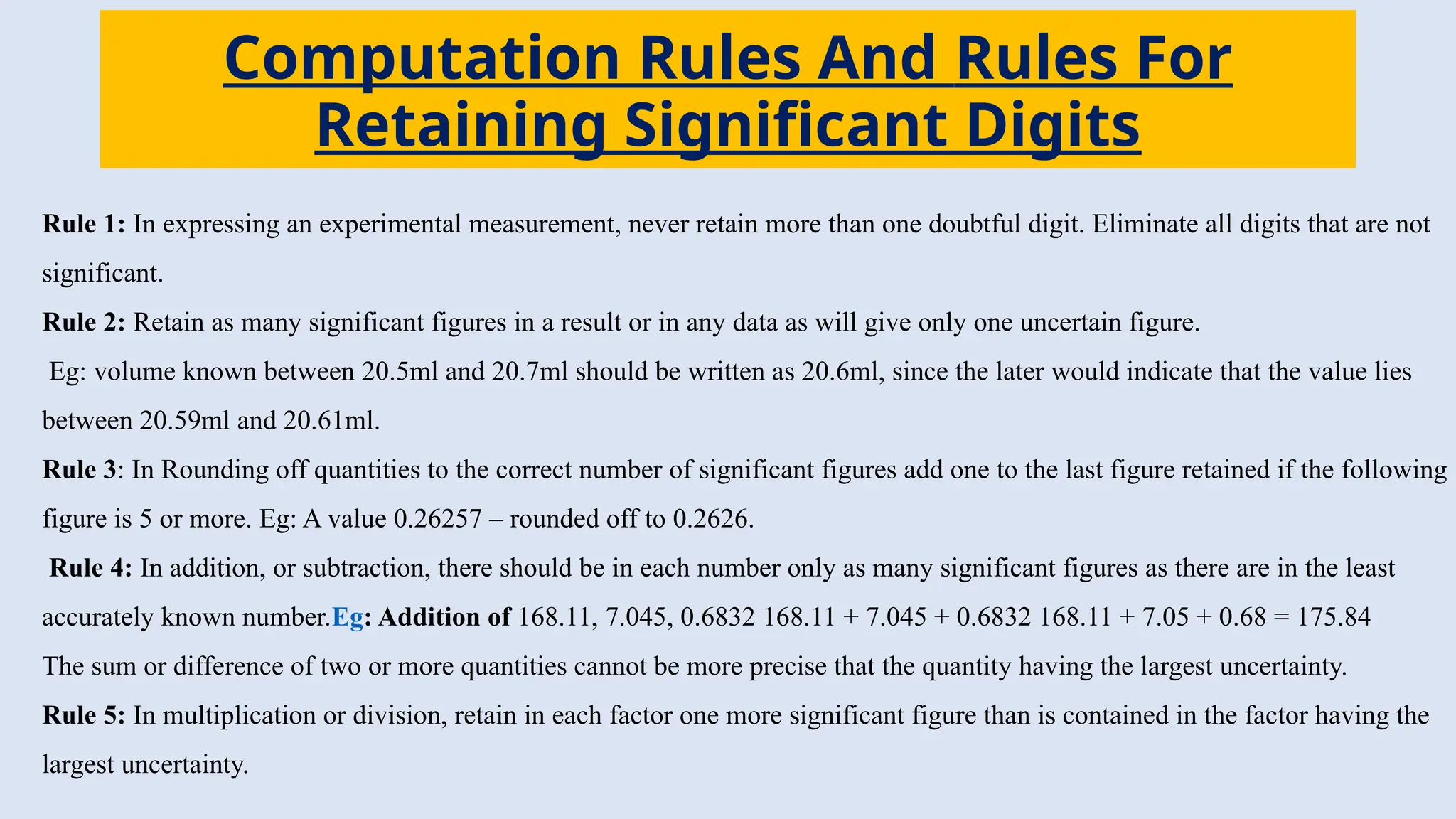
Computation Rules And Rules For
Retaining Significant Digits
Rule 1: In expressing an experimental measurement, never retain more than one doubtful digit. Eliminate all digits that are not
significant.
Rule 2: Retain as many significant figures in a result or in any data as will give only one uncertain figure.
Eg: volume known between 20.5ml and 20.7ml should be written as 20.6ml, since the later would indicate that the value lies
between 20.59ml and 20.61ml.
Rule 3: In Rounding off quantities to the correct number of significant figures add one to the last figure retained if the following
figure is 5 or more. Eg: A value 0.26257 – rounded off to 0.2626.
Rule 4: In addition, or subtraction, there should be in each number only as many significant figures as there are in the least
accurately known number.Eg: Addition of 168.11, 7.045, 0.6832 168.11 + 7.045 + 0.6832 168.11 + 7.05 + 0.68 = 175.84
The sum or difference of two or more quantities cannot be more precise that the quantity having the largest uncertainty.
Rule 5: In multiplication or division, retain in each factor one more significant figure than is contained in the factor having the
largest uncertainty.
Rounding
Rounding is the procedure of dropping non-significant digits in a calculation result and
adjusting the last digit reported.
•1. If this digit is greater than 5 or 5 followed by non zeros, add 1 to the digit to be retained
and drop all digits farther to the right.
•2. If this digit is less than 5, simply drop it and all digits further to the right.
•3. If this digit is simply 5 or 5 followed by zeros, and if the last digit to be retained is
even, just drop the 5 and any zeros after it.
•If the last digit to be retained is odd, add 1 to it and drop the 5 and any zeros after it.

Errors and types of errors found in Pharmaceutical analysis

  • 1.
  • 2.
    INTRODUCTION OF ERRORS Erroris the difference between the true result (or accepted true result) and the measured result. •Relative Error = Measured Mean Value – True Value True Value •And the difference between the experimental value and true value is termed as Absolute Error. • Absolute error may be negative or positive. • If the error in an analysis is large, serious consequences may result. • As reliability, reproducibility and accuracy are the basis of analytical chemistry. • A patient may undergo expensive & even dangerous medical treatment based on an incorrect laboratory result because of an analytical error.
  • 3.
    SOURCES OF ERRORS Errorsin the results in an analysis can be resulted from various sources. Some major sources of errors in pharmaceutical analysis are described here under: 1. Human Sources: • The Qualification and experience of an analyst performing the analysis has major impact on error in results. • If an experiment is performed by inexperienced person the chances of error are more as compared to same experiment performed by the experienced analyst. 2. Instrumental, Apparatus and Glassware: If the Instrument, Glassware as well as apparatus used in analysis is of low quality and uncalibrated the chances of error are increased at significant extent.
  • 4.
    3. Experimental conditions: Ifthe analysis is carried out in the conditions which are unfavorable for particular experiment or analysis the desirable result will not obtained. 4. Constitutes used in analysis: If various constituents like standards, solvents, reagents etc used in analysis are not of desired quality and purity the results will be obtained with errors. 5. Procedure: If the analytical procedure used in analysis is not validated and if validated but not fallowed carefully the errors on the results will be obtained.
  • 5.
    TYPES OF ERRORS Errorsthat may be broadly divided into two heads, namely : (i) Determinate (systematic)Errors (ii) Indeterminate (random) Errors 1. Determinate (Systematic) Errors –These are errors that possess a definite value with a reasonable cause and these avoidable errors may be measured and accounted for rectification. The most important errors belonging to this particular class are : (a) Personal Errors : They are exclusively caused due to ‘personal equation’ of an analyst and do not due to either on the prescribed procedure or methodology
  • 6.
    b) Instrumental Errors: These are invariably caused due to faulty and uncalibrated instruments, such as : pH meters, uv- spectrophotometers, potentiometers etc. (c) Reagent Errors : The errors that are solely introduced by virtue of the individual reagents, for instance : impurities inherently present in reagents ; high temperature volatalization of platinum (Pt) ; unwanted introduction of ‘foreign substances’ caused by the action of reagents on either porcelain or glass apparatus. (d) Constant Errors : They are observed to be rather independent of the magnitude of the measured amount ; and turn out to be relatively less significant as the magnitude enhances.
  • 7.
    (e) Proportional Errors: The absolute value of this kind of error changes with the size of the sample in such a fashion that the relative error remains constant. It is usually incorporated by a material that directly interferes in an analytical procedure. (f) Errors due to Methodology : Both improper (incorrect) sampling and incompleteness of a reaction often lead to serious errors. A few typical examples invariably encountered in titrimetric and gravimetric analysis (g) Additive Errors : It has been observed that the additive errors are independent of the quantum of the substances actually present in the assay. Examples : (i) Errors caused due to weights, and (ii) Loss in weight of a crucible in which a precipitate is incinerated.
  • 8.
    2. Indeterminate (Random)Errors- The second type of error includes the Indeterminate Errors Generally Called Accidental Or Random Errors. They are revealed by small differences in successive measurements made by the same analyst under virtually identical conditions. These errors cannot be Predicted Or Determined. These accidental errors will follow a random distribution thus a mathematical law of probability can be applied to arrive at some conclusion regarding the most probability can be applied to arrive at some conclusion regarding the most probable series of measurements. To give a simple example an analyst reads incorrectly the instrument panel reading in pH meter or spectrophotometer. He notes down this reading which is used in calculations based on in pH meter or spectrophotometer. He notes down these reading which is used in calculations based on this reading.
  • 9.
    Salient Features ofIndeterminate Errors 1)Repeated measurement of the same variable several times and subsequent refinement to the extent where it is simply a coincidence if the corresponding replicates eventually agree to the last digit, (2)Both unpredictable and imperceptible factors are unavoidably incorporated in the results what generally appear to be ‘random fluctuations’ in the measured quantity. (3)Recognition of specific definite variables which are beyond anyone’s control lying very close to the performance limit of an instrument, such as : temperature variations, noise as well as drift from an electronic circuit, and vibrations caused to a building by heavy vehicular-traffic
  • 11.
     1. CalibrationOf Apparatus And Application Of Corrections  All instruments (weights, flasks, burettes, pipettes, etc.) should be calibrated, and the appropriate corrections applied to the original measurements.  In some cases where an error cannot be eliminated, it is possible to apply a correction for the effect that it produces; thus, an impurity in a weighed precipitate may be determined and its weight deducted. 2. Running A Blank Determination  This consists in carrying out a separate determination, the sample being omitted, under exactly the same experimental conditions as are employed in the actual analysis of the sample.  The object is to find out the effect of the impurities introduced through the reagents and vessels, or to determine the excess of standard solution necessary to establish the end-point under the conditions met with in the titration of the unknown sample.  A large blank correction is undesirable, because the exact value then becomes uncertain and the precision of the analysis is reduced.
  • 12.
    Running A ControlDetermination By running a control determination parallelly to the sample by taking standard under same experimental conditions the error can reduce at very possible extent. However a standard should contain same weight of the constituent present in unknown sample.. The weight of the constituent in the unknown can then be calculated from the relation: Results Found For Standard = Weight of Constituent in Standard Results Found For Unknown X Where, x is the weight of the constituent in the unknown. Standard samples include primary standards (sodium oxalate, potassium hydrogen phthalate, arsenic(II1) oxide, and benzoic acid) and ores, ceramic materials, irons, steels, steel-making alloys, and non- ferrous alloys.
  • 19.
    The Accuracy OfA Determination May Be Defined As The Concordance Between The Data And The True Or Most Probable Value.  Accuracy Is The Agreement Between The Data And The True Value Or It Refers To The Closeness Of A Single Measurement To Its True Value.  The Accuracy Is Used To Denote The Agreement Of An Experimental Result Or The Agreement Of The Mean Value X Of A Series Of Experimental Results With The True Value, And It Is Usually Expressed In Terms Of Error.  The Difference Btw The Mean And The True Value Is Known As The Absolute Error  The Relative Error Is Found By Dividing The Absolute Error By The True Value.  Relative Error Is Usually Reported On A Percentage Basis By Multiplying The Relative Error By 100 Or On A Parts Per 1000 Basis By Multiplying The Relative Error By 1000. ACCURACY
  • 20.
    • The 2analytical methods to determine the accuracy: 1. Absolute Method 2. Comparative Method 1) Absolute method : A synthetic sample containing known amounts of the constituents is used. • Known amounts of a constituent can be obtained by weighing out pure elements or compounds of known stoichiometric composition. • These substances, primary standards may be available commercially or they may be prepared by the analyst and subjected to rigorous purification by recrystallization etc. – substance must be known purity. • Test for accuracy carried out and result expressed as parts per thousand, is a measure of accuracy of the method in the absence of foreign substance 2) Comparative Method: As in the analysis of a mineral it may be impossible to prepare solid synthetic samples of the desired composition . It is then necessary to resort to standard samples of the material in which the content of the constituent sought has been determined by one or more supposedly “accurate” methods of analysis. is method involving secondary standards. • Standard samples are issued by CDL.
  • 22.
    Precision may bedefined as the concordance of a series of measurements of the same quantity.  Mean deviation or relative mean deviation is a measure of precision.  Precision is a measure of reproducibility of data within a series of results.  Results within a series which agree closely with one another are said to be precise.  Precise results are not necessarily accurate – determinate error may be responsible for the inaccuracy of each results in a series of measurements.  Precision usually reported as the average deviation, standard deviation or range. Precision
  • 23.
    PRECISION ACCURACY Measure ofagreement among the values in a group of data Agreement between the data and the true value Reproducibility of a measurement Expresses the correctness of a measurement  Precision always accompanies accuracy,  But high degree of precision does not imply accuracy
  • 24.
    PRECISION MEASURES RUGGEDNESSTESTS Ruggedness Tests describes the influence of small but reasonable alterations in the procedures of the quality of analysis .E.g. of these minor variations are: • Source and age of reagents • Concentration and stability of solution and reagents • Heating rate • Thermometer errors • Column temperature • Humidity • Voltage • Fluctuation Variations of column to column, plate to plate, analyst to analyst and instrument to instrument  The various types of inter laboratory checks should be carried out to ensure that the analyst who developed the method is not the only one who can obtain satisfactory results from the procedure.  All details are written into the testing directions and are not in advertently omitted
  • 25.
    SIGNIFICANT FIGURE • Anumber is an expression of a quantity.  A figure of digit denotes any one of the ten numerical.  A digit alone or in combination serves to express a number.  A Significant figure is a digit which denotes the amount of quantity in the place in which it stands. The digit zero is significant figure except when it is the first figure in a number. Examples: 1. In the quantities 1.2980 gm and 2.0098 gm – the zero is significant, but in quantities 0.0024 kg – zeros are not significant figures. 2. In case of the number 432 , the figures signify that there are 4 hundreds, 3 tens and 2 units and are therefore all significant. • A zero is not a significant figure when it serves to locate the decimal point
  • 26.
    Computation Rules AndRules For Retaining Significant Digits Rule 1: In expressing an experimental measurement, never retain more than one doubtful digit. Eliminate all digits that are not significant. Rule 2: Retain as many significant figures in a result or in any data as will give only one uncertain figure. Eg: volume known between 20.5ml and 20.7ml should be written as 20.6ml, since the later would indicate that the value lies between 20.59ml and 20.61ml. Rule 3: In Rounding off quantities to the correct number of significant figures add one to the last figure retained if the following figure is 5 or more. Eg: A value 0.26257 – rounded off to 0.2626. Rule 4: In addition, or subtraction, there should be in each number only as many significant figures as there are in the least accurately known number.Eg: Addition of 168.11, 7.045, 0.6832 168.11 + 7.045 + 0.6832 168.11 + 7.05 + 0.68 = 175.84 The sum or difference of two or more quantities cannot be more precise that the quantity having the largest uncertainty. Rule 5: In multiplication or division, retain in each factor one more significant figure than is contained in the factor having the largest uncertainty.
  • 29.
    Rounding Rounding is theprocedure of dropping non-significant digits in a calculation result and adjusting the last digit reported. •1. If this digit is greater than 5 or 5 followed by non zeros, add 1 to the digit to be retained and drop all digits farther to the right. •2. If this digit is less than 5, simply drop it and all digits further to the right. •3. If this digit is simply 5 or 5 followed by zeros, and if the last digit to be retained is even, just drop the 5 and any zeros after it. •If the last digit to be retained is odd, add 1 to it and drop the 5 and any zeros after it.