Unit 1- Errors 1
ERRORS IN PHARMACEUTICAL
ANALYSIS
The terminology ‘error’ invariably refers to the difference in the
numerical values between a measured value and the true value.
• The skill, knowledge, expertise and above all the degree of
confidence involved in the ultimate result of an analyst is
solely governed by the extent of accuracy and precision
achieved by the analytical procedure vis-a-vis the possible
sources of error that may be incorporated inadvertently.
Importance of Error Analysis
• It has become universally accepted in methods of comparison
that the percentage composition of a ‘standard sample’
provided and certified by the National Institute of Standards
and Technology (NIST) or the British Pharmacopoeia Chemical
Reference Substance (BPCRS) or the European
Pharmacopoeia Chemical Reference Substance (EPCRS) must
be regarded and treated as absolutely correct, pure and
authentic while evaluating a new analytical method.
• Consequently, the differences thus obtained between the
standard values and those by the new analytical methods are
then treated as ‘errors’ in the latest procedure.
The numerous uncertainties usually encountered in a chemical
analysis give rise to a host of ‘errors’
may be broadly categorized into two heads, namely :
(i) Determinate (systematic) Errors, and
(ii) Indeterminate (random) Errors.
CLASSIFICATION OF ERRORS
DETERMINATE (SYSTEMATIC) ERRORS
• These are errors that possess a definite value together with a
reasonable assignable cause; however, in principle these
avoidable errors may be measured and accounted for
coveniently.
• Errors caused due to either incorrect adoption of an assay
method or an incorrect graduation read out by an analyst are
termed as determinate errors.
• Such errors, in principle may be determined and corrected.
• In usual practice the determinate errors are subtle in nature
and hence, not easily detected.
DETERMINATE (SYSTEMATIC) ERRORS
The most important errors belonging to this particular class are :
(a) Personal Errors : They are exclusively caused due to ‘personal
equation’ of an analyst and have no bearing whatsoever either
on the prescribed procedure or methodology involved.
(b) Instrumental Errors : These are invariably caused due to faulty
and uncalibrated instruments, such as : pH meters, single pan
electric balances, uv-spectrophotometers, potentiometers etc.
(c) Reagent Errors : The errors that are solely introduced by virtue
of the individual reagents,
For instance : impurities inherently present in reagents ; high
temperature volatilization of platinum (Pt) ; unwanted
introduction of ‘foreign substances’ caused by the action of
reagents on either porcelain or glass apparatus.
(d) Constant Errors : They are observed to be rather independent of
the magnitude of the measured amount ; and turn out to be
relatively less significant as the magnitude enhances.
Example : Assuming a constant equivalence—point error of 0.10 ml
is introduced in a series of titrations, hence for a specific titration
needing only 10.0 ml of titrant shall represent a relative error of
1% and only 0.2% for a corresponding 50 ml of titrant consumed.
(e) Proportional Errors : The absolute value of this kind of error
changes with the size of the sample in such a fashion that the
relative error remains constant. It is usually incorporated by a
material that directly interferes in an analytical procedure.
Example : Estimation of ‘chlorate’—an oxidant by iodometric
determination.
In this particular instance two things may happen, namely :
(i) Presence of ‘Bromate’—another oxidizing agent would give
rise to positively higher results, and hence, it must be duly
corrected for, and
(ii) Absolute error might increase while dealing with large
samples, whereas the relative error would remain more or less
constant if the sample is perfectly homogenous,
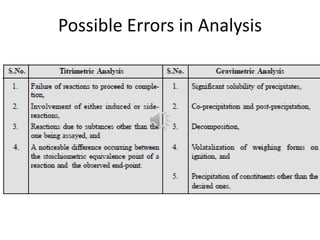
(f) Errors due to Methodology : Both improper (incorrect)
sampling and incompleteness of a reaction often lead to
serious errors. A few typical examples invariably encountered
in titrimetric and gravimetric analysis are cited below
(g) Additive Errors : It has been observed that the additive errors
are independent of the quantum of the substances actually
present in the assay.
Examples :
(i) Errors caused due to weights, and
(ii) Loss in weight of a crucible in which a precipitate is
incenerated.
Detection of this error is ascertained by taking samples of different
weights.
Possible Errors in Analysis
MINIMISING SYSTEMATIC ERRORS
Systematic errors may be reduced substantially and significantly
by adopting one of the following procedures rigidly, such as :
(i) Calibration of Instruments, Apparatus and Applying
Necessary Corrections
Most of the instruments, commonly used in an analytical
laboratory, such as : UV-Spectrophotometer,
IR-Spectrophotometer, single—pan electric balance, pH-meter,
turbidimeter and nephelometer, polarimeter, refractometer
and the like must be calibrated duly, before use so as to
eliminate any possible errors. In the same manner all
apparatus, namely : pipettes, burettes, volumetric flasks,
thermometers, weights etc., must be calibrated duly, and the
necessary corrections incorporated to the original
measurements.
(ii) Performing a Parallel Control Determination
It essentially comprises of performing an altogether separate
estimation under almost identical experimental parameters with a
quantity of a standard substance that consists of exactly the same
weight of the component as is present in the unknown sample.
(iii) Blank Determination :
In order to ascertain the effect of the impurities present in the reagents
employed and reaction vessels used ; besides establishing exactly
the extent to which an excess of standard solution required to locate
the exact end-point under the prevailing experimental parameters of
the unknown sample—a blank determination is an absolute
necessity. It may be accomplished by performing a separate
parallel estimation, without using the sample at all, and under
identical experimental parameters as employed in the actual
analysis of the given sample.
(iv) Cross-checking Results by Different Methods of Analysis
In certain specific cases tha accuracy of a result may be cross-checked
by performing another analysis of the same substance by an
altogether radically different method.
Examples :
(a) HCl-Solution : It may be assayed either by titration with a
standard solution of a strong alkali (NaOH), or by precipitation
and weighing as AgCl ; and
(b) (b) Fe3+ : It may be assayed either by gravimetric method as
Fe(III) hydroxide after getting rid of the interfering elements and
igniting the precipitate to Fe(III) oxide, or by titrimetric method
• i.e., first reducing to the Fe(II) state and then titrating with a
suitable oxidizing agent, for instance Ce(IV) sulphate, K2Cr2O7. In
short, the results thus obtained by the two fundamentally
different techniques must be concordant thereby justifying and
ascertaining the fact that the values obtained are fairly small limits
of error.
(v) Method of Standard Addition
• Here, a small known quantity of the component under
estimation is added to the sample, which is subsequently
subjected to analysis for the total amount of component present.
• The actual difference in the quantity of components present in
samples with or without the added component ultimately gives
the recovery of the quantum added component. A good
satisfactory recovery builds up the confidence in the accuracy of
the method of analysis.
(vi) Method of Internal Standards
The specific method is of immense value both in chromatographic
as well as spectroscopic determinations.
Here, a fixed quantity of a reference substance (i.e., the ‘internal
standard’) is added to a series of known concentrations of the
material to be assayed.
A graph is plotted between the concentration values and the
ratios obtained from the physical value (i.e., peak area of
absorption) of the ‘internal standard’ and the series of known
concentrations, thereby producing a straight line. Any unknown
concentration may be determined effectively by adding the
same amount of ‘internal standard’ and locating exactly where
the ratio obtained falls on the concentration scale.
INDETERMINATE (RANDOM) ERRORS
As the name suggests, indeterminate errors cannot be pin-pointed
to any specific well-defined reasons.
They are usually manifested due to the minute variations which
take place inadvertently in several successive measurements
performed by the same analyst, using utmost care, under almost
identical experimental parameters.
These errors are mostly random in nature and ultimately give rise
to high as well as low results with equal probability.
INDETERMINATE (RANDOM)
ERRORS
• They can neither be corrected nor eliminated, and therefore,
form the ‘ultimate limitation’ on the specific measurements.
• It has been observed that by performing repeated measurement
of the same variable, the subsequent statistical treatment of the
results would have a positive impact of ‘reducing their
importance’ to a considerable extent.
Salient Features of Indeterminate Errors
The various salient features of indeterminate errors are enumerated
below :
(1) Repeated mesurement of the same variable several times and
subsequent refinement to the extent where it is simply a
coincidence if the corresponding replicates eventually agree to the
last digit,
(2) Both unpredictable and imperceptible factors are unavoidably
incorporated in the results what generally appear to be ‘random
fluctuations’in the measured quantity,
(3) Recognition of specific definite variables which are beyond
anyone’s control lying very close to the performance limit of an
instrument, such as : temperature variations, noise as well as drift
from an electronic circuit, and vibrations caused to a building by
heavy vehicular-traffic,
Salient Features of Indeterminate
Errors
(4) A variation that may be regarded as random by a slipshod
analyst may at the same time prove to be quite evident and
manageable by a careful observer, and
(5) The average of a number of fine observations having random
scatter is definitely more accurate, precise and, hence, more
cogent than coarse data that appear to agree perfectly.

1625941889133.pptx

  • 1.
  • 2.
    ERRORS IN PHARMACEUTICAL ANALYSIS Theterminology ‘error’ invariably refers to the difference in the numerical values between a measured value and the true value. • The skill, knowledge, expertise and above all the degree of confidence involved in the ultimate result of an analyst is solely governed by the extent of accuracy and precision achieved by the analytical procedure vis-a-vis the possible sources of error that may be incorporated inadvertently.
  • 3.
    Importance of ErrorAnalysis • It has become universally accepted in methods of comparison that the percentage composition of a ‘standard sample’ provided and certified by the National Institute of Standards and Technology (NIST) or the British Pharmacopoeia Chemical Reference Substance (BPCRS) or the European Pharmacopoeia Chemical Reference Substance (EPCRS) must be regarded and treated as absolutely correct, pure and authentic while evaluating a new analytical method. • Consequently, the differences thus obtained between the standard values and those by the new analytical methods are then treated as ‘errors’ in the latest procedure.
  • 4.
    The numerous uncertaintiesusually encountered in a chemical analysis give rise to a host of ‘errors’ may be broadly categorized into two heads, namely : (i) Determinate (systematic) Errors, and (ii) Indeterminate (random) Errors. CLASSIFICATION OF ERRORS
  • 5.
    DETERMINATE (SYSTEMATIC) ERRORS •These are errors that possess a definite value together with a reasonable assignable cause; however, in principle these avoidable errors may be measured and accounted for coveniently. • Errors caused due to either incorrect adoption of an assay method or an incorrect graduation read out by an analyst are termed as determinate errors. • Such errors, in principle may be determined and corrected. • In usual practice the determinate errors are subtle in nature and hence, not easily detected.
  • 6.
    DETERMINATE (SYSTEMATIC) ERRORS Themost important errors belonging to this particular class are : (a) Personal Errors : They are exclusively caused due to ‘personal equation’ of an analyst and have no bearing whatsoever either on the prescribed procedure or methodology involved. (b) Instrumental Errors : These are invariably caused due to faulty and uncalibrated instruments, such as : pH meters, single pan electric balances, uv-spectrophotometers, potentiometers etc. (c) Reagent Errors : The errors that are solely introduced by virtue of the individual reagents, For instance : impurities inherently present in reagents ; high temperature volatilization of platinum (Pt) ; unwanted introduction of ‘foreign substances’ caused by the action of reagents on either porcelain or glass apparatus.
  • 7.
    (d) Constant Errors: They are observed to be rather independent of the magnitude of the measured amount ; and turn out to be relatively less significant as the magnitude enhances. Example : Assuming a constant equivalence—point error of 0.10 ml is introduced in a series of titrations, hence for a specific titration needing only 10.0 ml of titrant shall represent a relative error of 1% and only 0.2% for a corresponding 50 ml of titrant consumed. (e) Proportional Errors : The absolute value of this kind of error changes with the size of the sample in such a fashion that the relative error remains constant. It is usually incorporated by a material that directly interferes in an analytical procedure. Example : Estimation of ‘chlorate’—an oxidant by iodometric determination.
  • 8.
    In this particularinstance two things may happen, namely : (i) Presence of ‘Bromate’—another oxidizing agent would give rise to positively higher results, and hence, it must be duly corrected for, and (ii) Absolute error might increase while dealing with large samples, whereas the relative error would remain more or less constant if the sample is perfectly homogenous, (f) Errors due to Methodology : Both improper (incorrect) sampling and incompleteness of a reaction often lead to serious errors. A few typical examples invariably encountered in titrimetric and gravimetric analysis are cited below
  • 9.
    (g) Additive Errors: It has been observed that the additive errors are independent of the quantum of the substances actually present in the assay. Examples : (i) Errors caused due to weights, and (ii) Loss in weight of a crucible in which a precipitate is incenerated. Detection of this error is ascertained by taking samples of different weights.
  • 10.
  • 11.
    MINIMISING SYSTEMATIC ERRORS Systematicerrors may be reduced substantially and significantly by adopting one of the following procedures rigidly, such as : (i) Calibration of Instruments, Apparatus and Applying Necessary Corrections Most of the instruments, commonly used in an analytical laboratory, such as : UV-Spectrophotometer, IR-Spectrophotometer, single—pan electric balance, pH-meter, turbidimeter and nephelometer, polarimeter, refractometer and the like must be calibrated duly, before use so as to eliminate any possible errors. In the same manner all apparatus, namely : pipettes, burettes, volumetric flasks, thermometers, weights etc., must be calibrated duly, and the necessary corrections incorporated to the original measurements.
  • 12.
    (ii) Performing aParallel Control Determination It essentially comprises of performing an altogether separate estimation under almost identical experimental parameters with a quantity of a standard substance that consists of exactly the same weight of the component as is present in the unknown sample. (iii) Blank Determination : In order to ascertain the effect of the impurities present in the reagents employed and reaction vessels used ; besides establishing exactly the extent to which an excess of standard solution required to locate the exact end-point under the prevailing experimental parameters of the unknown sample—a blank determination is an absolute necessity. It may be accomplished by performing a separate parallel estimation, without using the sample at all, and under identical experimental parameters as employed in the actual analysis of the given sample.
  • 13.
    (iv) Cross-checking Resultsby Different Methods of Analysis In certain specific cases tha accuracy of a result may be cross-checked by performing another analysis of the same substance by an altogether radically different method. Examples : (a) HCl-Solution : It may be assayed either by titration with a standard solution of a strong alkali (NaOH), or by precipitation and weighing as AgCl ; and (b) (b) Fe3+ : It may be assayed either by gravimetric method as Fe(III) hydroxide after getting rid of the interfering elements and igniting the precipitate to Fe(III) oxide, or by titrimetric method • i.e., first reducing to the Fe(II) state and then titrating with a suitable oxidizing agent, for instance Ce(IV) sulphate, K2Cr2O7. In short, the results thus obtained by the two fundamentally different techniques must be concordant thereby justifying and ascertaining the fact that the values obtained are fairly small limits of error.
  • 14.
    (v) Method ofStandard Addition • Here, a small known quantity of the component under estimation is added to the sample, which is subsequently subjected to analysis for the total amount of component present. • The actual difference in the quantity of components present in samples with or without the added component ultimately gives the recovery of the quantum added component. A good satisfactory recovery builds up the confidence in the accuracy of the method of analysis.
  • 15.
    (vi) Method ofInternal Standards The specific method is of immense value both in chromatographic as well as spectroscopic determinations. Here, a fixed quantity of a reference substance (i.e., the ‘internal standard’) is added to a series of known concentrations of the material to be assayed. A graph is plotted between the concentration values and the ratios obtained from the physical value (i.e., peak area of absorption) of the ‘internal standard’ and the series of known concentrations, thereby producing a straight line. Any unknown concentration may be determined effectively by adding the same amount of ‘internal standard’ and locating exactly where the ratio obtained falls on the concentration scale.
  • 16.
    INDETERMINATE (RANDOM) ERRORS Asthe name suggests, indeterminate errors cannot be pin-pointed to any specific well-defined reasons. They are usually manifested due to the minute variations which take place inadvertently in several successive measurements performed by the same analyst, using utmost care, under almost identical experimental parameters. These errors are mostly random in nature and ultimately give rise to high as well as low results with equal probability.
  • 17.
    INDETERMINATE (RANDOM) ERRORS • Theycan neither be corrected nor eliminated, and therefore, form the ‘ultimate limitation’ on the specific measurements. • It has been observed that by performing repeated measurement of the same variable, the subsequent statistical treatment of the results would have a positive impact of ‘reducing their importance’ to a considerable extent.
  • 18.
    Salient Features ofIndeterminate Errors The various salient features of indeterminate errors are enumerated below : (1) Repeated mesurement of the same variable several times and subsequent refinement to the extent where it is simply a coincidence if the corresponding replicates eventually agree to the last digit, (2) Both unpredictable and imperceptible factors are unavoidably incorporated in the results what generally appear to be ‘random fluctuations’in the measured quantity, (3) Recognition of specific definite variables which are beyond anyone’s control lying very close to the performance limit of an instrument, such as : temperature variations, noise as well as drift from an electronic circuit, and vibrations caused to a building by heavy vehicular-traffic,
  • 19.
    Salient Features ofIndeterminate Errors (4) A variation that may be regarded as random by a slipshod analyst may at the same time prove to be quite evident and manageable by a careful observer, and (5) The average of a number of fine observations having random scatter is definitely more accurate, precise and, hence, more cogent than coarse data that appear to agree perfectly.