Engineering Materials
Instructor: Zafar Shakoor
HISTORICAL PERSPECTIVE
• Materials are probably more deep-seated in our
culture than most of us realize.
• Transportation, housing, clothing,
communication, recreation, and food
production—virtually every segment of our
everyday lives is influenced to one degree or
another by materials.
• Historically, the development and advancement
of societies have been intimately tied to the
members’ ability to produce and manipulate
materials to fill their needs.
HISTORICAL PERSPECTIVE
• In fact, early civilizations have been designated by
the level of their materials development (Stone
Age, Bronze Age, Iron Age).
• The earliest humans had access to only a very
limited number of materials, those that occur
naturally: stone, wood, clay, skins, and so on.
• With time they discovered techniques for
producing materials that had properties superior
to those of the natural ones; these new materials
included pottery and various metals.
HISTORICAL PERSPECTIVE
• it was discovered that the properties of a material could be
altered by heat treatments and by the addition of other
substances.
• At this point, materials utilization was totally a selection
process that involved deciding from a given, rather limited
set of materials the one best suited for an application by
virtue of its characteristics.
• It was not until relatively recent times that scientists came
to understand the relationships between the structural
elements of materials and their properties.
• This knowledge, acquired over approximately the past 100
years, has empowered them to fashion, to a large degree,
the characteristics of materials.
HISTORICAL PERSPECTIVE
• Thus, tens of thousands of different materials have evolved
with rather specialized characteristics that meet the needs
of our modern and complex society; these include metals,
plastics, glasses, and fibers.
• The development of many technologies that make our
existence so comfortable has been intimately associated
with the accessibility of suitable materials.
• For example, automobiles would not have been possible
without the availability of inexpensive steel or some other
comparable substitute.
• In our contemporary era, sophisticated electronic devices
rely on components that are made from what are called
semiconducting materials.
Material Science and material
Engineering
• It is useful to subdivide the discipline of materials
science and engineering into materials science
and materials engineering subdisciplines.
• “materials science” involves investigating the
relationships that exist between the structures
and properties of materials.
• “materials engineering” is, on the basis of these
structure–property correlations, designing or
engineering the structure of a material to
produce a predetermined set of properties.
Material Science and Material
Engineering
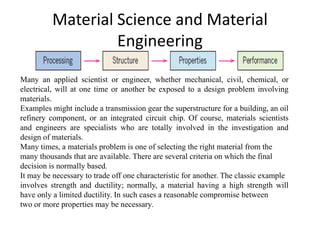
Many an applied scientist or engineer, whether mechanical, civil, chemical, or
electrical, will at one time or another be exposed to a design problem involving
materials.
Examples might include a transmission gear the superstructure for a building, an oil
refinery component, or an integrated circuit chip. Of course, materials scientists
and engineers are specialists who are totally involved in the investigation and
design of materials.
Many times, a materials problem is one of selecting the right material from the
many thousands that are available. There are several criteria on which the final
decision is normally based.
It may be necessary to trade off one characteristic for another. The classic example
involves strength and ductility; normally, a material having a high strength will
have only a limited ductility. In such cases a reasonable compromise between
two or more properties may be necessary.
CLASSIFICATION OF MATERIALS
• Solid materials have been conveniently grouped
into three basic classifications: metals, ceramics,
and polymers.
• This scheme is based primarily on chemical
makeup and atomic structure, and most materials
fall into one distinct grouping or another,
although there are some intermediates.
• In addition, there are the composites,
combinations of two or more of the above three
basic material classes.
Metals
Metals
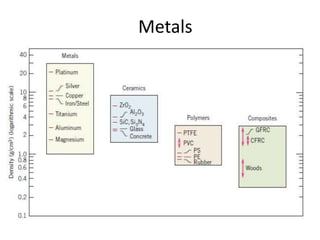
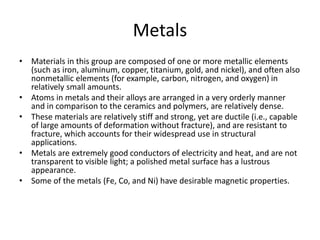
• Materials in this group are composed of one or more metallic elements
(such as iron, aluminum, copper, titanium, gold, and nickel), and often also
nonmetallic elements (for example, carbon, nitrogen, and oxygen) in
relatively small amounts.
• Atoms in metals and their alloys are arranged in a very orderly manner
and in comparison to the ceramics and polymers, are relatively dense.
• These materials are relatively stiff and strong, yet are ductile (i.e., capable
of large amounts of deformation without fracture), and are resistant to
fracture, which accounts for their widespread use in structural
applications.
• Metals are extremely good conductors of electricity and heat, and are not
transparent to visible light; a polished metal surface has a lustrous
appearance.
• Some of the metals (Fe, Co, and Ni) have desirable magnetic properties.
Ceramics
Ceramics
Ceramics
Ceramics
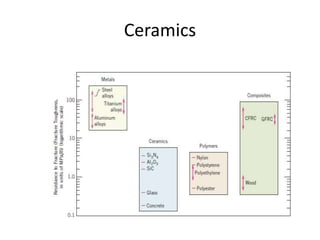
• Ceramics are compounds between metallic and
nonmetallic elements; they are most frequently
oxides, nitrides, and carbides.
• Ceramic materials include aluminum oxide (or
alumina,Al2O3), silicon dioxide (or silica, SiO2),
silicon carbide (SiC), silicon nitride (Si3N4), and, in
addition, what some refer to as the traditional
ceramics—those composed of clay minerals (i.e.,
porcelain), as well as cement, and glass.
Ceramics
• With regard to mechanical behavior, ceramic
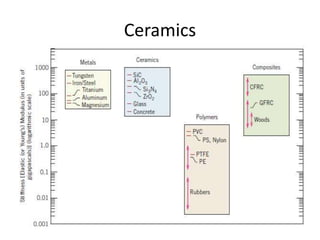
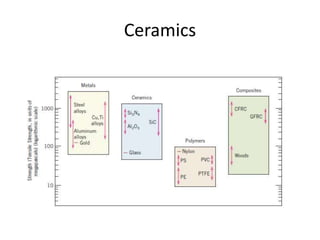
materials are relatively stiff and strong—
stiffnesses and strengths are comparable to
those of the metals.
• Ceramics are typically very hard. On the other
hand, they are extremely brittle (lack
ductility), and are highly susceptible to
fracture.
Ceramics
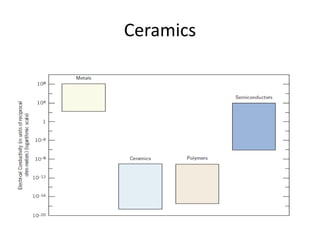
• These materials are typically insulative to the
passage of heat and electricity have low
electrical conductivities, and are more
resistant to high temperatures and harsh
environments than metals and polymers.
• With regard to optical characteristics,
ceramics may be transparent, translucent, or
opaque and some of the oxide ceramics (e.g.,
Fe3O4) exhibit magnetic behavior.
Ceramics
Polymers
• Polymers include the familiar plastic and rubber materials.
Many of them are organic compounds that are chemically
based on carbon, hydrogen, and other nonmetallic
elements (viz.O,N, and Si).
• They have very large molecular structures, often chain-like
in nature that have a backbone of carbon atoms. Some of
the common and familiar polymers are polyethylene (PE),
nylon, poly(vinyl chloride) (PVC), polycarbonate (PC),
polystyrene (PS), and silicone rubber.
• These materials typically have low densities (Figure 1.3),
whereas their mechanical characteristics are generally
dissimilar to the metallic and ceramic materials—they are
not as stiff nor as strong as these other material types.
Polymers
• However, on the basis of their low densities, many
times their stiffnesses and strengths on a per mass
basis are comparable to the metals and ceramics. many
of the polymers are extremely ductile and pliable.
• In general, they are relatively inert chemically and
unreactive in a large number of environments.
• One major drawback to the polymers is their tendency
to soften and/or decompose at modest temperatures,
which, in some instances, limits their use.
• They have low electrical conductivities and are
nonmagnetic.
Composites
• A composite is composed of two (or more) individual materials, which
come from the categories discussed above—viz., metals, ceramics, and
polymers.
• The design goal of a composite is to achieve a combination of properties
that is not displayed by any single material, and also to incorporate the
best characteristics of each of the component materials.
• A large number of composite types exist that are represented by different
combinations of metals, ceramics, and polymers.
• Some naturally-occurring materials are also considered to be
composites—for example, wood and bone. However, most of those we
consider in our discussions are synthetic (or man-made) composites.
• One of the most common and familiar composites is fiberglass, in which
small glass fibers are embedded within a polymeric material (normally an
epoxy or polyester).
Composites
• The glass fibers are relatively strong and stiff (but also
brittle), whereas the polymer is ductile (but also weak
and flexible).
• Thus, the resulting fiberglass is relatively stiff, strong,
flexible, and ductile. In addition, it has a low density.
• Another of these technologically important materials is
the “carbon fiber reinforced polymer” (or “CFRP”)
composite——carbon fibers that are embedded within
a polymer.
• These materials are stiffer and stronger than the glass
fiber-reinforced materials, yet they are more
expensive.
Composites
• The CFRP composites are used in some aircraft
and aerospace applications, as well as high-
tech sporting equipment (e.g., bicycles, golf
clubs, tennis rackets, and skis/snowboards).

Engineering materials

  • 1.
  • 2.
    HISTORICAL PERSPECTIVE • Materialsare probably more deep-seated in our culture than most of us realize. • Transportation, housing, clothing, communication, recreation, and food production—virtually every segment of our everyday lives is influenced to one degree or another by materials. • Historically, the development and advancement of societies have been intimately tied to the members’ ability to produce and manipulate materials to fill their needs.
  • 3.
    HISTORICAL PERSPECTIVE • Infact, early civilizations have been designated by the level of their materials development (Stone Age, Bronze Age, Iron Age). • The earliest humans had access to only a very limited number of materials, those that occur naturally: stone, wood, clay, skins, and so on. • With time they discovered techniques for producing materials that had properties superior to those of the natural ones; these new materials included pottery and various metals.
  • 4.
    HISTORICAL PERSPECTIVE • itwas discovered that the properties of a material could be altered by heat treatments and by the addition of other substances. • At this point, materials utilization was totally a selection process that involved deciding from a given, rather limited set of materials the one best suited for an application by virtue of its characteristics. • It was not until relatively recent times that scientists came to understand the relationships between the structural elements of materials and their properties. • This knowledge, acquired over approximately the past 100 years, has empowered them to fashion, to a large degree, the characteristics of materials.
  • 5.
    HISTORICAL PERSPECTIVE • Thus,tens of thousands of different materials have evolved with rather specialized characteristics that meet the needs of our modern and complex society; these include metals, plastics, glasses, and fibers. • The development of many technologies that make our existence so comfortable has been intimately associated with the accessibility of suitable materials. • For example, automobiles would not have been possible without the availability of inexpensive steel or some other comparable substitute. • In our contemporary era, sophisticated electronic devices rely on components that are made from what are called semiconducting materials.
  • 6.
    Material Science andmaterial Engineering • It is useful to subdivide the discipline of materials science and engineering into materials science and materials engineering subdisciplines. • “materials science” involves investigating the relationships that exist between the structures and properties of materials. • “materials engineering” is, on the basis of these structure–property correlations, designing or engineering the structure of a material to produce a predetermined set of properties.
  • 7.
    Material Science andMaterial Engineering Many an applied scientist or engineer, whether mechanical, civil, chemical, or electrical, will at one time or another be exposed to a design problem involving materials. Examples might include a transmission gear the superstructure for a building, an oil refinery component, or an integrated circuit chip. Of course, materials scientists and engineers are specialists who are totally involved in the investigation and design of materials. Many times, a materials problem is one of selecting the right material from the many thousands that are available. There are several criteria on which the final decision is normally based. It may be necessary to trade off one characteristic for another. The classic example involves strength and ductility; normally, a material having a high strength will have only a limited ductility. In such cases a reasonable compromise between two or more properties may be necessary.
  • 8.
    CLASSIFICATION OF MATERIALS •Solid materials have been conveniently grouped into three basic classifications: metals, ceramics, and polymers. • This scheme is based primarily on chemical makeup and atomic structure, and most materials fall into one distinct grouping or another, although there are some intermediates. • In addition, there are the composites, combinations of two or more of the above three basic material classes.
  • 9.
  • 10.
    Metals • Materials inthis group are composed of one or more metallic elements (such as iron, aluminum, copper, titanium, gold, and nickel), and often also nonmetallic elements (for example, carbon, nitrogen, and oxygen) in relatively small amounts. • Atoms in metals and their alloys are arranged in a very orderly manner and in comparison to the ceramics and polymers, are relatively dense. • These materials are relatively stiff and strong, yet are ductile (i.e., capable of large amounts of deformation without fracture), and are resistant to fracture, which accounts for their widespread use in structural applications. • Metals are extremely good conductors of electricity and heat, and are not transparent to visible light; a polished metal surface has a lustrous appearance. • Some of the metals (Fe, Co, and Ni) have desirable magnetic properties.
  • 11.
  • 12.
  • 13.
  • 14.
    Ceramics • Ceramics arecompounds between metallic and nonmetallic elements; they are most frequently oxides, nitrides, and carbides. • Ceramic materials include aluminum oxide (or alumina,Al2O3), silicon dioxide (or silica, SiO2), silicon carbide (SiC), silicon nitride (Si3N4), and, in addition, what some refer to as the traditional ceramics—those composed of clay minerals (i.e., porcelain), as well as cement, and glass.
  • 15.
    Ceramics • With regardto mechanical behavior, ceramic materials are relatively stiff and strong— stiffnesses and strengths are comparable to those of the metals. • Ceramics are typically very hard. On the other hand, they are extremely brittle (lack ductility), and are highly susceptible to fracture.
  • 16.
    Ceramics • These materialsare typically insulative to the passage of heat and electricity have low electrical conductivities, and are more resistant to high temperatures and harsh environments than metals and polymers. • With regard to optical characteristics, ceramics may be transparent, translucent, or opaque and some of the oxide ceramics (e.g., Fe3O4) exhibit magnetic behavior.
  • 17.
  • 18.
    Polymers • Polymers includethe familiar plastic and rubber materials. Many of them are organic compounds that are chemically based on carbon, hydrogen, and other nonmetallic elements (viz.O,N, and Si). • They have very large molecular structures, often chain-like in nature that have a backbone of carbon atoms. Some of the common and familiar polymers are polyethylene (PE), nylon, poly(vinyl chloride) (PVC), polycarbonate (PC), polystyrene (PS), and silicone rubber. • These materials typically have low densities (Figure 1.3), whereas their mechanical characteristics are generally dissimilar to the metallic and ceramic materials—they are not as stiff nor as strong as these other material types.
  • 19.
    Polymers • However, onthe basis of their low densities, many times their stiffnesses and strengths on a per mass basis are comparable to the metals and ceramics. many of the polymers are extremely ductile and pliable. • In general, they are relatively inert chemically and unreactive in a large number of environments. • One major drawback to the polymers is their tendency to soften and/or decompose at modest temperatures, which, in some instances, limits their use. • They have low electrical conductivities and are nonmagnetic.
  • 20.
    Composites • A compositeis composed of two (or more) individual materials, which come from the categories discussed above—viz., metals, ceramics, and polymers. • The design goal of a composite is to achieve a combination of properties that is not displayed by any single material, and also to incorporate the best characteristics of each of the component materials. • A large number of composite types exist that are represented by different combinations of metals, ceramics, and polymers. • Some naturally-occurring materials are also considered to be composites—for example, wood and bone. However, most of those we consider in our discussions are synthetic (or man-made) composites. • One of the most common and familiar composites is fiberglass, in which small glass fibers are embedded within a polymeric material (normally an epoxy or polyester).
  • 21.
    Composites • The glassfibers are relatively strong and stiff (but also brittle), whereas the polymer is ductile (but also weak and flexible). • Thus, the resulting fiberglass is relatively stiff, strong, flexible, and ductile. In addition, it has a low density. • Another of these technologically important materials is the “carbon fiber reinforced polymer” (or “CFRP”) composite——carbon fibers that are embedded within a polymer. • These materials are stiffer and stronger than the glass fiber-reinforced materials, yet they are more expensive.
  • 22.
    Composites • The CFRPcomposites are used in some aircraft and aerospace applications, as well as high- tech sporting equipment (e.g., bicycles, golf clubs, tennis rackets, and skis/snowboards).