



EXPLOSIVE FORMING
PRESENTED BY:
SAMEER VISHWAKARMA
M.Tech.( Production )
First Year
SUBMITTED TO-
PROF. S.K. SRIVASTAVA
DEPTT. OF MECH. ENGG.
OUTLINES-
 Introduction
 Practical Examples
 Explosives Used
 The Process Set-Up
 Energy Transfer Phenomenon
 Conclusion
 References
Introduction
 Explosive Forming is a manufacturing technique that uses explosions
to force metal into dies and molds.
 The explosives are typically either detonated underwater or in
direct contact with the materials.
 The technique is useful for short production runs of conventionally
difficult-to-manufacture parts.
 Explosive forming can be used for forming parts on the scale of a
few inches to up to 15 feet.
 For over 100 years it has been recognized that explosives can be
used in deforming metals. It was reported that the first application
of explosives to metalworking was undertaken by Daniel Adamson of
Manchester in the United Kingdom in 1878.
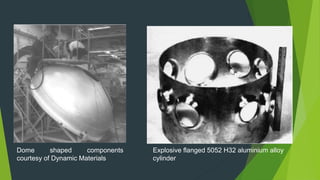
Dome shaped components
courtesy of Dynamic Materials
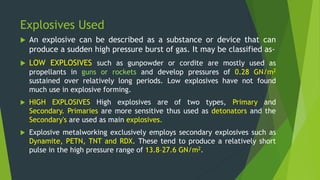
Explosive flanged 5052 H32 aluminium alloy
cylinder
Spherical vessel produced using dieless
forming
A formed, welded and machined
explosive forming die
Explosives Used
 An explosive can be described as a substance or device that can
produce a sudden high pressure burst of gas. It may be classified as-
 LOW EXPLOSIVES such as gunpowder or cordite are mostly used as
propellants in guns or rockets and develop pressures of 0.28 GN/m2
sustained over relatively long periods. Low explosives have not found
much use in explosive forming.
 HIGH EXPLOSIVES High explosives are of two types, Primary and
Secondary. Primaries are more sensitive thus used as detonators and the
Secondary's are used as main explosives.
 Explosive metalworking exclusively employs secondary explosives such as
Dynamite, PETN, TNT and RDX. These tend to produce a relatively short
pulse in the high pressure range of 13.8–27.6 GN/m2.
The Process Set-Up
Generally there are two types of
Explosive Forming:
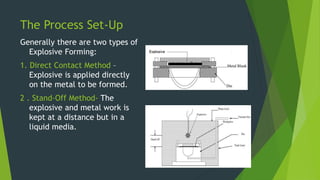
1. Direct Contact Method –
Explosive is applied directly
on the metal to be formed.
2 . Stand-Off Method- The
explosive and metal work is
kept at a distance but in a
liquid media.
1.Direct Contact Method
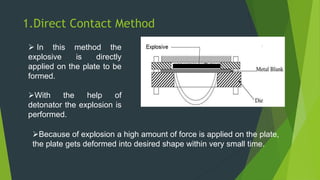
 In this method the
explosive is directly
applied on the plate to be
formed.
With the help of
detonator the explosion is
performed.
Because of explosion a high amount of force is applied on the plate,
the plate gets deformed into desired shape within very small time.
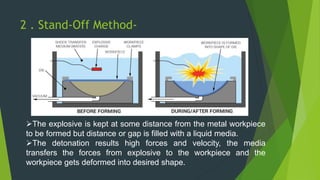
2 . Stand-Off Method-
The explosive is kept at some distance from the metal workpiece
to be formed but distance or gap is filled with a liquid media.
The detonation results high forces and velocity, the media
transfers the forces from explosive to the workpiece and the
workpiece gets deformed into desired shape.
Schematic diagram of a stand-off
explosive forming using a free
forming die
Schematic diagram of a stand-off
explosive forming using a male die
Energy Transfer Phenomenon
Approximate methods are available for estimating the total energy
delivered to a blank, the three common methods are:
1. The geometrical method
2. The energy method
3. The impulse method
 Peak pressure P generated where the transfer medium is water, can
be given by the expression-
Where: k=constant dependent upon explosive(21600 for TNT)
w=weight of explosive in pounds
R= standoff distance in feet
a= constant, generally taken as 1.15
Conclusion
 However from the information presented it appears that explosive
forming is versatile requiring low capital invest-ment and has great
application potential. The ability to vary the distribution, intensity
and of the forming pressure and energy levels over wide ranges
provides greater capabilities than conventional forming methods.
Another advantage that is common to all high energy rate forming
processes is the increased ductility that may be obtained at certain
deforma-tion velocities. The process does have disadvantages includ-
ing the requirement of specialist process knowledge and the need to
handle explosives. It is thought that explosive forming has potential
for the MMFSC project and future aerospace applications, and it is
hoped that this will be confirmed by the results from the trials.
REFERENCES
 D.J. Mynors et al. “Applications and capabilities
of explosive forming” (2002)
 google.com
 Sciencedirect.com
Explosive forming

Explosive forming

  • 1.
    EXPLOSIVE FORMING PRESENTED BY: SAMEERVISHWAKARMA M.Tech.( Production ) First Year SUBMITTED TO- PROF. S.K. SRIVASTAVA DEPTT. OF MECH. ENGG.
  • 2.
    OUTLINES-  Introduction  PracticalExamples  Explosives Used  The Process Set-Up  Energy Transfer Phenomenon  Conclusion  References
  • 3.
    Introduction  Explosive Formingis a manufacturing technique that uses explosions to force metal into dies and molds.  The explosives are typically either detonated underwater or in direct contact with the materials.  The technique is useful for short production runs of conventionally difficult-to-manufacture parts.  Explosive forming can be used for forming parts on the scale of a few inches to up to 15 feet.  For over 100 years it has been recognized that explosives can be used in deforming metals. It was reported that the first application of explosives to metalworking was undertaken by Daniel Adamson of Manchester in the United Kingdom in 1878.
  • 4.
    Dome shaped components courtesyof Dynamic Materials Explosive flanged 5052 H32 aluminium alloy cylinder
  • 5.
    Spherical vessel producedusing dieless forming A formed, welded and machined explosive forming die
  • 6.
    Explosives Used  Anexplosive can be described as a substance or device that can produce a sudden high pressure burst of gas. It may be classified as-  LOW EXPLOSIVES such as gunpowder or cordite are mostly used as propellants in guns or rockets and develop pressures of 0.28 GN/m2 sustained over relatively long periods. Low explosives have not found much use in explosive forming.  HIGH EXPLOSIVES High explosives are of two types, Primary and Secondary. Primaries are more sensitive thus used as detonators and the Secondary's are used as main explosives.  Explosive metalworking exclusively employs secondary explosives such as Dynamite, PETN, TNT and RDX. These tend to produce a relatively short pulse in the high pressure range of 13.8–27.6 GN/m2.
  • 7.
    The Process Set-Up Generallythere are two types of Explosive Forming: 1. Direct Contact Method – Explosive is applied directly on the metal to be formed. 2 . Stand-Off Method- The explosive and metal work is kept at a distance but in a liquid media.
  • 8.
    1.Direct Contact Method In this method the explosive is directly applied on the plate to be formed. With the help of detonator the explosion is performed. Because of explosion a high amount of force is applied on the plate, the plate gets deformed into desired shape within very small time.
  • 9.
    2 . Stand-OffMethod- The explosive is kept at some distance from the metal workpiece to be formed but distance or gap is filled with a liquid media. The detonation results high forces and velocity, the media transfers the forces from explosive to the workpiece and the workpiece gets deformed into desired shape.
  • 10.
    Schematic diagram ofa stand-off explosive forming using a free forming die Schematic diagram of a stand-off explosive forming using a male die
  • 11.
    Energy Transfer Phenomenon Approximatemethods are available for estimating the total energy delivered to a blank, the three common methods are: 1. The geometrical method 2. The energy method 3. The impulse method  Peak pressure P generated where the transfer medium is water, can be given by the expression- Where: k=constant dependent upon explosive(21600 for TNT) w=weight of explosive in pounds R= standoff distance in feet a= constant, generally taken as 1.15
  • 12.
    Conclusion  However fromthe information presented it appears that explosive forming is versatile requiring low capital invest-ment and has great application potential. The ability to vary the distribution, intensity and of the forming pressure and energy levels over wide ranges provides greater capabilities than conventional forming methods. Another advantage that is common to all high energy rate forming processes is the increased ductility that may be obtained at certain deforma-tion velocities. The process does have disadvantages includ- ing the requirement of specialist process knowledge and the need to handle explosives. It is thought that explosive forming has potential for the MMFSC project and future aerospace applications, and it is hoped that this will be confirmed by the results from the trials.
  • 13.
    REFERENCES  D.J. Mynorset al. “Applications and capabilities of explosive forming” (2002)  google.com  Sciencedirect.com