Chapter – 1: Introduction
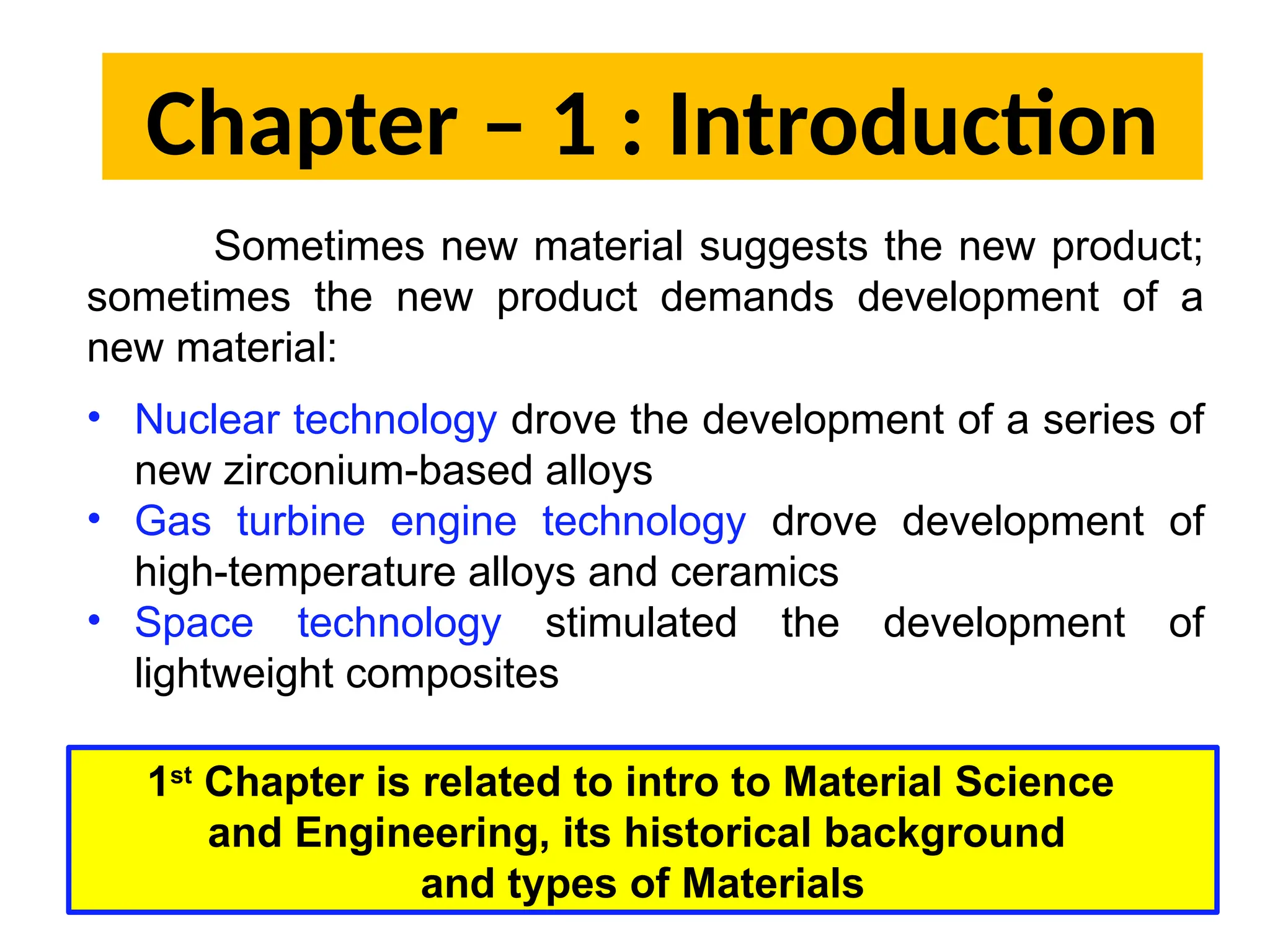
Sometimes new material suggests the new product;
sometimes the new product demands development of a
new material:
• Nuclear technology drove the development of a series of
new zirconium-based alloys
• Gas turbine engine technology drove development of
high-temperature alloys and ceramics
• Space technology stimulated the development of
lightweight composites
1st
Chapter is related to intro to Material Science
and Engineering, its historical background
and types of Materials
2.
What is aMaterial
• Material is a broad term for a chemical substance or
a mixture of substances that constitute a thing.
• materials can be anything consisting of, whether pure
or impure, a singular or a complex mix, living or non-
living matter, whether natural or man-made.
• Materials are inputs to production or manufacturing
processes. It may either be raw material, i.e.
unprocessed, or processed before being used in more
advanced production processes.
• Classification of Materials is based on different
properties such as physical and chemical properties,
geological, biological, etc.
3.
3
• Beginning ofthe Material Science - People began to make tools
from stone – Start of the Stone Age about two million years ago.
Natural materials: stone, wood, clay, skins, etc.
• Stone Age ended about 5000 years ago with introduction of Bronze.
• Bronze is an alloy (Cu based alloy containing other elements also).
Bronze can be hammered or cast into a variety of shapes, can be
made harder by alloying.
• Iron Age began about 3000 years ago and continues today. Use of
iron and steel, a stronger and cheaper material changed drastically
daily life of a common person.
• many new types of materials have been introduced throughout the
Iron Age (ceramic, semiconductors, polymers, composites…) thru
Understanding of the relationship among structure, properties,
processing, and performance of materials
Intelligent design of new materials
Historical Background
4.
What is MS&E
•Material Science deals with search and basic knowledge about the
internal structure, properties and processing of materials
It investigate relationships that exist between the structure and
properties of materials
• Material Engineering deals with the use of fundamental and applied
knowledge of materials to convert materials into products needed for use
by the society
– on the basis of structure-property correlations, Material Engineering
results in designing or engineering the structure of material to
produce a pre-determined set of properties
• Simply speaking
– Material Science is about basic knowledge of materials and Material
Engg is applied knowledge of materials
– Material Science & Engg is resultant knowledge of the structure,
properties, processing and performance of engineering materials 4
5.
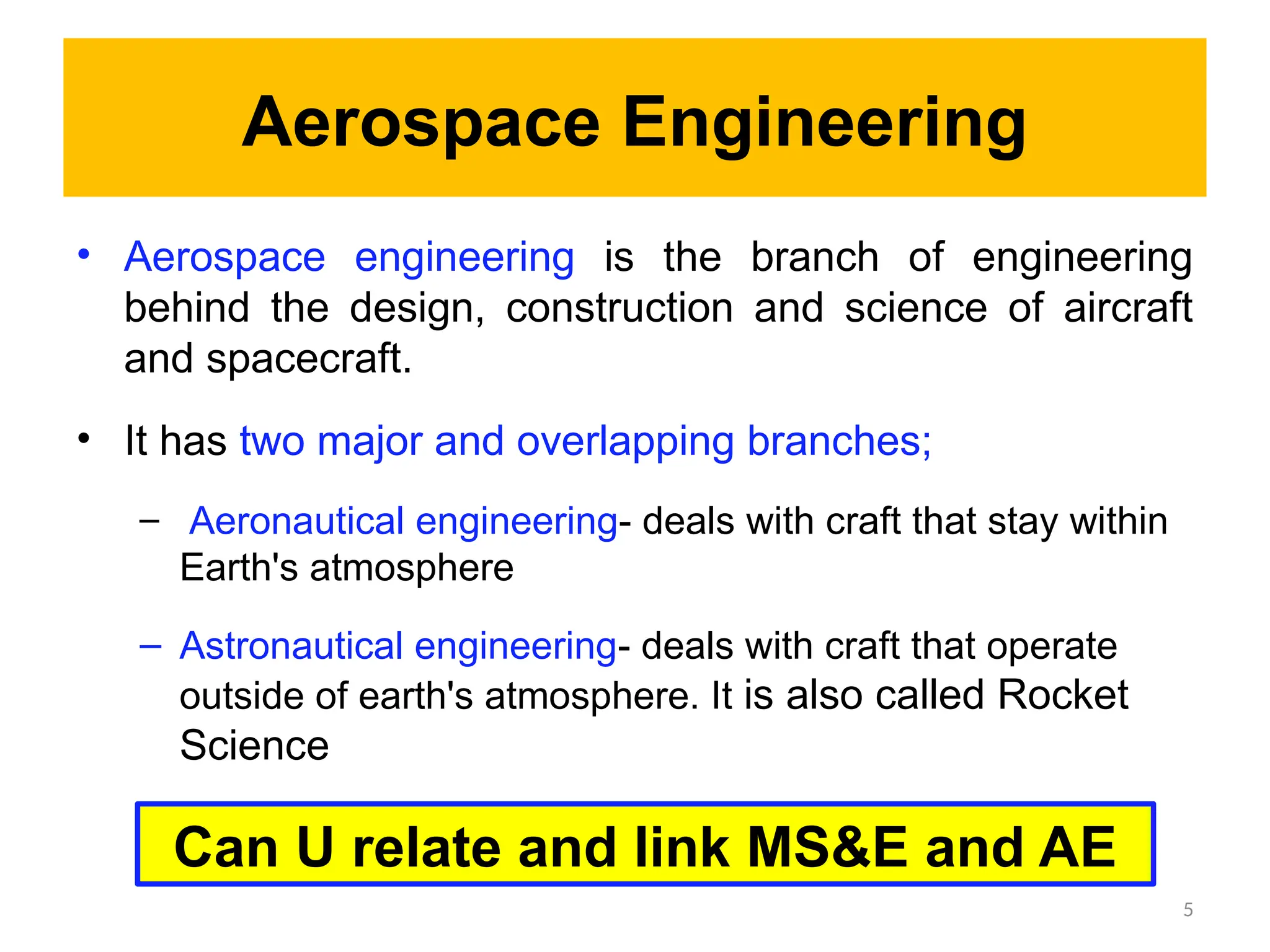
Aerospace Engineering
• Aerospaceengineering is the branch of engineering
behind the design, construction and science of aircraft
and spacecraft.
• It has two major and overlapping branches;
– Aeronautical engineering- deals with craft that stay within
Earth's atmosphere
– Astronautical engineering- deals with craft that operate
outside of earth's atmosphere. It is also called Rocket
Science
5
Can U relate and link MS&E and AE
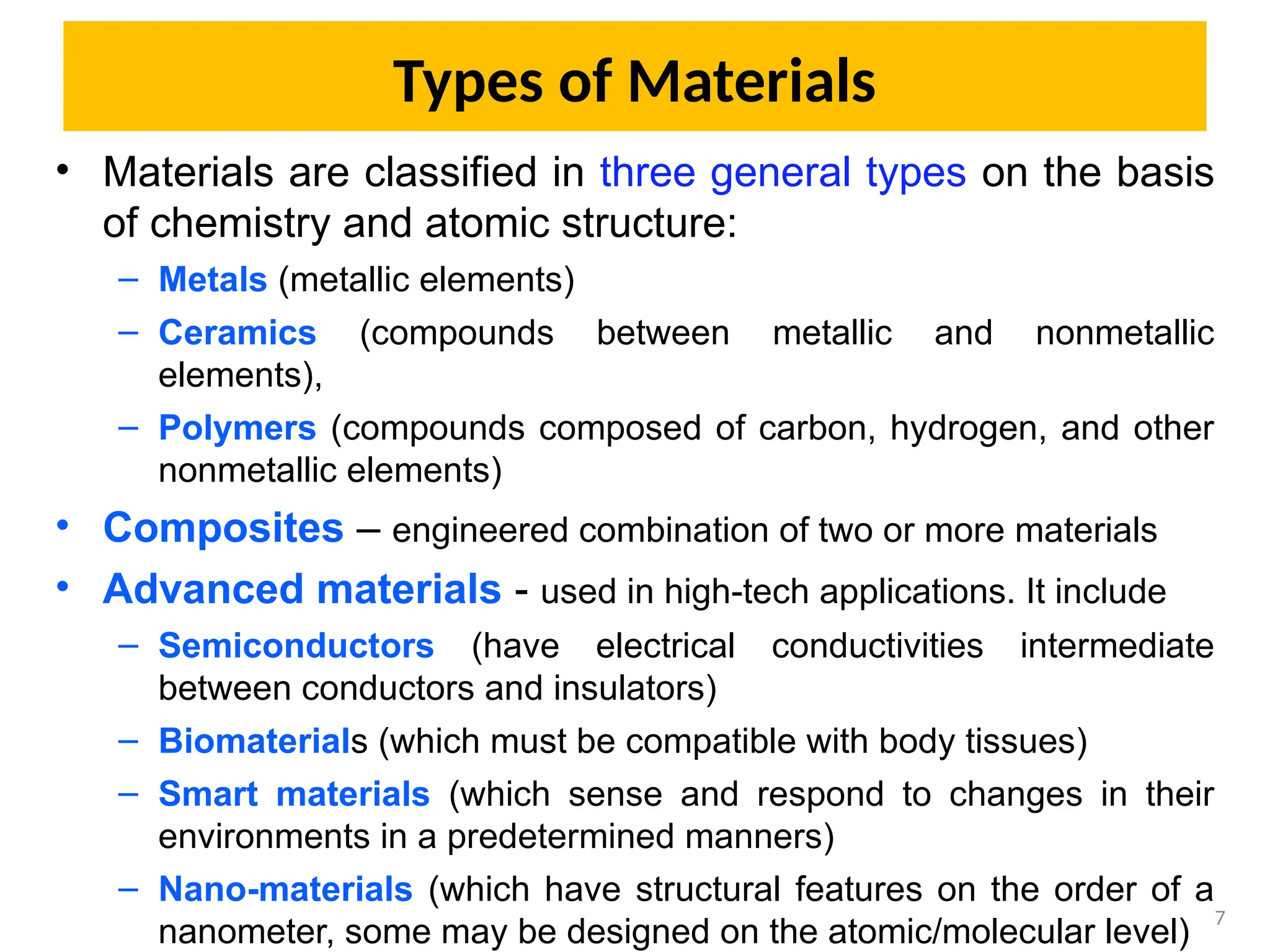
Types of Materials
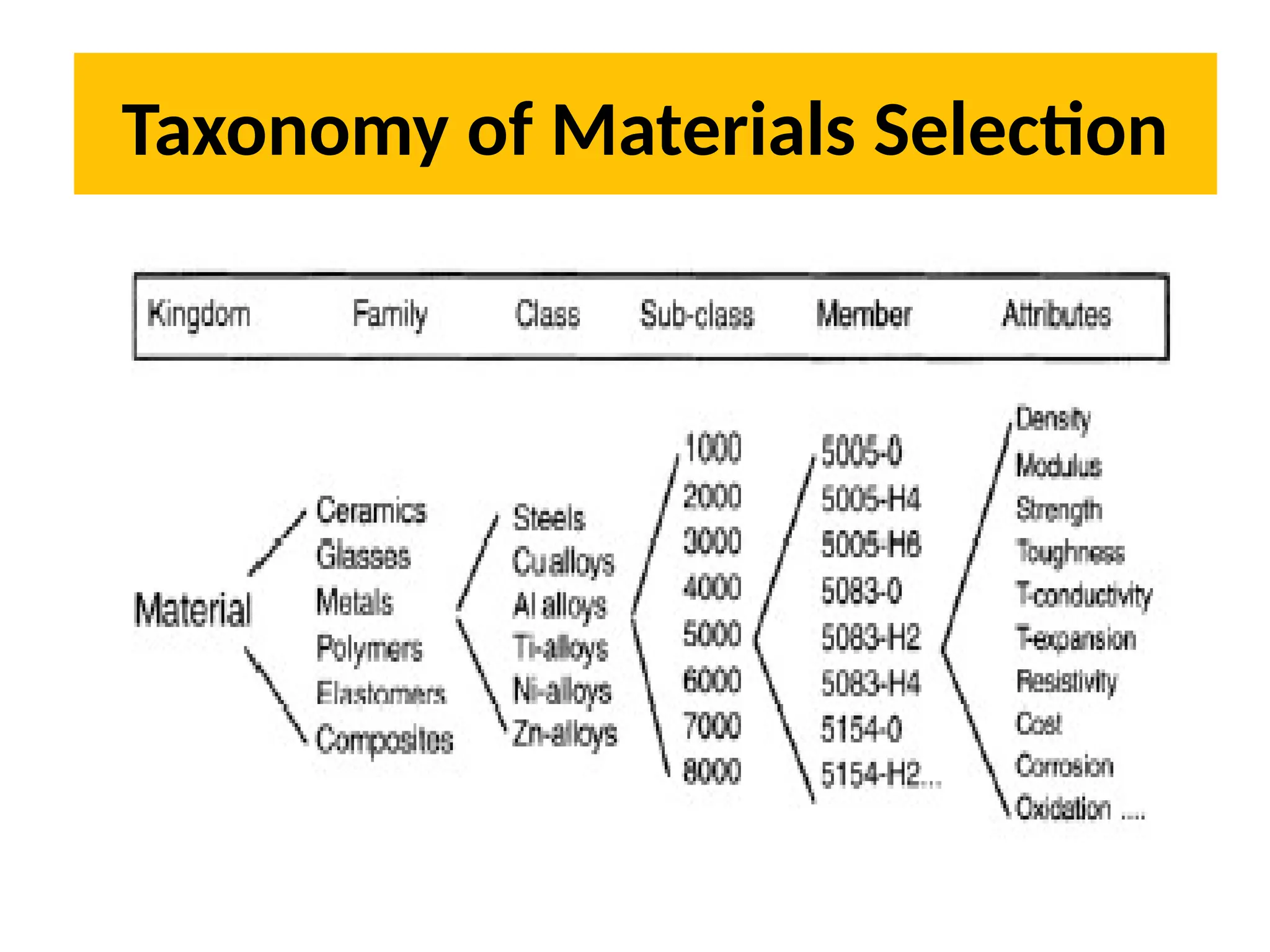
•Materials are classified in three general types on the basis
of chemistry and atomic structure:
– Metals (metallic elements)
– Ceramics (compounds between metallic and nonmetallic
elements),
– Polymers (compounds composed of carbon, hydrogen, and other
nonmetallic elements)
• Composites – engineered combination of two or more materials
• Advanced materials - used in high-tech applications. It include
– Semiconductors (have electrical conductivities intermediate
between conductors and insulators)
– Biomaterials (which must be compatible with body tissues)
– Smart materials (which sense and respond to changes in their
environments in a predetermined manners)
– Nano-materials (which have structural features on the order of a
nanometer, some may be designed on the atomic/molecular level)
7
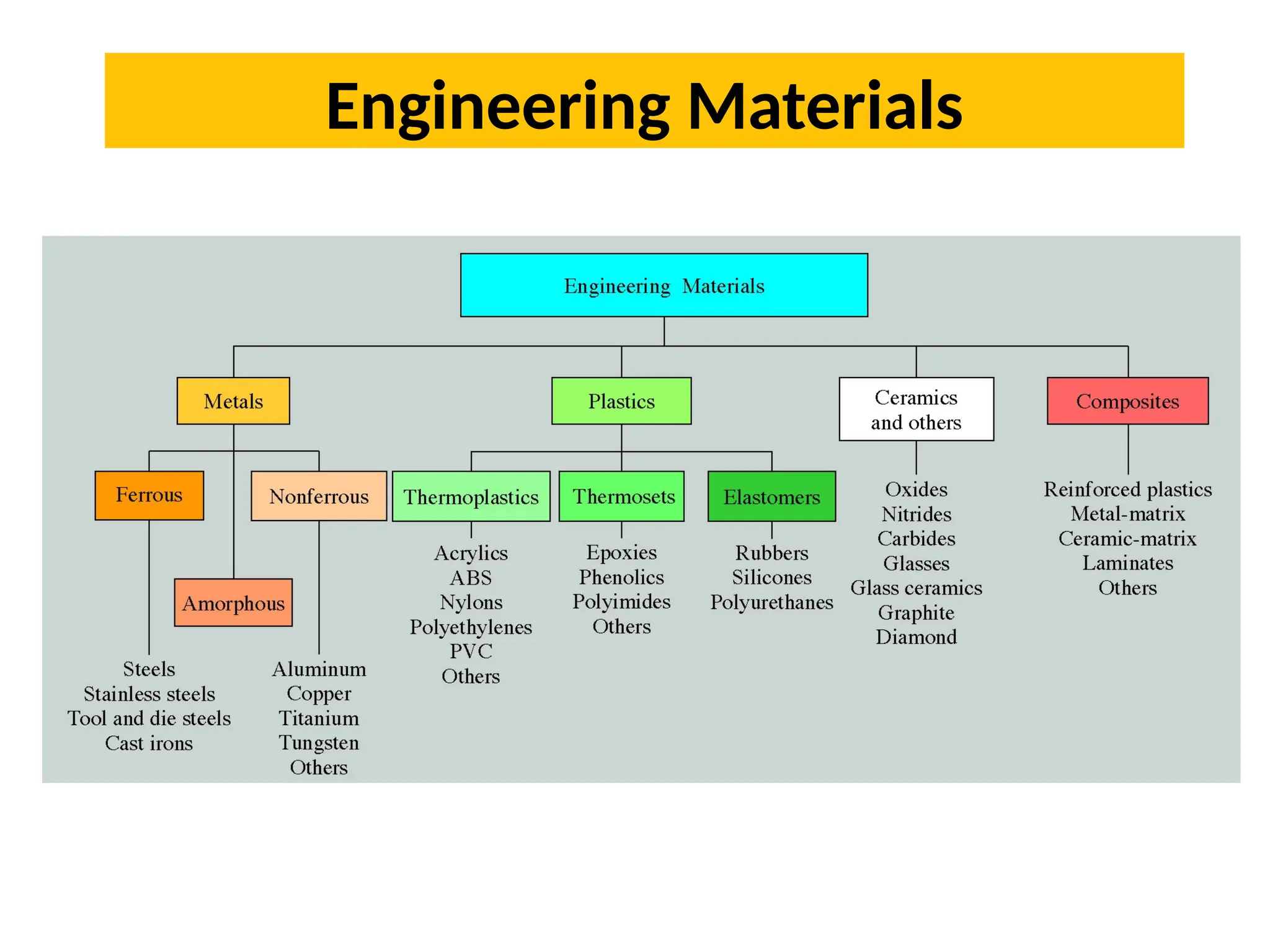
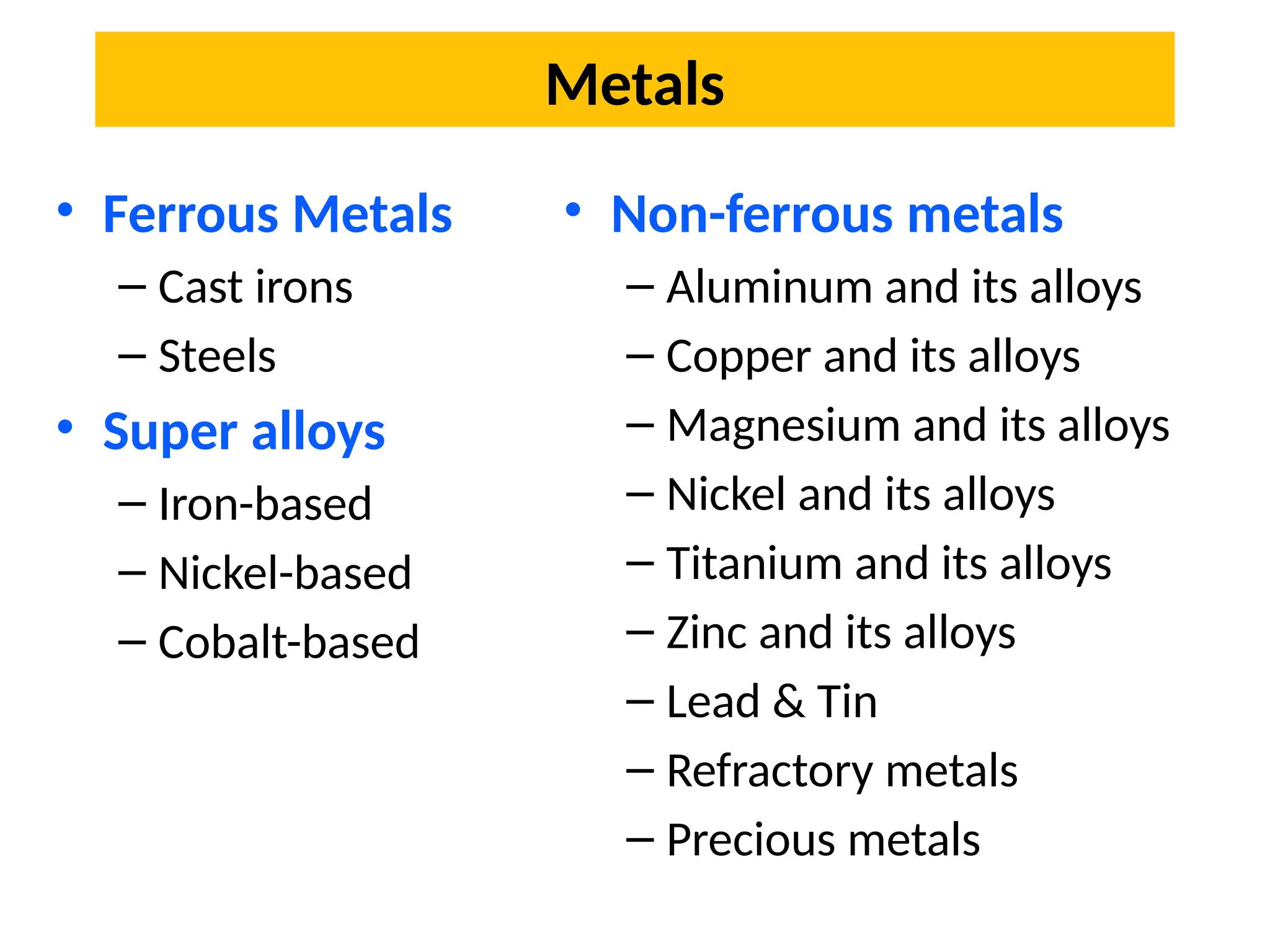
Metals
• Ferrous Metals
–Cast irons
– Steels
• Super alloys
– Iron-based
– Nickel-based
– Cobalt-based
• Non-ferrous metals
– Aluminum and its alloys
– Copper and its alloys
– Magnesium and its alloys
– Nickel and its alloys
– Titanium and its alloys
– Zinc and its alloys
– Lead & Tin
– Refractory metals
– Precious metals
10.
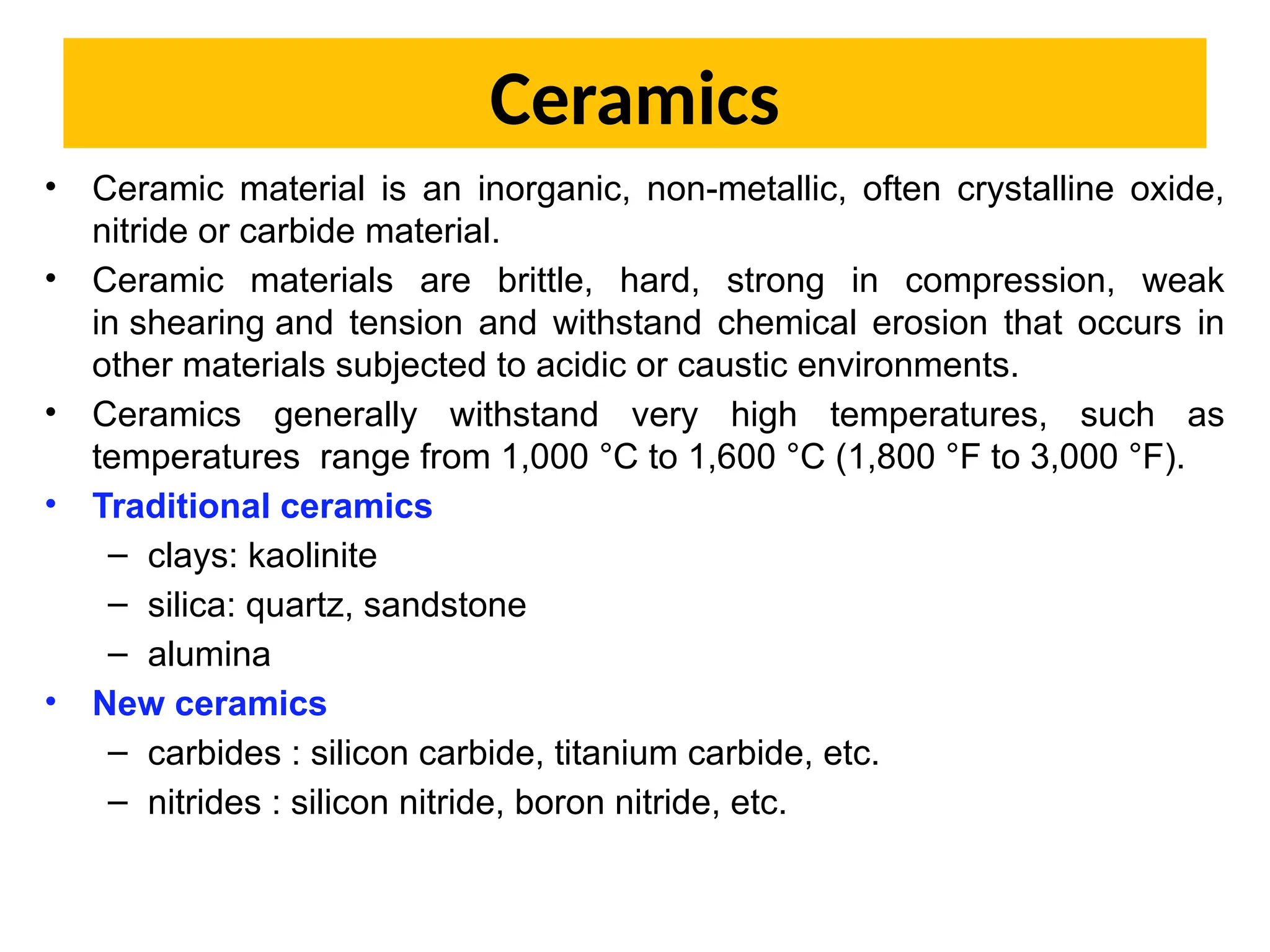
Ceramics
• Ceramic materialis an inorganic, non-metallic, often crystalline oxide,
nitride or carbide material.
• Ceramic materials are brittle, hard, strong in compression, weak
in shearing and tension and withstand chemical erosion that occurs in
other materials subjected to acidic or caustic environments.
• Ceramics generally withstand very high temperatures, such as
temperatures range from 1,000 °C to 1,600 °C (1,800 °F to 3,000 °F).
• Traditional ceramics
– clays: kaolinite
– silica: quartz, sandstone
– alumina
• New ceramics
– carbides : silicon carbide, titanium carbide, etc.
– nitrides : silicon nitride, boron nitride, etc.
11.
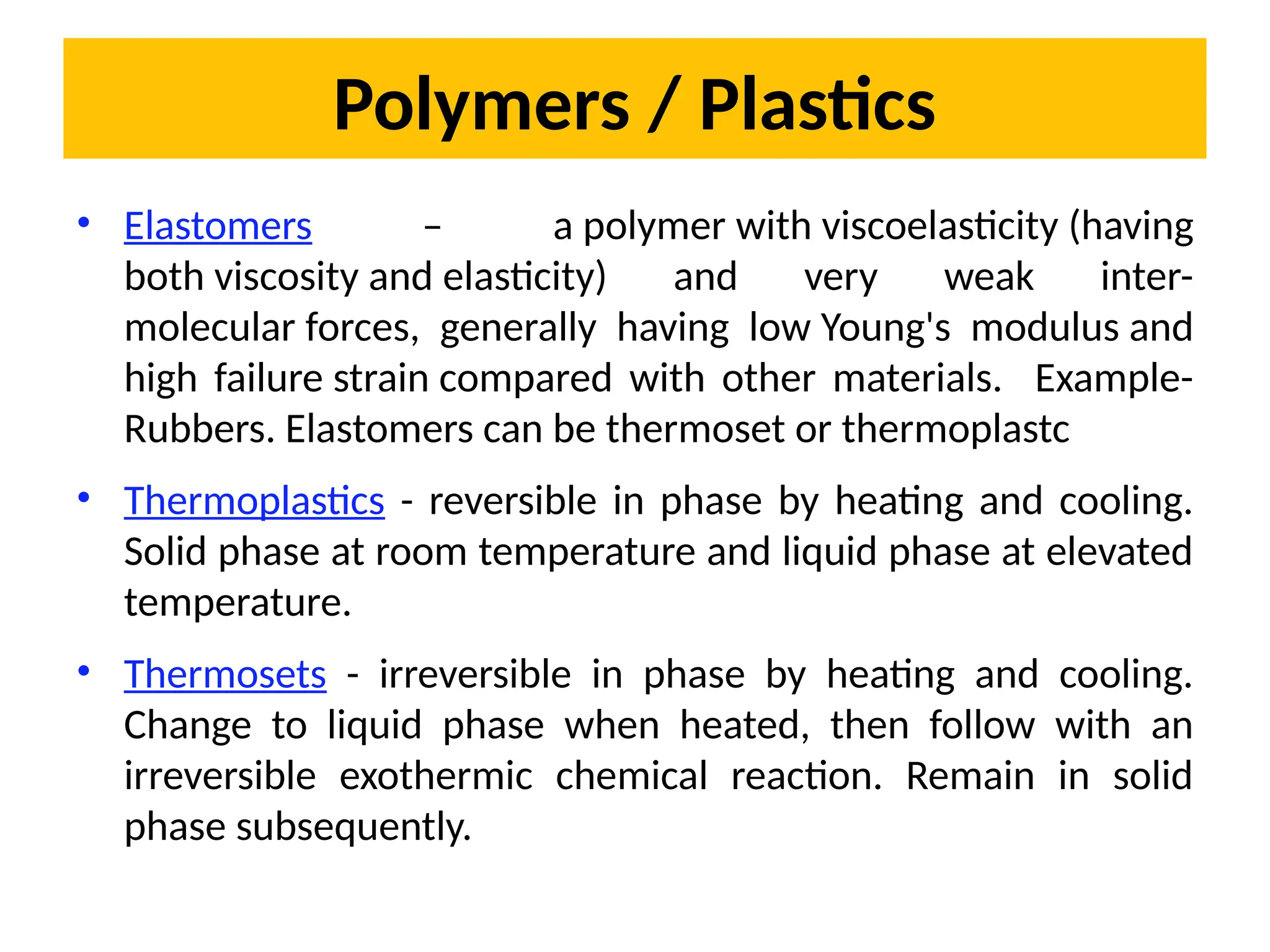
Polymers / Plastics
•Elastomers – a polymer with viscoelasticity (having
both viscosity and elasticity) and very weak inter-
molecular forces, generally having low Young's modulus and
high failure strain compared with other materials. Example-
Rubbers. Elastomers can be thermoset or thermoplastc
• Thermoplastics - reversible in phase by heating and cooling.
Solid phase at room temperature and liquid phase at elevated
temperature.
• Thermosets - irreversible in phase by heating and cooling.
Change to liquid phase when heated, then follow with an
irreversible exothermic chemical reaction. Remain in solid
phase subsequently.
12.
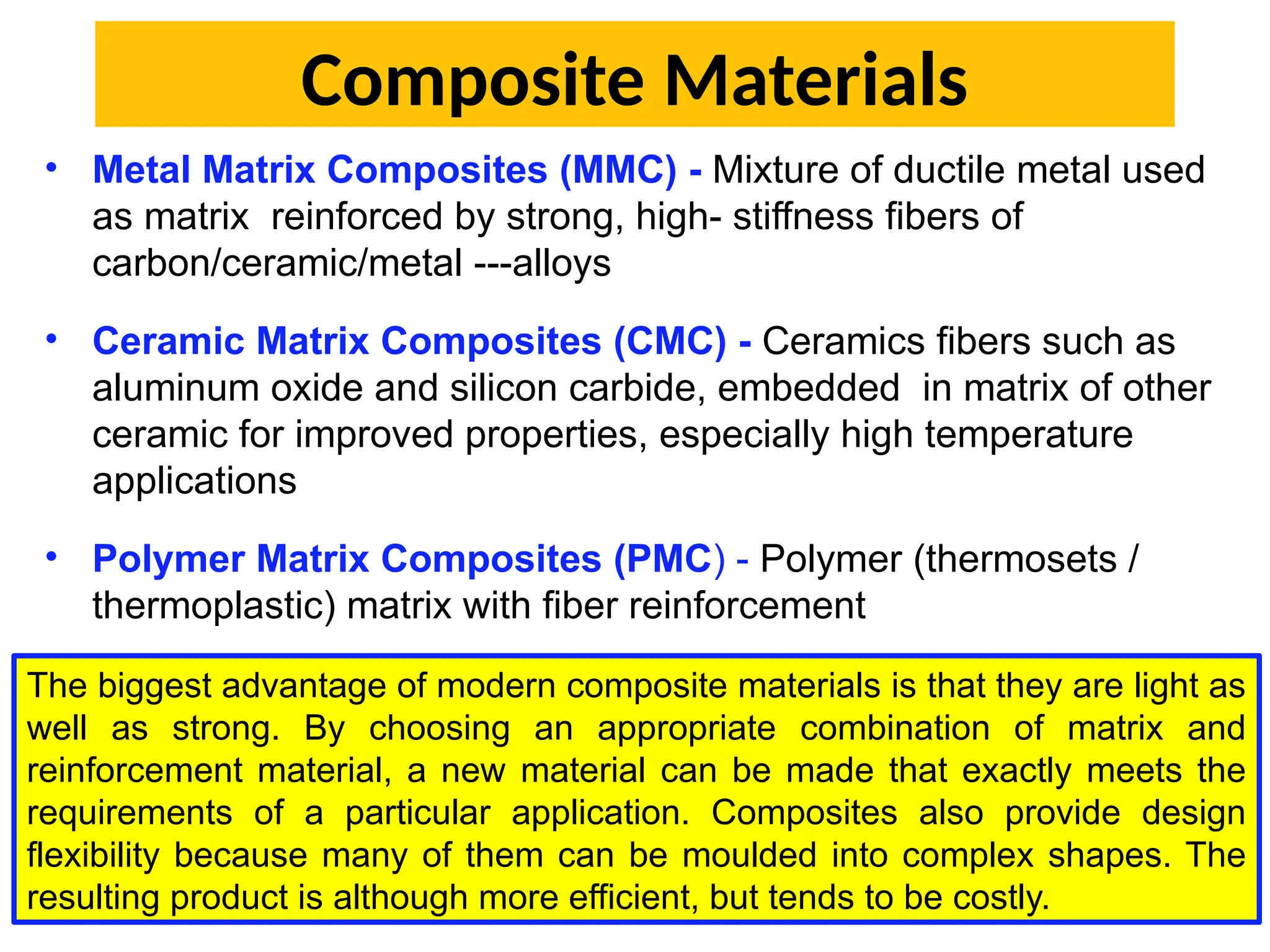
Composite Materials
• MetalMatrix Composites (MMC) - Mixture of ductile metal used
as matrix reinforced by strong, high- stiffness fibers of
carbon/ceramic/metal ---alloys
• Ceramic Matrix Composites (CMC) - Ceramics fibers such as
aluminum oxide and silicon carbide, embedded in matrix of other
ceramic for improved properties, especially high temperature
applications
• Polymer Matrix Composites (PMC) - Polymer (thermosets /
thermoplastic) matrix with fiber reinforcement
The biggest advantage of modern composite materials is that they are light as
well as strong. By choosing an appropriate combination of matrix and
reinforcement material, a new material can be made that exactly meets the
requirements of a particular application. Composites also provide design
flexibility because many of them can be moulded into complex shapes. The
resulting product is although more efficient, but tends to be costly.
13.
INSTITUTE OF SPACETECHNOLOGY,
ISLAMABAD
13
Concrete is considered a composite material. It is composed of a
combination of different materials that work together to form a
stronger, more durable product.
The main components of concrete are:
• Cement (typically Portland cement) acts as the binder.
Aggregates (such as sand, gravel, or crushed stone) provide bulk
and strength.
• Water initiates the chemical reaction (hydration) that causes the
cement to harden and bind the aggregates.
In some cases, other materials like additives or reinforcements (e.g.,
steel bars in reinforced concrete) are used to enhance its properties,
making concrete even more versatile and strong. These different
elements combined create a material that has properties distinct from
those of the individual components, which is why concrete is classified
as a composite material.
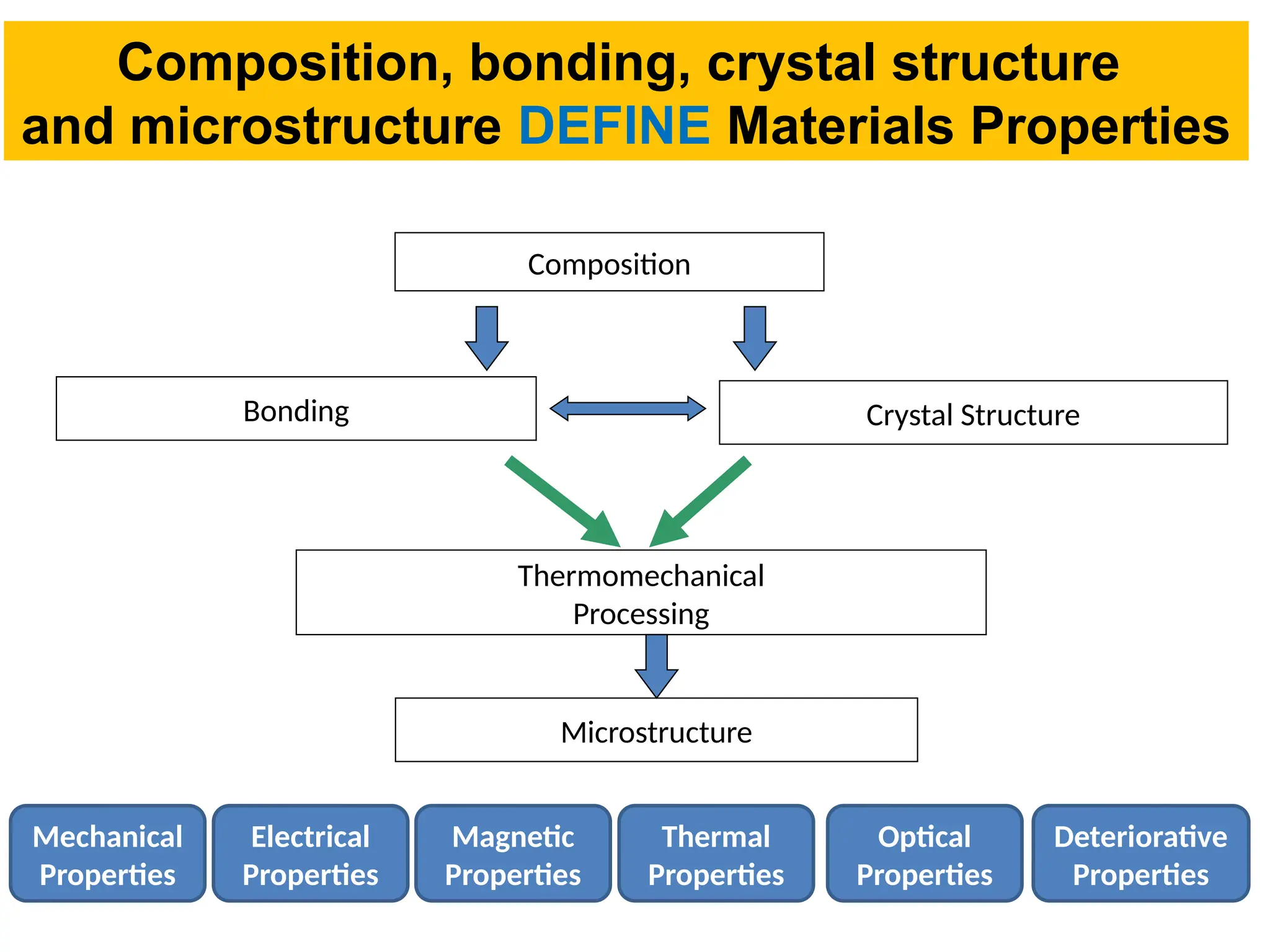
Materials’ Property Classification
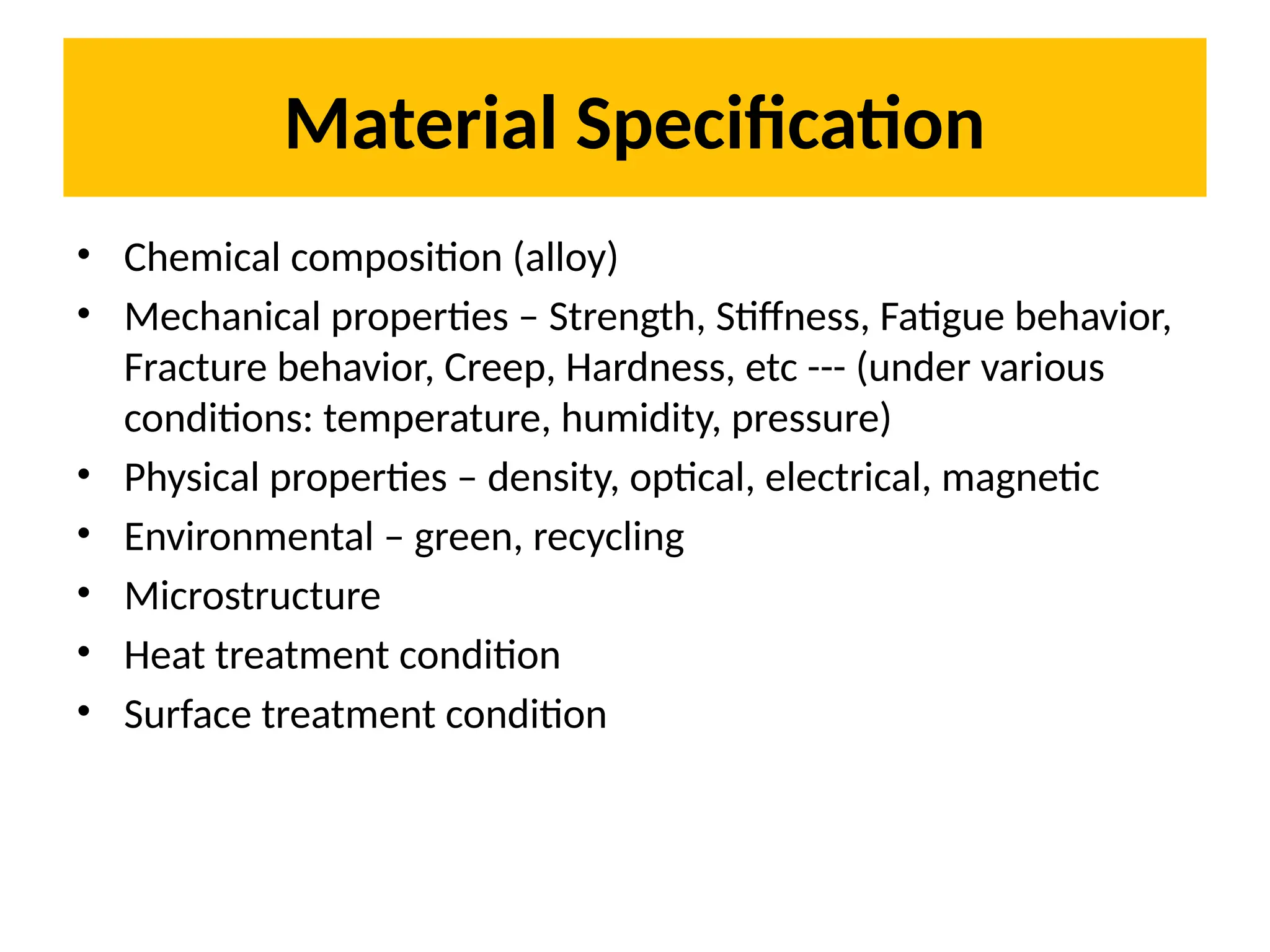
•There are six different property classifications of materials
that determine their applicability:
– mechanical, electrical, thermal, magnetic, optical, and
deteriorative
• Materials science investigates the relationships that exist
between the structures and properties of materials
• Structure means arrangement of internal components of the
material at subatomic, atomic, microscopic, and macroscopic
levels
• Properties are the way the material responds to the
environment and external forces
15
16.
Material Properties
16
Properties arethe way the material responds to the
environment and external forces.
• Mechanical properties – response to mechanical forces, strength, etc.
• Electrical and magnetic properties - response electrical and
magnetic fields, conductivity, etc.
• Thermal properties are related to transmission of heat and heat
capacity.
• Optical properties include to absorption, transmission and scattering
of light.
• Chemical stability in contact with the environment - corrosion
resistance.
Go to Mil Handbook-5 for example
17.
17
• For eachthere is a characteristic type of stimulus capable of
provoking different responses.
• Mechanical properties relate deformation to an applied load or
force; examples include elastic modulus (stiffness), strength,
and toughness.
• For electrical properties, such as electrical conductivity and
dielectric constant, the stimulus is an electric field.
• The thermal behavior of solids can be represented in terms of
heat capacity and thermal conductivity.
• Magnetic properties demonstrate the response of a material to
the application of a magnetic field.
• For optical properties, the stimulus is electromagnetic or light
radiation; index of refraction and reflectivity are representative
optical properties.
• Finally, deteriorative characteristics relate to the chemical
reactivity of materials.
Material Properties
18.
General Properties
• Metals
–have crystalline structure
– in general good thermal and electrical conductors
– are relatively strong and ductile at room temperature and many
maintain strength at elevated temperatures
– in its pre and alloyed form have many applications
• Research continues to improve existing or design new
metal alloys for better / improved product design– for
example super alloys, etc
18
19.
General Properties
• Polymers
–generally non-crystalline, some have mixture of crystalline – non
crystalline regions
– in general poor electrical conductors
– Strength and ductility of polymers vary very greatly
– have low density and low decomposition temperature
• Ceramics
– can have crystalline, non crystalline or mixture of both
– have high strength, high hardness and high thermal strength but very
brittle (very low ductility)
– have high wear resistance and good insulators
• Composite
– offer high strength and stiffness to weight ratio as compared to metals
owing to lower density
– tend to be brittle, have low fracture toughness
– prone to delamination
• Research continues to improve existing or design new Polymers, Ceramics
and Composites for better / improved product design 19
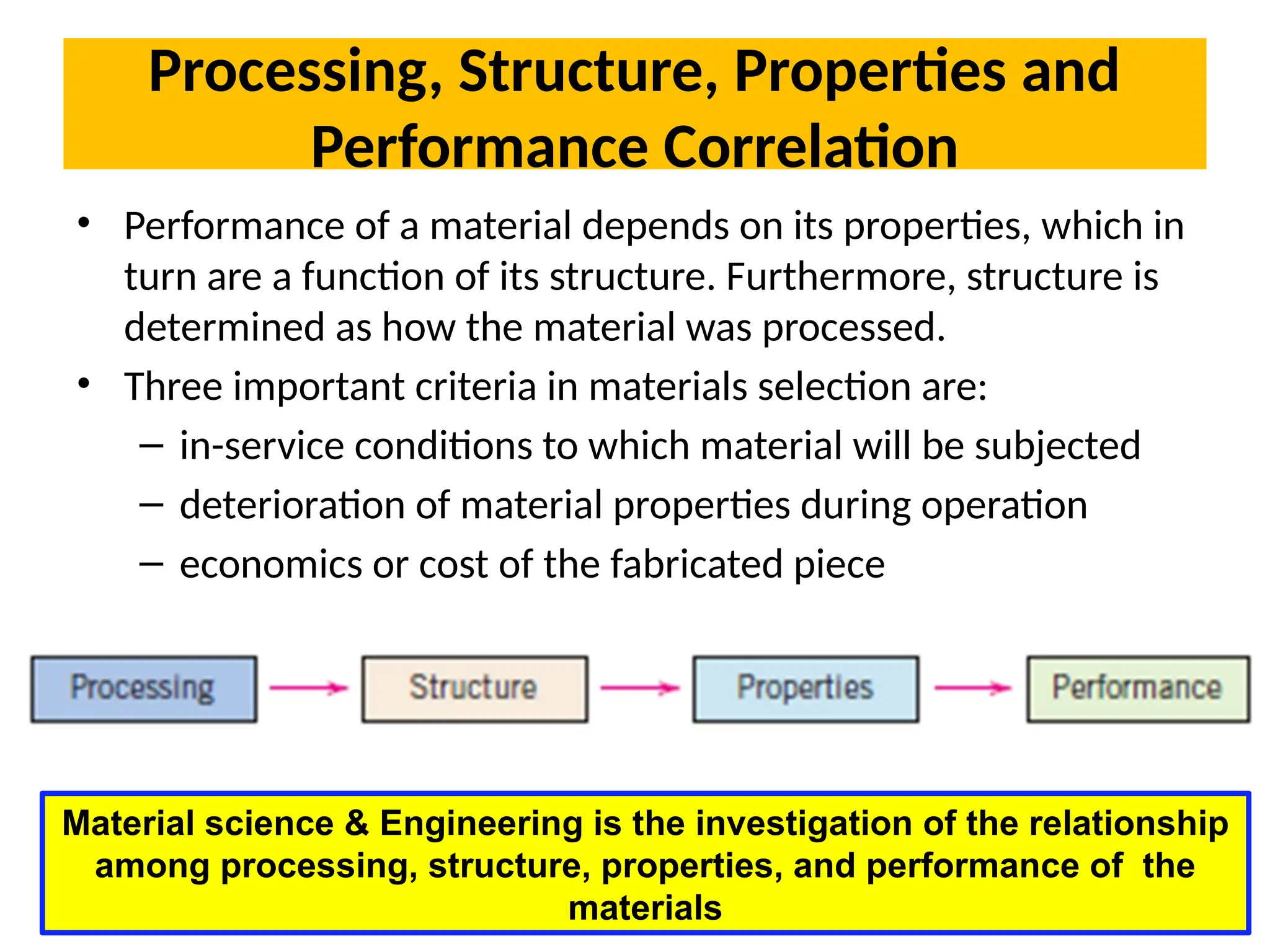
Processing, Structure, Propertiesand
Performance Correlation
• Performance of a material depends on its properties, which in
turn are a function of its structure. Furthermore, structure is
determined as how the material was processed.
• Three important criteria in materials selection are:
– in-service conditions to which material will be subjected
– deterioration of material properties during operation
– economics or cost of the fabricated piece
21
Material science & Engineering is the investigation of the relationship
among processing, structure, properties, and performance of the
materials
22.
22
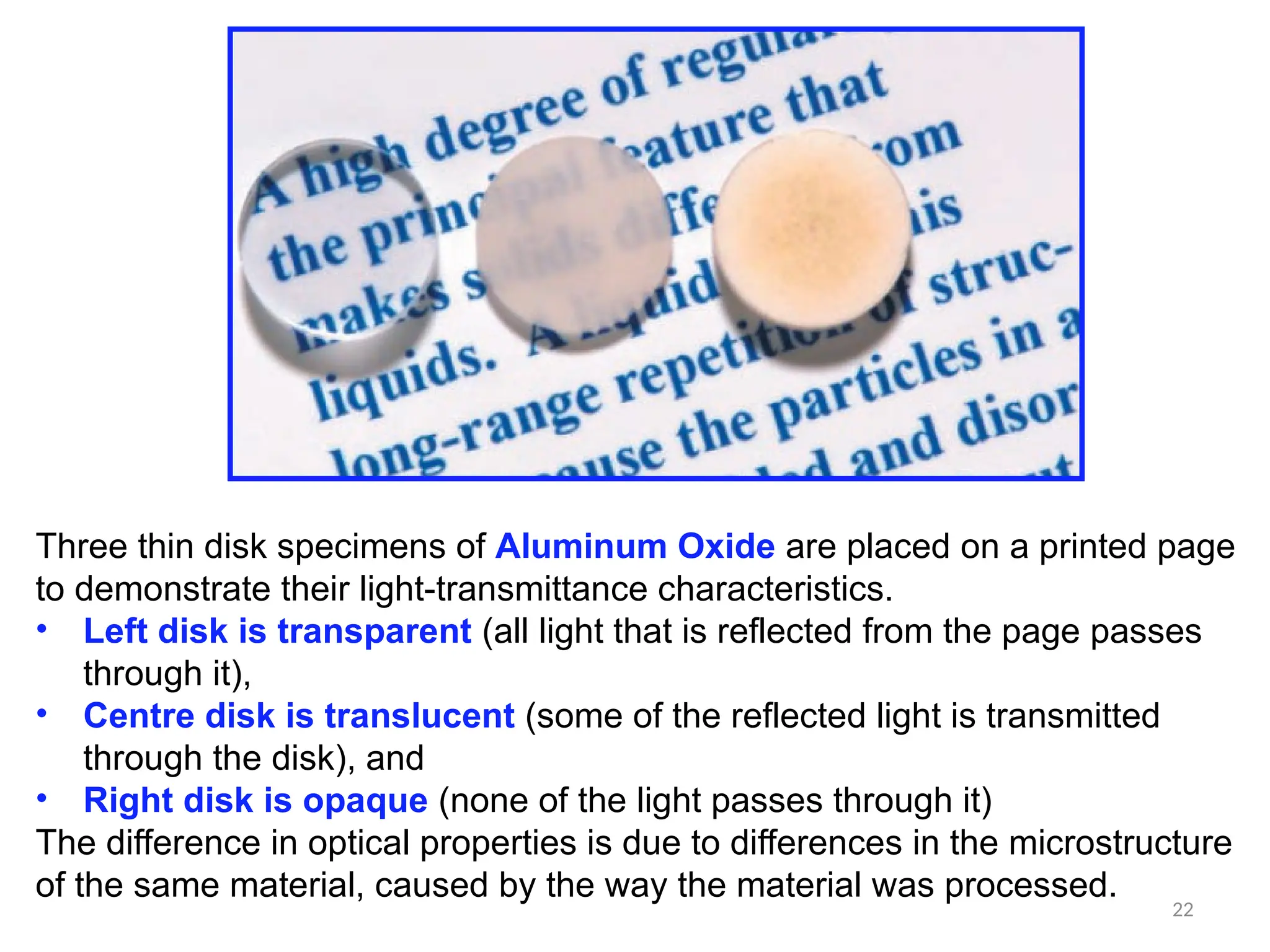
Three thin diskspecimens of Aluminum Oxide are placed on a printed page
to demonstrate their light-transmittance characteristics.
• Left disk is transparent (all light that is reflected from the page passes
through it),
• Centre disk is translucent (some of the reflected light is transmitted
through the disk), and
• Right disk is opaque (none of the light passes through it)
The difference in optical properties is due to differences in the microstructure
of the same material, caused by the way the material was processed.
Selection Process
24
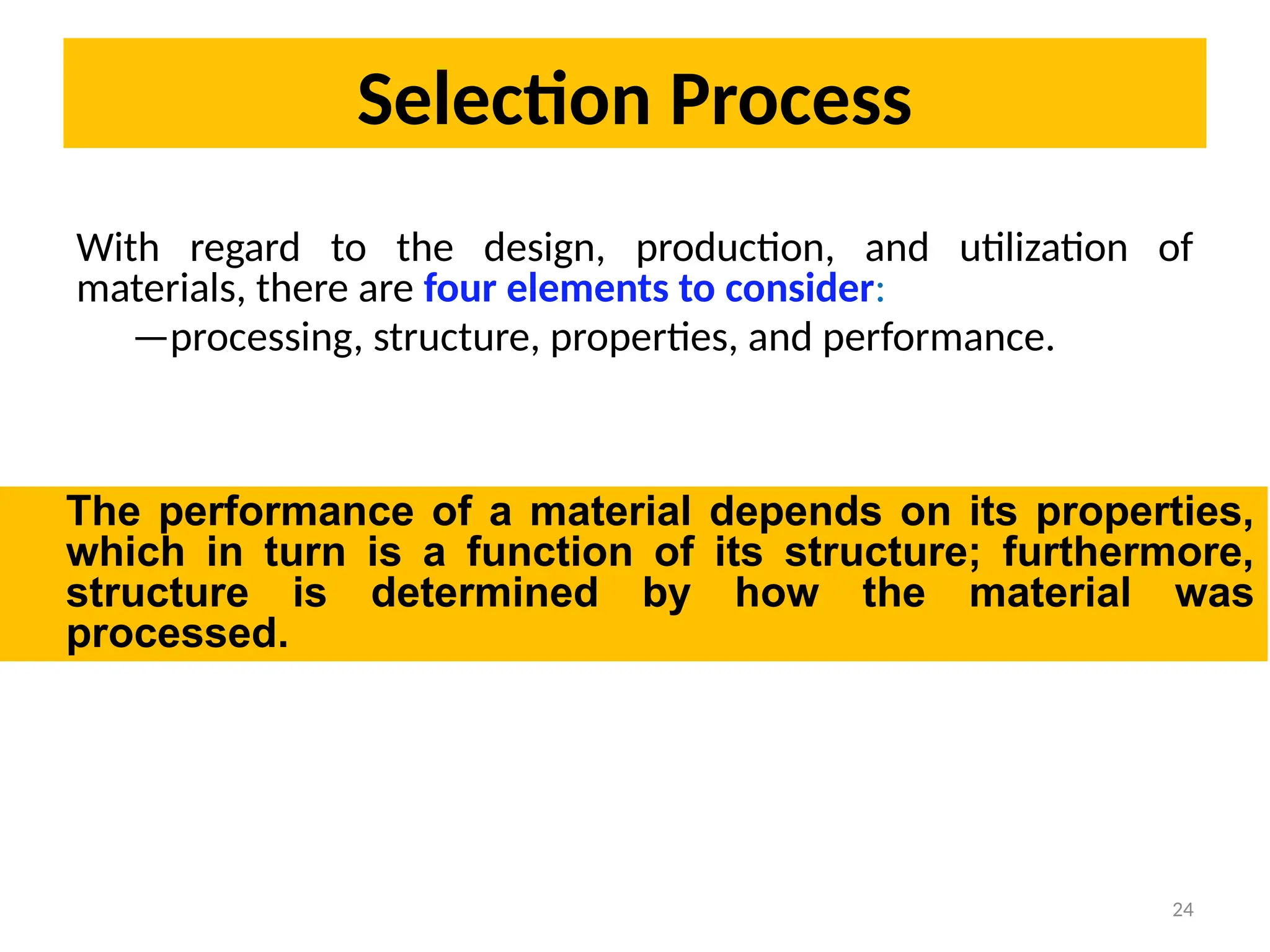
With regardto the design, production, and utilization of
materials, there are four elements to consider:
—processing, structure, properties, and performance.
The performance of a material depends on its properties,
which in turn is a function of its structure; furthermore,
structure is determined by how the material was
processed.