Material Science and Metallurgy
(BTME 402)
Dr. Ankitendran Mishra
Department of Mechanical Engineering
Oriental University, Indore
Unit-I (Introduction)
• Historic perspective and Materials Science
• Why study properties of materials?
• Classification of materials
• Advanced materials, Future materials and
• Modern materials’ needs
Historic Perspective
• Materials are very important in development of human civilization. In
respect, their names are associated in history, e.g. stone age, Bronze
age, Iron age, etc.
• With time humans discovered new materials and also techniques to
produce known materials. This is an ongoing process for coming
centuries, i.e. no end in sight!
Materials Science
• It can be defined as science dealing the relationships that exist between
the structures and properties of materials, which are useful in practice
of engineer’s profession.
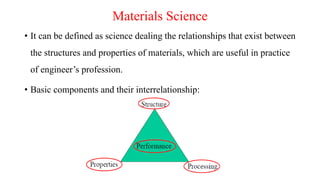
• Basic components and their interrelationship:
Properties of Materials
• All solid engineering materials are characterized for their properties.
• Engineering use of a material is reflection of its properties under
conditions of use.
• All important properties can be grouped into six categories:
• Mechanical, Electrical, Thermal, Magnetic, Optical, and Deteriorative.
• Each material possess a structure, relevant properties, which is
dependent on processing and determines the performance.
Why Study Properties of Materials?
• Since there are thousands of materials available it is almost impossible
to select a material for a specific task unless otherwise its properties
are known.
• There are several criteria on which the final decision is based on.
• There are less chances of material possessing optimal or ideal
combination of properties.
• A need to trade off between number of factors!
• The classic example involves strength and ductility: Normally material
possessing strength have limited ductility. In such cases a reasonable
compromise between two or more properties are important.
• A second selection consideration is any deterioration of material
properties during service operations.
• Finally the overriding consideration is economics.
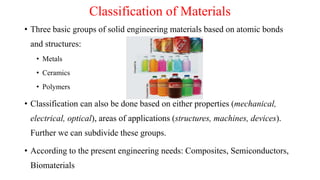
Classification of Materials
• Three basic groups of solid engineering materials based on atomic bonds
and structures:
• Metals
• Ceramics
• Polymers
• Classification can also be done based on either properties (mechanical,
electrical, optical), areas of applications (structures, machines, devices).
Further we can subdivide these groups.
• According to the present engineering needs: Composites, Semiconductors,
Biomaterials
Metals
• Characteristics are owed to non-localized electrons (metallic bond between
atoms) i.e. electrons are not bound to a particular atom.
• They are characterized by their high thermal and electrical conductivities.
• They are opaque, can be polished to high lustre. The opacity and reflectivity
of a metal arise from the response of the unbound electrons to
electromagnetic vibrations at light frequencies.
• Relatively heavier, strong, yet deformable.
E.g.: Steel, Aluminium, Brass, Bronze, Lead, Titanium, etc.
Ceramics
• They contain both metallic and non-metallic elements.
• Characterized by their higher resistance to high temperatures and harsh environments
than metals and polymers.
• Typically good insulators to passage of both heat and electricity.
• Less dense than most metals and alloys.
• They are harder and stiffer, but brittle in nature.
• They are mostly oxides, nitrides, and carbides of metals.
• Wide range: traditional (clay, silicate glass, cement) to advanced (carbides, pure oxides,
non-silicate glasses).
E.g.: Glass, Porcelain, Minerals, etc.
Polymers
• Commercially called plastics; noted for their low density, flexibility and use
as insulators.
• Mostly are of organic compounds i.e. based on carbon, oxygen and other
non-metallic elements.
• Consists large molecular structures bonded by covalent and van der Waals
forces.
• They decompose at relatively moderate temperatures (100-400C).
• Application: packaging, textiles, biomedical devices, optical devices,
household items, toys, etc. E.g.: Nylon, Teflon, Rubber, Polyester, etc.
Composites
• Consist more than one kind of material; tailor made to benefit from
combination of best characteristics of each constituent.
• Available over a very wide range: natural (wood) to synthetic (fiberglass).
• Many are composed of two phases; one is matrix – which is continuous and
surrounds the other, dispersed phase.
• Classified into many groups: (1) depending on orientation of phases; such as
particle reinforced, fiber reinforced, etc. (2) depending on matrix; metal matrix,
polymer matrix, ceramic matrix.
E.g.: Cement concrete, Fiberglass, special purpose refractory bricks,
plywood, etc.
Semiconductors
• Their electrical properties are intermediate when compared with
electrical conductors and electrical insulators.
• These electrical characteristics are extremely sensitive to the presence
of minute amounts of foreign atoms.
• Found many applications in electronic devices over decades through
integrated circuits. In can be said that semiconductors revolutionized
the electronic industry for last few decades.
Biomaterials
• Those used for replacement of damaged or diseased body parts.
• Primary requirements: must be biocompatible with body tissues, must not
produce toxic substances.
• Important materials factors: ability to support the forces, low friction and
wear, density, reproducibility and cost.
• All the above materials can be used depending on the application.
• A classic example: hip joint.
E.g.: Stainless steel, Co-28Cr-6Mo, Ti-6Al-4V, ultra high molecular
weight polyethelene, high purity dense Al-oxide, etc.
Advanced materials
• Can be defined as materials used in high-tech devices i.e. which operates based on
relatively intricate and sophisticated principles (e.g. computers, air/space-crafts,
electronic gadgets, etc.).
• These are either traditional materials with enhanced properties or newly developed
materials with high performance capabilities. Thus, these are relatively expensive.
• Typical applications: integrated circuits, lasers, LCDs, fiber optics, thermal
protection for space shuttle, etc.
E.g.: Metallic foams, inter-metallic compounds, multicomponent alloys,
magnetic alloys, special ceramics and high temperature materials, etc.
Future materials
• Group of new and state-of-the-art materials now being developed, and
expected to have significant influence on present-day technologies,
especially in the fields of medicine, manufacturing and defense.
• Smart/Intelligent material system consists some type of sensor (detects an
input) and an actuator (performs responsive and adaptive function).
• Actuators may be called upon to change shape, position, natural
frequency, mechanical characteristics in response to changes in
temperature, electric/magnetic fields, moisture, pH, etc.
Future materials (contd…)
• Four types of materials used as actuators:
- Shape memory alloys
- Piezoelectric ceramics
- Magnetostrictive materials
- Electro-/Magneto-rheological fluids
• Materials / Devices used as sensors:
- Optical fibers
- Piezoelectric materials
- Micro-electro-mechanical systems (MEMS)
- etc.
Typical applications
• By incorporating sensors, actuators and chip processors into system,
researchers are able to stimulate biological human like behavior.
• Fibres for bridges, buildings, and wood utility poles.
• They also help in fast moving and accurate robot parts, high speed
helicopter rotor blades.
• Actuators that control chatter in precision machine tools.
• Small microelectronic circuits in machines ranging from computers to
photolithography prints.
• Health monitoring detecting the success or failure of a product.
Modern materials’ needs
• Engine efficiency increases at high temperatures; requires high temperature
structural materials.
• Use of nuclear energy requires solving problems with residue, or advance in
nuclear waste processing.
• Hypersonic flight requires materials that are light, strong and resist high
temperatures.
• Optical communications require optical fibres that absorb light negligibly.
• Civil construction – materials for unbreakable windows.
• Structures: materials that are strong like metals and resist corrosion like
plastics.

Btme 402 part-1, Material Science

  • 1.
    Material Science andMetallurgy (BTME 402) Dr. Ankitendran Mishra Department of Mechanical Engineering Oriental University, Indore
  • 2.
    Unit-I (Introduction) • Historicperspective and Materials Science • Why study properties of materials? • Classification of materials • Advanced materials, Future materials and • Modern materials’ needs
  • 3.
    Historic Perspective • Materialsare very important in development of human civilization. In respect, their names are associated in history, e.g. stone age, Bronze age, Iron age, etc. • With time humans discovered new materials and also techniques to produce known materials. This is an ongoing process for coming centuries, i.e. no end in sight!
  • 4.
    Materials Science • Itcan be defined as science dealing the relationships that exist between the structures and properties of materials, which are useful in practice of engineer’s profession. • Basic components and their interrelationship:
  • 5.
    Properties of Materials •All solid engineering materials are characterized for their properties. • Engineering use of a material is reflection of its properties under conditions of use. • All important properties can be grouped into six categories: • Mechanical, Electrical, Thermal, Magnetic, Optical, and Deteriorative. • Each material possess a structure, relevant properties, which is dependent on processing and determines the performance.
  • 6.
    Why Study Propertiesof Materials? • Since there are thousands of materials available it is almost impossible to select a material for a specific task unless otherwise its properties are known. • There are several criteria on which the final decision is based on. • There are less chances of material possessing optimal or ideal combination of properties. • A need to trade off between number of factors!
  • 7.
    • The classicexample involves strength and ductility: Normally material possessing strength have limited ductility. In such cases a reasonable compromise between two or more properties are important. • A second selection consideration is any deterioration of material properties during service operations. • Finally the overriding consideration is economics.
  • 8.
    Classification of Materials •Three basic groups of solid engineering materials based on atomic bonds and structures: • Metals • Ceramics • Polymers • Classification can also be done based on either properties (mechanical, electrical, optical), areas of applications (structures, machines, devices). Further we can subdivide these groups. • According to the present engineering needs: Composites, Semiconductors, Biomaterials
  • 9.
    Metals • Characteristics areowed to non-localized electrons (metallic bond between atoms) i.e. electrons are not bound to a particular atom. • They are characterized by their high thermal and electrical conductivities. • They are opaque, can be polished to high lustre. The opacity and reflectivity of a metal arise from the response of the unbound electrons to electromagnetic vibrations at light frequencies. • Relatively heavier, strong, yet deformable. E.g.: Steel, Aluminium, Brass, Bronze, Lead, Titanium, etc.
  • 10.
    Ceramics • They containboth metallic and non-metallic elements. • Characterized by their higher resistance to high temperatures and harsh environments than metals and polymers. • Typically good insulators to passage of both heat and electricity. • Less dense than most metals and alloys. • They are harder and stiffer, but brittle in nature. • They are mostly oxides, nitrides, and carbides of metals. • Wide range: traditional (clay, silicate glass, cement) to advanced (carbides, pure oxides, non-silicate glasses). E.g.: Glass, Porcelain, Minerals, etc.
  • 11.
    Polymers • Commercially calledplastics; noted for their low density, flexibility and use as insulators. • Mostly are of organic compounds i.e. based on carbon, oxygen and other non-metallic elements. • Consists large molecular structures bonded by covalent and van der Waals forces. • They decompose at relatively moderate temperatures (100-400C). • Application: packaging, textiles, biomedical devices, optical devices, household items, toys, etc. E.g.: Nylon, Teflon, Rubber, Polyester, etc.
  • 12.
    Composites • Consist morethan one kind of material; tailor made to benefit from combination of best characteristics of each constituent. • Available over a very wide range: natural (wood) to synthetic (fiberglass). • Many are composed of two phases; one is matrix – which is continuous and surrounds the other, dispersed phase. • Classified into many groups: (1) depending on orientation of phases; such as particle reinforced, fiber reinforced, etc. (2) depending on matrix; metal matrix, polymer matrix, ceramic matrix. E.g.: Cement concrete, Fiberglass, special purpose refractory bricks, plywood, etc.
  • 13.
    Semiconductors • Their electricalproperties are intermediate when compared with electrical conductors and electrical insulators. • These electrical characteristics are extremely sensitive to the presence of minute amounts of foreign atoms. • Found many applications in electronic devices over decades through integrated circuits. In can be said that semiconductors revolutionized the electronic industry for last few decades.
  • 14.
    Biomaterials • Those usedfor replacement of damaged or diseased body parts. • Primary requirements: must be biocompatible with body tissues, must not produce toxic substances. • Important materials factors: ability to support the forces, low friction and wear, density, reproducibility and cost. • All the above materials can be used depending on the application. • A classic example: hip joint. E.g.: Stainless steel, Co-28Cr-6Mo, Ti-6Al-4V, ultra high molecular weight polyethelene, high purity dense Al-oxide, etc.
  • 15.
    Advanced materials • Canbe defined as materials used in high-tech devices i.e. which operates based on relatively intricate and sophisticated principles (e.g. computers, air/space-crafts, electronic gadgets, etc.). • These are either traditional materials with enhanced properties or newly developed materials with high performance capabilities. Thus, these are relatively expensive. • Typical applications: integrated circuits, lasers, LCDs, fiber optics, thermal protection for space shuttle, etc. E.g.: Metallic foams, inter-metallic compounds, multicomponent alloys, magnetic alloys, special ceramics and high temperature materials, etc.
  • 16.
    Future materials • Groupof new and state-of-the-art materials now being developed, and expected to have significant influence on present-day technologies, especially in the fields of medicine, manufacturing and defense. • Smart/Intelligent material system consists some type of sensor (detects an input) and an actuator (performs responsive and adaptive function). • Actuators may be called upon to change shape, position, natural frequency, mechanical characteristics in response to changes in temperature, electric/magnetic fields, moisture, pH, etc.
  • 17.
    Future materials (contd…) •Four types of materials used as actuators: - Shape memory alloys - Piezoelectric ceramics - Magnetostrictive materials - Electro-/Magneto-rheological fluids • Materials / Devices used as sensors: - Optical fibers - Piezoelectric materials - Micro-electro-mechanical systems (MEMS) - etc.
  • 18.
    Typical applications • Byincorporating sensors, actuators and chip processors into system, researchers are able to stimulate biological human like behavior. • Fibres for bridges, buildings, and wood utility poles. • They also help in fast moving and accurate robot parts, high speed helicopter rotor blades. • Actuators that control chatter in precision machine tools. • Small microelectronic circuits in machines ranging from computers to photolithography prints. • Health monitoring detecting the success or failure of a product.
  • 19.
    Modern materials’ needs •Engine efficiency increases at high temperatures; requires high temperature structural materials. • Use of nuclear energy requires solving problems with residue, or advance in nuclear waste processing. • Hypersonic flight requires materials that are light, strong and resist high temperatures. • Optical communications require optical fibres that absorb light negligibly. • Civil construction – materials for unbreakable windows. • Structures: materials that are strong like metals and resist corrosion like plastics.