1
Module 1
Introduction to Engineering Materials
2
1960’s Engineering Materials Metals
Design Choice of Material
New Materials New Products
Number of Materials 40 – 80,000!
General Definition of Material
According to Webster’s dictionary, materials are defined as
‘substances of which something is composed or made’
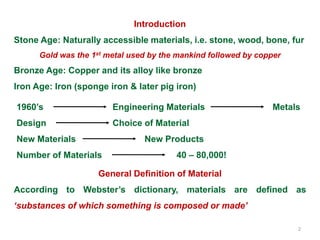
Introduction
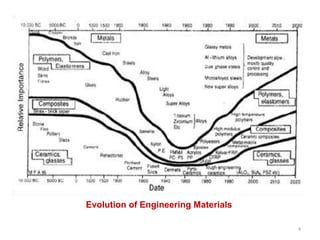
Stone Age: Naturally accessible materials, i.e. stone, wood, bone, fur
Gold was the 1st metal used by the mankind followed by copper
Bronze Age: Copper and its alloy like bronze
Iron Age: Iron (sponge iron & later pig iron)
3
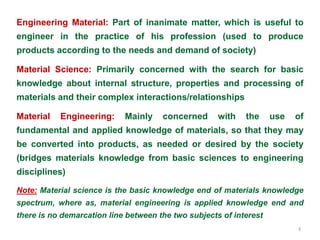
Engineering Material: Part of inanimate matter, which is useful to
engineer in the practice of his profession (used to produce
products according to the needs and demand of society)
Material Science: Primarily concerned with the search for basic
knowledge about internal structure, properties and processing of
materials and their complex interactions/relationships
Material Engineering: Mainly concerned with the use of
fundamental and applied knowledge of materials, so that they may
be converted into products, as needed or desired by the society
(bridges materials knowledge from basic sciences to engineering
disciplines)
Note: Material science is the basic knowledge end of materials knowledge
spectrum, where as, material engineering is applied knowledge end and
there is no demarcation line between the two subjects of interest
4
Evolution of Engineering Materials
5
Why Material Science & Engineering is important to technologists?
Examples:
• Mechanical engineers search for high temp material so that gas
turbines, jet engines etc can operate more efficiently and wear
resistance materials to manufacture bearing materials
• Electrical engineers search for materials by which electrical
devices or machines can be operated at a faster rate with minimum
power losses
• Aerospace & automobile engineers search for materials having
high strength-to-weight ratio
• Electronic engineers search for material that are useful in the
fabrication & miniaturization of electronic devices
• Chemical engineers search for highly corrosion-resistant materials
Note: All these demands may be fulfilled when the internal structure
and engineering properties are known to an engineer or technologist
6
Classification
It is the systematic arrangement or division of materials into
groups on the basis of some common characteristic
1. According to General Properties
2. According to Nature of Materials
3. According to Applications
7
1. According to General Properties
(a). Metals (e.g. iron, aluminium, copper, zinc, lead, etc)
Iron as the base metal, and range from plain carbon (> 98 % Fe) to
(i). Ferrous: high alloy steel (< 50 % alloying elements), e.g. cast
iron, wrought iron, steel, alloys like high-speed steel, spring steel,
etc
(ii). Non-Ferrous: Rest of the all other metals and their alloys, e.g.
copper, aluminium, zinc lead, alloys like brass, bronze, duralumin,
etc
(b). Non-Metals (e.g. leather, rubber, asbestos, plastics, etc)
8
2. According to Nature of Materials
(a). Metals: e.g. Iron & Steel, Alloys & Superalloys, Intermetallic
Compounds, etc
(b). Ceramics: e.g. Structural Ceramics (high-temperature load
bearing), Refractories (corrosion-resistant, insulating), Whitewares
(porcelains), Glass, Electrical Ceramics (capacitors, insulators,
transducers), Chemically Bonded Ceramics (cement & concrete)
(c).Polymers: e.g. Plastics, Liquid Crystals, Adhesives
(d). Electronic Materials: e.g. Silicon, Germanium, Photonic
materials (solid-state lasers, LEDs)
9
(e). Composites: e.g. Particulate composites (small particles
embedded in a different material), Laminate composites (golf club
shafts, tennis rackets), Fiber reinforced composites (fiberglass)
(f). Biomaterials: e.g. Man-made proteins (artificial bacterium),
Biosensors, etc
(g). Advanced / Smart Materials: e.g. materials in computers
(VCRs, CD Players, etc), fibreoptic systems, spacecrafts,
aircrafts, rockets, shape-memory alloys, piezoelectric ceramics,
magnetostrictive materials, optical fibres,
microelectromechanical (MEMs) devices, electrorheological /
magnetorheological fluids, Nanomaterials, etc
10
3. According to Applications
(a). Electrical Materials: e.g. conductors, insulators, dielectrics,
etc
(b). Electronic Materials: e.g. conductors, semi-conductors, etc
(c). Magnetic Materials: e.g. ferromagnetic, paramagnetic &
diamagnetic materials, etc
(d). Optical Materials: e.g. glass, quartz, etc
(e). Bio Materials: e.g. man-made proteins, artificial bacterium
11
Engineering Materials
Ceramics
Alumina
Diamond
Magnesia
Silicon
Carbide
Zirconia
Composites
Carbon Fiber
Ceramic
Matrix
Glass Fiber
Metal Matrix
Electronic
Materials
Silicon
Germanium
Photonic
Materials
Solid-State
Lasers
LEDs
Bio-
Materials
Man-Made
Proteins
Artificial
Bacterium
Biosensors
Advanced /
Smart
Materials
Shape-Memory Alloys
Piezoelectric Ceramics
Magnetostrictive Materials
Optical Fibres
Electrorheological Fluids
Nanomaterials
Metals
Ferrous
Non-
Ferrous
Cast Iron
Carbon Steels
Alloy Steels
Stainless Steels
Aluminium
Brass
Bronze
Copper
Lead
Magnesium
Nickel
Tin
Zinc
Titanium
Polymers
Thermoplastic
Thermosetting
Elastomers
ABS
Acrylic
Nylon
Polyethylene
Polystyrene
Vinyl
Epoxy
Phenolic
Polyester
Butyl
Fluorocarbon
Neoprene
Rubber
Silicone
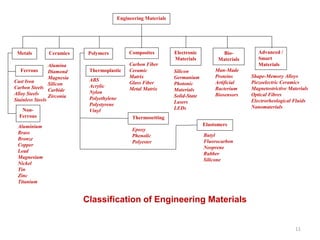
Classification of Engineering Materials
12
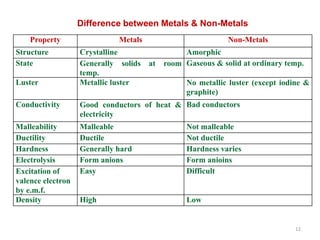
Property Metals Non-Metals
Structure Crystalline Amorphic
State Generally solids at room
temp.
Gaseous & solid at ordinary temp.
Luster Metallic luster No metallic luster (except iodine &
graphite)
Conductivity Good conductors of heat &
electricity
Bad conductors
Malleability Malleable Not malleable
Ductility Ductile Not ductile
Hardness Generally hard Hardness varies
Electrolysis Form anions Form anioins
Excitation of
valence electron
by e.m.f.
Easy Difficult
Density High Low
Difference between Metals & Non-Metals
13
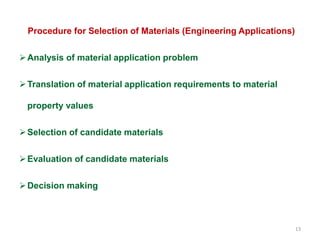
Procedure for Selection of Materials (Engineering Applications)
Analysis of material application problem
Translation of material application requirements to material
property values
Selection of candidate materials
Evaluation of candidate materials
Decision making
14
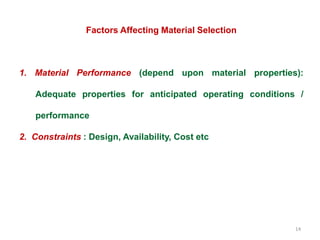
Factors Affecting Material Selection
1. Material Performance (depend upon material properties):
Adequate properties for anticipated operating conditions /
performance
2. Constraints : Design, Availability, Cost etc
15
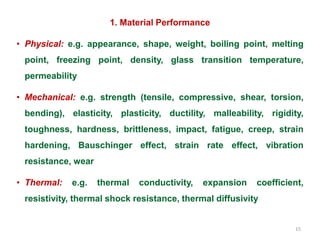
1. Material Performance
• Physical: e.g. appearance, shape, weight, boiling point, melting
point, freezing point, density, glass transition temperature,
permeability
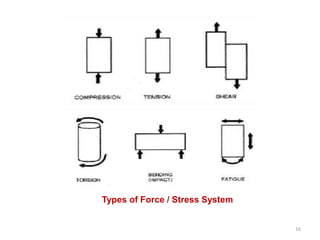
• Mechanical: e.g. strength (tensile, compressive, shear, torsion,
bending), elasticity, plasticity, ductility, malleability, rigidity,
toughness, hardness, brittleness, impact, fatigue, creep, strain
hardening, Bauschinger effect, strain rate effect, vibration
resistance, wear
• Thermal: e.g. thermal conductivity, expansion coefficient,
resistivity, thermal shock resistance, thermal diffusivity
16
Types of Force / Stress System
17
• Electrical: e.g. conductivity, resistivity, dielectric strength,
thermoelectricity, superconductivity, electric hysteresis
• Magnetic: e.g. ferromagnetism, paramagnetism, diamagnetism,
magnetic permeability, coercive force, curie temperature,
magnetic hysteresis
• Chemical: e.g. reactivity, corrosion resistance, polymerization,
composition, acidity, alkalinity
• Optical: e.g. reflectivity, refractivity, absorptivity, transparency,
opaqueness, color, luster
• Metallurgical: e.g. grain size, heat treatment done / required,
anisotropy, hardenability
18
2. Constraints
• Design Requirements
• Existing Facilities
• Availability
• Compatibility
• Marketability
• Manufacturability (Fabricability / Castability / Formability /
Machinability / Weldability)
• Cost (Material + Fabrication / Manufacturing)
19
Others Factors Affecting Material Performance
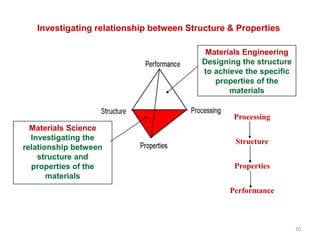
• Structure-property -Processing Relationships
• Hot Work, Cold Work,
• Solid Solution Strengthening
• Precipitation Hardening
• Inclusions
• Imperfections (Number of Dislocations)
• Crystal structures: Crystalline vs Amorphous
• Toughening
• Heat treatment (Annealing, Normalizing, Quenching)
• Residual Stresses
20
Investigating relationship between Structure & Properties
Materials Engineering
Designing the structure
to achieve the specific
properties of the
materials
Materials Science
Investigating the
relationship between
structure and
properties of the
materials
Processing
Structure
Properties
Performance
21
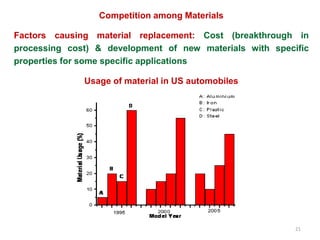
Competition among Materials
Factors causing material replacement: Cost (breakthrough in
processing cost) & development of new materials with specific
properties for some specific applications
Usage of material in US automobiles

Module 1, intro to engg materials

  • 1.
    1 Module 1 Introduction toEngineering Materials
  • 2.
    2 1960’s Engineering MaterialsMetals Design Choice of Material New Materials New Products Number of Materials 40 – 80,000! General Definition of Material According to Webster’s dictionary, materials are defined as ‘substances of which something is composed or made’ Introduction Stone Age: Naturally accessible materials, i.e. stone, wood, bone, fur Gold was the 1st metal used by the mankind followed by copper Bronze Age: Copper and its alloy like bronze Iron Age: Iron (sponge iron & later pig iron)
  • 3.
    3 Engineering Material: Partof inanimate matter, which is useful to engineer in the practice of his profession (used to produce products according to the needs and demand of society) Material Science: Primarily concerned with the search for basic knowledge about internal structure, properties and processing of materials and their complex interactions/relationships Material Engineering: Mainly concerned with the use of fundamental and applied knowledge of materials, so that they may be converted into products, as needed or desired by the society (bridges materials knowledge from basic sciences to engineering disciplines) Note: Material science is the basic knowledge end of materials knowledge spectrum, where as, material engineering is applied knowledge end and there is no demarcation line between the two subjects of interest
  • 4.
  • 5.
    5 Why Material Science& Engineering is important to technologists? Examples: • Mechanical engineers search for high temp material so that gas turbines, jet engines etc can operate more efficiently and wear resistance materials to manufacture bearing materials • Electrical engineers search for materials by which electrical devices or machines can be operated at a faster rate with minimum power losses • Aerospace & automobile engineers search for materials having high strength-to-weight ratio • Electronic engineers search for material that are useful in the fabrication & miniaturization of electronic devices • Chemical engineers search for highly corrosion-resistant materials Note: All these demands may be fulfilled when the internal structure and engineering properties are known to an engineer or technologist
  • 6.
    6 Classification It is thesystematic arrangement or division of materials into groups on the basis of some common characteristic 1. According to General Properties 2. According to Nature of Materials 3. According to Applications
  • 7.
    7 1. According toGeneral Properties (a). Metals (e.g. iron, aluminium, copper, zinc, lead, etc) Iron as the base metal, and range from plain carbon (> 98 % Fe) to (i). Ferrous: high alloy steel (< 50 % alloying elements), e.g. cast iron, wrought iron, steel, alloys like high-speed steel, spring steel, etc (ii). Non-Ferrous: Rest of the all other metals and their alloys, e.g. copper, aluminium, zinc lead, alloys like brass, bronze, duralumin, etc (b). Non-Metals (e.g. leather, rubber, asbestos, plastics, etc)
  • 8.
    8 2. According toNature of Materials (a). Metals: e.g. Iron & Steel, Alloys & Superalloys, Intermetallic Compounds, etc (b). Ceramics: e.g. Structural Ceramics (high-temperature load bearing), Refractories (corrosion-resistant, insulating), Whitewares (porcelains), Glass, Electrical Ceramics (capacitors, insulators, transducers), Chemically Bonded Ceramics (cement & concrete) (c).Polymers: e.g. Plastics, Liquid Crystals, Adhesives (d). Electronic Materials: e.g. Silicon, Germanium, Photonic materials (solid-state lasers, LEDs)
  • 9.
    9 (e). Composites: e.g.Particulate composites (small particles embedded in a different material), Laminate composites (golf club shafts, tennis rackets), Fiber reinforced composites (fiberglass) (f). Biomaterials: e.g. Man-made proteins (artificial bacterium), Biosensors, etc (g). Advanced / Smart Materials: e.g. materials in computers (VCRs, CD Players, etc), fibreoptic systems, spacecrafts, aircrafts, rockets, shape-memory alloys, piezoelectric ceramics, magnetostrictive materials, optical fibres, microelectromechanical (MEMs) devices, electrorheological / magnetorheological fluids, Nanomaterials, etc
  • 10.
    10 3. According toApplications (a). Electrical Materials: e.g. conductors, insulators, dielectrics, etc (b). Electronic Materials: e.g. conductors, semi-conductors, etc (c). Magnetic Materials: e.g. ferromagnetic, paramagnetic & diamagnetic materials, etc (d). Optical Materials: e.g. glass, quartz, etc (e). Bio Materials: e.g. man-made proteins, artificial bacterium
  • 11.
    11 Engineering Materials Ceramics Alumina Diamond Magnesia Silicon Carbide Zirconia Composites Carbon Fiber Ceramic Matrix GlassFiber Metal Matrix Electronic Materials Silicon Germanium Photonic Materials Solid-State Lasers LEDs Bio- Materials Man-Made Proteins Artificial Bacterium Biosensors Advanced / Smart Materials Shape-Memory Alloys Piezoelectric Ceramics Magnetostrictive Materials Optical Fibres Electrorheological Fluids Nanomaterials Metals Ferrous Non- Ferrous Cast Iron Carbon Steels Alloy Steels Stainless Steels Aluminium Brass Bronze Copper Lead Magnesium Nickel Tin Zinc Titanium Polymers Thermoplastic Thermosetting Elastomers ABS Acrylic Nylon Polyethylene Polystyrene Vinyl Epoxy Phenolic Polyester Butyl Fluorocarbon Neoprene Rubber Silicone Classification of Engineering Materials
  • 12.
    12 Property Metals Non-Metals StructureCrystalline Amorphic State Generally solids at room temp. Gaseous & solid at ordinary temp. Luster Metallic luster No metallic luster (except iodine & graphite) Conductivity Good conductors of heat & electricity Bad conductors Malleability Malleable Not malleable Ductility Ductile Not ductile Hardness Generally hard Hardness varies Electrolysis Form anions Form anioins Excitation of valence electron by e.m.f. Easy Difficult Density High Low Difference between Metals & Non-Metals
  • 13.
    13 Procedure for Selectionof Materials (Engineering Applications) Analysis of material application problem Translation of material application requirements to material property values Selection of candidate materials Evaluation of candidate materials Decision making
  • 14.
    14 Factors Affecting MaterialSelection 1. Material Performance (depend upon material properties): Adequate properties for anticipated operating conditions / performance 2. Constraints : Design, Availability, Cost etc
  • 15.
    15 1. Material Performance •Physical: e.g. appearance, shape, weight, boiling point, melting point, freezing point, density, glass transition temperature, permeability • Mechanical: e.g. strength (tensile, compressive, shear, torsion, bending), elasticity, plasticity, ductility, malleability, rigidity, toughness, hardness, brittleness, impact, fatigue, creep, strain hardening, Bauschinger effect, strain rate effect, vibration resistance, wear • Thermal: e.g. thermal conductivity, expansion coefficient, resistivity, thermal shock resistance, thermal diffusivity
  • 16.
    16 Types of Force/ Stress System
  • 17.
    17 • Electrical: e.g.conductivity, resistivity, dielectric strength, thermoelectricity, superconductivity, electric hysteresis • Magnetic: e.g. ferromagnetism, paramagnetism, diamagnetism, magnetic permeability, coercive force, curie temperature, magnetic hysteresis • Chemical: e.g. reactivity, corrosion resistance, polymerization, composition, acidity, alkalinity • Optical: e.g. reflectivity, refractivity, absorptivity, transparency, opaqueness, color, luster • Metallurgical: e.g. grain size, heat treatment done / required, anisotropy, hardenability
  • 18.
    18 2. Constraints • DesignRequirements • Existing Facilities • Availability • Compatibility • Marketability • Manufacturability (Fabricability / Castability / Formability / Machinability / Weldability) • Cost (Material + Fabrication / Manufacturing)
  • 19.
    19 Others Factors AffectingMaterial Performance • Structure-property -Processing Relationships • Hot Work, Cold Work, • Solid Solution Strengthening • Precipitation Hardening • Inclusions • Imperfections (Number of Dislocations) • Crystal structures: Crystalline vs Amorphous • Toughening • Heat treatment (Annealing, Normalizing, Quenching) • Residual Stresses
  • 20.
    20 Investigating relationship betweenStructure & Properties Materials Engineering Designing the structure to achieve the specific properties of the materials Materials Science Investigating the relationship between structure and properties of the materials Processing Structure Properties Performance
  • 21.
    21 Competition among Materials Factorscausing material replacement: Cost (breakthrough in processing cost) & development of new materials with specific properties for some specific applications Usage of material in US automobiles