The Iron–Carbon Phase Diagram
Prof. H. K. Khaira
Professor in MSME Deptt.
MANIT, Bhopal
Iron–Carbon Phase Diagram
• In their simplest form, steels are alloys of Iron
(Fe) and Carbon (C).
• The Fe-C phase diagram is a fairly complex
one, but we will only consider the steel and
cast iron part of the diagram, up to 6.67%
Carbon.
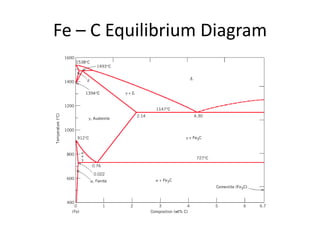
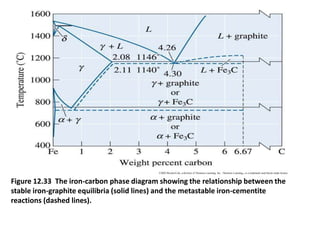
Fe – C Equilibrium Diagram
©2003 Brooks/Cole, a division of Thomson Learning, Inc. Thomson Learning ™ is a trademark used herein under license.

Figure 12.33 The iron-carbon phase diagram showing the relationship between the
stable iron-graphite equilibria (solid lines) and the metastable iron-cementite
reactions (dashed lines).
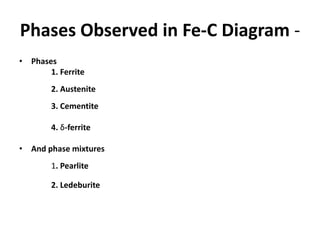
Phases Observed in Fe-C Diagram • Phases
1. Ferrite
2. Austenite
3. Cementite
4. δ-ferrite
• And phase mixtures
1. Pearlite
2. Ledeburite
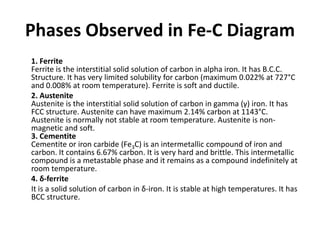
Phases Observed in Fe-C Diagram
1. Ferrite
Ferrite is the interstitial solid solution of carbon in alpha iron. It has B.C.C.
Structure. It has very limited solubility for carbon (maximum 0.022% at 727°C
and 0.008% at room temperature). Ferrite is soft and ductile.
2. Austenite
Austenite is the interstitial solid solution of carbon in gamma (γ) iron. It has
FCC structure. Austenite can have maximum 2.14% carbon at 1143°C.
Austenite is normally not stable at room temperature. Austenite is nonmagnetic and soft.
3. Cementite
Cementite or iron carbide (Fe3C) is an intermetallic compound of iron and
carbon. It contains 6.67% carbon. It is very hard and brittle. This intermetallic
compound is a metastable phase and it remains as a compound indefinitely at
room temperature.
4. δ-ferrite
It is a solid solution of carbon in δ-iron. It is stable at high temperatures. It has
BCC structure.
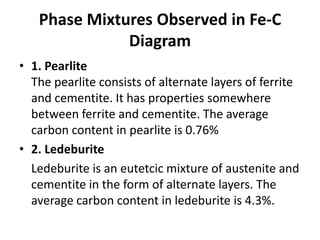
Phase Mixtures Observed in Fe-C
Diagram
• 1. Pearlite
The pearlite consists of alternate layers of ferrite
and cementite. It has properties somewhere
between ferrite and cementite. The average
carbon content in pearlite is 0.76%
• 2. Ledeburite
Ledeburite is an eutetcic mixture of austenite and
cementite in the form of alternate layers. The
average carbon content in ledeburite is 4.3%.
A few comments on Fe–C system
• Carbon occupies interstitial positions in Fe. It
forms a solid solution with α, γ, δ phases of
iron
• Maximum solubility in BCC α-ferrite is limited
(max. 0.025 % at 727 °C) as BCC has relatively
small interstitial positions
• Maximum solubility in FCC austenite is 2.14 %
at 1147 °C as FCC has larger interstitial
positions
A few comments on Fe–C system
• Mechanical properties
– Cementite is very hard and brittle - can strengthen
steels.
– Mechanical properties depend on the
microstructure, that is, amount and distribution of
ferrite and cementite.

• Magnetic properties: α -ferrite is magnetic
below 768 °C, austenite is non-magnetic
Fe-C Alloys
• Fe-C alloys can be of two types.
1. Steels
Steels are alloys of iron and carbon containing up
to 2.14% C. Other alloying elements may also be
present in steels.
2. Cast irons
Cast irons are alloys of iron and carbon
containing more than 2.14% C. Other alloying
elements may also be present in cast irons.
Important Reactions in Fe-C System
• There are three important reactions taking
place in Fe-C system
1. Eutectic reaction
2. Eutectoid reaction

3. Peritectic Reaction
Important Reactions in Fe-C System
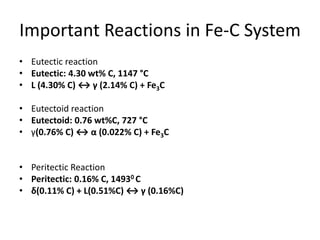
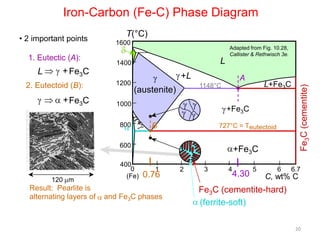
• Eutectic reaction
• Eutectic: 4.30 wt% C, 1147 °C
• L (4.30% C) ↔ γ (2.14% C) + Fe3C
• Eutectoid reaction
• Eutectoid: 0.76 wt%C, 727 °C
• γ(0.76% C) ↔ α (0.022% C) + Fe3C
• Peritectic Reaction
• Peritectic: 0.16% C, 14930 C
• δ(0.11% C) + L(0.51%C) ↔ γ (0.16%C)
Important Reactions in Fe–C System
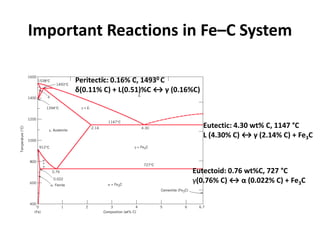
Peritectic: 0.16% C, 14930 C
δ(0.11% C) + L(0.51)%C ↔ γ (0.16%C)

Eutectic: 4.30 wt% C, 1147 °C
L (4.30% C) ↔ γ (2.14% C) + Fe3C

Eutectoid: 0.76 wt%C, 727 °C
γ(0.76% C) ↔ α (0.022% C) + Fe3C
Eutectic Reaction
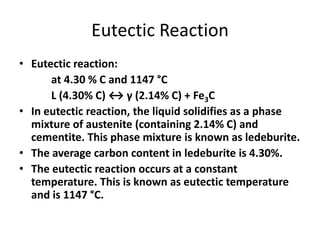
• Eutectic reaction:
at 4.30 % C and 1147 °C
L (4.30% C) ↔ γ (2.14% C) + Fe3C
• In eutectic reaction, the liquid solidifies as a phase
mixture of austenite (containing 2.14% C) and
cementite. This phase mixture is known as ledeburite.
• The average carbon content in ledeburite is 4.30%.
• The eutectic reaction occurs at a constant
temperature. This is known as eutectic temperature
and is 1147 °C.
Eutectoid Reaction
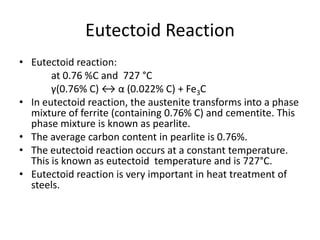
• Eutectoid reaction:
at 0.76 %C and 727 °C
γ(0.76% C) ↔ α (0.022% C) + Fe3C
• In eutectoid reaction, the austenite transforms into a phase
mixture of ferrite (containing 0.76% C) and cementite. This
phase mixture is known as pearlite.
• The average carbon content in pearlite is 0.76%.
• The eutectoid reaction occurs at a constant temperature.
This is known as eutectoid temperature and is 727°C.
• Eutectoid reaction is very important in heat treatment of
steels.
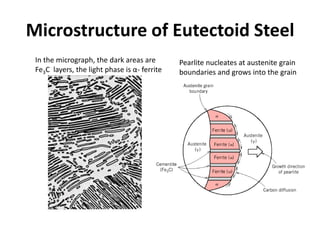
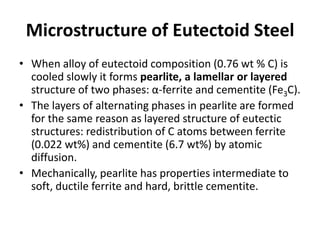
Microstructure of Eutectoid Steel
In the micrograph, the dark areas are
Fe3C layers, the light phase is α- ferrite

Pearlite nucleates at austenite grain
boundaries and grows into the grain
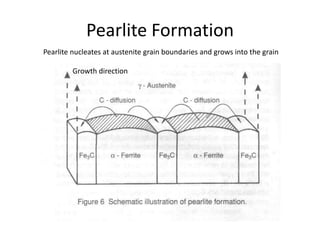
Pearlite Formation
Pearlite nucleates at austenite grain boundaries and grows into the grain
Growth direction
Peritectic Reaction
• Peritectic reaction:
at 0.16% C and 14930 C
δ(0.11% C) + L(0.51%C) ↔ γ (0.16%C)
• In peritectic reaction, the liquid and δ iron
transforms into austenite (containing 0.16%
C).
• The peritectic reaction occurs at a constant
temperature. This is known as peritectic
temperature and is 1493°C.
Development of Microstructure in
Iron - Carbon alloys
Iron-Carbon (Fe-C) Phase Diagram

1. Eutectic (A):

L

T(°C)
1600

Adapted from Fig. 10.28,
Callister & Rethwisch 3e.

L

1400

+ Fe3C

2. Eutectoid (B):

+ Fe3C

1200

+L

AA

(austenite)

1000
800

+Fe3C
B

727°C = T eutectoid

600

120 m

Result: Pearlite is
alternating layers of

400
0
(Fe)

L+Fe3C

1148°C

Fe3C (cementite)

• 2 important points

+Fe3C
1

0.76

and Fe3C phases

2

3

4

4.30

5

6

6.7

C, wt% C

Fe3C (cementite-hard)
(ferrite-soft)
20
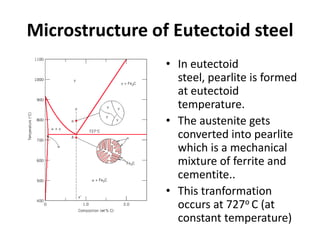
Microstructure of Eutectoid steel
• In eutectoid
steel, pearlite is formed
at eutectoid
temperature.
• The austenite gets
converted into pearlite
which is a mechanical
mixture of ferrite and
cementite..
• This tranformation
occurs at 727o C (at
constant temperature)
Microstructure of Eutectoid Steel
• When alloy of eutectoid composition (0.76 wt % C) is
cooled slowly it forms pearlite, a lamellar or layered
structure of two phases: α-ferrite and cementite (Fe3C).
• The layers of alternating phases in pearlite are formed
for the same reason as layered structure of eutectic
structures: redistribution of C atoms between ferrite
(0.022 wt%) and cementite (6.7 wt%) by atomic
diffusion.
• Mechanically, pearlite has properties intermediate to
soft, ductile ferrite and hard, brittle cementite.
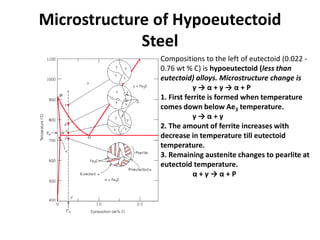
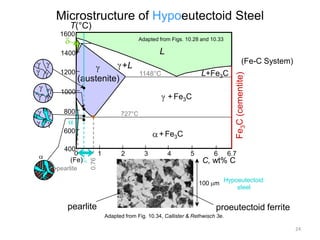
Microstructure of Hypoeutectoid
Steel
Compositions to the left of eutectoid (0.022 0.76 wt % C) is hypoeutectoid (less than
eutectoid) alloys. Microstructure change is
γ→α+γ→α+P
1. First ferrite is formed when temperature
comes down below Ae3 temperature.
γ→α+γ
2. The amount of ferrite increases with
decrease in temperature till eutectoid
temperature.
3. Remaining austenite changes to pearlite at

eutectoid temperature.
α+γ→α+P
Microstructure of Hypoeutectoid Steel
T(°C)

1600

Adapted from Figs. 10.28 and 10.33

L

1400

1000

+ Fe3C

800

727°C

600

pearlite

+ Fe3C
1
0.76

400
0
(Fe)C0

L+Fe3C

1148°C

(austenite)

2

3

4

5

6

6.7

C, wt% C
100 m

pearlite

Fe3C (cementite)

1200

(Fe-C System)

+L

Hypoeutectoid
steel

proeutectoid ferrite
Adapted from Fig. 10.34, Callister & Rethwisch 3e.
24
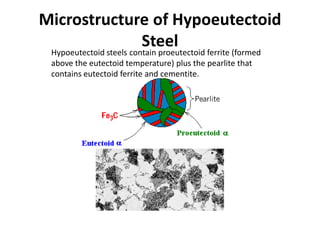
Microstructure of Hypoeutectoid
Steel
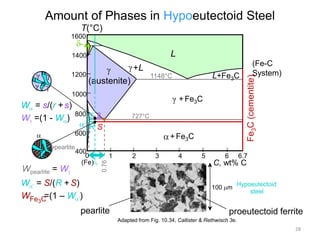
Hypoeutectoid steels contain proeutectoid ferrite (formed
above the eutectoid temperature) plus the pearlite that
contains eutectoid ferrite and cementite.
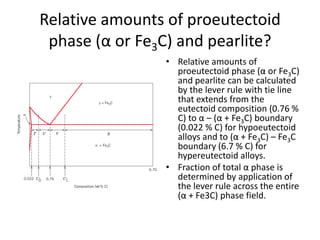
Relative amounts of proeutectoid
phase (α or Fe3C) and pearlite?
• Relative amounts of
proeutectoid phase (α or Fe3C)
and pearlite can be calculated
by the lever rule with tie line
that extends from the
eutectoid composition (0.76 %
C) to α – (α + Fe3C) boundary
(0.022 % C) for hypoeutectoid
alloys and to (α + Fe3C) – Fe3C
boundary (6.7 % C) for
hypereutectoid alloys.
• Fraction of total α phase is
determined by application of
the lever rule across the entire
(α + Fe3C) phase field.
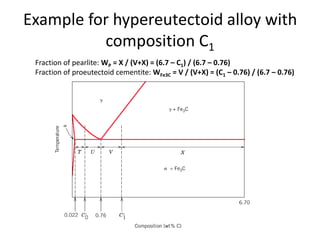
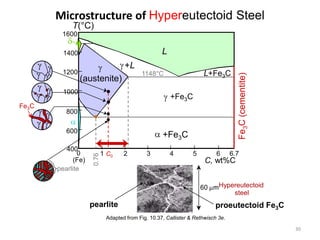
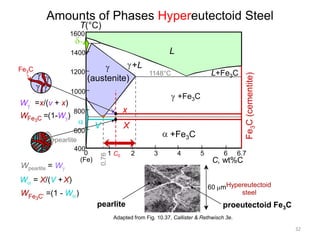
Example for hypereutectoid alloy with
composition C1
Fraction of pearlite: WP = X / (V+X) = (6.7 – C1) / (6.7 – 0.76)
Fraction of proeutectoid cementite: WFe3C = V / (V+X) = (C1 – 0.76) / (6.7 – 0.76)
Amount of Phases in Hypoeutectoid Steel
T(°C)
1600

L

1400

(austenite)

1000
800
600
pearlite

Wpearlite = W

+ Fe3C
r s

727°C

RS

400
0
(Fe)C0

+ Fe3C
1
0.76

W = s/(r + s)
W =(1 - W )

L+Fe3C

1148°C

W ’ = S/(R + S)
WFe3C
=(1 – W ’)
pearlite

2

3

4

5

6

(Fe-C
System)

Fe3C (cementite)

1200

+L

6.7

C, wt% C
100 m

Hypoeutectoid
steel

proeutectoid ferrite
Adapted from Fig. 10.34, Callister & Rethwisch 3e.
28
Microstructure of Hypereutectoid
Steel
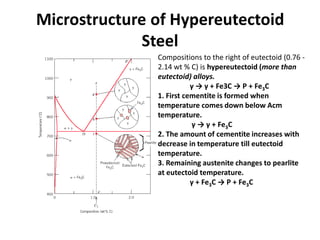
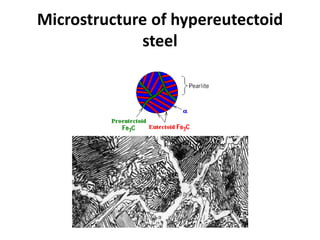
Compositions to the right of eutectoid (0.76 2.14 wt % C) is hypereutectoid (more than
eutectoid) alloys.
γ → γ + Fe3C → P + Fe3C
1. First cementite is formed when
temperature comes down below Acm
temperature.
γ → γ + Fe3C
2. The amount of cementite increases with
decrease in temperature till eutectoid
temperature.
3. Remaining austenite changes to pearlite
at eutectoid temperature.
γ + Fe3C → P + Fe3C
Microstructure of Hypereutectoid Steel
T(°C)

1600

L

1400

+L

1000

+Fe3C

800
600
400
0
(Fe)
pearlite

+Fe3C
0.76

Fe3C

L+Fe3C

1148°C

(austenite)

1 C0

2

3

4

5

6

Fe3C (cementite)

1200

6.7

C, wt%C
60 mHypereutectoid
steel

pearlite

proeutectoid Fe3C

Adapted from Fig. 10.37, Callister & Rethwisch 3e.
30
Microstructure of hypereutectoid
steel
Amounts of Phases Hypereutectoid Steel
T(°C)

1600

L

1400
1200

+L

1000

+Fe3C

W =x/(v + x)

v x

800

600
pearlite
400
0
(Fe)

Wpearlite = W

V

X
+Fe3C
0.76

WFe3C =(1-W )

1 C0

W = X/(V + X)
WFe

3C’

L+Fe3C

1148°C

(austenite)

2

3

4

5

6

Fe3C (cementite)

Fe3C

6.7

C, wt%C
60 mHypereutectoid
steel

=(1 - W )

pearlite

proeutectoid Fe3C

Adapted from Fig. 10.37, Callister & Rethwisch 3e.
32
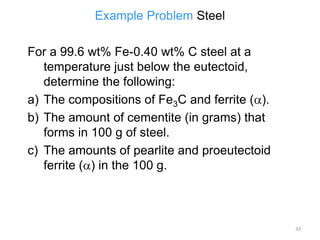
Example Problem Steel
For a 99.6 wt% Fe-0.40 wt% C steel at a
temperature just below the eutectoid,
determine the following:
a) The compositions of Fe3C and ferrite ( ).
b) The amount of cementite (in grams) that
forms in 100 g of steel.
c) The amounts of pearlite and proeutectoid
ferrite ( ) in the 100 g.

33
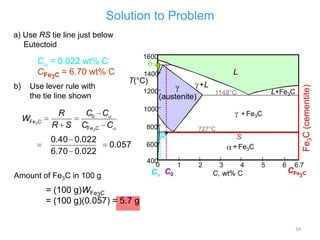
Solution to Problem
a) Use RS tie line just below
Eutectoid

b)

Use lever rule with
the tie line shown

WFe 3C

R
R S

1600

T(°C)

1200

C0 C
CFe 3C C

0.40 0.022
6.70 0.022

L

1400

+L

1000

+ Fe3C

800

727°C

R

0.057

S
+ Fe3C

600
400
0

Amount of Fe3C in 100 g

L+Fe3C

1148°C

(austenite)

Fe3C (cementite)

C = 0.022 wt% C
CFe3C = 6.70 wt% C

C C0

1

2

3

4

C, wt% C

5

6

6.7

CFe

3C

= (100 g)WFe3C
= (100 g)(0.057) = 5.7 g
34
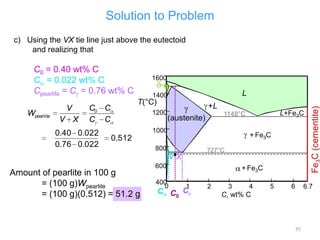
Solution to Problem
c) Using the VX tie line just above the eutectoid
and realizing that

C0 = 0.40 wt% C
C = 0.022 wt% C
Cpearlite = C = 0.76 wt% C
V X

T(°C)

C0 C
C C

0.40 0.022
0.76 0.022

L

1400

1200

+L
L+Fe3C

1148°C

(austenite)

1000

+ Fe3C

0.512
800

727°C

VX

Amount of pearlite in 100 g
= (100 g)Wpearlite
= (100 g)(0.512) = 51.2 g

600
400
0

+ Fe3C
1

C C0 C

2

3

4

5

6

Fe C (cementite)

Wpearlite

V

1600

6.7

C, wt% C

35
Summary
Fe – C Diagram
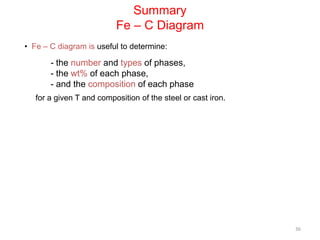
• Fe – C diagram is useful to determine:

- the number and types of phases,
- the wt% of each phase,
- and the composition of each phase
for a given T and composition of the steel or cast iron.

36
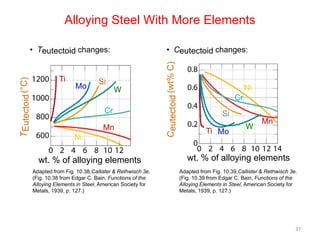
Alloying Steel With More Elements

Ti

Mo

• Ceutectoid changes:

Si
W
Cr
Mn

Ni

wt. % of alloying elements
Adapted from Fig. 10.38,Callister & Rethwisch 3e.
(Fig. 10.38 from Edgar C. Bain, Functions of the
Alloying Elements in Steel, American Society for
Metals, 1939, p. 127.)

Ceutectoid (wt% C)

T Eutectoid (°C)

• Teutectoid changes:

Ni
Cr
Si
Ti Mo

W

Mn

wt. % of alloying elements
Adapted from Fig. 10.39,Callister & Rethwisch 3e.
(Fig. 10.39 from Edgar C. Bain, Functions of the
Alloying Elements in Steel, American Society for
Metals, 1939, p. 127.)

37
THANKS

Fe-C diagram

  • 1.
    The Iron–Carbon PhaseDiagram Prof. H. K. Khaira Professor in MSME Deptt. MANIT, Bhopal
  • 2.
    Iron–Carbon Phase Diagram •In their simplest form, steels are alloys of Iron (Fe) and Carbon (C). • The Fe-C phase diagram is a fairly complex one, but we will only consider the steel and cast iron part of the diagram, up to 6.67% Carbon.
  • 3.
    Fe – CEquilibrium Diagram
  • 4.
    ©2003 Brooks/Cole, adivision of Thomson Learning, Inc. Thomson Learning ™ is a trademark used herein under license. Figure 12.33 The iron-carbon phase diagram showing the relationship between the stable iron-graphite equilibria (solid lines) and the metastable iron-cementite reactions (dashed lines).
  • 5.
    Phases Observed inFe-C Diagram • Phases 1. Ferrite 2. Austenite 3. Cementite 4. δ-ferrite • And phase mixtures 1. Pearlite 2. Ledeburite
  • 6.
    Phases Observed inFe-C Diagram 1. Ferrite Ferrite is the interstitial solid solution of carbon in alpha iron. It has B.C.C. Structure. It has very limited solubility for carbon (maximum 0.022% at 727°C and 0.008% at room temperature). Ferrite is soft and ductile. 2. Austenite Austenite is the interstitial solid solution of carbon in gamma (γ) iron. It has FCC structure. Austenite can have maximum 2.14% carbon at 1143°C. Austenite is normally not stable at room temperature. Austenite is nonmagnetic and soft. 3. Cementite Cementite or iron carbide (Fe3C) is an intermetallic compound of iron and carbon. It contains 6.67% carbon. It is very hard and brittle. This intermetallic compound is a metastable phase and it remains as a compound indefinitely at room temperature. 4. δ-ferrite It is a solid solution of carbon in δ-iron. It is stable at high temperatures. It has BCC structure.
  • 7.
    Phase Mixtures Observedin Fe-C Diagram • 1. Pearlite The pearlite consists of alternate layers of ferrite and cementite. It has properties somewhere between ferrite and cementite. The average carbon content in pearlite is 0.76% • 2. Ledeburite Ledeburite is an eutetcic mixture of austenite and cementite in the form of alternate layers. The average carbon content in ledeburite is 4.3%.
  • 8.
    A few commentson Fe–C system • Carbon occupies interstitial positions in Fe. It forms a solid solution with α, γ, δ phases of iron • Maximum solubility in BCC α-ferrite is limited (max. 0.025 % at 727 °C) as BCC has relatively small interstitial positions • Maximum solubility in FCC austenite is 2.14 % at 1147 °C as FCC has larger interstitial positions
  • 9.
    A few commentson Fe–C system • Mechanical properties – Cementite is very hard and brittle - can strengthen steels. – Mechanical properties depend on the microstructure, that is, amount and distribution of ferrite and cementite. • Magnetic properties: α -ferrite is magnetic below 768 °C, austenite is non-magnetic
  • 10.
    Fe-C Alloys • Fe-Calloys can be of two types. 1. Steels Steels are alloys of iron and carbon containing up to 2.14% C. Other alloying elements may also be present in steels. 2. Cast irons Cast irons are alloys of iron and carbon containing more than 2.14% C. Other alloying elements may also be present in cast irons.
  • 11.
    Important Reactions inFe-C System • There are three important reactions taking place in Fe-C system 1. Eutectic reaction 2. Eutectoid reaction 3. Peritectic Reaction
  • 12.
    Important Reactions inFe-C System • Eutectic reaction • Eutectic: 4.30 wt% C, 1147 °C • L (4.30% C) ↔ γ (2.14% C) + Fe3C • Eutectoid reaction • Eutectoid: 0.76 wt%C, 727 °C • γ(0.76% C) ↔ α (0.022% C) + Fe3C • Peritectic Reaction • Peritectic: 0.16% C, 14930 C • δ(0.11% C) + L(0.51%C) ↔ γ (0.16%C)
  • 13.
    Important Reactions inFe–C System Peritectic: 0.16% C, 14930 C δ(0.11% C) + L(0.51)%C ↔ γ (0.16%C) Eutectic: 4.30 wt% C, 1147 °C L (4.30% C) ↔ γ (2.14% C) + Fe3C Eutectoid: 0.76 wt%C, 727 °C γ(0.76% C) ↔ α (0.022% C) + Fe3C
  • 14.
    Eutectic Reaction • Eutecticreaction: at 4.30 % C and 1147 °C L (4.30% C) ↔ γ (2.14% C) + Fe3C • In eutectic reaction, the liquid solidifies as a phase mixture of austenite (containing 2.14% C) and cementite. This phase mixture is known as ledeburite. • The average carbon content in ledeburite is 4.30%. • The eutectic reaction occurs at a constant temperature. This is known as eutectic temperature and is 1147 °C.
  • 15.
    Eutectoid Reaction • Eutectoidreaction: at 0.76 %C and 727 °C γ(0.76% C) ↔ α (0.022% C) + Fe3C • In eutectoid reaction, the austenite transforms into a phase mixture of ferrite (containing 0.76% C) and cementite. This phase mixture is known as pearlite. • The average carbon content in pearlite is 0.76%. • The eutectoid reaction occurs at a constant temperature. This is known as eutectoid temperature and is 727°C. • Eutectoid reaction is very important in heat treatment of steels.
  • 16.
    Microstructure of EutectoidSteel In the micrograph, the dark areas are Fe3C layers, the light phase is α- ferrite Pearlite nucleates at austenite grain boundaries and grows into the grain
  • 17.
    Pearlite Formation Pearlite nucleatesat austenite grain boundaries and grows into the grain Growth direction
  • 18.
    Peritectic Reaction • Peritecticreaction: at 0.16% C and 14930 C δ(0.11% C) + L(0.51%C) ↔ γ (0.16%C) • In peritectic reaction, the liquid and δ iron transforms into austenite (containing 0.16% C). • The peritectic reaction occurs at a constant temperature. This is known as peritectic temperature and is 1493°C.
  • 19.
    Development of Microstructurein Iron - Carbon alloys
  • 20.
    Iron-Carbon (Fe-C) PhaseDiagram 1. Eutectic (A): L T(°C) 1600 Adapted from Fig. 10.28, Callister & Rethwisch 3e. L 1400 + Fe3C 2. Eutectoid (B): + Fe3C 1200 +L AA (austenite) 1000 800 +Fe3C B 727°C = T eutectoid 600 120 m Result: Pearlite is alternating layers of 400 0 (Fe) L+Fe3C 1148°C Fe3C (cementite) • 2 important points +Fe3C 1 0.76 and Fe3C phases 2 3 4 4.30 5 6 6.7 C, wt% C Fe3C (cementite-hard) (ferrite-soft) 20
  • 21.
    Microstructure of Eutectoidsteel • In eutectoid steel, pearlite is formed at eutectoid temperature. • The austenite gets converted into pearlite which is a mechanical mixture of ferrite and cementite.. • This tranformation occurs at 727o C (at constant temperature)
  • 22.
    Microstructure of EutectoidSteel • When alloy of eutectoid composition (0.76 wt % C) is cooled slowly it forms pearlite, a lamellar or layered structure of two phases: α-ferrite and cementite (Fe3C). • The layers of alternating phases in pearlite are formed for the same reason as layered structure of eutectic structures: redistribution of C atoms between ferrite (0.022 wt%) and cementite (6.7 wt%) by atomic diffusion. • Mechanically, pearlite has properties intermediate to soft, ductile ferrite and hard, brittle cementite.
  • 23.
    Microstructure of Hypoeutectoid Steel Compositionsto the left of eutectoid (0.022 0.76 wt % C) is hypoeutectoid (less than eutectoid) alloys. Microstructure change is γ→α+γ→α+P 1. First ferrite is formed when temperature comes down below Ae3 temperature. γ→α+γ 2. The amount of ferrite increases with decrease in temperature till eutectoid temperature. 3. Remaining austenite changes to pearlite at eutectoid temperature. α+γ→α+P
  • 24.
    Microstructure of HypoeutectoidSteel T(°C) 1600 Adapted from Figs. 10.28 and 10.33 L 1400 1000 + Fe3C 800 727°C 600 pearlite + Fe3C 1 0.76 400 0 (Fe)C0 L+Fe3C 1148°C (austenite) 2 3 4 5 6 6.7 C, wt% C 100 m pearlite Fe3C (cementite) 1200 (Fe-C System) +L Hypoeutectoid steel proeutectoid ferrite Adapted from Fig. 10.34, Callister & Rethwisch 3e. 24
  • 25.
    Microstructure of Hypoeutectoid Steel Hypoeutectoidsteels contain proeutectoid ferrite (formed above the eutectoid temperature) plus the pearlite that contains eutectoid ferrite and cementite.
  • 26.
    Relative amounts ofproeutectoid phase (α or Fe3C) and pearlite? • Relative amounts of proeutectoid phase (α or Fe3C) and pearlite can be calculated by the lever rule with tie line that extends from the eutectoid composition (0.76 % C) to α – (α + Fe3C) boundary (0.022 % C) for hypoeutectoid alloys and to (α + Fe3C) – Fe3C boundary (6.7 % C) for hypereutectoid alloys. • Fraction of total α phase is determined by application of the lever rule across the entire (α + Fe3C) phase field.
  • 27.
    Example for hypereutectoidalloy with composition C1 Fraction of pearlite: WP = X / (V+X) = (6.7 – C1) / (6.7 – 0.76) Fraction of proeutectoid cementite: WFe3C = V / (V+X) = (C1 – 0.76) / (6.7 – 0.76)
  • 28.
    Amount of Phasesin Hypoeutectoid Steel T(°C) 1600 L 1400 (austenite) 1000 800 600 pearlite Wpearlite = W + Fe3C r s 727°C RS 400 0 (Fe)C0 + Fe3C 1 0.76 W = s/(r + s) W =(1 - W ) L+Fe3C 1148°C W ’ = S/(R + S) WFe3C =(1 – W ’) pearlite 2 3 4 5 6 (Fe-C System) Fe3C (cementite) 1200 +L 6.7 C, wt% C 100 m Hypoeutectoid steel proeutectoid ferrite Adapted from Fig. 10.34, Callister & Rethwisch 3e. 28
  • 29.
    Microstructure of Hypereutectoid Steel Compositionsto the right of eutectoid (0.76 2.14 wt % C) is hypereutectoid (more than eutectoid) alloys. γ → γ + Fe3C → P + Fe3C 1. First cementite is formed when temperature comes down below Acm temperature. γ → γ + Fe3C 2. The amount of cementite increases with decrease in temperature till eutectoid temperature. 3. Remaining austenite changes to pearlite at eutectoid temperature. γ + Fe3C → P + Fe3C
  • 30.
    Microstructure of HypereutectoidSteel T(°C) 1600 L 1400 +L 1000 +Fe3C 800 600 400 0 (Fe) pearlite +Fe3C 0.76 Fe3C L+Fe3C 1148°C (austenite) 1 C0 2 3 4 5 6 Fe3C (cementite) 1200 6.7 C, wt%C 60 mHypereutectoid steel pearlite proeutectoid Fe3C Adapted from Fig. 10.37, Callister & Rethwisch 3e. 30
  • 31.
  • 32.
    Amounts of PhasesHypereutectoid Steel T(°C) 1600 L 1400 1200 +L 1000 +Fe3C W =x/(v + x) v x 800 600 pearlite 400 0 (Fe) Wpearlite = W V X +Fe3C 0.76 WFe3C =(1-W ) 1 C0 W = X/(V + X) WFe 3C’ L+Fe3C 1148°C (austenite) 2 3 4 5 6 Fe3C (cementite) Fe3C 6.7 C, wt%C 60 mHypereutectoid steel =(1 - W ) pearlite proeutectoid Fe3C Adapted from Fig. 10.37, Callister & Rethwisch 3e. 32
  • 33.
    Example Problem Steel Fora 99.6 wt% Fe-0.40 wt% C steel at a temperature just below the eutectoid, determine the following: a) The compositions of Fe3C and ferrite ( ). b) The amount of cementite (in grams) that forms in 100 g of steel. c) The amounts of pearlite and proeutectoid ferrite ( ) in the 100 g. 33
  • 34.
    Solution to Problem a)Use RS tie line just below Eutectoid b) Use lever rule with the tie line shown WFe 3C R R S 1600 T(°C) 1200 C0 C CFe 3C C 0.40 0.022 6.70 0.022 L 1400 +L 1000 + Fe3C 800 727°C R 0.057 S + Fe3C 600 400 0 Amount of Fe3C in 100 g L+Fe3C 1148°C (austenite) Fe3C (cementite) C = 0.022 wt% C CFe3C = 6.70 wt% C C C0 1 2 3 4 C, wt% C 5 6 6.7 CFe 3C = (100 g)WFe3C = (100 g)(0.057) = 5.7 g 34
  • 35.
    Solution to Problem c)Using the VX tie line just above the eutectoid and realizing that C0 = 0.40 wt% C C = 0.022 wt% C Cpearlite = C = 0.76 wt% C V X T(°C) C0 C C C 0.40 0.022 0.76 0.022 L 1400 1200 +L L+Fe3C 1148°C (austenite) 1000 + Fe3C 0.512 800 727°C VX Amount of pearlite in 100 g = (100 g)Wpearlite = (100 g)(0.512) = 51.2 g 600 400 0 + Fe3C 1 C C0 C 2 3 4 5 6 Fe C (cementite) Wpearlite V 1600 6.7 C, wt% C 35
  • 36.
    Summary Fe – CDiagram • Fe – C diagram is useful to determine: - the number and types of phases, - the wt% of each phase, - and the composition of each phase for a given T and composition of the steel or cast iron. 36
  • 37.
    Alloying Steel WithMore Elements Ti Mo • Ceutectoid changes: Si W Cr Mn Ni wt. % of alloying elements Adapted from Fig. 10.38,Callister & Rethwisch 3e. (Fig. 10.38 from Edgar C. Bain, Functions of the Alloying Elements in Steel, American Society for Metals, 1939, p. 127.) Ceutectoid (wt% C) T Eutectoid (°C) • Teutectoid changes: Ni Cr Si Ti Mo W Mn wt. % of alloying elements Adapted from Fig. 10.39,Callister & Rethwisch 3e. (Fig. 10.39 from Edgar C. Bain, Functions of the Alloying Elements in Steel, American Society for Metals, 1939, p. 127.) 37
  • 38.