Fatigue Testing (DT)
By -PAWAN KUMAR
PGLF2150056
Fatigue
• Fatigue is the condition whereby a material cracks or
fails because of repeated (cyclic) stresses applied
below the ultimate strength of the material. Fatigue
failure often occurs quite suddenly with catastrophic
result.
• Material fatigue is a phenomenon where structures
fail when subjected to a cyclic load.
• Examples of where Fatigue may occur are: springs,
turbine blades, airplane wings, bridges and bones.
• Failure of material under fluctuating stresses at
a stress magnitude which is lower than the
ultimate tensile strength of the material called
fatigue failure
• .Fatigue result is brittle appearing fracture,
without any deformation at the fracture.
• It particularly occur without any warning
• It is generally occurs in turbines, aircraft etc.
• A fatigue failure always starts as a small crack
and grows in size under repeated loading of the
stress
Types of fatigue failure
Types of Fatigue Failure:
1. Mechanical Fatigue - fluctuations in externally applied
stresses or strains.
2. Creep Fatigue - Cyclic loads at high temperatures.
3. Thermo mechanical Fatigue - fluctuations in
temperature as well as
stresses and strains.
4. Corrosion Fatigue - Cyclic loads in a chemically
aggressive or embrittling
environment.
5. Fretting Fatigue - Cyclic loads combined with frictional
sliding.
Stages of fatigue failure
• The process of fatigue consists of three key stages:
1. Initial fatigue damage leading to crack nucleation and
crack initiation,
2. Progressive cyclic growth of a crack (crack
propagation) until the remaining un-cracked cross
section of a part becomes too weak to withstand the
loads applied,
3. Final, sudden fracture of the remaining cross section.
• Stage of failure
Determination of fatigue limit
During fatigue the stress may alternate about
zero, may vary from zero to a maximum or may
vary about some value above - or below - zero.
To quantify the effect of these varying stresses
fatigue testing is carried out by applying a
particular stress range and this is continued until
the test piece fails. The number of cycles to
failure is recorded and the test then repeated at
a variety of different stress ranges.
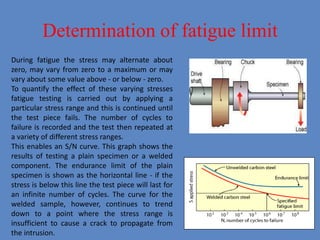
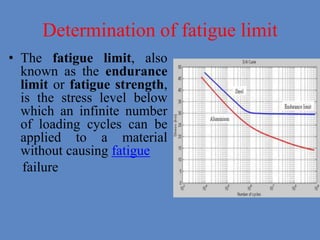
This enables an S/N curve. This graph shows the
results of testing a plain specimen or a welded
component. The endurance limit of the plain
specimen is shown as the horizontal line - if the
stress is below this line the test piece will last for
an infinite number of cycles. The curve for the
welded sample, however, continues to trend
down to a point where the stress range is
insufficient to cause a crack to propagate from
the intrusion.
Determination of fatigue limit
• The fatigue limit, also
known as the endurance
limit or fatigue strength,
is the stress level below
which an infinite number
of loading cycles can be
applied to a material
without causing fatigue
failure
THANKS

Fatigue testing

  • 1.
    Fatigue Testing (DT) By-PAWAN KUMAR PGLF2150056
  • 2.
    Fatigue • Fatigue isthe condition whereby a material cracks or fails because of repeated (cyclic) stresses applied below the ultimate strength of the material. Fatigue failure often occurs quite suddenly with catastrophic result. • Material fatigue is a phenomenon where structures fail when subjected to a cyclic load. • Examples of where Fatigue may occur are: springs, turbine blades, airplane wings, bridges and bones.
  • 3.
    • Failure ofmaterial under fluctuating stresses at a stress magnitude which is lower than the ultimate tensile strength of the material called fatigue failure • .Fatigue result is brittle appearing fracture, without any deformation at the fracture. • It particularly occur without any warning • It is generally occurs in turbines, aircraft etc. • A fatigue failure always starts as a small crack and grows in size under repeated loading of the stress
  • 4.
    Types of fatiguefailure Types of Fatigue Failure: 1. Mechanical Fatigue - fluctuations in externally applied stresses or strains. 2. Creep Fatigue - Cyclic loads at high temperatures. 3. Thermo mechanical Fatigue - fluctuations in temperature as well as stresses and strains. 4. Corrosion Fatigue - Cyclic loads in a chemically aggressive or embrittling environment. 5. Fretting Fatigue - Cyclic loads combined with frictional sliding.
  • 5.
    Stages of fatiguefailure • The process of fatigue consists of three key stages: 1. Initial fatigue damage leading to crack nucleation and crack initiation, 2. Progressive cyclic growth of a crack (crack propagation) until the remaining un-cracked cross section of a part becomes too weak to withstand the loads applied, 3. Final, sudden fracture of the remaining cross section.
  • 7.
    • Stage offailure
  • 8.
    Determination of fatiguelimit During fatigue the stress may alternate about zero, may vary from zero to a maximum or may vary about some value above - or below - zero. To quantify the effect of these varying stresses fatigue testing is carried out by applying a particular stress range and this is continued until the test piece fails. The number of cycles to failure is recorded and the test then repeated at a variety of different stress ranges. This enables an S/N curve. This graph shows the results of testing a plain specimen or a welded component. The endurance limit of the plain specimen is shown as the horizontal line - if the stress is below this line the test piece will last for an infinite number of cycles. The curve for the welded sample, however, continues to trend down to a point where the stress range is insufficient to cause a crack to propagate from the intrusion.
  • 9.
    Determination of fatiguelimit • The fatigue limit, also known as the endurance limit or fatigue strength, is the stress level below which an infinite number of loading cycles can be applied to a material without causing fatigue failure
  • 13.