HISTORICAL PERSPECTIVE
• Historically,the development and advancement of societies have been tied to
the members’ ability to produce and manipulate materials to fill their needs.
• Civilizations have been designated by the level of their material development
(Stone Age, Bronze Age, Iron Age)
• Oldest materials stone, wood, skin
• The development of many technologies that make our existence so
comfortable has been intimately associated with the accessibility of suitable
materials.
3.
Cont’d
• Automotive technologiesneed access to steel industries
• Electronic industries need access to semiconductors
• Power and transportation need access to rare earth elements
MATERIALS SCIENCE AND ENGINEERING
Materials science involves investigating the relationships that exist between
the structures and properties of materials (i.e., why materials have their
properties)
Materials engineering involves, designing or engineering the structure of a
material to produce a predetermined set of properties.
4.
Cont’d
Structural elements maybe classified on the basis of size
• Subatomic structure—involves electrons within the individual atoms, their energies and
interactions with the nuclei.
• Atomic structure—relates to the organization of atoms to yield molecules or crystals.
• Nanostructure—deals with aggregates of atoms that form particles (nanoparticles) that have
nanoscale dimensions (less that about 100 nm).
• Microstructure—those structural elements that are subject to direct observation using some
type of microscope
• Macrostructure—structural elements that may be viewed with the naked eye (with scale
range between several millimeters and on the order of a meter).
5.
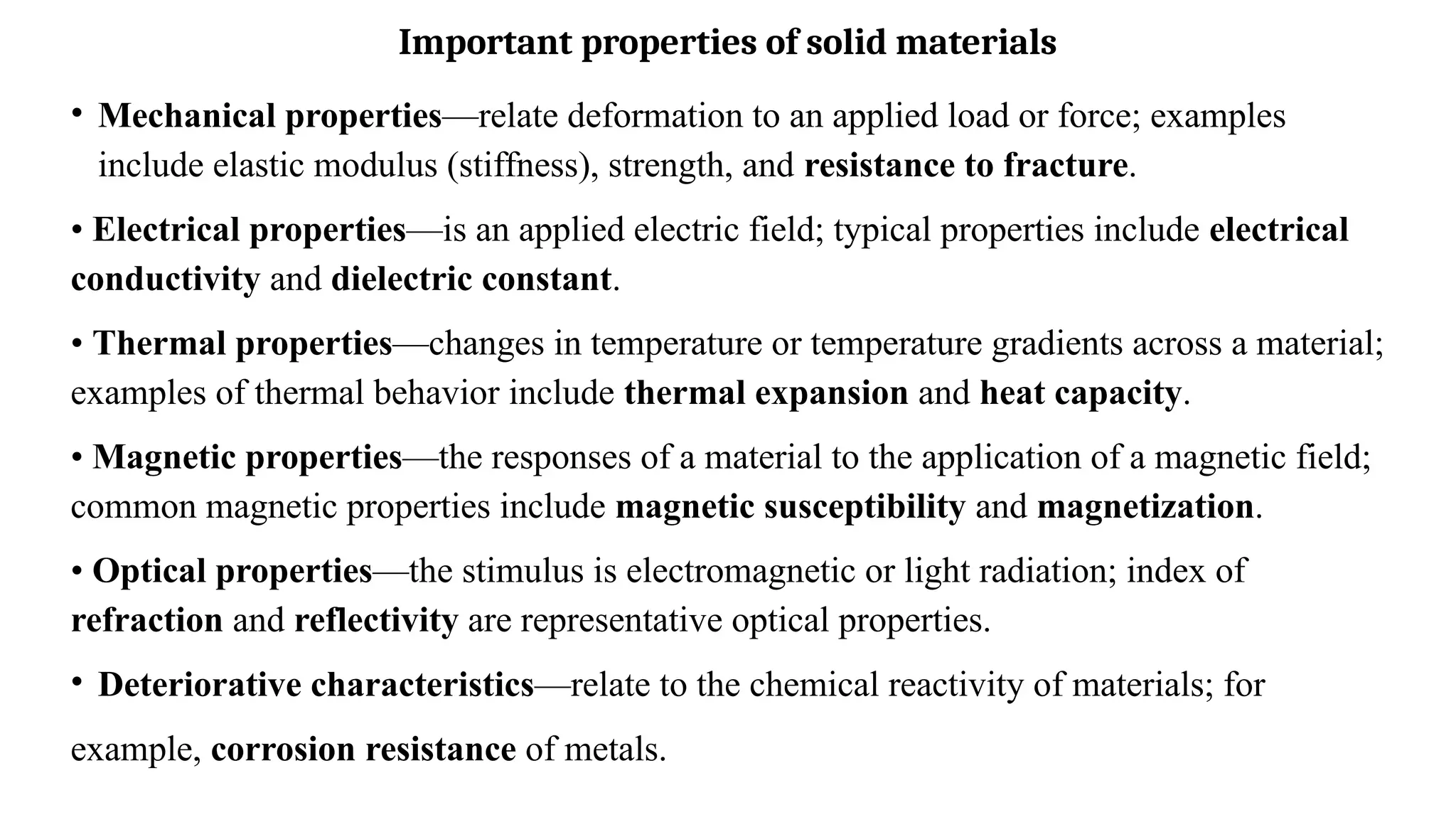
Important properties ofsolid materials
• Mechanical properties—relate deformation to an applied load or force; examples
include elastic modulus (stiffness), strength, and resistance to fracture.
• Electrical properties—is an applied electric field; typical properties include electrical
conductivity and dielectric constant.
• Thermal properties—changes in temperature or temperature gradients across a material;
examples of thermal behavior include thermal expansion and heat capacity.
• Magnetic properties—the responses of a material to the application of a magnetic field;
common magnetic properties include magnetic susceptibility and magnetization.
• Optical properties—the stimulus is electromagnetic or light radiation; index of
refraction and reflectivity are representative optical properties.
• Deteriorative characteristics—relate to the chemical reactivity of materials; for
example, corrosion resistance of metals.
6.
WHY STUDY MATERIALSSCIENCE AND ENGINEERING?
Because things engineers design are made of materials.
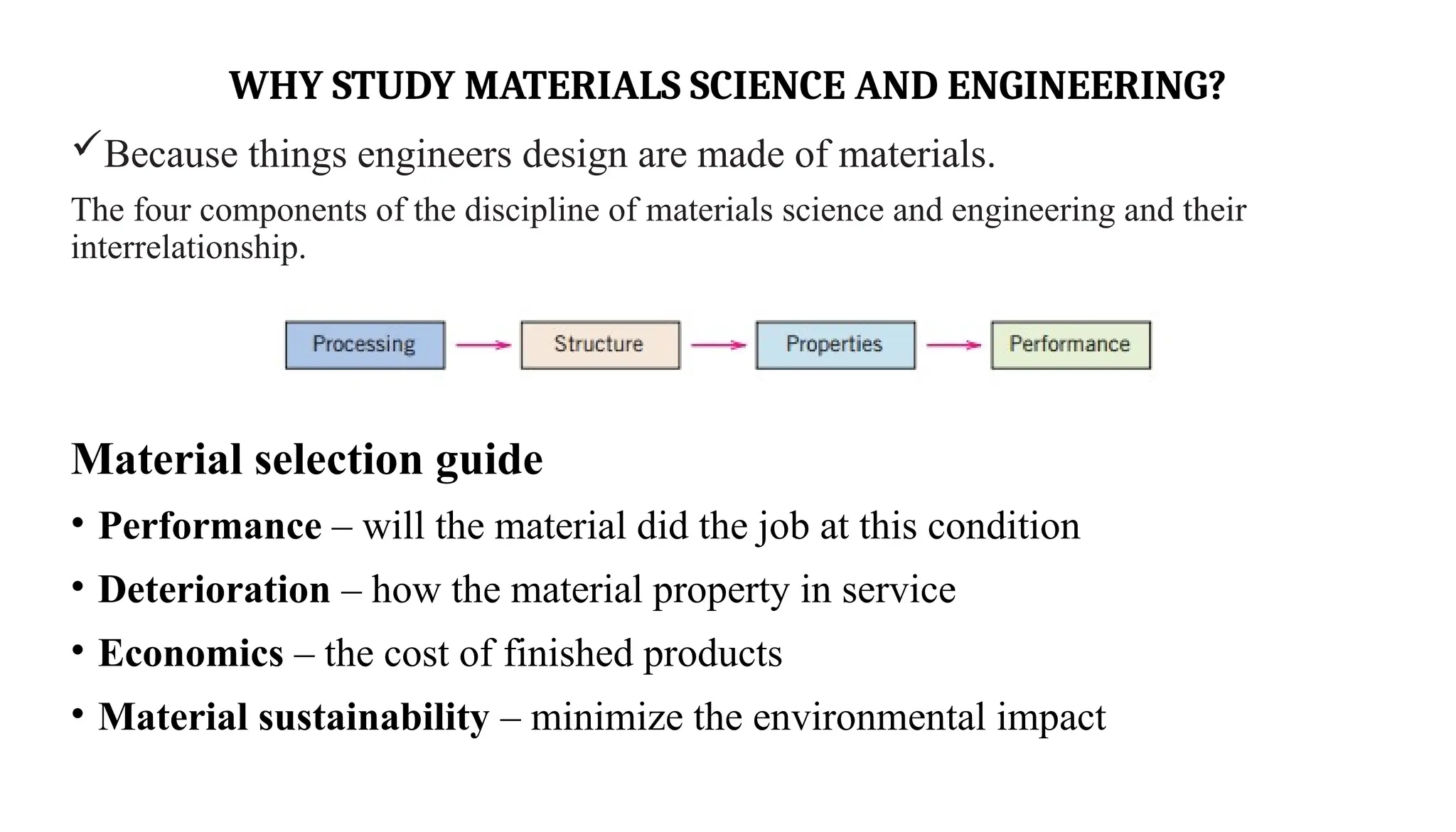
The four components of the discipline of materials science and engineering and their
interrelationship.
Material selection guide
• Performance – will the material did the job at this condition
• Deterioration – how the material property in service
• Economics – the cost of finished products
• Material sustainability – minimize the environmental impact
7.
CLASSIFICATION OF MATERIALS
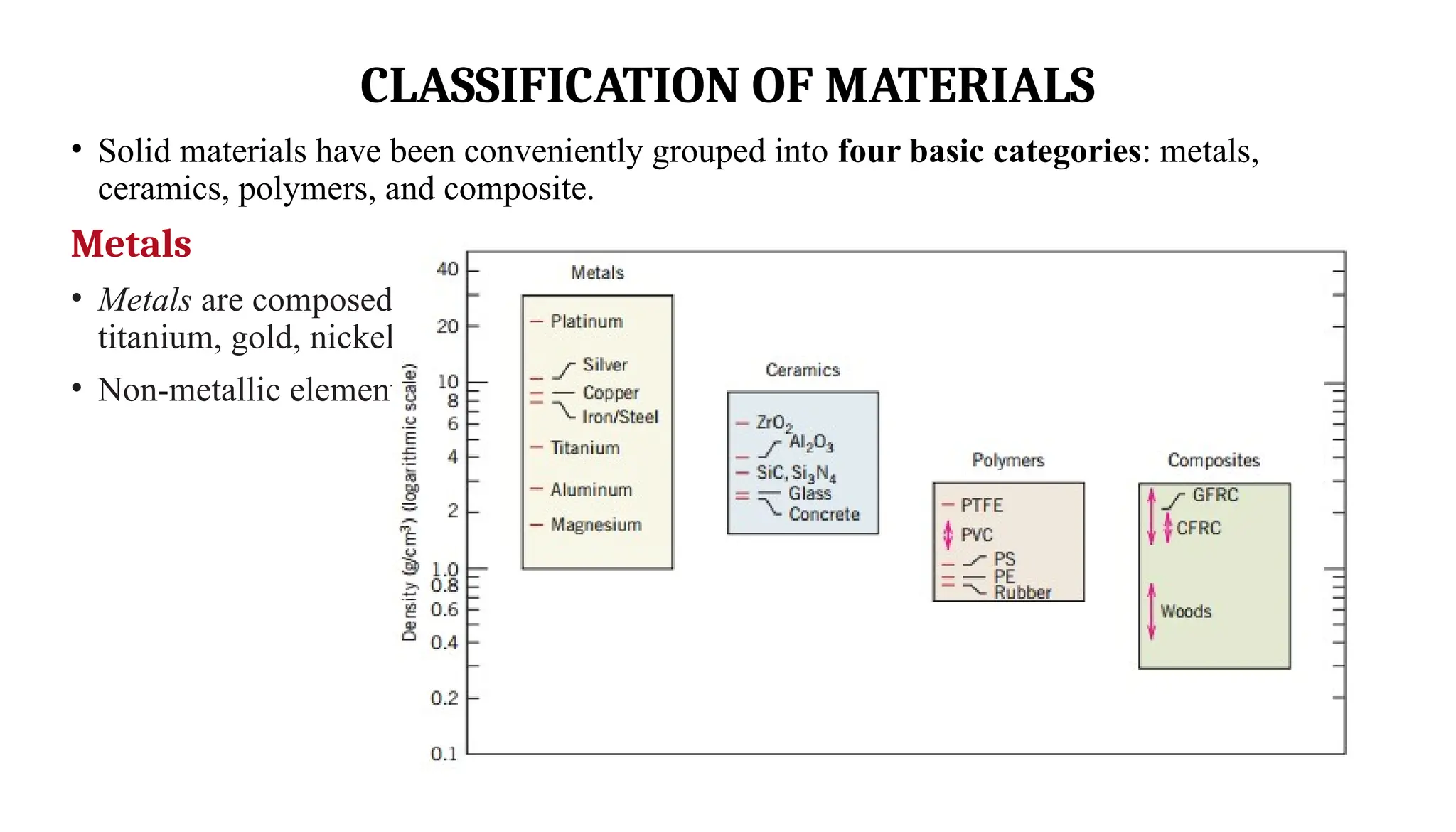
•Solid materials have been conveniently grouped into four basic categories: metals,
ceramics, polymers, and composite.
Metals
• Metals are composed of one or more metallic elements (e.g., iron, aluminum, copper,
titanium, gold, nickel),
• Non-metallic elements (e.g., carbon, nitrogen, oxygen) in relatively small amounts.
8.
Cont’d
• Familiar objectsmade of metals and metal alloys (from left to right): silverware (fork and
knife), scissors, coins, a gear, a wedding ring, and a nut and bolt.
9.
Ceramics
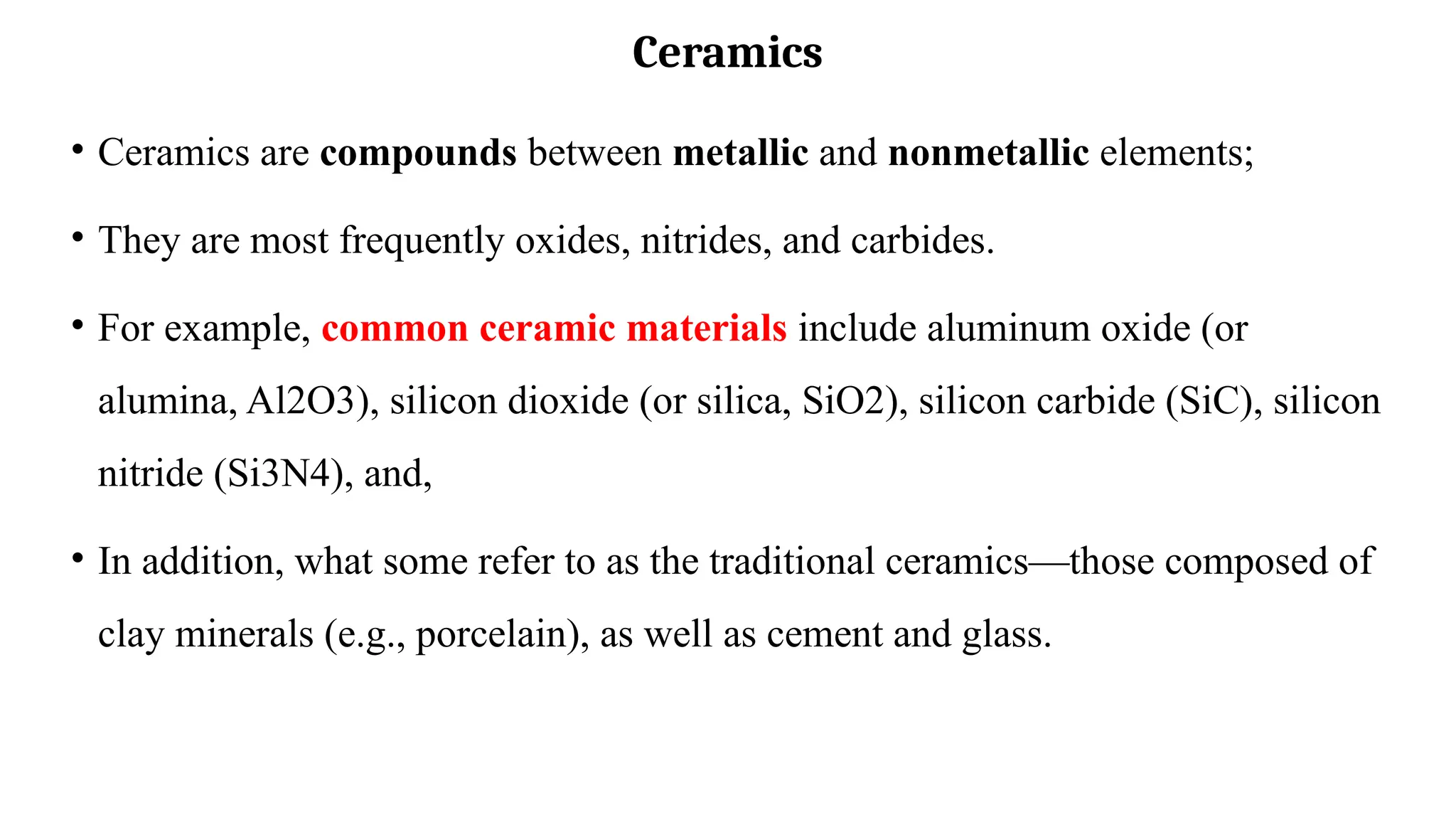
• Ceramics arecompounds between metallic and nonmetallic elements;
• They are most frequently oxides, nitrides, and carbides.
• For example, common ceramic materials include aluminum oxide (or
alumina, Al2O3), silicon dioxide (or silica, SiO2), silicon carbide (SiC), silicon
nitride (Si3N4), and,
• In addition, what some refer to as the traditional ceramics—those composed of
clay minerals (e.g., porcelain), as well as cement and glass.
10.
Cont’d
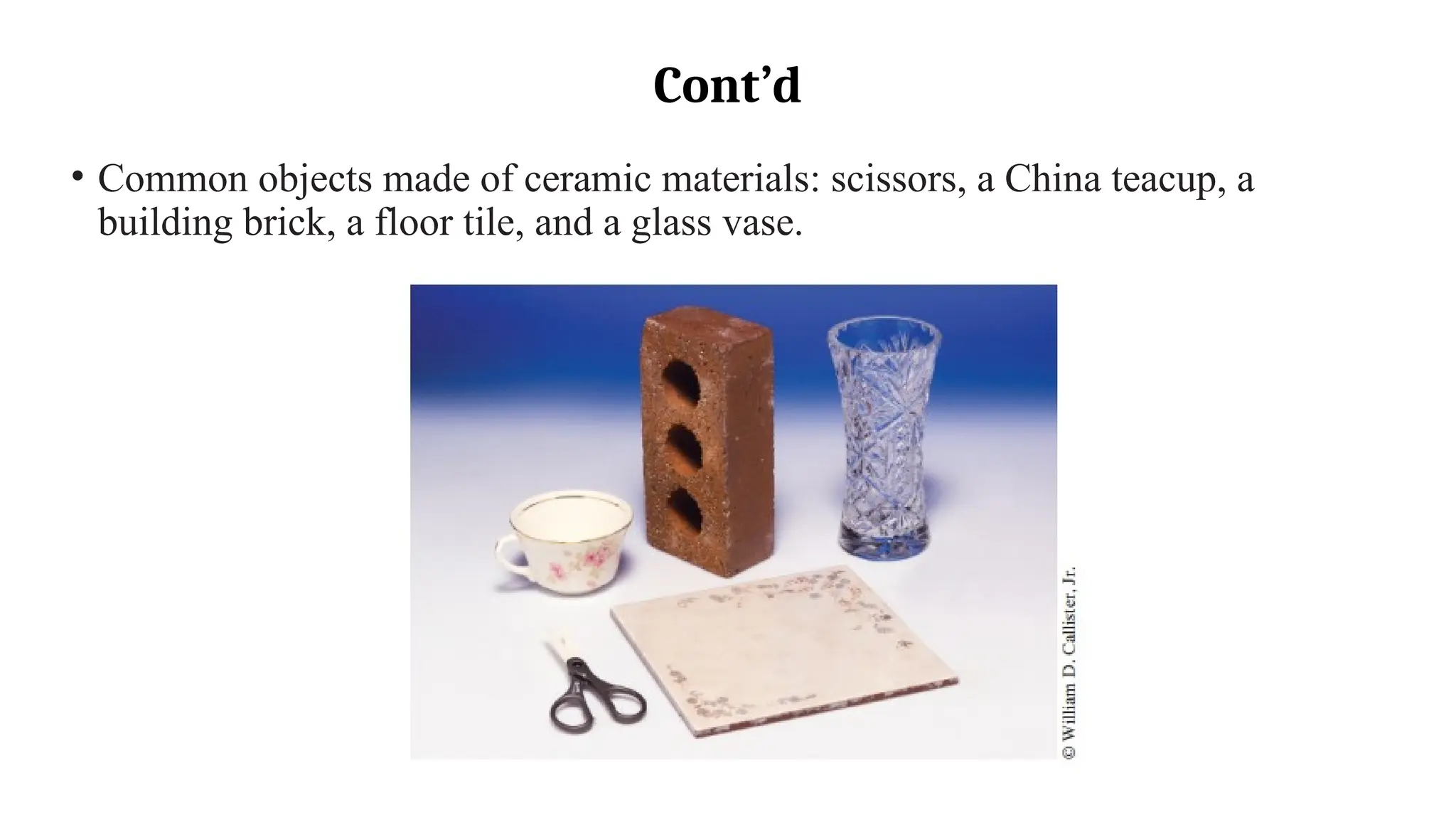
• Common objectsmade of ceramic materials: scissors, a China teacup, a
building brick, a floor tile, and a glass vase.
11.
Polymers
• Polymers includethe familiar plastic and rubber materials.
• Many of them are organic compounds that are chemically based on carbon, hydrogen, and
other nonmetallic elements (i.e., O, N, and Si).
• Furthermore, they have very large molecular structures, often chainlike in nature, that
often have a backbone of carbon atoms.
• Some common and familiar polymers are polyethylene (PE), nylon, poly(vinyl chloride)
(PVC), polycarbonate (PC), polystyrene (PS), and silicone rubber.
• These materials typically have low densities
12.
Cont’d
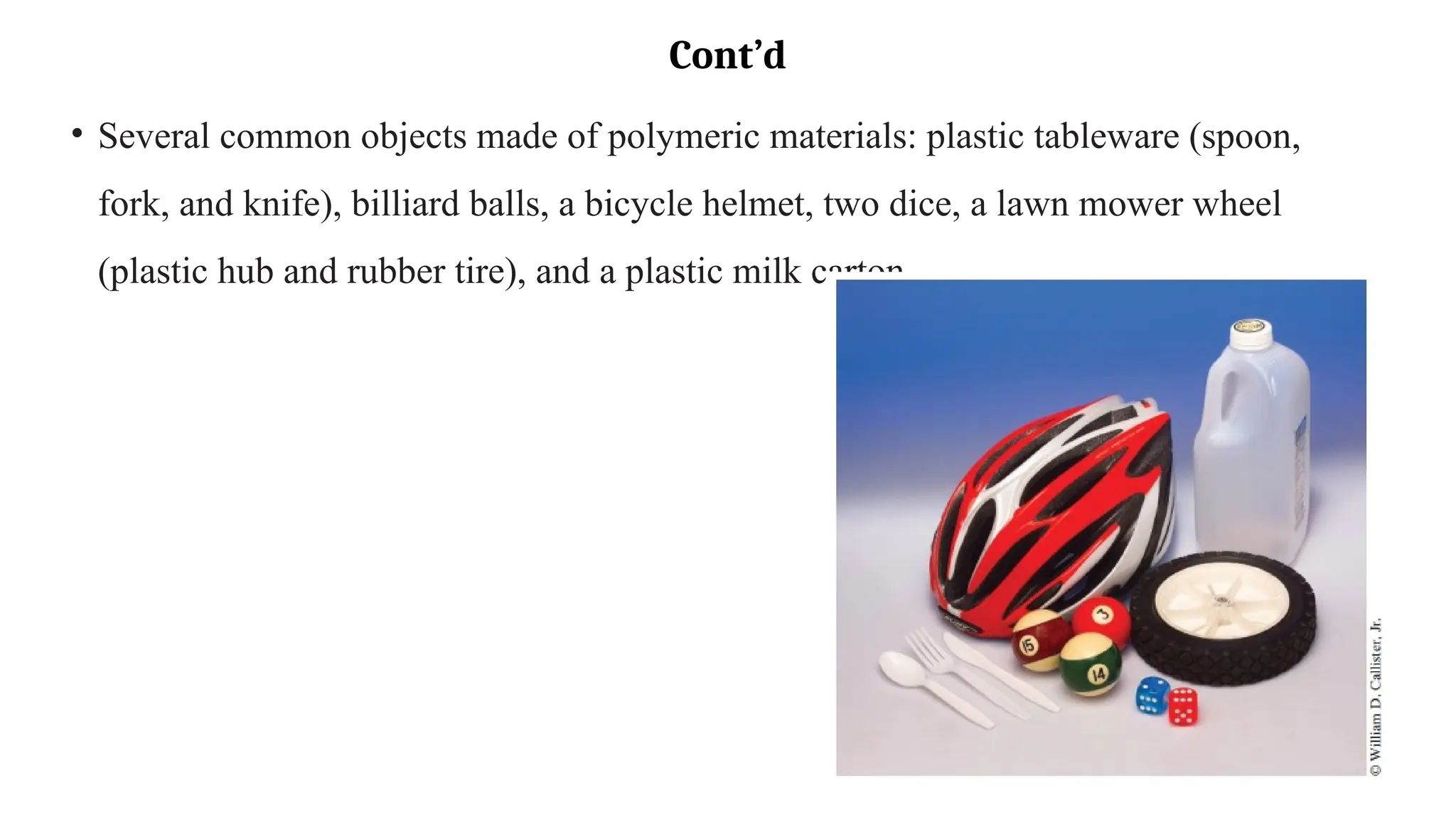
• Several commonobjects made of polymeric materials: plastic tableware (spoon,
fork, and knife), billiard balls, a bicycle helmet, two dice, a lawn mower wheel
(plastic hub and rubber tire), and a plastic milk carton.
13.
Composites
• A compositeis composed of two (or more) individual materials that come from the
categories previously discussed—metals, ceramics, and polymers.
• The design goal of a composite is to achieve a combination of properties that is not
displayed by any single material and also to incorporate the best characteristics of
each of the component materials.
• A large number of composite types are represented by different combinations of
metals, ceramics, and polymers.
• Some naturally occurring materials are composites—for example, wood and bone.
14.
ADVANCED MATERIALS
• Materialsutilized in high-technology (or high-tech) applications are sometimes
termed advanced materials.
Semiconductors
• Semiconductors have electrical properties that are intermediate between those of
electrical conductors (i.e., metals and metal alloys) and insulators (i.e., ceramics
and polymers)
• Semiconductors have made possible the advent of integrated circuitry that has
totally revolutionized the electronics and computer industries (not to mention
our lives) over the past four decades.
15.
Biomaterials
• Replacement implants(body parts) are constructed of biomaterials—so that
they function in a reliable, safe, and physiologically satisfactory manner,
while interacting with living tissue.
• That is, biomaterials must be biocompatible—compatible with body tissues
and fluids with which they are in contact over acceptable time periods.
• Example biomaterial applications include joint (e.g., hip, knee) and heart valve
replacements, vascular (blood vessel) grafts, fracture-fixation devices, dental
restorations, and generation of new organ tissues.
16.
Smart Materials
• Smart(or intelligent) materials are a group of new and state-of-the-art materials
• Smart implies that these materials are able to sense changes in their environment
and then respond to these changes in predetermined manners
• Shape-memory alloys are metals that, after having been deformed, revert to their
original shape when temperature is changed
• Piezoelectric ceramics expand and contract in response to an applied electric field
(or voltage)
• The behavior of magnetostrictive materials is analogous to that of the piezoelectrics,
except that they are responsive to magnetic fields.
• Also, electrorheological and magnetorheological fluids are liquids that experience
dramatic changes in viscosity upon the application of electric and magnetic fields,
respectively.
17.
Nanomaterials
• The nanoprefix denotes that the dimensions of these structural entities are on
the order of a nanometer, less than 100 nanometers
• Because of these unique and unusual properties, nanomaterials are finding
niches in electronic, biomedical, sporting, energy production, and other
industrial applications.
18.
Cont’d
Catalytic converters forautomobiles
• Nanocarbons—fullerenes, carbon nanotubes, and graphene
• Particles of carbon black as reinforcement for automobile tires
• Nanocomposites
• Magnetic nanosized grains that are used for hard disk drives
• Magnetic particles that store data on magnetic tapes
19.
MODERN MATERIALS’ NEEDS
•What material we may need in current and future world of engineering?
THANK YOU!!!