PROF. MAYUR S MODI
ASSISTANT PROFESSOR
MECHANICAL ENGINEERING DEPARTMENT
SHREE SWAMI ATMANAND SARASWATI INSTITUTE OF TECHNOLOGY,SURAT
MATERIAL SCIENCE AND METALLURGY
(2131904)
INTRODUCTION TO MATERIAL SCIENCEINTRODUCTION TO MATERIAL SCIENCE
AND METALLURGYAND METALLURGY
Metals
Ferrous metals Non-ferrous metals
Steels Cast Irons
Plain carbon steels
Low alloy steels
High alloy steels
Stainless & Tool steels
Grey Iron
White Iron
Malleable & Ductile Irons
Low carbon steels
Medium carbon steels
High carbon steels
12/28/18 PROF.MAYUR S MODI
ENGINEERING REQUIREMENTS OF
MATERIALS
• Engineers of any branch, has to deal with materials
for their proper utilization .
• Whether his product is a bridge, an automobile,
knowledge of properties and behavior under
service condition of the materials used for this
purpose is necessary.
• Service condition include the effect of mechanical
loading, temp., magnetic field, and chemical
surroundings.
• It is impossible for the engineer to have detailed
knowledge of thousands of materials.
12/28/18 PROF.MAYUR S MODI
PROPERTIES OF METALS
• 1. Physical properties
• 2. Chemical properties
• 3. Thermal properties
• 4. Electrical properties
• 5. Magnetic properties
• 6. Optical properties, and
• 7. Mechanical properties
12/28/18 PROF.MAYUR S MODI
PHYSICAL PROPERTIES
• Density -Mass per unit volume is called as density. In
metric system its unit is kg/mm3. Because of very low
density, aluminum and magnesium are preferred in
aeronautic and transportation applications.
• For a specific material density remains constant but
it varies with materials.
12/28/18 PROF.MAYUR S MODI
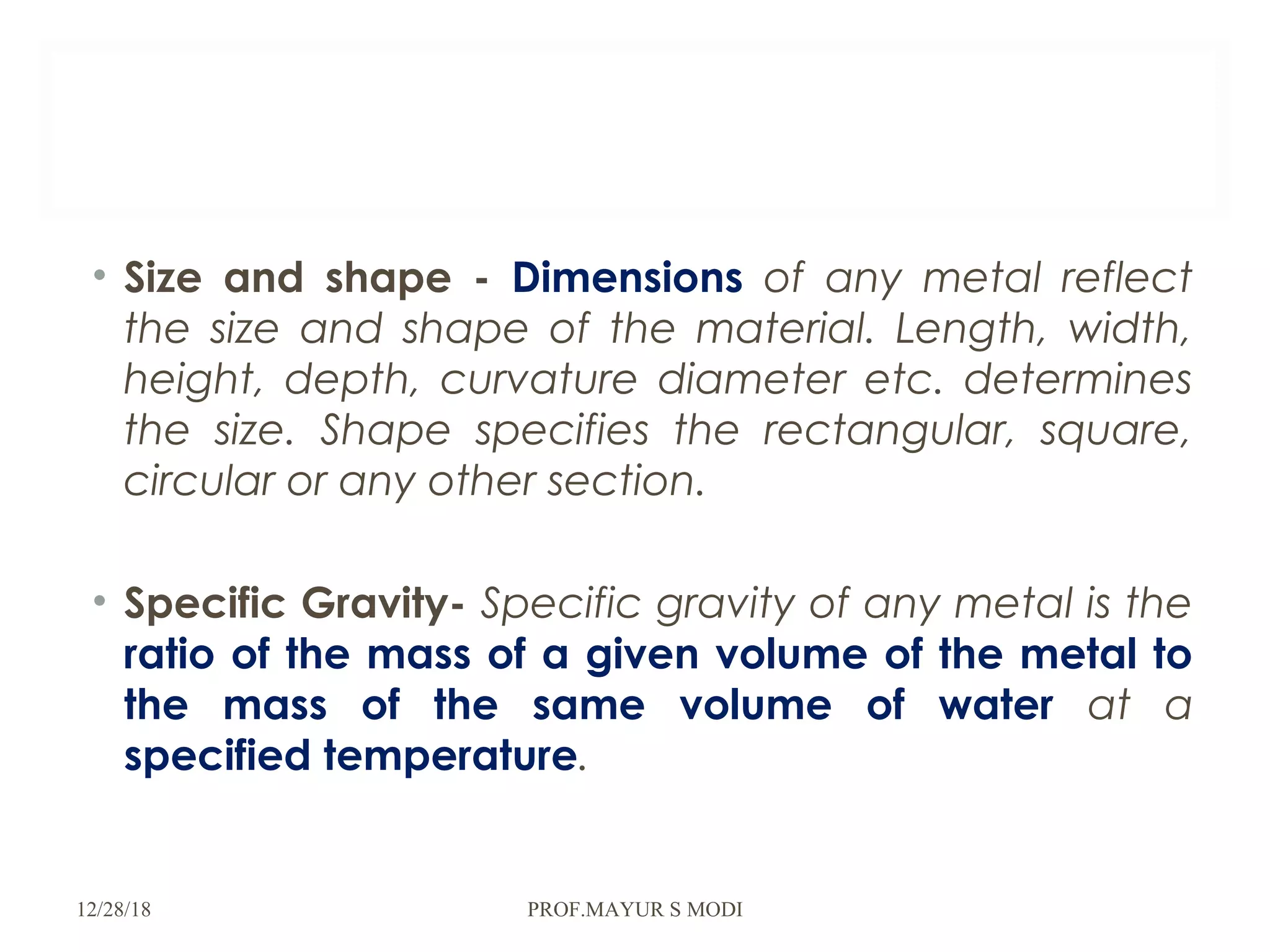
• Size and shape - Dimensions of any metal reflect
the size and shape of the material. Length, width,
height, depth, curvature diameter etc. determines
the size. Shape specifies the rectangular, square,
circular or any other section.
• Specific Gravity- Specific gravity of any metal is the
ratio of the mass of a given volume of the metal to
the mass of the same volume of water at a
specified temperature.
12/28/18 PROF.MAYUR S MODI
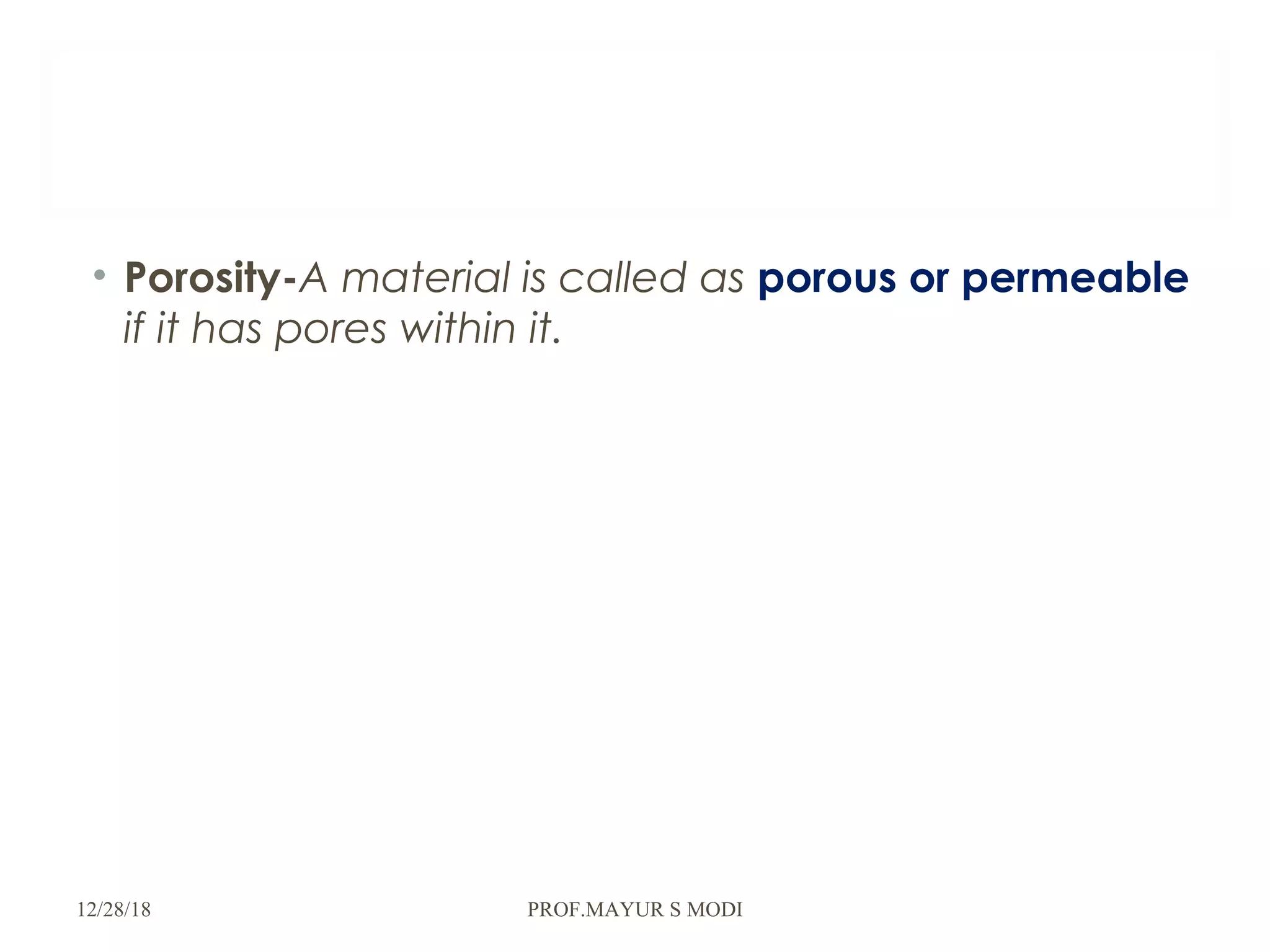
• Porosity-A material is called as porous or permeable
if it has pores within it.
12/28/18 PROF.MAYUR S MODI
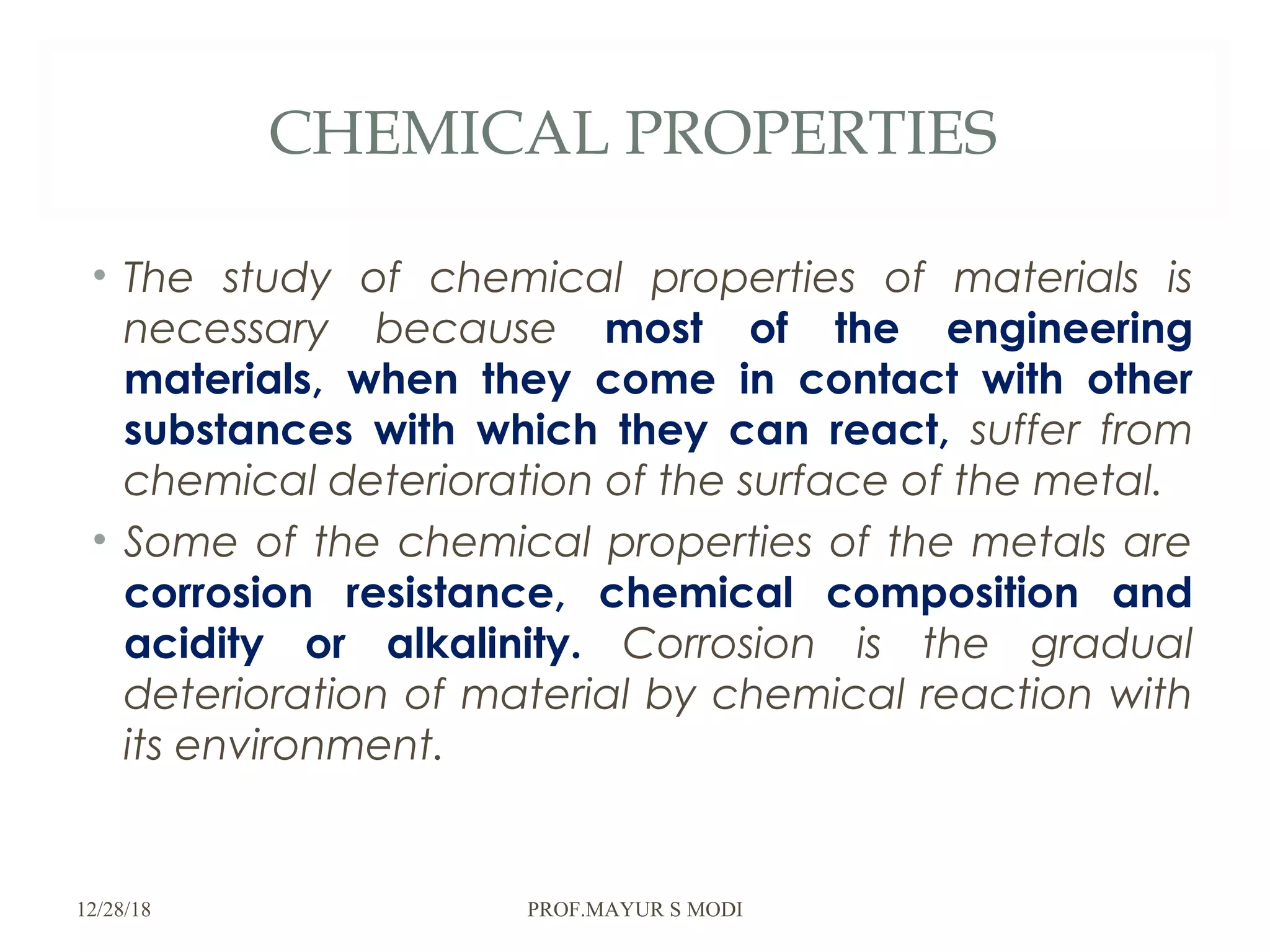
CHEMICAL PROPERTIES
• The study of chemical properties of materials is
necessary because most of the engineering
materials, when they come in contact with other
substances with which they can react, suffer from
chemical deterioration of the surface of the metal.
• Some of the chemical properties of the metals are
corrosion resistance, chemical composition and
acidity or alkalinity. Corrosion is the gradual
deterioration of material by chemical reaction with
its environment.
12/28/18 PROF.MAYUR S MODI
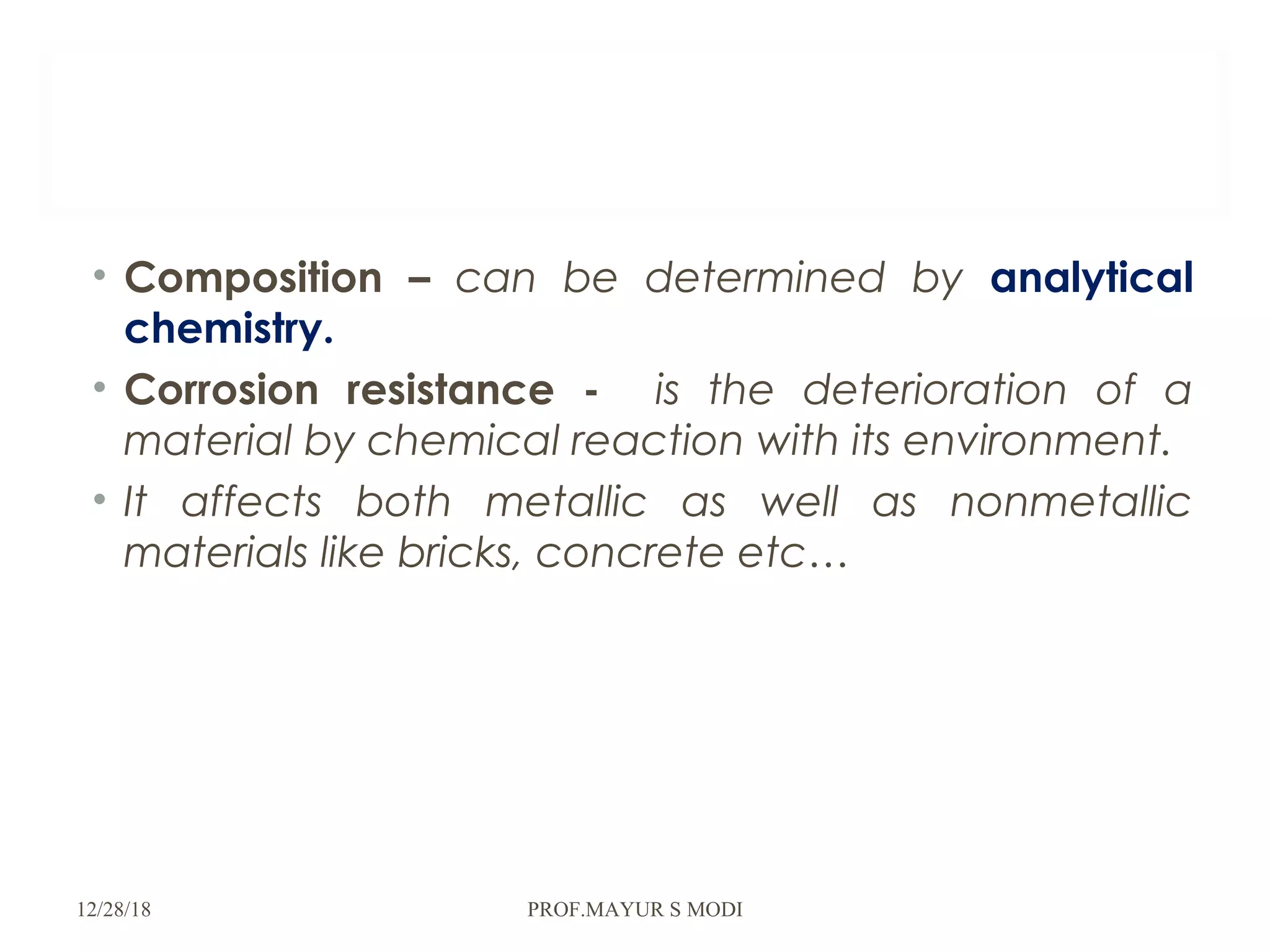
• Composition – can be determined by analytical
chemistry.
• Corrosion resistance - is the deterioration of a
material by chemical reaction with its environment.
• It affects both metallic as well as nonmetallic
materials like bricks, concrete etc…
12/28/18 PROF.MAYUR S MODI
THERMAL PROPERTIES
• Melting Point - Melting point is the temperature at
which a pure metal or compound changes its
shape from solid to liquid.
• It is called as the temperature at which the liquid
and solid are in equilibrium.
12/28/18 PROF.MAYUR S MODI
ELECTRICAL PROPERTIES
• Conductivity- Conductivity is defined as the ability
of the material to pass electric current through it
easily i.e. the material which is conductive will
provide an easy path for the flow of electricity
through it.
• Dielectric Strength- It means insulating capacity of
material at high voltage. A material having high
dielectric strength can withstand for longer time for
high voltage across it before it conducts the current
through it.
12/28/18 PROF.MAYUR S MODI
• Resistivity- It is the property of a material by which it
resists the flow of electricity through it.
• Thermoelectricity- If two dissimilar metals are joined
and then this junction is heated, a small voltage (in
the milli-volt range) is produced, and this is known
as thermoelectric effect. It is the base of the
thermocouple. Thermo -couples are prepared using
the properties of metals.
12/28/18 PROF.MAYUR S MODI
MECHANICAL PROPERTIES
• Elasticity- It is defined as the property of a material
to regain its original shape after deformation when
the external forces are removed.
• It can also be referred as the power of material to
come back to its original position after deformation
when the stress or load is removed. It is also called
as the tensile property of the material.
• Yield point- At a specific stress, ductile metals
particularly ceases, offering resistance to tensile
forces.
12/28/18 PROF.MAYUR S MODI
• Strength- Strength is defined as the ability of
material to resist the externally applied forces or
stresses without fracture.
• This property of material therefore determines the
ability to withstand stress without failure.
• The maximum stress that any material can
withstand before destruction is called its ultimate
strength. The tenacity of the material is its ultimate
strength in tension.
12/28/18 PROF.MAYUR S MODI
• Stiffness- It is defined as the ability of a material to
resist deformation under stress. The resistance of a
material to elastic deformation or deflection is
called stiffness or rigidity.
• Plasticity- Plasticity is defined the mechanical
property of a material which retains the
deformation produced under load permanently.
• This property of the material is required in forging, in
stamping images on coins. It is the ability or
tendency of material to undergo some degree of
permanent deformation without its rupture or its
failure.
12/28/18 PROF.MAYUR S MODI
• Ductility-Ductility is termed as the property of a
material enabling it to be drawn into wire with the
application of tensile load.
• The ductility is usually measured by the terms,
percentage elongation and percent reduction in
area which is often used as empirical measures of
ductility.
• The materials those possess more than 5%
elongation are called as ductile materials.
12/28/18 PROF.MAYUR S MODI
• Malleability - Malleability is the ability of the
material to be flattened into thin sheets under
applications of heavy compressive forces without
cracking by hot or cold working means.
• It is a special case of ductility which permits
materials to be rolled or hammered into thin sheets.
12/28/18 PROF.MAYUR S MODI
• Hardness - Hardness is defined as the ability of a
metal to cut another metal. A harder metal can
always cut or put impression to the softer metals by
virtue of its hardness.
• It embraces many different properties such as
resistance to wear, scratching, deformation and
machinability etc.
12/28/18 PROF.MAYUR S MODI
• Brittleness- Brittleness is the property of a material
opposite to ductility. It is the property of breaking of
a material with little permanent distortion.
• The materials having less than 5% elongation under
loading behavior are said to be brittle materials.
12/28/18 PROF.MAYUR S MODI
• Creep- When a metal part when is subjected to a
high constant stress at high temperature for a longer
period of time, it will undergo a slow and permanent
deformation (in form of a crack which may further
propagate further towards creep failure) called
creep.
12/28/18 PROF.MAYUR S MODI
• Workability or Formability- It is the property of
metals which denotes the ease in its forming in to
various shapes and sizes.
• The different factors that affect the formability are
crystal structure of metal, grain size of metal hot
and cold working, alloying element present in the
parent metal.
• Hot working increases formability. Low carbon steel
possesses good formability.
12/28/18 PROF.MAYUR S MODI
• Castability-Castability is defined as the property of
metal, which indicates the ease with it can be
casted into different shapes and sizes. Cast iron,
aluminium and brass are possessing good
castability.
12/28/18 PROF.MAYUR S MODI
• Weldability-Weldability is defined as the property of
a metal which indicates the two similar or dissimilar
metals are joined by fusion with or without the
application of pressure and with or without the use
of filler metal (welding) efficiently.
12/28/18 PROF.MAYUR S MODI
• Toughness- toughness is the amount of energy that
a material can absorb before it fractures.
• It is desirable property for structural and machine
parts which have to withstand shock and vibration.
• Resilience – resilience is the capacity of a material
to absorb or store energy, and to resist shock and
impact.
12/28/18 PROF.MAYUR S MODI
• Fatigue – The failure of a material caused under
repeated loads or stresses is known as fatigue or
fatigue failure.
12/28/18 PROF.MAYUR S MODI
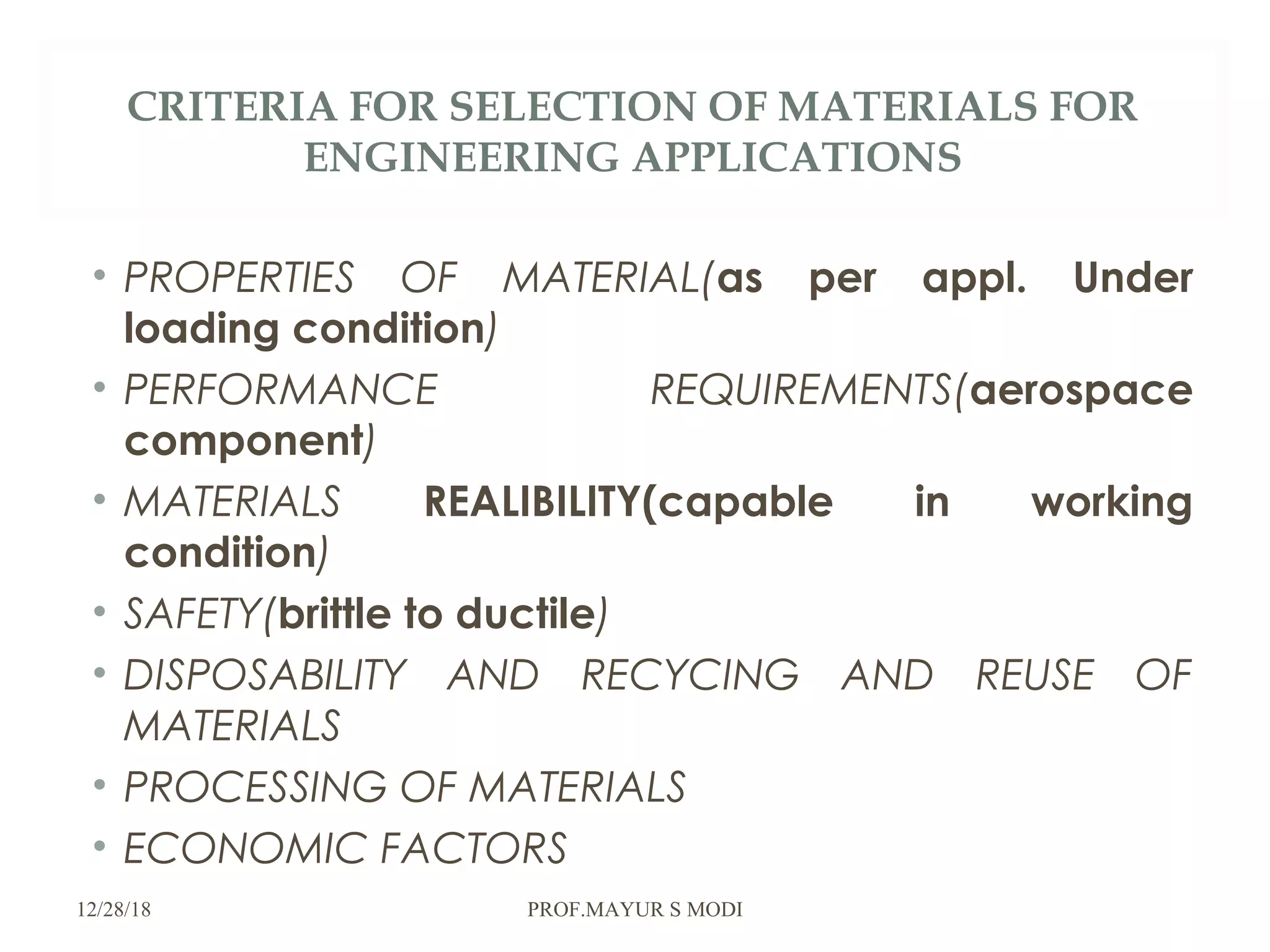
CRITERIA FOR SELECTION OF MATERIALS FOR
ENGINEERING APPLICATIONS
• PROPERTIES OF MATERIAL(as per appl. Under
loading condition)
• PERFORMANCE REQUIREMENTS(aerospace
component)
• MATERIALS REALIBILITY(capable in working
condition)
• SAFETY(brittle to ductile)
• DISPOSABILITY AND RECYCING AND REUSE OF
MATERIALS
• PROCESSING OF MATERIALS
• ECONOMIC FACTORS
12/28/18 PROF.MAYUR S MODI
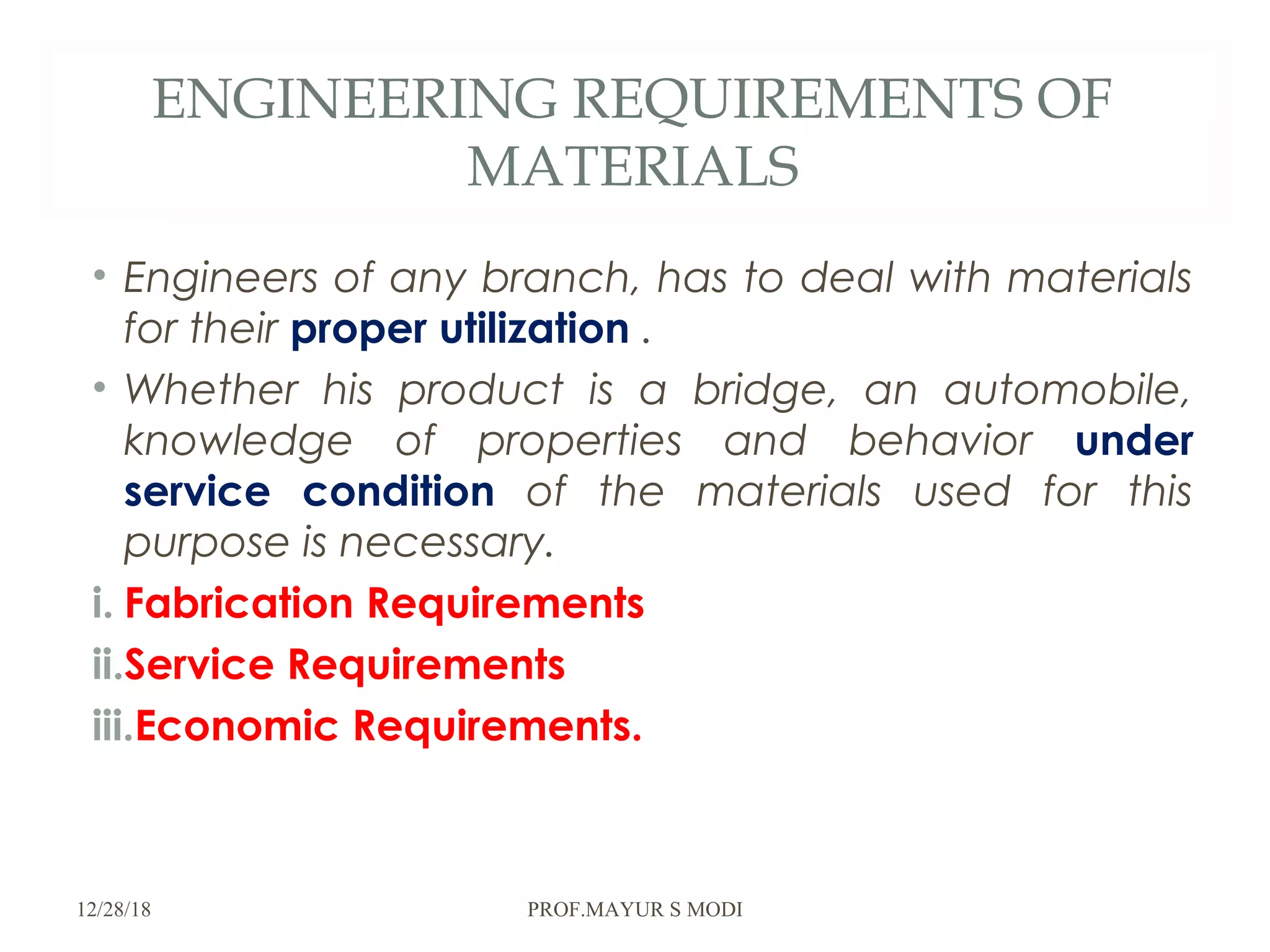
• Engineers of any branch, has to deal with materials
for their proper utilization .
• Whether his product is a bridge, an automobile,
knowledge of properties and behavior under
service condition of the materials used for this
purpose is necessary.
i. Fabrication Requirements
ii.Service Requirements
iii.Economic Requirements.
ENGINEERING REQUIREMENTS OF
MATERIALS
12/28/18 PROF.MAYUR S MODI

Chapter 1 INTRODUCTION TO MATERIAL SCIENCE AND METALLURGY

  • 1.
    PROF. MAYUR SMODI ASSISTANT PROFESSOR MECHANICAL ENGINEERING DEPARTMENT SHREE SWAMI ATMANAND SARASWATI INSTITUTE OF TECHNOLOGY,SURAT MATERIAL SCIENCE AND METALLURGY (2131904) INTRODUCTION TO MATERIAL SCIENCEINTRODUCTION TO MATERIAL SCIENCE AND METALLURGYAND METALLURGY
  • 2.
    Metals Ferrous metals Non-ferrousmetals Steels Cast Irons Plain carbon steels Low alloy steels High alloy steels Stainless & Tool steels Grey Iron White Iron Malleable & Ductile Irons Low carbon steels Medium carbon steels High carbon steels 12/28/18 PROF.MAYUR S MODI
  • 3.
    ENGINEERING REQUIREMENTS OF MATERIALS •Engineers of any branch, has to deal with materials for their proper utilization . • Whether his product is a bridge, an automobile, knowledge of properties and behavior under service condition of the materials used for this purpose is necessary. • Service condition include the effect of mechanical loading, temp., magnetic field, and chemical surroundings. • It is impossible for the engineer to have detailed knowledge of thousands of materials. 12/28/18 PROF.MAYUR S MODI
  • 4.
    PROPERTIES OF METALS •1. Physical properties • 2. Chemical properties • 3. Thermal properties • 4. Electrical properties • 5. Magnetic properties • 6. Optical properties, and • 7. Mechanical properties 12/28/18 PROF.MAYUR S MODI
  • 5.
    PHYSICAL PROPERTIES • Density-Mass per unit volume is called as density. In metric system its unit is kg/mm3. Because of very low density, aluminum and magnesium are preferred in aeronautic and transportation applications. • For a specific material density remains constant but it varies with materials. 12/28/18 PROF.MAYUR S MODI
  • 6.
    • Size andshape - Dimensions of any metal reflect the size and shape of the material. Length, width, height, depth, curvature diameter etc. determines the size. Shape specifies the rectangular, square, circular or any other section. • Specific Gravity- Specific gravity of any metal is the ratio of the mass of a given volume of the metal to the mass of the same volume of water at a specified temperature. 12/28/18 PROF.MAYUR S MODI
  • 7.
    • Porosity-A materialis called as porous or permeable if it has pores within it. 12/28/18 PROF.MAYUR S MODI
  • 8.
    CHEMICAL PROPERTIES • Thestudy of chemical properties of materials is necessary because most of the engineering materials, when they come in contact with other substances with which they can react, suffer from chemical deterioration of the surface of the metal. • Some of the chemical properties of the metals are corrosion resistance, chemical composition and acidity or alkalinity. Corrosion is the gradual deterioration of material by chemical reaction with its environment. 12/28/18 PROF.MAYUR S MODI
  • 9.
    • Composition –can be determined by analytical chemistry. • Corrosion resistance - is the deterioration of a material by chemical reaction with its environment. • It affects both metallic as well as nonmetallic materials like bricks, concrete etc… 12/28/18 PROF.MAYUR S MODI
  • 10.
    THERMAL PROPERTIES • MeltingPoint - Melting point is the temperature at which a pure metal or compound changes its shape from solid to liquid. • It is called as the temperature at which the liquid and solid are in equilibrium. 12/28/18 PROF.MAYUR S MODI
  • 11.
    ELECTRICAL PROPERTIES • Conductivity-Conductivity is defined as the ability of the material to pass electric current through it easily i.e. the material which is conductive will provide an easy path for the flow of electricity through it. • Dielectric Strength- It means insulating capacity of material at high voltage. A material having high dielectric strength can withstand for longer time for high voltage across it before it conducts the current through it. 12/28/18 PROF.MAYUR S MODI
  • 12.
    • Resistivity- Itis the property of a material by which it resists the flow of electricity through it. • Thermoelectricity- If two dissimilar metals are joined and then this junction is heated, a small voltage (in the milli-volt range) is produced, and this is known as thermoelectric effect. It is the base of the thermocouple. Thermo -couples are prepared using the properties of metals. 12/28/18 PROF.MAYUR S MODI
  • 13.
    MECHANICAL PROPERTIES • Elasticity-It is defined as the property of a material to regain its original shape after deformation when the external forces are removed. • It can also be referred as the power of material to come back to its original position after deformation when the stress or load is removed. It is also called as the tensile property of the material. • Yield point- At a specific stress, ductile metals particularly ceases, offering resistance to tensile forces. 12/28/18 PROF.MAYUR S MODI
  • 14.
    • Strength- Strengthis defined as the ability of material to resist the externally applied forces or stresses without fracture. • This property of material therefore determines the ability to withstand stress without failure. • The maximum stress that any material can withstand before destruction is called its ultimate strength. The tenacity of the material is its ultimate strength in tension. 12/28/18 PROF.MAYUR S MODI
  • 15.
    • Stiffness- Itis defined as the ability of a material to resist deformation under stress. The resistance of a material to elastic deformation or deflection is called stiffness or rigidity. • Plasticity- Plasticity is defined the mechanical property of a material which retains the deformation produced under load permanently. • This property of the material is required in forging, in stamping images on coins. It is the ability or tendency of material to undergo some degree of permanent deformation without its rupture or its failure. 12/28/18 PROF.MAYUR S MODI
  • 16.
    • Ductility-Ductility istermed as the property of a material enabling it to be drawn into wire with the application of tensile load. • The ductility is usually measured by the terms, percentage elongation and percent reduction in area which is often used as empirical measures of ductility. • The materials those possess more than 5% elongation are called as ductile materials. 12/28/18 PROF.MAYUR S MODI
  • 17.
    • Malleability -Malleability is the ability of the material to be flattened into thin sheets under applications of heavy compressive forces without cracking by hot or cold working means. • It is a special case of ductility which permits materials to be rolled or hammered into thin sheets. 12/28/18 PROF.MAYUR S MODI
  • 18.
    • Hardness -Hardness is defined as the ability of a metal to cut another metal. A harder metal can always cut or put impression to the softer metals by virtue of its hardness. • It embraces many different properties such as resistance to wear, scratching, deformation and machinability etc. 12/28/18 PROF.MAYUR S MODI
  • 19.
    • Brittleness- Brittlenessis the property of a material opposite to ductility. It is the property of breaking of a material with little permanent distortion. • The materials having less than 5% elongation under loading behavior are said to be brittle materials. 12/28/18 PROF.MAYUR S MODI
  • 20.
    • Creep- Whena metal part when is subjected to a high constant stress at high temperature for a longer period of time, it will undergo a slow and permanent deformation (in form of a crack which may further propagate further towards creep failure) called creep. 12/28/18 PROF.MAYUR S MODI
  • 21.
    • Workability orFormability- It is the property of metals which denotes the ease in its forming in to various shapes and sizes. • The different factors that affect the formability are crystal structure of metal, grain size of metal hot and cold working, alloying element present in the parent metal. • Hot working increases formability. Low carbon steel possesses good formability. 12/28/18 PROF.MAYUR S MODI
  • 22.
    • Castability-Castability isdefined as the property of metal, which indicates the ease with it can be casted into different shapes and sizes. Cast iron, aluminium and brass are possessing good castability. 12/28/18 PROF.MAYUR S MODI
  • 23.
    • Weldability-Weldability isdefined as the property of a metal which indicates the two similar or dissimilar metals are joined by fusion with or without the application of pressure and with or without the use of filler metal (welding) efficiently. 12/28/18 PROF.MAYUR S MODI
  • 24.
    • Toughness- toughnessis the amount of energy that a material can absorb before it fractures. • It is desirable property for structural and machine parts which have to withstand shock and vibration. • Resilience – resilience is the capacity of a material to absorb or store energy, and to resist shock and impact. 12/28/18 PROF.MAYUR S MODI
  • 25.
    • Fatigue –The failure of a material caused under repeated loads or stresses is known as fatigue or fatigue failure. 12/28/18 PROF.MAYUR S MODI
  • 26.
    CRITERIA FOR SELECTIONOF MATERIALS FOR ENGINEERING APPLICATIONS • PROPERTIES OF MATERIAL(as per appl. Under loading condition) • PERFORMANCE REQUIREMENTS(aerospace component) • MATERIALS REALIBILITY(capable in working condition) • SAFETY(brittle to ductile) • DISPOSABILITY AND RECYCING AND REUSE OF MATERIALS • PROCESSING OF MATERIALS • ECONOMIC FACTORS 12/28/18 PROF.MAYUR S MODI
  • 27.
    • Engineers ofany branch, has to deal with materials for their proper utilization . • Whether his product is a bridge, an automobile, knowledge of properties and behavior under service condition of the materials used for this purpose is necessary. i. Fabrication Requirements ii.Service Requirements iii.Economic Requirements. ENGINEERING REQUIREMENTS OF MATERIALS 12/28/18 PROF.MAYUR S MODI
  • 28.