Fracture
Fracture: 
Simple fracture is the separation of a body into two or more pieces in 
response to an imposed stress that is static (i.e. constant or slowly 
changing with time) and at temperatures that are low relative to the 
melting temperature of the material. 
The applied stress may be tensile,compressive,shear or torsional. 
The present discussion will be confined to fractures that result from 
uniaxial tensile loads. 
Any fracture process involves two steps : 
i. Crack formation 
ii. Propagation 
For engineering materials, two fracture modes are possible 
1.Ductile 
2.Brittle
Ductile Fracture: 
Classification is based on the ability of a material to 
experience plastic deformation. 
Ductile materials typically exhibit substantial plastic 
deformation with high energy absorption before fracture. 
 ductility may be quantified in terms of 
1. %EL = Final length - Initial Length x 100 
Initial Length 
2. % RA = Original area- final area x 100 
original area
Cont… 
Ductile fracture is characterized by extensive plastic 
deformation in the vicinity of an advancing crack. 
Ductile fracture is almost always preferred for two reasons. 
1st brittle fracture occurs suddenly and catastrophically without 
any warning: 
This is consequence of the spontaneous and rapid crack 
propagation. 
On the other hand, the ductile fracture, the presence of plastic 
deformation gives warning that fracture is imminent, allowing 
preventive measures to be taken.
Cont…. 
Second, more strain energy is required to induce 
ductile fracture in as much as ductile materials are 
generally tougher. 
Ductile fracture surfaces will have their own 
distinctive features on both microscopic and 
macroscopic levels. 
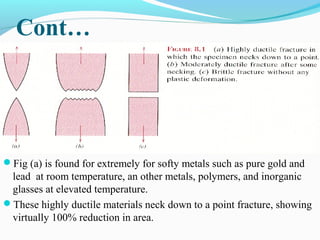
Below fig shows schematic representations for two 
characteristics macroscopic fracture profiles.
Cont… 
Fig (a) is found for extremely for softy metals such as pure gold and 
lead at room temperature, an other metals, polymers, and inorganic 
glasses at elevated temperature. 
These highly ductile materials neck down to a point fracture, showing 
virtually 100% reduction in area.
Stages of fracture: 
The fracture process normally occurs in several stages given 
below.
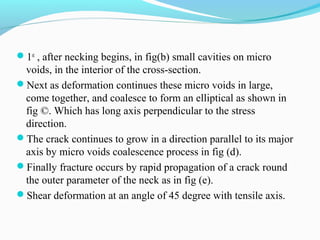
1st , after necking begins, in fig(b) small cavities on micro 
voids, in the interior of the cross-section. 
Next as deformation continues these micro voids in large, 
come together, and coalesce to form an elliptical as shown in 
fig ©. Which has long axis perpendicular to the stress 
direction. 
The crack continues to grow in a direction parallel to its major 
axis by micro voids coalescence process in fig (d). 
Finally fracture occurs by rapid propagation of a crack round 
the outer parameter of the neck as in fig (e). 
Shear deformation at an angle of 45 degree with tensile axis.
Brittle fracture: 
Brittle fracture takes place without any appreciable 
deformation, and by rapid crack propagation. 
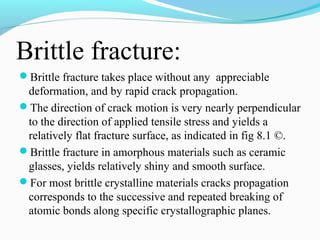
The direction of crack motion is very nearly perpendicular 
to the direction of applied tensile stress and yields a 
relatively flat fracture surface, as indicated in fig 8.1 ©. 
Brittle fracture in amorphous materials such as ceramic 
glasses, yields relatively shiny and smooth surface. 
For most brittle crystalline materials cracks propagation 
corresponds to the successive and repeated breaking of 
atomic bonds along specific crystallographic planes.
Cont… 
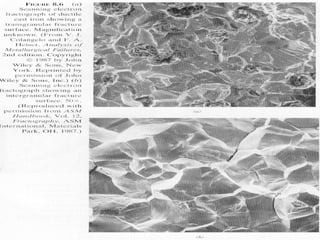
Such a process is termed cleavage. 
This type of fracture is said to be transgranular(or 
trans crystalline),because the fracture cracks pass 
through the grains. 
In some alloys crack propagation is along grain 
boundaries, this fracture is termed as intergranular.
Fracture
Fracture

Fracture

  • 1.
  • 2.
    Fracture: Simple fractureis the separation of a body into two or more pieces in response to an imposed stress that is static (i.e. constant or slowly changing with time) and at temperatures that are low relative to the melting temperature of the material. The applied stress may be tensile,compressive,shear or torsional. The present discussion will be confined to fractures that result from uniaxial tensile loads. Any fracture process involves two steps : i. Crack formation ii. Propagation For engineering materials, two fracture modes are possible 1.Ductile 2.Brittle
  • 3.
    Ductile Fracture: Classificationis based on the ability of a material to experience plastic deformation. Ductile materials typically exhibit substantial plastic deformation with high energy absorption before fracture.  ductility may be quantified in terms of 1. %EL = Final length - Initial Length x 100 Initial Length 2. % RA = Original area- final area x 100 original area
  • 4.
    Cont… Ductile fractureis characterized by extensive plastic deformation in the vicinity of an advancing crack. Ductile fracture is almost always preferred for two reasons. 1st brittle fracture occurs suddenly and catastrophically without any warning: This is consequence of the spontaneous and rapid crack propagation. On the other hand, the ductile fracture, the presence of plastic deformation gives warning that fracture is imminent, allowing preventive measures to be taken.
  • 5.
    Cont…. Second, morestrain energy is required to induce ductile fracture in as much as ductile materials are generally tougher. Ductile fracture surfaces will have their own distinctive features on both microscopic and macroscopic levels. Below fig shows schematic representations for two characteristics macroscopic fracture profiles.
  • 6.
    Cont… Fig (a)is found for extremely for softy metals such as pure gold and lead at room temperature, an other metals, polymers, and inorganic glasses at elevated temperature. These highly ductile materials neck down to a point fracture, showing virtually 100% reduction in area.
  • 7.
    Stages of fracture: The fracture process normally occurs in several stages given below.
  • 8.
    1st , afternecking begins, in fig(b) small cavities on micro voids, in the interior of the cross-section. Next as deformation continues these micro voids in large, come together, and coalesce to form an elliptical as shown in fig ©. Which has long axis perpendicular to the stress direction. The crack continues to grow in a direction parallel to its major axis by micro voids coalescence process in fig (d). Finally fracture occurs by rapid propagation of a crack round the outer parameter of the neck as in fig (e). Shear deformation at an angle of 45 degree with tensile axis.
  • 9.
    Brittle fracture: Brittlefracture takes place without any appreciable deformation, and by rapid crack propagation. The direction of crack motion is very nearly perpendicular to the direction of applied tensile stress and yields a relatively flat fracture surface, as indicated in fig 8.1 ©. Brittle fracture in amorphous materials such as ceramic glasses, yields relatively shiny and smooth surface. For most brittle crystalline materials cracks propagation corresponds to the successive and repeated breaking of atomic bonds along specific crystallographic planes.
  • 10.
    Cont… Such aprocess is termed cleavage. This type of fracture is said to be transgranular(or trans crystalline),because the fracture cracks pass through the grains. In some alloys crack propagation is along grain boundaries, this fracture is termed as intergranular.