INTRODUCTION
 The ultimate goal of manufacturing engineer is to
produce required steel/metal components of
required geometrical shape and structurally
optimized for a given applications. One of the
method Is metal forming processes.
 Metal forming processes are used to produce
wrought products. These products include
angles, channels, I-beams, railroad rails, round,
square, and hexagonal bar stock, sheets and
plates, forgings, tubes, pipes etc.
TYPES OF METAL FORMING
PROCESSES
 HOT WORKING
 COLD WORKING
 EXTRUSION
 FORGING
 ROLLING
 BENDING
 SPINNING
HOT & COLD WORKING
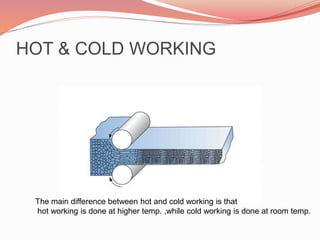
The main difference between hot and cold working is that
hot working is done at higher temp. ,while cold working is done at room temp.
HOT WORKING
The distinction between hot working and cold
working does not depends solely on temperature,
but rather o the processing temperature. When the
processing temperature of the mechanical
deformation of steel is above the recrystallization
temperature, the process is termed as hot working
process otherwise it is termed as cold working.
CONTINUED…
For hot working processes, large deformation can
be successively repeated as the metal remain soft
and ductile. The hardness of material cannot be
controlled after hot rolling and it is a function of
chemical composition and the rate of cooling after
rolling.
The hardness obtained by hot rolling is less
comparatively that of obtained by cold rolling.
CONTINUED…
However most metal will experience some surface
oxidation resulting in material loss and poor
surface finish.
Hot working does not produce strain hardening.
Hence there will be no increase in either yield
strength or hardness. In addition yield strength will
decrease with increase in temperature and the
ductility will improve.
CONTINUED…
When a work piece is hot worked, the atoms of the
work piece reach a certain higher energy level due
to heat and force.
As a result new crystals start forming. This is
called recrystallization. These crystals are train
free.
ADVANTGES
 Higher ductility – more deformation without
cracking
 Lower flow stress – less mechanical energy
required for deformation
 Pores seal up
 Smaller grain size
 Stronger, tougher and more ductile compare to
cast metals
 Metal that usually fracture in cold working can
be hot formed.
DISADVANTAGES
Surface reactions between metal and the furnace
atmosphere. (i.e. oxidation)
Hot shortness, when the working temperature
exceeds the melting temperature.
Dimension tolerance is poor due to thermal
expansion at higher temperatures.
Handling is more difficult (from furnace to machine).
COLD WORKING
In cold working metal is shaped by the application
of pressure at temperature below recrystallization
temperature of the metal. In most cases it is done
at room temperature.
Cold working is done to achieve closer dimensions
and accuracies and to improve mechanical
properties.
It is often done after hot working to obtain better
dimensional control.
CONTINUED…
If a material is cold worked to a point near the
breaking point further deformation may become
impossible due to cold working. This is rectified by
making the material go through a process
annealing operation which returns the material to
its original state.
Cold working involves larger forces and heavier
equipment compared to hot working but leads to
much better dimensional accuracy and finish.
ADVANTAGES
Better dimensional control than hot working is
possible because the reduction In size is not
much.
Strength and hardness of the metal increased.
Easier handling (low operating temperature)
Contamination problems are minimized.
No heating of work required.
DISADVANTAGES
Higher forces are required to initiate and
complete the deformation.
Heavier, more powerful and stronger equipments
are required.
Ductility and strain hardening limit the amount of
forming that can be done.
Undesirable residual stresses may be produced.
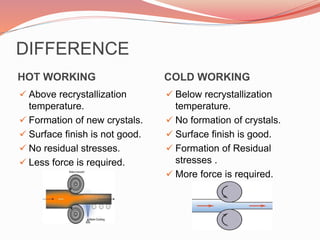
DIFFERENCE
HOT WORKING COLD WORKING
 Above recrystallization
temperature.
 Formation of new crystals.
 Surface finish is not good.
 No residual stresses.
 Less force is required.
 Below recrystallization
temperature.
 No formation of crystals.
 Surface finish is good.
 Formation of Residual
stresses .
 More force is required.
THANK YOU

Hot and cold working

  • 2.
    INTRODUCTION  The ultimategoal of manufacturing engineer is to produce required steel/metal components of required geometrical shape and structurally optimized for a given applications. One of the method Is metal forming processes.  Metal forming processes are used to produce wrought products. These products include angles, channels, I-beams, railroad rails, round, square, and hexagonal bar stock, sheets and plates, forgings, tubes, pipes etc.
  • 3.
    TYPES OF METALFORMING PROCESSES  HOT WORKING  COLD WORKING  EXTRUSION  FORGING  ROLLING  BENDING  SPINNING
  • 4.
    HOT & COLDWORKING The main difference between hot and cold working is that hot working is done at higher temp. ,while cold working is done at room temp.
  • 5.
    HOT WORKING The distinctionbetween hot working and cold working does not depends solely on temperature, but rather o the processing temperature. When the processing temperature of the mechanical deformation of steel is above the recrystallization temperature, the process is termed as hot working process otherwise it is termed as cold working.
  • 6.
    CONTINUED… For hot workingprocesses, large deformation can be successively repeated as the metal remain soft and ductile. The hardness of material cannot be controlled after hot rolling and it is a function of chemical composition and the rate of cooling after rolling. The hardness obtained by hot rolling is less comparatively that of obtained by cold rolling.
  • 7.
    CONTINUED… However most metalwill experience some surface oxidation resulting in material loss and poor surface finish. Hot working does not produce strain hardening. Hence there will be no increase in either yield strength or hardness. In addition yield strength will decrease with increase in temperature and the ductility will improve.
  • 8.
    CONTINUED… When a workpiece is hot worked, the atoms of the work piece reach a certain higher energy level due to heat and force. As a result new crystals start forming. This is called recrystallization. These crystals are train free.
  • 9.
    ADVANTGES  Higher ductility– more deformation without cracking  Lower flow stress – less mechanical energy required for deformation  Pores seal up  Smaller grain size  Stronger, tougher and more ductile compare to cast metals  Metal that usually fracture in cold working can be hot formed.
  • 10.
    DISADVANTAGES Surface reactions betweenmetal and the furnace atmosphere. (i.e. oxidation) Hot shortness, when the working temperature exceeds the melting temperature. Dimension tolerance is poor due to thermal expansion at higher temperatures. Handling is more difficult (from furnace to machine).
  • 11.
    COLD WORKING In coldworking metal is shaped by the application of pressure at temperature below recrystallization temperature of the metal. In most cases it is done at room temperature. Cold working is done to achieve closer dimensions and accuracies and to improve mechanical properties. It is often done after hot working to obtain better dimensional control.
  • 12.
    CONTINUED… If a materialis cold worked to a point near the breaking point further deformation may become impossible due to cold working. This is rectified by making the material go through a process annealing operation which returns the material to its original state. Cold working involves larger forces and heavier equipment compared to hot working but leads to much better dimensional accuracy and finish.
  • 13.
    ADVANTAGES Better dimensional controlthan hot working is possible because the reduction In size is not much. Strength and hardness of the metal increased. Easier handling (low operating temperature) Contamination problems are minimized. No heating of work required.
  • 14.
    DISADVANTAGES Higher forces arerequired to initiate and complete the deformation. Heavier, more powerful and stronger equipments are required. Ductility and strain hardening limit the amount of forming that can be done. Undesirable residual stresses may be produced.
  • 15.
    DIFFERENCE HOT WORKING COLDWORKING  Above recrystallization temperature.  Formation of new crystals.  Surface finish is not good.  No residual stresses.  Less force is required.  Below recrystallization temperature.  No formation of crystals.  Surface finish is good.  Formation of Residual stresses .  More force is required.
  • 16.