MaterialscienceandEngineering
Lecture1:Introduction
January23, 2021
Contents
• What is material?
• Materials Science and Engineering
• Why Study Materials Science and Engineering?
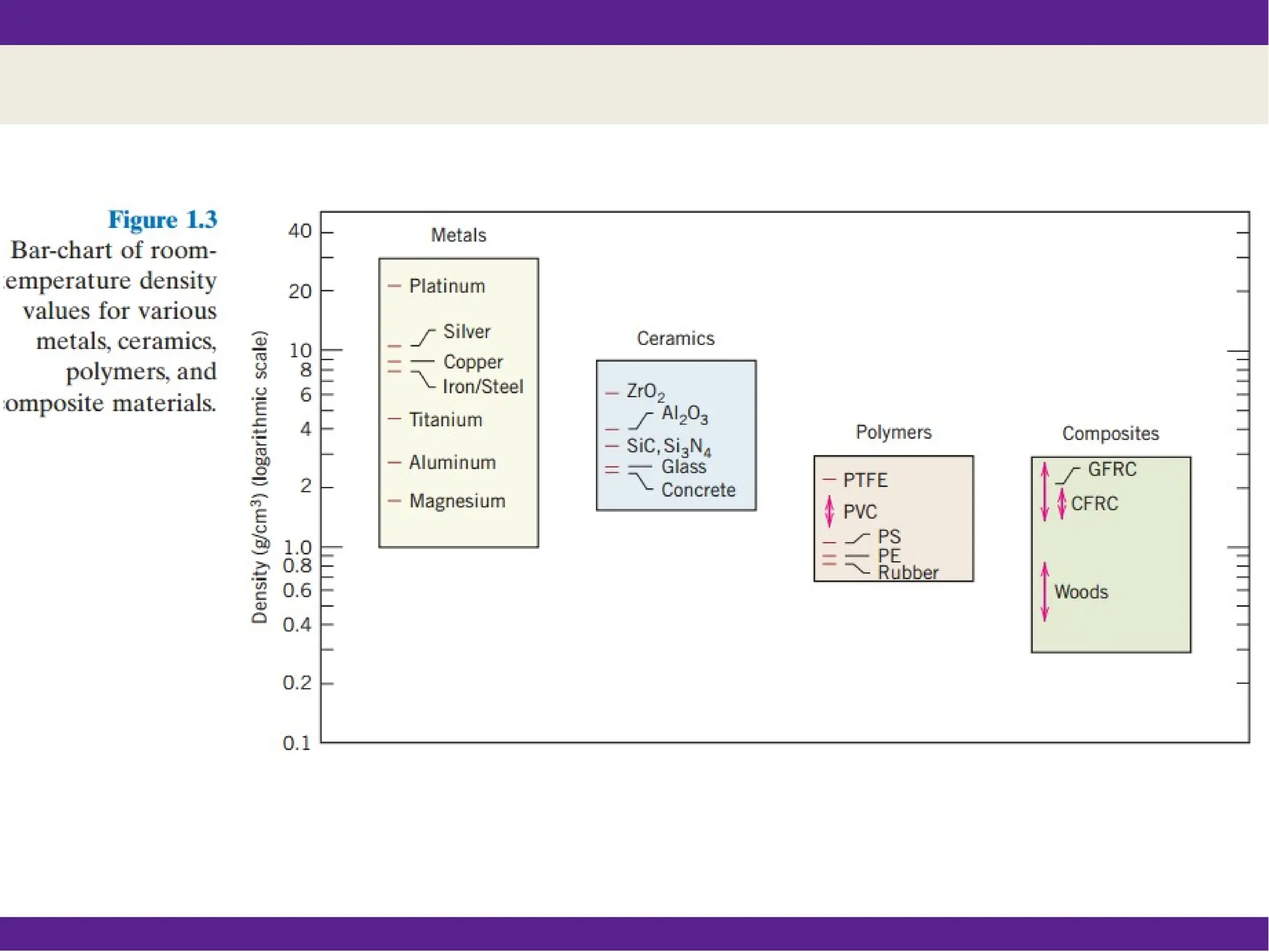
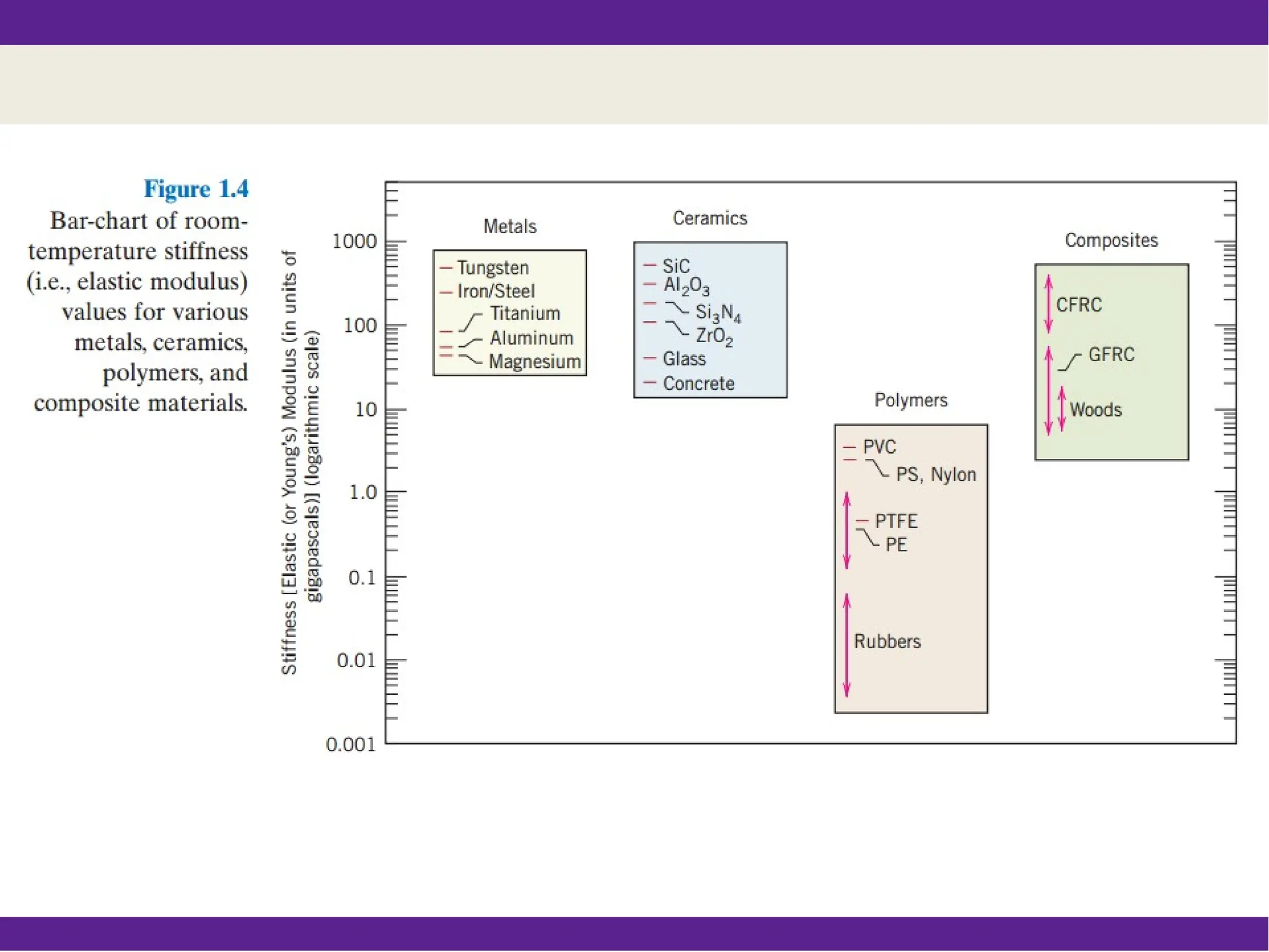
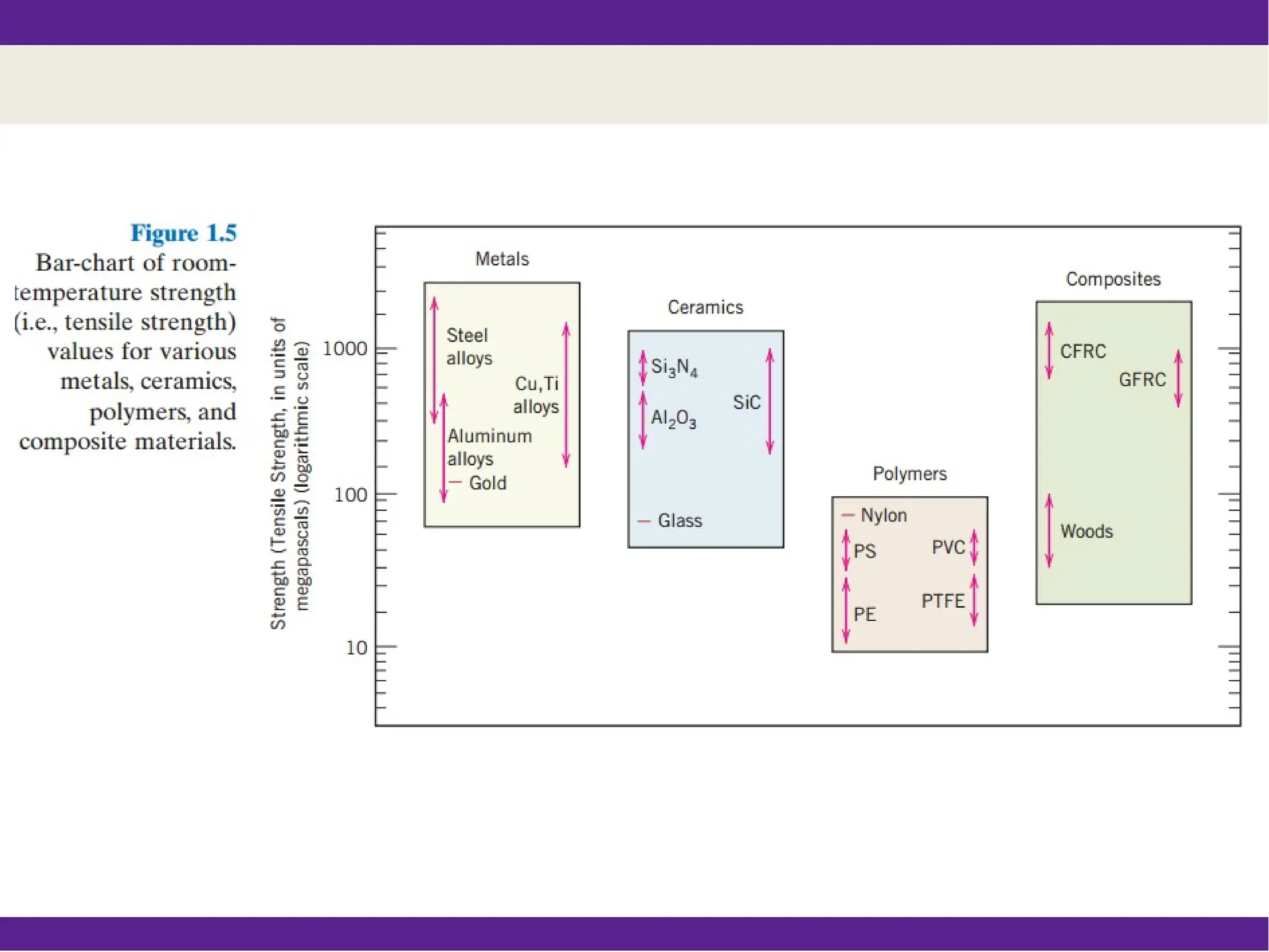
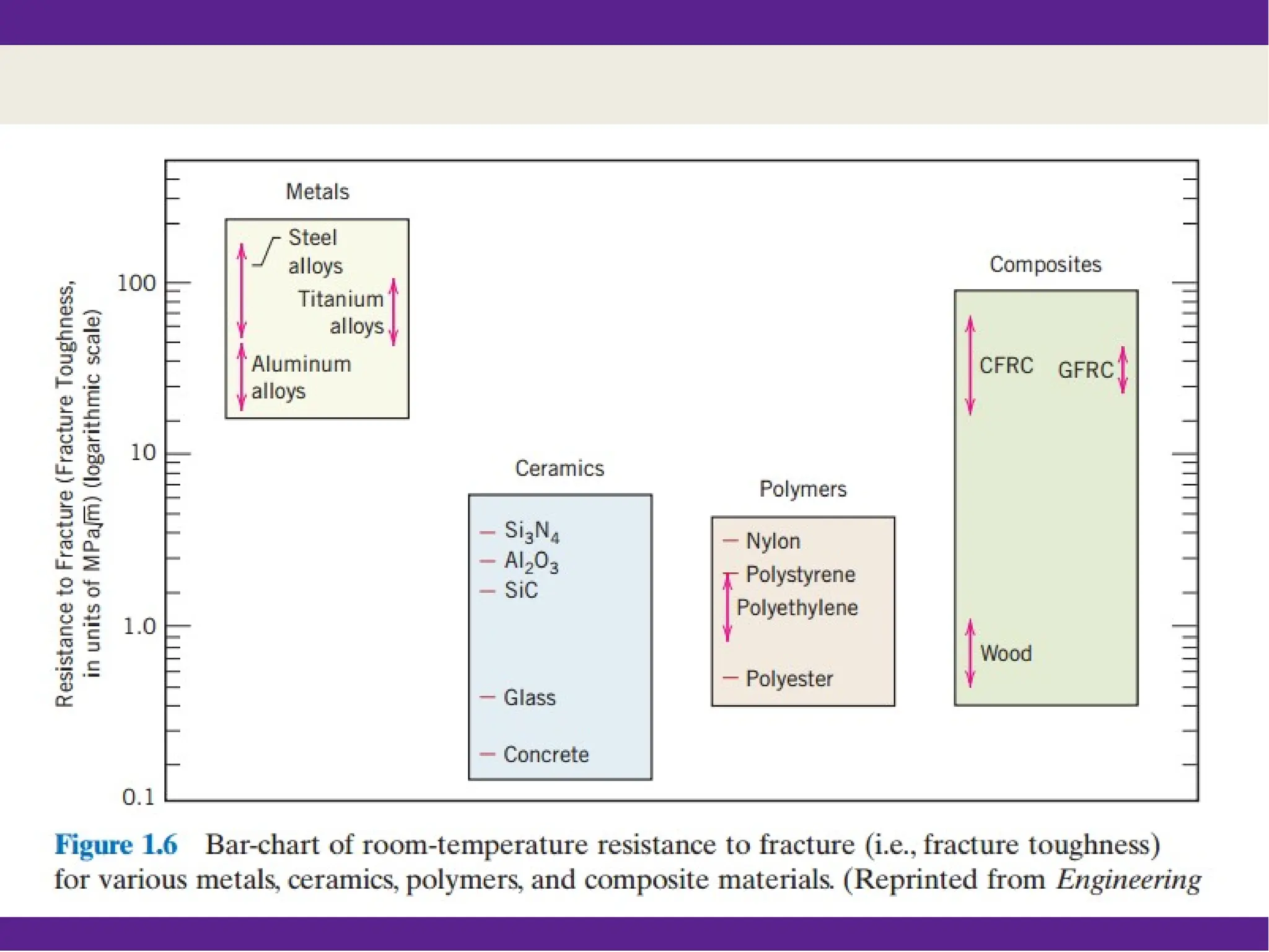
• Classification of Materials
• Advanced Materials
MATERIALS SCIENCE AND ENGINEERING
 Materials is: Substances that humans have assembled or produced
as products, appliances, inventions, various constructions.
• Such as concrete, steel, aluminum, copper, paper, plastic.
• Materials science: Involves investigating the relationships that
exist between the structures and properties of materials.
 Materials engineering: is, on the basis of the structure–property
correlations, designing or engineering the structure of a material to
produce a predetermined set of properties
 Requires knowledge of materials science
MATERIALS SCIENCE AND ENGINEERING
 Materials scientist is to develop or synthesize new materials
whereas a materials engineer is called upon to create new
products or systems using existing materials, and/or to develop
techniques for processing materials
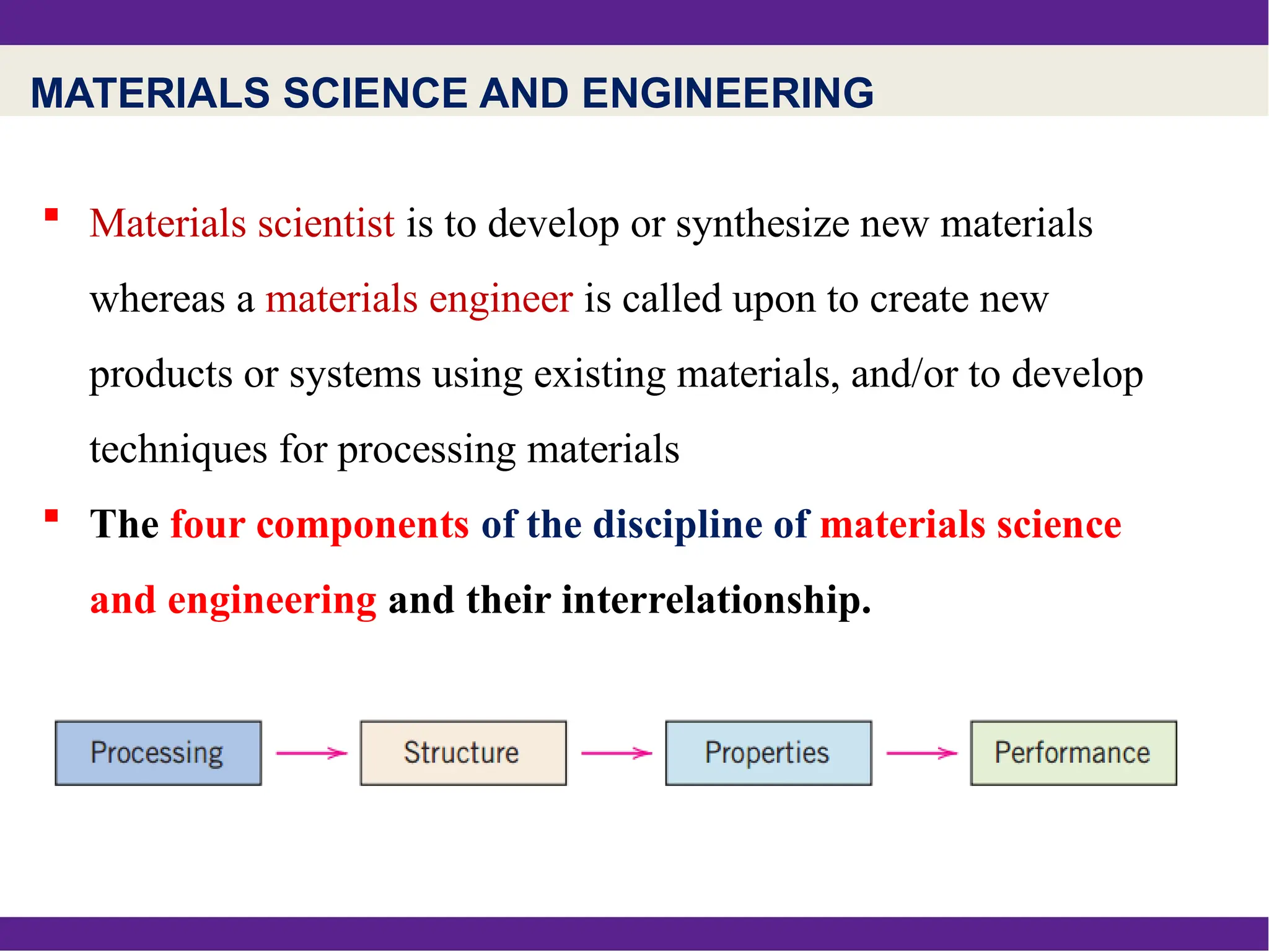
 The four components of the discipline of materials science
and engineering and their interrelationship.
MATERIALS SCIENCE AND ENGINEERING
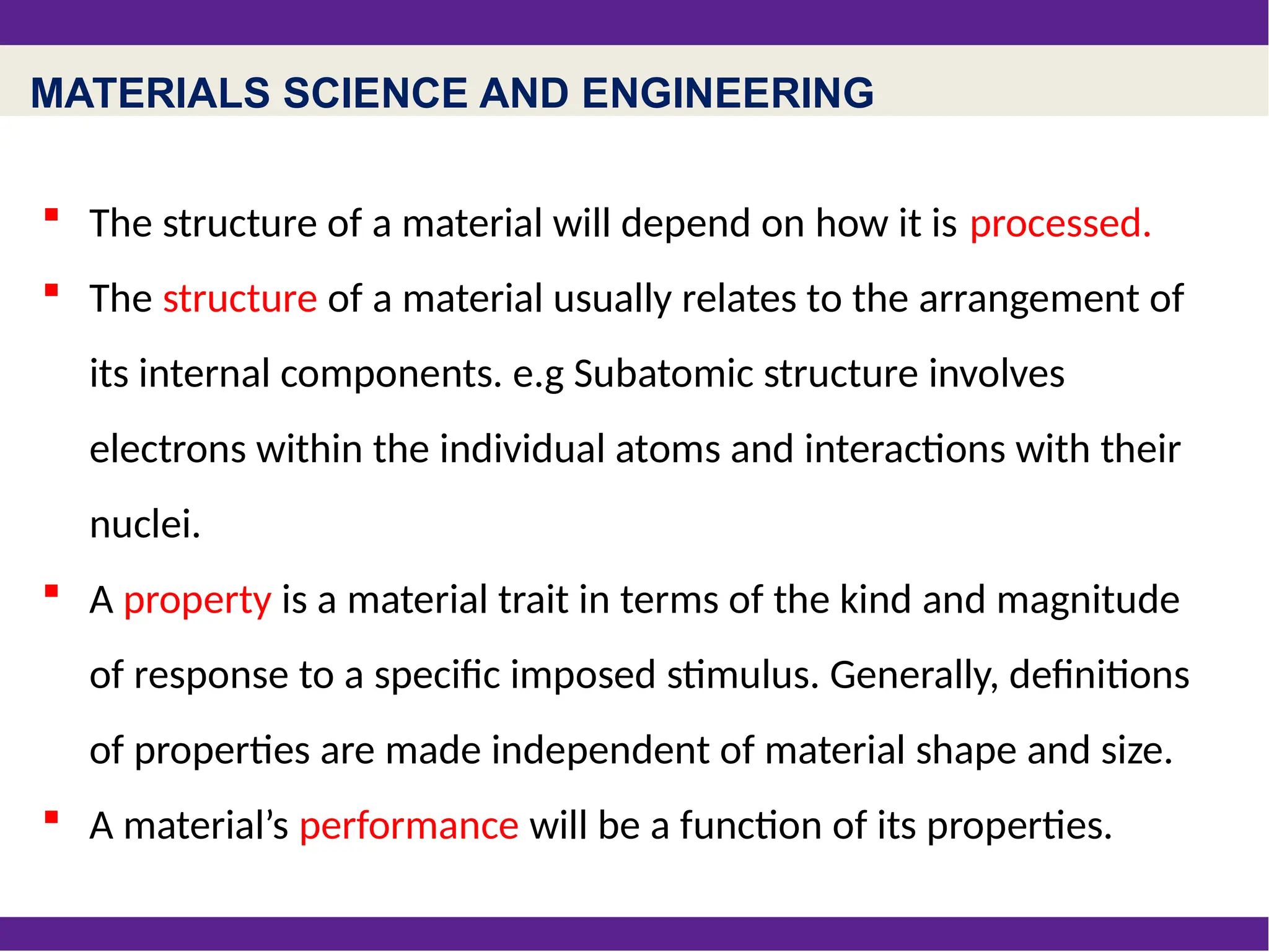
 The structure of a material will depend on how it is processed.
 The structure of a material usually relates to the arrangement of
its internal components. e.g Subatomic structure involves
electrons within the individual atoms and interactions with their
nuclei.
 A property is a material trait in terms of the kind and magnitude
of response to a specific imposed stimulus. Generally, definitions
of properties are made independent of material shape and size.
 A material’s performance will be a function of its properties.
WHY STUDY MATERIALS SCIENCE AND ENGINEERING?
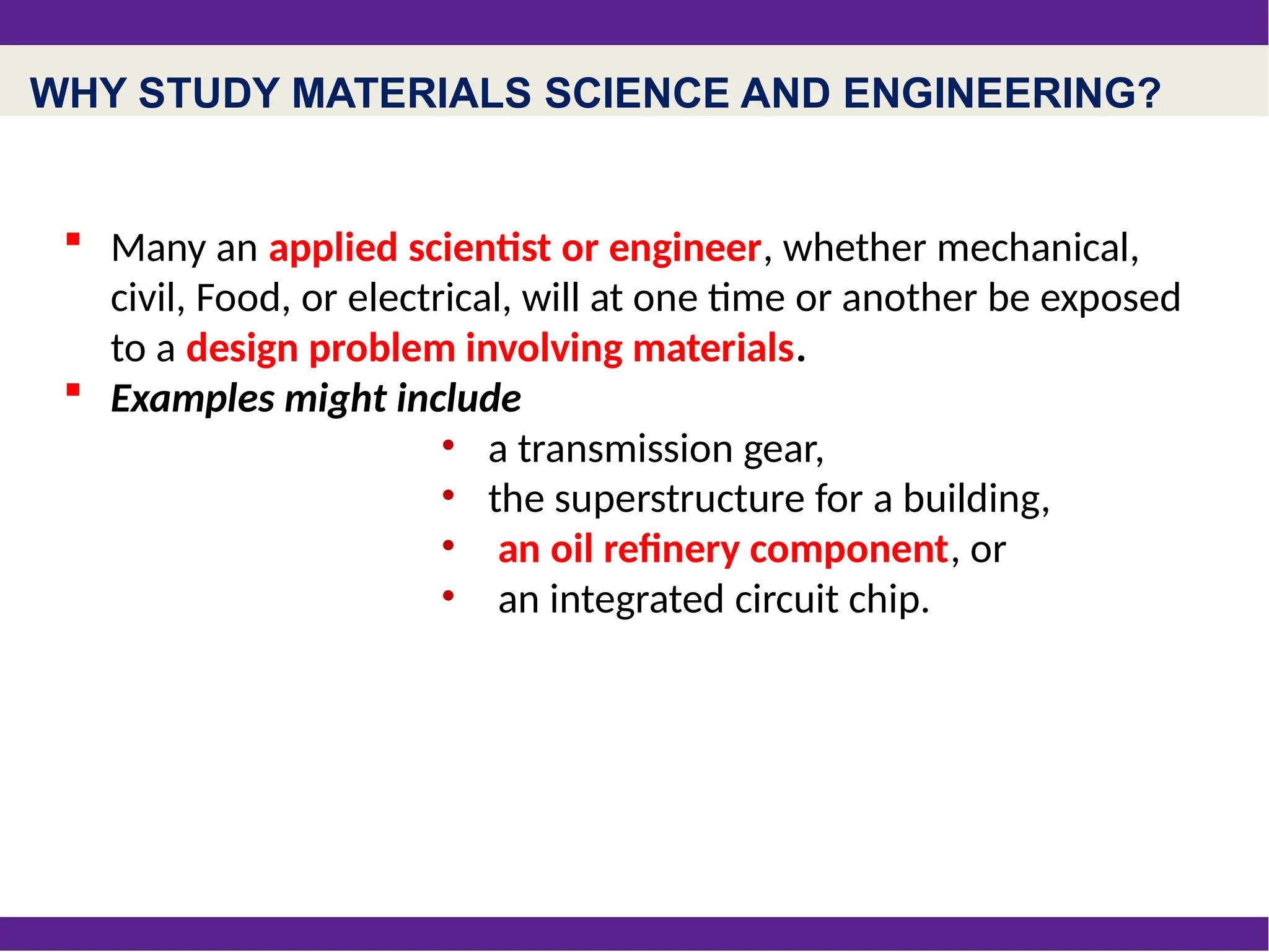
 Many an applied scientist or engineer, whether mechanical,
civil, Food, or electrical, will at one time or another be exposed
to a design problem involving materials.
 Examples might include
• a transmission gear,
• the superstructure for a building,
• an oil refinery component, or
• an integrated circuit chip.
Cont’d
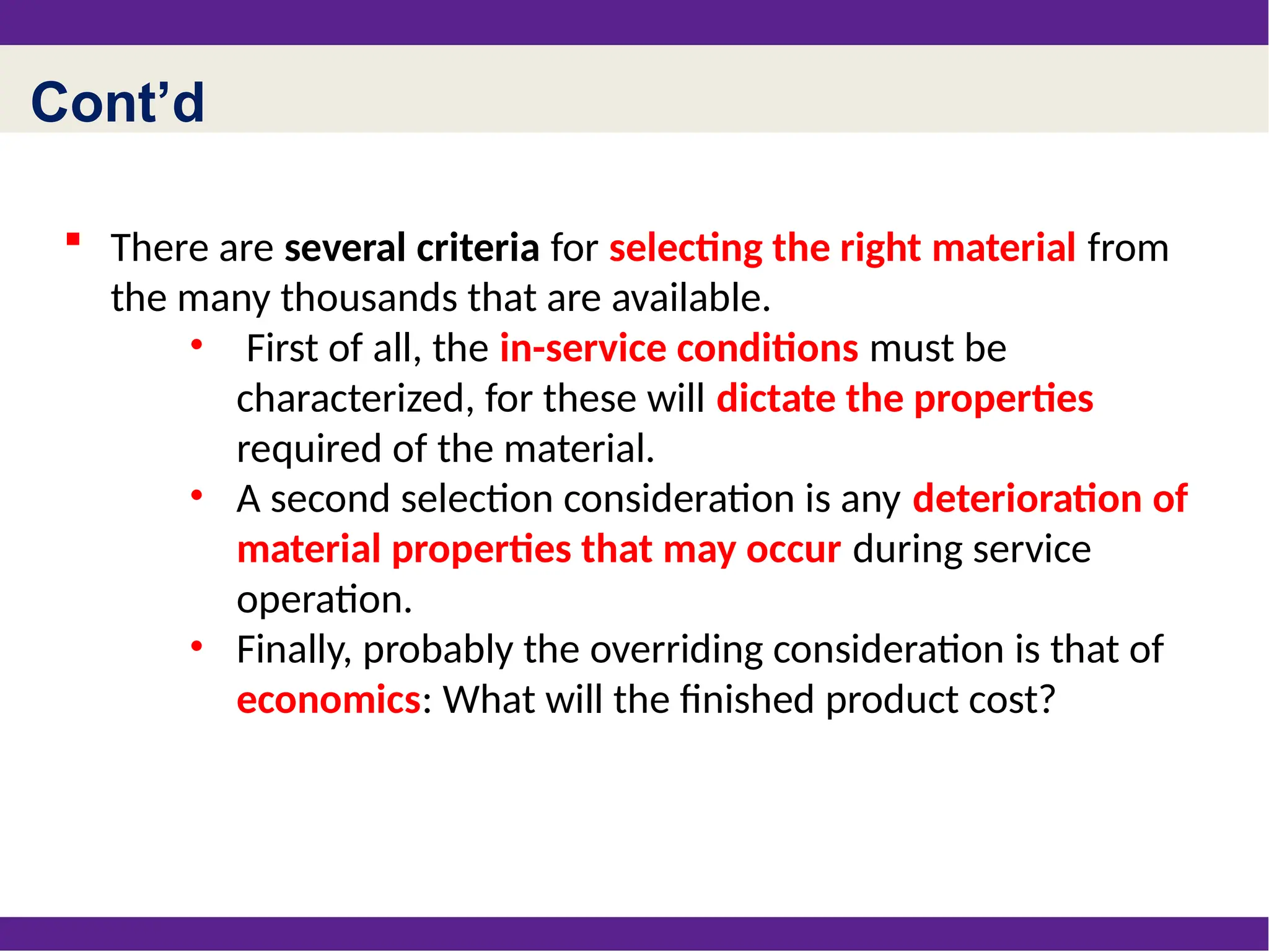
 There are several criteria for selecting the right material from
the many thousands that are available.
• First of all, the in-service conditions must be
characterized, for these will dictate the properties
required of the material.
• A second selection consideration is any deterioration of
material properties that may occur during service
operation.
• Finally, probably the overriding consideration is that of
economics: What will the finished product cost?
Cont’d
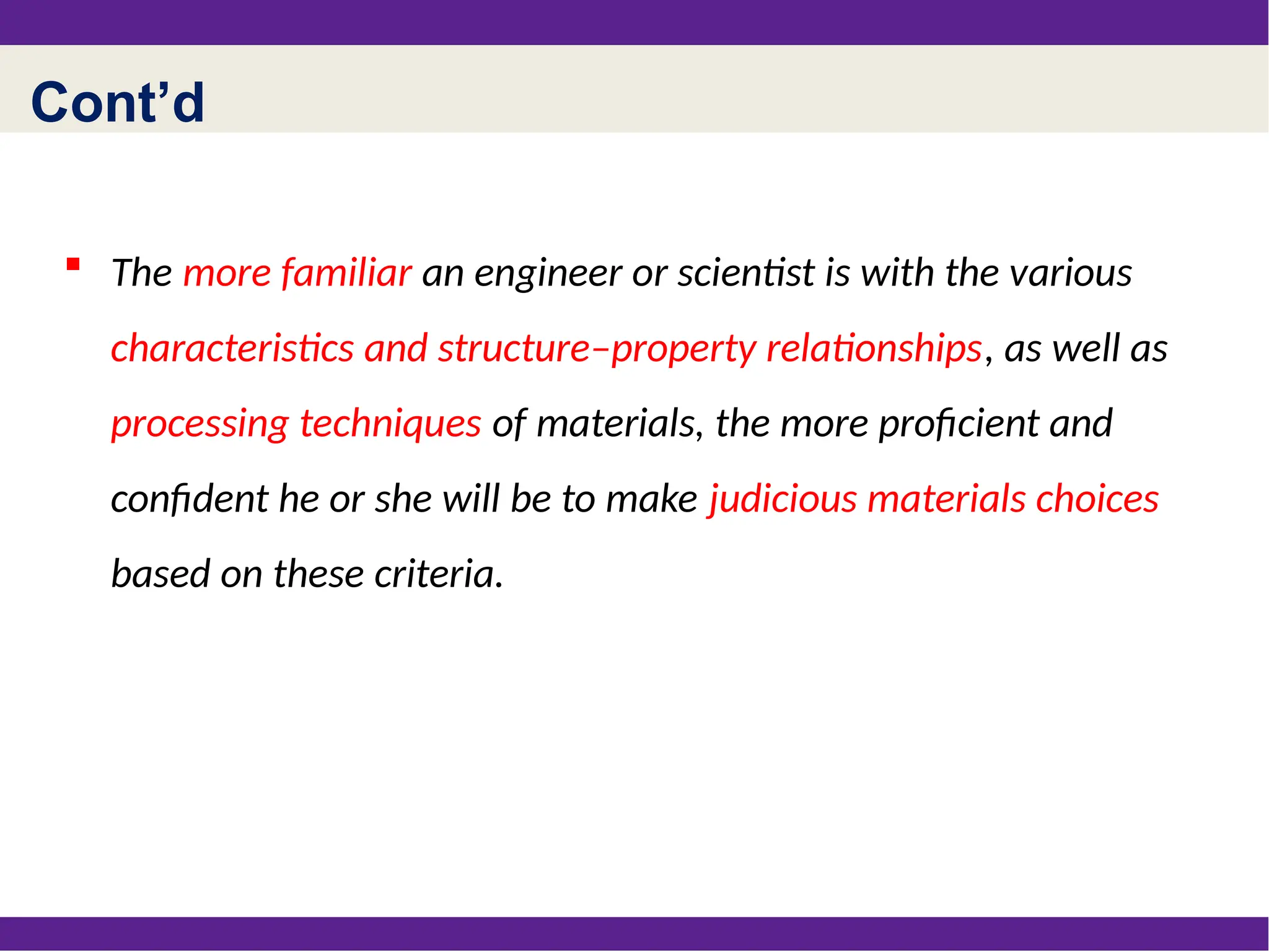
 The more familiar an engineer or scientist is with the various
characteristics and structure–property relationships, as well as
processing techniques of materials, the more proficient and
confident he or she will be to make judicious materials choices
based on these criteria.
CLASSIFICATION OF MATERIALS
 Solid materials have been conveniently grouped into three basic
classifications:
 metals,
 ceramics, and
 polymers.
 This scheme is based primarily on chemical makeup and atomic
structure, and most materials fall into one distinct grouping or
another , although there are some intermediates.
 In addition, there are the composites, combinations of two or
more of the above three basic material classes
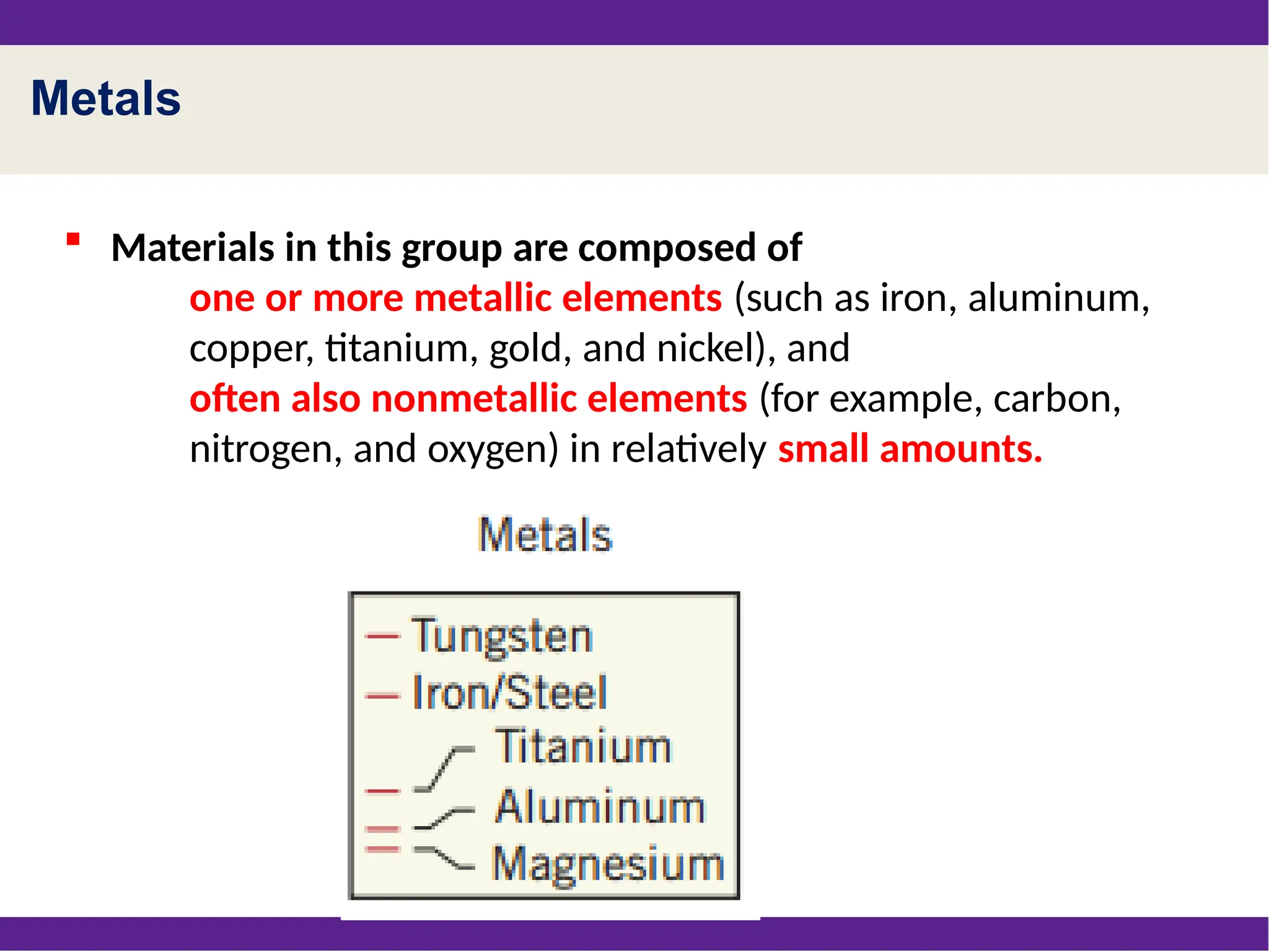
Metals
 Materials in this group are composed of
one or more metallic elements (such as iron, aluminum,
copper, titanium, gold, and nickel), and
often also nonmetallic elements (for example, carbon,
nitrogen, and oxygen) in relatively small amounts.
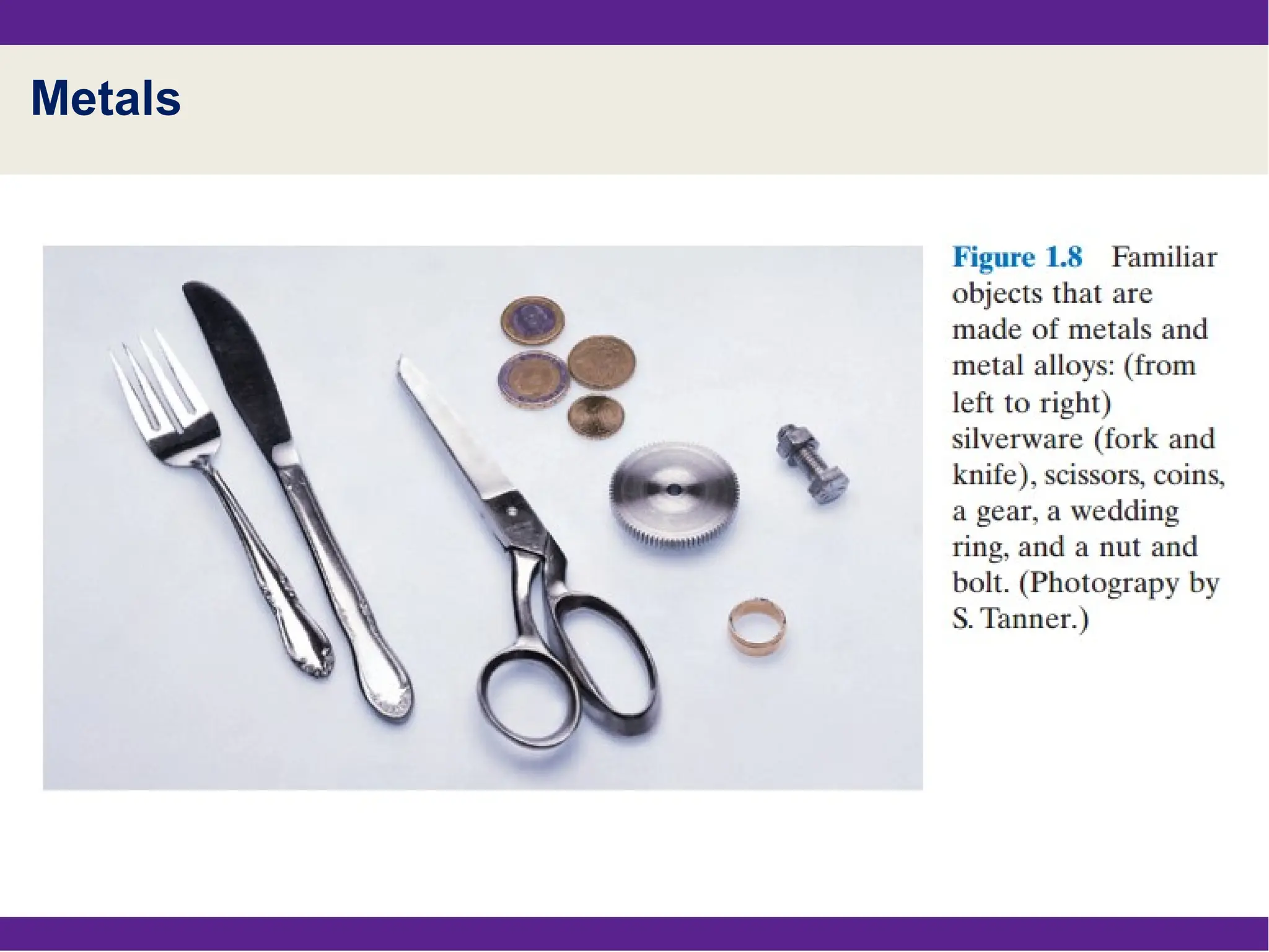
Metals
Ceramics
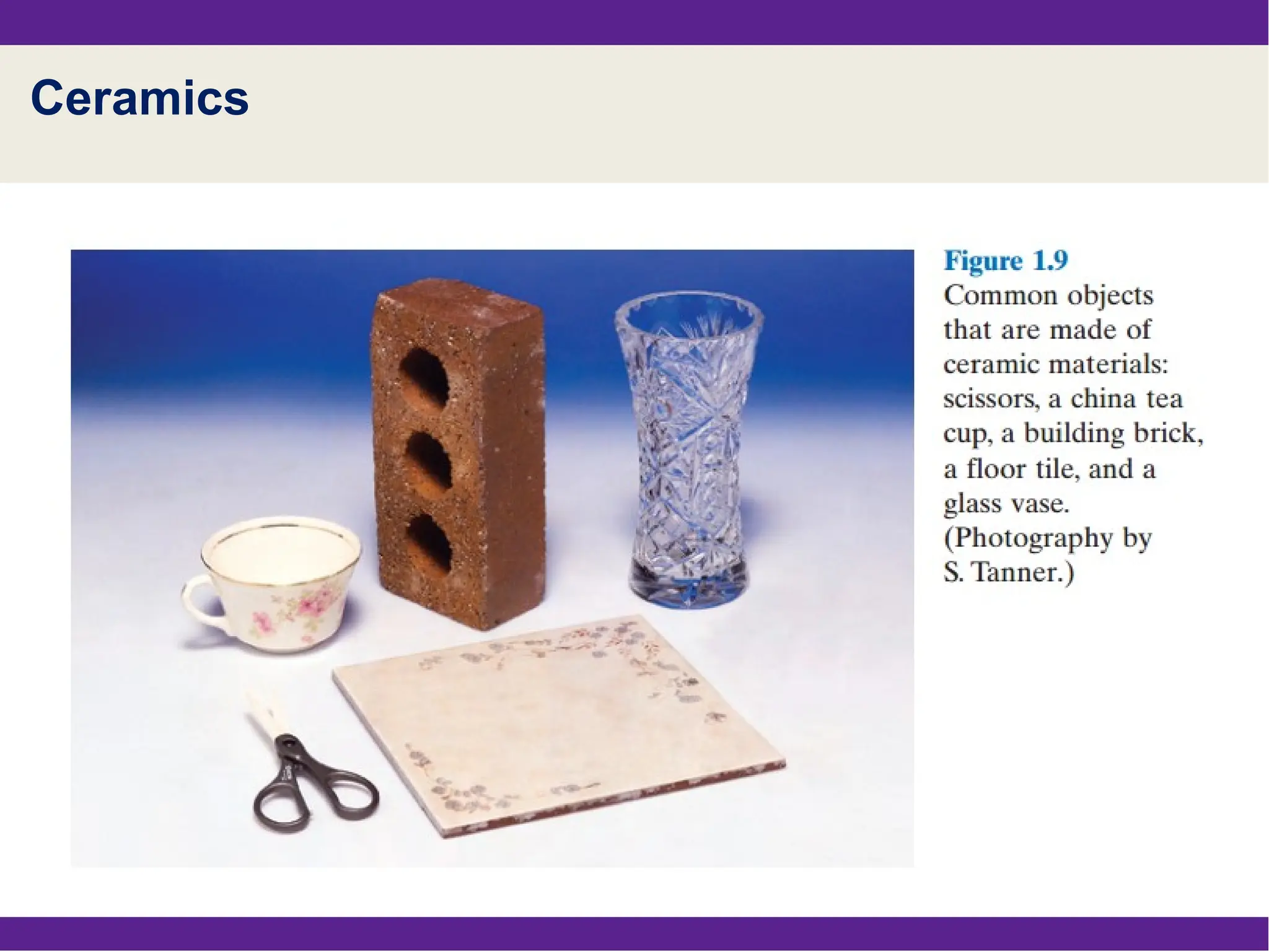
 Ceramics are compounds between metallic and nonmetallic
elements; they are most frequently oxides, nitrides, and
carbides.
 Some of the common ceramic materials include
 aluminum oxide (or alumina,Al2O3),
 silicon dioxide (or silica, SiO2),
 silicon carbide (SiC),
 silicon nitride (Si3N4), and,
 the traditional ceramics—those composed of clay
minerals (i.e., porcelain), as well as cement, and
glass.
Ceramics
Polymers
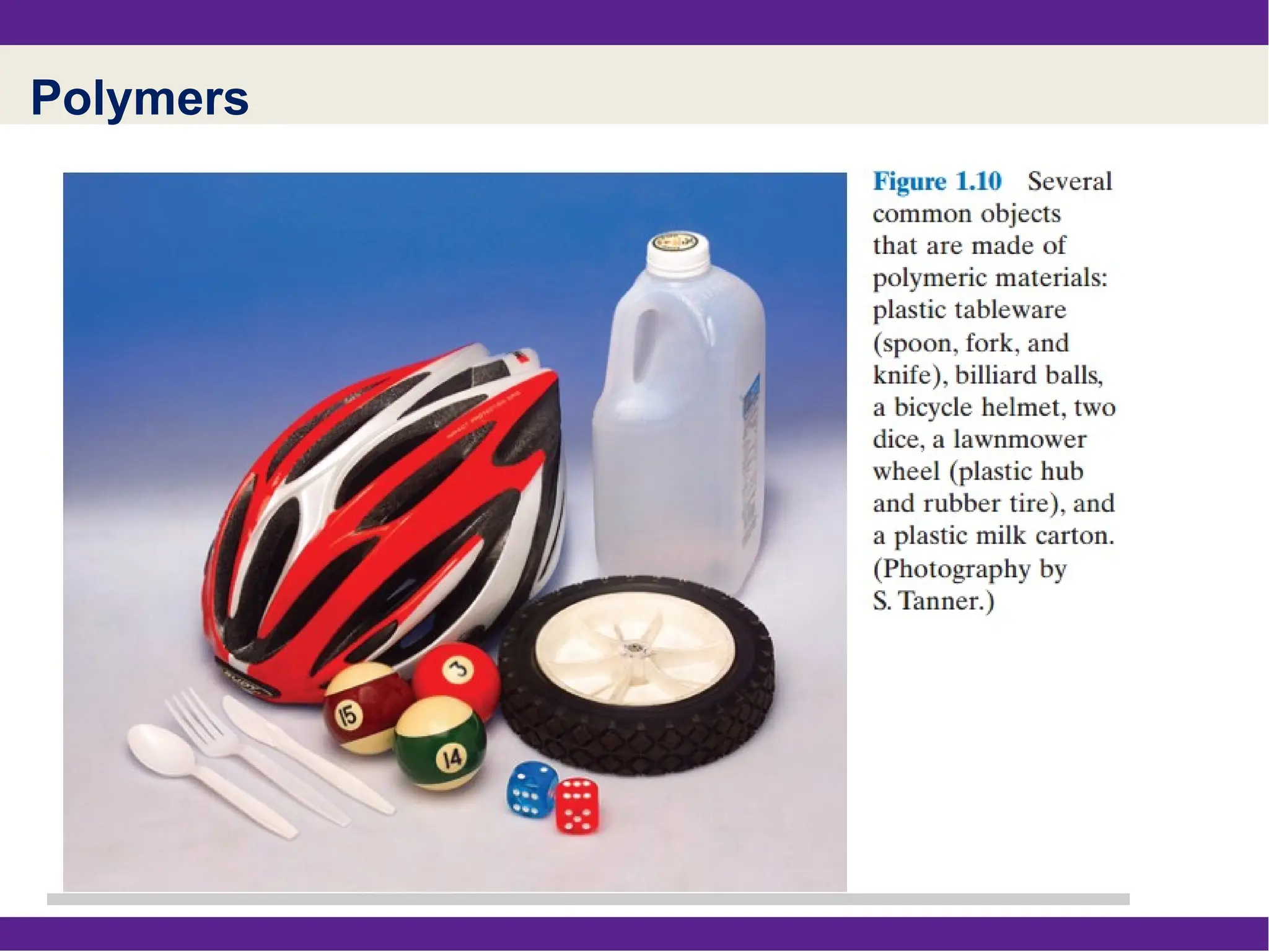
 Polymers include the familiar plastic and rubber materials.
 Many of them are organic compounds that are chemically based on
carbon, hydrogen, and other nonmetallic elements (viz. O, N, and
Si).
 Furthermore, they have very large molecular structures,
often chain-like in nature that have a backbone of carbon atoms.
 Some of the common and familiar polymers are
 polyethylene (PE),
 nylon,
 poly(vinyl chloride) (PVC),
 polycarbonate (PC),
 polystyrene (PS), and
 silicone rubber.
Polymers
Composites
 Polymers include the familiar plastic and rubber materials.
 A composite is composed of two (or more) individual materials,
which come from metals, ceramics, and polymers.
 The design goal of a composite is
to achieve a combination of properties that is not displayed by
any single material, and
to incorporate the best characteristics of each of the
component materials.
 One of the most common and familiar composites is fiberglass, in
which small glass fibers are embedded within a polymeric material
(normally an epoxy or polyester).
 Some naturally-occurring materials are also considered to be
composites—for example, wood and bone.
Cont.
 Advanced materials include
 semiconductors,
 biomaterials, and
 “materials of the future” (that is, smart materials and
nanoengineered materials)
Semiconductors
 have electrical properties that are intermediate between
o the electrical conductors (viz. metals and metal alloys)
and
insulators (viz. ceramics and polymers)
 the electrical characteristics are extremely sensitive to the presence
of minute concentrations of impurity atoms
 have made possible the advent of integrated circuitry that has totally
revolutionized the electronics and computer industries (not to
mention our lives) over the past three decades.
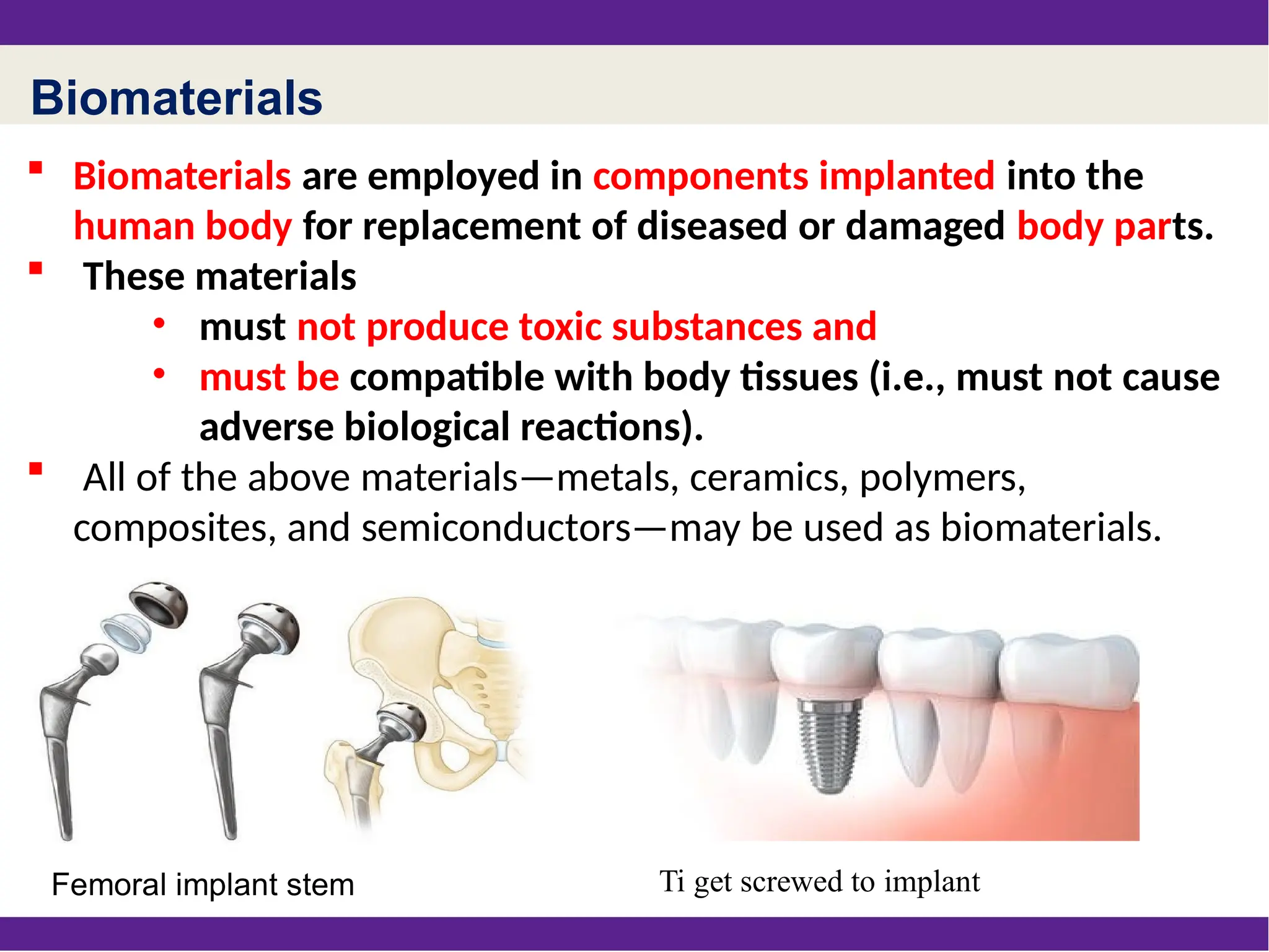
Biomaterials
 Biomaterials are employed in components implanted into the
human body for replacement of diseased or damaged body parts.
 These materials
• must not produce toxic substances and
• must be compatible with body tissues (i.e., must not cause
adverse biological reactions).
 All of the above materials—metals, ceramics, polymers,
composites, and semiconductors—may be used as biomaterials.
Femoral implant stem Ti get screwed to implant
Materials of the Future- Smart Materials
 Smart (or intelligent) materials are a group of new and state-of-
the-art materials now being developed that will have a significant
influence on many of our technologies.
 The adjective “smart” implies that
• these materials are able to sense changes in their
environments and
• then respond to these changes in predetermined manners
—traits that are also found in living organisms.
Materials of the Future- Nanoengineered Materials
 Until very recent times the general procedure utilized by
scientists to understand the chemistry and physics of
materials has been
• to begin by studying large and complex
structures, and
• then to investigate the fundamental building
blocks of these structures that are smaller and
simpler.
 This approach is sometimes termed “topdown” science.
Cont.
 However, with the advent of scanning probe microscopes , which
permit observation of individual atoms and molecules, it has
become possible to
 manipulate and move atoms and molecules to form new
structures
and,
 thus, design new materials that are built from simple atomic-
level constituents (i.e., “materials by design”).
 We call this the “bottom-up” approach, and the study of the
properties of these materials is termed “nanotechnology”;

Material scienceLecture 1. Introduction.pptx

  • 1.
  • 2.
    Contents • What ismaterial? • Materials Science and Engineering • Why Study Materials Science and Engineering? • Classification of Materials • Advanced Materials
  • 3.
    MATERIALS SCIENCE ANDENGINEERING  Materials is: Substances that humans have assembled or produced as products, appliances, inventions, various constructions. • Such as concrete, steel, aluminum, copper, paper, plastic. • Materials science: Involves investigating the relationships that exist between the structures and properties of materials.  Materials engineering: is, on the basis of the structure–property correlations, designing or engineering the structure of a material to produce a predetermined set of properties  Requires knowledge of materials science
  • 4.
    MATERIALS SCIENCE ANDENGINEERING  Materials scientist is to develop or synthesize new materials whereas a materials engineer is called upon to create new products or systems using existing materials, and/or to develop techniques for processing materials  The four components of the discipline of materials science and engineering and their interrelationship.
  • 5.
    MATERIALS SCIENCE ANDENGINEERING  The structure of a material will depend on how it is processed.  The structure of a material usually relates to the arrangement of its internal components. e.g Subatomic structure involves electrons within the individual atoms and interactions with their nuclei.  A property is a material trait in terms of the kind and magnitude of response to a specific imposed stimulus. Generally, definitions of properties are made independent of material shape and size.  A material’s performance will be a function of its properties.
  • 6.
    WHY STUDY MATERIALSSCIENCE AND ENGINEERING?  Many an applied scientist or engineer, whether mechanical, civil, Food, or electrical, will at one time or another be exposed to a design problem involving materials.  Examples might include • a transmission gear, • the superstructure for a building, • an oil refinery component, or • an integrated circuit chip.
  • 7.
    Cont’d  There areseveral criteria for selecting the right material from the many thousands that are available. • First of all, the in-service conditions must be characterized, for these will dictate the properties required of the material. • A second selection consideration is any deterioration of material properties that may occur during service operation. • Finally, probably the overriding consideration is that of economics: What will the finished product cost?
  • 8.
    Cont’d  The morefamiliar an engineer or scientist is with the various characteristics and structure–property relationships, as well as processing techniques of materials, the more proficient and confident he or she will be to make judicious materials choices based on these criteria.
  • 9.
    CLASSIFICATION OF MATERIALS Solid materials have been conveniently grouped into three basic classifications:  metals,  ceramics, and  polymers.  This scheme is based primarily on chemical makeup and atomic structure, and most materials fall into one distinct grouping or another , although there are some intermediates.  In addition, there are the composites, combinations of two or more of the above three basic material classes
  • 10.
    Metals  Materials inthis group are composed of one or more metallic elements (such as iron, aluminum, copper, titanium, gold, and nickel), and often also nonmetallic elements (for example, carbon, nitrogen, and oxygen) in relatively small amounts.
  • 11.
  • 12.
    Ceramics  Ceramics arecompounds between metallic and nonmetallic elements; they are most frequently oxides, nitrides, and carbides.  Some of the common ceramic materials include  aluminum oxide (or alumina,Al2O3),  silicon dioxide (or silica, SiO2),  silicon carbide (SiC),  silicon nitride (Si3N4), and,  the traditional ceramics—those composed of clay minerals (i.e., porcelain), as well as cement, and glass.
  • 13.
  • 14.
    Polymers  Polymers includethe familiar plastic and rubber materials.  Many of them are organic compounds that are chemically based on carbon, hydrogen, and other nonmetallic elements (viz. O, N, and Si).  Furthermore, they have very large molecular structures, often chain-like in nature that have a backbone of carbon atoms.  Some of the common and familiar polymers are  polyethylene (PE),  nylon,  poly(vinyl chloride) (PVC),  polycarbonate (PC),  polystyrene (PS), and  silicone rubber.
  • 15.
  • 16.
    Composites  Polymers includethe familiar plastic and rubber materials.  A composite is composed of two (or more) individual materials, which come from metals, ceramics, and polymers.  The design goal of a composite is to achieve a combination of properties that is not displayed by any single material, and to incorporate the best characteristics of each of the component materials.  One of the most common and familiar composites is fiberglass, in which small glass fibers are embedded within a polymeric material (normally an epoxy or polyester).  Some naturally-occurring materials are also considered to be composites—for example, wood and bone.
  • 21.
    Cont.  Advanced materialsinclude  semiconductors,  biomaterials, and  “materials of the future” (that is, smart materials and nanoengineered materials)
  • 22.
    Semiconductors  have electricalproperties that are intermediate between o the electrical conductors (viz. metals and metal alloys) and insulators (viz. ceramics and polymers)  the electrical characteristics are extremely sensitive to the presence of minute concentrations of impurity atoms  have made possible the advent of integrated circuitry that has totally revolutionized the electronics and computer industries (not to mention our lives) over the past three decades.
  • 23.
    Biomaterials  Biomaterials areemployed in components implanted into the human body for replacement of diseased or damaged body parts.  These materials • must not produce toxic substances and • must be compatible with body tissues (i.e., must not cause adverse biological reactions).  All of the above materials—metals, ceramics, polymers, composites, and semiconductors—may be used as biomaterials. Femoral implant stem Ti get screwed to implant
  • 24.
    Materials of theFuture- Smart Materials  Smart (or intelligent) materials are a group of new and state-of- the-art materials now being developed that will have a significant influence on many of our technologies.  The adjective “smart” implies that • these materials are able to sense changes in their environments and • then respond to these changes in predetermined manners —traits that are also found in living organisms.
  • 25.
    Materials of theFuture- Nanoengineered Materials  Until very recent times the general procedure utilized by scientists to understand the chemistry and physics of materials has been • to begin by studying large and complex structures, and • then to investigate the fundamental building blocks of these structures that are smaller and simpler.  This approach is sometimes termed “topdown” science.
  • 26.
    Cont.  However, withthe advent of scanning probe microscopes , which permit observation of individual atoms and molecules, it has become possible to  manipulate and move atoms and molecules to form new structures and,  thus, design new materials that are built from simple atomic- level constituents (i.e., “materials by design”).  We call this the “bottom-up” approach, and the study of the properties of these materials is termed “nanotechnology”;