Energy
Energy
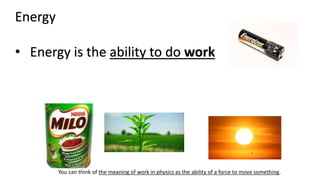
• Energy is the ability to do work
You can think of the meaning of work in physics as the ability of a force to move something.
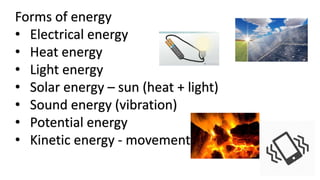
Forms of energy
• Electrical energy
• Heat energy
• Light energy
• Solar energy – sun (heat + light)
• Sound energy (vibration)
• Potential energy
• Kinetic energy - movement
Basic question you need to know
How do you identify the different forms of
energy?
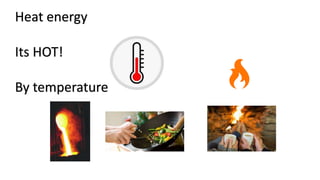
Heat energy
Its HOT!
By temperature
Also recall:
Heat will always travel from hotter(warmer)
place to a colder place
i.e. of there is a difference in temperature, heat
transfer will occur until all the things in the
surrounding are the same temperature
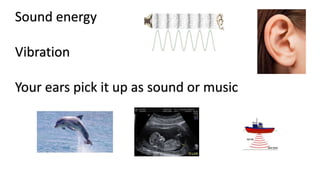
Sound energy
Vibration
Your ears pick it up as sound or music
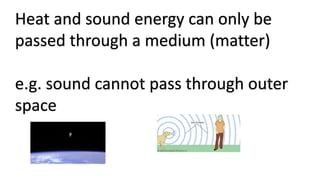
Heat and sound energy can only be
passed through a medium (matter)
e.g. sound cannot pass through outer
space
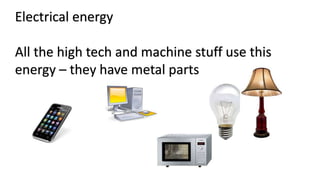
Electrical energy
All the high tech and machine stuff use this
energy – they have metal parts
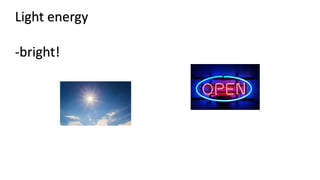
Light energy
-bright!
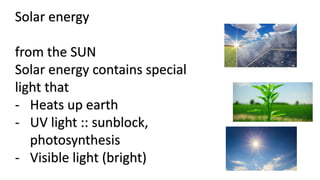
Solar energy
from the SUN
Solar energy contains special
light that
- Heats up earth
- UV light :: sunblock,
photosynthesis
- Visible light (bright)
Kinetic energy
Anything that moves has kinetic energy!
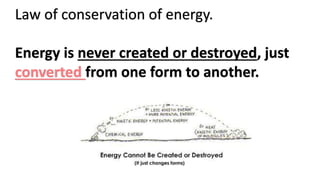
Law of conservation of energy.
Energy is never created or destroyed, just
converted from one form to another.
And that feature of energy is useful!
Why?
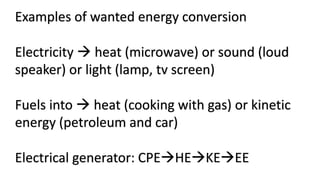
Examples of wanted energy conversion
Electricity  heat (microwave) or sound (loud
speaker) or light (lamp, tv screen)
Fuels into  heat (cooking with gas) or kinetic
energy (petroleum and car)
Electrical generator: CPEHEKEEE
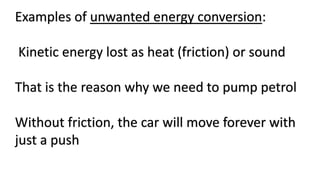
Examples of unwanted energy conversion:
Kinetic energy lost as heat (friction) or sound
That is the reason why we need to pump petrol
Without friction, the car will move forever with
just a push
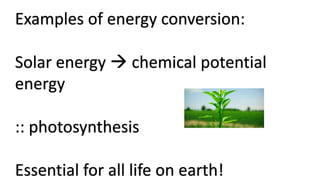
Examples of energy conversion:
Solar energy  chemical potential
energy
:: photosynthesis
Essential for all life on earth!
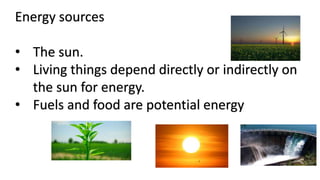
Energy sources
• The sun.
• Living things depend directly or indirectly on
the sun for energy.
• Fuels and food are potential energy
• Living things require energy -
respiration
• Non living things can also have
energy
• Plants use the energy of the sun
(solar energy, which contains light
energy) and converts it into food
(chemical potential energy)
Solar energy
• energy from the sun
• Source of energy on earth
• Solar energy is often experienced as
heat and light energy
• Used for photosynthesis to make
food
Did you know? – advanced science
• How does the sun produce energy seemingly from
nowhere?
• Remember the law of energy: energy cannot be created
nor destroyed, only converted from one form to
another.
• It turns out, you can release energy from mass
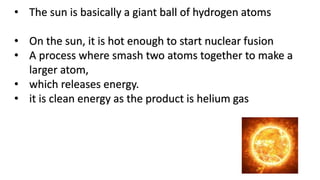
• The sun is basically a giant ball of hydrogen atoms
• On the sun, it is hot enough to start nuclear fusion
• A process where smash two atoms together to make a
larger atom,
• which releases energy.
• it is clean energy as the product is helium gas
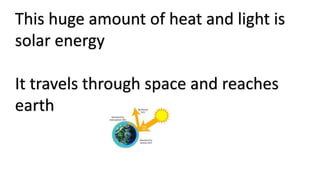
This huge amount of heat and light is
solar energy
It travels through space and reaches
earth
The sun is the indirect primary source of energy
on earth
Plants use sunlight to photosynthesis
Plants are the primary source of the food chain
Trees that died millions of years ago provide us
with fuel for cars, cooking and electricity
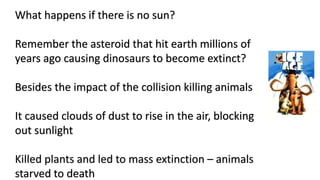
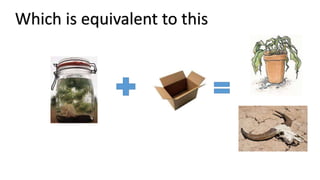
What happens if there is no sun?
Remember the asteroid that hit earth millions of
years ago causing dinosaurs to become extinct?
Besides the impact of the collision killing animals
It caused clouds of dust to rise in the air, blocking
out sunlight
Killed plants and led to mass extinction – animals
starved to death
Which is equivalent to this
What is potential energy?
Stored energy
What are the forms of PE?
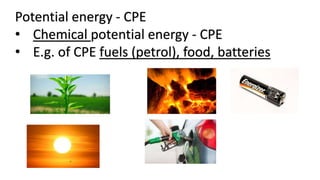
Potential energy - CPE
• Chemical potential energy - CPE
• E.g. of CPE fuels (petrol), food, batteries
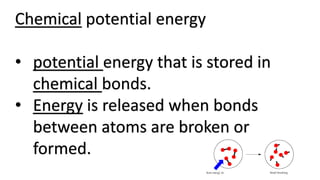
Chemical potential energy
• potential energy that is stored in
chemical bonds.
• Energy is released when bonds
between atoms are broken or
formed.
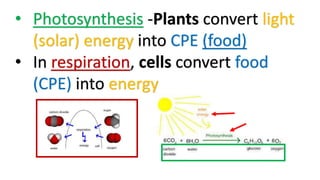
• Photosynthesis -Plants convert light
(solar) energy into CPE (food)
• In respiration, cells convert food
(CPE) into energy
• Batteries (CPE) are used to power
devices (EE)
• Fuel, petrol (CPE) is burnt to provide
energy eg to move a car (EE, KE)
• Food is burnt during respiration to
provide living things energy
Remember!
Battery = CPE :: CPE  EE bulb light up
Petrol = CPE :: CPE  EE  KE car moves
Food = CPE :: CPE  heat E (keep you
warm)
or KE (move your muscles)
Or various chemical processes; living things
basically a lot of chemical reactions inside
Different types of potential energy
-gravitational PE
-chemical PE
-elastic PE
GPE CPE EPE remember remember!!
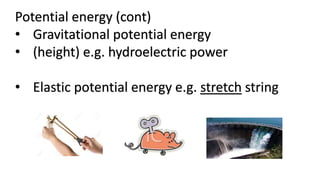
Potential energy (cont)
• Gravitational potential energy
• (height) e.g. hydroelectric power
• Elastic potential energy e.g. stretch string
What is gravitational potential energy?
• Anything at a high position has gravitational
potential energy
• It doesn’t refer to the height of the object but
the height of the object’s position
• Means you are at a high up place, but not you
are tall
• GPE resulting from earth exerting its gravity on the
object
• Gravity is dependent not only on height(position), but
also the mass of the object
• Height: if you jump down from a higher place, ↑ GPE
• Mass: If you are heavier and you jump down, ↑ GPE
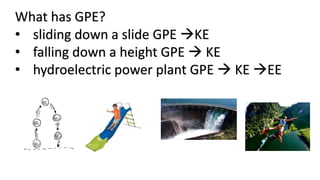
What has GPE?
• sliding down a slide GPE KE
• falling down a height GPE  KE
• hydroelectric power plant GPE  KE EE
Elastic potential energy
• comes from stretched rubber band, wound up
toy, stretched spring
• The stretched elastic wants to return to its
original relaxed state
• The potential energy PE is stored as
stretched/wound up state
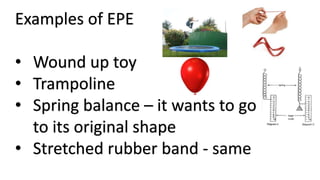
Examples of EPE
• Wound up toy
• Trampoline
• Spring balance – it wants to go back
to its original shape
• Stretched rubber band - same
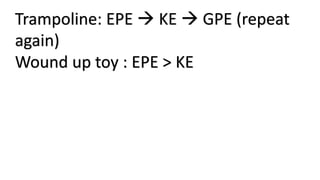
Trampoline: EPE  KE  GPE (repeat
again)
Wound up toy : EPE > KE
Recall again:
Law of conservation of energy.
Energy is never created or destroyed, just
converted from one form to another.
• Examples of energy conversion:
• Pendulum: gravitational potential
energy to kinetic energy
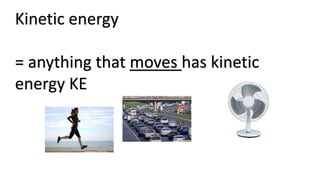
Kinetic energy
= anything that moves has kinetic
energy KE
Examples of energy conversion
involving KE and GPE
• GPE  KE and KE back  GE within
the same system
• E.g. throwing a ball into the air
• Swinging pendulum
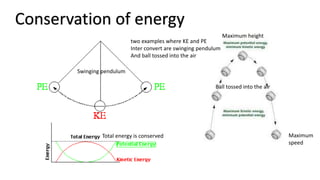
Conservation of energy
Total energy is conserved
Maximum height
Maximum
speed
two examples where KE and PE
Inter convert are swinging pendulum
And ball tossed into the air
Swinging pendulum
Ball tossed into the air
So if you toss the ball higher, it will fall
back down with a faster speed
If you swing the pendulum from a
greater height, it will swing faster
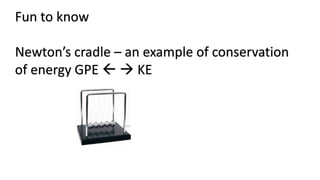
Fun to know
Newton’s cradle – an example of conservation
of energy GPE   KE
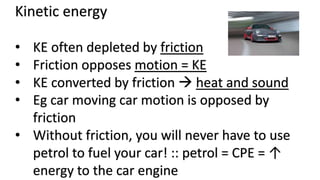
Kinetic energy
• KE often depleted by friction
• Friction opposes motion = KE
• KE converted by friction  heat and sound
• Eg car moving car motion is opposed by
friction
• Without friction, you will never have to use
petrol to fuel your car! :: petrol = CPE = ↑
energy to the car engine
Advertisement break
Nuclear energy
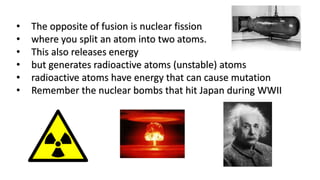
• The opposite of fusion is nuclear fission
• where you split an atom into two atoms.
• This also releases energy
• but generates radioactive atoms (unstable) atoms
• radioactive atoms have energy that can cause mutation
• Remember the nuclear bombs that hit Japan during WWII
Besides bombs, this science can be used for nuclear energy
The amount of energy released during nuclear fission is
huge – enough for power homes for a year.
It would be nice to have so much energy
However, the downside is the radioactive waste produced
Exposure to radioactivity causes mutation and cancer
What’s the big deal about energy
We are running out of energy sources
We are polluting the earth when we burn
traditional fuels for energy
We are causing damage to the land when we
extract energy sources from the earth
Your text here
Your text here
Your text here
Your text here

Energy

  • 1.
  • 2.
    Energy • Energy isthe ability to do work You can think of the meaning of work in physics as the ability of a force to move something.
  • 3.
    Forms of energy •Electrical energy • Heat energy • Light energy • Solar energy – sun (heat + light) • Sound energy (vibration) • Potential energy • Kinetic energy - movement
  • 4.
    Basic question youneed to know How do you identify the different forms of energy?
  • 5.
  • 6.
    Also recall: Heat willalways travel from hotter(warmer) place to a colder place i.e. of there is a difference in temperature, heat transfer will occur until all the things in the surrounding are the same temperature
  • 7.
    Sound energy Vibration Your earspick it up as sound or music
  • 8.
    Heat and soundenergy can only be passed through a medium (matter) e.g. sound cannot pass through outer space
  • 9.
    Electrical energy All thehigh tech and machine stuff use this energy – they have metal parts
  • 10.
  • 11.
    Solar energy from theSUN Solar energy contains special light that - Heats up earth - UV light :: sunblock, photosynthesis - Visible light (bright)
  • 12.
    Kinetic energy Anything thatmoves has kinetic energy!
  • 13.
    Law of conservationof energy. Energy is never created or destroyed, just converted from one form to another.
  • 14.
    And that featureof energy is useful! Why?
  • 15.
    Examples of wantedenergy conversion Electricity  heat (microwave) or sound (loud speaker) or light (lamp, tv screen) Fuels into  heat (cooking with gas) or kinetic energy (petroleum and car) Electrical generator: CPEHEKEEE
  • 16.
    Examples of unwantedenergy conversion: Kinetic energy lost as heat (friction) or sound That is the reason why we need to pump petrol Without friction, the car will move forever with just a push
  • 17.
    Examples of energyconversion: Solar energy  chemical potential energy :: photosynthesis Essential for all life on earth!
  • 18.
    Energy sources • Thesun. • Living things depend directly or indirectly on the sun for energy. • Fuels and food are potential energy
  • 19.
    • Living thingsrequire energy - respiration • Non living things can also have energy • Plants use the energy of the sun (solar energy, which contains light energy) and converts it into food (chemical potential energy)
  • 20.
    Solar energy • energyfrom the sun • Source of energy on earth • Solar energy is often experienced as heat and light energy • Used for photosynthesis to make food
  • 21.
    Did you know?– advanced science • How does the sun produce energy seemingly from nowhere? • Remember the law of energy: energy cannot be created nor destroyed, only converted from one form to another.
  • 22.
    • It turnsout, you can release energy from mass
  • 23.
    • The sunis basically a giant ball of hydrogen atoms • On the sun, it is hot enough to start nuclear fusion • A process where smash two atoms together to make a larger atom, • which releases energy. • it is clean energy as the product is helium gas
  • 24.
    This huge amountof heat and light is solar energy It travels through space and reaches earth
  • 25.
    The sun isthe indirect primary source of energy on earth Plants use sunlight to photosynthesis Plants are the primary source of the food chain Trees that died millions of years ago provide us with fuel for cars, cooking and electricity
  • 26.
    What happens ifthere is no sun? Remember the asteroid that hit earth millions of years ago causing dinosaurs to become extinct? Besides the impact of the collision killing animals It caused clouds of dust to rise in the air, blocking out sunlight Killed plants and led to mass extinction – animals starved to death
  • 27.
  • 28.
    What is potentialenergy? Stored energy What are the forms of PE?
  • 29.
    Potential energy -CPE • Chemical potential energy - CPE • E.g. of CPE fuels (petrol), food, batteries
  • 30.
    Chemical potential energy •potential energy that is stored in chemical bonds. • Energy is released when bonds between atoms are broken or formed.
  • 31.
    • Photosynthesis -Plantsconvert light (solar) energy into CPE (food) • In respiration, cells convert food (CPE) into energy
  • 32.
    • Batteries (CPE)are used to power devices (EE) • Fuel, petrol (CPE) is burnt to provide energy eg to move a car (EE, KE) • Food is burnt during respiration to provide living things energy
  • 33.
    Remember! Battery = CPE:: CPE  EE bulb light up Petrol = CPE :: CPE  EE  KE car moves Food = CPE :: CPE  heat E (keep you warm) or KE (move your muscles) Or various chemical processes; living things basically a lot of chemical reactions inside
  • 34.
    Different types ofpotential energy -gravitational PE -chemical PE -elastic PE GPE CPE EPE remember remember!!
  • 35.
    Potential energy (cont) •Gravitational potential energy • (height) e.g. hydroelectric power • Elastic potential energy e.g. stretch string
  • 36.
    What is gravitationalpotential energy? • Anything at a high position has gravitational potential energy • It doesn’t refer to the height of the object but the height of the object’s position • Means you are at a high up place, but not you are tall
  • 37.
    • GPE resultingfrom earth exerting its gravity on the object • Gravity is dependent not only on height(position), but also the mass of the object • Height: if you jump down from a higher place, ↑ GPE • Mass: If you are heavier and you jump down, ↑ GPE
  • 38.
    What has GPE? •sliding down a slide GPE KE • falling down a height GPE  KE • hydroelectric power plant GPE  KE EE
  • 39.
    Elastic potential energy •comes from stretched rubber band, wound up toy, stretched spring • The stretched elastic wants to return to its original relaxed state • The potential energy PE is stored as stretched/wound up state
  • 40.
    Examples of EPE •Wound up toy • Trampoline • Spring balance – it wants to go back to its original shape • Stretched rubber band - same
  • 41.
    Trampoline: EPE KE  GPE (repeat again) Wound up toy : EPE > KE
  • 42.
    Recall again: Law ofconservation of energy. Energy is never created or destroyed, just converted from one form to another.
  • 43.
    • Examples ofenergy conversion: • Pendulum: gravitational potential energy to kinetic energy
  • 44.
    Kinetic energy = anythingthat moves has kinetic energy KE
  • 45.
    Examples of energyconversion involving KE and GPE • GPE  KE and KE back  GE within the same system • E.g. throwing a ball into the air • Swinging pendulum
  • 46.
    Conservation of energy Totalenergy is conserved Maximum height Maximum speed two examples where KE and PE Inter convert are swinging pendulum And ball tossed into the air Swinging pendulum Ball tossed into the air
  • 47.
    So if youtoss the ball higher, it will fall back down with a faster speed If you swing the pendulum from a greater height, it will swing faster
  • 48.
    Fun to know Newton’scradle – an example of conservation of energy GPE   KE
  • 49.
    Kinetic energy • KEoften depleted by friction • Friction opposes motion = KE • KE converted by friction  heat and sound • Eg car moving car motion is opposed by friction • Without friction, you will never have to use petrol to fuel your car! :: petrol = CPE = ↑ energy to the car engine
  • 50.
  • 51.
    • The oppositeof fusion is nuclear fission • where you split an atom into two atoms. • This also releases energy • but generates radioactive atoms (unstable) atoms • radioactive atoms have energy that can cause mutation • Remember the nuclear bombs that hit Japan during WWII
  • 52.
    Besides bombs, thisscience can be used for nuclear energy The amount of energy released during nuclear fission is huge – enough for power homes for a year. It would be nice to have so much energy However, the downside is the radioactive waste produced Exposure to radioactivity causes mutation and cancer
  • 53.
    What’s the bigdeal about energy We are running out of energy sources We are polluting the earth when we burn traditional fuels for energy We are causing damage to the land when we extract energy sources from the earth
  • 54.
  • 55.
  • 56.
  • 57.